Key takeaways
- Most UK conifers (Leylandii, Lawson, Thuja) do not regrow from old brown wood - cut into the brown zone and the gap is permanent
- The safe annual reduction is 30% of green growth, taken in late spring or early summer, no more
- Yew (Taxus baccata) is the exception - it regrows from old wood and tolerates hard pruning back to bare stumps
- Beech and hornbeam are good deciduous replacements - dense, formal, and tolerate hard pruning back to a stump
- The High Hedges Act 2003 lets neighbours complain to the council about hedges over 2 metres that block light
- Removing a mature Leylandii row costs £200-£600 per tree including stump grinding, plus £100-£200 per cubic metre of arisings
- Replacement hedge plants at 1.5m establish in 2-3 years - faster than waiting for a botched conifer to regrow
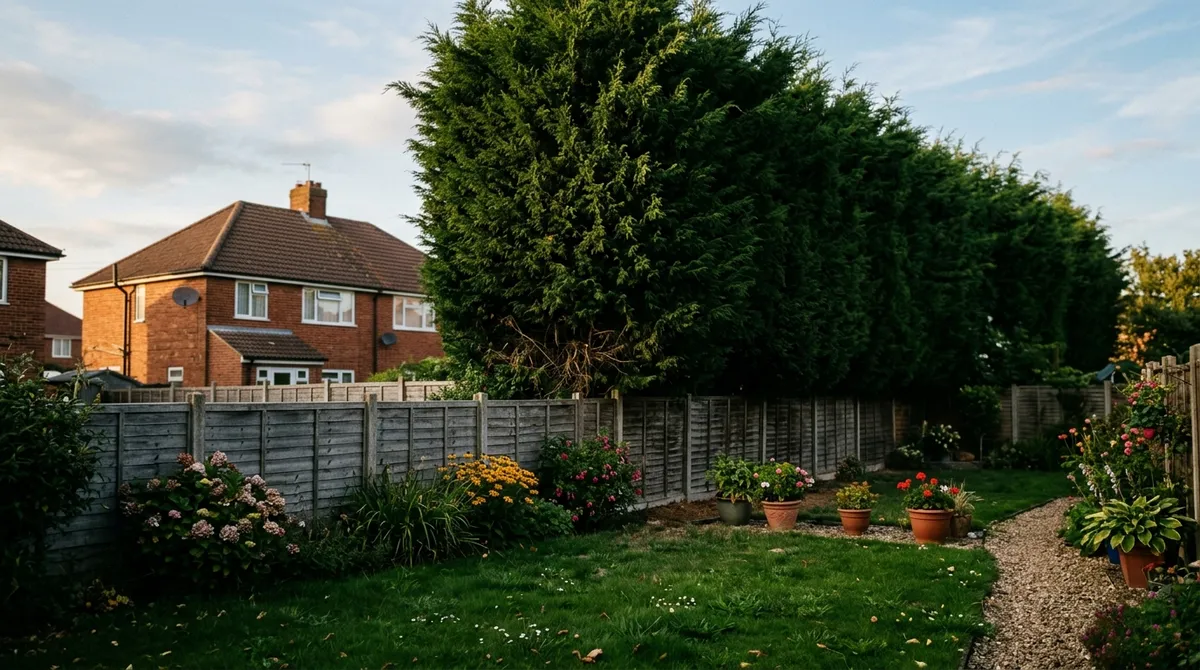
A conifer that has outgrown its space is one of the most frustrating problems in a UK garden because the obvious fix - cutting it down to size - usually makes things worse. Most commonly planted UK conifers do not regrow from bare wood. Cut a Leylandii back into the brown interior and the gap stays brown for the life of the tree.
This guide explains why the brown zone is permanent on most species, when staged reduction works, why yew is the standout exception, and how to plan a full removal-and-replacement when reduction is not an option. The legal context - the High Hedges Act 2003 and the bird-nesting timing - is in the final section.
The brown zone - why most conifers don’t regrow
A mature Leylandii, Lawson cypress or Thuja has an outer layer of green growing tissue and an inner layer of dead twigs and old wood. The outer layer is anywhere from 100mm to 400mm thick depending on the species and how the tree has been managed. Inside that, the brown zone is structurally part of the tree but contains no dormant buds and no growing tissue that can resprout.
This is a fundamental difference from deciduous trees and most shrubs. A beech, holly or hornbeam contains dormant buds along the length of its branches and trunk. Cut a beech back to a stump and within one growing season fresh shoots emerge from buds that were hidden under the bark. A Leylandii has none of this latent bud capacity in its brown zone. Cut into it and the wood stays bare.
The fix is to never cut into brown wood on most conifers. Stay in the green outer layer where the photosynthetically active foliage lives. The maximum safe annual reduction is around 30% of the green growth - more than that and even the green outer layer can struggle to maintain enough leaf surface to keep the tree alive.
Conifers with permanent brown zones (do not hard-prune):
- Leyland cypress (x Cupressocyparis leylandii) - the most common UK hedge conifer
- Lawson cypress (Chamaecyparis lawsoniana) and its many cultivars
- Western red cedar (Thuja plicata) and emerald cedar (Thuja occidentalis ‘Smaragd’)
- Italian cypress (Cupressus sempervirens) - the tall thin Mediterranean look
- Juniper (Juniperus species) - common dwarf and prostrate forms
- Most pine and spruce species - do not respond to hedge-style pruning
For background on how UK hedges should be managed annually, see our when to cut hedges UK legal dates guide and the wider year-round pruning calendar.
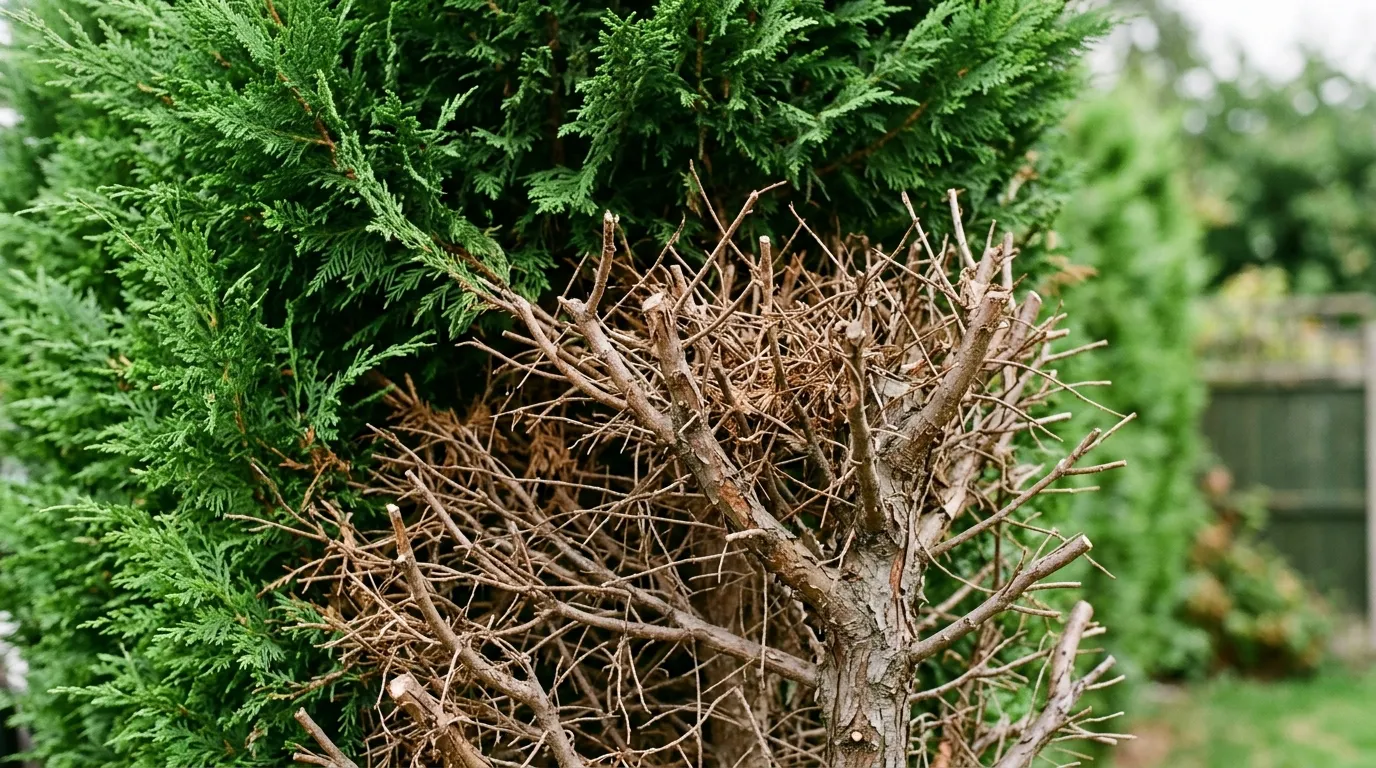 The brown zone exposed after a hard cut. Twelve months on this Lawson cypress has produced no regrowth from the bare wood. The gap is permanent.
The 30% rule - staged reduction in the green layer
When a conifer needs reducing, the answer is staged work over two to three years, taking no more than 30% of green growth in any single year. The principle is to remove enough that the tree shows obvious shape change but to leave enough green foliage to keep photosynthesis at full capacity.
The staged reduction routine for a Leylandii or Lawson hedge that needs to come down by 2m:
- Year one (late April to mid-June): Take 700-800mm off the top, staying in green growth. Lightly tidy the sides if they need it but do not reduce side spread by more than 30% either.
- Year two: Take a further 600-700mm off the top, again staying in green. The hedge should now be 1.3-1.5m lower than the start. Side reduction can continue at 30%.
- Year three: Final 500-600mm off the top to reach target height. Tidy the shape and round over the top corners to encourage even regrowth.
- Year four onwards: Annual light trim only, holding at the new height. Two trims per year (May and August) keep the form tight.
The work needs to be done in late spring after new growth has hardened (mid-April onwards in southern England, early to mid-May in the Midlands and north) but before the hot dry weather of July and August stresses the tree.
If a faster reduction is essential - because of planning enforcement, a complaint under the High Hedges Act, or a new house build - the realistic answer is removal and replanting, not faster pruning.
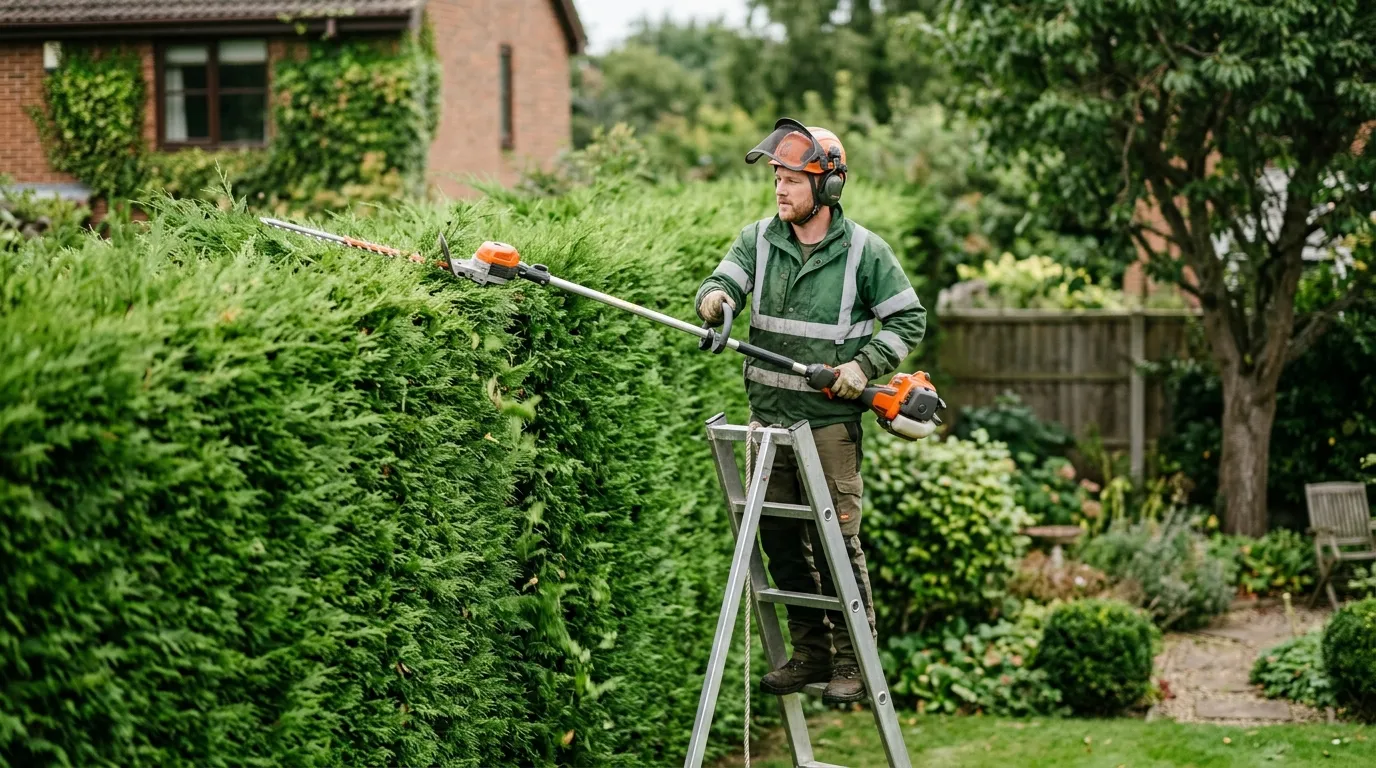 Staged reduction in progress on a Lawson cypress hedge. The contractor is taking 700mm off the top, staying in green growth. The remaining hedge will hold while the cuts heal over.
The yew exception
Yew (Taxus baccata) is the standout exception to the brown-zone rule. Yew is one of the few coniferous trees that retains dormant buds throughout its woody tissue, and a hard-pruned yew regenerates from bare wood within one to two years.
This is why historic yew topiary at Powis Castle, Sissinghurst and Levens Hall has been maintained for 300+ years through repeated hard pruning. The same plant cut back to bare 600mm stubs in March will be fully clothed in fresh green growth by the following summer.
The yew hard-prune routine:
- Timing: Late spring (April to early June) for the cleanest regrowth. Avoid winter pruning which can let frost into fresh cuts.
- Depth: As hard as needed. Yew has been documented regenerating from cuts down to the main trunk at 1m above ground.
- Aftercare: Water deeply twice a week through the first summer (around 20 litres per cubic metre of original canopy). Apply a 50mm mulch of well-rotted manure or composted bark. Apply a balanced feed (NPK 6-9-6) at 50g per square metre in early August.
- Expectations: Green flush from latent buds within 4-8 weeks of pruning. Full canopy recovery by the end of the second growing season.
Other UK conifers that show some old-wood regeneration but not as reliably as yew:
- Holly (Ilex aquifolium) - not a conifer but often confused, regrows reliably from hard pruning
- Box (Buxus sempervirens) - tolerates hard pruning back to bare stumps where box blight is absent
- Hemlock (Tsuga heterophylla) - patchy but better than Leylandii on old wood
If you want a conifer that can be hard-cut back when needed, plant yew or holly. Avoid Leylandii unless you are committed to annual maintenance to hold the size.
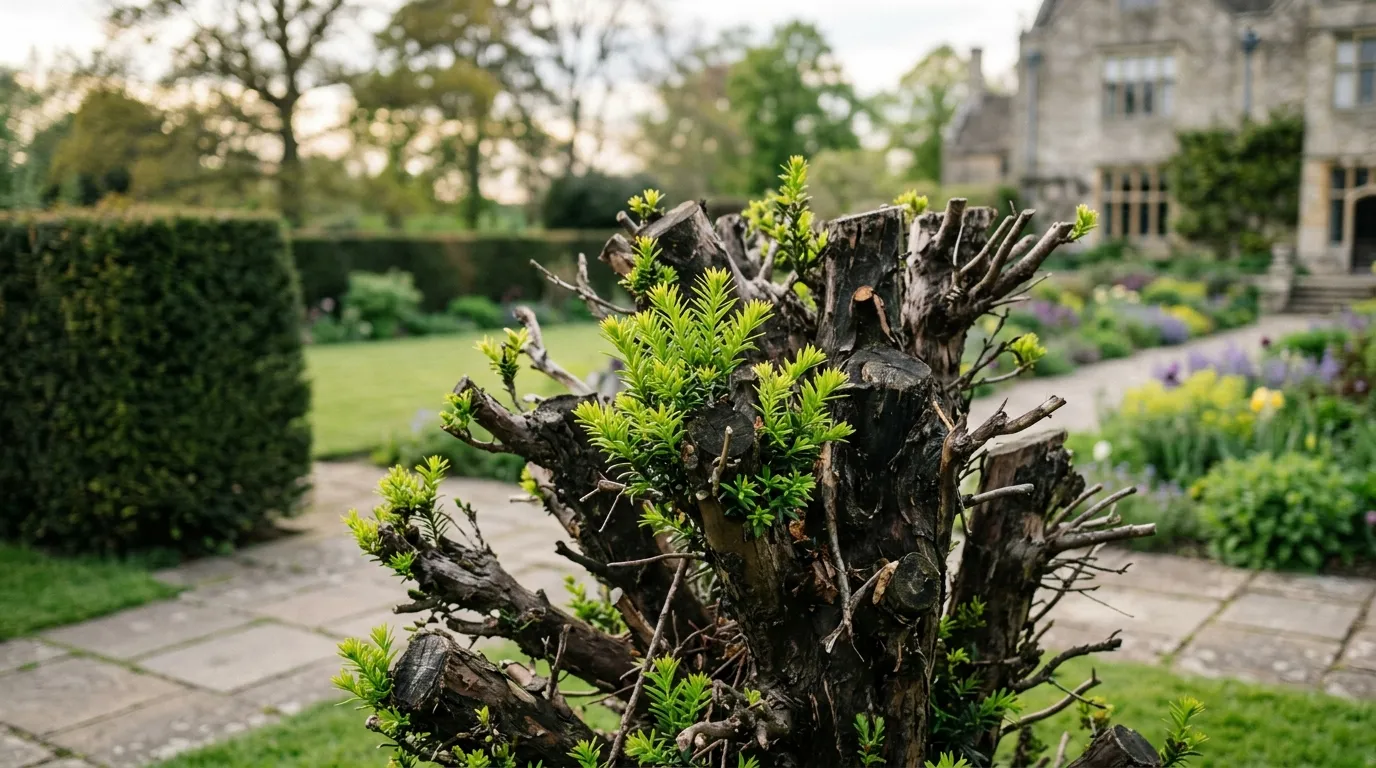 Yew (Taxus baccata) eight weeks after a hard cut back to bare wood. Fresh shoots are pushing from old-wood latent buds - the regeneration capacity that sets yew apart from other UK conifers.
Comparison table - UK conifer species and pruning limits
| Species | Common name | Brown zone? | Max annual reduction | Hard-prune option | UK use |
|---|---|---|---|---|---|
| x Cupressocyparis leylandii | Leylandii | Yes | 30% of green | No | Boundary hedges |
| Chamaecyparis lawsoniana | Lawson cypress | Yes | 30% of green | No | Specimen and hedges |
| Thuja plicata | Western red cedar | Yes | 30% of green | No | Hedges |
| Thuja occidentalis ‘Smaragd’ | Emerald cedar | Yes | 25% of green | No | Formal hedges |
| Cupressus sempervirens | Italian cypress | Yes | 25% of green | No | Specimen, Mediterranean style |
| Taxus baccata | Yew | No (regrows from old wood) | 50% safely | Yes, cut to bare wood | Hedges, topiary, formal |
| Juniperus communis | Common juniper | Yes | 20% of green | No | Specimen, ground cover |
| Picea abies | Norway spruce | Yes | 15% of green | No | Specimen, Christmas tree |
| Pinus sylvestris | Scots pine | Yes | 10% of green | No (avoid hedge use) | Specimen |
When to remove and replant instead
Staged reduction works when the target height is achievable in 2-3 years of 30% cuts. Beyond that, removal and replanting is usually the better answer.
The mathematics of replacement:
- 8m Leylandii hedge reduced to 2m in stages: 5-6 years of work, repeated contractor visits, ongoing eyesore phase
- 8m Leylandii removed and replaced with 1.5m beech: 2-year establishment to 2.5m, then 0.5m/year growth to target
- Visual impact: Removal-and-replant is uglier in year one but tidier and growing on plan by year three
Removal costs in the UK in 2026:
- £200-£400 per mature Leylandii cut down to a 500mm stump (allow access for a chipper)
- £100-£200 extra per stump for grinding out to allow replanting
- £100-£200 per cubic metre of arisings removed from site
- £15-£40 per replacement hedge plant at 1.5m bare-root or rootball
A typical 20m boundary of 10 mature Leylandii: £3,000-£5,000 for removal and stump grinding, plus £400-£800 for replacement beech or hornbeam at 1.5m planted 600mm apart. Compared with five years of contractor visits at £200-£400 each, removal often comes out cheaper.
If you are taking the bigger limbs off yourself before the trunk comes down, use the three-cut method for big limbs to avoid tearing bark down the trunk. The legal point: planning permission is not required for conifer removal in most UK gardens. Tree Preservation Orders (TPOs) and Conservation Area protections apply to specific trees - check with your local planning authority before felling anything mature. The Royal Horticultural Society’s hedge guide covers the planning detail in full.
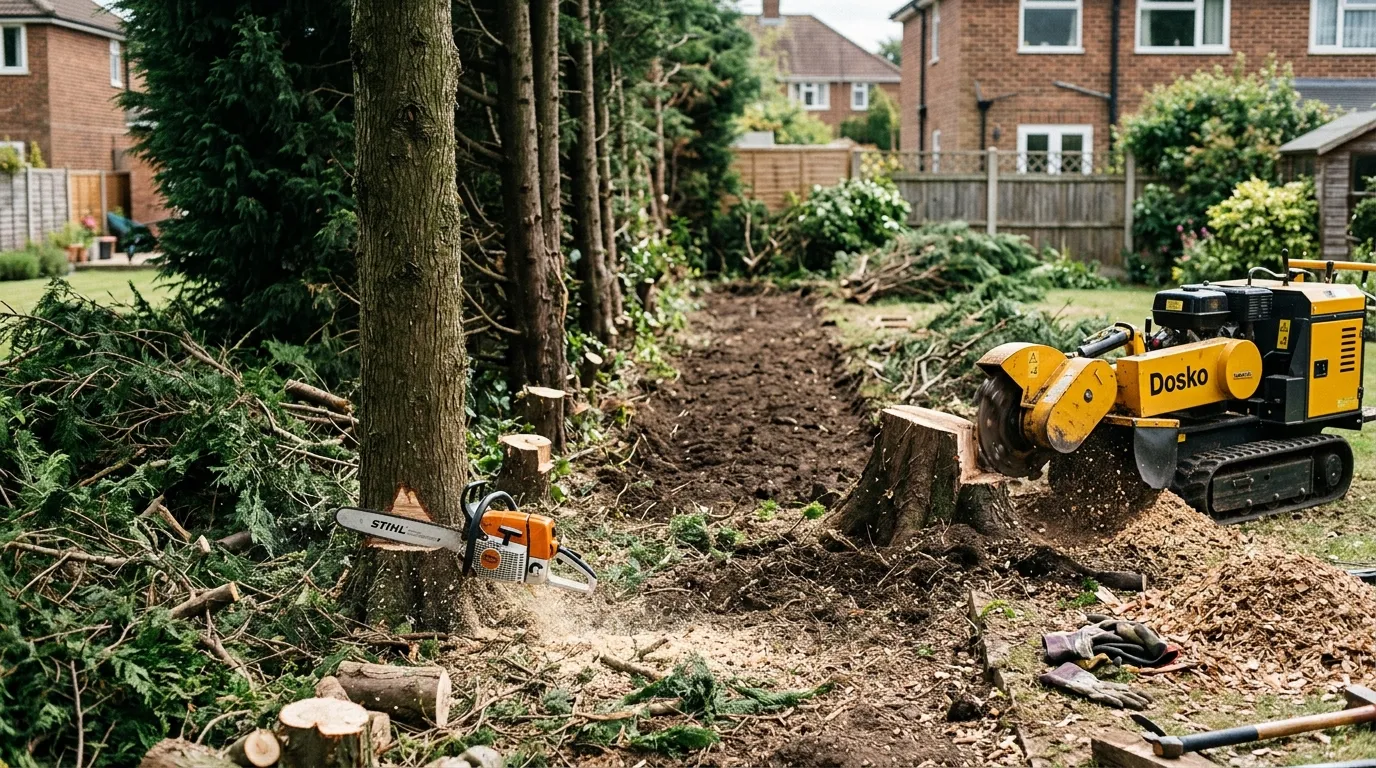 Removal in progress on an overgrown Leylandii boundary. Stumps will be ground out to 200mm below soil level before the replacement hedge goes in.
Replacement hedging - the UK options
Replacement choice depends on what you need the hedge to do: privacy, wind shelter, wildlife value, formal appearance, or low maintenance.
Best UK replacement hedges for a removed conifer line:
| Hedge plant | Type | Mature size | Time to 2.5m | Best for |
|---|---|---|---|---|
| Fagus sylvatica (Beech) | Deciduous (hangs onto leaves in winter) | 1.5-4m | 3-4 years | Formal screening, traditional gardens |
| Carpinus betulus (Hornbeam) | Deciduous (similar leaf retention) | 1.5-4m | 3-4 years | Heavy clay soils where beech struggles |
| Taxus baccata (Yew) | Evergreen | 1.5-5m | 4-5 years | Formal, long-lived, hard-prunable |
| Ilex aquifolium (Holly) | Evergreen | 2-5m | 5-6 years | Wildlife value, slower-growing |
| Mixed native (hawthorn, blackthorn, hazel) | Deciduous | 2-4m | 3-4 years | Wildlife corridor, country style |
| Prunus laurocerasus (Cherry laurel) | Evergreen | 2-5m | 3-4 years | Quick evergreen screen on free-draining soils |
For a planning starting point on UK hedge selection see our hedge planting guide and native hedgerow species guide. For privacy specifically see privacy screening hedges and trees.
The cheapest establishment route is bare-root plants in November to March at £4-£15 each for 600mm-1m plants. The fastest is rootball or container at 1.5-2m planted any time the soil is workable, at £25-£60 each. Two-stage planting (a row of fast-growing rootball plus a second row of bare-root behind for the long term) gives privacy in year one and longevity by year five.
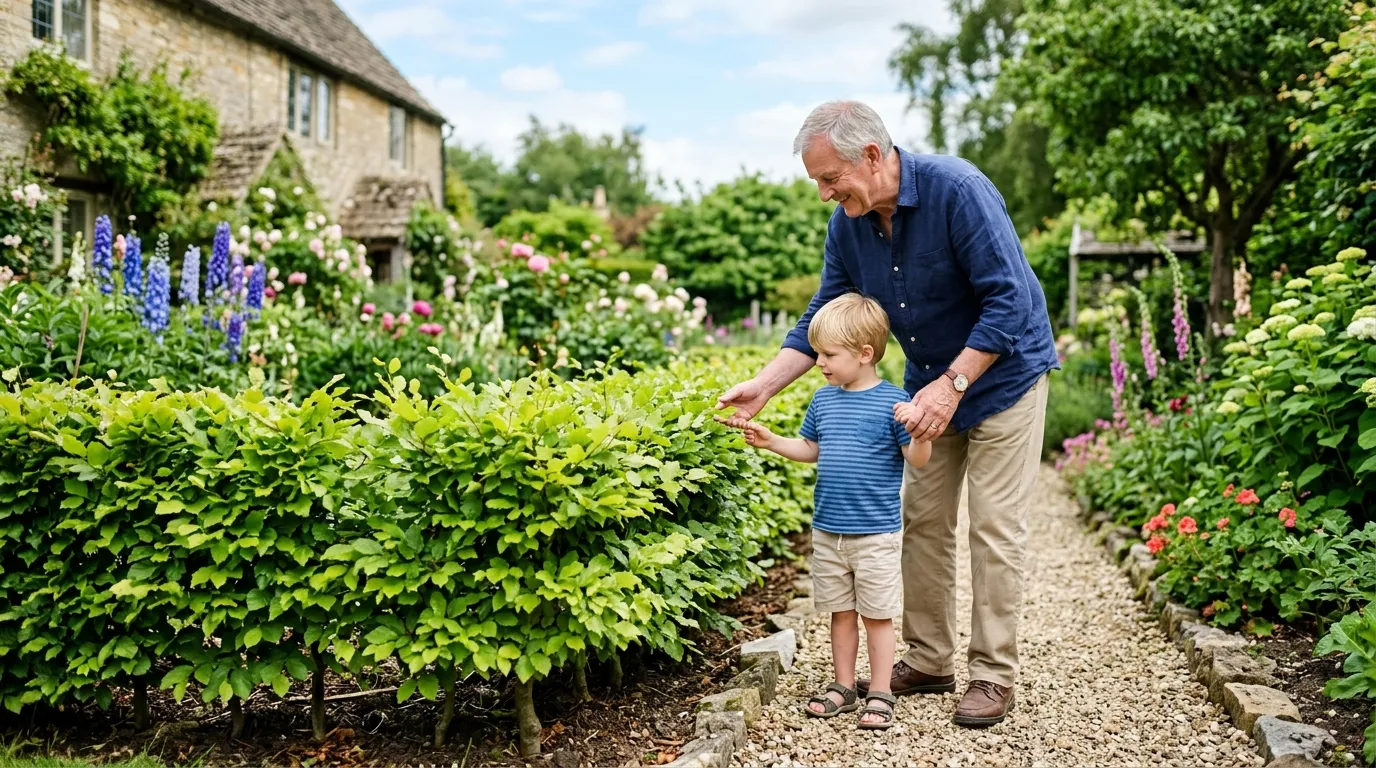 A young beech hedge two years after planting. By year four it will be at 2.5m and providing the boundary screening the removed Leylandii used to give.
The legal context - High Hedges Act and bird nesting
The High Hedges Act 2003 (Part 8 of the Anti-Social Behaviour Act 2003) covers evergreen and semi-evergreen hedges over 2 metres tall that reasonably block neighbours’ light. The Act applies to England and Wales.
The complaint process:
- Neighbour-to-neighbour discussion is the required first step. The council will not consider a complaint until evidence shows the neighbour has tried to resolve it directly.
- Council complaint can follow if direct discussion fails. There is a fee (typically £300-£700 depending on the council).
- Council assessment considers the hedge height, the orientation of the neighbour’s property, the light loss measured against a baseline, and any reasonable use of the hedge for privacy.
- Remedial notice can be issued requiring the hedge owner to reduce the height. Failure to comply is a criminal offence.
In Scotland the equivalent is the High Hedges (Scotland) Act 2013. In Northern Ireland it is the High Hedges Act (NI) 2011.
Bird-nesting law is separate. The Wildlife and Countryside Act 1981 makes it an offence to damage or destroy an active bird’s nest. Birds nest in hedges in the UK from 1 March to 31 August (peak April-July). Hedge cutting during this window is legal only if you have confirmed no active nests are present, which is rarely possible in a dense conifer hedge. The practical rule: avoid hedge cutting between 1 March and 31 August. The British Trust for Ornithology maintains current nesting records by region if you need to confirm species and timings.
For a UK gardener facing both issues, the safe routine is:
- Check Tree Preservation Orders and Conservation Area status with the local council before any work
- Carry out staged reductions in September-October (after nesting, before frost) or April (before main nesting)
- Notify the neighbour in writing before work begins
- Keep photographs and measurements before, during and after
Common mistakes to avoid
- Cutting into the brown zone on Leylandii or Lawson. The bare patch is permanent. Once made, it cannot be repaired - only hidden by replacement planting or removal.
- Reducing height in a single year. Even with good intent, removing more than 30% in a year exposes shaded wood that will not green up. Stage it over 2-3 years.
- Hard pruning in July or August. UK summer heat stresses cut conifers. Wait for the spring growth window (April-June).
- Planting Leylandii close to a boundary. The 2m limit under the High Hedges Act applies, and Leylandii grows 0.6-1m per year. Even a well-meaning original planting becomes a problem within 8-10 years.
- Pruning during bird-nesting season. Active nests in any UK hedge are protected by law. The safe window is September-October or late February to mid-March.
- Refusing replacement when reduction is impossible. Five years of staged work plus contractor visits often costs more than a clean removal and replant, with a worse-looking outcome along the way.
If the foliage is browning as well as overgrown, see our guide to conifer hedge browning.
Frequently asked questions
Can you cut a Leylandii right back to bare wood?
No, Leylandii does not regrow from bare brown wood. Cut into the brown zone and the stub remains brown for the life of the tree. Safe reduction is 30% of the green outer layer per year, taken in late spring. For more drastic size reduction, full removal and replanting is the only realistic option.
Which conifers can be hard-pruned back?
Yew (Taxus baccata) is the only common UK conifer that regrows from old wood. Hard-prune yew in late spring back to bare stumps and it regenerates with fresh shoots within one to two years. All other widely planted UK conifers (Leylandii, Lawson cypress, Thuja, juniper, most cypress varieties) have a permanent brown zone inside.
How tall can a hedge be in the UK before the council can act?
The High Hedges Act 2003 covers evergreen hedges over 2 metres tall that block neighbours’ light. A neighbour can complain to the local council, which may issue a remedial notice forcing reduction. The Act applies to England and Wales; similar legislation exists in Scotland (Antisocial Behaviour etc. Act 2004) and Northern Ireland.
When is the best time to cut conifer hedges in the UK?
Late spring (mid-April to mid-June) for most conifers, after new growth has hardened but before bird-nesting peaks. Avoid pruning in hot dry weather (July to August) which stresses the plant. Yew tolerates pruning anytime from March to September. Never cut between 1 March and 31 August where birds are actively nesting in the hedge.
What can I plant to replace an overgrown Leylandii hedge?
Beech (Fagus sylvatica) and hornbeam (Carpinus betulus) for formal hedges that take hard pruning. Yew for an evergreen that can be cut back hard if needed. Holly for a dense evergreen wildlife hedge. Native mixed hedges (hawthorn, blackthorn, hazel) for wildlife value. Replacement plants at 1.5m establish in two to three years.
Next steps
Now you know the limits of conifer pruning and your replacement options, the next step is planning the new hedge. Read our guide on the hedge planting guide UK for the bare-root planting routine that gets a beech or yew replacement to working height in three years.
Our team produces practical UK gardening guidance from source research, contributor records and established horticultural practice. Editorial standards are overseen by Matt W.