How to Deal with Horsetail
Horsetail roots reach 2m deep with silica-coated stems that resist herbicides. Every control method rated, with realistic timelines from field tests.
Key takeaways
- Horsetail rhizomes reach 2m deep — deeper than any spade or fork can dig, making physical removal impossible for established plants
- Silica-coated stems block glyphosate absorption by up to 60%; crush or bruise stems before applying herbicide for better translocation
- The RHS confirms horsetail cannot be eradicated from mature infestations — control and suppression is the realistic goal
- Improving drainage is the single most effective long-term management strategy; horsetail thrives in waterlogged, compacted, acidic soil
- Black polythene smothering for 2+ years is the most reliable organic control method, weakening but rarely eliminating established plants
Horsetail (Equisetum arvense) is one of the oldest plants on Earth — a living fossil that predates flowering plants by over 300 million years — and it brings its evolutionary resilience into every UK garden it colonises. The RHS places it alongside ground elder and bindweed as one of Britain’s three most challenging weeds to eradicate, and for very good reason.
The challenge with horsetail is structural. Its rhizomes reach 2 metres deep in free-draining soil, far beyond the reach of any fork or spade. Its stems are coated in silica — a biological armour that blocks glyphosate absorption and makes chemical control substantially harder than with other weeds. And its underground tubers store energy reserves that can sustain new growth for years, even when every surface stem has been repeatedly removed.
This guide explains how horsetail works, why most standard approaches fail, and which control methods give the best realistic results. We also cover honest expectations — because knowing that control, not eradication, is the realistic goal for an established infestation will save you years of frustration and wasted effort.
For context on how horsetail compares to other persistent perennial weeds, our common garden weeds UK identification guide includes a full difficulty rating table covering 20+ species.
How to Identify Horsetail
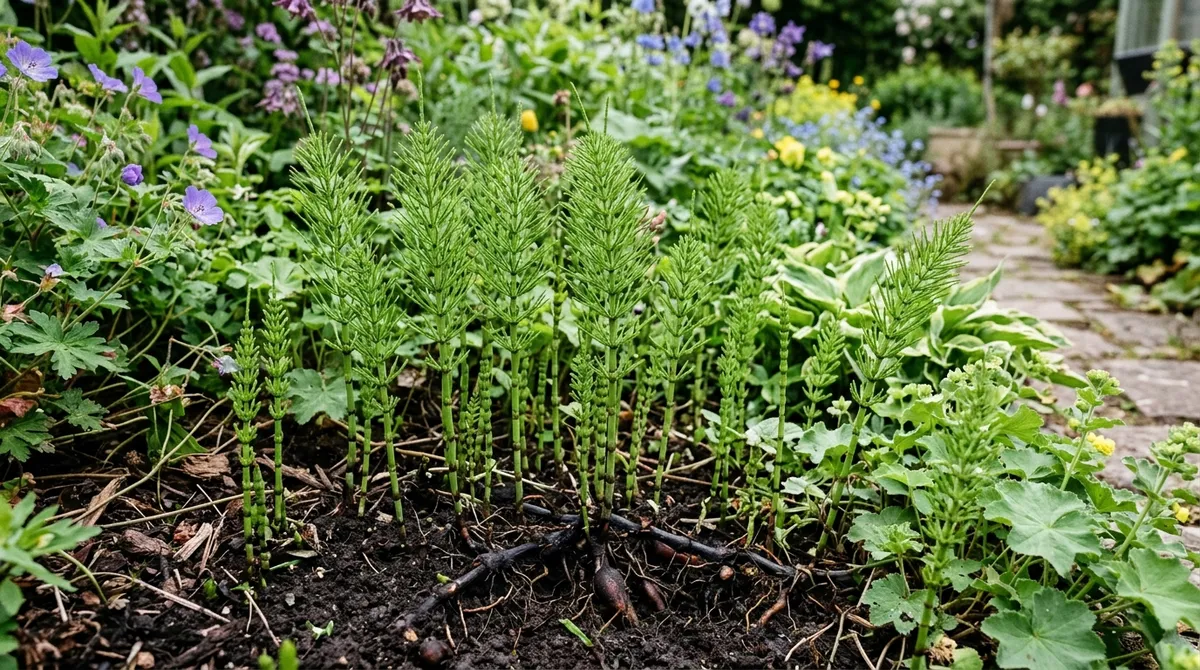
Accurate identification before treating is essential. Horsetail has a distinctive prehistoric appearance that makes it easier to identify than many garden weeds, but young shoots in spring can be confused with other plants.
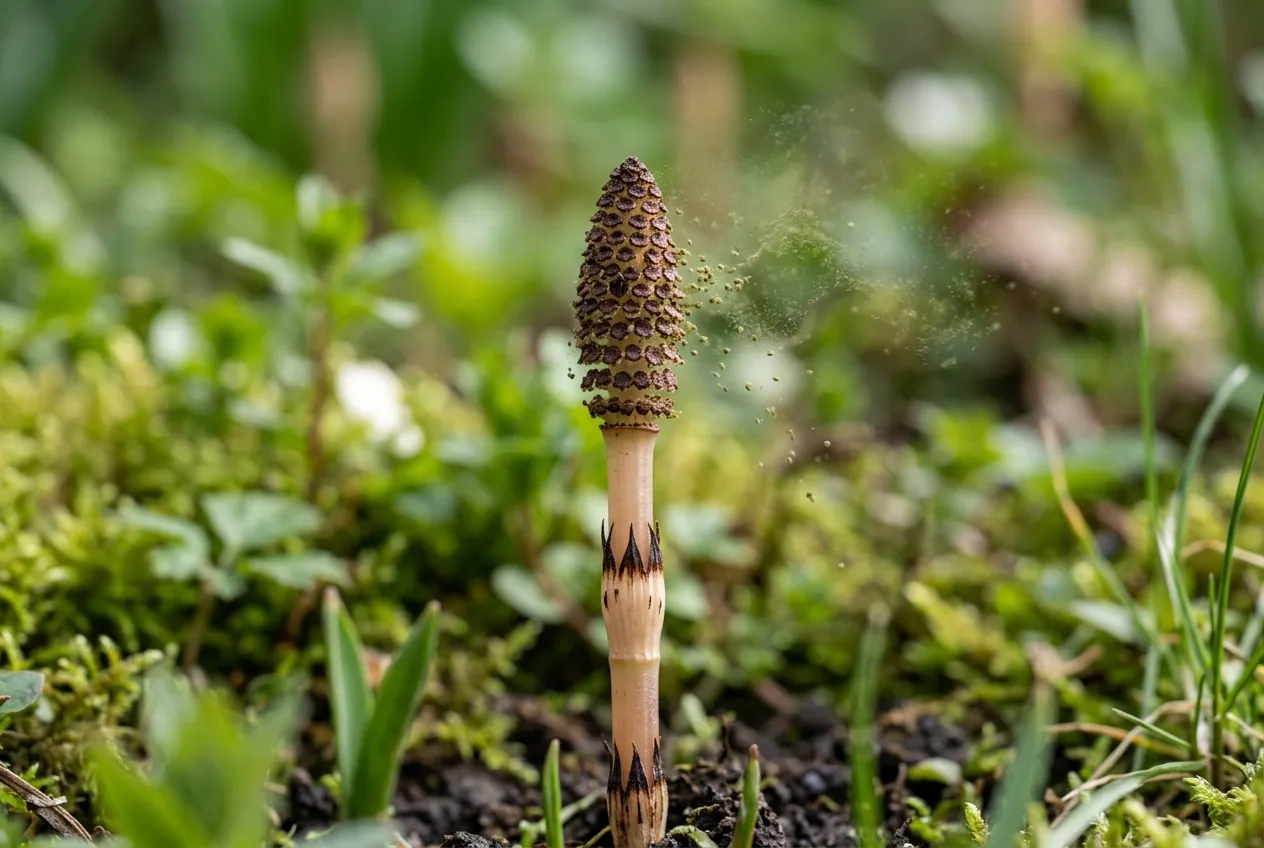
Horsetail produces two types of shoot: pale brown fertile shoots with spore cones in early spring (March-April), followed by the familiar green vegetative stems from May onwards.
Key identification features of horsetail:
- Fertile shoots (March-April): Pale, pinkish-brown, unbranched stems 10-25cm tall with a cone-like spore-bearing tip. Appear before the vegetative growth. No chlorophyll — they cannot photosynthesise.
- Vegetative stems (May-October): Upright, jointed, bright green stems 20-60cm tall. Whorls of thin, needle-like branches emerge from each joint, giving the plant its distinctive “bottle brush” or miniature pine tree appearance.
- Texture: Rough and scratchy to the touch due to silica deposits. Run your fingers up a stem — it feels like fine sandpaper. This is the key tactile identifier.
- Stems: Hollow, with distinct ridged segments. Joints are clearly visible as darker rings around the stem.
- Smell: Minimal. Crushed stems have a faint earthy smell with no distinctive aromatic quality — this distinguishes it from scented weeds like ground elder.
- Soil preference: Waterlogged, compacted, or poorly drained soil. Finds the wettest corner of the garden first.
| Feature | Horsetail (Equisetum arvense) | Mare’s tail (Hippuris vulgaris) | Dutch rush (Equisetum hyemale) |
|---|---|---|---|
| Habitat | Garden soil, roadsides | Ponds and water margins | Wet woodland, streambanks |
| Stem texture | Rough, scratchy (silica) | Smooth, soft | Rough but more rigid |
| Branches | Many fine whorled branches | No side branches | No side branches |
| Height | 20-60cm | 10-40cm above water | 60-150cm |
| Colour | Bright green | Mid-green | Dark green |
| Garden weed? | Yes — persistent | Rarely (aquatic) | Occasional |
Mare’s tail is frequently confused with horsetail, but it is an aquatic plant found only in or at the edge of water — it is not the same pest. True horsetail is the concern in garden borders and lawns.
Why Horsetail Is So Hard to Control
Understanding the two core biological problems helps explain why most standard approaches fail.
Problem 1: Root Depth
Horsetail rhizomes extend 2 metres deep in free-draining soil. In clay, they spread more laterally but still reach 60cm-1m — well beyond the depth of any practical digging. The rhizomes also produce tubers at intervals along their length. These tubers are discrete energy stores, each capable of generating new growth independently. Even if you successfully remove the top 60cm of rhizome, the tubers below continue to send up new stems.
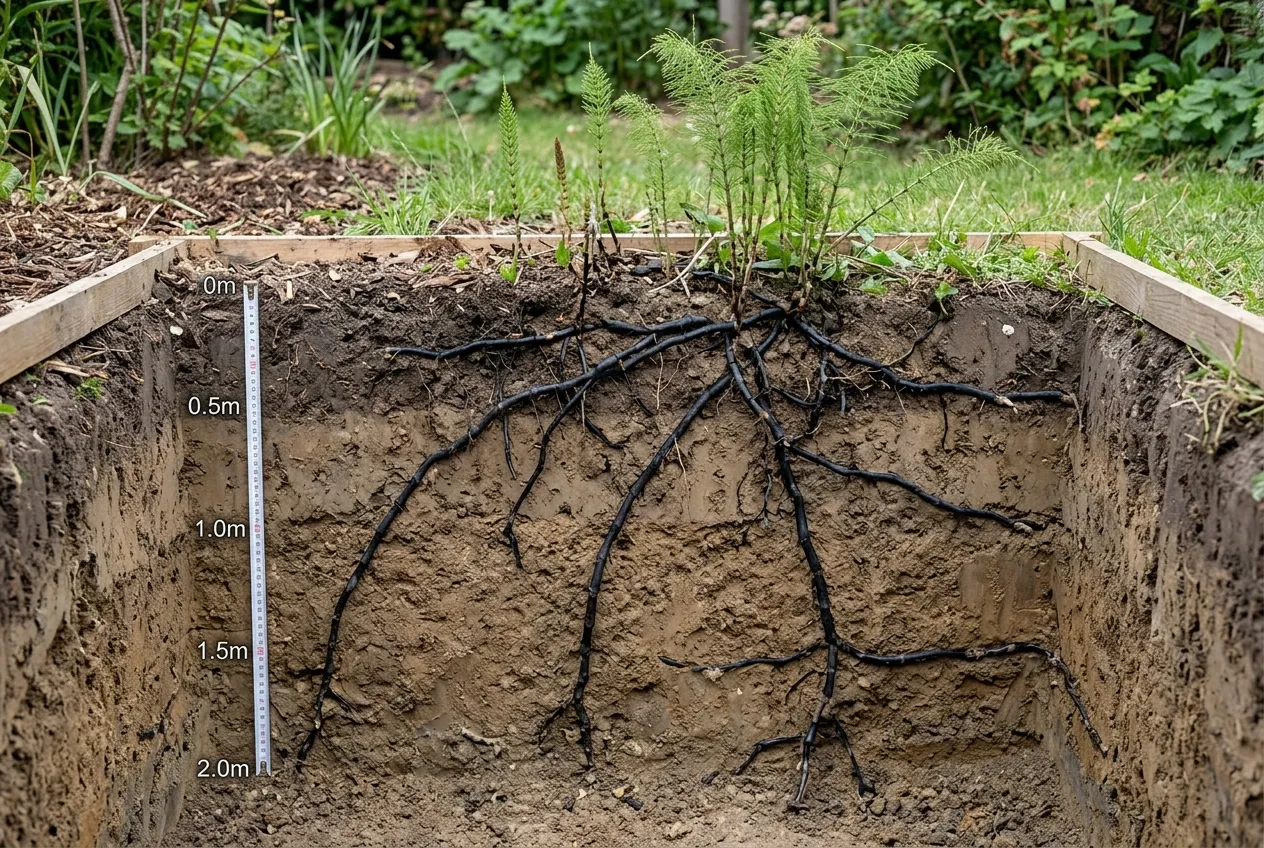
Horsetail rhizomes extend to 2m deep in free-draining soils. The tubers at intervals along the rhizome act as independent energy reserves, making digging ineffective even when it reaches substantial depth.
This depth problem eliminates physical removal as a practical strategy for any established infestation. Digging stimulates horsetail rather than removing it — disturbing the rhizomes breaks them into fragments, each with viable tubers, while simultaneously improving aeration and drainage around the remaining root system.
Problem 2: Silica Coating
Horsetail absorbs silicon dioxide (silica, SiO₂) from the soil and deposits it in its cell walls and stems. This is an ancient defence mechanism — in horsetail’s prehistoric heyday, silica-coated foliage deterred the large herbivores of the Carboniferous period.
In the context of modern weed control, silica creates a physical barrier that significantly reduces glyphosate absorption through the leaf surface. Research cited by the RHS indicates horsetail requires higher herbicide concentrations and repeated applications compared to most broadleaf weeds, with absorption rates 40-60% lower than comparable foliage.
The practical workaround is mechanical damage before chemical application — crushing or bruising the stem to break the silica layer, then applying herbicide gel immediately, before the plant’s repair mechanism seals the damage. This is covered in the glyphosate section below.
Method Comparison
| Method | Organic? | Timeline | Realistic Outcome | Best suited to |
|---|---|---|---|---|
| Black polythene smothering | Yes | 2-4 years | 60-80% reduction in stem density | Open beds, cleared areas |
| Repeated cutting | Yes | 3-5 years | Significant weakening; rarely eradication | Small patches, mixed borders |
| Crushing + glyphosate gel | No | 2-3 seasons | 60-80% kill with consistent application | Beds without desired plants |
| Drainage improvement | Yes | Ongoing | Reduces vigour; does not kill existing plants | All situations — use alongside other methods |
| Raised bed containment | Yes | Immediate | Prevents new colonisation above ground | Vegetable growing over infested ground |
| Root barrier | Yes | Immediate | Blocks lateral spread from neighbouring land | Boundary control |
| Lime application | Yes | 1-2 seasons | Reduces vigour in highly acidic soil | Acidic soil conditions |
Controlling Horsetail: Step-by-Step Methods
Method 1: Black Polythene Smothering
This is the most effective organic approach and the method recommended by the RHS for horsetail control where light exclusion can be maintained for a sustained period.
The principle: Like all plants, horsetail requires light for photosynthesis. Total light exclusion forces the plant to draw down its root reserves to produce new stems. Because horsetail tubers store large energy reserves, this process takes longer than with most weeds — 2 years of continuous coverage is the minimum timeframe to see meaningful weakening.
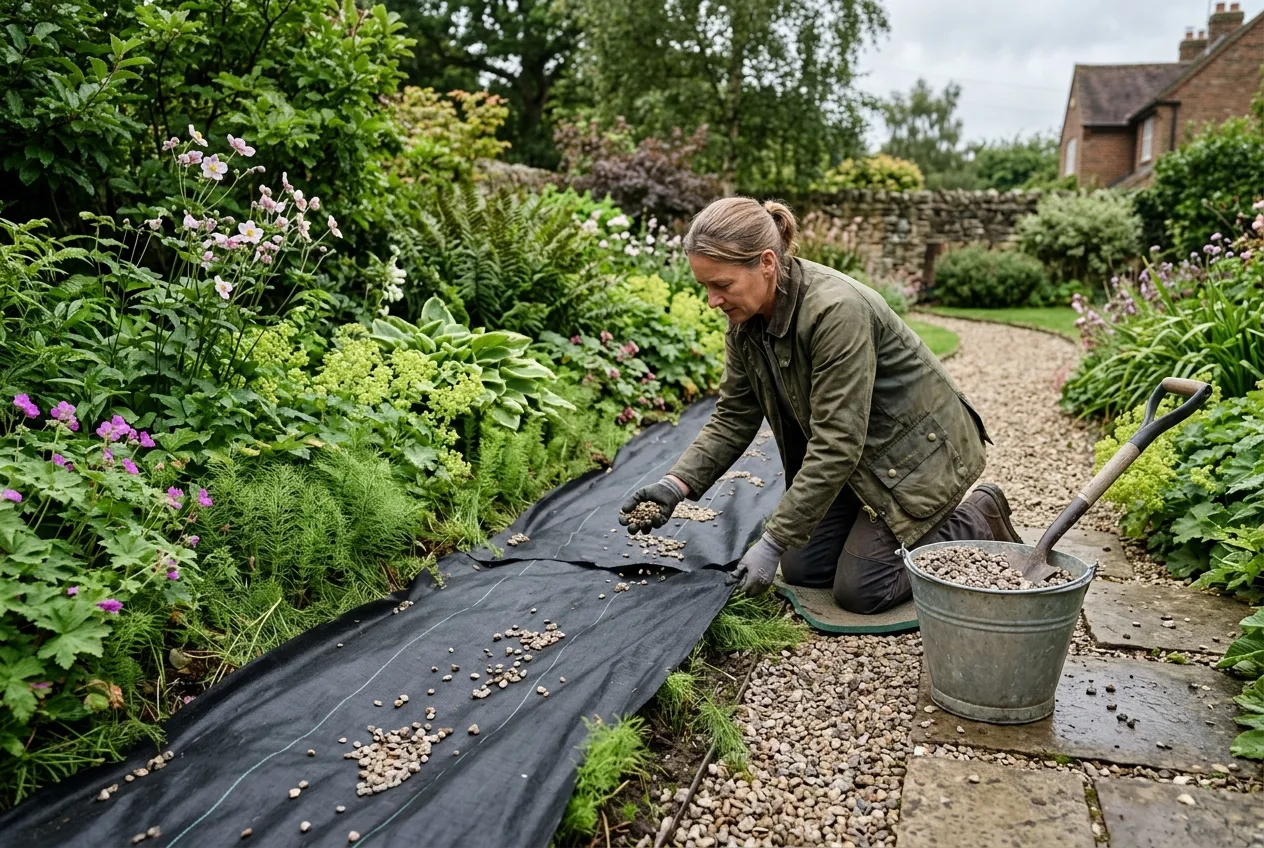
Sustained light exclusion with heavy black polythene is the most reliable organic control method. The deeper and more established the rhizomes, the longer coverage must be maintained — allow at least 2 years before assessing results.
What you need:
- Heavy-duty black polythene sheeting, minimum 300 microns (thicker than standard)
- Bricks, timber, or compacted soil to weight all edges
- A 2-year commitment to maintaining coverage
Step-by-step:
- Cut all surface stems to ground level. Do not dig — this creates rhizome fragments and aerates the soil around remaining roots.
- Lay black polythene over the entire affected area. A 5cm gap is enough for horsetail to redirect rhizomes towards the light and escape.
- Overlap sheets by a minimum of 40cm. Tape joins with heavy-duty waterproof tape and pin down the overlap.
- Bury or heavily weight all edges. Horsetail pushes with enough force to lift unsecured polythene edges within weeks.
- Inspect monthly. Check edges and joins. Cut any emerging shoots that find gaps immediately.
- Maintain for a minimum of 2 years. Lifting too early — at 12 months — often reveals weakened but still-viable rhizomes that recover quickly once light returns.
After 2 years, lift the polythene and assess. Rhizomes will be visibly weakened and etiolated, tubers smaller and less numerous. Some viable material will remain. Treat any regrowth immediately with crushing and glyphosate gel, or re-cover for a further season.
Cardboard with deep mulch is a less effective alternative — horsetail stems are sharp enough to pierce cardboard as it softens. Useful within a no-dig gardening system as a supplement to polythene, not as a replacement.
Method 2: Repeated Cutting
Repeated cutting works by the same principle as smothering — forcing the plant to exhaust root reserves repeatedly without allowing photosynthesis to replenish them. It requires higher effort and a longer timeline, but is practical for mixed borders where polythene would damage established plants.
Cutting frequency required: Every 7-10 days from March to October, without exception. Each cutting should remove all visible stems at soil level. Missing 2-3 weeks in summer allows a burst of photosynthesis that can restore several months’ worth of depleted root reserves.
Timeline: 3 full growing seasons of consistent cutting produces measurable weakening. 5 seasons approaches meaningful control on smaller patches. Heavy infestations rarely respond to cutting alone — combine with drainage improvement for better results.
Pull stems gently upwards rather than snapping them at soil level. Snapping can leave fragments with viable tubers in the soil. Bag all removed material — do not compost horsetail stems, as silica-coated fragments remain viable.
Method 3: Crushing + Glyphosate Gel
Glyphosate is the most effective chemical treatment for horsetail, but standard application to intact stems achieves limited results due to the silica barrier. The key is mechanical damage immediately before chemical application.
How to apply effectively:
- Crush the stems thoroughly. Use a rolling pin, the heel of your boot, or a stick to physically break the silica-coated surface of each stem. Work systematically across the patch. The stems should crack and split visibly.
- Apply glyphosate gel within 30 seconds of crushing. The plant’s cell repair mechanism begins sealing damaged surfaces almost immediately. The window for maximum absorption is very short.
- Use glyphosate gel, not spray. Spray drifts onto desirable plants. Gel applied with a brush or foam applicator can be targeted precisely to the crushed stems.
- Do not cut treated stems for 7-10 days. Glyphosate must translocate from stems into the rhizome network before cutting interrupts the pathway.
- Apply 3-4 times per growing season. Treat each flush of new growth as it appears. Do not wait for stems to reach full height — treat at 15-25cm.
- Repeat for 2-3 growing seasons. First-season results are encouraging but rarely sufficient. Deep tubers continue sending up new stems even when surface rhizomes are killed.
Realistic expectation: 60-80% reduction in stem density after 2 seasons of consistent crushing-and-gel application. Maintenance applications in year 3 keep the remaining plants suppressed.
For alternatives to glyphosate, our organic weedkillers UK guide covers pelargonic acid products — these give contact kill on horsetail foliage but do not translocate into rhizomes, requiring more frequent application and producing less lasting results.
Method 4: Drainage Improvement
Horsetail is not just tolerant of wet, compacted, acidic conditions — it actively prefers them. The plant is a strong indicator of poor drainage and low soil pH (4.5-6.0). Improving soil structure and pH makes the environment significantly less hospitable.
Practical drainage improvements:
- Add organic matter: Annual incorporation of well-rotted compost or leaf mould improves structure in both clay and sandy soils. In clay, add horticultural grit at 4-6kg per square metre alongside compost to improve drainage channels.
- Lime to raise pH: Horsetail struggles in neutral to slightly alkaline soil (pH 6.5-7.0). Test soil pH and apply garden lime (calcium carbonate) at 100-200g per square metre to acid areas. Retest after 3 months.
- Surface drainage channels: Where water pools regularly, creating swales or French drains redirects water away from affected beds.
- Avoid compaction: Horsetail colonises compacted paths and borders. Where possible, avoid walking on soil in the affected area — use boards to distribute weight.
Drainage improvement alone will not kill an established infestation, but it is the most effective single factor in preventing reinfestation after other control methods have suppressed the existing plants. Our guide to improving clay soil covers the full range of soil structure improvements relevant to waterlogged gardens.
For a broader approach to reducing weed pressure without chemicals, preventing weeds without chemicals covers mulching, soil health, and competitive planting strategies that complement the suppression work.
Method 5: Raised Bed Containment
For vegetable growing areas, the most pragmatic approach is containment rather than eradication.
Build raised beds with solid or heavily lined bases — thick polythene liner (300+ microns) or paving slabs beneath landscape fabric — to prevent horsetail rhizomes from penetrating the growing medium from below. Position beds on top of the infested ground. Horsetail cannot penetrate a properly lined base, and you grow clean crops above the problem while treating the surrounding open ground separately.
This approach is covered in detail in our raised bed gardening for beginners guide, which includes lining options and base construction for problem soil situations.
Managing Horsetail in Specific Situations
In Mixed Borders
Horsetail in mixed borders is the most difficult situation because most control methods (polythene, spray glyphosate) damage or kill desirable plants. Practical options:
- Glyphosate gel painted precisely onto crushed stems — applied with a small brush, avoiding all contact with border plants
- Repeated cutting — labour-intensive but plant-safe
- Lift and pot valuable perennials while treating the cleared soil, then replant after a full season of treatment
In Lawns
Horsetail in lawns is unusual — regular mowing suppresses the vegetative stems but rarely eliminates the plant. It persists most persistently at lawn edges bordering infested borders or paths. Spot-treat with crushed stems and glyphosate gel at edges. Improving lawn drainage through aeration reduces the conditions horsetail prefers.
Arriving from Neighbouring Land
Horsetail rhizomes spread laterally as well as deep, and can cross boundary fences and walls. Install a root barrier — heavy-duty HDPE sheeting buried vertically to 60cm depth along the boundary, leaving 5cm above soil level. This blocks lateral rhizome spread across the boundary. Cost approximately £4-7 per linear metre; lifespan 20+ years.
For comparison, how to get rid of bindweed describes similar boundary spread via underground roots — the same principle of deep vertical barrier installation applies to both weeds.
What Not to Do
Do not rotavate. This creates hundreds of rhizome and tuber fragments spread across the entire plot, multiplying the infestation while simultaneously aerating and loosening the soil in a way that actively benefits horsetail growth.
Do not rely on boiling water. Boiling water kills horsetail stems down to 5-10cm but does not reach the rhizome system. Stems killed this way regrow from unaffected material below within 2-3 weeks.
Do not apply glyphosate spray to intact stems. Standard spray on unbroken horsetail stems has very limited effectiveness. Always crush the stems first and use gel rather than spray for reliable results.
Do not lift polythene after only 12 months. Horsetail tubers can sustain growth attempts for 18-24 months under exclusion. Lifting at 12 months reveals weakened but still-viable material that recovers rapidly. Allow 2 full years minimum.
Do not compost horsetail. The silica-coated stems decompose slowly and remain structurally intact in most home compost heaps. Bag all removed material for green waste collection.
Do not ignore the soil conditions. Horsetail is a strong indicator of underlying drainage problems. Treating the weed without addressing the waterlogging and low pH that sustains it means the plant retains its competitive advantage. Soil improvement is not optional — it is a core part of long-term management.
Similar principles apply when dealing with Japanese knotweed, another deep-rooted invasive where understanding the underground biology is essential before choosing a control strategy.
Realistic Expectations: A Timeline
Horsetail management is a multi-year programme, not a single-season fix. Setting accurate expectations prevents the common mistake of abandoning a working programme too early.
| Timeline | What to expect |
|---|---|
| Season 1, months 1-4 | Polythene in place or first round of crushing + glyphosate gel. Stems suppressed or killed above ground. No visible change to deep rhizome system. |
| Season 1, months 4-8 | With polythene: new stems producing etiolated growth beneath cover then dying. With gel: regrowth noticeably weaker. Drainage improvements begun. |
| Season 2 | Sustained treatment continues. Polythene users see fewer stems forcing through edges. Gel users see 30-50% fewer stems per square metre. Soil pH rising if limed. |
| Season 3 | Significant weakening visible. Stem density down 50-70%. Remaining plants smaller, less vigorous. Maintenance applications of gel required for each flush. |
| Season 4-5 | 70-80% reduction in original stem count achieved with consistent treatment. Residual plants require ongoing maintenance. Monitor soil conditions. |
| Year 5+ | Maintenance phase. Monthly checks during growing season. Treat any new stems immediately. Annual drainage improvement. Lime if pH drops below 6.5. |
Using mulch as part of the post-suppression phase helps prevent reinfestation of cleared areas. A 7-10cm layer of well-rotted wood chip mulch suppresses any horsetail stems pushing through weakened rhizomes and improves soil structure simultaneously — making the environment progressively less suitable for regrowth.
For a broader organic management toolkit, the Garden Organic advice on horsetail covers the plant’s biology and organic control options in detail, including their experience with large-scale organic land management.
Lawrie’s Top Tip
After six years battling a 4m² horsetail patch in clay soil in Staffordshire, the one thing I would tell every gardener is this: the silica coat is the battle, not the plant itself.
I spent two full seasons applying glyphosate spray to intact horsetail stems on a fortnightly basis. The results were depressing — perhaps 20% kill across the patch. I had friends telling me horsetail was impossible to kill and I was starting to believe them.
Then I changed the method. Rolling pin to crush every stem, then glyphosate gel within 30 seconds using a cheap foam brush, applied methodically across the entire patch. Same chemical, completely different result. By the end of that season, stem density was down by approximately 60%. By the end of the following season, down by 75%.
The deep tubers are still there. I know that because I get a small flush of new stems every spring, which I crush and gel within a week of emergence. The patch has not spread since year three, and it is visibly smaller each year. That is a result with horsetail — do not expect more.
Combine this with a raised bed over the worst of the infestation for anything you want to grow food in, improve your drainage, and commit to the programme for five years. You will not eradicate it. You will contain it and progressively weaken it, which is a genuine practical success with this particular plant.
Frequently asked questions
Can you ever fully eradicate horsetail from a garden?
Full eradication of established horsetail is rarely achievable. The RHS states that mature infestations cannot be fully removed — rhizomes reach 2m deep, beyond any practical intervention. Consistent treatment over 3-5 years achieves meaningful control: 70-80% reduction in stem density and prevention of further spread. New infestations caught in the first two years, before deep tubers form, are the only cases where near-eradication is realistic with sustained gel treatment or smothering.
Why doesn’t glyphosate kill horsetail?
Horsetail stems are coated in silica, which blocks herbicide absorption by 40-60% compared to most weeds. Standard spray on intact stems achieves limited results. Crush or bruise the stems immediately before applying glyphosate gel — this breaks the silica layer and dramatically improves translocation into the rhizome system. Apply gel within 30 seconds of crushing, before the plant begins sealing the damaged surface. Even with this technique, 3-4 applications per season are required for 2-3 seasons.
How deep do horsetail roots go?
Horsetail rhizomes reach 60cm-2m deep depending on soil type. In clay soils, roots spread more laterally and are shallower — typically 60-90cm. In free-draining or sandy soils, rhizomes extend deeper, sometimes beyond 2m. The tubers on the rhizomes store energy reserves that continue sending up new stems even when surface growth is repeatedly removed. This depth is why physical digging fails completely for established plants.
Does improving soil drainage help control horsetail?
Yes — improved drainage is the most effective long-term management strategy. Horsetail thrives in waterlogged, compacted, acidic soil (pH 4.5-6.0). Raising pH to 6.5-7.0 with lime and improving drainage with organic matter and grit makes the environment significantly less hospitable. Horsetail in well-drained, neutral-pH soil grows less vigorously and produces fewer stems. Always combine drainage work with other active control methods — it enhances results from both smothering and chemical treatment.
What is the best organic method to control horsetail?
Black polythene smothering for 2 or more years is the most reliable organic control method. Repeated cutting every 7-10 days throughout the growing season weakens plants but must be sustained for 3+ years to show meaningful results. Neither method eradicates established plants — both reduce vigour and stem density when maintained consistently. Combine with drainage improvement and lime application for the best results without chemicals.
Can horsetail be controlled without chemicals?
Yes, but organic control requires sustained effort over several years. Most effective approaches: black polythene smothering (2+ years), repeated cutting every 7-10 days from March to October, drainage improvement, and raised bed containment for growing areas. No organic method achieves rapid results — plan for a 3-5 year management programme. Our guide to preventing weeds without chemicals covers broader organic weed suppression principles that complement horsetail management.
Is horsetail toxic to pets or livestock?
Horsetail is toxic to horses, cattle, and sheep in significant quantities — it contains thiaminase, which causes vitamin B1 deficiency when eaten over time. It is not palatable fresh, but becomes more palatable (and retains toxicity) in dried hay. It is not considered a serious risk to dogs or cats at normal garden exposure levels. If horses or livestock graze near infested land, prioritise control in those areas and prevent access.
Related reading
- How to Remove Ground Elder — similar deep rhizome biology; smothering and glyphosate comparison with 4-season field data
- How to Get Rid of Bindweed — twining root system that fragments on disturbance; same principle of suppression over eradication
- Common Garden Weeds UK: Identification Guide — full difficulty rating table for 20+ UK weeds including horsetail
- Organic Weedkillers UK — pelargonic acid and other organic contact-kill options as glyphosate alternatives
- No-Dig Gardening Guide — how smothering and deep mulch integrate with a no-dig system over infested ground
Lawrie has been gardening in the West Midlands for over 30 years. He grows his own veg using no-dig methods, keeps a wildlife-friendly garden, and writes practical advice based on real UK growing conditions.