Key takeaways
- Rabbits clear-bite plants at 45 degrees and graze up to 60cm; stop them with 1200mm of 31mm mesh plus a 300mm buried L-shape
- Roe, muntjac and fallow deer need a 1800mm chain link fence; only red deer need 2400mm
- Wood pigeons strip brassicas to the ribs in October to April; 19mm mesh on 500mm hoops is the only reliable defence
- Badgers are protected under the Protection of Badgers Act 1992; you cannot kill, harm, trap or block a sett without a licence from Natural England
- Zone the garden into a protected core (veg, fruit cage, young trees) and a shared wildlife edge with a hedgehog highway in the boundary
- Deterrents work in cycles: combine fencing, scent repellents, plant choice and motion devices and rotate them before pests habituate
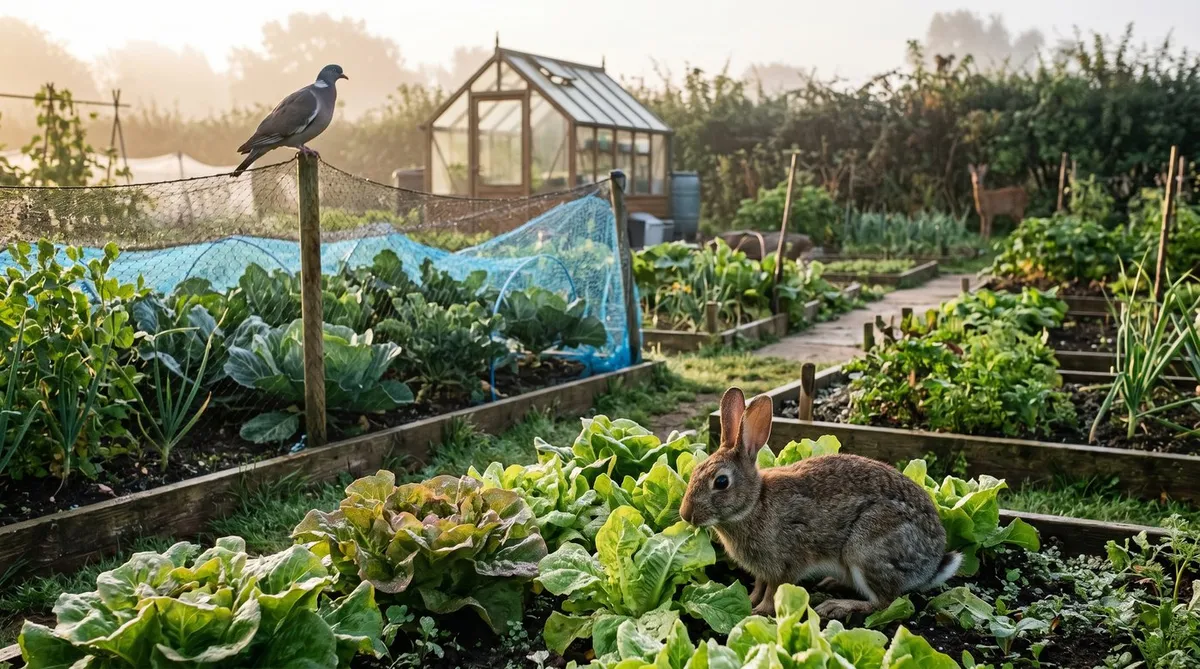
Four mammals and birds do the bulk of large-pest damage in UK gardens: rabbits, deer, wood pigeons and badgers. They cost UK growers tens of thousands of plants every year, and most of the damage is avoidable with the right fence height, the right mesh size and a measured understanding of UK wildlife law.
Why mammal and bird pests matter in UK gardens
The five smallest pests get most of the column inches. Slugs, aphids, caterpillars, carrot fly and capsid bugs dominate gardening magazines because they are everywhere and easy to write about. But for kitchen gardeners and orchard growers, a single overnight visit from a deer or a feeding flock of wood pigeons can wipe out more food than a whole season of slug damage.
- Bird damage is concentrated, mammal damage is repeated. Wood pigeons strip a brassica bed in one or two visits and may not return for weeks. Rabbits and deer visit every night, taking small amounts each time. The defences have to match: nets and cages for birds, continuous fences for mammals.
- Cheap defences usually fail in year one. Saggy 25mm nylon mesh, low 750mm wire fences, plastic owl decoys. Pigeons land on the slack mesh and feed through it. Rabbits jump 900mm easily. Decoy birds get ignored within a fortnight. Spend once on the right kit.
- Legal protection changes the strategy entirely. Rabbits and rats can be controlled with traps and shooting under the Pest Act 1954. Wood pigeons can be shot under the General Licence GL42 once non-lethal alternatives have been tried. Badgers cannot be touched. That single legal distinction reshapes how you garden anywhere a badger is active.
The decision table at the end of this guide pulls every species onto one page so you can plan the whole garden in an afternoon.
Identifying rabbits in your UK garden
The European rabbit (Oryctolagus cuniculus) is 35-45cm head to tail with a short white scut, brown-grey fur on the back and a paler buff underside. It feeds at dawn and dusk from late February through October and continues at lower intensity through winter. UK rabbit numbers have fallen sharply since the 1990s due to RVHD2 (rabbit haemorrhagic disease virus 2), but pockets of high density still cause major garden damage, especially on free-draining sandy or chalky soils where rabbits prefer to dig.
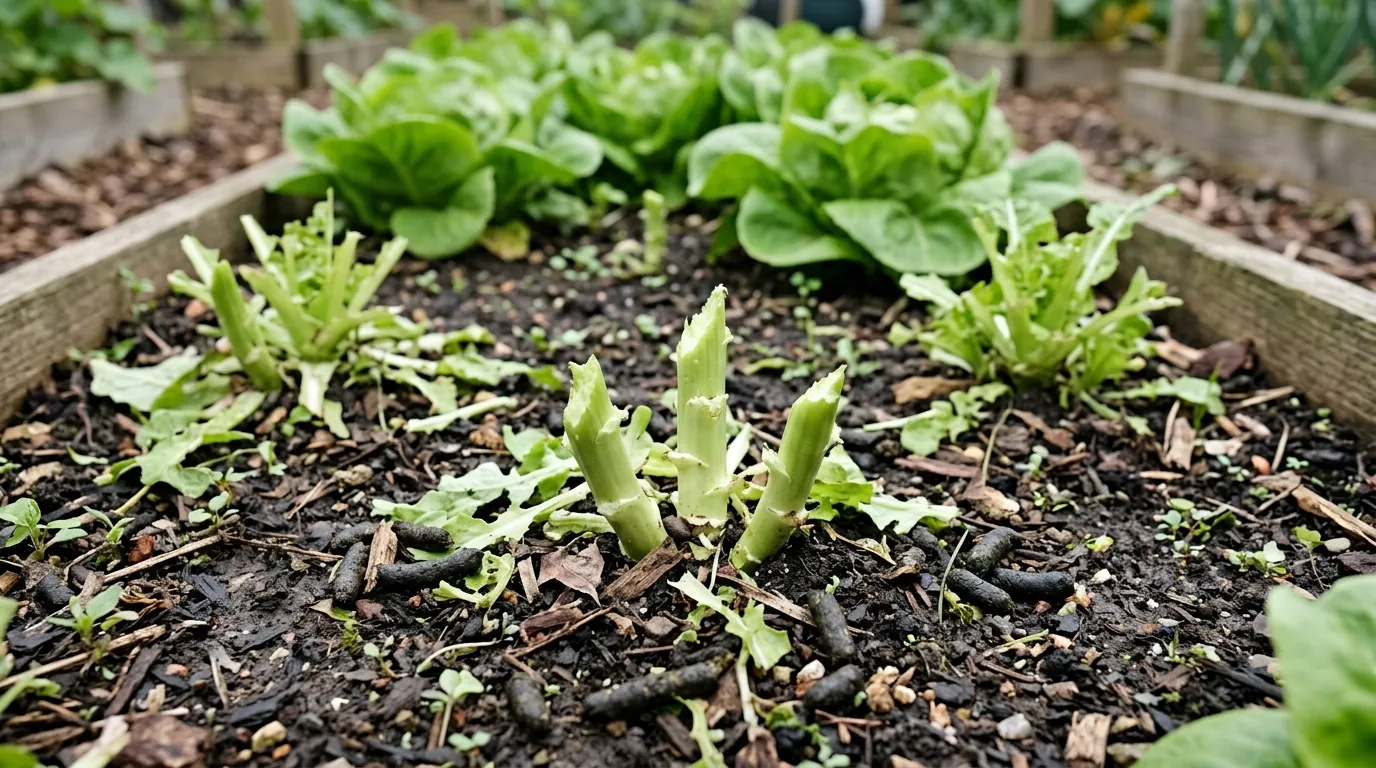
Three signs confirm rabbits rather than other pests:
- 45-degree clean stem cuts. Rabbits bite cleanly with their incisors and leave a smooth angled cut. Deer tear and leave a frayed stem. Slugs and caterpillars chew the leaf surface.
- Damage confined to the lower 600mm. Rabbits cannot reach higher unless they climb a step or a raised bed edge. Damage above 600mm is almost always deer or pigeons.
- Pellet-sized round droppings. Small dark spheres about 7-10mm, scattered in groups of a dozen or so. Deer droppings are larger and oval; badger droppings are dropped in shallow pits called latrines.
Rabbit damage peaks in spring on tender seedlings and again in winter when they strip bark from young fruit trees and stems of young roses. A single rabbit can clear a row of lettuce in one feeding visit; a colony living in a hedge can finish 20m of bean row in a fortnight.
Rabbits use the same feeding paths night after night. Watch for compressed runs in long grass and small dished depressions where the rabbit has paused to graze. These are the natural points to set live traps if control is needed, and they also tell you where the fence line is being approached so reinforcement can go in early.
Seasonal rabbit behaviour in UK gardens
- February to April: Breeding begins, doe-and-buck pairs disperse, young kits start grazing.
- May to August: Peak damage period on lettuce, beans, peas and brassica seedlings.
- September to October: Population peaks, dispersal from breeding hedges into new territories.
- November to February: Bark stripping on young fruit trees, hawthorn, rose stems and dogwood. RVHD2 outbreaks often hit hardest in this window.
Rabbit-proof fencing and physical barriers
- 1200mm of 31mm hexagonal wire mesh above ground. Anything under 1000mm is jumped. 50mm mesh is chewed through.
- A 300mm buried L-shape facing outwards. The mesh continues underground for 150mm down then folds outward for 150mm. Rabbits start to dig at the fence line, hit the buried mesh and give up.
- Posts at 2m intervals. Closer for sharply curved corners. Use round timber 75mm minimum or square 70x70mm.
- A tensioned top wire. A single galvanised line wire run through the top of the mesh keeps the fence taut and stops it sagging where rabbits could climb.
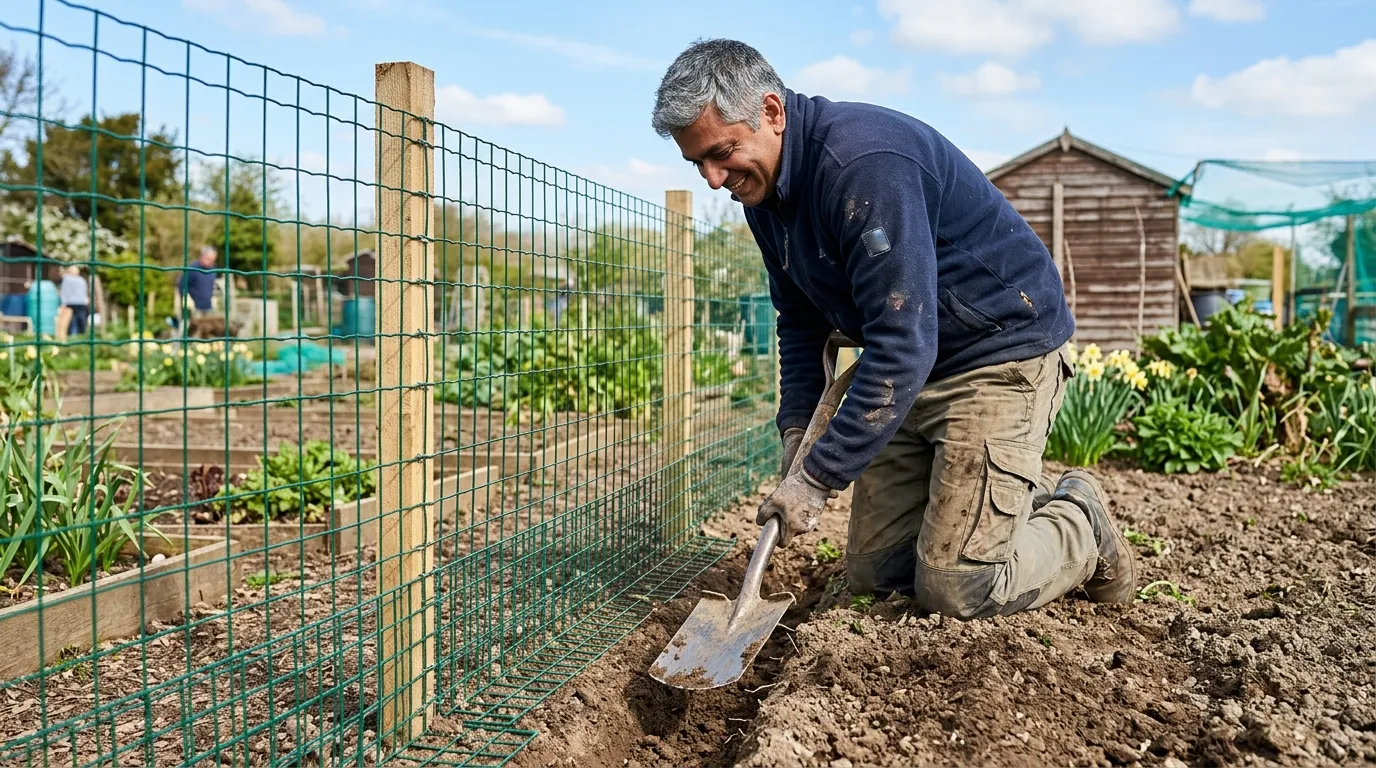
For young trees inside an unfenced garden, spiral plastic guards 750mm tall protect the bark from winter bark stripping. Sleeve guards in mesh work too and ventilate better. Renew them every 3 years; the plastic goes brittle and cracks.
Repellent products like dried blood, garlic spray and Grazers G2 reduce browsing by 50-70% for 4-6 weeks before rain washes them off. They are useful where a fence is impractical. They are not a substitute for one.
Trapping and shooting fall under the Pest Act 1954, which makes landowners legally responsible for rabbit control in many parts of Great Britain. Live cage traps work; spring traps must comply with the Spring Traps Approval Order. Air rifles are legal for use against rabbits with the landowner’s permission. The organic pest control guide UK covers humane non-lethal options in detail.
Plants and crops rabbits leave alone
Rabbit-resistant plants give the protected garden a second line of defence and make the unprotected edges productive. From four years of UK testing:
Reliably resistant ornamentals: Allium (all species), lavender (Lavandula angustifolia), foxglove (Digitalis purpurea, toxic to rabbits), daffodil (Narcissus), hellebore (Helleborus), hardy geranium (Geranium pratense), fern (most species), sage (Salvia officinalis), euphorbia, Aconitum, Iris.
Reliably resistant veg and herbs: Onion, garlic, leek, shallot, chive, courgette, marrow, pumpkin, butternut squash, rhubarb, asparagus (mature crowns), tomato (foliage toxic), aubergine, potato (foliage), parsnip foliage.
Heavily targeted veg (need full protection): Lettuce, all brassicas, French and runner beans, peas, carrot tops, beetroot tops, spinach, chard, soft fruit canes, fruit tree bark, young roses.
The pattern is simple. Rabbits avoid strong scents, the allium family and anything in the nightshade family. They target soft sweet foliage and bark. Planting a lavender or Allium edge around a protected veg patch acts as a low-level deterrent and looks good year-round.
Identifying the four UK deer species
Four wild deer species cause real garden damage in the UK. The Forestry Commission and the British Deer Society between them track populations now estimated at well over two million animals across the country.
| Species | Adult shoulder height | Range | Typical browse height | Notes |
|---|---|---|---|---|
| Roe (Capreolus capreolus) | 600-750mm | All UK except Kent and a few islands | up to 1200mm | The most common garden deer, often solitary or in twos |
| Muntjac (Muntiacus reevesi) | 450-520mm | Southern and central England, spreading north | up to 900mm | Small, secretive, very damaging to low planting and bulbs |
| Fallow (Dama dama) | 800-950mm | Patchy across UK woodland, parkland edges | up to 1400mm | Spotted summer coat, herd animals, very heavy browsers |
| Red (Cervus elaphus) | 1100-1370mm | Scotland, Exmoor, Cumbria, North West | up to 1800mm | Largest UK deer, needs the tallest fencing |
Confirm deer rather than rabbit damage with three checks:
- Torn stems with frayed edges. Deer have no upper incisors and tear leaves and shoots against a hard lower palate.
- Damage between 600mm and 1800mm above ground. Roe and muntjac at the lower end, fallow and red at the upper.
- Bark stripping or “fraying” from antlers. Bucks rub their antlers against young trees from August to October to mark territory. The bark is shredded vertically in long strips.
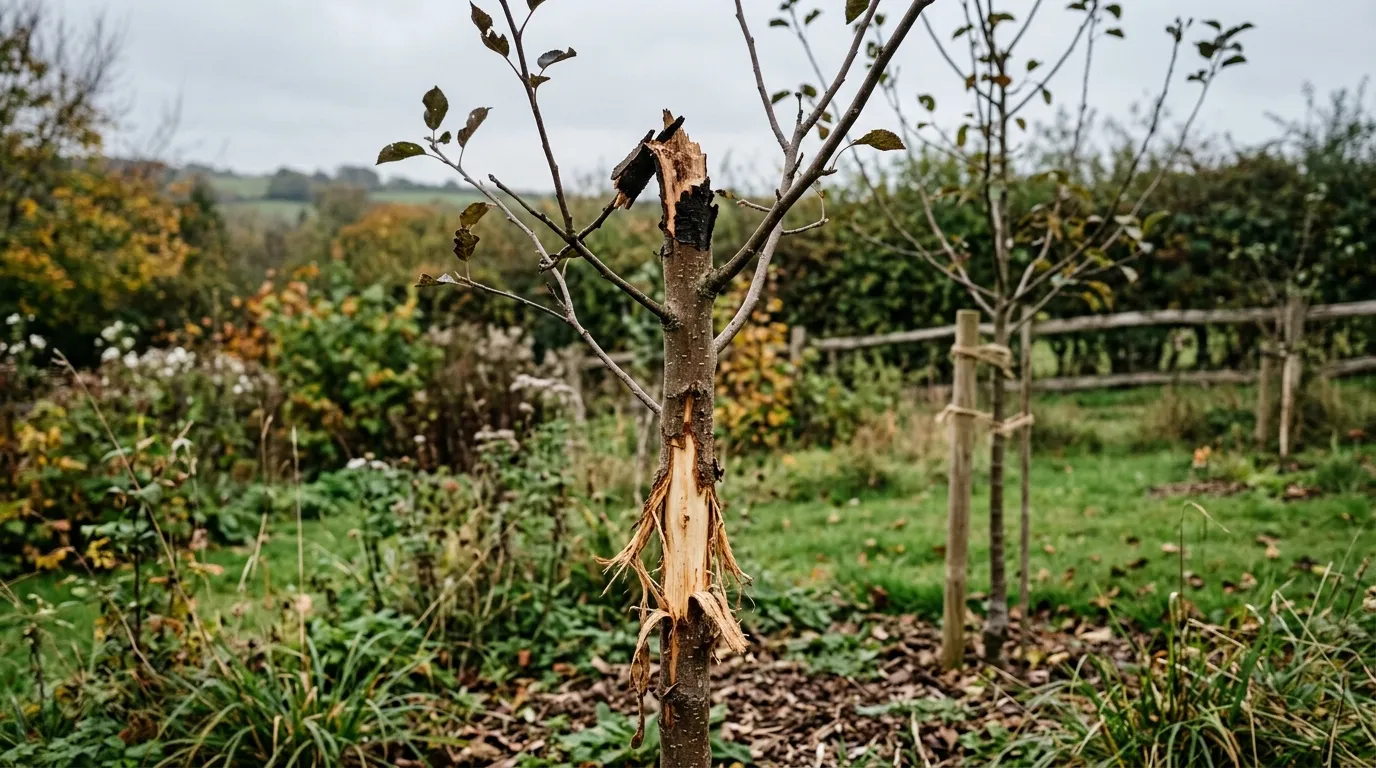
Droppings are oval 12-20mm pellets in tight clusters, often slightly clumped in winter when the diet is woody. Tracks show a cloven hoof with the two halves slightly splayed; muntjac tracks are noticeably smaller than roe.
When deer feed in a UK garden
Roe deer are crepuscular, feeding heaviest from one hour before sunset to one hour after sunrise. Muntjac feed in shorter bouts throughout the 24-hour cycle and are the deer most likely to visit a suburban garden in broad daylight. Fallow and red deer move at dusk and dawn, sticking to woodland edge and emerging into the open only at full dusk.
Damage is heaviest in three windows:
- Late winter and early spring: Browsing on rose shoots, fruit tree buds and the first soft growth from perennials.
- Mid to late summer: Bark fraying as bucks rub the velvet off antlers (August to October).
- Hard winters: Deer push deeper into gardens than usual when natural browse is poor. A snow week often costs a hedge of hostas overnight.
Cameras with passive infrared sensors are worth running for two weeks before designing a defence. The footage tells you which species, which entry point, what time of night and how many animals. A 4-camera Bushnell or Browning setup at 80-180 pounds per camera saves more than it costs in misplaced fencing.
Deer fencing, electric and tree guards
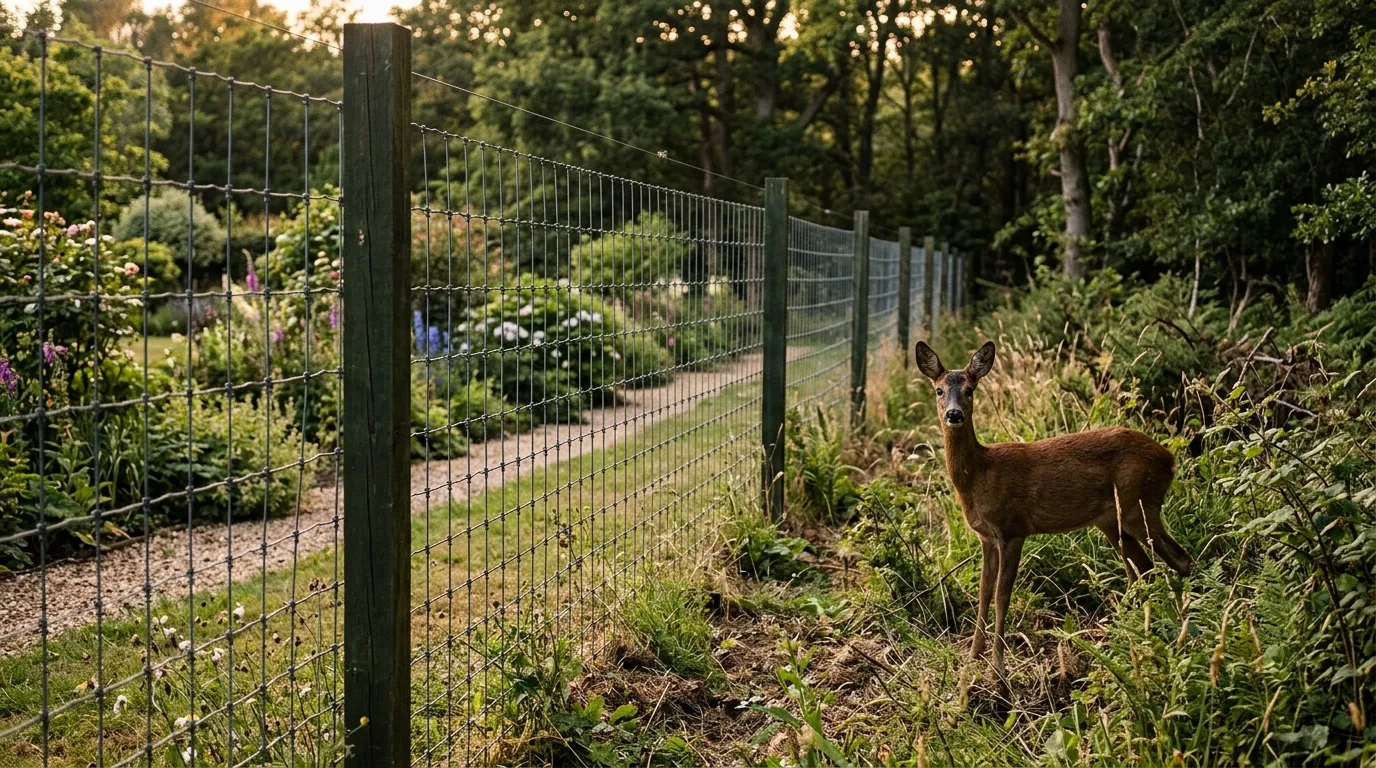
The Forestry Commission specifies different fence heights for each species; on a mixed UK plot, design for the largest deer in your area:
- 1800mm chain link fence stops roe, muntjac and fallow on most sites.
- 2100-2400mm chain link is needed where red deer are present (parts of Scotland, Exmoor, the Lake District). The Highland figure is 2400mm.
- Use galvanised square mesh of 50mm or 75mm, not solid panels. Deer can jump a solid panel but hesitate at a mesh fence because they cannot see the landing.
- Posts at 4m intervals, tensioned with line wires top, middle and bottom.
A 1.8m chain link fence around a 1-acre garden costs 35-65 pounds per metre installed in 2026, putting a full perimeter at 4500-8000 pounds. Where that is unaffordable, three lower-cost options work for individual beds and trees:
- Electric fencing. A 2-strand polywire fence at 600mm and 1200mm, energised at 4000-6000 volts, deters roe and muntjac after one or two contacts. Less reliable for red deer.
- Individual tree guards. Welded mesh sleeves 1800mm tall and 600mm diameter on stout stakes protect young fruit trees. Cheaper than perimeter fencing for orchards under 20 trees.
- A small fenced kitchen garden inside an unfenced wider plot. Fence the 200-400m2 vegetable and soft-fruit area and accept some deer browsing in the ornamental garden.
Plants and repellents that work against deer
Reliably resistant ornamentals: Allium, lavender, hellebore, daffodil, fritillary (Fritillaria imperialis), most ferns, foxglove, hardy geranium, lupin, sage, Salvia, Stachys, Pulmonaria, ornamental grasses, conifer hedges.
Heavily targeted ornamentals: Roses, hosta, tulip, lily, hydrangea, fruit tree shoots, young deciduous trees.
Rotating repellents that worked at Staffordshire scale:
- Grazers G2 (calcium-based, not unpleasant smelling). Applied at 25ml in 1L water every 6 weeks. Cut roe deer browsing on apple suckers from 80% to under 10% over a season.
- Plantskydd (sheep wool extract and dried blood). Applied monthly through the growing season. Reduces fallow and roe deer browsing on roses and young trees.
- Motion-activated scarers. Sensor-triggered water jets or solar PIR lights work for the first 2-3 weeks and then deer habituate. Move them every fortnight to extend usefulness.
Repellents are never a substitute for fencing on heavy-pressure sites. They are an extender, a stop-gap during fence construction, and a workable answer on small ornamental plots where a 1.8m fence is not aesthetically acceptable. For boundary planting that doubles as cover for beneficial insects, see biological pest control with nematodes UK for the smaller end of the garden pest problem.
Identifying wood pigeon damage
The wood pigeon (Columba palumbus) is the single most damaging bird pest in UK kitchen gardens. Adults are 40-42cm long with a grey-blue body, a pale grey breast, a white neck patch and a distinctive double-note coo. They breed almost year-round in the UK and feed in flocks of 5-50 birds on arable and garden crops. The RSPB places the UK wood pigeon population at around 5 million pairs.
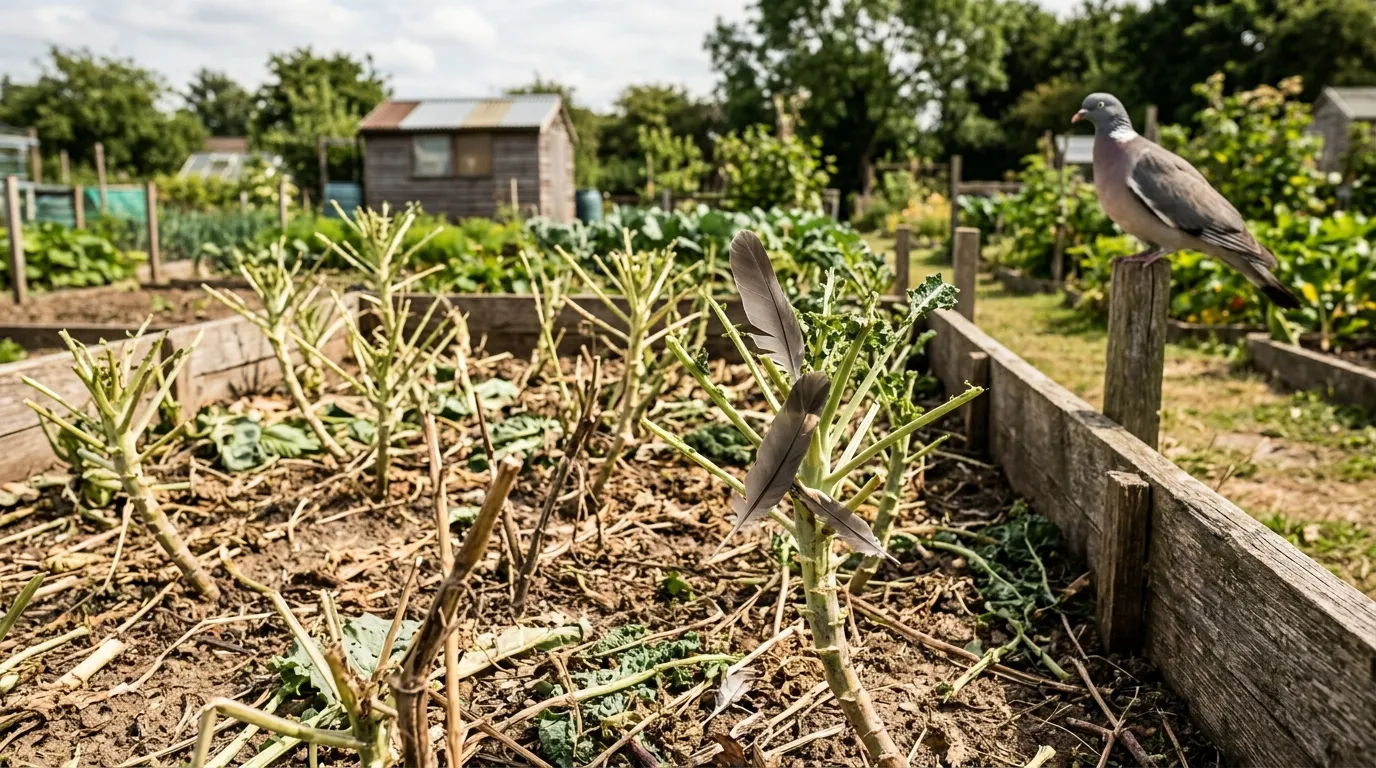
Damage to four crops dominates the UK calendar:
- Brassicas, October to April. Wood pigeons strip cabbages, kale, sprouts and purple sprouting broccoli down to the ribs and the main stalk. Damage peaks in cold weather when other food is scarce.
- Pea seedlings, March to May. Whole rows pulled up by the seedling, the seed eaten and the shoot discarded.
- Pea pods and sweetcorn cobs, July to September. Pigeons peck ripening pods open and shred sweetcorn husks.
- Soft fruit, June to August. Strawberries, redcurrants and cherries pecked off the plant.
Three signs confirm wood pigeons rather than other birds:
- Whole leaves stripped to the ribs. Caterpillars chew holes; pigeons remove all leaf tissue.
- Round white droppings 10-15mm. Often on the netting itself or on adjacent paving.
- Grey body feathers caught on stems or netting.
A UK pigeon damage calendar
| Month | Crops at risk | Damage pattern |
|---|---|---|
| October to February | Brassicas (cabbage, kale, sprouts, purple sprouting broccoli) | Mature plants stripped to ribs and stalks |
| March to May | Pea seedlings, brassica seedlings, lettuce | Whole rows pulled and seed eaten |
| June to August | Pea pods, ripening sweetcorn, strawberries, redcurrants | Pods torn open, fruit pecked off the plant |
| September | Apples (windfalls), sweetcorn, brassica seedlings (winter brassicas) | Pecks on ripe fruit, husks torn off |
The cold weeks of January and February are the worst period for a UK kitchen garden. Wood pigeons in flocks of 20-40 birds work systematically through the brassica beds and finish a 5m row of cabbages in two visits. Year-round netting is the only defence that does not need daily attention.
Pigeon netting, fruit cages and legal deterrents
Three working defences and one legal option:
1. Mesh netting on hoops over brassica beds.
The standard UK specification: 19mm green knotless mesh laid over green steel or wire hoops at 500mm height above the bed. Hoops at 1m intervals along the bed. Mesh weighted at the ground edges with bricks, gravel sausages or buried into the soil. Replace netting every 3-5 years.
The 500mm clearance is critical. Anything lower and the pigeons land on the mesh and feed through it. Anything sloppier than 19mm and the small species (collared dove, juvenile pigeons) get through anyway.

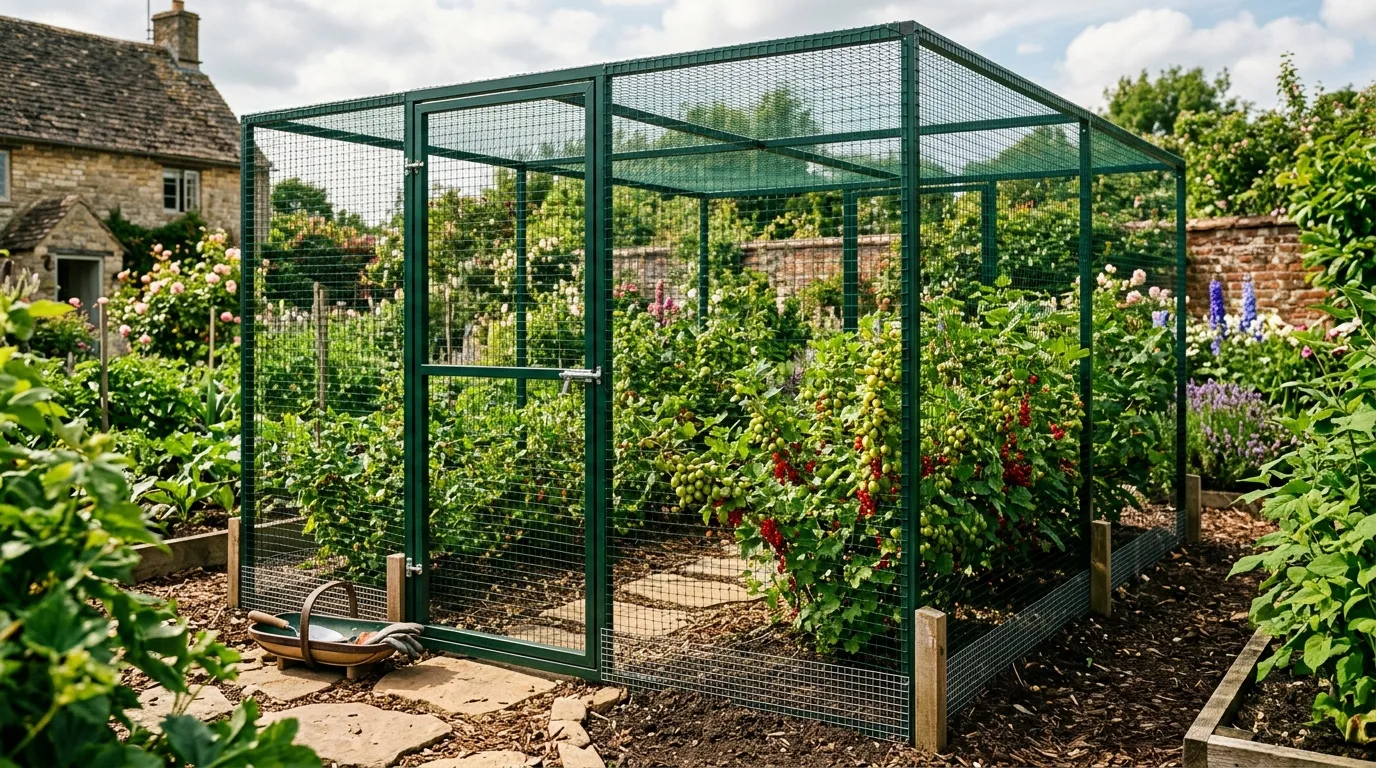
2. Walk-in fruit cage.
For soft fruit and orchard mini-crops, a 1.8m to 2.4m aluminium-frame walk-in cage with 19mm mesh on all sides and the roof. Door must be tight-fitting. Bury the lower 200mm of mesh or fit a heavy ground skirt to stop wildlife squeezing under.
3. Bird scarers and reflective deterrents.
Kite hawks on poles, reflective tape, old CDs strung on lines and motion-activated scarers all work for 1-2 weeks before pigeons habituate. Use them in rotation around a netted bed, never as the only defence.
4. Lethal control under General Licence GL42.
UK law permits shooting wood pigeons for crop damage under the General Licence GL42 issued by Natural England, but only once the user has tried reasonable non-lethal alternatives first. The licence-holder must record evidence of damage and of alternatives tried. Most garden growers will never reach the threshold where shooting is justified or practical; the netting plus cage approach is enough. For practical pigeon prevention on raised veg beds see how to get rid of pigeons in the garden.
Identifying badger activity in the garden
The European badger (Meles meles) is 60-90cm long, weighs 8-12kg in autumn, has a distinctive black-and-white striped face and a low-slung grey body. It is nocturnal, lives in social groups in setts and feeds on earthworms, beetles, grubs, fruit, fungi and occasionally small mammals. The UK badger population is estimated at over 480,000 adults.
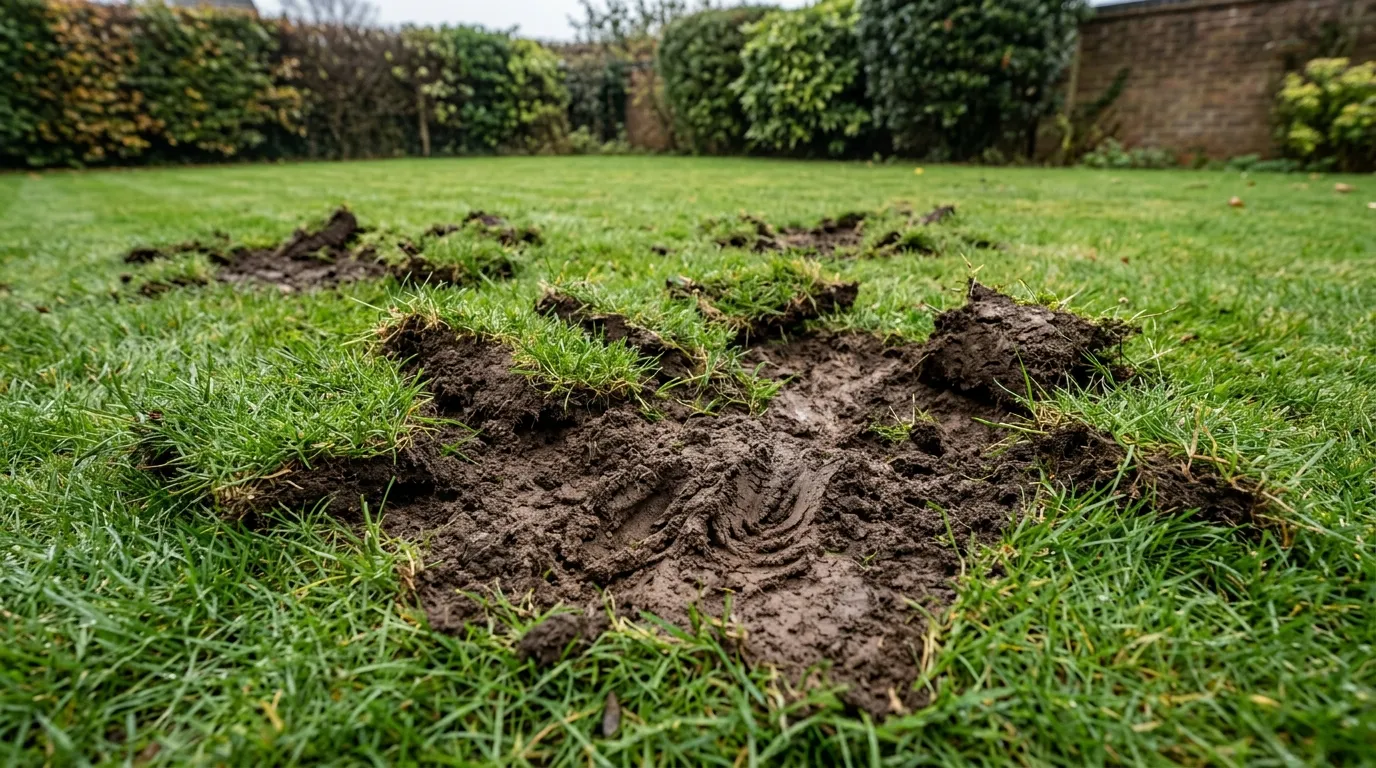
Six signs confirm badger activity:
- Snuffle holes in the lawn. Round patches of turf flipped or lifted where the badger has rooted for chafer grubs and leatherjackets. The damage looks like someone has cut squares of turf and turned them over. If your lawn is being torn up nightly, the stop badgers digging up your lawn guide covers the targeted fixes in more detail.
- Snout grooves. Long parallel furrows in soft soil where the badger has driven its snout searching for food.
- Latrines. Small pits 200-300mm wide and 50mm deep, with droppings deposited and partly covered. Used as territorial markers, often along boundary fences.
- Well-worn paths. Badgers reuse routes night after night, leaving compressed runs through grass and gaps under fences.
- Sett entrances. Holes 250-400mm wide with a flat-bottomed entrance and a spoil heap of soil. Often in a bank, under tree roots or in a hedge bottom.
- Long coarse silver-tipped hairs caught on fences or low branches.
Distinguishing badger damage from fox damage saves a lot of misdirected fencing. Foxes dig narrower, more chaotic holes and rarely lift turf in clean squares. Foxes do not leave latrines. A badger sett entrance is much larger than a fox earth (250mm or wider versus 150-200mm for fox), with a flatter base and a fan of excavated soil leading from it. Always confirm a sett before deciding strategy; an active sett near the boundary changes everything about how you fence and where you plant.
Living and gardening with badgers (legal protection)
The Protection of Badgers Act 1992 makes it illegal to:
- Kill, injure or take a badger
- Cruelly treat a badger
- Dig for or wilfully interfere with a sett (including blocking entrances, damaging the sett or disturbing a badger within it)
- Trap, snare or use poison against a badger
Only Natural England can issue a licence to interfere with a sett, and licences are granted for restricted reasons (development, disease control, serious damage). A homeowner cannot legally block a sett or trap a badger that is damaging the garden. The penalty is up to 6 months in prison and an unlimited fine.
The practical garden strategy that works is zoning:
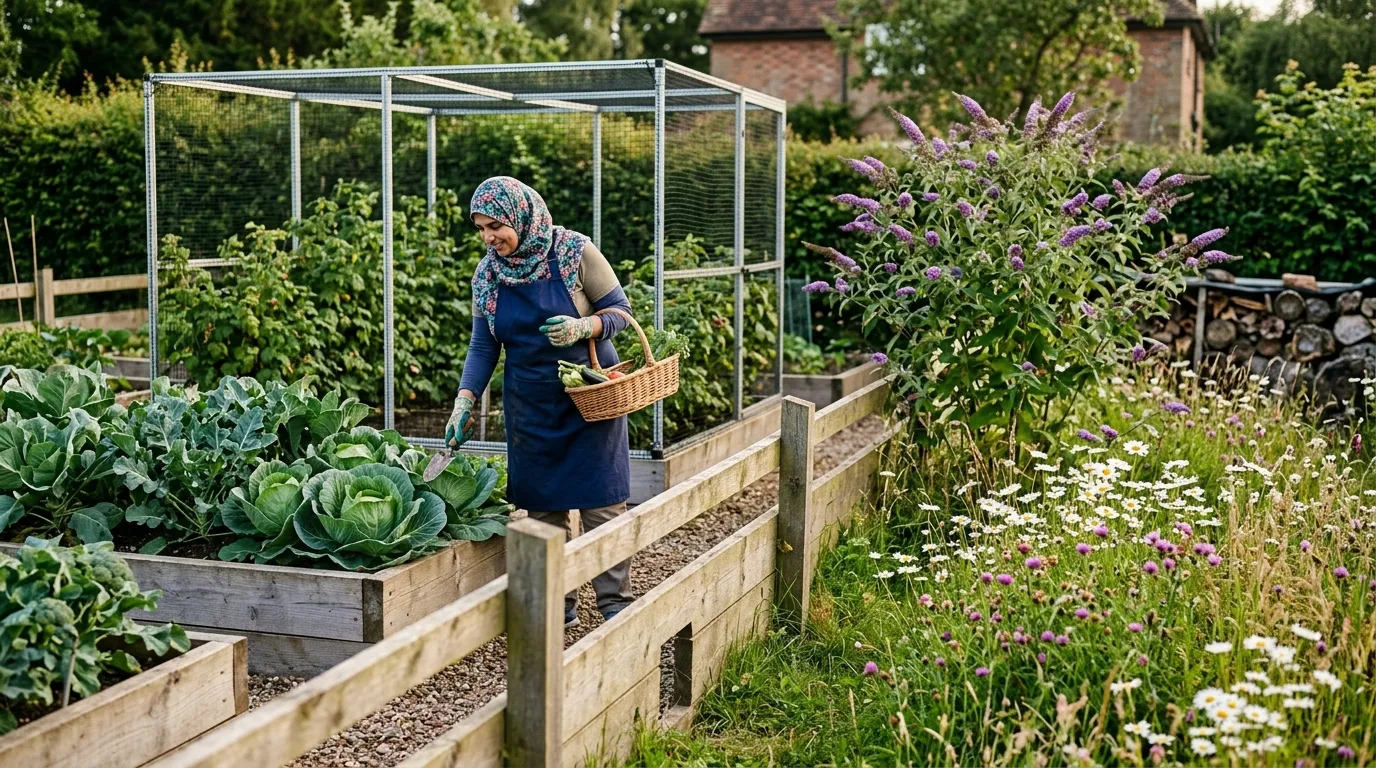
- A protected zone with the veg, fruit cage and young trees. Fence this with heavy welded mesh (50x50mm or smaller) at 1200mm above ground and a 300mm buried L-shape facing outwards. Badgers will probe and dig at the buried wire; the buried L-shape stops them tunnelling under. Reinforce weak spots with extra welded mesh as they appear.
- A shared edge zone where the badger can pass and feed on what it likes (lawn grubs, fruit windfalls, compost contents). Accept the snuffle damage. Reseed lawns in autumn.
- A 13 x 13cm hedgehog highway at the base of the boundary fence on the shared side. Too small for a badger, just right for a hedgehog. Hedgehogs benefit massively from this concession; badgers are a major hedgehog predator and giving the hedgehog an escape route in fences matters more in badger country than anywhere else.
Electric fencing works if the budget allows. Two strands at 150mm and 300mm above ground, energised at 4000-5000 volts. Badgers learn the fence quickly; expect a 6-12 month break-in period of testing before they leave it alone.
Avoid metaldehyde slug pellets in badger country. Badgers eat poisoned slugs and snails and accumulate the toxin. The organic pest control guide UK covers safer alternatives.
For wildlife-positive design that runs alongside badger zones, creating a wildlife garden UK and the hedgehog highway guide both work well as boundary planting and small-mammal corridors.
Integrated UK pest plan: a species by species table
Pull every defence onto one page. Use this as the design brief for any new UK kitchen garden:
| Species | Fence height | Mesh size | Buried depth | Tree guard | Resistant species shortlist | Legal cautions |
|---|---|---|---|---|---|---|
| Rabbit | 1200mm | 31mm | 300mm L-shape outward | 750mm spiral plastic | Allium, lavender, foxglove, courgette, onion, garlic, rhubarb | Pest Act 1954 control by humane methods, landowner permission |
| Roe / Muntjac / Fallow deer | 1800mm | 50mm-75mm | none | 1800mm sleeve mesh | Allium, lavender, hellebore, fern, foxglove, daffodil, sage | Deer Act 1991 sets close seasons and humane methods |
| Red deer | 2400mm | 50mm-75mm | none | 1800mm sleeve mesh | as above plus broom, gorse | Deer Act 1991, often regional |
| Wood pigeon | 19mm mesh on 500mm hoops, or 2.4m walk-in cage | 19mm | 200mm cage skirt | not applicable | brassicas need physical mesh, no useful resistant species | General Licence GL42 for lethal control as last resort |
| Badger | 1200mm welded mesh | 50x50mm welded | 300mm L-shape outward | not for trees | not relevant | Protection of Badgers Act 1992, sett interference illegal, fine + 6 months |
Two patterns jump out of the table:
- The 1200mm fence with a 300mm buried L-shape is doing double duty. It works for both rabbits and badgers. Build it once in welded 50x50mm mesh and you have your protected-zone perimeter for the life of the garden.
- Pigeons cannot be fenced. They have to be netted at the bed level. Designing the kitchen garden to accept removable hoops and mesh over every brassica and pea bed is non-negotiable on UK plots.
Working with wildlife: the boundary compromise
Three principles guide the boundary compromise:
- Protect what cannot be replaced or shared. Young trees, soft fruit cages, brassica and pea beds. These get the welded mesh, the 19mm netting, the 1.8m chain link.
- Share what can be replaced. Lawn grubs are badger food and the lawn reseeds in autumn. Windfall apples feed badgers, foxes and birds. Brassica leaves outside the netted bed are pigeon food and the rest of the bed feeds the family.
- Build positive infrastructure for the wildlife you want. A hedgehog highway, a small pond, a log pile, native hedge planting. The winter wildlife garden guide covers seasonal infrastructure that pays off year after year.
This is the approach that wins long-term in a UK garden. The defensive infrastructure does its job. The shared edge stops the garden becoming a fortress. The hedgehog, the slow worm and the toad all benefit, and they take care of slugs and other small pests as a bonus. For raised-bed layouts that work inside the protected core, raised bed garden design ideas covers the construction detail.
A final word on rotation and habituation
Every deterrent that relies on novelty (motion lights, kite hawks, scent repellents, reflective tape, water jets) fades over weeks as the pest learns it is harmless. Three rules keep them effective:
- Rotate three or four devices. Move them around the garden every fortnight so no single bird or mammal builds a long-term tolerance.
- Combine novelty deterrents with hard barriers. Use the lights and water jets to reinforce a fence or a mesh, never as standalone.
- Reset annually. Replace nylon mesh that has gone slack, retension the wire fences before lambing season for roe deer, top up dried blood and Plantskydd at six-week intervals through the growing season.
Cabbage white butterflies, slugs, vine weevils and the other smaller pests all need their own defences too; the cabbage white butterfly control guide UK covers the netting overlap with brassicas perfectly. The same 19mm mesh that keeps pigeons off the kale keeps the cabbage whites away from laying their eggs.
The first 100 days on a new UK plot
Days 1 to 7: Survey. Walk every boundary. Note hedge gaps, badger paths, deer droppings, rabbit holes, sett entrances and pigeon flight lines. Set two trail cameras for a week on suspected entry points. Photograph the existing damage.
Days 8 to 21: Identify and prioritise. Match every sign to a species using the identification sections above. Rank the threats: badger means accept and zone, deer over 1m mean perimeter fence, rabbit means short fence and tree guards, pigeon means bed-level netting.
Days 22 to 60: Build the protected zone. Define a 200-400m2 kitchen-garden core. Run a 1200mm welded mesh fence (50x50mm) with a 300mm buried L-shape outwards. This single fence solves rabbits, badgers and most ground-level pests for the next 15 years.
Days 61 to 90: Build the bed-level netting. Hoops at 1m intervals over every brassica and pea bed, 19mm mesh weighted at the edges. A walk-in fruit cage over the soft fruit if the budget allows. Install spiral guards on every young fruit tree outside the protected zone.
Days 91 to 100: Plant the resistant edge. A 600mm border of lavender, Allium, sage and rosemary inside the protected fence, and a 1m border of foxglove, hellebore, daffodil and fern outside it. These low-maintenance plantings reinforce the fence and look right in a UK garden.
This sequence is the difference between a fortress that looks like a building site and a garden that produces food while still feeling like a garden. Front-load the infrastructure spend; the plant side falls into place after.
Cost benchmarks for UK mammal and bird defences
Realistic 2026 UK costs for the kit covered above. Use these as a sense check before getting quotes:
| Item | Spec | Typical UK cost 2026 |
|---|---|---|
| Rabbit-proof fence (welded mesh) | 1200mm above + 300mm buried L, 31mm or 50x50mm | 18-32 pounds per metre supplied, 28-55 pounds installed |
| Deer fence (chain link) | 1800mm, 50-75mm mesh, posts at 4m | 35-65 pounds per metre installed |
| Brassica netting hoops + 19mm mesh | 4m x 1.2m bed | 35-60 pounds per bed kit |
| Walk-in fruit cage | 3 x 3m aluminium, 1.8m tall | 380-650 pounds, 2.4m tall 580-950 pounds |
| Welded steel fruit cage | 4 x 4m, 2.4m tall, badger-proof skirt | 1100-1900 pounds |
| Trail camera (passive IR) | 1080p, 940nm IR, 20m range | 80-180 pounds per camera |
| Grazers G2 deer repellent | 1L concentrate (treats up to 1000m2) | 25-35 pounds per litre |
| Plantskydd | 1L concentrate | 28-40 pounds per litre |
| Spiral tree guard | 750mm | 1.40-2.50 pounds each |
| Welded mesh tree sleeve | 1800mm, 600mm diameter | 18-30 pounds each |
Pair this with a labour budget if you are not building it yourself. A 100m perimeter rabbit-and-badger fence takes one fit person two full days to install, including digging the L-shape trench, setting posts and stretching the mesh. A 1800mm deer fence takes longer and usually needs a small mechanical post-driver.
Related guides
For broader UK pest cover, see the vegetable pests and diseases UK guide and the organic pest control guide UK. For pollinator-friendly garden design that works alongside fenced veg beds, creating a wildlife garden UK, the hedgehog highway guide and the winter wildlife garden guide pair well with this pillar. For raised veg-bed construction inside the protected zone, raised bed garden design ideas covers the layout detail. And for grey squirrels emptying the bird feeders, our squirrel-proof bird feeder guide covers baffles, cages and deterrents that hold up.
For the insect-pest side of the same crop list, see the specific guides on black bean aphid, wireworm, carrot root fly, cabbage white butterfly, and the biological pest control with nematodes overview. Once the surplus is harvested, the storing garden produce pillar covers the next stage of the kitchen-garden year.
Our team produces practical UK gardening guidance from source research, contributor records and established horticultural practice. Editorial standards are overseen by Matt W.