Key takeaways
- Wireworms are 20-25mm orange-yellow larvae of click beetles; the 3-5 year life cycle is why damage runs across several seasons
- Risk is highest on newly broken grassland: a first potato crop on an old lawn or paddock can lose 40-60% of tubers
- Steinernema feltiae nematodes are the only home-garden treatment that actually drops damage in one season (apply soil >12C, May to September)
- Resistant potato varieties (Cara, Maris Piper, Sante) hold up far better than King Edward, Charlotte or Desiree on infested plots
- A spring mustard or buckwheat green manure dug in three weeks before planting reduces wireworm numbers by 30-50%
- Lift potatoes early (late July, not September) on infested plots: every extra week in the ground multiplies tuber damage
Wireworm is the slow, hidden pest that destroys a first allotment potato crop and leaves the gardener wondering what went wrong. The damage shows up at lift, not during the growing season, and by then the larvae have moved on through the soil to feed on the next root crop in the rotation. This guide covers what wireworm actually looks like in the ground, how to tell the damage apart from slug holes and rot, and the cultural and biological controls that work in UK gardens and allotments.
The good news is that wireworm is a finite problem. On a typical UK plot the population peaks in the first three years after breaking grass to vegetables, then falls. The bad news is that those first three years can be brutal, and on a recently grassed-down plot the gardener can lose more than half of every root crop until either the natural decline or active control kicks in.
What is a wireworm
Wireworms are the larvae of click beetles, a family of UK insects belonging to the genus Agriotes. Five species cause damage in British gardens: A. lineatus, A. obscurus, A. sputator, A. sordidus and A. lineatus. The larvae spend three to five years living in the soil, feeding on plant roots, before pupating into the small dark adult beetles.
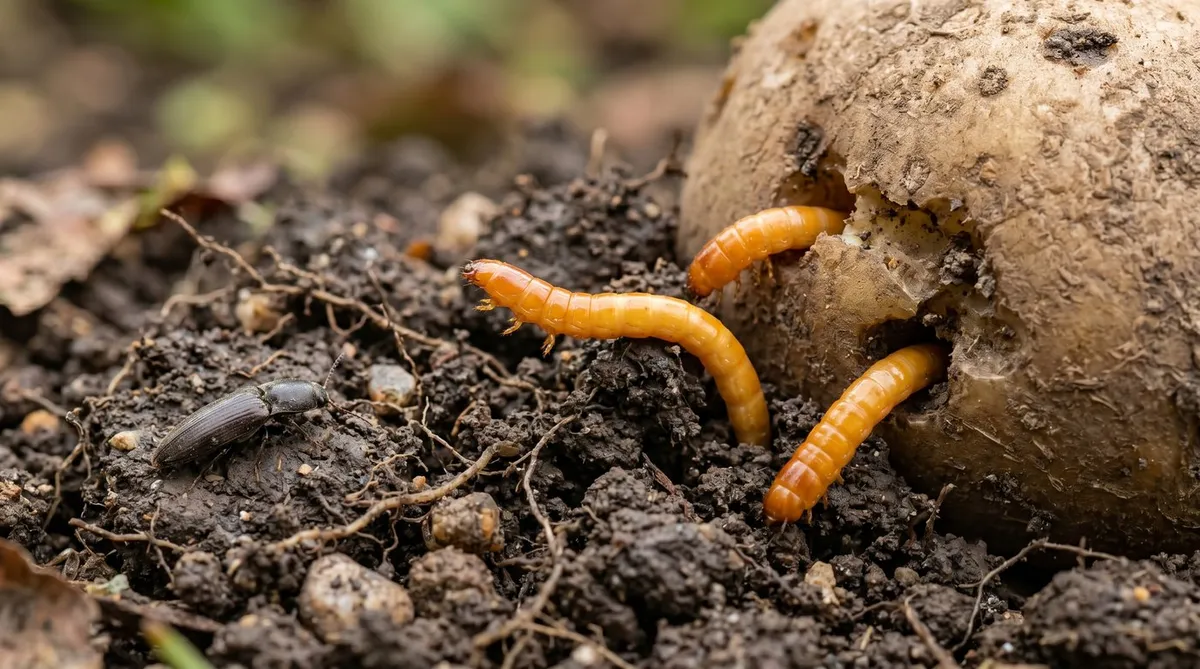
A wireworm is 20-25mm long, glossy orange-yellow to honey brown, with three pairs of tiny legs at the head end and a hard segmented body that flexes but does not curl up when handled. Pick one up and it feels firm and shiny, like a piece of dry spaghetti with legs. This is the single most reliable way to tell it from anything else in the soil.
The adult click beetle is small and easy to miss: 7-10mm long, narrow, dark grey-brown, and named for the audible click it makes when flipping itself upright after being turned over. Adults emerge from May to August, mate, and lay eggs in dense grass or weedy soil. This is why wireworm risk is high on plots recently converted from lawn, paddock or weedy grassland: the previous owner has been hosting click beetles for years.
How to spot wireworm damage
Wireworm tunnels are distinctive once you have seen them. The damage is hidden until you lift the crop, which is part of what makes the pest so frustrating.
On potatoes
A potato with wireworm damage has clean round holes 2-3mm in diameter, running straight through the flesh. The tunnel walls are usually blackened by oxidation. There is no rot, no slime, and the skin around the entry hole is undamaged unless secondary infection has set in. Cut a tuber in half and the tunnels look like neat pencil holes through the cream-coloured flesh.
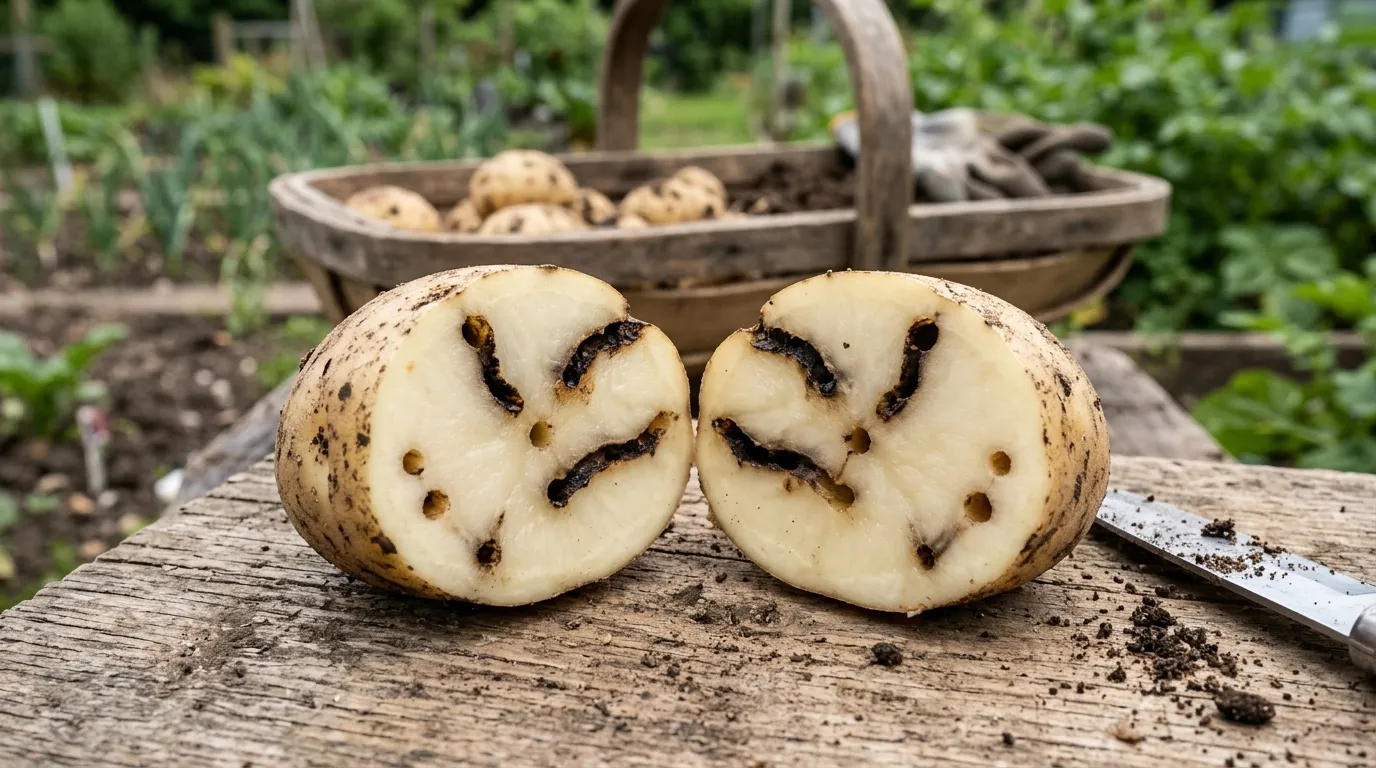
This is different from slug damage, where the holes are larger (5-15mm), ragged-edged, often filled with frass and slime, and concentrated near the surface. It is also different from blight rot, which is wet, brown and smelly. Wireworm holes are dry, clean and round. See the broader UK vegetable pests and diseases guide for the full visual comparison.
On carrots
Carrots show short tunnels running along the length of the root, with small entry holes at the surface. The damage is usually worst at the shoulder where the carrot pushes up out of the soil. A carrot may look fine from above and be unusable below, which is the same trap that catches gardeners with carrot root fly damage. Telling the two apart: wireworm tunnels are straight and clean; carrot fly tunnels are rust-brown, twisting and full of frass.

On seedlings and field crops
Newly planted seedlings, especially brassicas, lettuce, sweetcorn and onions, may show dead rows. The wireworms feed on the developing root and stem just below the surface, and the seedling collapses as if it has been cut with a knife. Pull the dead plant up and the stem is often hollow at the base. Multiple plants going down in a straight line along a row is a classic wireworm pattern; one plant here and there is more likely to be cutworm or slug.
Why wireworm is worst on newly broken grassland
The wireworm life cycle takes three to five years to complete in UK soil. Eggs laid by a click beetle in June 2024 may not pupate into adults until 2027 or later. This means the larvae present in a plot today were laid by beetles three or more years ago.
Click beetles prefer dense grass for egg-laying. A lawn, a paddock, a weedy allotment that has been let go: all of these are perfect nurseries. When you turn that grass over to vegetable beds, you uncover the accumulated stock of three to five years’ worth of larvae, all hungry, all in your soil.
The numbers from UK allotment surveys are consistent: a first potato crop on land that was grass the previous autumn typically loses 40-60% of tubers to wireworm. Year two losses fall to 20-35%. Year three to 10-20%. By year four the plot is usually at background level, around 2-5% damage, which most growers accept without treatment.
The exception is plots adjacent to permanent grass paths, hedgerows or weedy field edges. Adult beetles fly in from the grass every summer, lay eggs at the boundary, and the larvae work their way inward over years. If your allotment backs onto a hayfield, expect persistent low-level wireworm pressure forever.
Cultural controls that actually work
A combination of three cultural controls makes the biggest difference on UK plots. None of them are quick fixes; they need to be in place over two or three seasons to compound.
Early lifting
Every extra week a potato sits in the ground after the foliage dies back doubles the wireworm damage. The standard UK advice to lift second earlies in late August and maincrops in September was written for plots without serious wireworm. On infested plots, lift second earlies in early July and maincrops by the end of July. The yield is slightly lower because the tubers have less time to bulk up, but the saleable percentage is much higher.
Resistant varieties
On wireworm-heavy plots, plant Cara and Maris Piper for the staples and accept that Charlotte and Pink Fir Apple are not viable until the population drops. For full variety planning see growing potatoes in the UK.
Crop rotation
A three-year rotation away from the top wireworm crops (potatoes, carrots, parsnips, sweetcorn, onions) gives the larvae nothing to feed on and pushes them either to pupate early or to die. Replace those crops with brassicas (cabbage, kale, broccoli), legumes (peas, broad beans, French beans) and salads (lettuce, rocket, chicory), all of which are less attractive to wireworm.
Frequent cultivation
Wireworms live 50-150mm below the soil surface in spring and autumn. Frequent shallow cultivation in April and May, when birds are most active, brings larvae to the surface where robins, blackbirds and starlings will eat them. On a 100 square metre plot, ten minutes with a fork three times in spring will visibly reduce wireworm numbers by the following autumn. This works less well on no-dig systems on heavy clay, which is one of the rare downsides of no-dig on a wireworm-infested plot.
Biological control with nematodes
The one home-garden treatment that reliably drops wireworm damage in a single season is the parasitic nematode Steinernema feltiae, sold by UK biological control suppliers as a soil drench. The nematodes are microscopic worms that actively seek out wireworm larvae, enter through natural openings, release bacteria that kill the host within 48 hours, and reproduce inside the carcass. The next generation of nematodes goes hunting again.

The application detail matters because nematodes are living organisms with narrow tolerances:
- Soil temperature must be above 12C. Measure with a probe at 100mm depth. In most of the UK this means mid-May at the earliest and not after early September. Cold soil shuts the nematodes down within hours.
- Soil must be moist. Water the bed the day before, apply the nematodes through a watering can with the rose off, then water again for ten minutes immediately after. Keep the bed damp for at least two weeks.
- Apply at dusk or on a cloudy day. UV light kills nematodes within minutes. Avoid bright sun.
- Use the right rate. Standard UK packs treat 100 square metres at 250,000 nematodes per square metre. Cheap “garden pack” rates of 50,000 per square metre do not give meaningful kill on wireworm.
Expect a single application to drop wireworm damage from 40-60% to 5-15% on a Year One plot. A second application the following spring usually takes it below 5%. After that, cultural controls hold the line. Wider biological options sit in the biological pest control nematodes guide.
The Royal Horticultural Society lists the licensed nematode products for UK home gardens and the suppliers that ship them.
Trap crops and green manures
A spring-sown green manure of yellow mustard (Sinapis alba) or buckwheat (Fagopyrum esculentum) reduces wireworm numbers by 30-50% if dug in correctly. The mechanism is glucosinolates: mustard plants release sulphur-based compounds when chopped and incorporated into wet soil, and those compounds are toxic to wireworm at the contact zone.

The method:
- Sow yellow mustard at 5g per square metre in late March or early April once soil reaches 8C.
- Let the crop grow to flowering, usually four to six weeks, until plants are 300-400mm tall.
- Chop the entire crop with a sharp hoe or shears on a damp morning.
- Dig the chopped material into the top 150mm of soil within an hour. The volatile compounds need to be in contact with the soil to act.
- Water the bed heavily and cover with cardboard or black plastic for ten days to keep the soil moist and trap the volatiles.
- Plant the following root crop three weeks after digging in. Wait this gap or the mustard residues will check the next crop.
Buckwheat works similarly but is less wireworm-active. Use it as a second-summer green manure between an early lifted potato crop in July and an autumn sowing of overwintered onions.
What does not work
Several widely-suggested wireworm controls have little or no effect in UK conditions:
- Lime. Wireworms are not strongly affected by soil pH within the range vegetables tolerate. Liming a wireworm-infested plot will not reduce damage.
- Tagetes (French marigolds). Useful for reducing slug damage and root knot eelworm; no measurable effect on wireworm in UK trials.
- Chickens or ducks. Birds will eat wireworm at the surface but cannot reach larvae 100mm deep. Useful as a supplementary control during cultivation only.
- Diatomaceous earth. Works on surface-active soft-bodied pests; does not penetrate to wireworm depth or affect their hard segmented body.
- Coffee grounds. No effect.
- Garlic sprays. No effect.
The full picture, including non-working controls, sits in the organic pest control guide.
Wireworm vs leatherjacket: telling them apart
These two pests get confused because both live in soil and both damage UK gardens. They are entirely different and need different treatments.
| Feature | Wireworm | Leatherjacket |
|---|---|---|
| Length | 20-25mm | 25-45mm |
| Colour | Glossy orange-yellow | Dull grey-brown |
| Body | Hard, segmented, firm | Soft, leathery, slightly wrinkled |
| Legs | Three pairs near head | No visible legs |
| Habitat | Vegetable beds, root crops | Lawn turf, grass roots |
| Adult | Click beetle (Agriotes) | Crane fly / daddy long legs |
| Treatment | Steinernema feltiae | Steinernema feltiae or carrierii |
If the pest is in the vegetable bed eating potato tubers, it is wireworm. If it is in the lawn killing patches of grass, it is leatherjacket. See leatherjackets in UK lawns for the lawn-side picture.
A wireworm action plan for a new allotment
If you have just taken on a plot that was grass for several years, this is the order of work that gives the best results over three seasons.
Year one:
- Plant only the most resistant potato varieties (Cara, Maris Piper, Sante).
- Lift potatoes by late July, not September.
- Cultivate the soil at least three times between March and May to expose larvae to birds.
- Skip carrots and parsnips this year. Grow brassicas, peas and salads instead.
- Apply Steinernema feltiae as a soil drench in late May or early June.
Year two:
- Sow yellow mustard green manure on the potato bed in late March.
- Dig in mustard three weeks before planting potatoes in late April.
- Continue with resistant potato varieties and early lifting.
- Apply nematodes again in late May.
- Try a small carrot bed with horticultural fleece cover; lift early.
Year three:
- Damage should now be below 10%. Re-introduce Charlotte, King Edward and other less-resistant varieties if you wish.
- Continue mustard green manure on a rotation.
- One final nematode application in late May closes the gap.
- By year four most plots no longer need active treatment.
Related guides
For the full vegetable pest picture pair this guide with the UK vegetable pests and diseases guide. For potato variety selection see growing potatoes in the UK. For other beneficial nematode applications see biological pest control with nematodes, and for the wider organic toolkit organic pest control. The lawn-side cousin is covered in leatherjackets and crane fly larvae.
Our team produces practical UK gardening guidance from source research, contributor records and established horticultural practice. Editorial standards are overseen by Matt W.