Key takeaways
- A 2x2 metre herb bed supports 12-15 varieties and 4-6kg per year of cut herbs
- Zone the bed: woody perennials at the back, biennials middle, annuals front
- Mediterranean herbs need free-draining gritty soil; soft herbs need moisture
- Mint must be confined in a buried pot or kept on the bed edge
- Succession-sow basil and coriander every 3-4 weeks for continuous supply
- Avoid full shade and waterlogged sites; both kill most culinary herbs
A dedicated herb bed transforms an allotment plot. The kitchen has fresh herbs year-round, the bed needs less weekly maintenance than vegetable rows, and the visual impact of a productive herb bed in summer is hard to beat. Most UK plot holders dot a few herbs randomly between vegetable rows; the dedicated 2x2 metre bed gives better yields, easier maintenance, and a clearer plot layout.
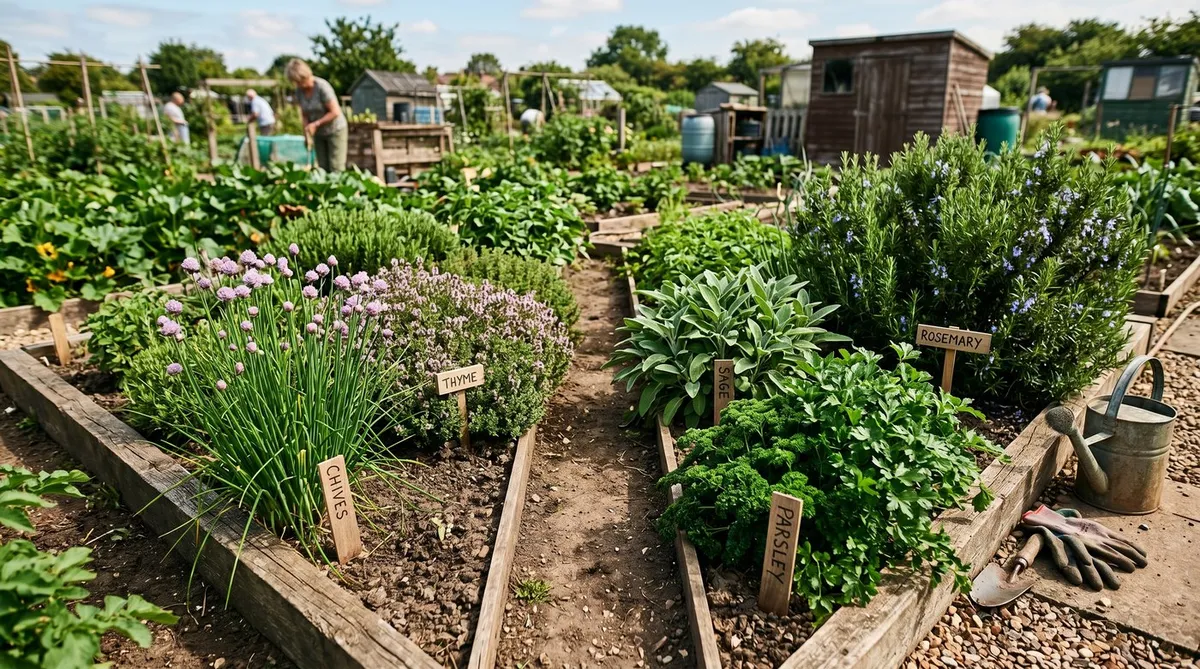
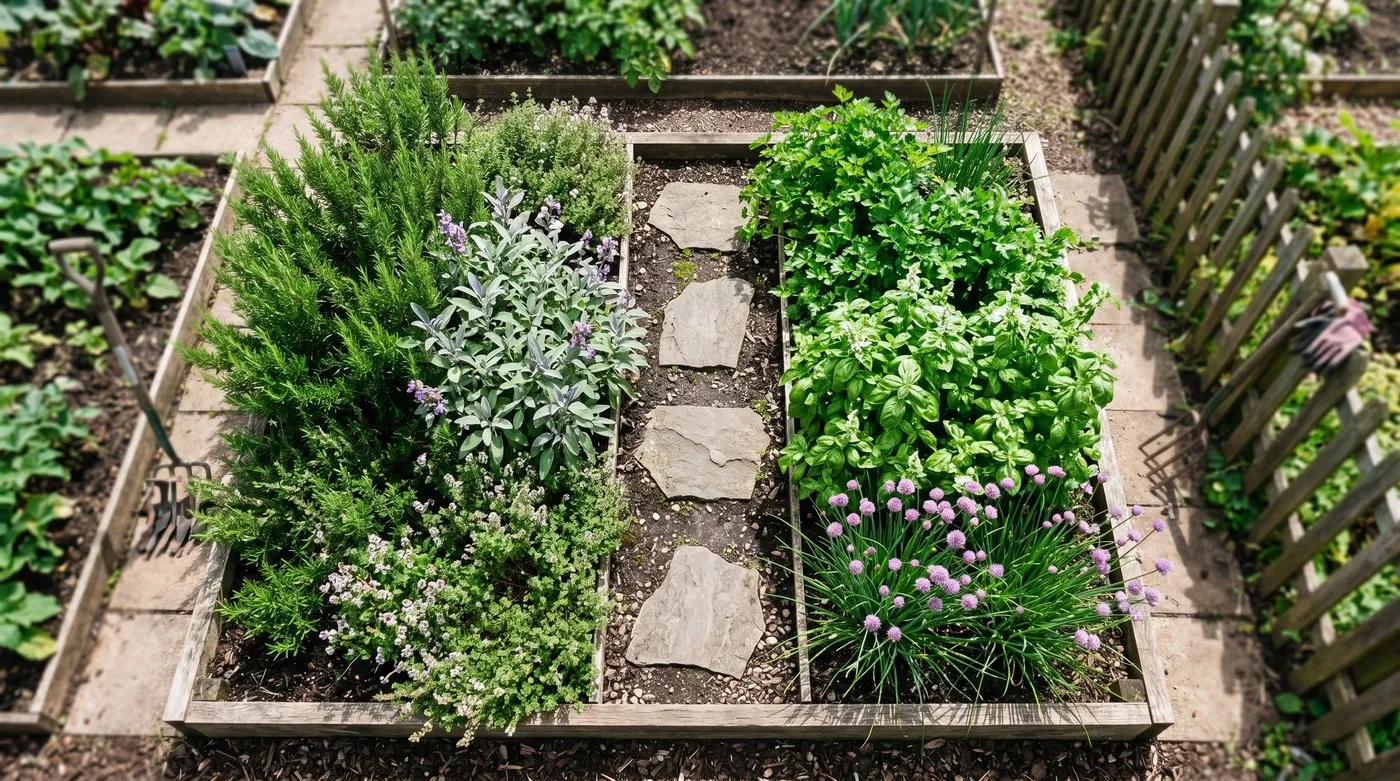 Two-by-two metre herb bed at peak summer. Mediterranean herbs on the right (rosemary, thyme, sage); soft herbs on the left (parsley, chives, basil). The zoning rule matches soil and water needs to plant requirements
Why a dedicated herb bed pays back
Dotting herbs between vegetable rows is the default UK plot approach. A clump of mint here, a chives plant there, parsley in odd corners. It looks productive but rarely is. Herbs compete with vegetables for water, sun, and nutrients. Harvesting is slow because you walk the plot looking for each herb.
A dedicated 2x2 metre herb bed produces 4-6kg of cut herbs per year. This compares to roughly 1-2kg from the same area of scattered plantings. The yield improvement comes from better species-specific soil preparation, optimised spacing, and easier harvest access.
Maintenance time drops by 50-60% compared to scattered herbs. All weeding, mulching, and harvesting happens in one location. The plot’s other beds stay free of herb competition.
The bed becomes a year-round visual feature. Rosemary in flower in March, chives in flower in May, lavender in June, oregano in July, thyme in August. The bed has interest from late winter through autumn.
Pollinator value is significant. Herb beds host bees, hoverflies, lacewings, and butterflies. A 2x2m herb bed provides nectar for 14+ pollinator species across the season. Several of the same aromatic herbs, basil, mint, and lavender among them, also serve as plants that repel flies near a kitchen door or seating area.
Kitchen access improves harvest frequency. A clear bed near the plot path encourages picking. Scattered herbs hidden between brassicas often go unharvested.
| Approach | Annual yield | Maintenance | Visual impact |
|---|---|---|---|
| Scattered between rows | 1-2kg | Spread across plot | Minimal |
| Dedicated 2x2m bed | 4-6kg | Concentrated, 50-60% less | Significant year-round |
| Container herb cluster | 0.8-1.5kg | Higher (frequent watering) | Decorative |
| Mixed border at edge | 1.5-3kg | Moderate | Boundary appeal |
The zoning rule: Mediterranean vs soft herbs
The single most important decision is to zone the bed by water and soil needs. Mediterranean herbs and soft herbs have opposite requirements.
Mediterranean herbs (rosemary, thyme, sage, oregano, marjoram, lavender, hyssop) need free-draining gritty soil. Wet feet kill them. They tolerate drought, prefer poor stony soils, and dislike rich compost.
Soft herbs (parsley, chives, basil, coriander, dill, chervil, fennel, tarragon, mint) need moisture-retentive soil with high organic matter. They wilt in drought and prefer compost-rich beds.
The mismatch is severe. Plant rosemary in moisture-retentive compost and it rots in winter. Plant parsley in gritty Mediterranean soil and it bolts in early summer.
Solution: split the bed into two zones with different soil preparation.
- Zone A (back/north half): Mediterranean herbs. Dig in 30% sharp grit and 20% sand. Reduce compost to 10%.
- Zone B (front/south half): Soft herbs. Dig in 30% garden compost. Standard plot soil. No added grit.
A 10-15cm divider of buried timber or stone separates the zones. This prevents soil mixing over time.
Within each zone, plant by relative water needs. Rosemary and lavender are driest; thyme and oregano slightly less so. Mint and parsley are wettest; basil and chives moderate.
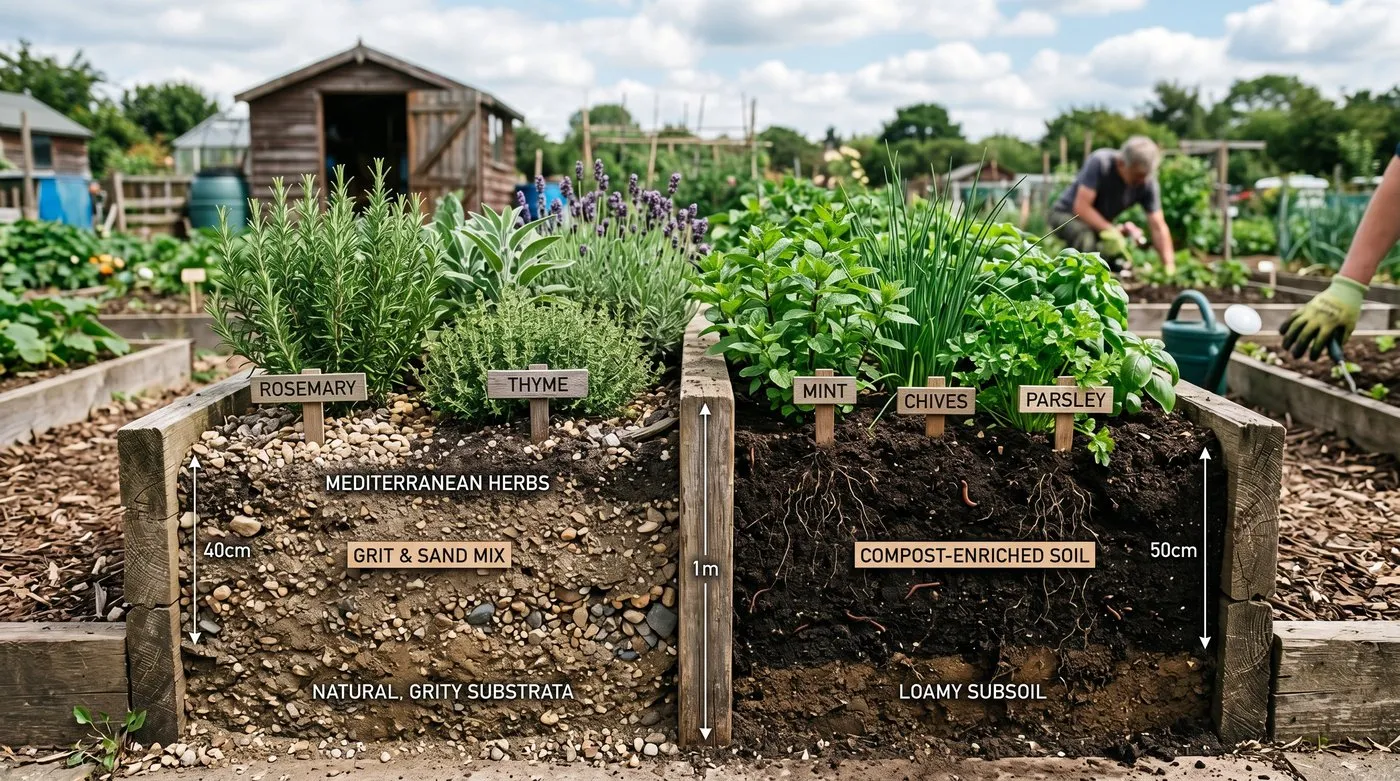 Soil cross-section showing zone preparation. Free-draining grit/sand mix on the Mediterranean side; compost-enriched moisture-retentive soil on the soft herb side, with a timber divider between
The 15-herb species plan
Mediterranean zone (back half):
- Rosemary ‘Miss Jessopp’s Upright’ - one plant at the back corner, 70cm spread
- Sage ‘Purpurascens’ - one plant, purple foliage for contrast
- Thyme ‘Common’ - 2-3 plants at the front edge
- Oregano ‘Compact’ - 2 plants
- Marjoram ‘Aureum’ (golden) - 2 plants
- Lavender ‘Hidcote’ - 1 plant at corner
- Greek bush basil - 1 plant in summer pot, lifted in autumn
Soft herb zone (front half):
- Mint ‘Spearmint’ - in a buried 25cm pot
- Chives ‘Garlic chives’ plus ‘Common chives’ - 3 plants
- Parsley ‘Flat-leaf’ - 4-6 plants in succession
- Coriander ‘Calypso’ (slow-bolt) - succession sown every 3 weeks
- Dill ‘Mammoth’ - 2 plants
- Fennel ‘Bronze’ - 1 plant at the back of soft zone
- Tarragon ‘French’ - 1 plant
- Basil ‘Genovese’ - 4-6 plants in summer
Optional additions if space permits:
- Bay laurel (in a pot at the corner)
- Lemon balm (contained like mint)
- Sorrel
- Chervil
- Borage (annual, self-seeds)
| Zone | Herb | Position | Permanence | Annual yield |
|---|---|---|---|---|
| Med | Rosemary | Back corner | Permanent 8-15 years | 500g-1kg cut |
| Med | Sage | Mid back | Permanent 4-6 years | 200-400g |
| Med | Thyme | Front of zone | Permanent 3-5 years | 100-300g per plant |
| Med | Oregano | Mid zone | Permanent 4-6 years | 200-500g |
| Med | Lavender | Corner | Permanent 6-10 years | Aromatic only |
| Soft | Mint | Buried pot | Permanent 5-10 years | 400-800g |
| Soft | Chives | Mid zone | Permanent 5-8 years | 200-500g |
| Soft | Parsley | Front zone | Biennial 12-15 months | 300-500g per plant |
| Soft | Basil | Summer position | Annual | 200-400g per plant |
| Soft | Coriander | Front zone, succession | Annual | 200-400g per cycle |
Position, size and access
A 2x2 metre herb bed is the standard size for a 10-rod allotment. This holds 12-15 species and produces enough herbs for a household with active cooking habits.
Position requires full sun for 6+ hours daily. South or south-west facing. Avoid shade from sheds, trees, or fences. Avoid north-facing slopes.
Shelter from cold east and north winds. Plant near a hedge, fence, or shed for wind protection. Exposed sites lose Mediterranean herbs to winter wind chill.
Adjacent to the plot path for easy access. The kitchen-to-plot harvest route should pass the herb bed. Reach the bed in seconds, not minutes.
Raised bed or ground level both work. Raised beds (15-30cm above ground level) help with drainage on heavy clay sites. Ground-level beds are simpler and cheaper.
Stepping stones or paving in the bed for harvest access. A 2x2 bed is too wide to reach into from any one edge. Lay 2-3 stepping stones to access the centre without compacting the soil.
Allow 60-90cm path access around at least two sides of the bed. Standard plot paths work; do not site herb beds in tight corners.
Soil preparation by zone
Mediterranean zone preparation:
- Dig out the soil to 30-40cm depth
- Mix 30% sharp grit (5-10mm), 20% builders’ sand, 50% original soil
- Backfill, mounding slightly above surrounding ground (free drainage)
- Add only 10% well-rotted compost; Mediterranean herbs hate rich soils
- Aim for pH 6.5-7.5 (slightly alkaline)
Soft herb zone preparation:
- Dig out the soil to 30-40cm depth
- Mix 30% garden compost, 70% original soil
- Add 1kg per square metre of fish, blood and bone meal
- Aim for pH 6.0-7.0
Divide the zones with buried treated timber or stone. A 10-15cm strip of buried material, with 2-3cm above the surface, prevents soil intermixing over time.
Add a 3-5cm gravel mulch to the Mediterranean zone after planting. Suppresses weeds, retains warmth, looks Mediterranean. Reapply every 2-3 years.
Add a 3-5cm compost mulch to the soft herb zone in spring. Retains moisture, suppresses weeds, feeds plants slowly. Reapply annually.
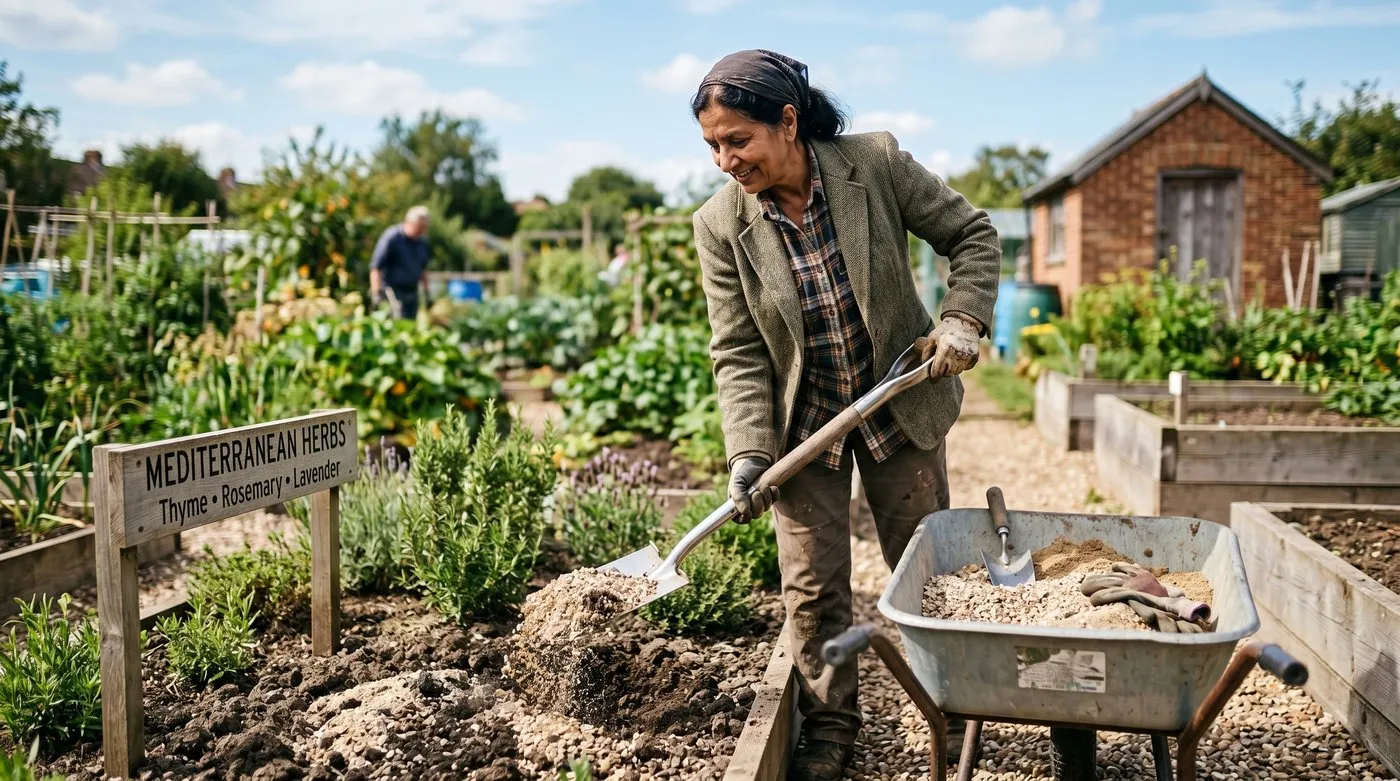 Mediterranean zone soil preparation. Mix 30% sharp grit and 20% builders’ sand into the original soil; the gritty mix prevents rosemary, thyme, and lavender from rotting in UK winters
Succession sowing for annual herbs
Basil, coriander, dill, and rocket are annual herbs that produce briefly before bolting. Succession sowing every 3-4 weeks gives continuous supply.
Basil: Sow indoors February to May; transplant outdoors after last frost. Each plant crops for 6-10 weeks. Three sowings 3 weeks apart give 18-30 weeks of basil. Plant in the soft herb zone in summer; lift before frost.
Coriander: Sow direct March to September. Each sowing crops for 4-6 weeks before bolting. Sow every 3 weeks. Slow-bolt varieties (Calypso, Confetti) extend cropping by 2-3 weeks.
Dill: Sow direct April to August. Each sowing crops for 8-12 weeks. Sow every 4-6 weeks for continuous supply.
Parsley: Sow March, then again in July for an overwintering crop. Parsley is biennial; first-year cuttings are best.
Rocket: Sow direct March to September. Bolts in midsummer heat. Sow every 3 weeks.
Mark a small succession sowing area at the front of the soft herb zone. Roughly 30x60cm. Use this space repeatedly through the season.
Keep a simple sowing diary. Date of each sowing; herb sown; outcome. Year 2 sowings improve dramatically with year 1 records.
| Herb | First sowing | Last sowing | Interval | Crops per year |
|---|---|---|---|---|
| Basil | Indoors February | June (transplant) | 3 weeks | 3-5 |
| Coriander | March | September | 3 weeks | 6-8 |
| Dill | April | August | 4-6 weeks | 3-4 |
| Rocket | March | September | 3 weeks | 6-8 |
| Parsley | March then July | - | One main, one autumn | 2 |
Mint confinement and other troublemakers
Mint roots spread aggressively underground. Unchecked, mint colonises the entire bed within 3-4 seasons. Confinement is essential.
The buried pot method: Use a 25cm plastic pot with the bottom cut off. Sink to ground level. Plant mint inside. The pot wall stops sideways root spread. Check annually for escapees over the rim.
Alternative confinement methods:
- Plant mint in a permanent pot beside the bed, not in it
- Use a square metal raised bed insert as a barrier
- Plant mint in a 60cm-deep trench lined with weed membrane
Other invasive herbs that need confinement:
- Lemon balm (Melissa officinalis) - similar root spread to mint
- Tansy (Tanacetum vulgare) - aggressive
- Garlic chives (Allium tuberosum) - self-seeds aggressively, deadhead before flowering
Aggressive self-seeders that benefit from deadheading:
- Borage - thousands of seeds per plant
- Fennel - prolific volunteers
- Dill - moderate self-seeding
- Coriander - useful self-seeders, can leave to spread
Gardener’s tip: Cut all flower heads off mint, lemon balm, and any plant you want to confine before they set seed. The roots spread underground; the seeds spread above ground. Stopping both keeps the bed tidy. Cut heads compost normally.
Year-one calendar
February: Mark bed position. Dig over and remove perennial weeds. Order seeds and perennial plants.
March: Build zone divider. Mix grit/sand into Mediterranean zone. Mix compost into soft herb zone.
April: Plant perennial herbs (rosemary, sage, thyme, oregano, lavender, mint in buried pot, chives, tarragon, fennel). Sow first batch of annual herbs indoors or direct.
May: Plant basil seedlings into pots ready to move outdoors. Direct sow coriander, dill, rocket. Mulch the bed.
June: Move basil pots into the bed after last frost. Begin first harvests of chives, thyme, oregano, parsley.
July: Peak harvest month. Cut chives, mint, parsley, basil, coriander regularly. Sow next batch of fast crops.
August: Harvest thyme, sage, oregano, marjoram for drying. Continue succession sowing.
September: Lift annual herbs as they finish. Harvest last basil. Sow autumn parsley.
October: Cut back perennials for winter. Mulch the soft herb zone with compost.
November-January: Bed rest period. Harvest chives, parsley, mint, rosemary as needed for kitchen.
February (year 2): Top-dress bed with compost. Begin next cycle.
Harvest schedule and yield
Daily through the growing season: Chives, parsley, mint, basil (in summer).
Weekly to fortnightly: Coriander, dill, sage, oregano, thyme.
Twice or three times per season: Rosemary (heavy cuts for drying), lavender.
Total annual yield from a 2x2m bed: 4-6kg of cut herbs across 12-15 species.
Equivalent supermarket value: £80-£200 worth of fresh herbs per year, depending on which species you buy frequently.
Drying excess: Mediterranean herbs (rosemary, thyme, sage, oregano, marjoram) dry well and retain flavour for 6-12 months. Soft herbs (basil, parsley, coriander) lose most flavour when dried.
Freezing excess basil and parsley: Chop and freeze in ice cube trays with olive oil. Useful for soups and sauces.
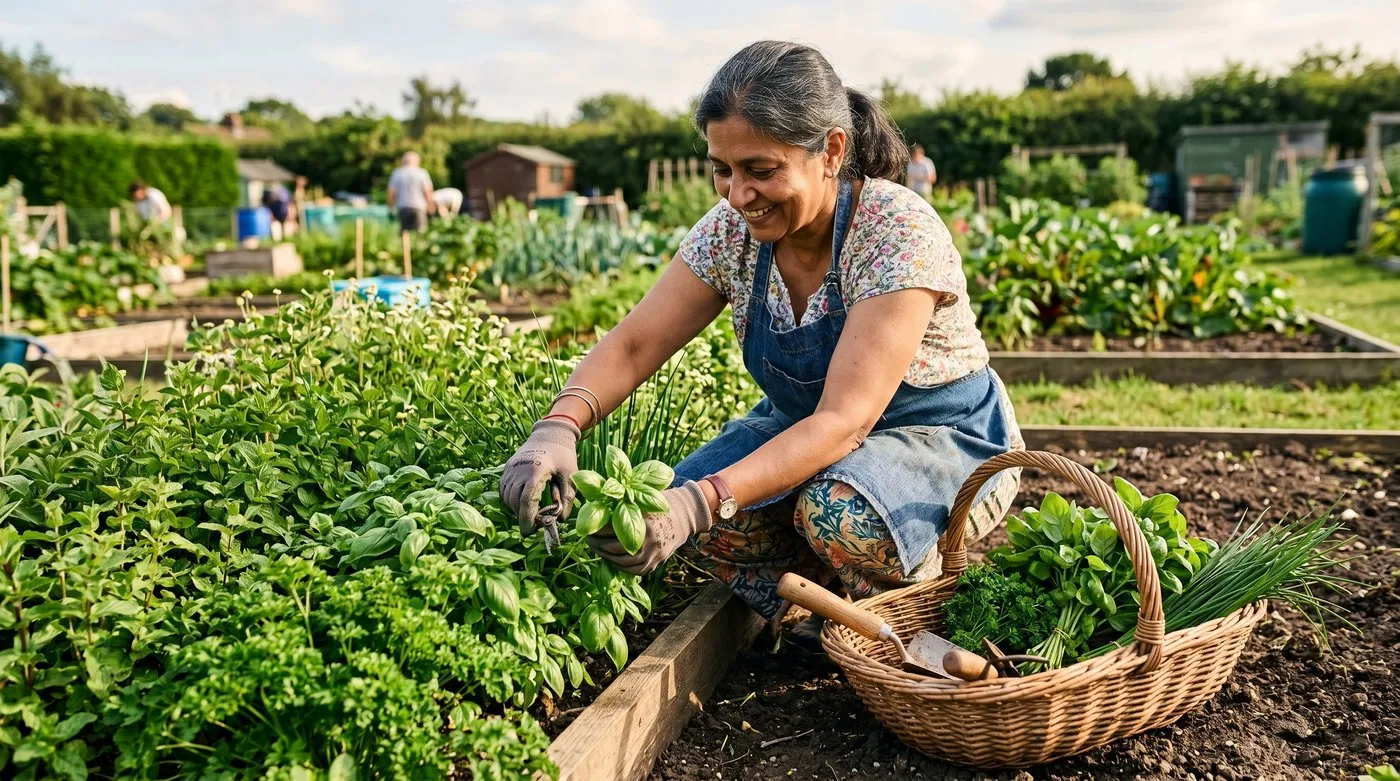 Mid-summer herb harvest with a wicker trug. The dedicated bed makes weekly cropping a 15-minute job, encouraging frequent kitchen use
Common mistakes to avoid
Skipping the zoning. Planting rosemary next to parsley with the same soil and watering kills one or both within 12 months.
Forgetting to confine mint. A free-rooting mint plant colonises the entire bed in 3-4 seasons.
Too much compost in the Mediterranean zone. Rich soil promotes soft growth that rots in winter. Mediterranean herbs want poor stony soil.
Sowing all annual herbs in one go. Gives a glut, then nothing. Sow every 3-4 weeks for continuous supply.
Bed in deep shade. Most culinary herbs need 6+ hours of direct sun. Shaded beds produce leggy weak plants.
No stepping stones in the bed. Compacting the soil ruins the structure. Lay 2-3 stones for access.
Step-by-step: building the 2x2 bed
Step 1: choose position. South or south-west facing, full sun 6+ hours, sheltered from cold winds, adjacent to plot path.
Step 2: mark out 2x2 metres with string and pegs. Check it is square with a tape diagonal.
Step 3: dig out the bed to 30-40cm depth. Remove perennial weeds. Keep topsoil separate from subsoil.
Step 4: split the bed in half with a buried timber or stone divider. 10-15cm strip; 2-3cm above surface.
Step 5: prepare Mediterranean zone. Mix 30% grit, 20% sand, 50% topsoil. Mound slightly. Backfill.
Step 6: prepare soft herb zone. Mix 30% garden compost, 70% topsoil. Add 1kg fish/blood/bone per square metre.
Step 7: lay stepping stones. 2-3 stones across the bed for access without compacting soil.
Step 8: plant perennials. Mediterranean herbs at back of their zone; soft herbs at back of their zone.
Step 9: install mint in a buried 25cm pot. Cut bottom off, sink to ground level, plant mint inside.
Step 10: sow first annual herbs. Coriander, dill, rocket at the front of the soft zone.
Step 11: mulch. Gravel mulch (3-5cm) on Mediterranean zone; compost mulch (3-5cm) on soft zone.
Step 12: water in well. Settled soil ensures root contact. Then leave the bed alone for 2 weeks before first harvest.
Frequently asked questions
What is the best size for an allotment herb bed?
A 2x2 metre herb bed is the standard size that holds 12-15 culinary herb varieties. Larger beds (4x2 metres) suit growers using herbs commercially. Smaller beds (1x1 metre) work for a household with limited cooking demand. The 2x2 size gives a productive bed without dominating the plot. Position adjacent to the main plot path for easy harvest access.
Which herbs work in a UK allotment bed?
The core UK allotment herbs are rosemary, thyme, sage, oregano, mint, chives, parsley, basil, coriander, dill, fennel, and tarragon. All grow well outdoors in UK plots and supply a year-round culinary range. Mediterranean herbs at the back, soft herbs at the front with succession sowing. Optional additions include bay, lemon balm (confined), sorrel, chervil, and borage.
Where should I put my allotment herb bed?
Choose a sheltered south or south-west facing position with full sun for 6+ hours per day. Avoid frost pockets, north-facing slopes, and waterlogged corners. Position near the plot entrance for easy harvesting. Most plot holders site the herb bed adjacent to the path that links house to plot. Shelter from cold east winds is important for Mediterranean species.
How do I stop mint taking over the herb bed?
Plant mint in a 25cm plastic pot with the bottom cut off, sunk into the soil at ground level. The pot wall stops roots spreading sideways. Check annually for any escapees over the rim. Alternative: keep mint in a permanent pot beside the bed, not in it. Cut all flower heads before seed set to stop the above-ground spread.
How often should I water an allotment herb bed?
Established Mediterranean herbs need watering only in prolonged dry spells (no rain for 14+ days). Soft herbs (parsley, chives, basil, coriander) need more regular water, every 3-7 days in summer dry weather. Mulch the bed with 3-5cm of compost in spring to reduce watering needs by 50%. Newly planted herbs need water every 2-3 days for the first 4 weeks.
Our team produces practical UK gardening guidance from source research, contributor records and established horticultural practice. Editorial standards are overseen by Matt W.