Key takeaways
- Editorial pot design uses one signature plant plus 2-4 supporting plants, not a busy mix
- Single-material pots (terracotta, zinc, corten, granite) work better than mixed materials
- Pot size of 35-80cm gives the volume needed for a layered editorial planting
- Restraint matters; 4-6 plants per pot beats 12-15 supermarket-style stuffed pots
- Replant the headline plant every 2-3 years; structure plants last 5-8 years
- Winter structure carries the pot through the off-season
Editorial container planting is the contemporary pot design language. The look is restrained, layered, and architectural. One signature plant carries each pot. Two or three supporting species add complexity. A single trailing or filler softens the edge. The result reads like the pot was designed, not assembled from a garden centre trolley. Gardens Illustrated, Beth Chatto, Tom Stuart-Smith, and the RHS show gardens all use the approach.
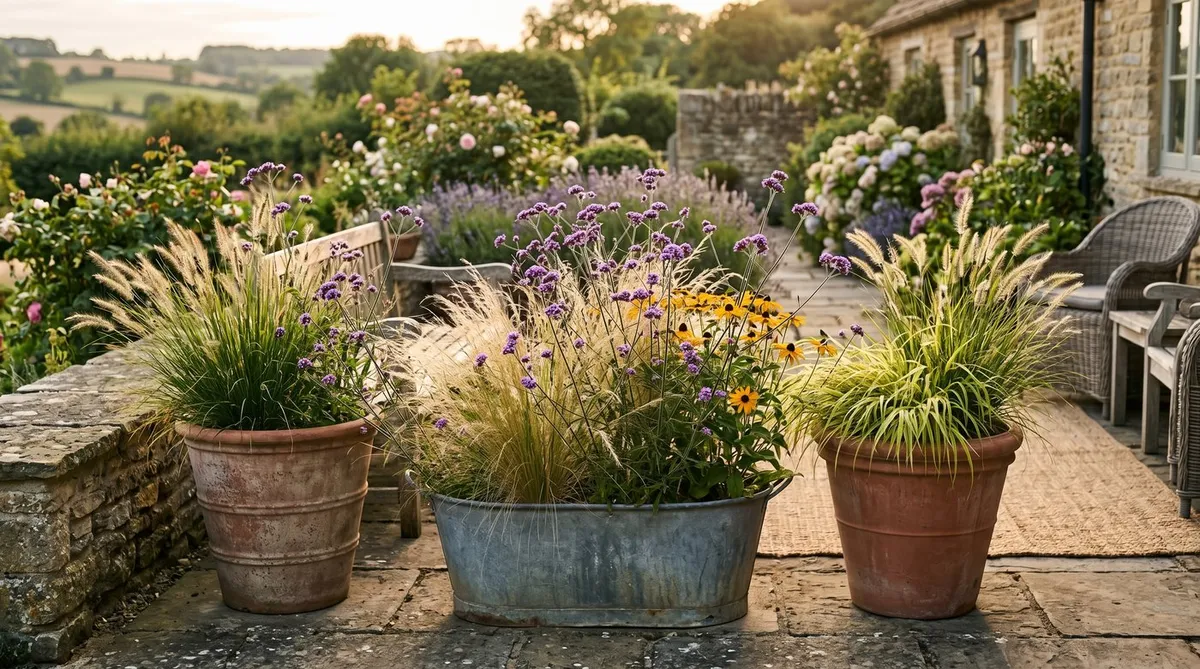
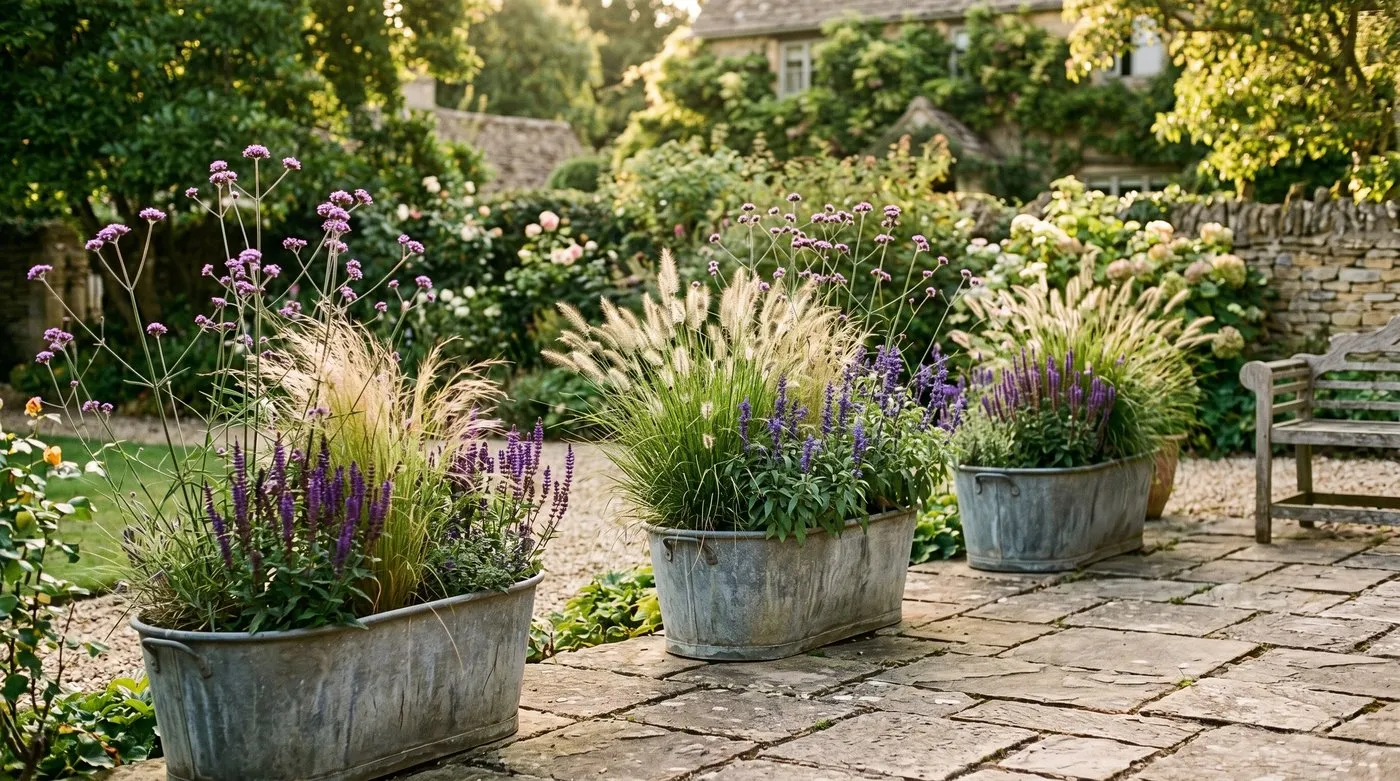 Three matching 60cm zinc planters on a sunny terrace. Pennisetum ‘Hameln’ as the signature grass, Verbena bonariensis as height, Salvia ‘Caradonna’ for early colour, Stipa tenuissima as low textural fill
The 60-30-10 rule for editorial pots
One signature plant occupies 60% of the visual weight in each pot. This is the headline. Choose a plant with strong form, height, or distinctive foliage. Examples: a tall grass like Pennisetum or Stipa, a shrub like Sambucus ‘Black Lace’, a flowering perennial like Verbena bonariensis or Echinacea.
Two or three supporting plants take 30% of the visual weight. These complement the signature without competing. Choose plants with secondary textures, slightly different colours, or staggered flowering times. Astrantia, Sanguisorba, hardy geraniums, Heuchera all work as supporting plants.
One trailing or filler plant gives 10%. This softens the edge of the pot and ties it visually to the surrounding ground. Ivy, trailing Pratia, golden creeping Jenny, sweet woodruff all work.
Total plants per pot: 4-6 species. Two specimens of each may be used in larger pots, but the species count stays low.
Avoid mixed nursery trays. Trays of 12-15 plants are designed for window boxes and small pots. Editorial planting needs fewer, larger plants.
Pot height matters as much as diameter. A 35cm pot 30cm tall holds less than a 35cm pot 50cm tall. Bigger volume supports the layered planting better.
| Ratio element | % weight | Role | Example plants |
|---|---|---|---|
| Signature | 60% | Headline plant, defines the pot | Pennisetum, Verbena bonariensis, Echinacea |
| Supporting | 30% | Complement, secondary texture | Astrantia, Heuchera, Sanguisorba |
| Filler/trailing | 10% | Softens edge, ties to ground | Ivy, Pratia, creeping Jenny |
Material choice: single, not mixed
Editorial pots succeed when the material matches the architecture and stays consistent within a group. A terracotta pot alongside a zinc pot alongside a glazed ceramic pot creates visual chaos. The plants get lost in competing materials.
Terracotta suits traditional architecture, brick houses, country gardens. UK frost-proof Italian terracotta from Whichford Pottery or English Terracotta Pots costs £80-£400 for 50-70cm pots. Cheap Mediterranean imports break in UK winters.
Zinc suits modern minimalist gardens. Galvanised feeding troughs and bespoke zinc planters from suppliers like A Place in the Garden cost £100-£500 depending on size. Develops a soft grey patina over 1-2 years.
Corten steel suits contemporary garden design with rusted-brown finish. Pre-weathered Corten planters cost £200-£800 for 50-80cm sizes. The colour deepens over the first 2 years.
Granite or stone suits formal settings and grand gardens. Heavy, expensive (£300-£1500), and last centuries.
Glazed ceramic is hardest to use editorially because the coloured glaze competes with plants. Restrict to plain matte finishes in earth tones.
Concrete and recycled plastic work for budget editorial pots if used in single colours and matched-set groupings. Avoid mixing.
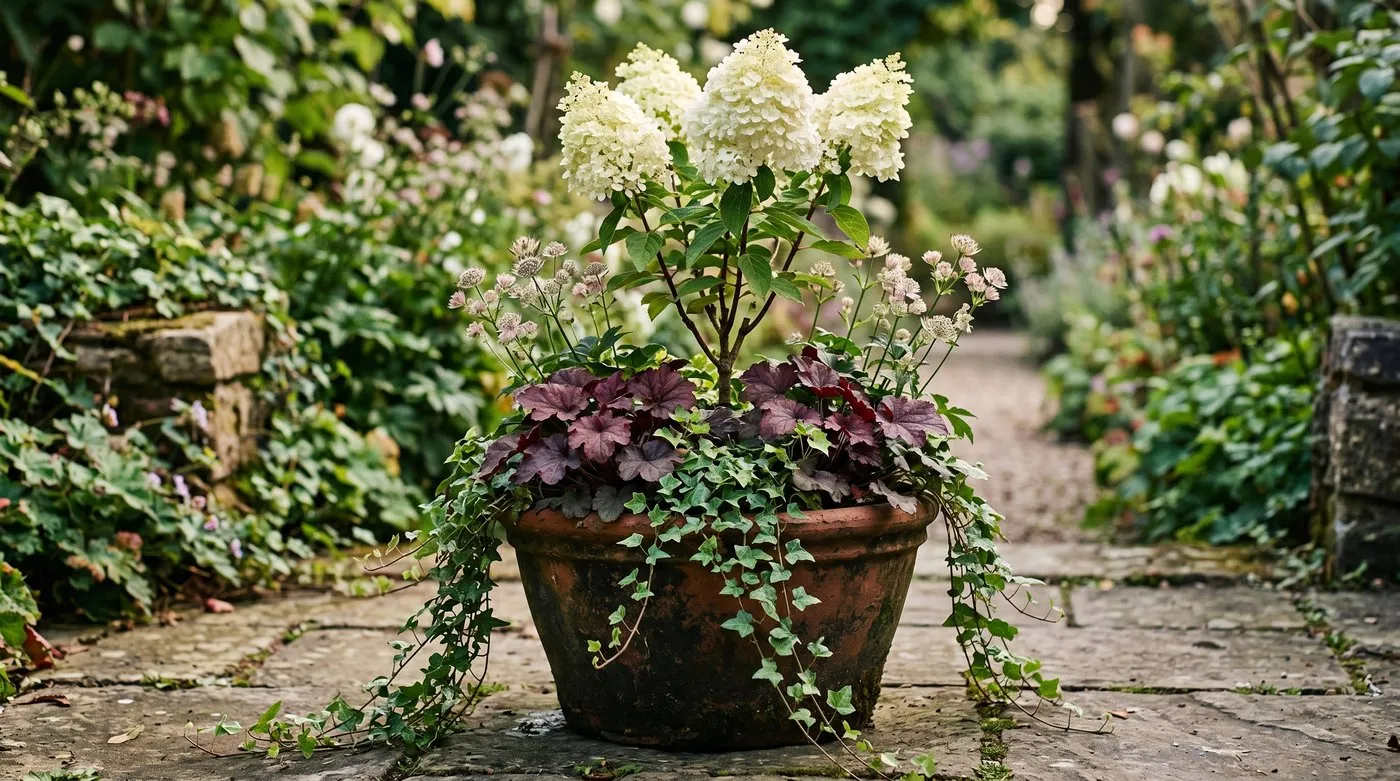 A 50cm Italian terracotta planter with Hydrangea paniculata ‘Limelight’ as the signature shrub. Heuchera ‘Plum Pudding’ and Astrantia ‘Roma’ as supporting plants, ivy trailing over the rim
Recipe 1: Spring bulb to summer perennial pot
A spring-flowering pot that transitions to summer perennials in May. The pot reads through two seasons without major intervention.
Pot: 60cm terracotta or zinc, full sun position.
Spring (March-May):
- Signature: Tulip ‘Spring Green’ x 15 (deep planted in November)
- Supporting: Anemone blanda x 25
- Filler: Hardy primrose (Primula vulgaris) x 5
Summer transition (May onwards):
- Lift fading tulip foliage (do not cut; let leaves yellow first)
- Plant Salvia ‘Caradonna’ x 1 as new signature
- Add Astrantia ‘Roma’ x 2 as supporting
- Add Geum ‘Mai Tai’ x 2 for warmth
Cost in year 1: £45-£80 (pot extra). Bulbs replanted every 2-3 years; perennials carry across multiple seasons.
Position: Full sun, sheltered from cold winds.
Maintenance: Water weekly in dry weather. Feed with seaweed once monthly April to September. Deadhead Salvia for repeat flowering.
Recipe 2: Grass-led summer container
Tall ornamental grasses give an architectural summer pot that needs no flowering for impact. Best in late summer when grasses produce flower plumes.
Pot: 70cm zinc or matte stone, full sun.
Plants:
- Signature: Pennisetum ‘Hameln’ x 1 large clump (60% volume)
- Supporting: Verbena bonariensis x 2 (height, see-through purple)
- Supporting: Stipa tenuissima x 3 (low textural mass)
- Filler: Erigeron karvinskianus (Mexican daisy) x 2 (over the rim)
Cost year 1: £55-£90.
Position: Full sun, sheltered. Movement is the point; needs a breeze.
Maintenance: Cut grasses back to 10cm in February. Pennisetum may not survive harsh UK winters; treat as 2-3 year plant. Verbena bonariensis self-seeds, providing replacement plants. Stipa lasts 4-5 years before becoming straggly.
Year-round read: Excellent August-October. Winter brown but architectural until February cut.
Recipe 3: Foliage-only contemporary pot
A pot built entirely on leaf colour and texture, with no flowers. Suits modernist architecture and minimalist gardens. Reads year-round.
Pot: 50cm Corten steel or matte black ceramic, partial sun position.
Plants:
- Signature: Sambucus nigra ‘Black Lace’ (dwarf elder) x 1 (60% - dramatic black-purple foliage)
- Supporting: Heuchera ‘Marmalade’ x 2 (orange-russet foliage)
- Supporting: Carex ‘Frosted Curls’ x 2 (silver-grey grass)
- Filler: Ajuga reptans ‘Black Scallop’ x 2 (dark trailing)
Cost year 1: £70-£120.
Position: Partial sun, sheltered from harsh midday.
Maintenance: Prune Sambucus annually in February to maintain shape. Heuchera lasts 3-4 years before splitting. Carex semi-evergreen so reads in winter. Water weekly; feed twice annually.
Year-round: Strong in all seasons. Sambucus leafless in winter but stem structure provides interest.
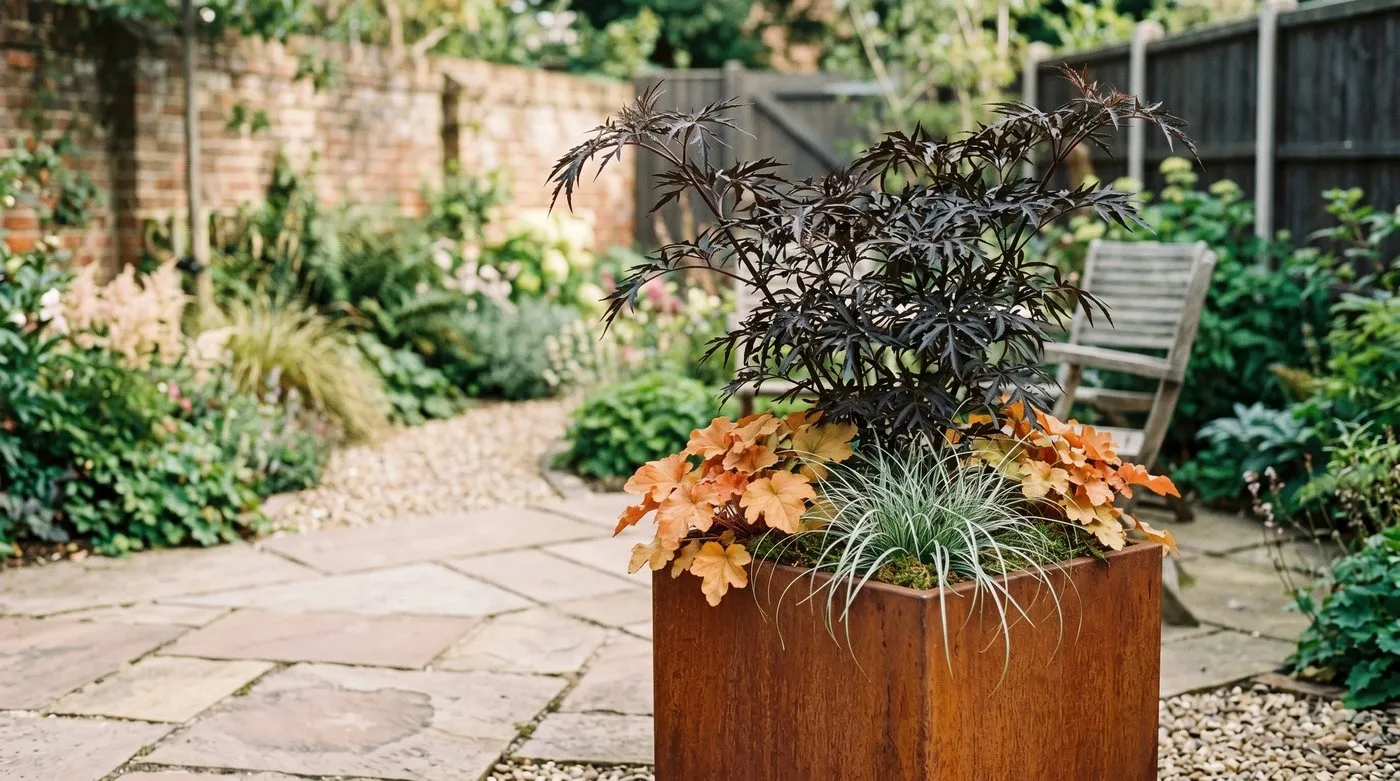 Foliage-only pot. Sambucus ‘Black Lace’ as the dark architectural signature, Heuchera ‘Marmalade’ for warm contrast, Carex ‘Frosted Curls’ for silver texture. No flowers needed
Recipe 4: Autumn-into-winter structure pot
A pot designed for September through March, when summer pots have collapsed. Carries the patio through the winter months when most gardens are dull.
Pot: 45cm terracotta or stone, sheltered position near building.
Plants:
- Signature: Hydrangea paniculata ‘Limelight’ x 1 (dwarf form) (60% - cone flower heads age to russet, persist through winter)
- Supporting: Skimmia japonica ‘Rubella’ x 1 (evergreen with red flower buds all winter)
- Supporting: Heuchera ‘Forever Red’ x 2 (evergreen)
- Filler: Bergenia ‘Bressingham Ruby’ x 2 (large evergreen leaves bronze in winter)
Cost year 1: £80-£150.
Position: Sheltered. Hydrangea paniculata wants morning sun.
Maintenance: Prune Hydrangea panicle hard in March. Heuchera lift and divide every 3-4 years. Bergenia almost maintenance-free.
Year-round: Strong September to April. Quiet in midsummer; pair with a separate summer pot nearby.
Recipe 5: Edible-ornamental container
A pot that delivers food and visual impact in equal measure. Suits productive gardens where every container must earn its keep.
Pot: 50cm terracotta or zinc trough.
Plants:
- Signature: Tomato ‘Tumbling Tom Red’ x 1 (cherry tomato cascade) (60%)
- Supporting: Basil ‘Greek Bush’ x 1 (dwarf compact culinary)
- Supporting: Calendula officinalis ‘Indian Prince’ x 1 (orange flowers, edible, pollinator)
- Filler: Trailing nasturtium ‘Salmon Gleam’ x 2 (edible, trailing)
Cost year 1: £20-£40 (annuals).
Position: Full sun, sheltered.
Maintenance: Daily watering in summer (1-2 litres in hot weather). Weekly tomato feed. Pinch out tomato side shoots only on indeterminate types.
Year-round: Annual pot; replant from scratch each May.
Recipe 6: Drought-tolerant Mediterranean pot
A pot for hot dry corners that cannot be watered daily. Mediterranean herbs and silver-leaved perennials thrive on neglect.
Pot: 55cm terracotta, gritty compost mix, full sun.
Plants:
- Signature: Cistus ‘Sunset’ x 1 (Mediterranean rockrose, magenta flowers) (60%)
- Supporting: Lavender ‘Munstead’ x 2
- Supporting: Stachys byzantina (lambs ears) x 2 (silver foliage)
- Filler: Sempervivum (houseleek) mixed varieties x 5
Cost year 1: £45-£75.
Position: Full sun, gritty compost (50% grit, 30% topsoil, 20% peat-free compost).
Maintenance: Water only in extreme drought (no rain for 14+ days). No feeding. Trim lavender after flowering. Replace Cistus every 4-5 years.
Year-round: Strong summer (Cistus and lavender in flower June-August). Silver foliage carries autumn and mild winters. Hard winters can kill Cistus; replace as needed.
| Recipe | Pot size | Best season | Cost year 1 | Maintenance level |
|---|---|---|---|---|
| Spring bulb to summer | 60cm | March-September | £45-£80 | Low |
| Grass-led summer | 70cm | June-October | £55-£90 | Low |
| Foliage contemporary | 50cm | Year-round | £70-£120 | Low |
| Autumn-into-winter | 45cm | September-April | £80-£150 | Low |
| Edible-ornamental | 50cm | May-September | £20-£40 | High (daily water) |
| Drought-tolerant Med | 55cm | June-September | £45-£75 | Very low |
Compost, drainage and planting
Peat-free general-purpose compost mixed with John Innes No. 3 (50/50) is the standard mix. Pure peat-free dries out fast and loses structure in 12-18 months. The added John Innes (with grit and loam) holds moisture and lasts 3-5 years.
Add 20% grit or perlite for drainage. Pot bottom should drain freely; standing water rots roots.
Drainage holes are essential. Most ornamental pots have one hole; this is often too small. Add 2-3cm of crocks or coarse gravel at the base.
Top-dress compost annually in March. Remove the top 5cm of old compost; replace with fresh. This refreshes nutrients without disturbing established roots.
Replant the signature plant every 2-3 years. It exhausts the compost and the look tires. Supporting plants typically last 3-5 years; structural evergreens 5-8 years.
Slow-release fertiliser pellets in spring save weekly feeding labour. One application gives 6 months of feeding. Use organic-certified granules for edibles.
Position, scale and grouping
Group pots in odd numbers: 3, 5, or 7. Even-numbered groupings feel formal and static; odd groupings feel dynamic and natural.
Vary pot heights within a group. Three pots of different heights (40cm, 60cm, 80cm) work better than three identical pots at the same height.
One signature pot plus 2 smaller pots is the most flexible group. The signature draws the eye; the smaller pots add support.
Position pots against a contrasting background. Dark pots in front of pale walls; pale pots against dark hedges.
Move container groupings annually. Pots in identical positions for years compress the soil beneath and damage paving. A new position every spring also refreshes the visual interest.
Consider winter wind exposure. Tall containers blow over in exposed positions. Anchor with paving or move to sheltered corners before autumn.
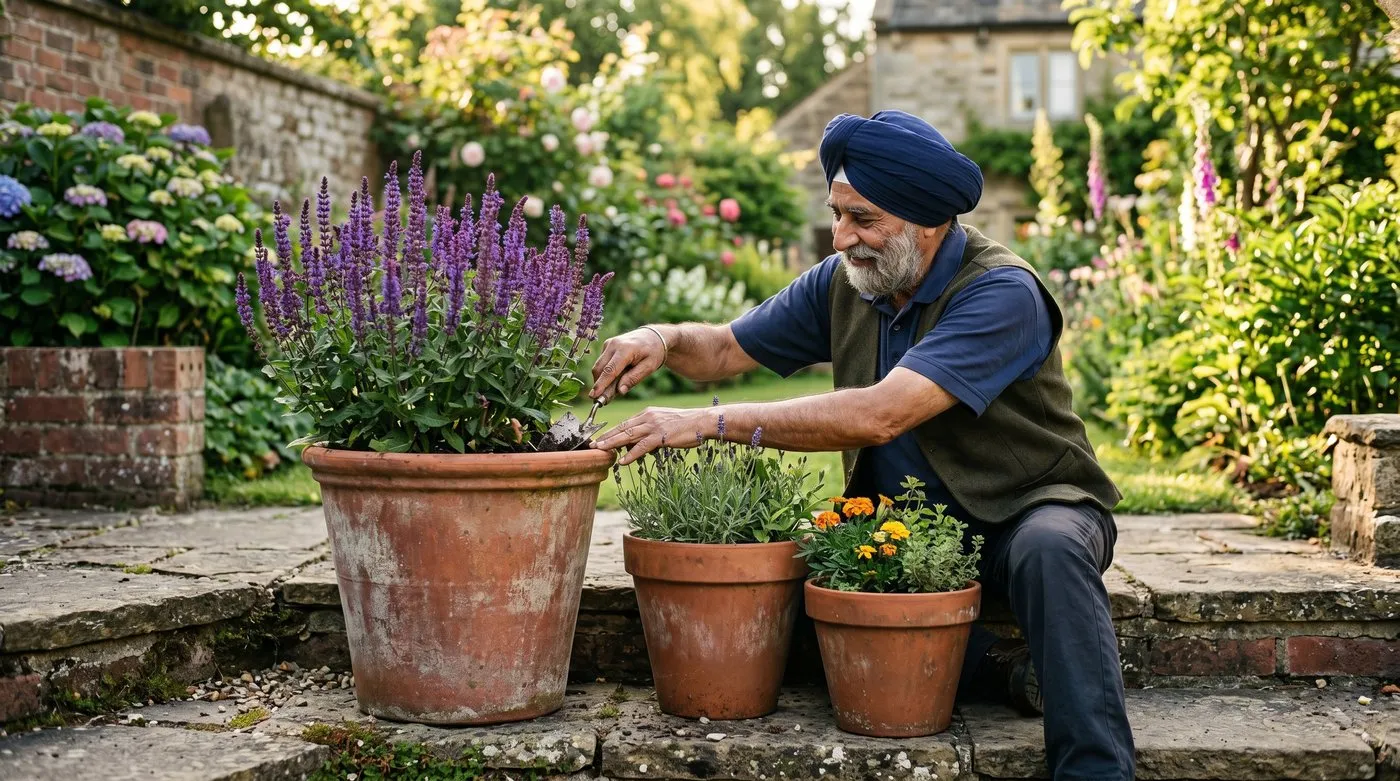 Three-pot grouping in graduated sizes on a UK terrace. The largest pot anchors the composition; smaller pots support the visual flow
Maintenance and seasonal swaps
Annual jobs by season:
Spring (March-April):
- Remove dead summer growth from perennials
- Prune Hydrangea panicle, Sambucus, Cistus
- Top-dress with 5cm fresh compost
- Apply slow-release fertiliser pellets
- Plant new annuals or fill empty pots
Summer (June-August):
- Water 2-7 times per week depending on weather
- Deadhead flowering plants weekly
- Feed monthly with liquid seaweed if not using slow-release pellets
- Watch for pests (vine weevil, aphid, slug)
Autumn (September-October):
- Lift annual fillers; replace with autumn-into-winter structure plants
- Move tender pots into sheltered position or unheated greenhouse
- Reduce watering as growth slows
Winter (November-February):
- Move susceptible pots to sheltered positions
- Wrap large pots with bubble wrap if frost penetration is a concern
- Water lightly if compost dries (rare in UK winter rain)
- Inspect for cracked pots after hard frost
Common mistakes to avoid
Too many species per pot. 12-15 plants in a 35cm pot looks busy at the supermarket but fails after 3 weeks. Stick to 4-6 species in the 60-30-10 ratio.
Mixing pot materials in one grouping. Terracotta + zinc + glazed ceramic creates visual chaos. Stick to one material per group.
Cheap Mediterranean terracotta on a UK terrace. Cracks in the first winter. Frost-proof Italian or English terracotta lasts decades.
Inadequate drainage. Pots with one small hole and no crocks waterlog. Add crocks and check holes are clear.
Skipping the annual compost top-up. Old compost loses nutrients and structure within 12-18 months. Refresh 5cm annually.
Pot too small for the plant ambition. A signature shrub needs a 50-60cm pot minimum. 25cm pots only hold annuals or small herbs.
Step-by-step: building a 60cm signature pot
Step 1: choose the pot. Frost-proof terracotta or zinc, 60cm diameter, 45cm deep. Check the drainage hole.
Step 2: prepare drainage. 3cm of crocks or coarse gravel at the bottom.
Step 3: mix compost. 50% peat-free general-purpose, 30% John Innes No. 3, 20% horticultural grit.
Step 4: position the pot before filling. Once full it weighs 40-80kg.
Step 5: fill pot to 25cm depth. Press lightly to settle.
Step 6: position the signature plant. Place pot still in its nursery container in the centre. Adjust depth so plant root collar will sit 3cm below pot rim.
Step 7: remove signature plant from nursery container, place in position. Backfill with compost.
Step 8: add supporting plants. Position 2-3 supporting plants around the signature. Backfill with compost.
Step 9: add filler/trailing plant at the edge. Cascade over the rim.
Step 10: top up compost to within 3cm of the rim. Firm gently.
Step 11: water in well with 5-10 litres of water. Soaks compost and settles roots.
Step 12: top dress with 2-3cm of decorative gravel or bark. Suppresses surface weed and reduces evaporation.
Frequently asked questions
What is editorial container planting?
Editorial container planting is the contemporary design style of using fewer plants per pot, one signature species, and matching materials. The look is championed by Gardens Illustrated, RHS designers, and gardens like Beth Chatto’s. Pots typically hold 4-6 plants in a 60-30-10 visual weight ratio rather than 12-15 stuffed supermarket-style mixes. The style is restrained, layered, and architectural.
What size pot do I need for editorial container planting?
Pots of 35-80cm diameter work best for editorial planting. Smaller pots cannot hold the layered plant volume that the style needs. A 50cm zinc planter or 60cm terracotta pot is the typical scale. Group 2-3 large pots rather than spreading many small pots across the space. Larger pots reduce watering frequency and let plants grow into mature specimens.
How long does an editorial container planting last?
Signature perennials and shrubs in a pot last 2-3 years before replanting; structural evergreens last 5-8 years; trailing fillers are typically annual or 2-year. Top up compost annually, refresh the headline plant every 2-3 years, and replace structure plants when they outgrow the pot. The supporting plants between these refreshes provide continuity.
Which plants work in editorial UK containers?
Signature plants: Verbena bonariensis, Pennisetum, Stipa tenuissima, Salvia ‘Caradonna’, Echinacea, Hydrangea paniculata, Sambucus ‘Black Lace’. Supporting plants: Astrantia, Sanguisorba, Heuchera, Geum. Trailing fillers: ivy, trailing Pratia, golden creeping Jenny. Structure: dwarf box, festuca, dwarf yew. Match plant requirements (sun, water) to pot position.
Can I mix pot materials in a garden?
Yes but with restraint. Stick to one material per visual group; mix only across separated zones. A terracotta cluster on one terrace and a zinc cluster on another works; mixing terracotta and zinc in the same group looks chaotic. Pick the material that fits the architecture of the building. Modern houses suit zinc or corten; traditional brick houses suit terracotta or stone.
Our team produces practical UK gardening guidance from source research, contributor records and established horticultural practice. Editorial standards are overseen by Matt W.