Key takeaways
- Garden step risers should measure 130-160mm; treads 350-400mm for comfortable walking
- Retaining walls under 600mm need a 200mm concrete foundation; over 1.2m needs engineering
- Behind every retaining wall: 100mm gravel drainage plus weep holes every 1-2 metres
- Balustrades or handrails required for steps over 600mm height per Building Regs
- UK costs run £150-£500 per square metre for hard landscaping (materials plus labour)
- Foundation depth = retaining wall height divided by 4, minimum 200mm
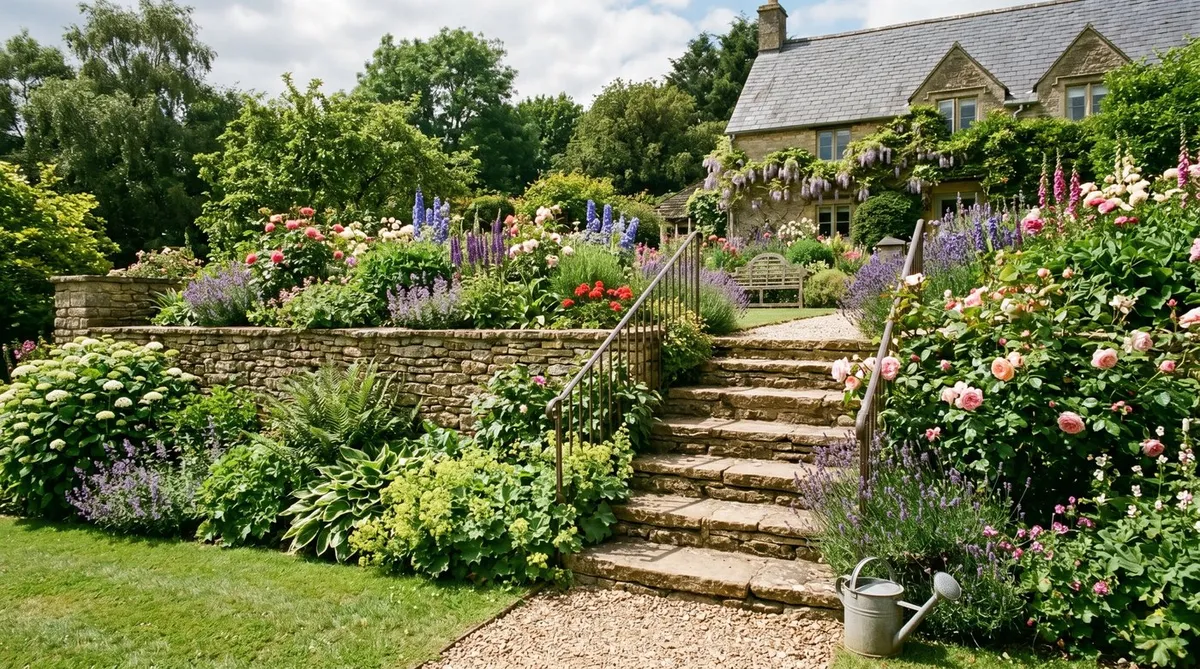
A sloping garden is an opportunity, not a problem. Terracing transforms unusable steep ground into a series of useable level platforms. Garden steps connect the levels for comfortable movement. Retaining walls hold the soil in place. Done well, the result is a layered garden that uses every metre of the slope. Done badly, a sloping garden becomes muddy, inaccessible, and prone to expensive structural failure.
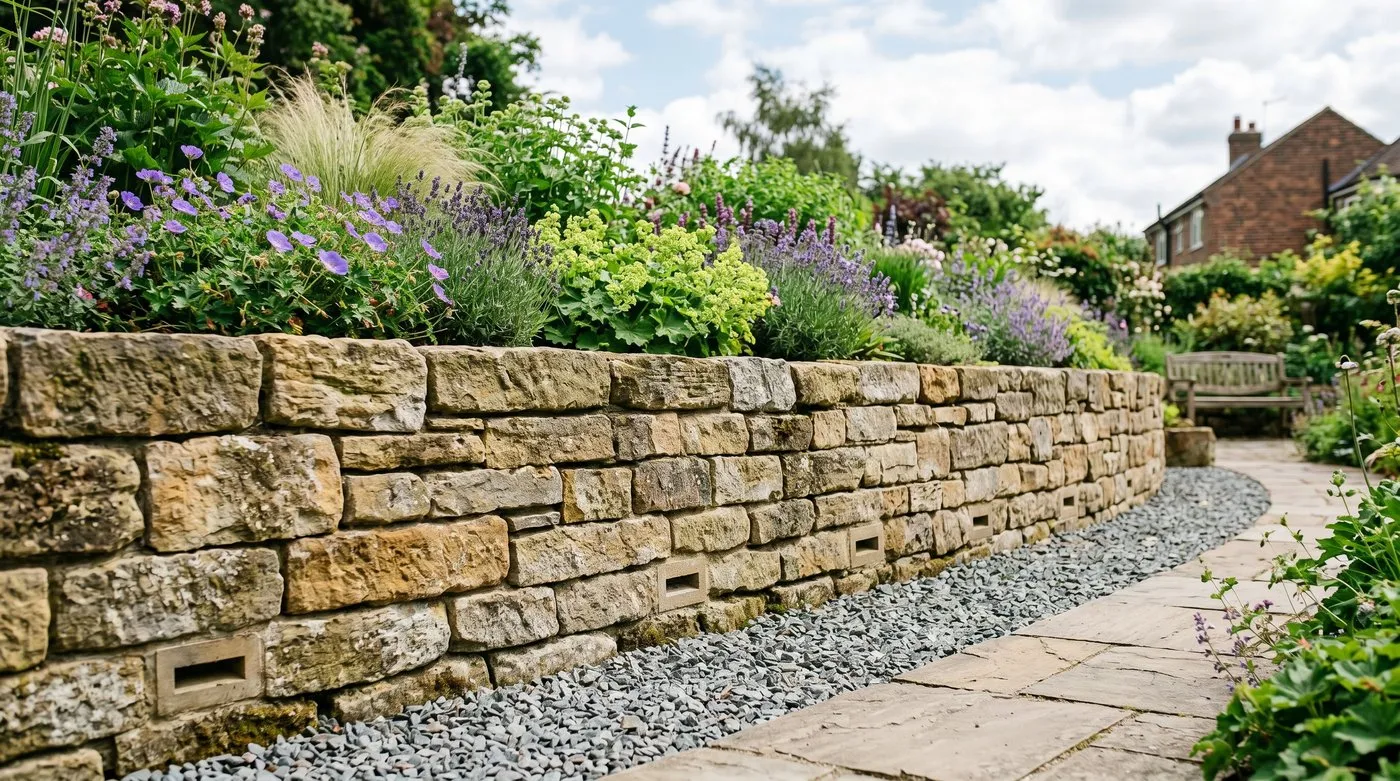 Retaining wall structure: gravel drainage layer behind the wall, weep holes at the base, deep concrete foundation. The drainage detail is invisible but decides whether the wall survives 30 years
How garden steps work: riser, tread, and the pitch line
Garden steps need to match natural walking rhythm. The brain expects each step to take the same effort as the previous one, on average covering 650-680mm of forward movement per step.
Riser height (vertical rise per step): 130-160mm is comfortable. Below 100mm feels cramped; above 180mm feels tiring and aggressive. Risers up to 200mm work in functional service steps but never in main garden routes.
Tread depth (horizontal step surface): 350-400mm. Below 280mm forces awkward foot placement. Above 450mm creates an irregular pace.
The pace rule: 2 risers plus 1 tread = 650-680mm. A 150mm riser plus 380mm tread gives 680mm. This calculation has stood since Vitruvius and underpins all UK building regulations on stairs.
Total rise determines step count. A 1.2m level change needs 8 risers at 150mm. A 2.4m change needs 16 risers. Long flights (over 12 risers) need a landing of 600-1000mm to break the rhythm.
Pitch line is the imaginary line connecting the nosing of each tread. Build the pitch line at 30-35 degrees from horizontal for garden steps. Steeper than 40 degrees feels precarious.
Width of garden steps: 900mm minimum for single-person use; 1200-1500mm for two people side by side; 1800mm+ for stately entrance flights.
| Riser height | Tread depth | Use case | Comfort |
|---|---|---|---|
| 100-130mm | 350-450mm | Stately entrances, formal | Gentle, generous |
| 130-160mm | 350-400mm | Standard garden routes | Optimal comfort |
| 160-180mm | 300-380mm | Cottage and informal | Comfortable, slightly steeper |
| 180-200mm | 280-330mm | Service steps, secondary routes | Functional only |
| Over 200mm | Under 280mm | Avoid in garden settings | Tiring, aggressive |
Step materials and costs
Sandstone or York stone (£400-£800 per metre run). Premium choice. Natural varying colours, weathered surface, lasts centuries. Heavy and needs strong foundations.
Reclaimed brick paviour (£150-£300 per metre run). Traditional UK look, durable. Buy frost-resistant engineering brick or older salvage stock. Avoid modern facing brick which spalls in frost.
Concrete sleeper risers with gravel treads (£100-£200 per metre run). Simple, fast, contemporary. Used at major UK gardens including Beth Chatto.
Pressure-treated timber sleeper steps (£80-£180 per metre run). Cheapest option. Lasts 8-15 years before timber rots. Suits informal gardens.
Granite setts or cobbles (£300-£600 per metre run). Traditional, very durable. Difficult to walk on for older users; not ADA-compliant.
Poured concrete (£100-£200 per metre run). Plain functional appearance. Can be coloured or texture-stamped. Cracks if foundations move.
Foundation under each step type: 100-150mm of compacted MOT type 1 hardcore, plus 75-100mm concrete bedding for stone or paviour steps. Sleepers can be laid direct on hardcore.
Drainage of treads: Fall the tread surface 5-10mm from back to front so water sheds forward and not into the wall behind.
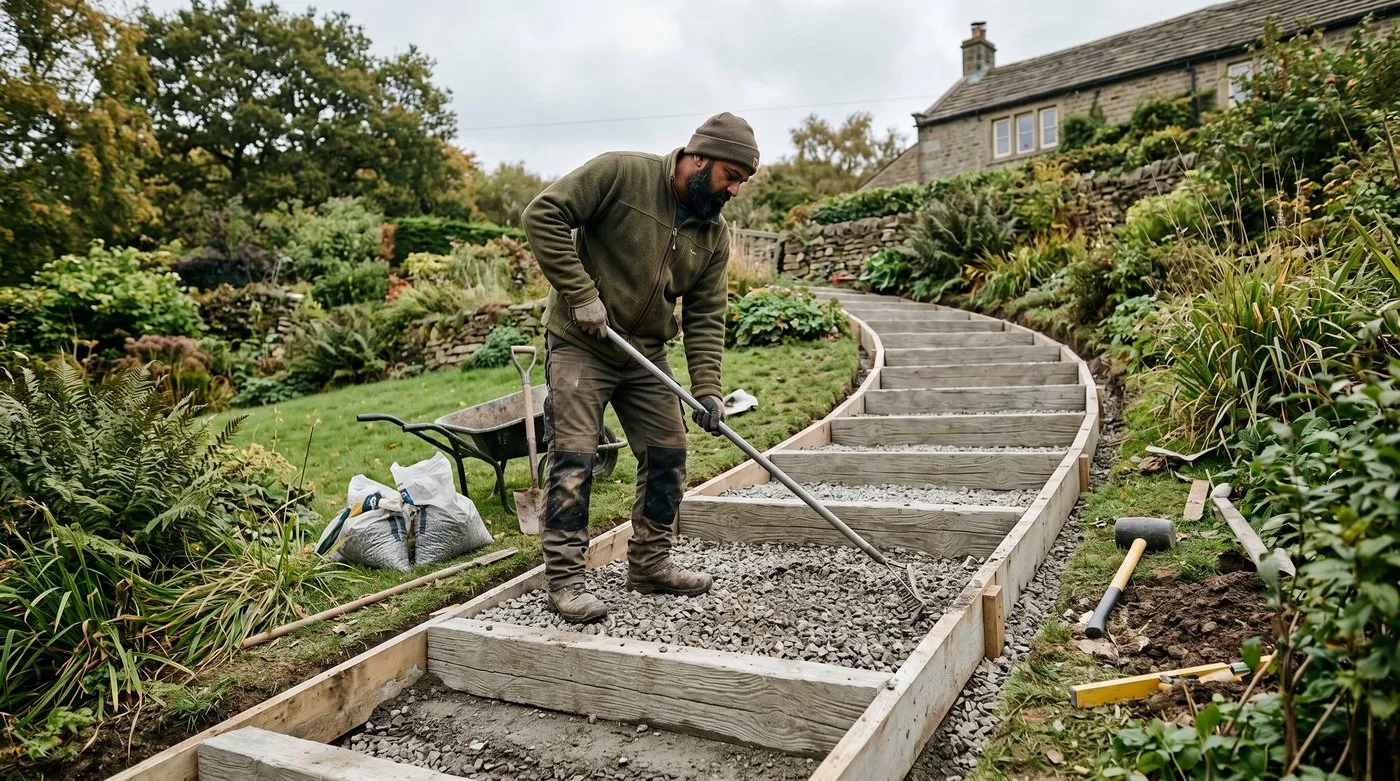 Concrete sleeper step build. Sleepers bed into 100mm compacted hardcore; gravel treads levelled to a 5-10mm forward fall for drainage
Retaining wall design: height, foundation, drainage
Retaining walls hold back soil at a higher level. They face hydraulic pressure from saturated soil behind, additional surcharge load from any traffic or buildings above, and frost heave in UK winters. Failure is expensive; design matters.
Wall height drives every other decision. Walls under 600mm are essentially garden edges; minimal engineering needed. Walls 600mm-1200mm need attention to foundations and drainage. Walls over 1200mm need structural calculations and building consent.
Foundation depth rule: wall height divided by 4, minimum 200mm. A 600mm wall needs a 200mm foundation; a 1m wall needs 250mm; a 1.5m wall needs 375mm.
Foundation must extend below local frost line. UK frost penetrates 300-450mm in most regions, deeper in Scotland. Foundations above the frost line shift each winter; soil heave cracks the wall.
Foundation material: 150-200mm concrete (C20 mix) over 100-150mm compacted MOT type 1 hardcore. Total foundation profile 250-400mm. Pour level; check with spirit level before setting.
Wall thickness in masonry: 215mm (one full brick) for walls up to 800mm. 327mm (one-and-a-half bricks) for walls 800mm-1500mm. Engineered concrete blocks (215mm) work to 1500mm with steel reinforcement.
Wall thickness in dry stone: 50-65% of wall height. A 1m dry stone wall needs to be 500-650mm thick at the base. This is the reason traditional dry stone walls look so substantial.
Lean back into the slope (batter): 1:6 to 1:8. A 1m-high wall leans back 125-165mm at the top. This adds stability against hydraulic pressure.
Drainage layer 100mm wide of clean 20mm gravel runs vertically behind the wall the full height. Lay perforated 100mm pipe at the base inside the gravel, exit to daylight or soakaway.
Weep holes 50mm diameter open pipes through the wall at the base, spaced 1-2m apart along the length. Allows trapped water to escape. Without weep holes, even a perfect gravel layer fails.
Geotextile fabric between the gravel layer and the soil prevents fine particles washing into the gravel and blocking drainage.
Building Regulations and planning consent
Garden retaining walls over 1m height adjacent to a highway need planning consent. Lower walls usually fall under permitted development. Check with your local authority before building.
Retaining walls over 2m height anywhere need planning consent. Building Regulations Part A (structure) applies above this height; structural calculations from a chartered engineer required.
Garden steps over 600mm total rise need a handrail under Building Regulations Part K. Private gardens are less strictly enforced than public access, but installing one is best practice for safety, particularly for older users and children.
Handrail height 900-1000mm above the pitch line. Continuous along the flight. Capable of withstanding 0.36 kN per metre force.
Steps onto a highway (pavement, road, public footpath) need additional consents and may need to comply with public access standards (1:12 gradient for ramps, tactile paving, etc.).
Listed buildings and conservation areas have additional consent requirements. Almost any external alteration needs prior approval.
Party walls (walls on or near a boundary with a neighbour) require Party Wall Act notification 2 months before work starts.
Boundary disputes are the biggest non-technical risk. Establish the boundary line with the neighbour before building; written agreement saves litigation.
| Wall height | Consent needed | Engineering |
|---|---|---|
| Under 600mm | None typically | Basic foundation |
| 600mm-1200mm | None typically | Designed foundation |
| 1200mm-2000mm | Sometimes (adjacent highway) | Engineered design |
| Over 2000mm | Yes (Part A) | Structural calcs required |
Materials for retaining walls
Stone (dry-laid): Reclaimed local stone is the traditional finish. £120-£300 per square metre face. Needs skilled stoneworker; not a DIY material.
Stone (cement-laid): Combines stone face with mortar joints. £150-£350 per square metre face. Allows DIY building.
Concrete sleeper: Concrete-cast sleepers stacked or set on edge. Brutalist contemporary finish. £60-£150 per square metre.
Concrete block (rendered): Building blocks rendered with painted finish. £80-£150 per square metre. Plain but functional.
Gabion baskets: Wire mesh baskets filled with stone. £60-£150 per square metre. Contemporary look, drains naturally, fast to build.
Corten steel sheet: Pre-weathered rusted-brown steel. £200-£500 per square metre. Architectural finish, very contemporary.
Modular interlocking concrete blocks: Marshalls Tegula or Bradstone systems. £80-£180 per square metre. DIY-friendly, fast, look engineered.
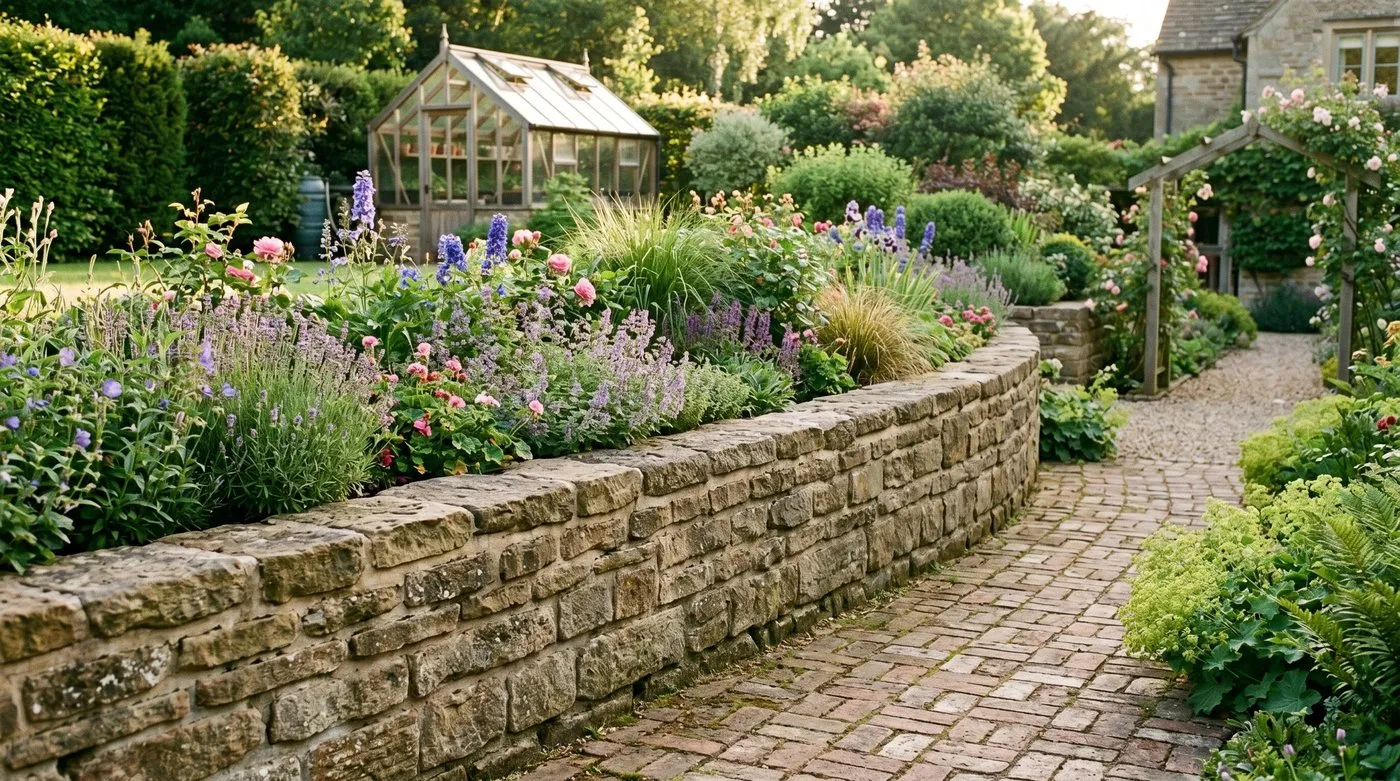 Reclaimed local sandstone wall, cement-laid for DIY buildability. 1m height, 250mm foundation, 100mm gravel drainage behind, weep holes every 1.5m at the base
Terracing a sloping garden
Terracing converts a slope into a series of level platforms. Each terrace needs a retaining wall at the lower edge, steps connecting the levels, and planting designed for the available depth of soil.
Terrace depth (the level platform): 1.5-3m minimum for useable garden space. Narrower than 1.5m feels constrained; wider than 3m may need its own internal level change.
Vertical drop per terrace: 400-800mm typical. Matches one short retaining wall and 3-5 steps.
Slope angle analysis first. A 1:10 slope (10% gradient) probably does not need terracing; planting can carry the level change. A 1:3 slope (33%) definitely needs terracing for usable space.
Plan steps and walls together. Walls and steps form one structural system. Build foundations and drainage as a continuous design, not piecemeal.
Plant cascading species on each wall face. Trailing rosemary, alpine plants, hardy geraniums, and Aubrieta soften the hard edge and tie levels visually.
Consider water drainage across the full slope. Each terrace creates a potential water trap. Plan a continuous drainage path from top to bottom; otherwise water pools on each level and damages walls.
Service routes (hose, paths) along the terrace edges. Plan utility access into the design before building.
Lighting in step risers and along walls extends usability into the evening and improves safety.
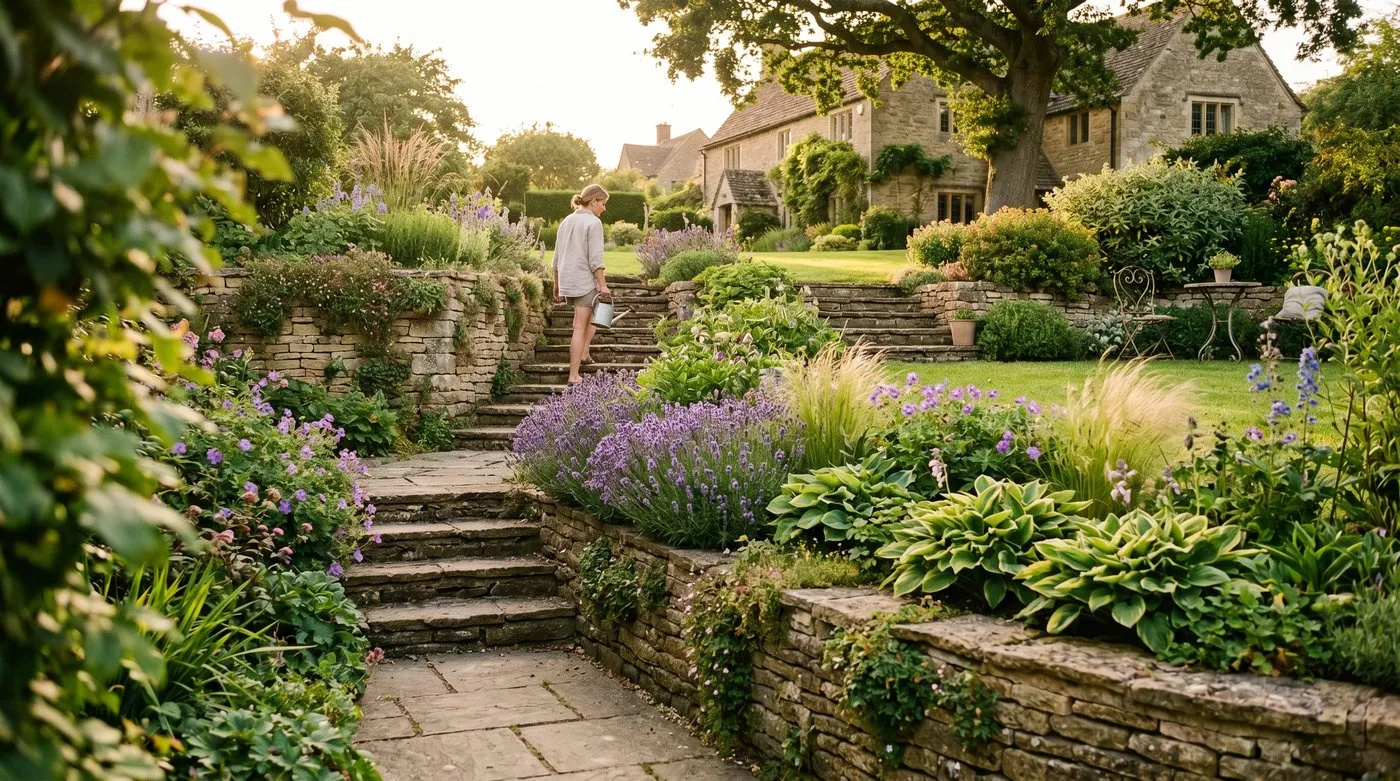 Three-level terraced garden on a former 1:4 slope. Each terrace 2-3m deep with a 600-800mm retaining wall and 5-step flights between levels
Common mistakes to avoid
Skipping the drainage layer. Walls without 100mm gravel plus weep holes fail within 3-7 winters. Adding drainage after the fact requires demolition.
Foundation too shallow. Foundations above the frost line heave in winter and crack walls within 5 years.
Risers too tall. Steps with risers above 180mm tire users and discourage use. Match the 130-160mm comfort range.
Brick choice wrong for UK frost. Facing brick spalls (flakes off) in UK winter freeze-thaw. Use engineering brick rated F2 frost resistance minimum.
Skipping planning consent for tall walls. Walls over 1.2m adjacent to highway, or over 2m anywhere, need consent. Building without consent risks demolition order.
No balustrade on steep flights. Steps with total rise over 600mm need a handrail. Skipping this is unsafe and breaches Building Regulations.
Step-by-step: building a 1m retaining wall
Step 1: mark the wall position with string lines and pegs. Set the line straight or to a planned curve.
Step 2: dig the foundation trench. 250mm deep, 400mm wide (wider than the wall thickness for stability).
Step 3: extend the trench down to below frost line. 300-450mm depending on UK region.
Step 4: compact a 100mm layer of MOT type 1 hardcore. Wacker plate or hand-tamp.
Step 5: pour 150mm concrete foundation (C20 mix). Level with spirit level.
Step 6: allow 48 hours to cure. Cover with plastic if rain forecast.
Step 7: build the first course of wall units (brick, block, stone). Bed in mortar (1:5 cement to sand for brick; 1:6 for stone).
Step 8: continue courses to full height. Maintain a 1:6 to 1:8 batter back into the slope. Use a spirit level on every course.
Step 9: install weep holes during construction. 50mm pipe through the wall at the base, every 1-2m along the length.
Step 10: install drainage layer behind the wall. Geotextile fabric, 100mm gravel layer, perforated 100mm pipe at base inside the gravel.
Step 11: backfill above the gravel with the original excavated soil. Tamp lightly to settle.
Step 12: top the wall with a coping stone or capping brick. Sheds water off the top and gives a finished line.
Cost estimate for a typical UK terracing project
Example: 5m of 1m-high wall plus 8 step risers connecting two levels.
- Materials: brick (£800), foundation concrete (£200), drainage gravel and geotextile (£150), step materials (£400) = £1,550
- Labour (skilled bricklayer, 5 days at £250/day): £1,250
- Hire of mixer and tools: £150
- Skip hire for excavated soil: £200
- Total: £3,150
DIY equivalent (if you have the skills): Materials and hire only at £2,100. Saves £1,050.
Premium finish equivalent (reclaimed sandstone with stoneworker): £6,000-£9,000 for the same job.
Budget option (concrete sleepers and gravel treads): £1,800-£2,500 total.
| Element | Budget | Mid-range | Premium |
|---|---|---|---|
| 5m of 1m wall plus 8 steps | £2,000-£2,800 | £3,000-£4,500 | £6,000-£9,000 |
| Cost per square metre | £150-£200 | £250-£350 | £450-£600 |
| Build time | 3-5 days | 5-7 days | 7-12 days |
| Material | Concrete sleeper, brick | Engineering brick, paviour | Sandstone, York stone |
Frequently asked questions
What is a comfortable height for garden steps?
Garden step risers should be 130-160mm tall with treads 350-400mm deep. This matches the standard comfortable walking pace. Risers below 100mm feel cramped; risers above 180mm feel tiring and aggressive. The ‘two-rise-plus-tread = 650-680mm’ rule applies: 2x150 plus 380 = 680mm. Long flights over 12 risers need a landing of 600-1000mm to break the rhythm.
How deep should the foundation be for a garden retaining wall?
Foundation depth equals retaining wall height divided by 4, with a 200mm minimum. A 600mm wall needs a 200mm-deep foundation; a 1.2m wall needs 300mm. Foundations must extend below the local frost line (300-450mm in most UK regions) to prevent winter heave damage. Use 150-200mm of concrete over 100-150mm of compacted hardcore for typical garden walls.
Do retaining walls need drainage?
Yes, drainage is essential. Behind every retaining wall install a 100mm-wide vertical layer of clean gravel, and weep holes (50mm pipes through the wall) every 1-2 metres at the wall base. Without drainage, hydraulic pressure from accumulated water in winter pushes walls over. Water-related failure is the single biggest cause of UK garden wall collapse. Add a geotextile fabric between gravel and soil to prevent blockage.
Do garden steps need a handrail?
Steps with a total rise over 600mm require a handrail or balustrade under Building Regulations Part K. The handrail must be 900-1000mm above the pitch line, continuous along the flight, and capable of withstanding 0.36 kN per metre. Garden steps in private gardens are less strictly enforced than public access, but installing one is best practice for safety, particularly for older users and children.
What does it cost to build garden steps in the UK?
UK garden steps cost £150-£500 per square metre depending on materials and complexity. Concrete sleeper risers with gravel treads sit at the low end (£100-£200 per metre run). Sandstone or York stone steps sit at the high end (£400-£800 per metre run). Foundation prep, drainage, and labour typically add 40-60% to material costs. DIY can save 50% on labour if you have the skills.
Our team produces practical UK gardening guidance from source research, contributor records and established horticultural practice. Editorial standards are overseen by Matt W.