Key takeaways
- Alpine troughs are 60cm x 30cm x 15cm shallow containers with sharp drainage
- Compost mix: 1 part John Innes No.2, 1 part grit, 1 part horticultural sand
- Six recipe options cover sun, shade, acid soil, woodland and sink garden styles
- Sempervivums need almost no watering once established (3-4 times a year)
- A planted trough lasts 8 to 15 years before needing rejuvenation
- Tap water with high lime content kills most acid-loving alpines
An alpine trough is one of the most rewarding small-scale plantings in a UK garden. A shallow container, a gritty mix, and a tight grouping of high-altitude small plants give you a year-round miniature mountain scene that needs almost no watering, stays interesting through winter, and lasts a decade or more.
This guide covers the trough itself, the compost mix, six classic UK planting recipes, and the year-round care that keeps an alpine display alive. After 14 years of running alpine troughs in Staffordshire, here is the playbook.
What makes a trough an alpine trough
Three things distinguish an alpine trough from any other container.
- Shallow depth. Typically 15 to 20cm. Alpines have shallow root systems adapted to thin scree soils.
- Sharp drainage. The compost mix drains in seconds. Alpine plants tolerate cold dry winters but rot in cold wet winters.
- A gritty top dressing. A 1-2cm mulch of horticultural grit on the surface. Keeps stems dry, prevents weed germination, mimics natural alpine habitat.
Get any of these wrong and the planting fails within one winter. The same scree principles scale up to open ground in a crevice garden, where slabs set on edge keep the crowns dry.
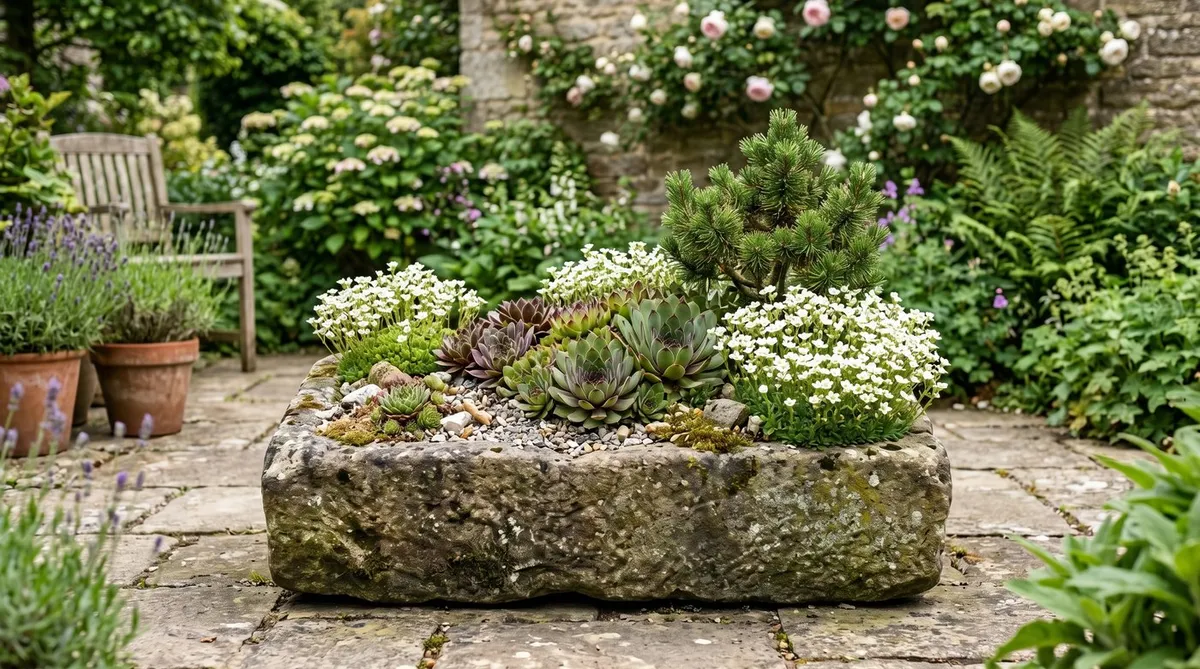
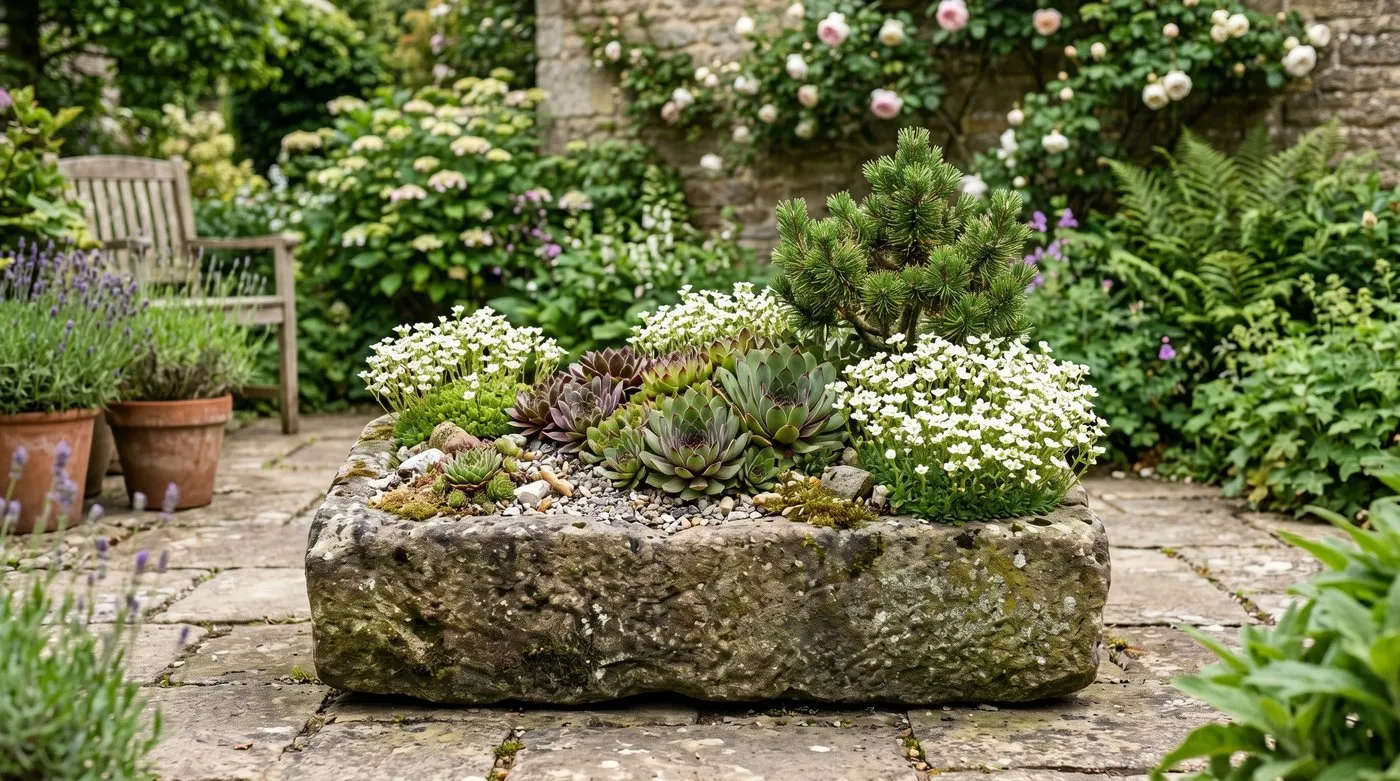 An established alpine trough in late spring. Sempervivums in foreground, dwarf saxifrage in flower, a Picea abies ‘Little Gem’ as the structural element at the back.
Choosing a trough
Five trough materials work for UK alpine gardening. Each has its own look, price, and weight.
| Trough | Size 60x30x15cm | Cost | Weight | Look |
|---|---|---|---|---|
| Stone (real) | Genuine antique | £180-£420 | 60-90kg | Authentic, ages beautifully |
| Hypertufa (DIY) | Make your own | £25-£35 in materials | 30-50kg | Convincing stone substitute |
| Reconstituted stone (cast) | Garden centre | £55-£140 | 35-50kg | Good imitation, lasts decades |
| Glazed ceramic | Garden centre | £45-£95 | 18-28kg | Bright, modern, less authentic |
| Wooden trough (lined) | DIY or kit | £30-£75 | 12-18kg | Country, lasts 8-12 years |
The hypertufa DIY route is the best value. You mix Portland cement with coir and perlite, mould around a cardboard box, and produce a stone-look trough for £30 that ages to look 50 years old within two years.
Drainage holes
The trough needs at least three 25mm drainage holes in the base. A single hole blocks easily. Cover each hole with broken terracotta crocks or wire mesh to prevent compost loss.
If you convert an old stone sink or trough that has no holes, drill them with a 25mm masonry bit. The trough does not work without drainage, no matter how beautiful.
The compost mix
The single most important component. The mix is 1 part John Innes No. 2, 1 part horticultural grit (4-6mm), 1 part horticultural sharp sand, by volume.
A 60cm x 30cm x 15cm trough holds approximately 27 litres of compost. So:
- 9 litres John Innes No. 2
- 9 litres horticultural grit
- 9 litres horticultural sharp sand
Total cost £12-£18 from a garden centre.
The drainage test: pour 1 litre of water onto the dry mix surface. It should disappear within 5 seconds. If it pools for longer, add more grit.
Warning: Builder’s sand is not horticultural sharp sand. Builder’s sand contains fines that bind together when wet, creating concrete-like clogging. Always specify “horticultural sharp sand” or “lime-free sharp sand” from a garden centre.
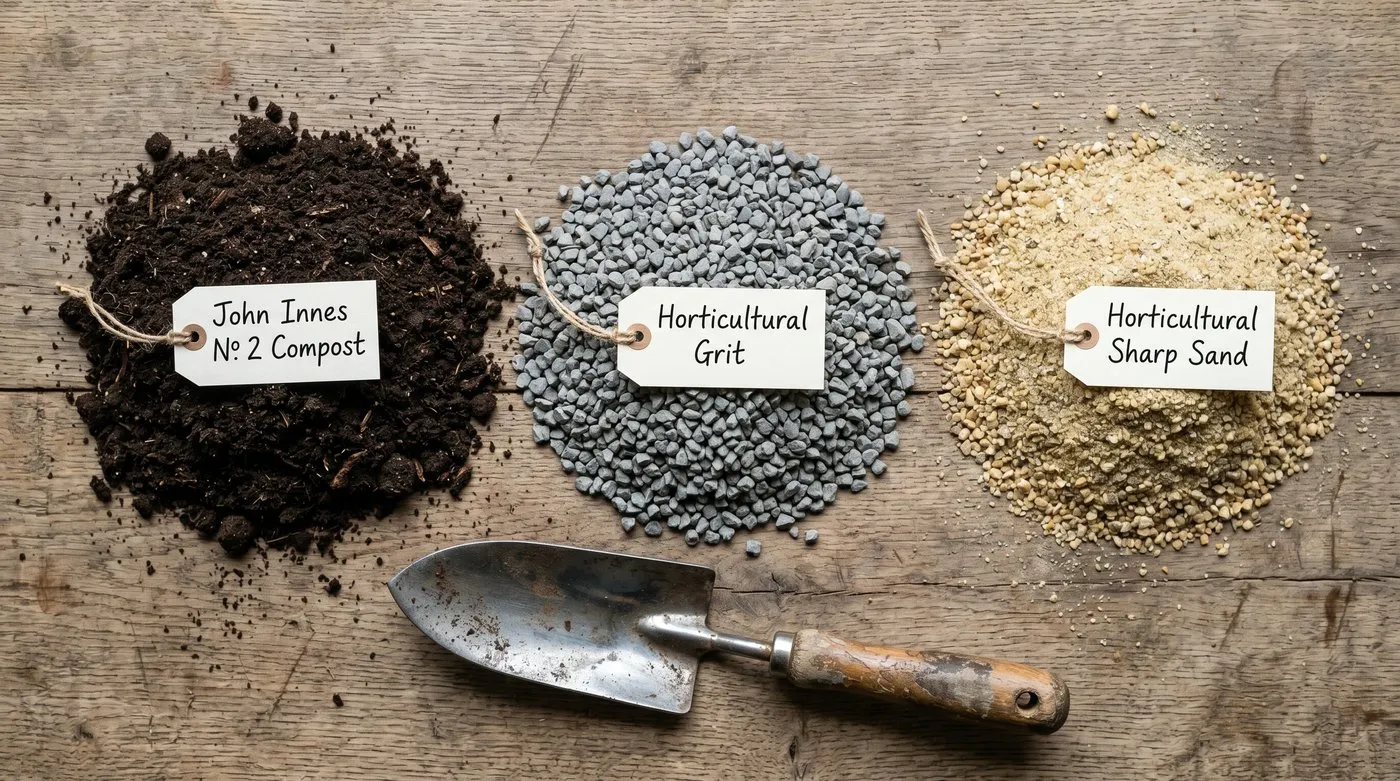 The 1:1:1 alpine compost mix. John Innes No. 2 (left), horticultural grit (centre), horticultural sharp sand (right). Equal volumes mixed thoroughly before filling the trough.
Six classic recipes
Each recipe suits a different garden aspect or planting style. All assume a 60cm x 30cm x 15cm trough.
Recipe 1: Sunny scree (full sun, south facing)
The simplest and most reliable trough planting. Tolerates heat and drought.
| Plant | Quantity | Position |
|---|---|---|
| Sempervivum ‘Mahogany’ | 4 | Front centre |
| Sempervivum arachnoideum | 2 | Front edges |
| Sedum ‘Cape Blanco’ | 3 | Cascading over edges |
| Sedum spathulifolium ‘Purpureum’ | 2 | Mid level |
| Dianthus ‘Pike’s Pink’ | 1 | Back left |
| Erodium reichardii | 1 | Back right |
| Picea abies ‘Little Gem’ | 1 | Back centre, structural |
| Total | 14 plants |
Plant cost: £45-£65. Survives full UK summer drought without watering. The sempervivums and sedums here sit comfortably alongside hardy cacti and succulents, so a sunny scree trough is an easy way to start a collection that lives outside through the winter. For a spring flower among the rosettes, dwarf oxalis such as Oxalis adenophylla lifts silver-grey leaves and pink cups in April.
Recipe 2: Acid trough (acidic plants, cool conditions)
For ericaceous plants that need lime-free conditions.
Replace John Innes with ericaceous compost in the mix. Use rainwater only, never tap water.
| Plant | Quantity | Position |
|---|---|---|
| Gentian acaulis | 3 | Front |
| Primula auricula ‘Hawkwood’ | 2 | Centre |
| Primula marginata | 2 | Mid level |
| Edraianthus pumilio | 2 | Edges |
| Dwarf rhododendron ‘Patty Bee’ | 1 | Back centre |
| Trillium grandiflorum (small) | 2 | Back edges |
| Total | 12 plants |
Plant cost: £55-£85. Place in part shade with morning sun only.
Recipe 3: Sink garden mix (mixed conditions)
A traditional Edwardian planting in an old stone sink.
| Plant | Quantity | Position |
|---|---|---|
| Sempervivum tectorum | 3 | Centre cluster |
| Saxifraga ‘Tumbling Waters’ | 2 | Front edges |
| Dianthus alpinus | 2 | Mid level |
| Thymus serpyllum ‘Coccineus’ | 2 | Cascading over edges |
| Helianthemum ‘Wisley Pink’ | 1 | Back |
| Juniperus communis ‘Compressa’ | 1 | Back centre, structural |
| Total | 11 plants |
Plant cost: £40-£60. The classic mix every UK alpine grower starts with.
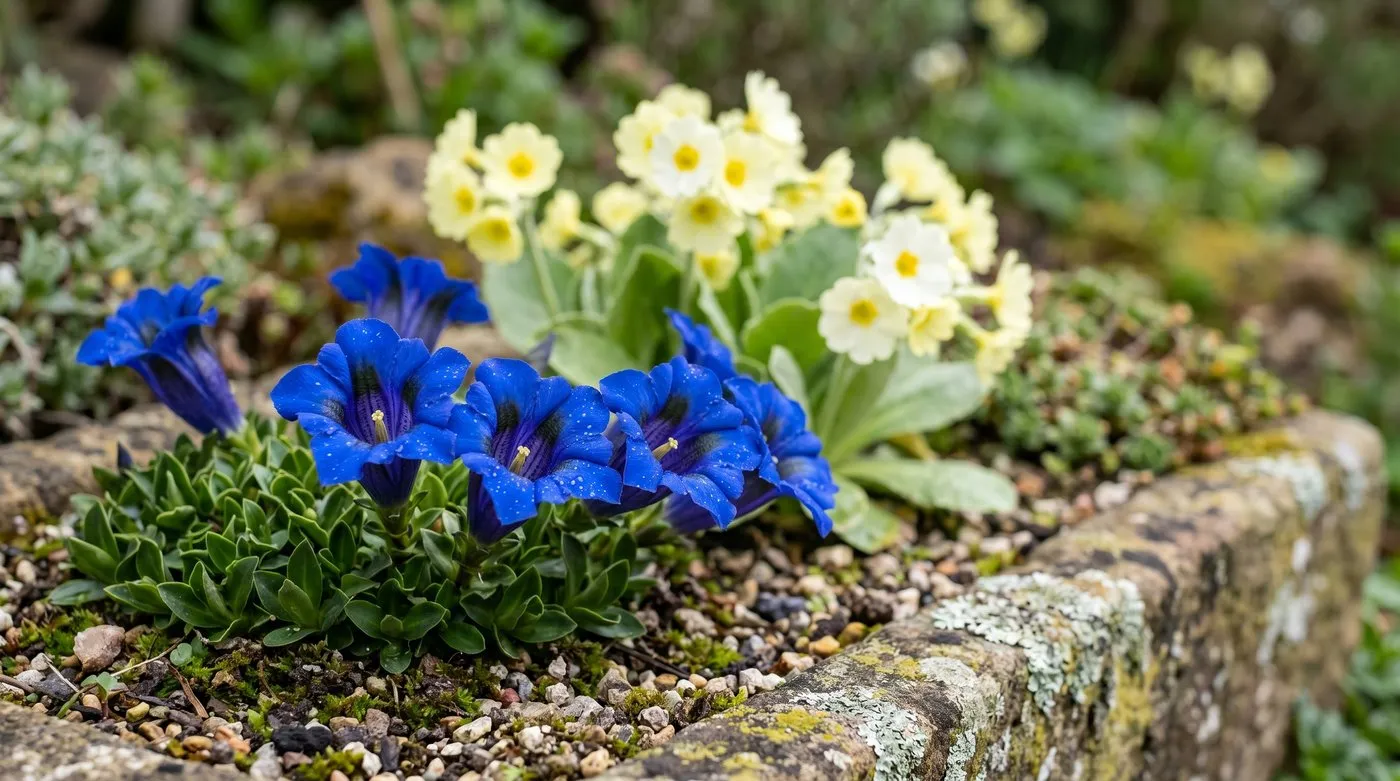 Recipe 2 in late April. Gentian acaulis (deep blue trumpets at front), Primula auricula (centre) and dwarf rhododendron ‘Patty Bee’ (back). Ericaceous mix and rainwater only.
Recipe 4: Woodland alpine (shade trough)
For a north-facing or shady spot.
| Plant | Quantity | Position |
|---|---|---|
| Saxifraga umbrosa | 3 | Front |
| Primula vulgaris ‘Wanda’ | 2 | Centre |
| Cyclamen hederifolium | 2 | Edges (will multiply) |
| Dryopteris affinis ‘Crispa Gracilis’ (dwarf fern) | 1 | Back left |
| Adiantum venustum | 1 | Back right |
| Galanthus nivalis (small bulbs) | 12 | Scattered |
| Total | 9 plants + 12 bulbs |
Plant cost: £45-£75. Provides spring colour and summer fern foliage in deep shade.
Recipe 5: Drought-resistant Mediterranean (hot sunny spot)
For Mediterranean alpine plants tolerating heat and drought.
| Plant | Quantity | Position |
|---|---|---|
| Sempervivum heuffelii | 4 | Front cluster |
| Sedum dasyphyllum | 3 | Cascading edges |
| Aubrieta deltoidea | 2 | Mid front |
| Cerastium tomentosum (snow in summer) | 1 | Back left |
| Pulsatilla vulgaris | 2 | Back centre |
| Iris reticulata ‘Harmony’ bulbs | 10 | Scattered |
| Total | 12 plants + 10 bulbs |
Plant cost: £40-£60. Spring iris bulbs followed by summer foliage and flowers.
Recipe 6: Spring bulb trough
Spring-only display, dormant after May.
| Bulb | Quantity |
|---|---|
| Crocus sieberi ‘Tricolor’ | 20 |
| Iris reticulata ‘Harmony’ | 15 |
| Narcissus ‘Minnow’ | 12 |
| Anemone blanda ‘White Splendour’ | 15 |
| Galanthus nivalis | 20 |
| Total bulbs | 82 |
Bulb cost: £28-£42. Plant October. Flowers February through May. Then plant Sempervivums for summer cover over the dormant bulbs.
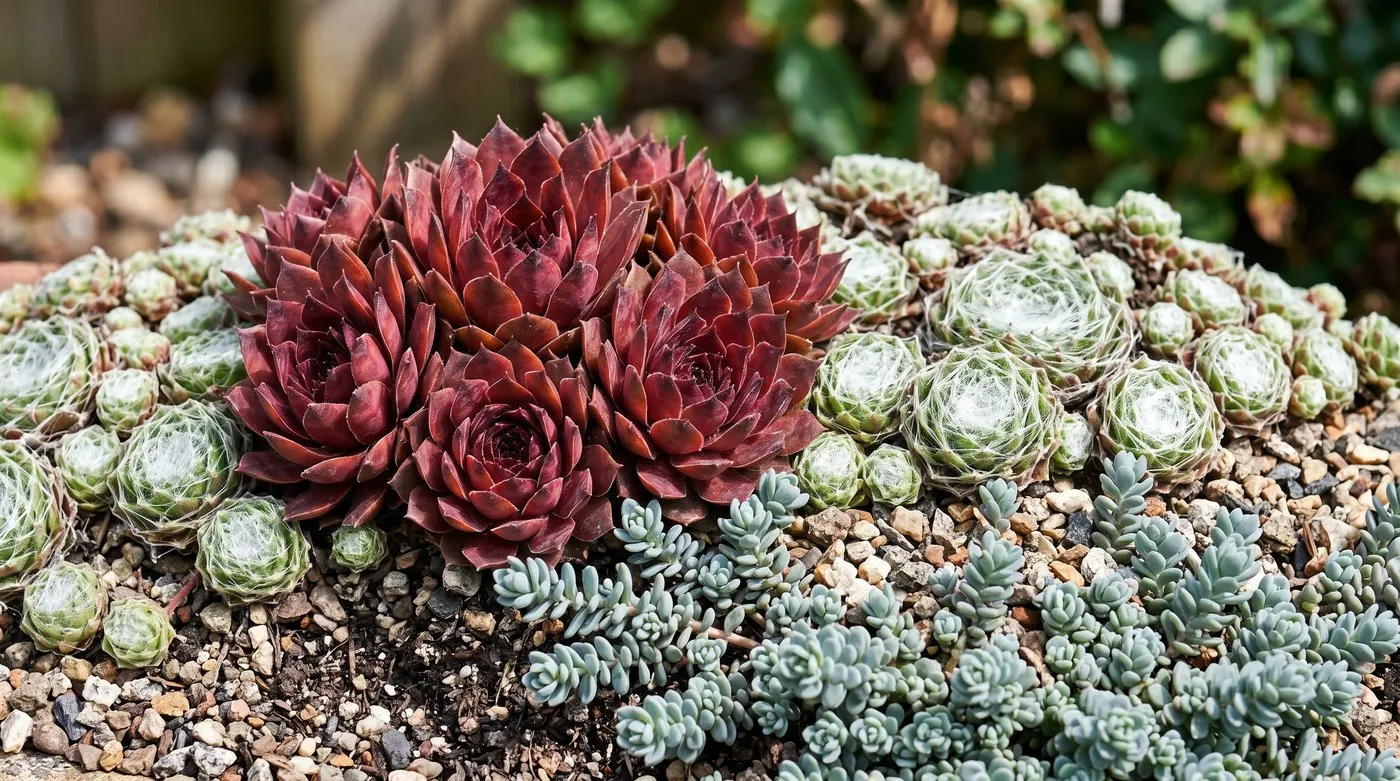 Recipe 1 in mid-summer. Sempervivum ‘Mahogany’ (centre), Sempervivum arachnoideum (cobweb form), and cascading Sedum ‘Cape Blanco’ over the front edge.
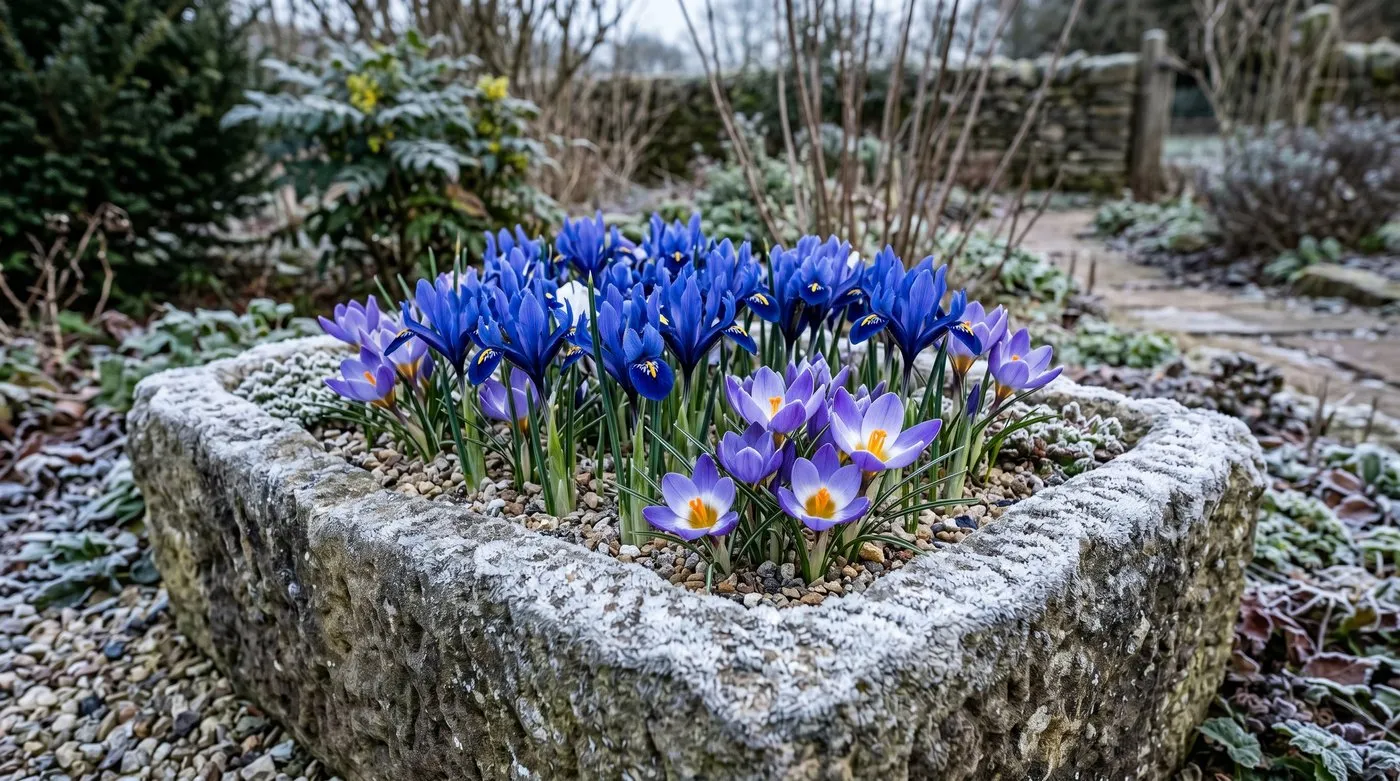 Recipe 6 in February. Iris reticulata ‘Harmony’ and Crocus sieberi ‘Tricolor’ in flower. The trough wakes earliest in the garden, before any border bulbs are showing.
Planting the trough
The build sequence matters. Get it wrong and you compress roots or trap air pockets.
- Cover drainage holes with crocks or wire mesh. Stops compost washing out.
- Add 25mm of coarse grit at the base. Reinforces drainage.
- Fill with alpine compost mix to within 25mm of the rim.
- Place plants in their pots on the surface to plan positions. Move around until happy with the layout.
- Plant the largest (structural) plant first. Dwarf conifer at the back if used.
- Plant medium plants next. Saxifrage, primula, etc.
- Plant smaller cushion and ground cover last. Sempervivums, sedums, edge plants.
- Add a 1-2cm grit mulch over the whole surface. Right up to the stems.
- Water lightly to settle. Just enough to moisten, not to soak.
Total planting time: 45 minutes to 1 hour.
Year-round care
Alpine troughs need less work than almost any other container planting.
Watering
The single biggest mistake is over-watering. Established troughs need watering:
- March to April: Once after a dry March
- May to June: Once if rainfall under 30mm/month
- July to August: Once a fortnight in extended drought
- September: Once if needed
- October to February: Never (rainfall is sufficient)
A trough is properly watered if the grit mulch is dry at the surface but the compost 25mm below is slightly moist when probed with a finger.
Feeding
Minimal. A single half-strength application of liquid feed (Tomorite or similar) in late April provides enough nutrients for the season. Over-feeding produces soft growth and reduces flower density.
Top dressing
Each March, top up the grit mulch where needed. Brush old grit aside, replace with fresh, work in around any new plants added.
Replanting
Every 5-7 years, lift and divide sempervivums (they multiply rapidly). Replace any failed plants. The dwarf conifers and slow growers can stay in place for 15+ years.
Tip: Sempervivums produce “chicks” (small offset rosettes) each year. Detach them at year 2-3 and plant them into a new trough. By year 4 you have populated 2-3 troughs from one original plant.
Common alpine trough mistakes
Mistake 1: using multipurpose compost
Standard peat-based or peat-free multipurpose compost is too retentive. Alpines drown in it. Always use the 1:1:1 alpine mix. No exceptions.
Mistake 2: planting too densely
A new alpine trough looks sparse. The temptation is to add more plants. Resist it. Sempervivums and sedums double their size within two years. A trough planted at recommended spacing looks perfect by year three.
Mistake 3: positioning in heavy shade
Most alpines need 6+ hours of direct sun daily. A trough in deep shade fails. If your site is shady, choose Recipe 4 (woodland alpine) with shade-tolerant plants.
Mistake 4: watering in winter
Alpine roots in cold wet UK winters rot easily. Stop watering completely from October through February. Cover the trough with a sheet of clear glass or plexiglass if winter rainfall is excessive, propped up on bricks for ventilation.
Mistake 5: applying tap water to acid-loving alpines
Many UK water supplies are hard (high calcium). This kills gentian, rhododendron, primula vulgaris, and most ericaceous plants within months. Use rainwater only for Recipe 2 (acid trough).
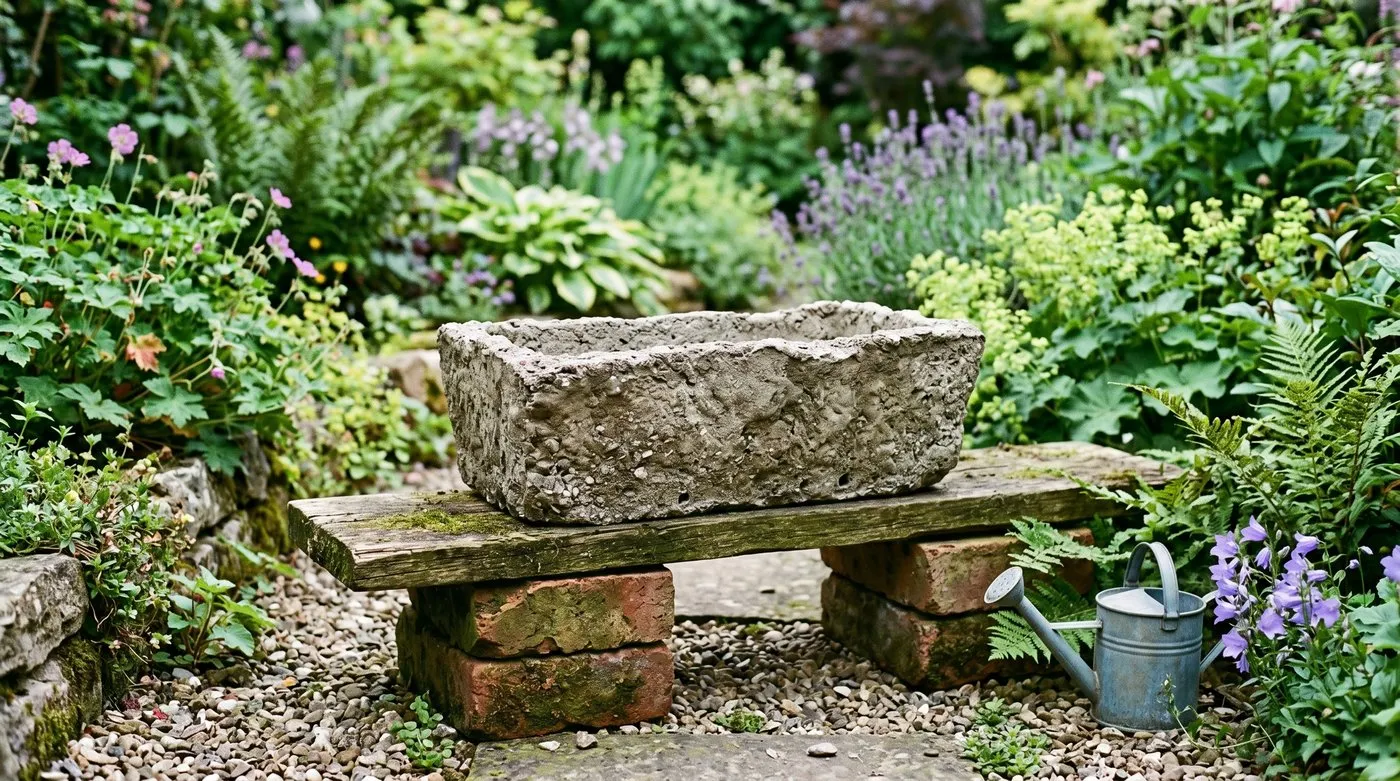 A hypertufa trough being moulded from a 1:1.5:1.5 mix of cement, coir and perlite. Total materials £25-£35. The finished trough ages to look like real stone within two years.
Where to buy alpine plants
Three specialist UK alpine nurseries supply the full range.
- Pottertons Nursery (Lincolnshire). The leading UK alpine nursery. Mail order across the UK. pottertons.co.uk
- D’Arcy & Everest (Cambridgeshire). Specialist in dwarf bulbs and rarer alpine species. darcyeverest.co.uk
- Aberconwy Nursery (North Wales). Mountain plants and dwarf rhododendrons. aberconwynursery.co.uk
All three are mail order and ship UK-wide. Pottertons holds the Plant Heritage National Collection for Auriculas and is the best starting point for any UK alpine grower.
Building your own hypertufa trough
A hypertufa trough is a lightweight stone-look container made from cement, coir, and perlite. The result looks indistinguishable from real stone within two years.
Materials (one 60cm trough)
- 5kg Portland cement
- 7.5L coir (or peat substitute)
- 7.5L coarse perlite
- Water
- Cardboard box, 60cm x 30cm x 20cm (mould)
- Plastic sheeting
- Wire mesh (optional, for reinforcement)
Total materials cost: £25-£35.
Method
- Mix the dry ingredients in a wheelbarrow (cement, coir, perlite at 1:1.5:1.5 by volume)
- Add water gradually until the mix holds together when squeezed but is not soupy
- Line the cardboard box with plastic sheeting
- Pack 40mm of mix into the bottom
- Place a smaller cardboard box inside (40mm smaller all round) and pack the mix into the gap, building the walls
- Insert wooden dowels for drainage holes (remove after 24 hours)
- Cover with plastic and let cure for 7 days
- Remove cardboard, brush surface to expose texture
- Cure outdoors for another 4 weeks before planting (allows lime to leach)
The finished trough weighs around 25kg and looks like aged stone within two seasons.
Month-by-month alpine trough calendar
| Month | Task |
|---|---|
| January | Cover with glass if rainfall heavy. Check for waterlogging. |
| February | Allow first crocus and iris to flower. No watering needed. |
| March | Top up grit mulch. Apply half-strength liquid feed. |
| April | First major flowering display. Inspect for winter losses. Replace any failed plants. |
| May | Peak flowering for most alpine genera. Continue minimal watering. |
| June | Cut back primulas and saxifrages after flowering. |
| July | Watch for drought stress. Water once a fortnight if needed. |
| August | Detach sempervivum chicks for new troughs. |
| September | Plant spring bulbs in Recipe 6 troughs. |
| October | Stop all watering. Cover acid trough with glass for winter wet protection. |
| November | Inspect drainage holes. Clean any debris from grit surface. |
| December | No work needed. Enjoy structural plants through frost. |
Where to read more
The Alpine Garden Society is the UK’s specialist body. Members publish detailed cultivation notes for thousands of species. The Royal Horticultural Society alpine pages cover the basic species suitable for UK gardens.
Troughs look their best with company, so try grouping pots for a layered display at varied heights.
Frequently asked questions
What is an alpine trough?
A shallow long container (typically 60cm x 30cm x 15cm) planted with high-altitude small plants in a free-draining grit-based mix. Originally a converted stone sink or animal trough in Edwardian gardens, the modern version uses hypertufa, stone or concrete and replicates a mountain scree habitat.
What plants suit an alpine trough UK?
Sempervivums (houseleeks), sedums, saxifragas, dianthus, erodium, dwarf primulas, gentians, dwarf conifers (Picea abies ‘Little Gem’, Juniperus communis ‘Compressa’), and dwarf spring bulbs (Crocus sieberi, Iris reticulata, Anemone blanda). Choose plants that stay under 25cm tall.
What compost mix do alpines need?
Equal parts John Innes No. 2 loam-based compost, horticultural grit (4-6mm), and horticultural sharp sand. The mix must drain in under 5 seconds when water is poured on the surface. Standard multipurpose compost rots alpine roots within one wet UK winter.
How often should I water an alpine trough?
Sparingly. Most established alpine troughs need watering 3-4 times a year, mainly in extended summer drought. Sempervivums tolerate weeks of no watering. Over-watering kills more alpines than under-watering. The grit mulch on top tells you when to water - if it stays damp, do not water.
Do alpines need full sun?
Most do. Sempervivums, sedums, dianthus, and erodium need 6+ hours of direct sun daily. Saxifrage, primula, and some gentian tolerate partial shade. Plan the planting based on the trough’s aspect, not on a generic alpine mix.
Can I make a trough myself?
Yes. Hypertufa (1 part cement, 1.5 part sphagnum peat substitute or coir, 1.5 part perlite) makes a lightweight stone-look trough for under £30 in materials. Old butler sinks coated in hypertufa look identical to expensive bought stone troughs at one-tenth the cost.
How long does an alpine trough last?
Eight to 15 years with annual top-dressing and partial replanting. Sempervivums multiply each year and need thinning at year 5-7. Slower plants like dwarf conifers can stay in place for 15+ years. Replace the top 5cm of compost annually to refresh nutrients.
Now you have the recipes
Six recipes, one drainage mix, a 60cm trough, and the discipline to under-water rather than over-water. That combination delivers a UK alpine planting that runs for a decade or more with almost no maintenance.
Our team produces practical UK gardening guidance from source research, contributor records and established horticultural practice. Editorial standards are overseen by Matt W.