Key takeaways
- 70% structural plants (clipped balls, grasses, hedges) hold the design through 12 months
- 30% loose romantic flowers (cosmos, foxgloves, sweet peas) carry summer colour
- Three-layer height rule: 1.8m back, 0.8m middle, 0.3m front for a 12sqm border
- Three colours plus white only; no rainbow planting in the contemporary cottage style
- Matrix planting: repeat each structural plant 3 to 5 times across the border
- Budget: £480 to £720 for a 12 square metre border at year-one plant prices
The traditional UK cottage garden is a romantic idea that collapses in practice. By mid-July the hollyhocks are leaning, the delphiniums need staking, the love-in-a-mist is over, and the whole bed reads as a brown wreck for three months. The contemporary cottage garden keeps the romance but adds the architecture that holds the design through twelve months. The rule is simple: 70% structural plants, 30% loose romantic flowers.
For wider design context, see garden design principles for beginners and the traditional cottage garden planting plan.
The 70/30 framework explained
The ratio is the heart of the style. Seventy per cent structural and architectural plants form the design’s backbone. Thirty per cent loose romantic flowers fill the air with summer colour and self-sown drifts. The split is by ground area, not by plant count.
The structural 70% does the heavy lifting:
- Clipped evergreens (Buxus, box, yew, hebe) for year-round mass
- Ornamental grasses (Stipa, Calamagrostis, Hakonechloa) for movement and winter texture
- Long-lived perennials (alchemilla, hardy geranium, sedum) for foliage and reliability
- Evergreen herbs (lavender, rosemary, sage) for scent and form
The romantic 30% adds the summer drama:
- Self-sowing annuals (cosmos, nigella, Ammi majus, opium poppies)
- Short-lived biennials (foxgloves, honesty, sweet rocket, Verbascum)
- Cottage classics (sweet peas, hollyhocks, delphiniums) used sparingly
- Tall airy perennials (Verbena bonariensis, Thalictrum, fennel)
The structural layer keeps the garden readable from October to April when the romantic layer is cut to the ground. By May the loose flowers reappear among the clipped mass and the garden reaches peak fullness from late May to late September.
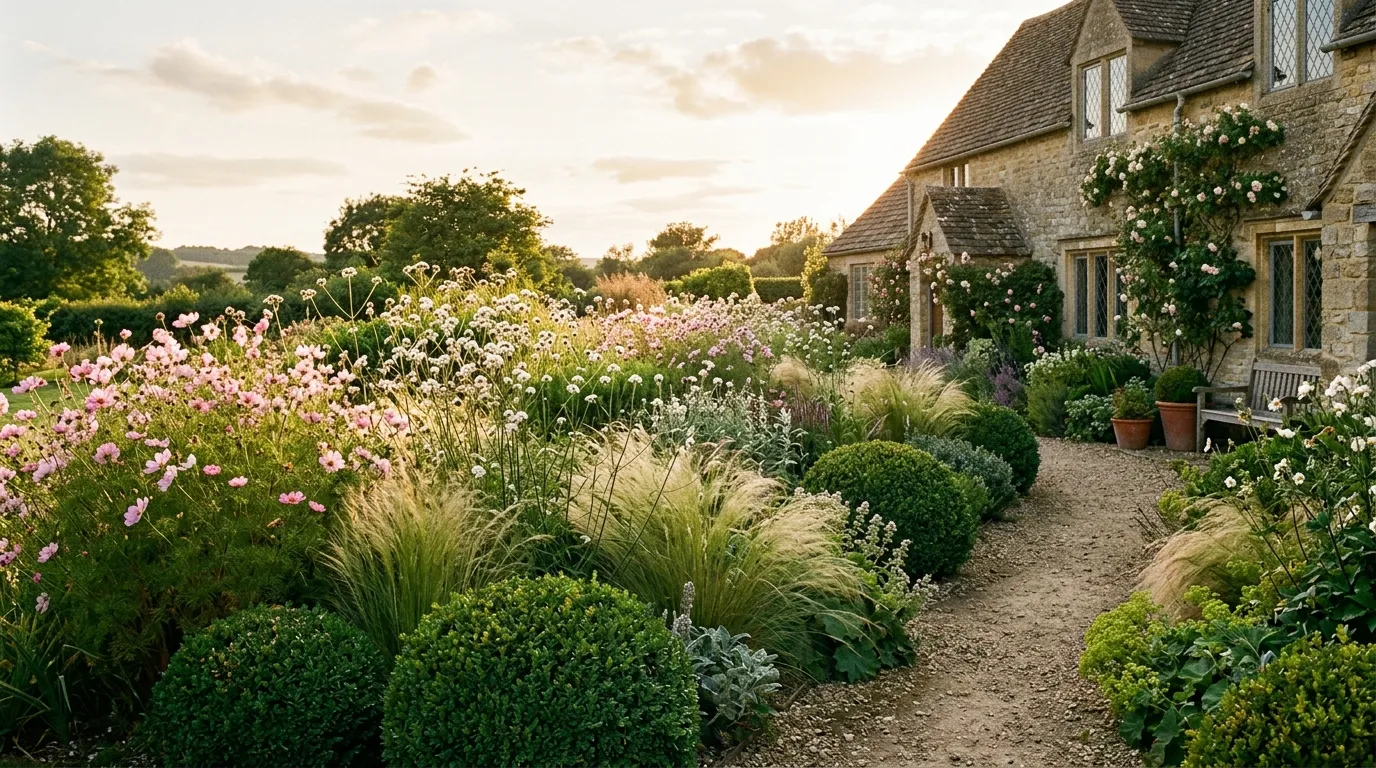 The 70/30 ratio in practice: clipped balls and ornamental grasses hold the bones; the loose flowers fill the air for 17 weeks of summer.
Layer 1: The structural skeleton (40% of border area)
Forty per cent of the border goes to the heaviest, most visible structural plants. These are the clipped or architectural pieces that read as a sculpture in winter and a backdrop in summer.
The reliable UK list:
| Plant | Form | Mature size | Trim schedule |
|---|---|---|---|
| Buxus sempervirens (box ball) | Clipped sphere | 60-90cm | Once in June |
| Hebe rakaiensis | Natural dome | 70-90cm | Light trim May |
| Hornbeam (Carpinus betulus) | Clipped column or lollipop | 1.5-2.0m | Twice (June and August) |
| Yew (Taxus baccata) | Clipped pyramid | 1.5-1.8m | Once in August |
| Pittosporum tenuifolium ‘Tom Thumb’ | Natural mound | 80-100cm | Light tidy April |
Plant in groups of three or five, repeated across the border at irregular spacing. The rhythm matters as much as the individual plant. A line of six identical box balls reads as a hedge; three balls plus two hebes plus one hornbeam ball reads as a composition.
Pittosporum and box have struggled with box tree moth since 2018 in southern England. For low-risk alternatives see our guide on how to grow pittosporum and how to grow photinia Red Robin.
Layer 2: Mid-height fillers (30% of border area)
Thirty per cent fills the middle of the border at knee to hip height (40 to 90cm). These are the soft fillers that smooth the joints between structural plants.
| Plant | Height | Spread | Role | Months of interest |
|---|---|---|---|---|
| Lavandula angustifolia ‘Hidcote’ | 60cm | 60cm | Evergreen hedge or repeated mound | 12 (silver foliage) |
| Alchemilla mollis | 40cm | 60cm | Foliage carpet, lime froth | 9 (April-Dec) |
| Hardy geranium ‘Rozanne’ | 50cm | 90cm | Blue flower carpet | 6 (June-Nov) |
| Salvia ‘Caradonna’ | 60cm | 40cm | Dark purple spike | 4 (May-Sept) |
| Nepeta racemosa ‘Walkers Low’ | 70cm | 70cm | Soft blue haze | 5 (May-Sept) |
| Sedum ‘Matrona’ | 60cm | 60cm | Late season pink, winter stems | 8 (June-Feb) |
These are the workhorses. Each one is a long-lived perennial that holds its place through 8 to 12 winters in average UK conditions. Plant in groups of three to five for the same matrix effect as the structural layer.
For more on lavender selection and care, see our guide on how to grow lavender and how to prune lavender so the hedge stays compact rather than woody.
Layer 3: Loose romantic flowers (30% of border area)
This is the cottage layer. The thirty per cent of the border that gives the summer riot, but disciplined by colour palette and height rules.
The reliable cottage list for UK conditions:
| Plant | Type | Height | Self-sows? | Flower months |
|---|---|---|---|---|
| Cosmos bipinnatus ‘Purity’ | Half-hardy annual | 90-120cm | Yes (mild winters) | July-October |
| Verbena bonariensis | Tender perennial | 1.5-2.0m | Yes | June-November |
| Foxglove (Digitalis purpurea) | Biennial | 1.5m | Yes | May-July |
| Sweet pea (Lathyrus odoratus) | Annual climber | 1.8m | No | June-September |
| Ammi majus (bishop’s flower) | Annual | 90cm | Yes | June-August |
| Nigella damascena | Annual | 50cm | Yes | June-July |
| Thalictrum delavayi | Perennial | 1.5m | Yes | June-August |
The loose layer is intentionally airy. Plants are spaced widely (40-60cm apart) so the structural plants behind read through the screen. Airy perennials like gaura suit this layer too, floating white or pink butterfly flowers on wiry stems from June to October. Self-sowing is the long-term strategy; bought-in cosmos plants at £3 to £5 each in year one drop seed and produce free plants in year two and beyond.
For more on cottage seed annuals, see our guide on how to grow cosmos from seed, how to grow sweet peas, and how to grow foxgloves.
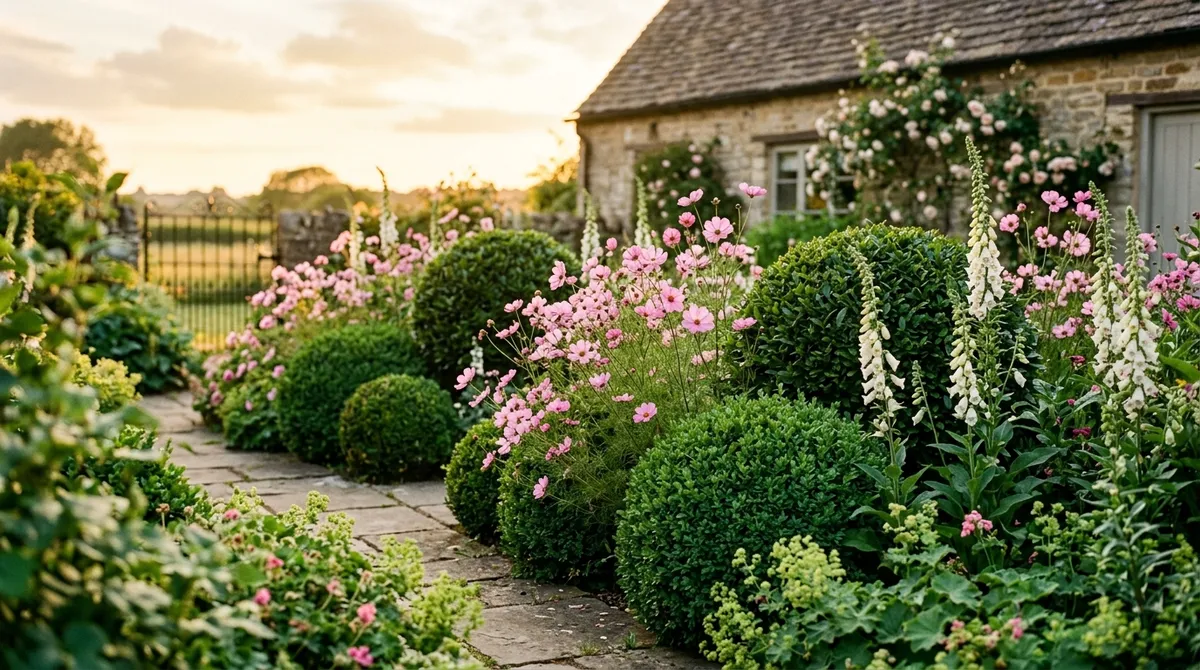
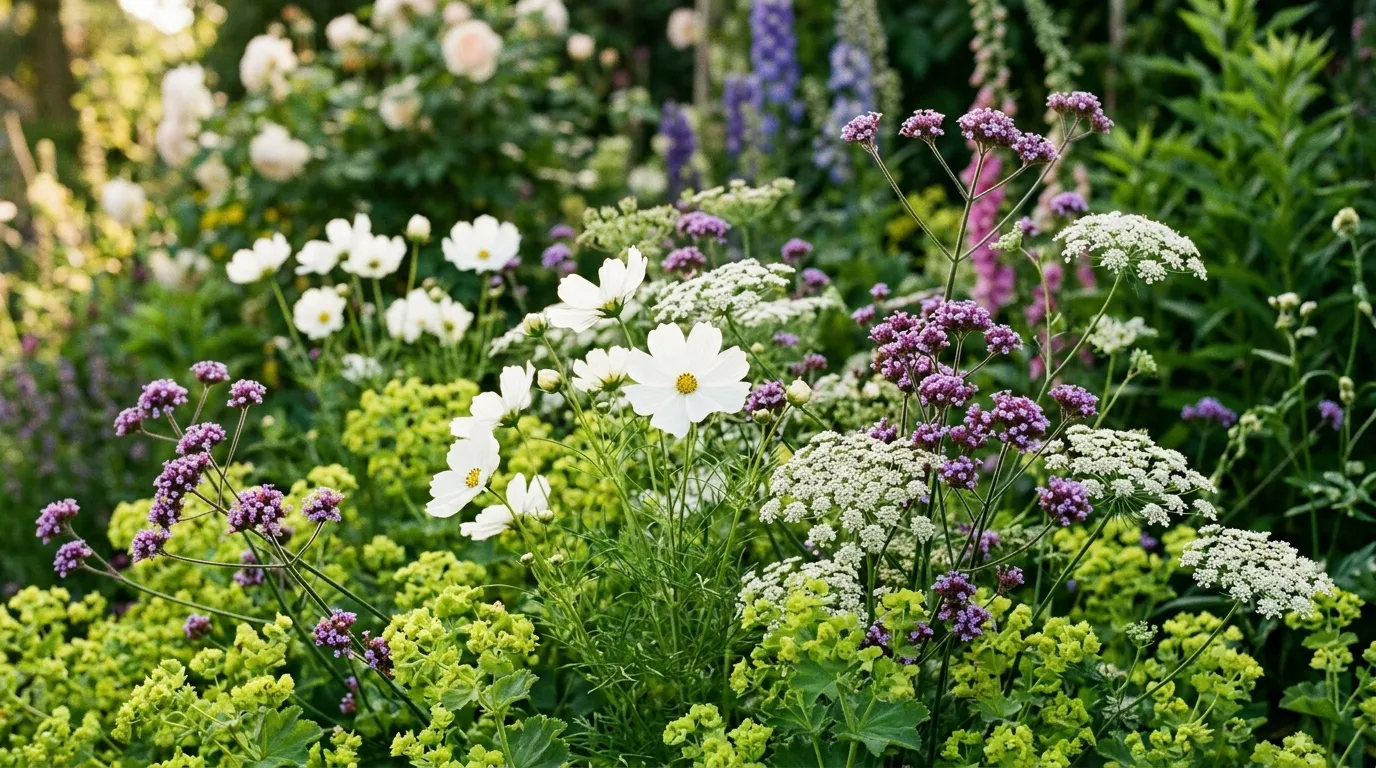 The 30% loose layer: Cosmos ‘Purity’, Verbena bonariensis and self-sown Ammi majus weave through alchemilla foliage in July.
Matrix planting and repetition
The single design rule that separates a contemporary cottage garden from a chaotic one is matrix planting. Each plant repeats across the border in groups of three, five or seven, not in a single specimen clump.
The Piet Oudolf principle, refined at Hauser and Wirth Bruton in Somerset and at Wisley’s Oudolf borders since 2018, is to plant in drifts that interpenetrate rather than block. Each drift overlaps the next at the edges. The effect reads as a flowing weave rather than a row of named perennials.
The practical rules:
- Repeat each structural plant 3 to 5 times across a 12sqm border at irregular spacing
- Plant in odd numbers (3, 5, 7) of each filler perennial
- Stagger heights so the eye moves diagonally through the border, not horizontally
- Overlap drifts at the edges with the next plant group, never leave a hard joint
- Limit each border to 8 to 12 species total for the modernist effect
Twelve plant species is plenty. The error in old-style cottage gardens is buying one of every interesting plant from the garden centre, ending with 35 different species in a 12sqm bed. The contemporary style edits ruthlessly.
Colour palette discipline
The hardest discipline in a contemporary cottage garden is colour restraint. Three colours plus white is the working rule.
Five tested UK palettes:
| Palette | Colours | Best for | Example anchor |
|---|---|---|---|
| Soft romantic | Pink, white, dusky purple | South-west cottages | Cosmos ‘Purity’ + Verbena + Salvia |
| Classic white | All white + green foliage | Formal courtyards | Sissinghurst Cottage Garden style |
| Cool sophisticated | Blue, white, cream | Urban courtyards | Nepeta + Ammi + Foxglove ‘Camelot Cream’ |
| Smoky purple | Plum, lavender, smoke-pink | Modern country | Salvia ‘Caradonna’ + Stipa + Verbena |
| Warm Mediterranean | Apricot, gold, brick red | Sunny south-facing | Achillea ‘Terracotta’ + Helenium + Stipa |
Pick one palette and refuse anything outside it. The temptation in year two is to add a bright marigold or a yellow rudbeckia. Resist. The discipline is what holds the look. The structural green foliage from box, hornbeam and lavender provides the calming anchor.
For ideas on monochrome borders, our guide on best white flowers UK gardens and best purple, pink and blue flowers lists varieties that fit each palette.
Three-layer height structure
A successful contemporary cottage border uses three height layers that step from front to back.
- Back layer (1.5-2.0m): Hornbeam columns, Verbena bonariensis, Thalictrum, sweet pea wigwams, foxgloves
- Middle layer (0.6-0.9m): Lavender, hebe, salvia, nepeta, alchemilla, hardy geranium, Stipa tenuissima
- Front layer (0.2-0.4m): Box balls (lower), sedum, hakonechloa, primulas, low alpine pinks
The eye reads from front to back in this stepped progression. The trick that makes a cottage garden feel romantic rather than formal is to break the line in two or three places: pull a tall verbena forward into the middle layer, or push a low alchemilla back among the foxgloves. The rule sets the rhythm; the broken rule gives the looseness.
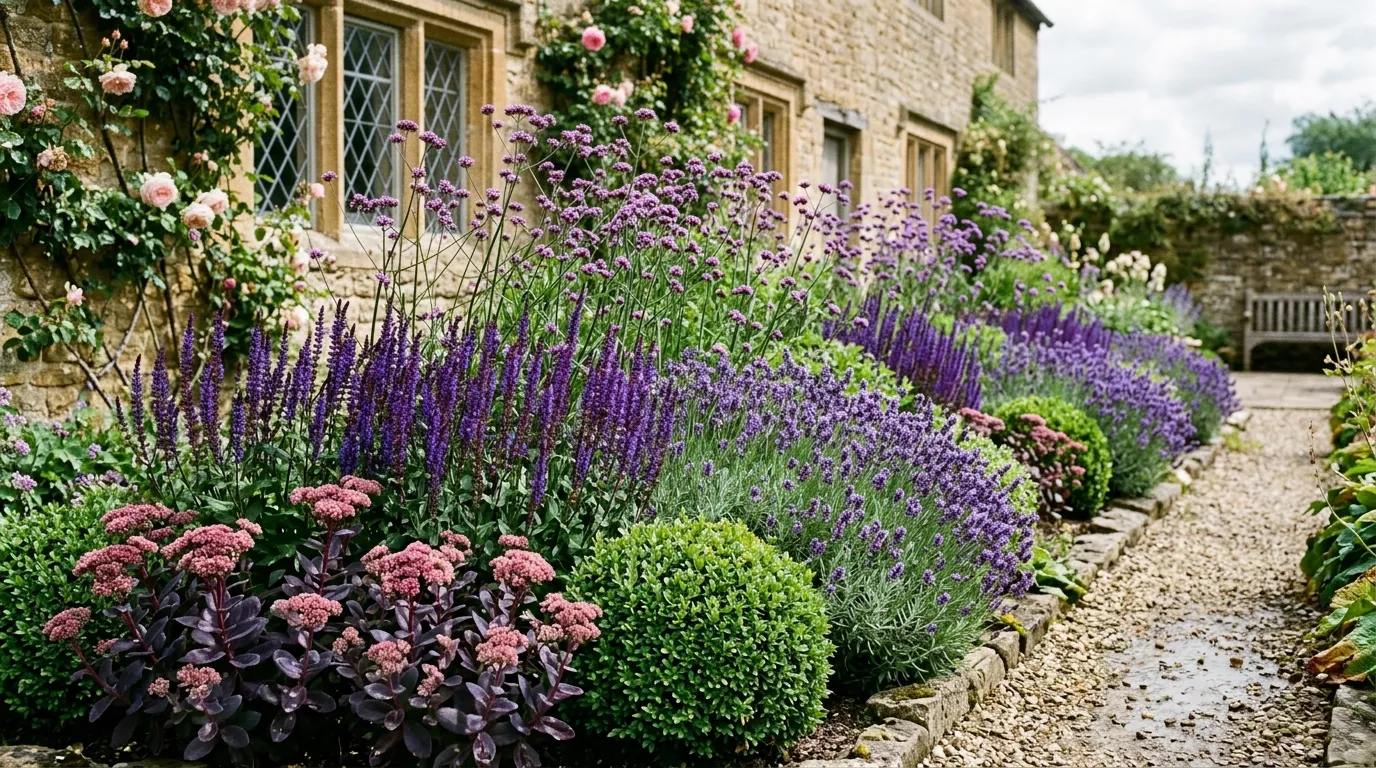 Three-layer height: Verbena bonariensis and hornbeam at the back, lavender and salvia in the middle, sedum and box balls at the front.
Inspiration from UK gardens
Three UK gardens demonstrate the 70/30 style at full maturity. All are open to the public.
| Garden | Designer | County | Best months | Style notes |
|---|---|---|---|---|
| Great Dixter Modernist Border | Christopher Lloyd | East Sussex | June-September | The original 70/30 cottage hybrid, dating from the 1990s |
| Sissinghurst Cottage Garden | Vita Sackville-West | Kent | June-July | Restricted palette (hot colours), tight structure |
| Tom Stuart-Smith Barn Garden | Tom Stuart-Smith | Hertfordshire | May-October | Matrix planting at its most refined |
| Hauser and Wirth Bruton | Piet Oudolf | Somerset | June-November | The Oudolf principles in a UK climate |
| Sarah Raven Perch Hill | Sarah Raven | East Sussex | June-October | Restricted palette cutting garden, structural framework |
A day visit in late June or late September is worth more than ten gardening books. Photograph the joints between plant groups; the secret is in how plants meet, not in the species themselves.
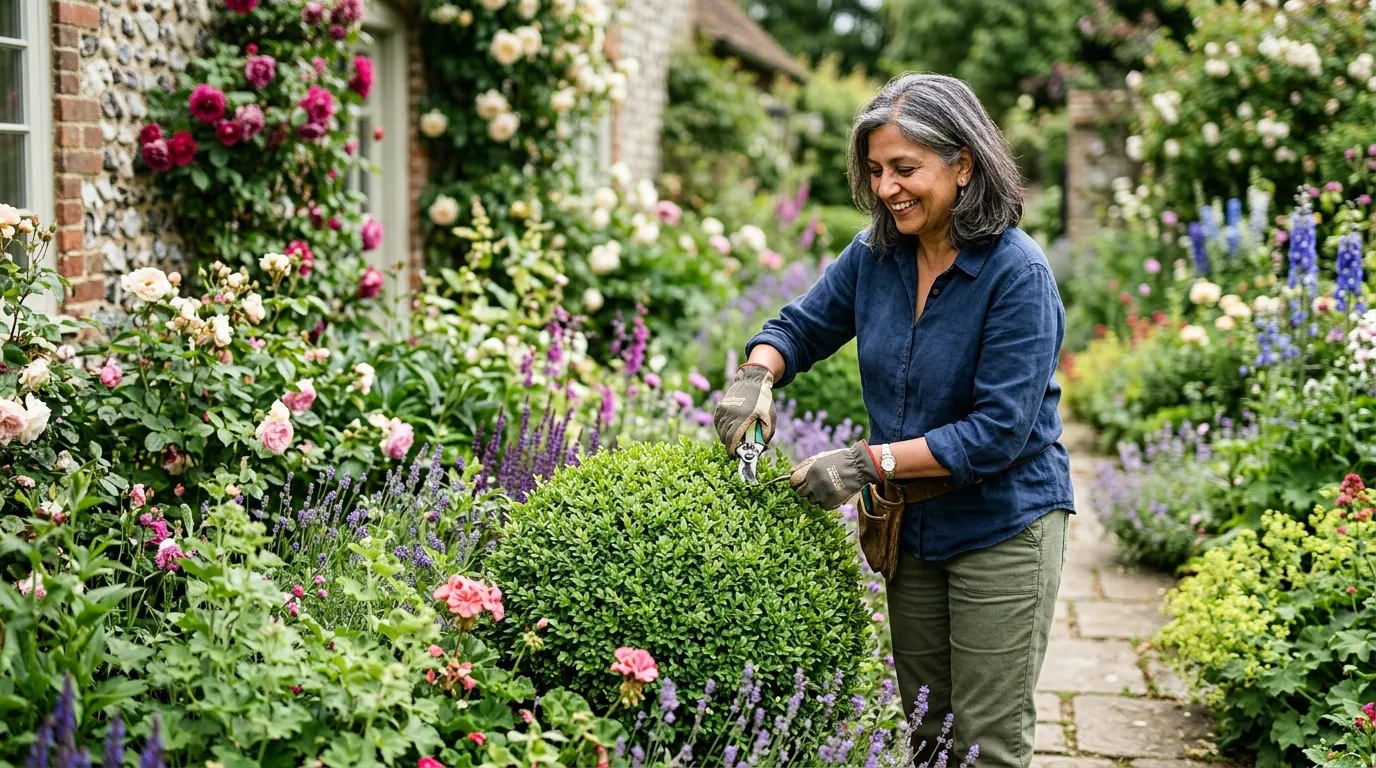 The June box trim is the main maintenance moment in the contemporary cottage style. Hand shears keep the form crisp; a second light tidy in August holds the shape through autumn.
Year-one planting plan for a 12 square metre border
A worked plan for a south-facing 4m by 3m UK border, with quantities and current UK plant prices.
| Plant | Layer | Quantity | Cost each | Total |
|---|---|---|---|---|
| Buxus sempervirens ball 50cm | Structural | 4 | £38 | £152 |
| Hebe rakaiensis | Structural | 3 | £15 | £45 |
| Carpinus betulus column | Structural | 2 | £48 | £96 |
| Stipa tenuissima | Structural grass | 5 | £8 | £40 |
| Lavandula ‘Hidcote’ | Filler | 5 | £7 | £35 |
| Alchemilla mollis | Filler | 5 | £6 | £30 |
| Salvia ‘Caradonna’ | Filler | 3 | £9 | £27 |
| Hardy geranium ‘Rozanne’ | Filler | 3 | £9 | £27 |
| Cosmos ‘Purity’ | Loose | 7 (plug plants) | £3 | £21 |
| Verbena bonariensis | Loose | 5 | £8 | £40 |
| Foxglove ‘Pam’s Choice’ | Loose | 5 | £6 | £30 |
| Sweet pea ‘Cupani’ | Loose | 1 packet (10 seeds) | £4 | £4 |
| Total plants | 48 plants | £547 | ||
| Compost, grit, mulch | £90 | |||
| Grand total year 1 | £637 |
The 48 plants cover the 12 square metre border at proper spacing. Year-two costs drop to around £90 because the cosmos, foxgloves, Ammi and Verbena self-sow. Year three onwards the border largely self-funds through seed and division. For more on container planting combinations that suit the same style for terraces and patios.
Maintenance calendar
Twelve months of work for the 12 square metre border. Total annual hours: around 38.
| Month | Job | Time (mins) |
|---|---|---|
| Jan | Plan, order seeds, sharpen tools | 30 |
| Feb | Cut back ornamental grasses to 10cm | 45 |
| Mar | Mulch with 50mm compost, sow cosmos and Ammi indoors | 90 |
| Apr | Lift and divide hardy geranium, plant out cosmos | 90 |
| May | Plant sweet peas at wigwam, light trim of hebe | 60 |
| Jun | Trim box balls, trim hornbeam lollipops, deadhead foxgloves | 120 |
| Jul | Light deadhead cosmos, water if dry, observe and photograph | 60 |
| Aug | Second hornbeam trim, second box trim if needed | 75 |
| Sep | Cut back self-sown Ammi (keep some for seed), lift weeds | 60 |
| Oct | Plant tulip bulbs at 15cm depth (next spring layer) | 90 |
| Nov | Leave grasses standing, cut back herbaceous perennials | 75 |
| Dec | Pour a glass of mulled wine and look at the silhouettes | 0 |
Common contemporary cottage garden mistakes
The same five errors derail most first attempts:
- Buying one of every interesting plant. The contemporary cottage garden uses 8 to 12 species, repeated. Resist the catalogue temptation.
- Ignoring winter structure. If a border vanishes in November, the design is broken. The 70% structural rule fixes this.
- Rainbow colour panic. Three colours plus white. A bright yellow planted in year two destroys the palette.
- Cutting the loose layer too early. Leave seed heads on Ammi, foxgloves and Verbena until late autumn for self-sowing and bird food.
- Skipping the matrix repetition. A single box ball and a single hebe and a single hornbeam reads as random. Repeat each in threes or fives.
For more on contemporary border design, see modern mixed border design and the wider garden design trends UK piece for emerging styles.
Frequently asked questions
What is a contemporary cottage garden?
A contemporary cottage garden uses 70% structural plants and 30% loose romantic flowers. The structure (clipped balls, grasses, evergreen shrubs) holds the design year-round. The loose layer adds summer flower without the August collapse of traditional cottage borders. Restricted colour palettes (three colours plus white) replace the rainbow mix of old cottage gardens.
What is the 70/30 rule in cottage gardening?
Seventy per cent structural and architectural plants, thirty per cent loose romantic flowers. The ratio means the garden reads clearly in every month, not just summer. Clipped hornbeam, box and yew supply winter structure; ornamental grasses add movement; lavender and hebe provide evergreen mass. Cosmos, sweet peas and foxgloves fill the remaining space for summer colour.
What are the best structural plants for a UK contemporary cottage garden?
Clipped Buxus sempervirens balls, Hebe rakaiensis domes, Lavandula angustifolia ‘Hidcote’ hedge, hornbeam (Carpinus betulus) lollipops or columns. Add ornamental grasses for movement: Stipa tenuissima, Calamagrostis ‘Karl Foerster’, Hakonechloa macra. These hold form in winter when the loose layer is cut to the ground.
How many plants do I need for a contemporary cottage border?
A 12 square metre border needs roughly 8 structural plants (clipped balls, grasses, evergreens), 12 mid-height fillers (lavender, hebe, alchemilla, hardy geranium), and 14 loose romantic flowers (cosmos, foxgloves, sweet peas, verbena). The structural plants repeat in groups of 3 or 5 across the border for visual rhythm.
How much does a contemporary cottage garden cost to plant?
Around £40 to £60 per square metre at year-one plant prices. A 12 square metre border costs £480 to £720 in plants, plus £80 to £120 for compost, grit and mulch. Costs drop sharply after year three as self-sowing annuals and divided perennials replace bought plants.
Next step
Our team produces practical UK gardening guidance from source research, contributor records and established horticultural practice. Editorial standards are overseen by Matt W.