Key takeaways
- Six recipes for UK conditions: sun-trap, shade, drought, pollinator, edible, all-foliage
- 35cm basket holds 7-9 plants; 45cm basket holds 11-14 plants
- Daily watering from late June to mid-September; twice daily in heatwave above 28C
- Start regular feeding after the compost's initial nutrient charge begins to run down
- Coir liners outperform sphagnum moss on water retention and ethical sourcing
- Plant out late May in southern UK; first week of June in Midlands and north
A loaded summer hanging basket is one of the most demanding garden features. It is exposed to wind and sun and holds a limited volume of compost. A well-planned basket can flower from late spring into autumn when watering, feeding and deadheading stay consistent.
For wider container context, see our hanging baskets how-to guide and best window box plants.
Basket sizes and plant counts
Most UK garden centre baskets are 30cm, 35cm or 45cm. The internal compost volume runs roughly 4 litres, 6 litres and 12 litres. The plant counts that fill each size for a packed display:
| Basket size | Internal compost volume | Plants for instant fill | Watering on a hot UK day |
|---|---|---|---|
| 30cm | 4 litres | 5-6 plants | 1.5-2 litres |
| 35cm | 6 litres | 7-9 plants | 2.5-3.5 litres |
| 40cm | 8 litres | 9-11 plants | 3.5-4.5 litres |
| 45cm | 12 litres | 11-14 plants | 4.5-6 litres |
The 35cm basket is the most common size in UK garden centres. The recipes below default to 35cm plant counts with 45cm quantities in brackets.
The framework is thriller-filler-spiller, the same as window boxes. One upright thriller at the centre, three to four fillers around it, three to five trailers spilling over the rim. Plant the spillers at a 30-degree angle outwards from the basket so they hang as soon as the basket is hung.
Recipe 1: Classic sun-trap (south or west wall)
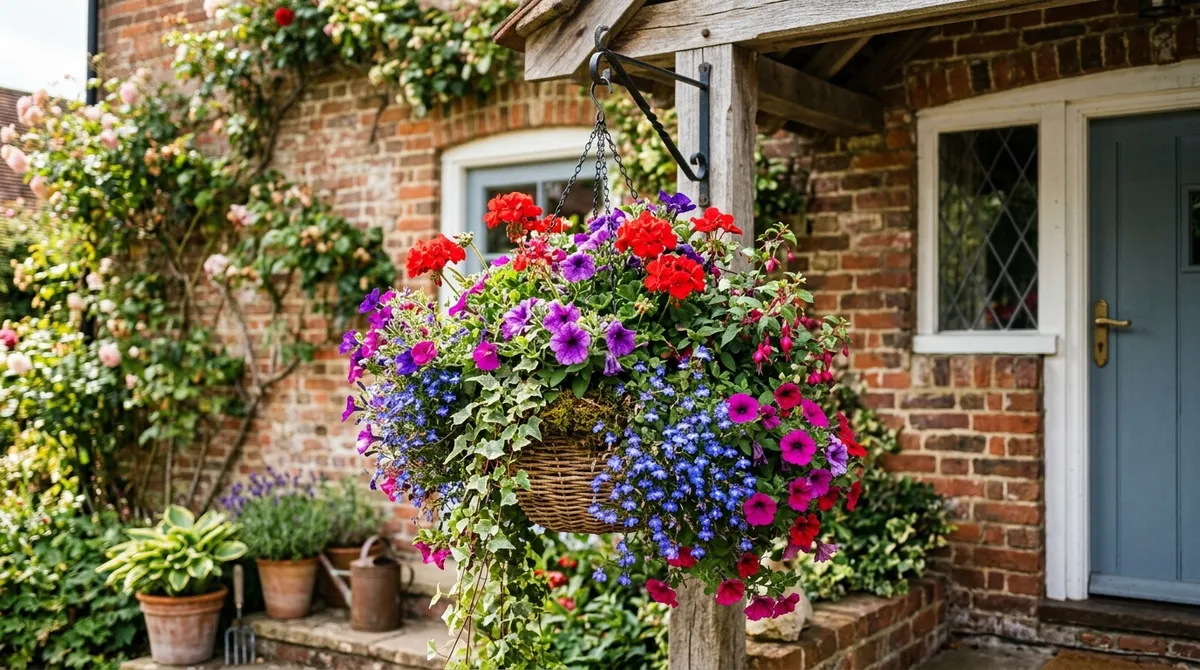
A reliable summer recipe for a sunny wall. Zonal pelargonium provides upright form, petunia adds massed flowers, lobelia softens the edge and helichrysum adds silver foliage.
| Role | Plant | 35cm basket | 45cm basket |
|---|---|---|---|
| Thriller | Zonal pelargonium ‘Mr Wren’ (red and white) | 1 | 2 |
| Filler | Trailing petunia ‘Surfinia’ purple | 3 | 4 |
| Filler | Helichrysum petiolare (silver) | 1 | 2 |
| Spiller | Lobelia erinus ‘Sapphire’ | 3 | 4 |
| Spiller | Calibrachoa ‘Million Bells’ yellow | 1 | 2 |
| Total plants | 9 | 14 | |
| Estimated cost (plug plants) | £18-22 | £28-34 |
This recipe wants full sun. On a south or west wall it produces flower from week 4 through week 18. On a north wall the pelargonium flowers thinly and the petunia mildews.
For more on the star plant, see our guide on how to grow pelargoniums and how to grow petunias.
Recipe 2: Cool shade (north or east wall)
Most “north-facing” UK gardens get 2 to 3 hours of direct sun in mid-summer. Bedding adapted to lower light fills these baskets. Begonias, impatiens (busy lizzies) and bacopa carry the show.
| Role | Plant | 35cm basket | 45cm basket |
|---|---|---|---|
| Thriller | Fuchsia ‘Mrs Popple’ (semi-trailing) | 1 | 2 |
| Filler | Begonia ‘Apricot Shades’ (trailing tuberous) | 3 | 4 |
| Filler | Impatiens ‘Beacon’ (downy mildew resistant) | 2 | 3 |
| Spiller | Bacopa ‘Snowflake’ (white) | 2 | 3 |
| Spiller | Trailing variegated ivy | 1 | 2 |
| Total plants | 9 | 14 | |
| Estimated cost | £17-22 | £28-35 |
The fuchsia is the surprise performer in shade. Mrs Popple is fully hardy in UK conditions and flowers from June to first frost. The basket can move to the patio at the end of summer with the fuchsia transplanted to the border for next year.
A small detail that matters: choose impatiens ‘Beacon’ specifically. Standard busy lizzies suffered a UK-wide downy mildew collapse from 2011 to 2018. Beacon is the bred-resistant cultivar that came on the market in 2018 and now dominates the shade category.
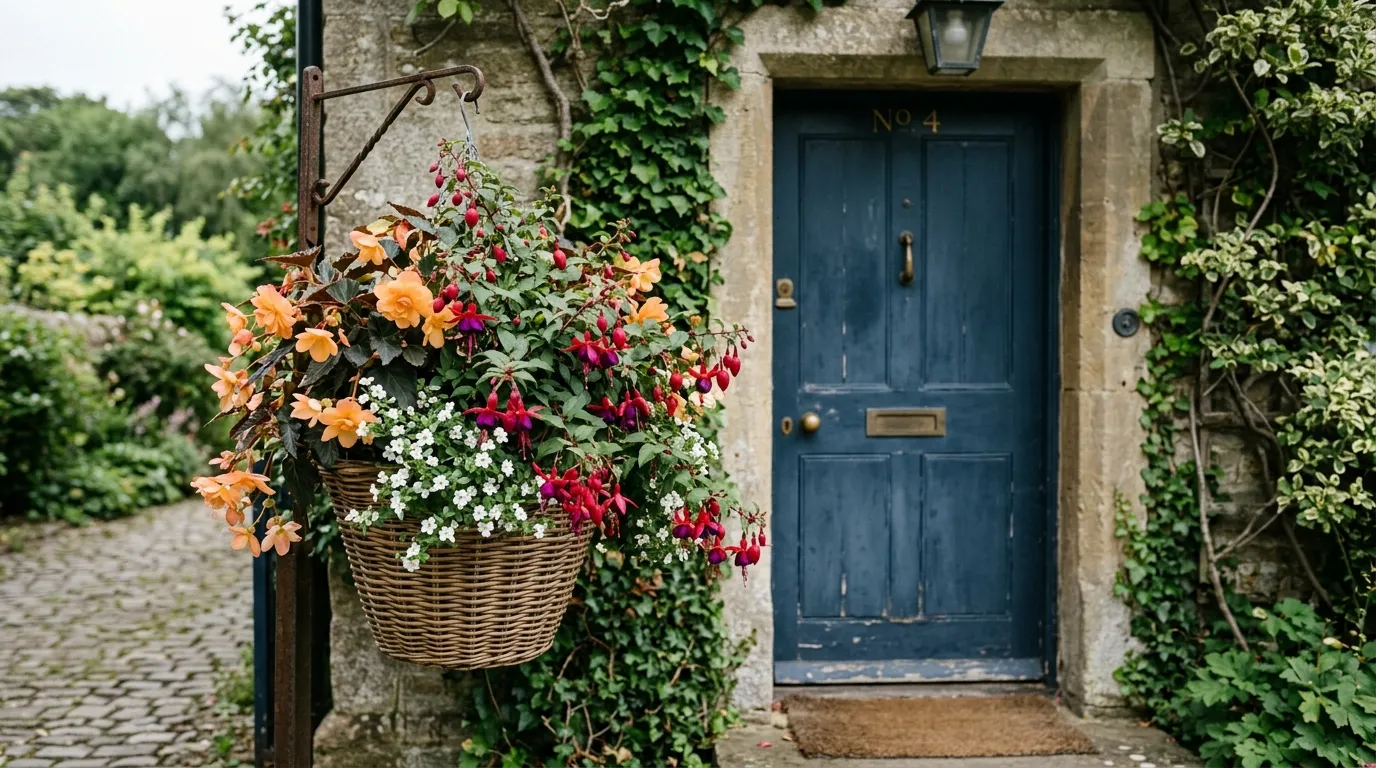 Recipe 2 in practice: a shaded north-facing doorway with fuchsia ‘Mrs Popple’ as the thriller, tuberous begonia ‘Apricot Shades’ as the filler, and trailing white bacopa as the spiller.
Recipe 3: Drought-tough Mediterranean (south wall, low watering)
For sunny baskets where daily watering is unreliable (holiday gardens, second homes, busy households). The plant list shifts to grey-foliaged Mediterranean species that survive on every-other-day watering.
| Role | Plant | 35cm basket | 45cm basket |
|---|---|---|---|
| Thriller | Salvia ‘Amistad’ (purple, drought tolerant) | 1 | 2 |
| Filler | Verbena ‘Lanai’ purple | 3 | 4 |
| Filler | Bidens ‘Yellow Bee’ | 2 | 3 |
| Spiller | Trailing rosemary | 2 | 3 |
| Spiller | Helichrysum petiolare | 1 | 2 |
| Total plants | 9 | 14 | |
| Estimated cost | £14-18 | £22-28 |
This is one of the lower-cost recipes. The Mediterranean species suit a sunny position and cope better with short dry spells than soft-leaved bedding.
This recipe also smells beautiful. Trailing rosemary, salvia and verbena are all bee magnets and scented enough to notice when watering. For more on the plants in this group, see our guide on how to grow lavender which carries the same Mediterranean approach to drought.
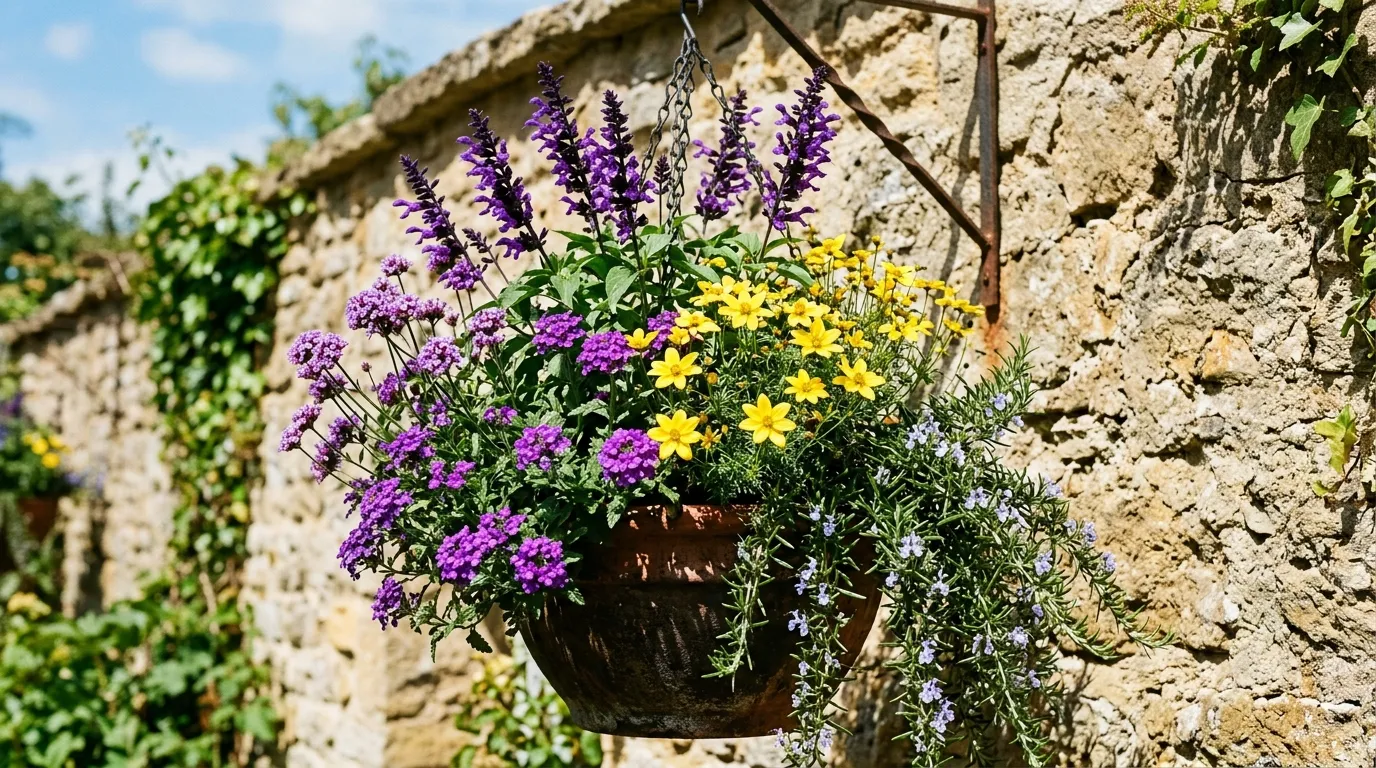 Recipe 3 in practice: the Mediterranean recipe needs watering only every other day on a south wall, against daily for the classic sun-trap mix.
Recipe 4: Pollinator pleaser (any aspect)
This basket is designed for bees, hoverflies and butterflies. It uses single rather than double flowers, with several bloom shapes and a long flowering period.
| Role | Plant | 35cm basket | 45cm basket |
|---|---|---|---|
| Thriller | Cosmos ‘Apricot Lemonade’ (dwarf, 60cm) | 1 | 2 |
| Filler | Nemesia ‘Wisley Vanilla’ (scented) | 3 | 4 |
| Filler | Calendula ‘Sherbert Fizz’ | 2 | 3 |
| Spiller | Trailing nasturtium ‘Empress of India’ | 2 | 3 |
| Spiller | Lobularia ‘Snow Princess’ (sweet alyssum) | 1 | 2 |
| Total plants | 9 | 14 | |
| Estimated cost | £15-20 | £25-32 |
The nasturtium adds an edible bonus. Both the flowers and the young leaves are peppery in salads. The basket needs deadheading more often than the others (twice a week instead of weekly) because cosmos and calendula flower briefly.
Recipe 5: Edible kitchen basket (south or west wall)
A productive basket near the back door. Cherry tomatoes, strawberries and herbs all crop well in the 35cm size. Surprisingly heavy when fully ripe (around 4kg with fruit), so use a heavy-duty bracket rated to 10kg.
| Role | Plant | 35cm basket | 45cm basket |
|---|---|---|---|
| Thriller | Cherry tomato ‘Tumbling Tom Red’ (basket variety) | 1 | 2 |
| Filler | Everbearing strawberry ‘Mara des Bois’ | 3 | 4 |
| Filler | Basil ‘Sweet Genovese’ | 2 | 3 |
| Spiller | Trailing thyme | 2 | 3 |
| Spiller | Trailing nasturtium | 1 | 2 |
| Total plants | 9 | 14 | |
| Estimated cost | £22-28 | £36-45 |
The cherry tomato is the highlight. Tumbling Tom produces 1.5 to 2kg of cherry tomatoes per plant over the summer in a 35cm basket. Pick daily from late July to mid-September. Pinch out the leading shoot at the centre when it reaches 30cm to encourage trailing side shoots.
For more on basket-friendly cropping, see our guide on growing tomatoes for UK beginners and growing vegetables on a windowsill.
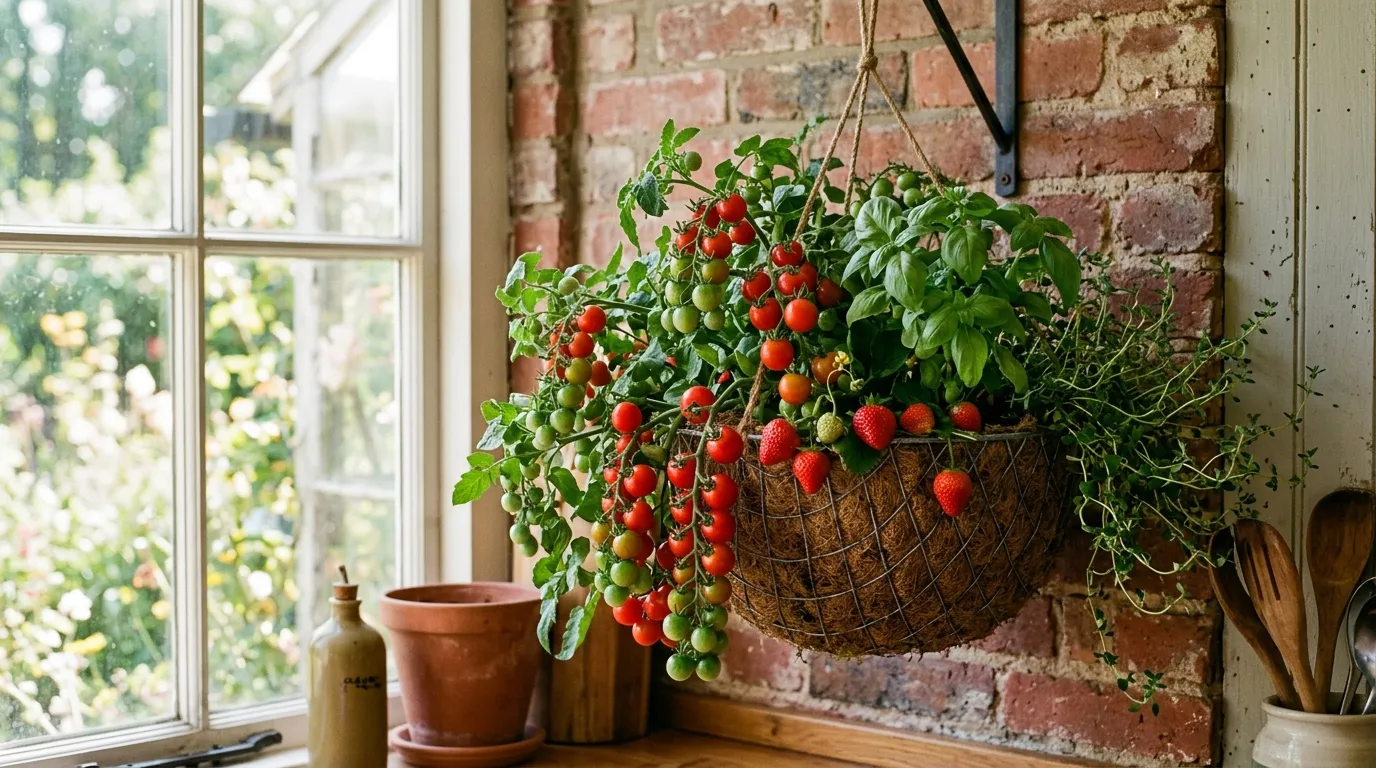 Recipe 5 in practice: ‘Tumbling Tom Red’ cherry tomato carries the centre, three Mara des Bois strawberries fill the body, and basil plus thyme drape the edges in late August.
Recipe 6: All-foliage (contemporary, low maintenance)
For a contemporary garden where flower-heavy baskets read as too fussy. All foliage, in five colour and texture combinations. Holds shape and tone from May to first frost with minimal deadheading.
| Role | Plant | 35cm basket | 45cm basket |
|---|---|---|---|
| Thriller | Heuchera ‘Marmalade’ (orange foliage) | 1 | 2 |
| Filler | Ipomoea batatas ‘Bright Ideas Black’ (sweet potato vine) | 2 | 3 |
| Filler | Hakonechloa macra (Japanese forest grass) | 2 | 3 |
| Spiller | Trailing ivy (Hedera helix ‘Glacier’ variegated) | 3 | 4 |
| Spiller | Trailing Plectranthus ‘Mona Lavender’ | 1 | 2 |
| Total plants | 9 | 14 | |
| Estimated cost | £22-28 | £35-44 |
The lowest maintenance of the six recipes. No deadheading. Watering twice weekly is enough on most aspects because the foliage species tolerate more drought than flowering bedding. The heuchera, hakonechloa and ivy carry over to a permanent container in autumn for at least three more years of use.
Watering protocol that doubles basket life
The single biggest failure point in UK hanging baskets is watering. A basket that goes dry once between June and September drops 30% to 50% of its flowers and never recovers fully.
The working schedule by aspect:
| Aspect | June | July | August | September |
|---|---|---|---|---|
| South-facing | Daily | Daily (twice in heatwave) | Daily | Every 2 days |
| West-facing | Every 2 days | Daily | Daily | Every 2 days |
| East-facing | Every 2 days | Every 2 days | Every 2 days | Every 3 days |
| North-facing | Every 3 days | Every 2 days | Every 2 days | Twice a week |
Three tricks that double the gap between waterings:
- Hidden reservoir bottle. Push a 500ml plastic bottle with 6 small drainage holes into the centre of the compost at planting. Top up at every watering. Holds 1 to 2 extra days of moisture buffer.
- Mulch layer. Add 20mm of compost-grade bark to the surface to cut evaporation by 30%.
- Water-retaining crystals. Mix 5ml of polymer crystals per litre of compost at planting. Holds an extra litre of water per 6 litres of compost.
Water at the base of the plants, not from above. Wet foliage in still humid weather causes downy mildew and botrytis. Water in the early morning (best) or late evening (acceptable). Midday watering shocks roots.
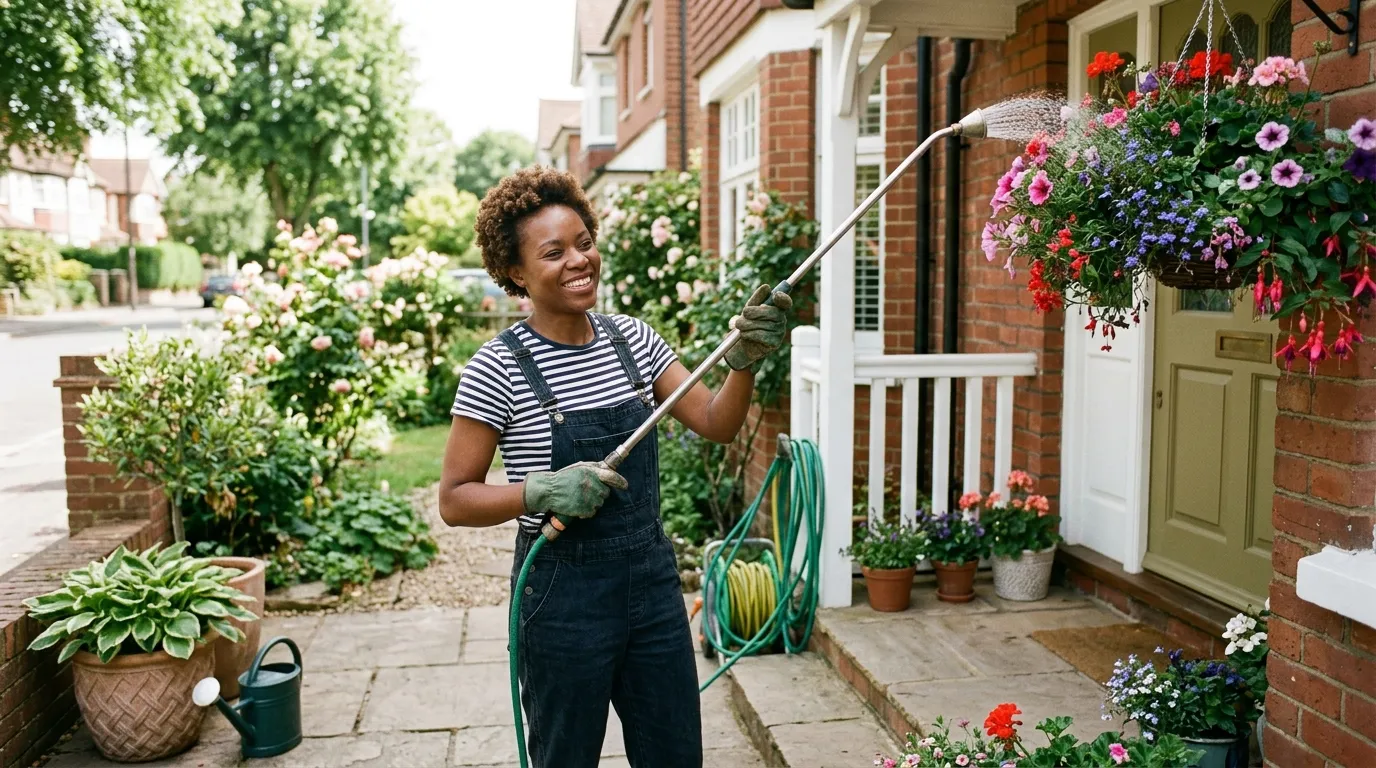 A long-handled watering lance lets you fill the hidden reservoir bottle without lifting the basket. Most basket failures come from one missed day in July, not from poor planting.
Feeding schedule and compost
The compost charge in a 35cm basket runs out by week three of active growth. Without a feeding plan the basket peaks at week 4 and declines through August.
The reliable feeding routine:
- At planting: mix one teaspoon of slow-release fertiliser (Osmocote 6-month) per litre of compost
- Week 3 onwards: weekly Tomorite (4-3-8 ratio) at label dilution
- Mid-July onwards: double the Tomorite dose to lift August flowering
- Mid-September: switch to seaweed extract (Maxicrop) for final 2 weeks to harden plants before first frost
The compost itself matters. A 50:50 mix of peat-free multipurpose compost and John Innes No. 2 holds water and nutrients better than pure peat-free, which dries out faster and rots in heavy rain. The added loam in John Innes acts as a buffer.
Liner choice: why coir beats moss
Four liner materials cover most UK basket options. Compare their drainage, durability, materials and cost before planting:
| Liner | Water retention | Durability | Sustainability | Cost (35cm) |
|---|---|---|---|---|
| Sphagnum moss | Medium | 1 summer | Poor (peat bog harvest) | £6 |
| Coir (coconut fibre) | Highest | 2-3 summers | Good (coconut by-product) | £5 |
| Jute fibre | High | 2 summers | Good (renewable plant) | £4 |
| Plastic (with holes) | Highest | 5+ summers | Poor (plastic waste) | £3 |
Pre-soak the liner in a bucket of water for 30 minutes before planting. A dry coir liner draws moisture out of the compost during the first week.
Anchoring against wind
A loaded 45cm basket weighs 7 to 10kg in summer. A wind gust at 60mph generates 30kg of lateral force on the basket. Brackets fail more often than baskets do.
The reliable bracket setup:
- Wall-mounted bracket rated to 15kg minimum for 45cm baskets, 10kg minimum for 35cm
- M8 wall anchors (not the included M6) in solid masonry; resin anchors in soft brick
- Two screw fixings per bracket, never one
- Chain or hanging cable to the bracket eye, never wire (wire snaps after 2 winters)
In exposed sites or coastal Britain, drop the recipe by one or two plants and bulk up the trailing edge to streamline the basket. Wind-shredded foliage looks worse than a slightly thinner display.
Plant out dates by UK region
Frost is the basket killer. A late frost on 10 May can wipe pelargoniums, petunias and lobelia overnight.
| Region | Last frost (average) | Plant out date |
|---|---|---|
| South-west (Cornwall, Devon) | 1 May | 20 May |
| London and South East | 7 May | 22 May |
| Midlands | 12 May | 28 May |
| North-west and Yorkshire | 18 May | 1 June |
| North-east | 22 May | 4 June |
| Scotland (lowland) | 28 May | 8 June |
For a head start, plant up the baskets in mid-April under cover (greenhouse, conservatory, porch) and harden off through the last fortnight by daytime exposure outside. The basket reaches full mass by late June, 3 weeks ahead of an outdoor-planted basket.
For more on frost protection, see our guide on how to protect plants from frost and hardening off bedding.
Common hanging basket mistakes
Five errors account for most failed baskets:
- Planting too few plants. A 35cm basket needs 7 to 9 plants for instant fill. Five looks thin all summer.
- Skipping the feeding plan. No food after week 3 and the basket peaks early then collapses.
- Watering once a week. A south-facing basket needs daily watering from late June to mid-September.
- Using a sphagnum moss liner. Coir holds more water, lasts longer, and is sustainable.
- Hanging the basket too high. Lower to chest height for daily watering reach. A basket at 2.5m gets watered half as often.
Frequently asked questions
How many plants fit in a 35cm hanging basket?
Seven to nine plants in a 35cm basket. One upright thriller in the centre, three or four fillers around it, three trailing spillers at the edge. Crowd slightly for instant impact; bedding plants compete fine for the 16-week summer life of the basket. Larger root systems like geraniums limit you to 7 plants total.
What is the best hanging basket recipe for full sun?
Use zonal pelargonium, trailing petunia and blue lobelia for full sun. Add silver helichrysum for foliage contrast. Keep the compost evenly moist, feed regularly and deadhead spent blooms to maintain the display.
How often should I water a summer hanging basket?
Daily from late June to mid-September; twice daily in a heatwave above 28C. South-facing baskets dry twice as fast as north-facing ones. Add a 500ml water reservoir bottle in the compost at planting to extend dry-day tolerance from 1 to 3 days. Water at the base, not over the leaves.
When should I plant up a hanging basket in the UK?
Late May in southern England (after the last frost on around 20 May); first week of June in the Midlands and north. Plant indoors or in a greenhouse two weeks earlier and harden off in a sheltered spot during the day. Frost on tender bedding kills the basket overnight; wait for stable nights above 8C.
What is the best liner for a hanging basket?
Coir or jute liners suit most wire baskets. Both hold compost while allowing drainage. Pre-soak natural-fibre liners before planting and add drainage holes to any plastic layer.
Next step
Our team produces practical UK gardening guidance from source research, contributor records and established horticultural practice. Editorial standards are overseen by Matt W.