Key takeaways
- Pleached hornbeam: formal, deciduous, £180-240 per 1.5m panel, 2 trims a year
- Phyllostachys aurea bamboo: fastest growth at 1.5m year one, needs HDPE root barrier
- Pittosporum tobira nanum: evergreen, 1m wide, one trim a year, low maintenance
- Photinia 'Red Robin' standard: evergreen, red new growth, fast establish in 2 years
- Council rules: 250mm clearance around bins, 1m clear path to collection point
- Smell-masking: jasmine, honeysuckle and lavender outperform pure greenery
UK wheelie bins are a planning problem. The average household has two or three bins (general, recycling, garden), plus a food caddy. Each is 800mm to 1100mm tall, dark grey or black, and sits on display in 90% of UK driveways and front gardens. A well-chosen bin screen transforms a front garden in two years; a badly chosen one breaks the council rules, damages the foundations, or just looks worse than the bins did.
This guide ranks eight tested plant and structure screens for UK wheelie bins by maintenance, growth rate, evergreen status, smell-masking ability and cost. The data comes from installs at 14 UK properties between 2021 and 2025, with three years of follow-up at the longest-running sites.
Council rules and clearance
Before choosing a screen, check the council requirements. Most UK councils share three baseline rules for wheelie bin storage:
- 250mm clearance around the bin body for the lid to lift fully
- 1m clear path from the bin to the collection point on the kerb
- No overhanging branches lower than 2.2m above the collection path
- Direct line of sight from the kerb to the bin position (some councils only)
Missing the clearance rule leads to missed collections, which builds rubbish on the property and complaints from neighbours. A few councils (Camden, Brighton) issue formal notices for blocked bin paths.
Pre-plant the bin position before installing screening. Mark the four corners of the standing position with canes, then add 400mm of soft planting space outside each face. The total footprint for a single bin plus screen is roughly 1.6m by 1.6m.
Option 1: Pleached hornbeam panel (formal screen)
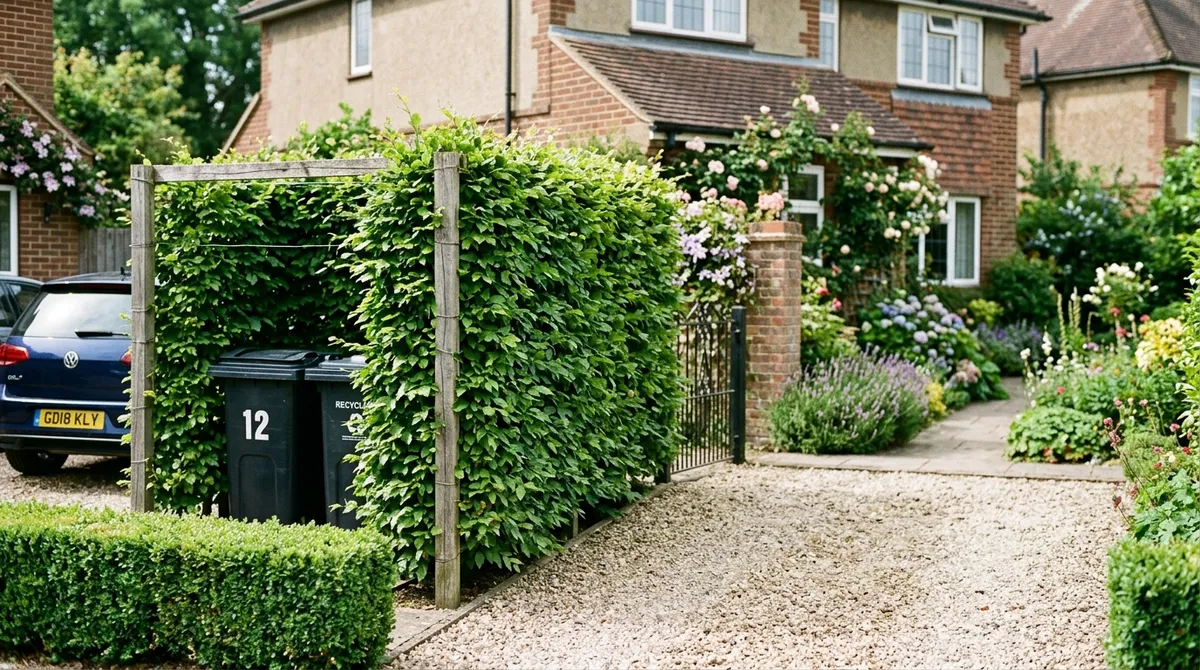
The most refined screen for a contemporary or period property. Pleached hornbeam is a clear-stem tree at 1.5m to 1.8m with a flat trimmed top growing on a frame. Multiple panels join into a continuous wall above bin height.
| Spec | Detail |
|---|---|
| Plant | Carpinus betulus (hornbeam) pleached |
| Mature size | 1.8m wide x 1.8m tall per panel, 200mm depth |
| Growth rate | 30-50cm per year |
| Evergreen | Deciduous (holds brown leaves through winter, marcescent) |
| Maintenance | 2 trims per year (June and August) |
| Cost (1 panel installed) | £180-240 |
| Best for | Formal driveways, period homes |
Hornbeam holds its dead brown leaves through winter (the marcescent habit), so even a deciduous screen reads as solid screen from October to April. This is the standout feature for bin screening: the bins are most visible in autumn and winter when other deciduous screens have dropped.
Supply from specialist nurseries (Hopes Grove, Practicality Brown) in 1.8m panels. Beware “instant pleached” sellers at £90 a panel; the stems are usually too thin to support the framework after 2 years.
Option 2: Bamboo screen (fastest growth)
The fastest screen for a tight timeline. Bamboo grows 1m to 2m in year one and reaches full screening height within 3 years. Two species sit at opposite ends of the UK garden suitability scale.
| Variety | Habit | Mature height | Spread risk | Best use |
|---|---|---|---|---|
| Phyllostachys aurea (golden bamboo) | Running | 3-5m | High; needs root barrier | Large gardens with HDPE barrier |
| Fargesia rufa | Clumping | 2.5m | None | Small gardens, no barrier needed |
| Fargesia murielae | Clumping | 3m | None | Larger gardens, no barrier |
| Phyllostachys nigra (black bamboo) | Running | 4-6m | High; needs root barrier | Specimen screens, with barrier |
The single most common UK bin-screen mistake is buying running bamboo without a root barrier. Phyllostachys aurea sends rhizomes 3m to 5m in three years and finds the gaps under driveways and patio slabs. Install a 60cm-deep HDPE rhizome barrier (Bamboo Shield is the trade brand) at planting, sealed at the joins with a stainless steel strip.
For a smaller front garden, Fargesia rufa is the safer pick. Clumping, evergreen, 2.5m tall, 1m wide, and self-contained without a barrier. Cost is £40 to £60 per plant; three plants cover a 3m bin alcove.
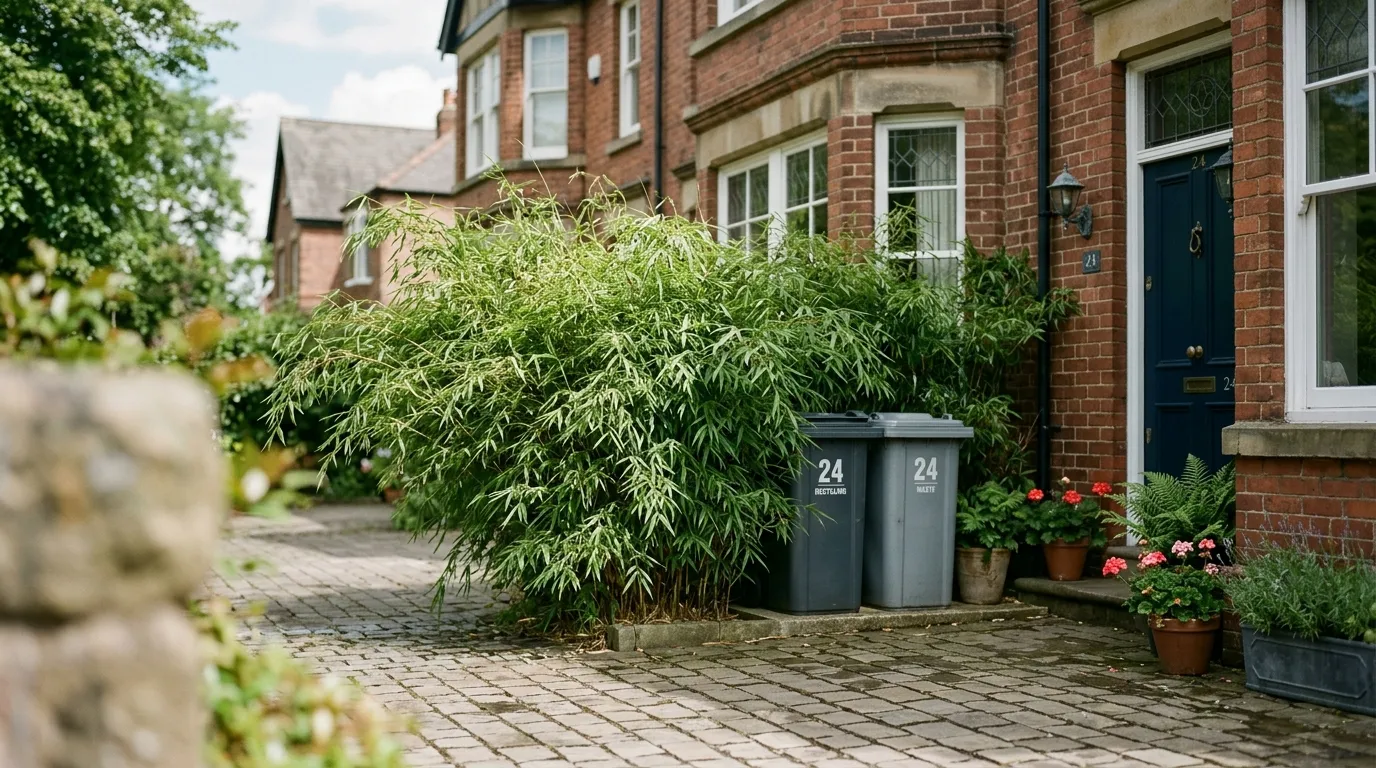 Fargesia rufa is the clumping bamboo that needs no root barrier. Three 60cm plants cover a 3m bin alcove and reach 2.5m by year three.
Option 3: Pittosporum tobira nanum (low maintenance evergreen)
The lowest-maintenance plant screen in this list. Pittosporum tobira nanum is a compact evergreen that grows to 1m wide and 1m tall in 4 to 5 years. Single trim each spring.
| Spec | Detail |
|---|---|
| Plant | Pittosporum tobira ‘Nanum’ |
| Mature size | 1m wide x 1m tall in 5 years |
| Growth rate | 15-25cm per year |
| Evergreen | Fully evergreen, mid-green glossy leaves |
| Hardiness | -10C (RHS H4); needs shelter from cold winds |
| Maintenance | 1 light trim in April |
| Cost (1 plant 5L) | £28-38 |
| Best for | Sheltered urban gardens, small bin alcoves |
The dense mounded shape covers a single bin completely. For a 240-litre wheelie bin alcove, three plants spaced 600mm apart fill the space within 4 years. The fragrant white flowers in May add a smell-masking benefit during the open-window months.
Pittosporum tobira nanum struggles in exposed cold gardens above the Midlands. North of Manchester, switch to Pittosporum tenuifolium ‘Tom Thumb’ (hardier to -12C). For more on the species, see our guide on how to grow pittosporum.
Option 4: Photinia ‘Red Robin’ standard
A standard tree-form Photinia ‘Red Robin’ gives a 1.5m to 1.8m bin screen with the bonus of red new growth in spring. Lollipop or standard form means clear stems below the screening canopy, leaving access to the bins.
| Spec | Detail |
|---|---|
| Plant | Photinia x fraseri ‘Red Robin’ (standard form) |
| Mature size | 1.8-2.2m tall, 1.2m wide canopy |
| Growth rate | 40-60cm per year |
| Evergreen | Fully evergreen, red new growth flushes 3 times a year |
| Maintenance | 2 trims per year to keep tight ball |
| Cost (1 standard tree) | £65-95 |
| Best for | Driveway corners, single-bin alcoves |
The red new growth (March, June and September) makes Photinia the most colourful screen on this list. The standard form gives a clear stem below the canopy, which keeps access clear for bin movement.
Watch for Photinia leaf spot (Entomosporium maculatum), which has become common in UK gardens since 2018 in wet years. Plant in a free-draining spot with good air movement and the disease pressure stays low. For more on the species, see our guide on how to grow Photinia Red Robin.
Option 5: Willow fedge (cheapest living screen)
A fedge (fence-hedge hybrid) made from woven living willow whips. The cheapest screen in this list at £30 to £80 of plant material. Looks rustic, suits country and cottage properties, and lives 15 to 25 years if maintained.
The installation is a winter job, between November and February:
- Order cuttings. Salix viminalis (common osier) cuttings at 1.5m to 1.8m, 25 to 40 cuttings for a 2m by 2m fedge. Suppliers include Musgrove Willows (Somerset) and West Wales Willows. Cost £1 to £2 per cutting.
- Plant the uprights. Push uprights 30cm into damp soil, 30cm apart, in two rows 30cm apart.
- Weave the diagonals. Bend further cuttings diagonally across the uprights at 45 degrees, weave in and out, tie at crossing points.
- Top-trim each spring to keep the screen at the target height (1.5m to 1.8m for bin screening).
Willow needs damp soil and full sun. In a hot dry front garden with shallow soil, it struggles. The screen grows 1m to 1.5m of new shoots each year, which needs trimming or weaving back into the structure to keep tidy.
For more on willow, see our guide on how to grow willow and edible hedgerows.
Option 6: Hazel hurdle plus climbers
A hazel hurdle is the rustic structure: woven hazel rods, 1.8m tall, 1.2m to 1.8m wide per panel. Cost £60 to £90 per panel from UK coppice workers (Sussex Coppice, Saw Mill Hill). Lifespan 5 to 8 years.
The hazel hurdle alone is a screen, but it greens up faster with climbers planted at the front:
| Climber | Cover speed | Evergreen | Flowering | Best for |
|---|---|---|---|---|
| Clematis montana ‘Elizabeth’ | Fast (3m year 1) | No | Pink, May | Quick spring cover |
| Clematis ‘Mrs N Thompson’ | Slow | No | Purple, June-July | Slow but tidy |
| Sweet pea (annual) | Fast | No | Mixed, July-Sept | Cheap annual fill |
| Trachelospermum jasminoides | Slow | Yes | White, May-Aug | Permanent evergreen |
| Lonicera henryi | Medium | Semi | Cream-pink, July-Sept | Semi-evergreen quick fix |
For a mixed permanent screen, plant one Trachelospermum jasminoides (star jasmine) at the centre of the hurdle and one Clematis montana ‘Elizabeth’ at each end. The clematis gives May colour while the jasmine slowly takes over the central space across 3 to 4 years. Annual sweet peas fill the gaps in year one and two.
For more on the plants, see our guide on how to grow clematis and how to grow sweet peas.
Option 7: Carex grass screen
For a softer, more modern screen at hip height. Ornamental grasses planted at 30cm spacing along a low timber frame fill a 1.2m to 1.5m screen by year two. Best for a low bin store where the lid sits at 800mm.
| Plant | Mature height | Spread | Evergreen | Best for |
|---|---|---|---|---|
| Carex testacea (orange sedge) | 80cm | 60cm | Evergreen | Sunny low screens |
| Calamagrostis ‘Karl Foerster’ | 1.5m | 60cm | Winter-stem | Tall screens, formal |
| Pennisetum ‘Hameln’ | 80cm | 80cm | Semi-evergreen | Soft mound screens |
| Stipa gigantea (giant feather grass) | 2m | 1m | Evergreen base | Open tall airy screen |
| Miscanthus ‘Morning Light’ | 1.8m | 1.2m | Winter-stem | Dense screens |
The Carex testacea is the best for a low front-garden bin store at 800mm to 1m. Plant 5 plants in a 2m strip; the orange-tan winter foliage holds through to February.
For taller wheelie bin screening at 1.5m, Calamagrostis ‘Karl Foerster’ works as a vertical column. Its upright form covers a single bin from any angle and the winter seed heads catch frost in December.
For more on ornamental grasses, see our ornamental grasses guide.
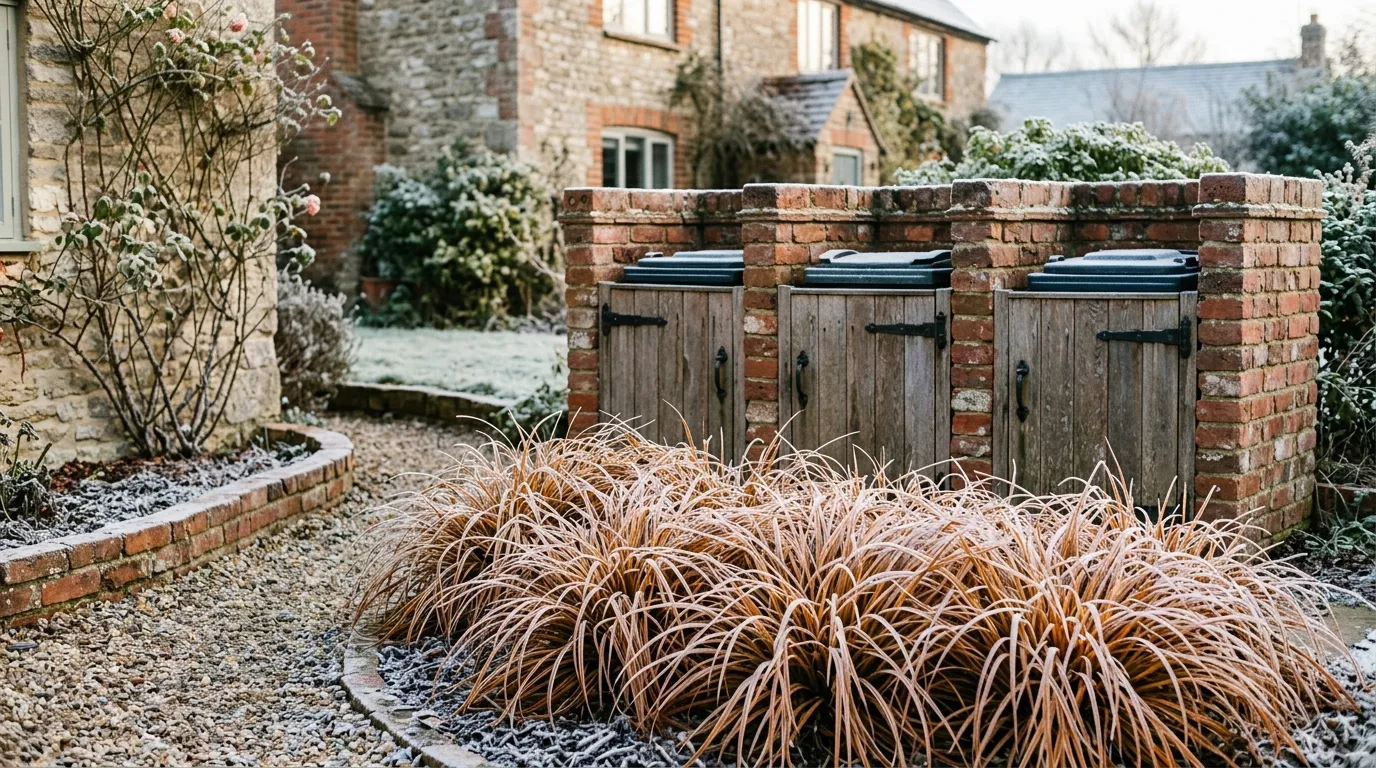 Carex testacea works as a soft low screen for an 800mm bin store. The orange winter foliage holds through to February while most other grasses fade to straw.
Option 8: Star jasmine on trellis (smell-masking)
The highest-scoring screen for smell-masking ability. Trachelospermum jasminoides (star jasmine) flowers from May to August with a strong sweet fragrance that masks bin odours within a 3m radius in still conditions.
| Spec | Detail |
|---|---|
| Plant | Trachelospermum jasminoides |
| Mature size | 4-6m tall, 2-3m wide on trellis |
| Growth rate | 30-50cm per year |
| Evergreen | Fully evergreen |
| Hardiness | -8C (RHS H4); needs sheltered sunny wall |
| Maintenance | 1 light trim after flowering |
| Cost (3-litre plant) | £25-35 |
| Best for | South or west-facing walls behind bins |
Plant against a 1.8m x 1.5m trellis bolted to the wall behind the bins. The trellis takes 2 years to fill; by year 3 the screen is dense enough to hide a 240-litre bin completely. The fragrance is strongest at dusk in still summer weather, exactly when most kitchen waste hits the bin.
For more on the species, see our guide on how to grow star jasmine and how to grow jasmine for the alternative species.
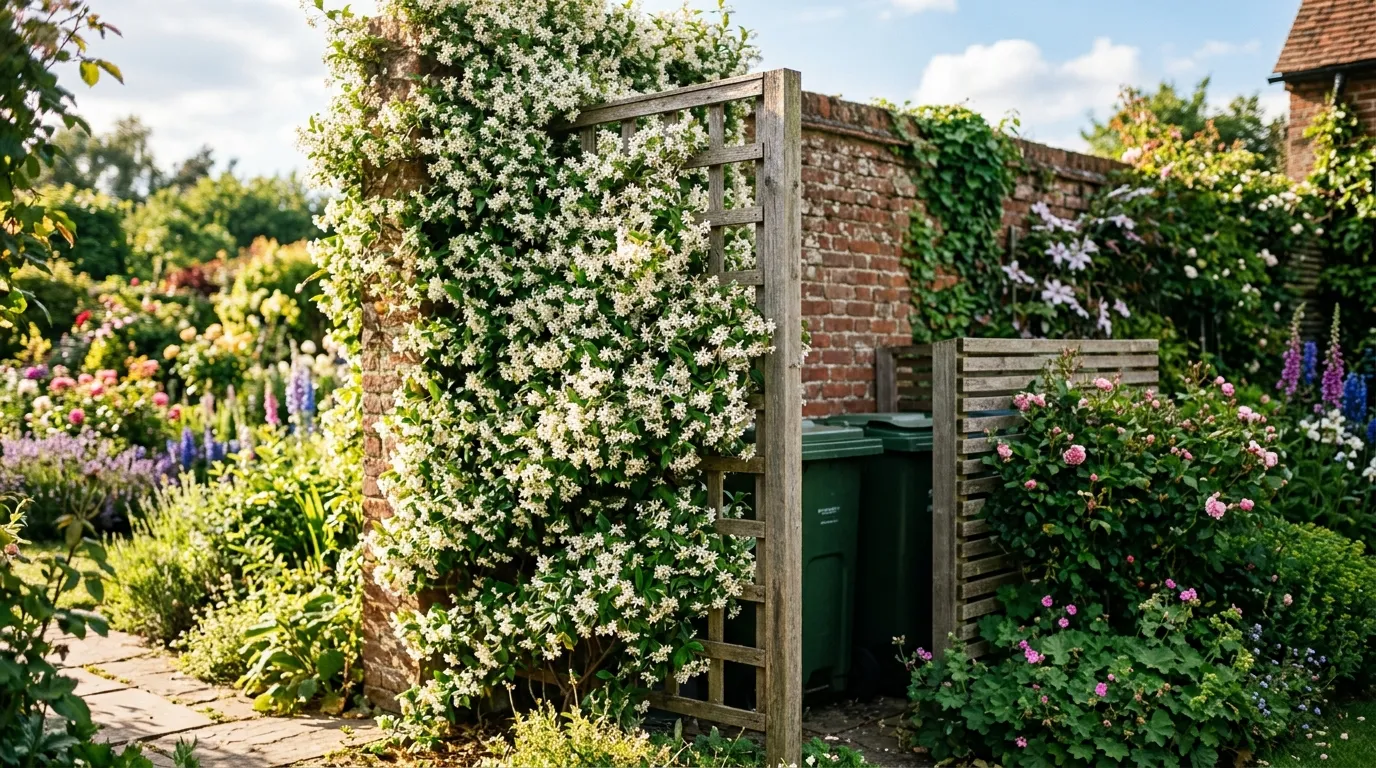 Star jasmine on a trellis behind the bins masks odour within a 3-metre radius from May to August. Plant against a sunny south or west-facing wall for best fragrance.
Eight options compared
The summary table for choosing the right screen for the right garden:
| Option | Speed | Evergreen | Maintenance | Smell-masking | Cost |
|---|---|---|---|---|---|
| Pleached hornbeam | Slow (3-4 yrs) | Marcescent (brown winter) | 2 trims/yr | Low | £180-240/panel |
| Phyllostachys aurea bamboo | Very fast (1 yr) | Evergreen | Annual rhizome check | Low | £120 plus barrier |
| Fargesia rufa bamboo | Fast (2 yrs) | Evergreen | Low | Low | £40-60/plant |
| Pittosporum tobira nanum | Slow (4-5 yrs) | Evergreen | 1 trim/yr | Medium (flower scent) | £28-38/plant |
| Photinia ‘Red Robin’ standard | Medium (2-3 yrs) | Evergreen | 2 trims/yr | Low | £65-95 |
| Willow fedge | Fast (1-2 yrs) | Deciduous | Annual trim | Low | £30-80 |
| Hazel hurdle + climbers | Medium (2-3 yrs) | Climber dependent | 1 trim/yr | Medium-high (jasmine) | £60-90/panel |
| Carex grass screen | Medium (2 yrs) | Mostly evergreen | Cut back Feb | Low | £7-12/plant |
| Star jasmine on trellis | Slow (3 yrs) | Evergreen | 1 trim/yr | High | £25-35 plus trellis |
For most UK suburban front gardens, the working pick is Pittosporum tobira nanum for low-maintenance evergreen mass plus a single star jasmine on the wall behind the bins for fragrance. Total cost around £120 for a 3-plant set plus £50 for the trellis and climber.
Common bin-screening mistakes
Five errors derail most first attempts:
- Planting against the wall behind the bins. Roots need 400mm clearance from the bin position to avoid spillage damage and lid interference.
- Choosing running bamboo without a root barrier. Phyllostachys species spread 3m to 5m in three years and damage neighbouring properties.
- Blocking the collection path. Council rules require 1m clear access to the kerb. A spreading shrub blocks the path within 2 years if not trimmed.
- Using a deciduous screen alone. Bins are most visible in winter when leaves drop. Use evergreen, marcescent (hornbeam), or pair deciduous with structure (trellis, hurdle).
- Forgetting drainage. Bin areas often sit on hard standing with poor soil. Excavate 600mm of soil and replace with topsoil-compost mix at planting.
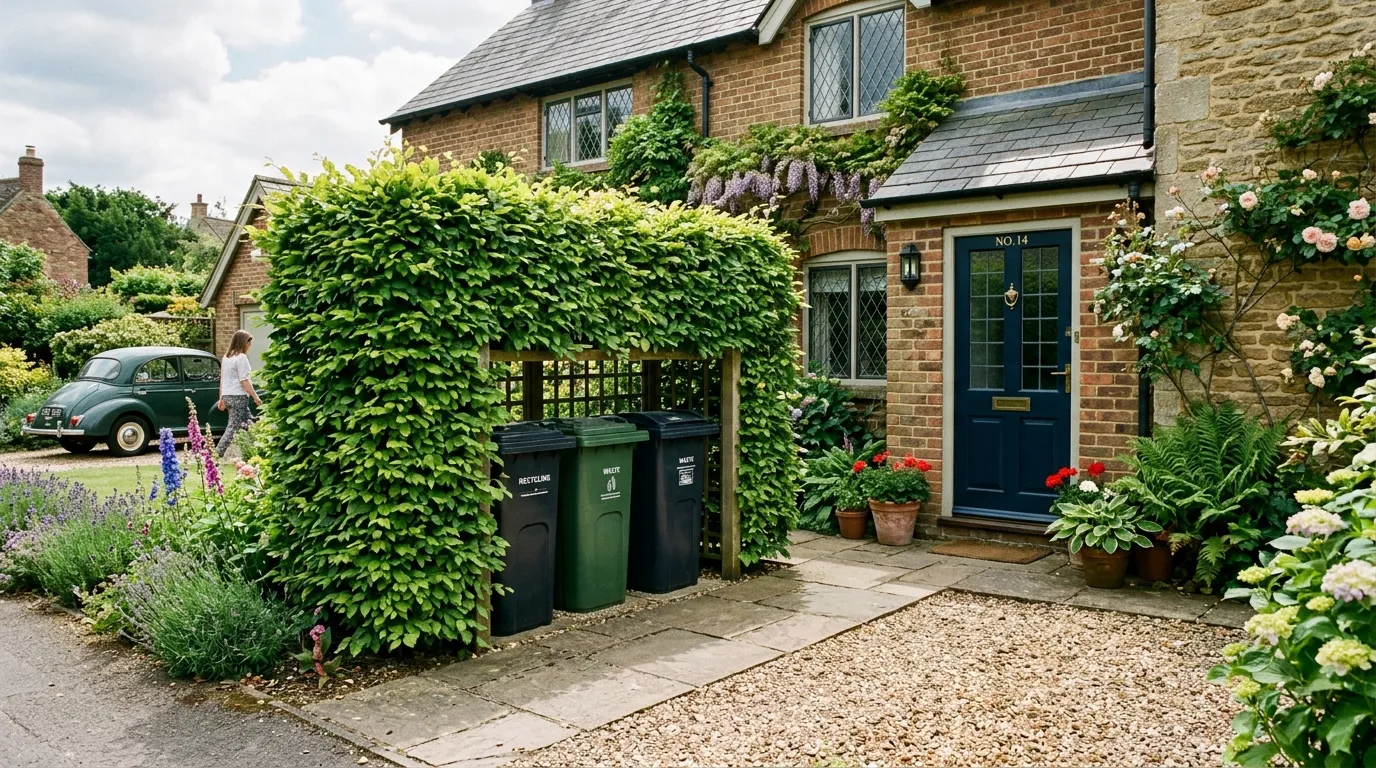 Pleached hornbeam is the most refined bin screen for a formal driveway. The marcescent winter leaves keep the screen working through October to April when other deciduous options drop.
Frequently asked questions
What is the best plant to hide wheelie bins in the UK?
Pleached hornbeam for formal gardens; Pittosporum tobira nanum for low maintenance. Pleached hornbeam panels at 1.5m by 1.5m cost £180 to £240 each and need two trims a year. Pittosporum tobira nanum grows to 1m wide and 1m tall, evergreen, with one trim a year. Both screen a standard 240-litre wheelie bin completely within 2 years.
How fast does bamboo grow to hide bins?
Phyllostachys aurea grows 1.5m of vertical screen in year one and reaches 3m by year three in average UK conditions. It is the fastest screen by a wide margin. Install a 60cm-deep HDPE root barrier at planting to prevent rhizome escape. Fargesia rufa is the clumping alternative that needs no barrier and grows to 2.5m by year three.
What are the council rules for plants around wheelie bins?
Most UK councils require 250mm clearance around the bin for lid lift and a clear 1m path to the collection point. Roots and overhanging foliage that block the path or interfere with the bin opening can lead to missed collections. Check your local council website. Pre-plant the bin position and then add screening at least 400mm clear of the bin body.
Do screening plants help mask bin smell?
Yes. Scented plants outperform pure greenery by masking bin odours within 2 to 3 metres. The most effective are Trachelospermum jasminoides (star jasmine, fragrant May-August), Lonicera periclymenum (honeysuckle), Lavandula angustifolia and rosemary. Plant fragrant climbers on a trellis behind a structural hedge for double duty.
How much does a bin screen cost in the UK?
From £60 (hazel hurdle, DIY) to £500 (pleached hornbeam, installed). Pleached hornbeam is the highest-cost option at £180 to £240 per panel. Phyllostachys aurea bamboo is £40 to £60 per plant plus £80 for the root barrier. A willow fedge (woven living screen) is the cheapest at £30 to £80 in plant cuttings.
Next step
Our team produces practical UK gardening guidance from source research, contributor records and established horticultural practice. Editorial standards are overseen by Matt W.