Key takeaways
- Beth Chatto's dry garden in Essex has thrived since 1991 with zero irrigation on a former gravel car park
- The 'right plant, right place' principle means matching species to your soil, light, and moisture levels rather than fighting conditions
- A UK dry garden needs 50-75mm of gravel over free-draining soil amended with sharp grit on clay
- Over 200 species thrive in dry conditions including stipa, verbascum, eryngium, alliums, and cistus
- Dry shade under trees is the hardest condition: epimedium, geranium macrorrhizum, and cyclamen hederifolium all cope
- Annual maintenance takes 20-30 hours total, roughly a tenth of the time a traditional border demands
Beth Chatto’s dry garden proves that the right plants in the right place need no watering, no feeding, and almost no maintenance. Built in 1991 on a former car park in Essex, her gravel garden has never been irrigated. It thrives on under 500mm of annual rainfall in one of the driest counties in England.
The principle behind it is simple: stop fighting your conditions. Instead of amending soil or installing irrigation, choose plants adapted to what you already have. Whether that is baked gravel in full sun, dry shade under mature trees, or heavy clay that cracks in summer, there are plants that will thrive there without your help.
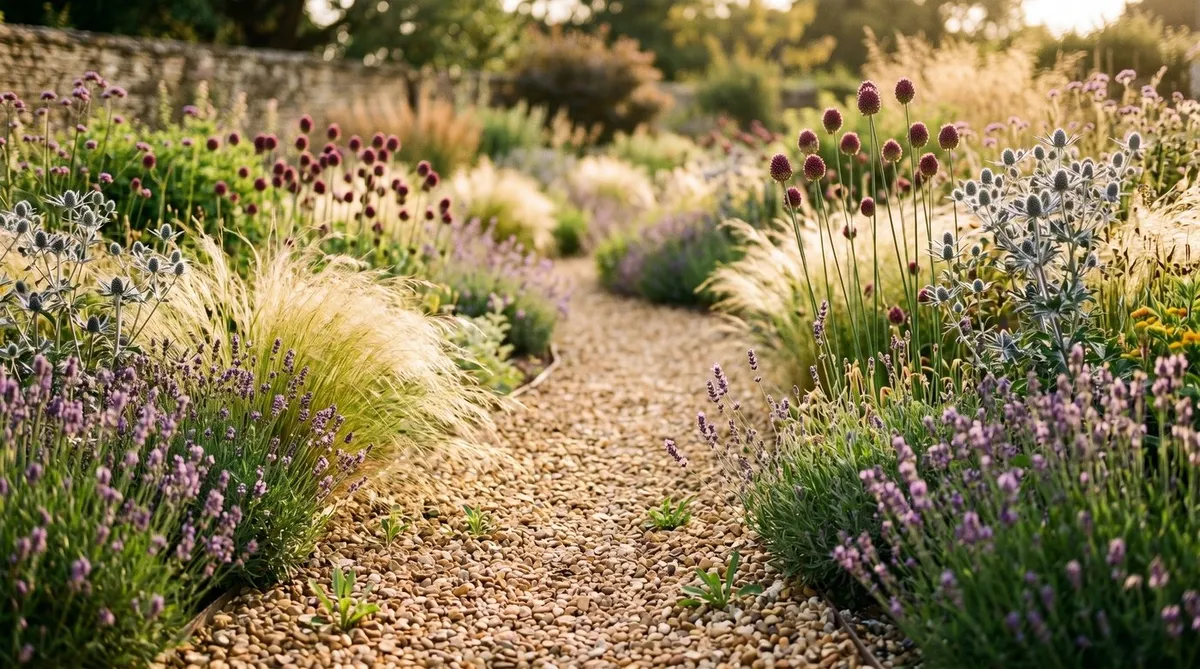
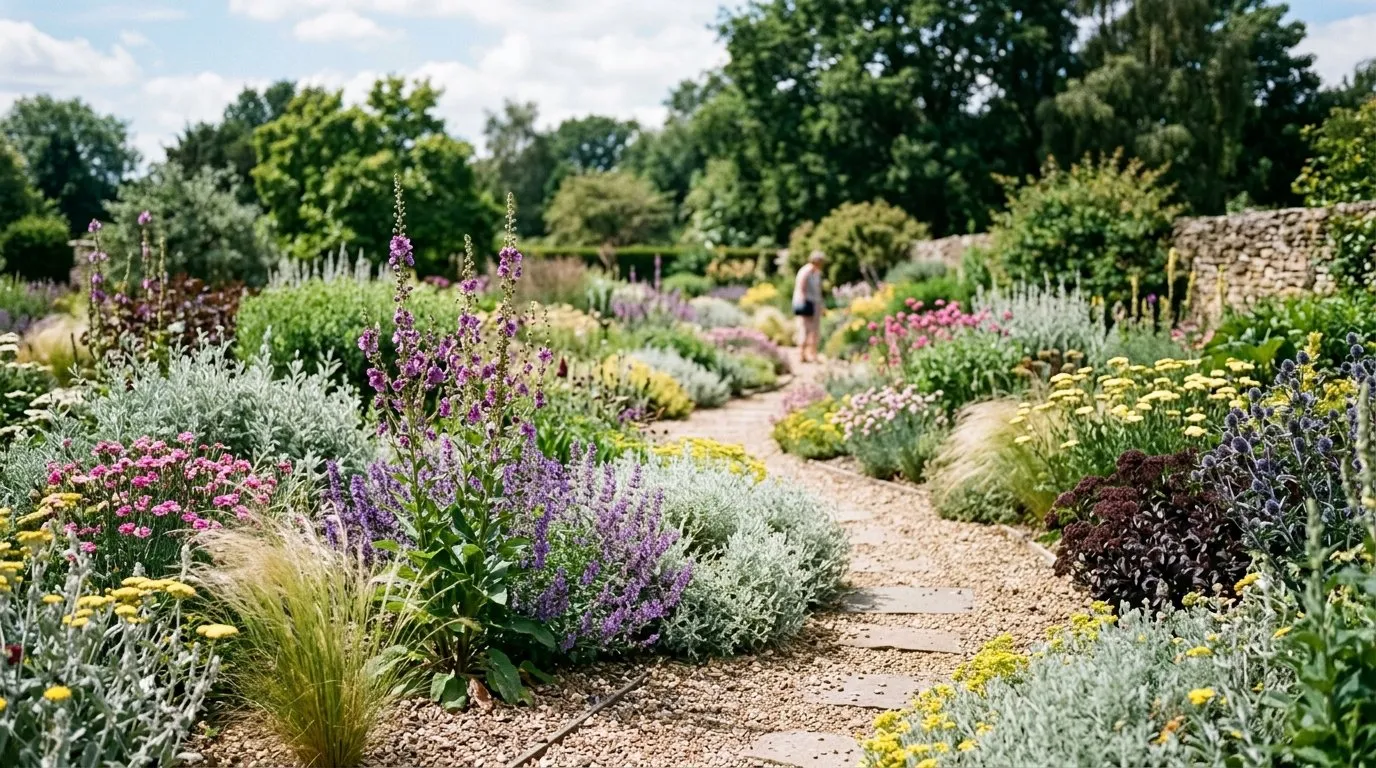 A Beth Chatto-inspired dry garden with stipa grasses, eryngium, and verbascum growing through pale gravel.
What is the Beth Chatto approach to gardening?
Beth Chatto’s philosophy centres on one idea: right plant, right place. She argued that gardeners waste time and money forcing plants into unsuitable positions. A sun-loving lavender in wet shade fails. A moisture-loving hosta in baked gravel fails. But each one thrives when placed where conditions match its natural habitat.
She demonstrated this at her nursery in Elmstead Market, Essex. The site included a dry, gravelly car park, a boggy ditch, and areas of dry shade beneath mature oaks. Instead of levelling and irrigating, she planted each area with species adapted to its exact conditions. The results still stand over 30 years later.
Her books, The Dry Garden (1978) and Beth Chatto’s Gravel Garden (2000), set out the principles in detail. The core idea is borrowed from ecology: observe the wild habitat a plant comes from, then find the spot in your garden that most closely matches it. Mediterranean hillsides, steppe grasslands, woodland floors, and riverbanks each have UK garden equivalents.
How to assess your garden conditions
Before choosing a single plant, walk your garden and map the conditions. Beth Chatto spent years observing her site before planting. You do not need years, but you do need an honest assessment.
Light: Track which areas receive full sun (6+ hours), partial shade (3-6 hours), and full shade (under 3 hours). Note seasonal changes: a spot shaded by a deciduous tree in July may get full sun from November to April.
Soil: Dig a handful from 15cm deep. Clay feels sticky and holds its shape when squeezed. Sand feels gritty and falls apart. Chalky soil is pale, stony, and alkaline. Test pH with a kit from any garden centre for under five pounds. Most dry garden plants prefer pH 6.5-7.5.
Drainage: After heavy rain, check how long water sits on the surface. If puddles remain after 2-3 hours, drainage needs improving. If water drains within minutes, you already have dry garden conditions. For tips on improving fast-draining soils, see our guide to sandy soil gardening.
Moisture competition: Trees and hedges draw huge amounts of water from surrounding soil. A mature oak can absorb 500 litres per day in summer. Planting within 3 metres of large trees means competing for every drop.
Which plants thrive in a dry gravel garden?
Gravel gardens in full sun suit the widest range of drought-tolerant species. These plants evolved on Mediterranean hillsides, South African fynbos, and Central Asian steppes where summer rainfall is rare and soil is thin and stony.
| Plant | Height | Flowers | Soil | Notes |
|---|---|---|---|---|
| Stipa tenuissima | 60cm | Jun-Sep, buff | Any well-drained | Wispy movement, self-seeds freely |
| Verbascum bombyciferum | 180cm | Jun-Jul, yellow | Poor, dry | Felted silver rosettes, biennial |
| Eryngium bourgatii | 45cm | Jun-Aug, steel blue | Dry, gritty | Architectural, deep taproot |
| Allium hollandicum | 90cm | May-Jun, purple | Any drained | Structural seed heads persist months |
| Cistus x purpureus | 100cm | Jun-Jul, pink | Poor, dry | Papery flowers, aromatic foliage |
| Lavandula angustifolia | 60cm | Jun-Aug, purple | Alkaline, drained | RHS AGM, aromatic |
| Pennisetum villosum | 60cm | Aug-Oct, white | Dry, sunny | Fluffy seed heads, half-hardy |
| Euphorbia characias | 120cm | Mar-May, lime | Any drained | Architectural, evergreen |
| Salvia nemorosa | 50cm | Jun-Sep, violet | Dry, full sun | Repeat flowers if deadheaded |
Stipa feather grass is the signature plant of Beth Chatto’s gravel garden. Its fine, hair-like foliage catches every breeze and every shaft of light. Plant it in drifts of five or more for the best effect.
Cistus (rock rose) is another dry garden essential. Each flower lasts a single day, but dozens open every morning through June and July. It needs no pruning and no feeding.
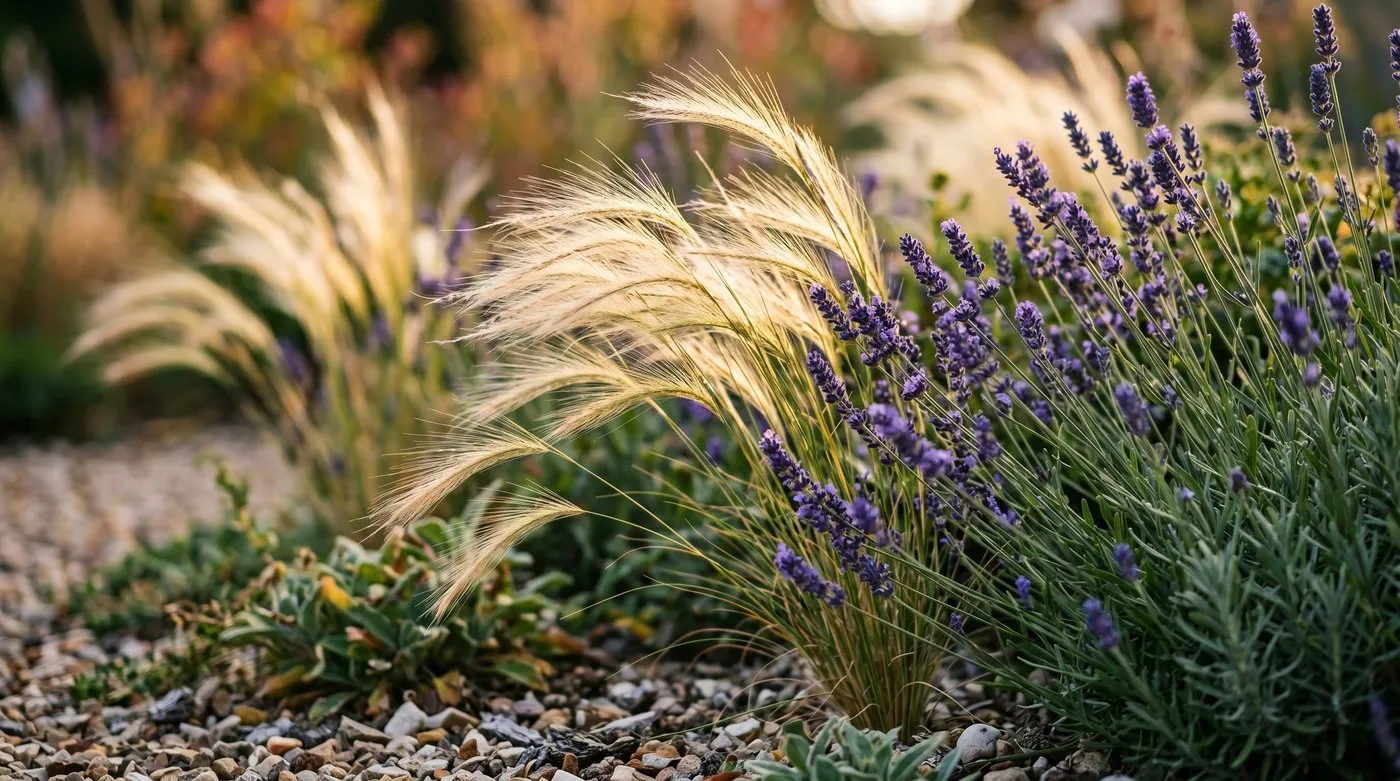 Stipa tenuissima and lavender create a naturalistic border in a dry gravel garden.
Best plants for dry shade in the UK
Dry shade is the hardest condition in any garden. The soil beneath mature trees is bone-dry from May to October because tree roots take everything. Light levels drop below 3 hours of direct sun. Rain barely reaches the ground through the canopy in summer.
Beth Chatto tackled this at her Essex nursery beneath a mature oak. Her approach was ruthless in its simplicity: only plant species from woodland floors where conditions are identical.
The top performers for dry shade:
- Epimedium x versicolor ‘Sulphureum’ - 30cm, heart-shaped leaves, yellow spring flowers. Tough as nails once established. Cut foliage to ground level in February to reveal flowers.
- Geranium macrorrhizum - 40cm, aromatic semi-evergreen leaves, pink or white flowers May-June. Spreads to form dense ground cover that suppresses weeds.
- Cyclamen hederifolium - 12cm, pink flowers in September before ivy-shaped leaves emerge. Naturalises under trees and in hedge bases.
- Iris foetidissima - 50cm, evergreen sword leaves, orange berries in autumn. Tolerates deep shade and root competition.
- Dryopteris filix-mas (male fern) - 90cm, native, shuttlecock-shaped. Self-sows once established.
- Brunnera macrophylla - 40cm, forget-me-not flowers in April, large heart-shaped leaves. ‘Jack Frost’ has silver-frosted foliage.
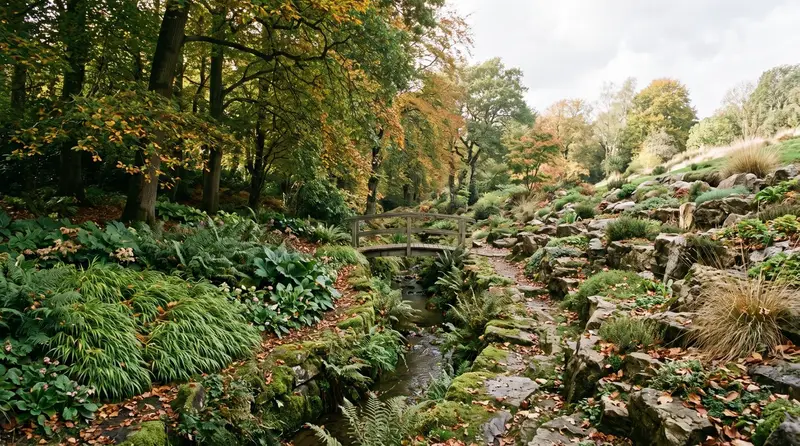
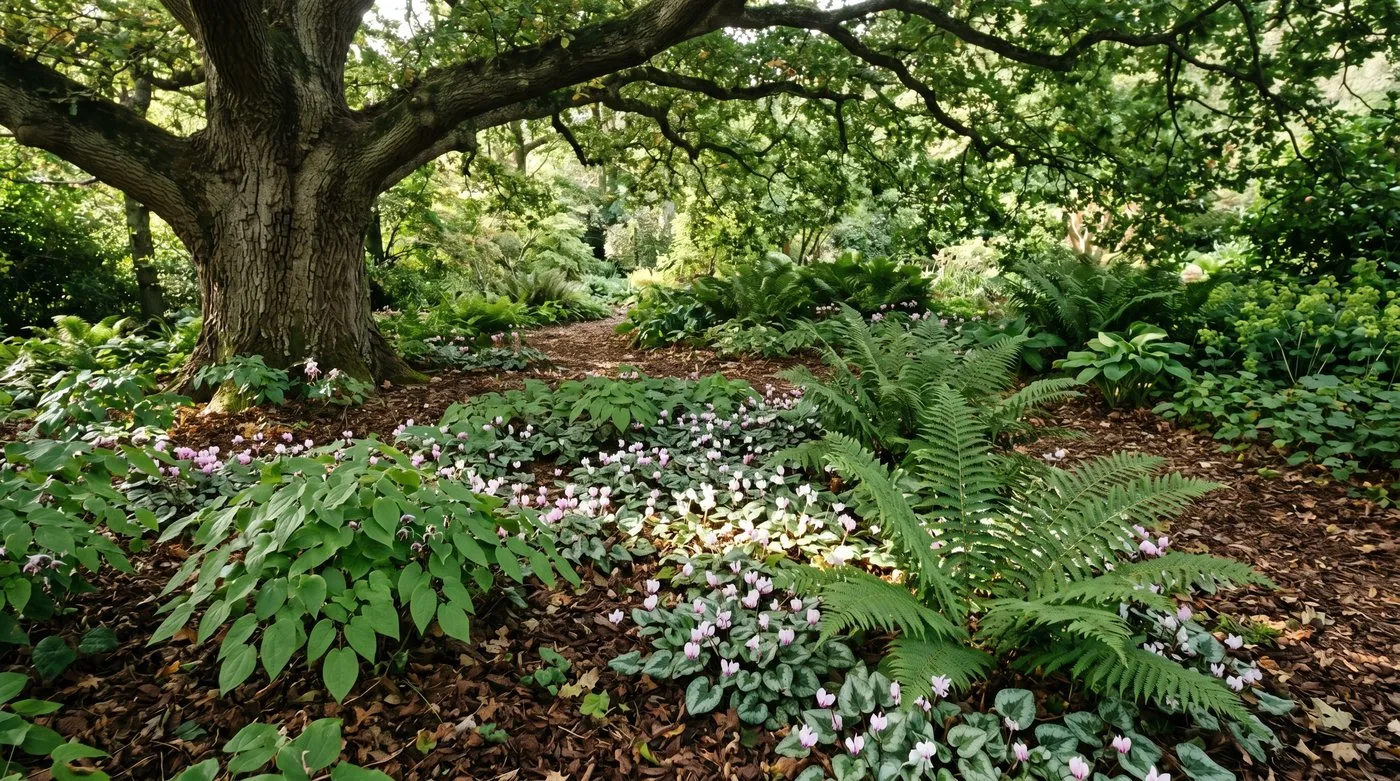 Epimedium, ferns, and cyclamen thrive in dry shade beneath a mature oak.
How to prepare soil for a dry garden
Soil preparation differs by soil type. The goal is always the same: ensure water drains freely away from plant roots in winter, while the soil retains just enough moisture for establishment.
On sandy soil: Almost no preparation needed. Sandy ground already drains fast. Check pH and add garden lime if below 6.5. Most Beth Chatto plants prefer neutral to slightly alkaline conditions. Sandy soils suit grasses like stipa and pennisetum without amendment.
On chalk: The best natural base for a dry garden. Free-draining, alkaline, and stony. Chalk gardens suit lavender, cistus, eryngium, and verbascum perfectly. See our guide to plants for chalky soil for a full species list.
On thin, rubble-filled ground: This is what Beth Chatto had. If your soil is already poor, stony, and dry, celebrate. You are starting from the ideal position. Remove perennial weeds, spread 50-75mm of gravel, and plant directly into the rubble beneath.
How to create a gravel garden without irrigation
The practical steps to build a dry garden follow Beth Chatto’s original method. She did not use membrane, edging, or irrigation. The approach is deliberately low-input.
Step 1 - Clear the ground. Remove turf, perennial weeds, and debris. Kill bindweed and couch grass roots with a fork, not chemicals. Wait three weeks and re-fork any regrowth.
Step 2 - Amend drainage if needed. On clay, dig in grit as described above. On free-draining soil, skip this step entirely.
Step 3 - Spread gravel. Lay 50-75mm of 20mm pea gravel or angular flint directly over the prepared soil. No membrane. Beth Chatto never used membrane because it prevents the natural self-seeding that gives gravel gardens their character.
Step 4 - Plant through the gravel. Scrape gravel aside, dig a hole twice the pot width, water the hole, plant at the same depth as the nursery pot, backfill with a mix of soil and grit, and draw gravel back around the plant stem. Leave a 3cm gap between gravel and the stem to prevent collar rot.
Step 5 - Water the first season only. Water new plants weekly from April to September in their first year. After that, stop completely. The plants must send roots deep to find their own moisture. Continued watering produces shallow, dependent root systems.
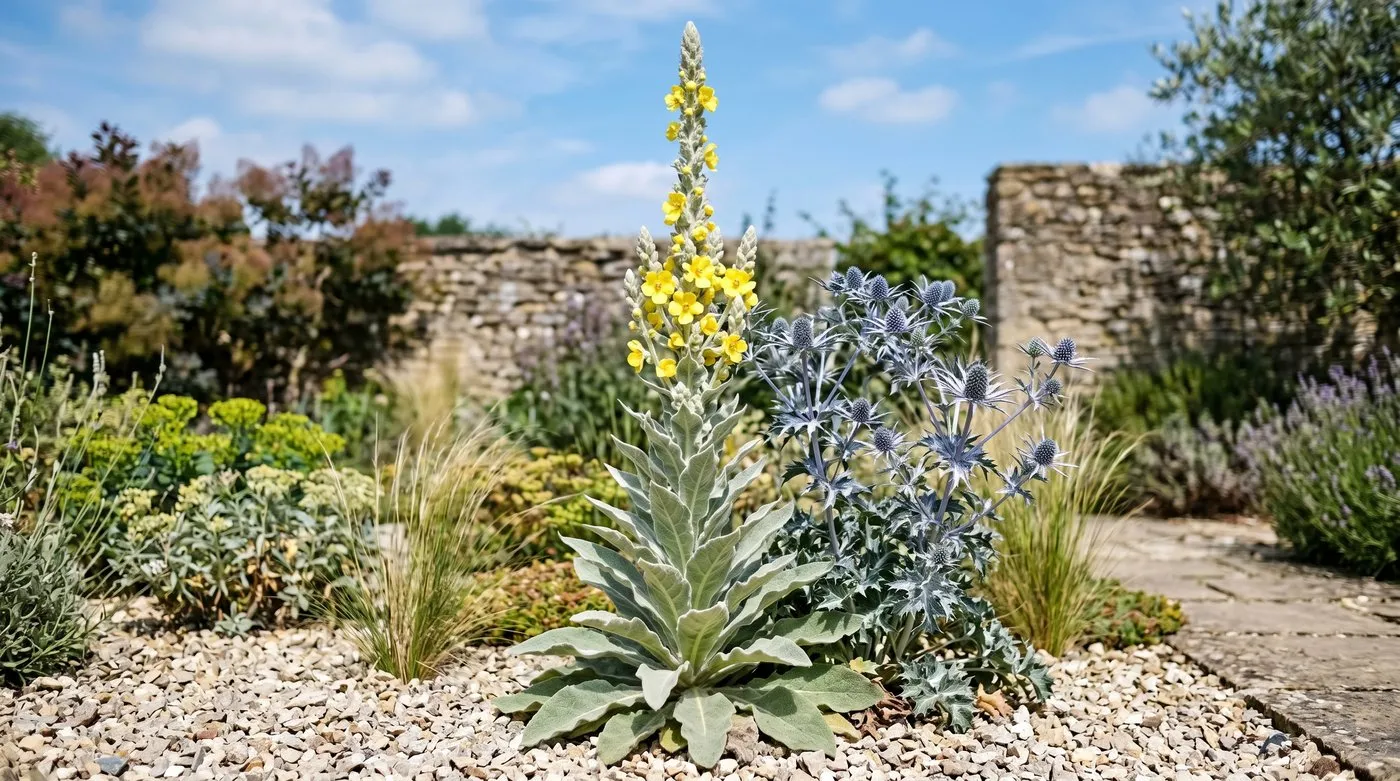 Verbascum bombyciferum and eryngium growing through gravel. Both are biennial or short-lived perennial, but self-seed reliably.
What is the right plant, right place principle?
Beth Chatto’s ‘right plant, right place’ means matching each species to the precise conditions where it evolved. It is the opposite of the traditional approach of buying whatever looks good at the garden centre and then modifying soil, drainage, and watering to keep it alive.
Keep dry-garden ideas separate from assumptions about any area described as alpine. Church Gill’s brighter alpine area does not establish its soil mix or pH. Our Church Gill planting-zone article uses the official description to explain Garden UK’s approach to checking conditions before planning connections.
The principle works by dividing your garden into habitat zones:
| Zone | Conditions | Example plants | UK garden equivalent |
|---|---|---|---|
| Dry sun | Full sun, free-draining, low fertility | Stipa, lavender, verbascum, eryngium | South-facing gravel bed, drive border |
| Dry shade | Under trees, root competition, low light | Epimedium, cyclamen, iris, ferns | Base of mature trees, north-facing hedge |
| Moist shade | Sheltered, humus-rich, damp | Hosta, astilbe, ligularia, rodgersia | Bog edge, north-facing border with mulch |
| Damp open | Full sun, moisture-retentive soil | Iris sibirica, trollius, caltha | Pond margin, low-lying clay border |
The power of this approach is that every plant performs at its best because it is in conditions it evolved for. No supplementary watering. No extra feeding. No repeated replacements. Beth Chatto’s own garden has run for over 30 years on this principle alone.
Dry garden maintenance through the year
A Beth Chatto-style dry garden demands less than a quarter of the time a traditional herbaceous border requires. The calendar below covers a 20 square metre gravel garden.
| Month | Task | Time |
|---|---|---|
| February | Cut epimedium foliage to ground. Cut ornamental grasses to 10cm. | 2 hours |
| March-April | Hand-weed annual seedlings in gravel. Thin self-sown stipa and verbascum. | 1 hour/month |
| May | Deadhead alliums after flowering if you want tidy seed heads. | 30 minutes |
| June-July | Trim lavender after first flush. Remove spent cistus flowers. | 1 hour |
| August-September | Collect seed from verbascum and eryngium. Plant autumn cyclamen corms. | 1 hour |
| October | Spread 50mm leaf mould on dry shade beds. Leave gravel beds uncovered. | 2 hours |
| November-January | Leave all seed heads standing for structure and wildlife. No cutting back. | None |
Total annual maintenance sits around 20-30 hours. Compare that to a lawn needing 40+ mows per year, or a traditional border requiring fortnightly weeding, staking, feeding, and watering.
The most common mistake is tidying too early. Leave seed heads and dried foliage through winter. They protect plant crowns from frost, feed birds, and look beautiful in morning frost. Cut back in late February, just before new growth starts.
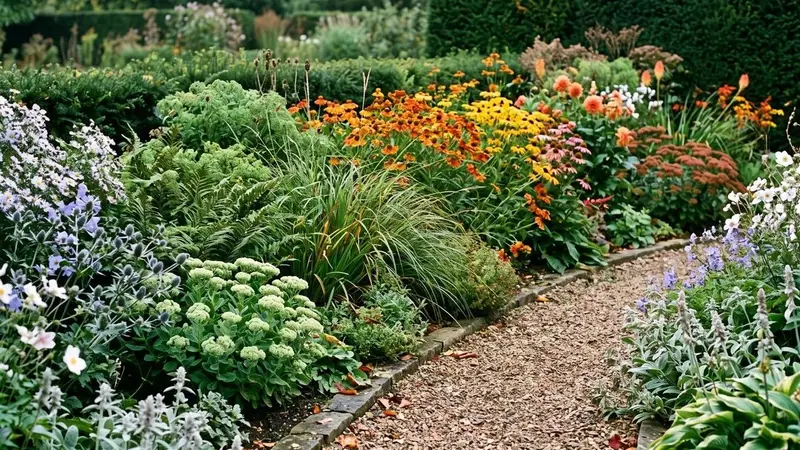
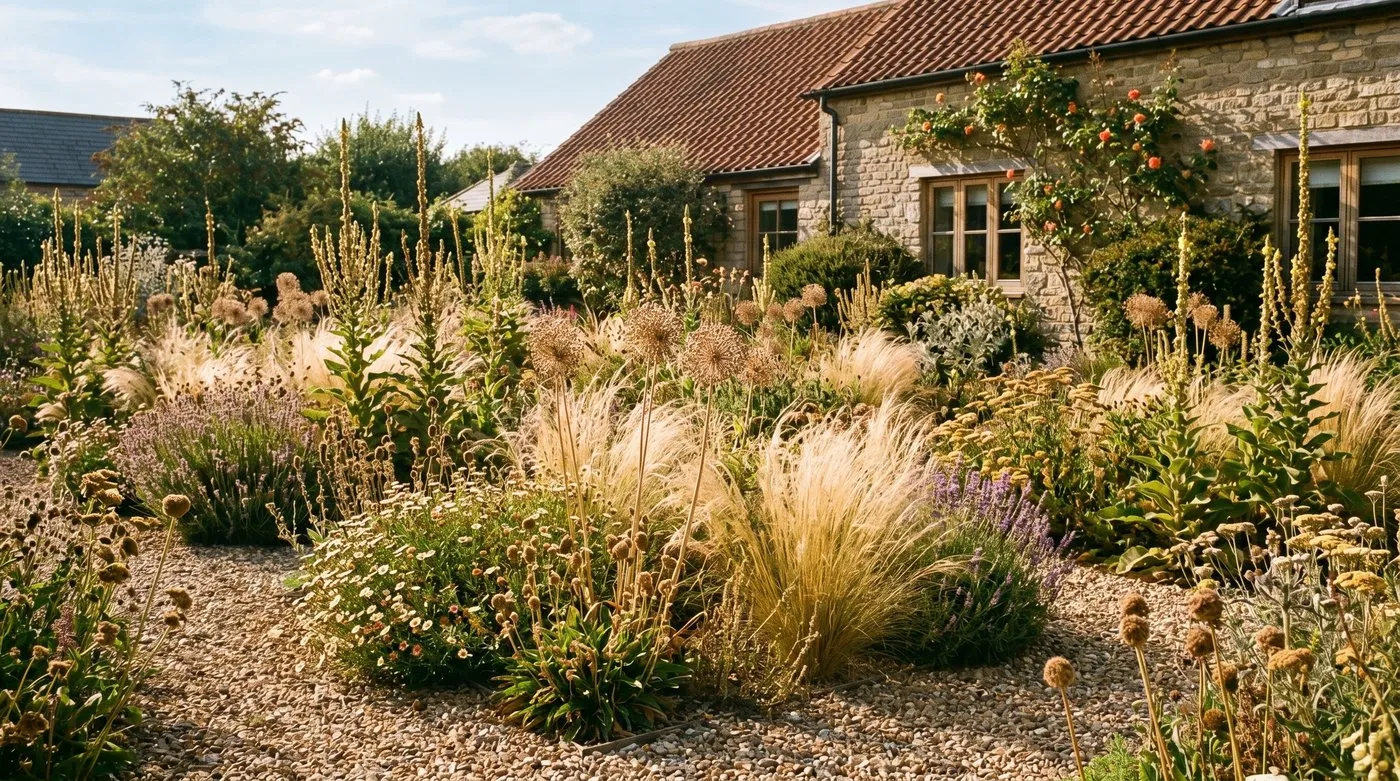 A mature dry garden in late summer. Self-sown verbascum and allium seed heads create natural structure with zero irrigation.
Building a Beth Chatto border on a budget
You do not need a large garden or a large budget. Beth Chatto’s principles apply to a 2-metre strip beside a drive or a single raised bed on a patio.
Starter border (2m x 4m) - under 150 pounds:
- 1 tonne of 20mm pea gravel: 35-50 pounds delivered
- 0.5 tonnes of sharp grit for clay amendment: 20-30 pounds
- 5 x stipa tenuissima (9cm pots): 15 pounds
- 3 x lavender (9cm pots): 8 pounds
- 5 x allium bulbs: 6 pounds
- 3 x sedum (9cm pots): 8 pounds
- 1 x eryngium (2-litre pot): 9 pounds
- 1 x verbascum (2-litre pot): 9 pounds
Buy small. Nine-centimetre pots cost a third of the price of 2-litre specimens and establish faster in gravel conditions because smaller root balls adapt more quickly to the lean soil. Within two seasons, self-seeding fills the gaps naturally. Beth Chatto herself advocated small plants and patience.
For a fuller range of drought-tolerant plants suited to dry gardens, see our dedicated species guide. If you favour a Mediterranean garden style, many of the same species work in sheltered sunny borders too.
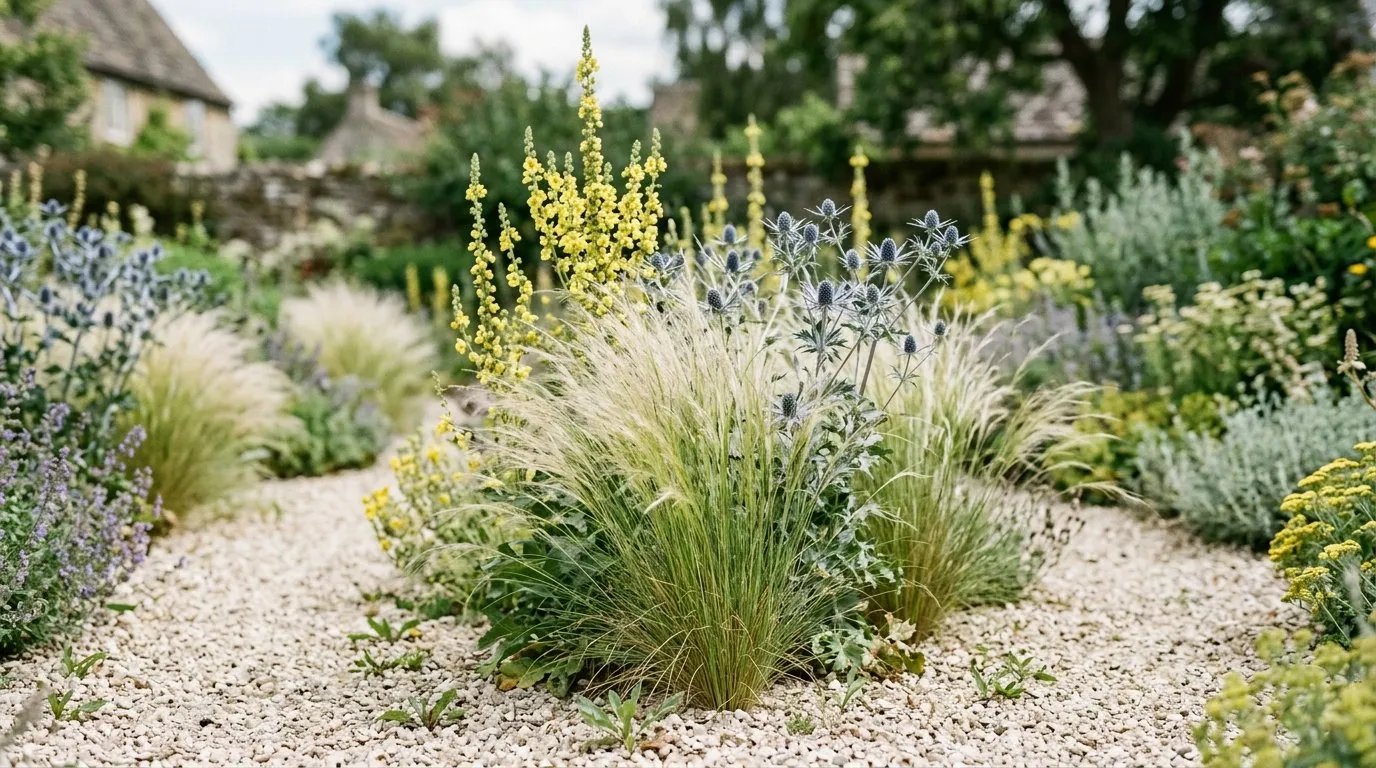 Mature dry garden after three seasons of self-seeding. Stipa, verbascum, and eryngium spread naturally where Beth Chatto advocated patience over intervention.
Frequently asked questions
What is the right plant right place principle?
It means choosing plants adapted to your existing conditions. Beth Chatto coined the phrase to describe matching species to the soil type, moisture level, and light in each part of a garden. Instead of amending heavy clay or irrigating dry ground, you select plants that already thrive in those conditions. A lavender planted in wet clay dies. The same lavender in gravel and full sun flourishes for years without watering.
Can you visit the Beth Chatto dry garden?
Yes, the garden is open to visitors year-round. It is located at Beth Chatto’s Gardens in Elmstead Market, near Colchester, Essex (CO7 7DB). Opening hours are typically 10am to 4pm Monday to Saturday. Admission costs around eight pounds for adults. Spring and early summer offer the best display, though the garden holds interest through every season.
Does a dry garden work on clay soil?
Yes, with proper drainage preparation. Dig 10-15cm of sharp horticultural grit into the top 30cm of clay before planting. Alternatively, raise beds 15-20cm above ground level with a grit-enriched mix. Without drainage improvement, Mediterranean plants rot in waterlogged winter clay. Once amended, clay holds enough moisture for even dry garden plants to establish quickly.
What plants grow in dry shade UK?
Epimedium, geranium macrorrhizum, and cyclamen hederifolium are the three most reliable species. Dry shade under mature trees is the toughest garden condition because tree roots compete for every drop of moisture. Other survivors include Iris foetidissima, Dryopteris filix-mas, and Brunnera macrophylla. Mulch with leaf mould annually to improve the thin soil.
How much does a dry garden cost to create?
Budget 15-30 pounds per square metre for a gravel dry garden. A 20 square metre plot costs 300-600 pounds for gravel, plants, grit, and edging. Running costs after the first year are almost zero because dry gardens need no irrigation, no feeding, and minimal weeding. Compare that to a traditional border costing 30-50 pounds per square metre plus ongoing watering and feeding.
Do dry gardens need watering?
Only in the first growing season after planting. Water new plants weekly from April to September during their first year. After roots establish, natural UK rainfall is sufficient even in dry summers. Beth Chatto’s original dry garden in Essex has never been irrigated since 1991, despite the region receiving under 500mm of annual rainfall.
What gravel is best for a Beth Chatto style garden?
Use 20mm pea gravel or angular flint at 50-75mm depth. Warm-toned gravel in honey or buff shades suits most UK settings and complements the silver and green foliage of drought-tolerant plants. Avoid bright white stone, which looks artificial, and anything smaller than 10mm, which sticks to shoes and migrates indoors.
Sources: Beth Chatto Gardens | RHS Drought-Tolerant Gardening For more borrow-these-ideas notes from a famous garden, see what we took from a day at RHS Wisley.
Our team produces practical UK gardening guidance from source research, contributor records and established horticultural practice. Editorial standards are overseen by Matt W.