Key takeaways
- 12 features together define the classic English garden look across all four seasons
- Yew hedging takes 7-10 years to establish but lasts 200+ years
- A 12m lavender walk costs £180 plus 90 minutes of planting time
- Mixed herbaceous borders need 5m of depth minimum to read correctly
- Wisteria takes 5-7 years to flower from a £25 nursery plant
- Stone sundials and armillary spheres cost £150-£800 and anchor a focal point
The classic English garden is not a style. It is a vocabulary of around twelve elements that get used in different combinations at every great English country house garden. Sissinghurst uses them. Great Dixter uses them. Hidcote, Kiftsgate, Bourton House, and most of the National Trust catalogue use them. Strip away the celebrity head gardeners and the famous owners, and the underlying twelve features are remarkably consistent.
What the classic English garden actually is
A clear definition before the elements. The English garden is four-season layered planting set inside formal structure. The formal structure (hedging, paths, focal points) provides the bones that hold the romantic plantings in place. Without the structure, the plantings look messy. Without the plantings, the structure looks municipal.
Three references everyone working in this style uses:
- Sissinghurst Castle Garden in Kent. Vita Sackville-West’s 1930s design. The model for compartmentalised “garden rooms” connected by clipped yew.
- Great Dixter in East Sussex. Christopher Lloyd’s 1950s rebuild of an Arts and Crafts framework. The model for adventurous herbaceous combinations inside traditional structure.
- Hidcote Manor Garden in Gloucestershire. Lawrence Johnston’s 1907-1948 layered build. The original “garden rooms” concept.
All three use the same twelve elements in different combinations. Here they are.
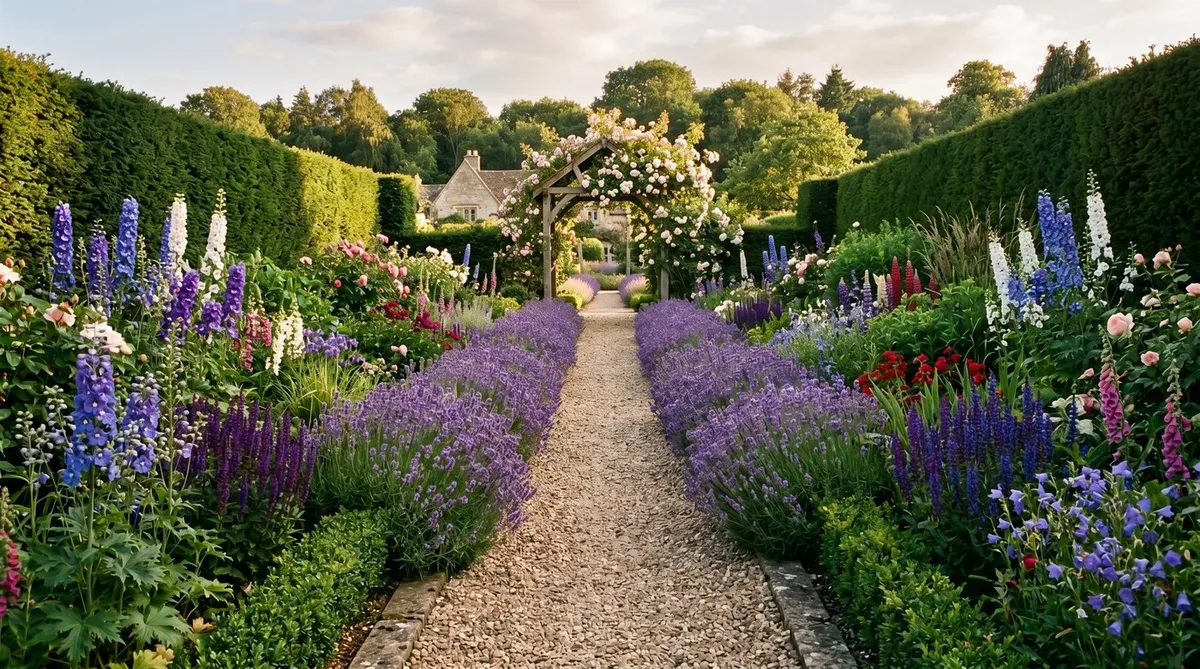
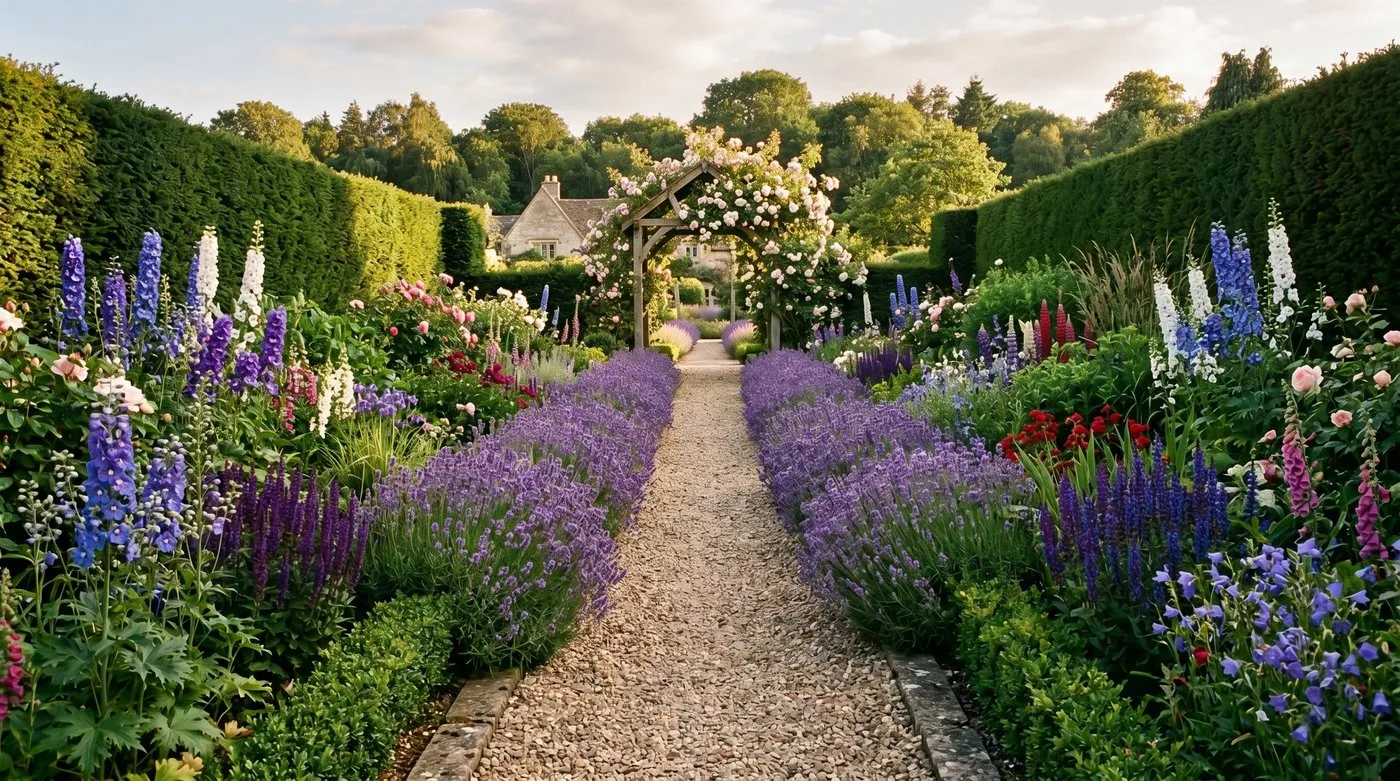 The classic English garden combines formal structure (yew hedging, axial paths, parterres) with romantic plantings (lavender, roses, herbaceous borders).
The 12 elements
1. Clipped yew or box hedging
The single most important element. Yew (Taxus baccata) for tall divisions and “garden room” walls. Box (Buxus sempervirens) for low edging at 30 to 60cm. Both clip into formal lines that hold the rest of the garden in place.
| Hedging | Cost per metre | Years to maturity | Lifespan |
|---|---|---|---|
| Yew 60cm bare-root | £4-£6 | 8-10 years | 200+ years |
| Yew 120cm rootballed | £35-£55 | 4-5 years | 200+ years |
| Box 30cm pot grown | £8-£14 | 4-5 years | 50-80 years |
| Box hedge 60cm pre-formed | £55-£85 | Instant | 50-80 years |
A 20m yew hedge from bare-root costs £80 to £120, takes 8 years to reach full height, and outlasts five generations of gardeners. A 5m box parterre edge costs £40 to £70 and takes 4 years to fill out.
Tip: Plant yew at 50cm spacing and box at 20-25cm spacing. Closer than that wastes plants. Wider than that leaves gaps that take three extra years to close.
2. A long axial path
The spine of the design. Always longer than it is wide. Always pointing at a focal point at the far end (a statue, a bench, a urn, an open vista). Materials are gravel, York stone, brick herringbone, or compacted hoggin.
A 12m by 1.2m gravel path with steel edging costs £350 to £640 to lay yourself, including the geotextile membrane and 10mm limestone chips. The same path in York stone slabs costs £2,800 to £4,200.
3. A lavender walk
The most photographed feature in any English garden. A double row of Lavandula angustifolia ‘Hidcote’ or ‘Munstead’ planted at 35cm spacing along both sides of the axial path. Heads dropped on the path. Bees everywhere.
A 12m double-sided lavender walk needs around 70 plants at £2.50 each, totalling £175. Establishment takes 18 months from 9cm pots. Lavender needs hard pruning every August to year three and beyond, otherwise the plants go woody and need replacing at year 5.
4. A rose arbour or pergola
A timber pergola covered in climbing roses (‘New Dawn’, ‘Albertine’, ‘Mme Alfred Carriere’), often combined with clematis (‘Etoile Violette’, ‘Perle d’Azur’). The arbour creates a vertical accent and a scented walkway in June and July.
A 3m square cedar pergola kit costs £435 to £680. Climbing roses cost £14 to £24 each as bare-roots in November. Allow 3 to 5 years for full coverage.
5. A deep mixed herbaceous border
The romantic showpiece. Minimum 5m wide, ideally 7m. Tall plants at the back (delphiniums, hollyhocks, sunflowers), medium in the middle (phlox, salvias, echinacea), low at the front (hardy geraniums, nepeta, alchemilla). Always backed by a clipped hedge.
A 7m by 2m border with 30 perennials costs £180 to £320 to plant. The classic colour palette is purple-blue-pink-white. The Christopher Lloyd model at Great Dixter throws in clashing orange and red.
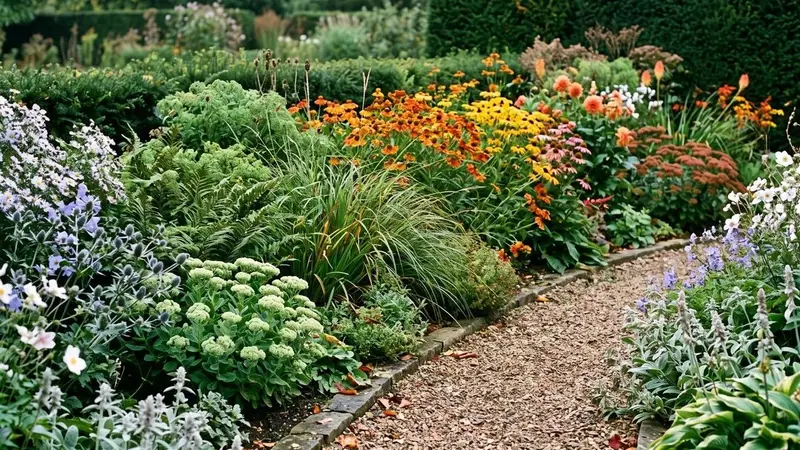
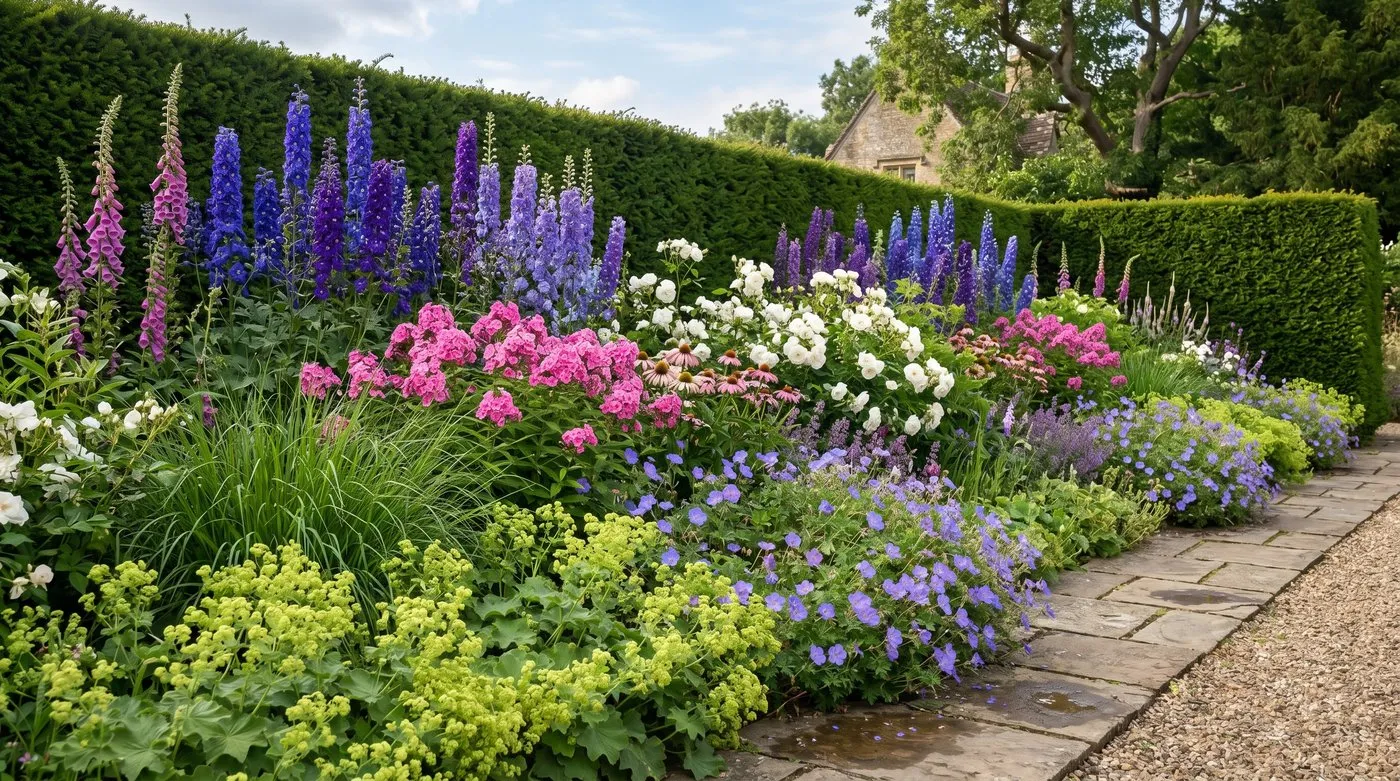 A deep mixed herbaceous border 7m wide backed by a 1.8m yew hedge. The hedge holds the planting in place visually and provides four-season green when the perennials are dormant.
6. A stone sundial or armillary sphere
The classic English garden focal point. Placed at the end of an axial path, at the centre of a parterre, or at the intersection of two paths. Materials are limestone, sandstone, or weathered bronze.
A stone sundial costs £150 to £450. An armillary sphere on a stone plinth costs £350 to £800. Both can sit on a simple plinth (£60 paving slab) and read as professional immediately.
7. A wildflower meadow strip
The Sarah Raven and Great Dixter modernisation. A 3m to 8m strip of long grass sown with corn cockle, poppy, ox-eye daisy, knautia, scabious, and yellow rattle (the parasitic key to suppressing the grass). Cut once a year in August.
A 30 square metre meadow strip costs £35 in seed and one day’s preparation. After year two, yellow rattle does the work and the meadow self-sustains.
8. Espalier or step-over fruit boundary
Apple and pear trained flat against a wall or wire. The horizontal espalier (“step-over” if at 60cm height, “espalier” if at 1.5m) was a 17th century kitchen garden technique borrowed for ornamental boundaries by the great Edwardian gardens.
A trained 4-year espalier apple costs £75 to £160. A bare-root maiden trained yourself over 4 years costs £18. The training takes one evening a year for the first four years.
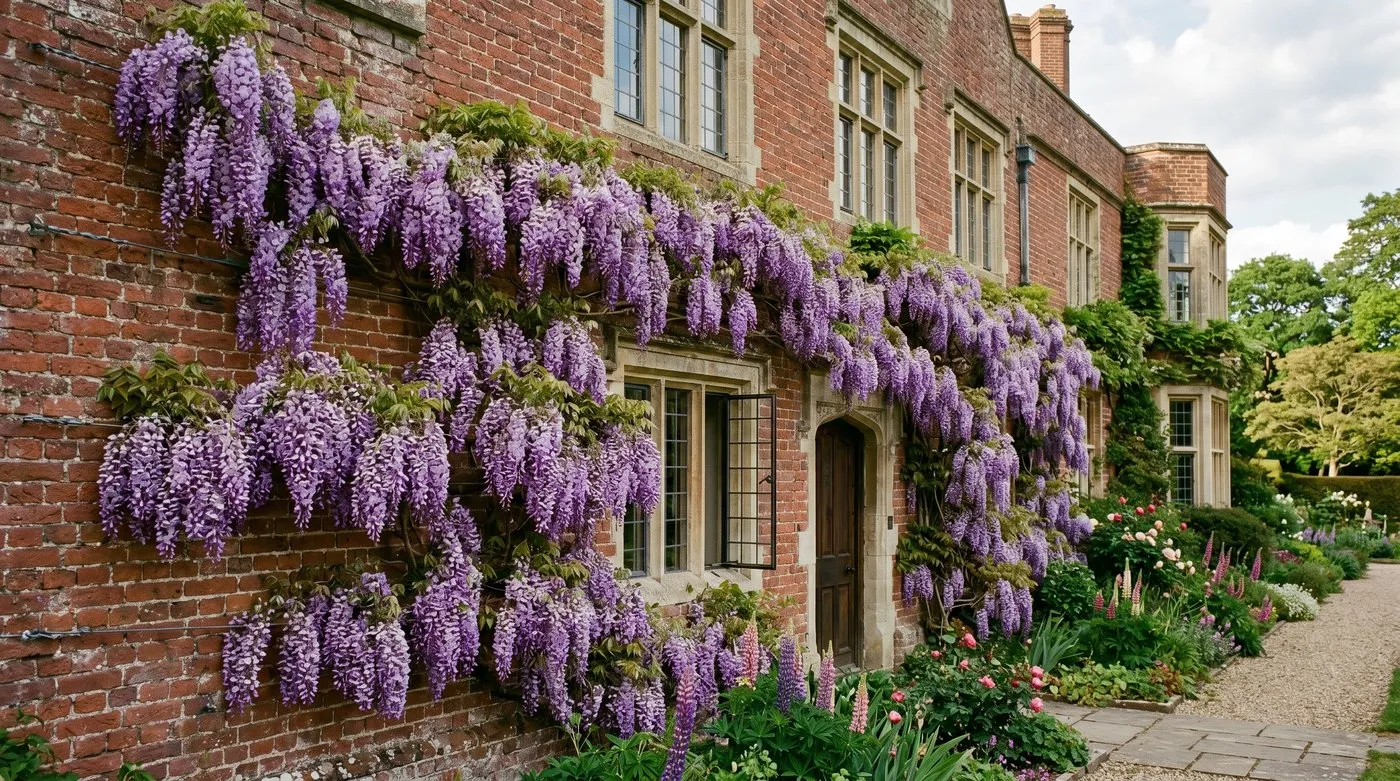 Wisteria sinensis trained on a red brick south wall in May. Five to seven years from a £25 nursery plant to this level of coverage, with two pruning sessions a year.
9. A wisteria-clad south wall
The single most photographed plant in any English garden. Wisteria sinensis or W. floribunda trained as a horizontal-cordoned mass on a south or south-west facing wall. Flowers in May. Foliage dense by June. Bare and architectural in winter.
A 5L wisteria from a nursery costs £25 to £45. Allow 5 to 7 years for the first flowers. The wisteria itself is the patience test of any English garden.
10. A buxus parterre
A 4m by 4m four-section box parterre needs 60 box plants at £14 each, totalling £840 (or £400 for bare-root yew if you want a green substitute that handles full sun better in southern UK).
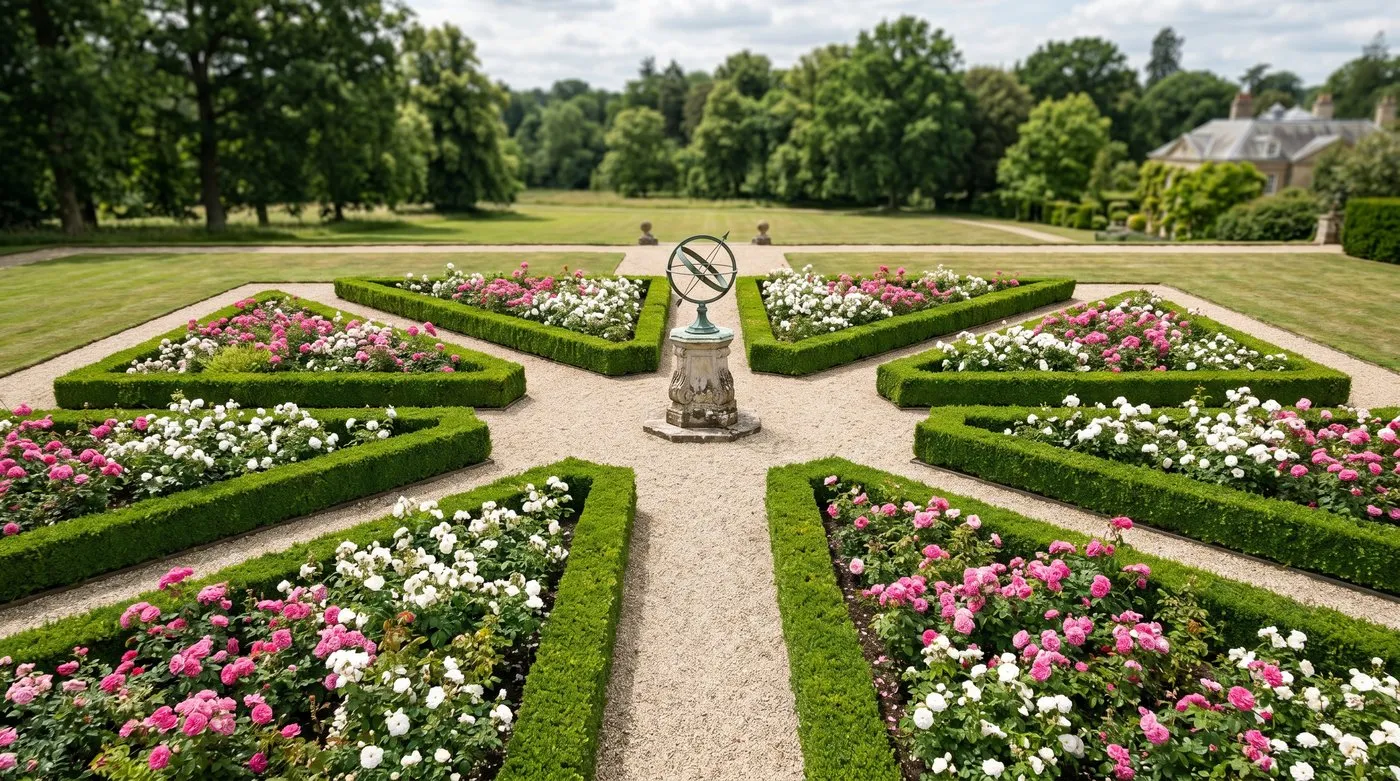 A four-section box parterre containing rose beds and a central armillary sphere. The geometric box hedging formalises a square that would otherwise read as ornamental.
11. A topiary form
A single sculptural shape in clipped evergreen. Cone, ball, peacock, spiral. Box, yew, or holly. Placed as an exclamation point at a path junction, a focal point in a parterre, or a pair flanking a doorway.
A trained 1m cone in box costs £60 to £140. A 1.5m peacock or spiral in yew costs £180 to £450. Topiary anchors a design with a single feature.
12. A sheltered seat or arbour
The end of the journey. A bench positioned at the terminus of an axial path, often under an arch of climbing roses or clematis, often facing back down the path to the house. The seat reads as the reward for the walk through the garden.
A cedar arbour with built-in bench costs £350 to £880 ready-built. A timber bench against a brick wall with a climbing rose costs £180.
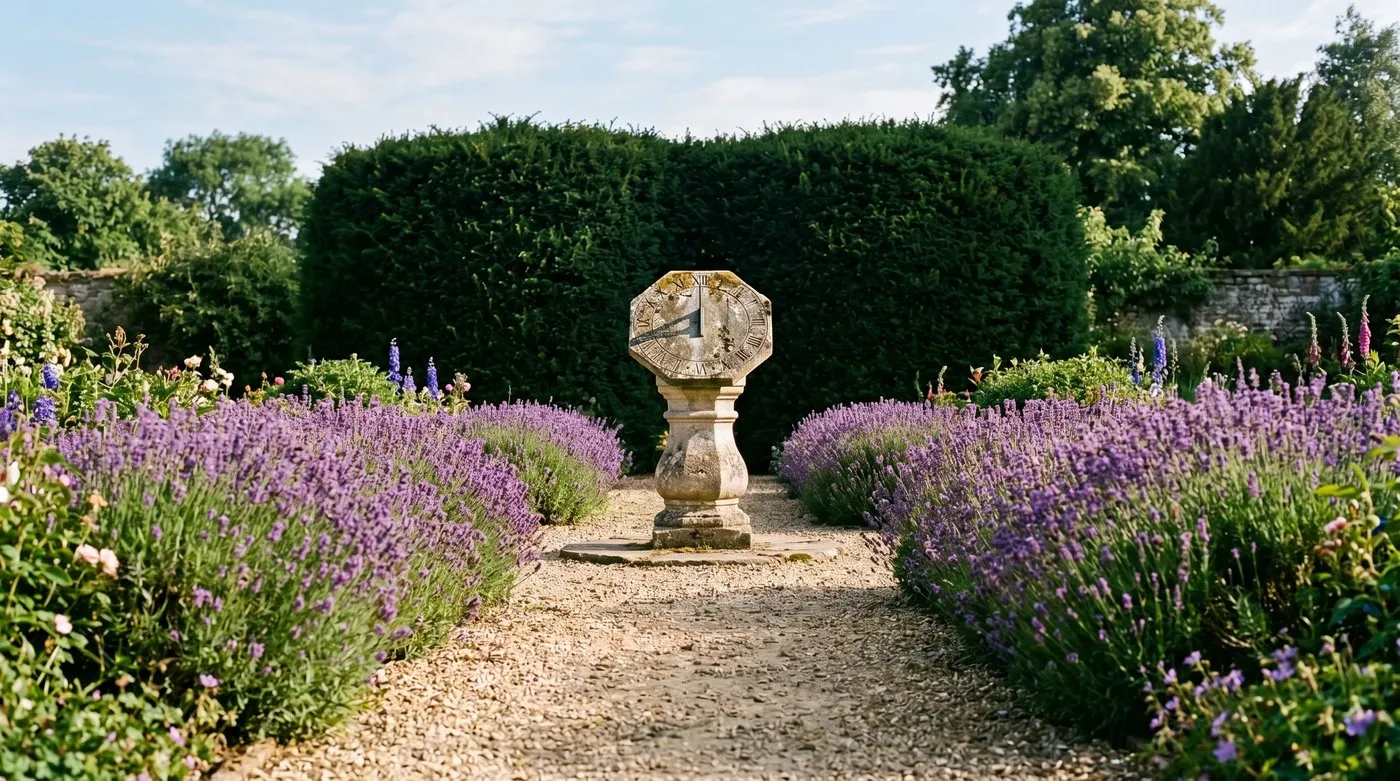 A stone sundial at the terminus of a long gravel path between lavender hedges. The axial design draws the eye and the foot through the garden.
The order to install them
Fourteen years of trial and error gives the following sequence.
- Year 1: Axial path (£350-£640). Defines the spine. Everything else hangs off it.
- Year 1: Yew hedging (£80-£120 per 20m). Plant immediately because it takes 8-10 years to mature.
- Year 2: Box parterre or low hedging (£400-£840). Establishes the formal geometry.
- Year 2: Lavender walk (£175 per 12m). Fast result, instant gratification.
- Year 2: Wisteria on south wall (£25-£45). Plant early because it takes 5-7 years.
- Year 3: Herbaceous border preparation (£180-£320 in plants). Layer behind the now-established yew.
- Year 3: Stone focal point (£150-£800). Sundial or armillary at terminus of path.
- Year 4: Rose arbour or pergola (£435-£680). Add vertical structure once horizontals are in place.
- Year 4: Espalier fruit boundary (£72 in maidens). Begin training.
- Year 5: Wildflower meadow strip (£35). The garden is structurally complete enough to absorb the looseness.
- Year 5: Topiary form (£60-£450). Add as ornament once the bones are mature.
- Year 6: Sheltered seat or arbour (£180-£880). The reward at journey’s end.
By year six the garden reads as a mature English garden. By year ten the hedging hits full height. By year fifteen the wisteria covers the wall and the espaliers carry full crops.
Total cost across the 12 elements
| Element | Budget version | Standard version | Premium version |
|---|---|---|---|
| Yew hedging (40m) | £160 | £700 | £2,200 |
| Axial path (15m) | £450 | £1,100 | £4,200 |
| Lavender walk | £175 | £225 | £340 |
| Rose arbour | £435 | £680 | £1,400 |
| Herbaceous border | £180 | £320 | £820 |
| Sundial focal point | £150 | £350 | £800 |
| Wildflower meadow | £35 | £80 | £180 |
| Espalier boundary | £72 | £160 | £640 |
| Wisteria | £25 | £45 | £180 |
| Box parterre | £400 | £840 | £2,400 |
| Topiary form | £60 | £180 | £450 |
| Seat/arbour | £180 | £450 | £1,400 |
| Total | £2,322 | £5,130 | £15,010 |
Budget version uses bare-root hedging, gravel paths, and self-grown trained fruit. Premium version uses mature yew, York stone, and ready-grown topiary.
Garden size matters
The 12 elements scale to garden size. Below is the practical minimum and the comfortable maximum.
| Garden size | Elements you can fit |
|---|---|
| Up to 30 sqm (small back garden) | 4-5 elements |
| 30-100 sqm (suburban) | 6-7 elements |
| 100-300 sqm (large suburban) | 8-9 elements |
| 300-1000 sqm (rural cottage) | 10-12 elements |
| Over 1000 sqm (country garden) | All 12 elements at full scale |
A 50 sqm back garden can hit a short lavender walk, a 1m wisteria, a single rose arch, a 1.5m deep border, a small box edge, and a sundial focal point. That is six elements, enough to read as English.
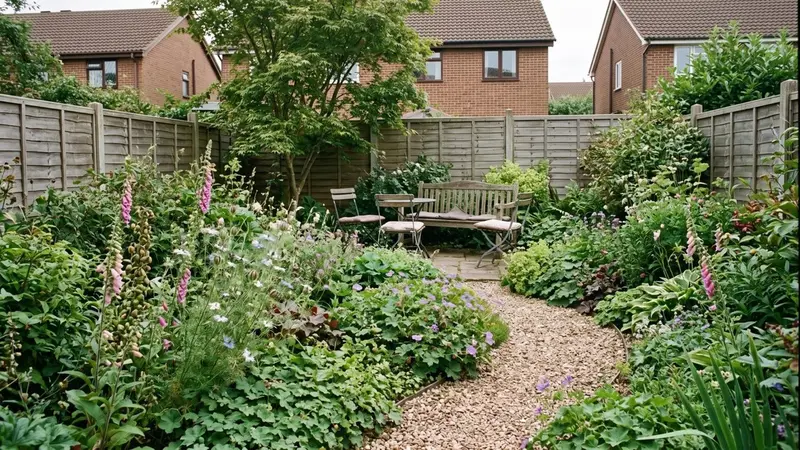
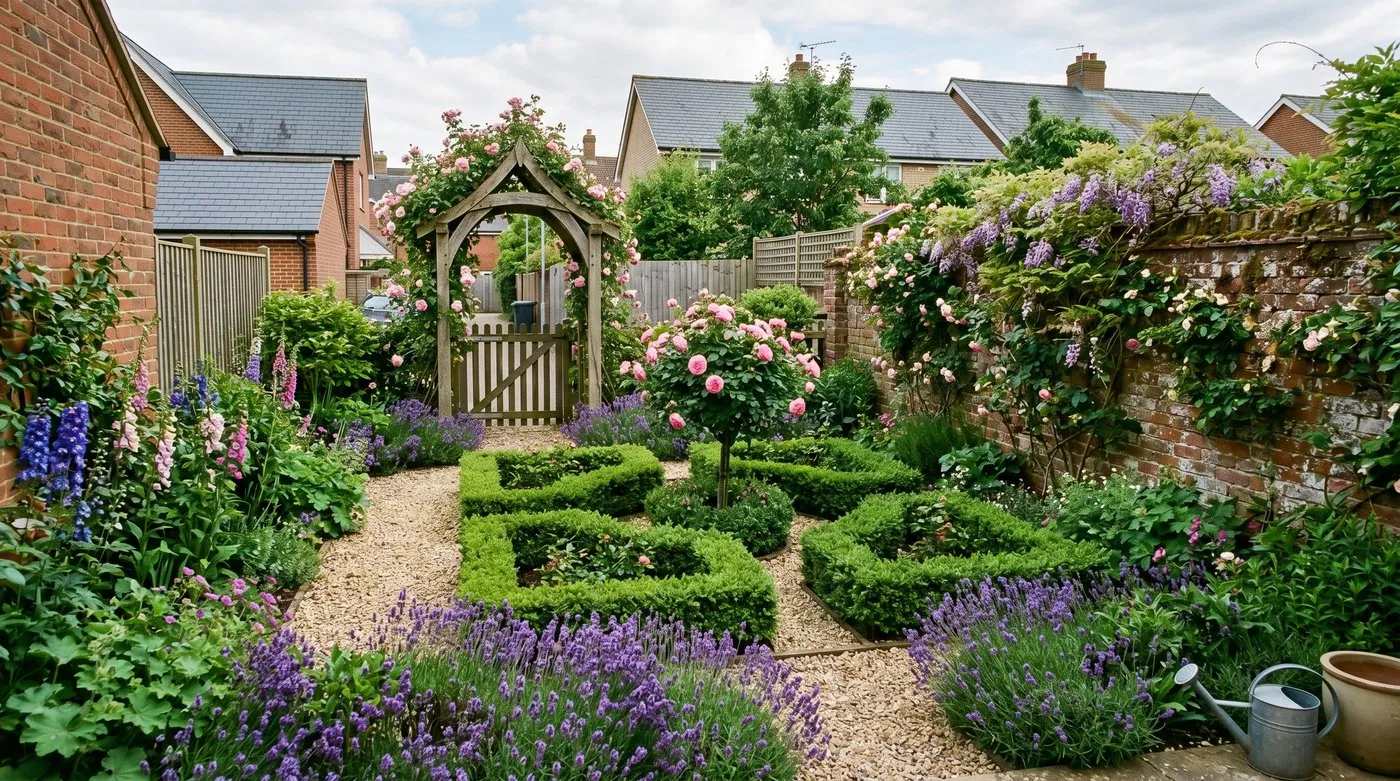 A 50 square metre back garden hitting six of the 12 elements: box parterre, rose arch, lavender edge, herbaceous border, axial path, and sundial. Enough to read clearly as English.
How to layer the planting
The English garden uses a four-tier planting structure.
- Hedging tier (1.5-2.5m). Yew, holly, hornbeam. Provides the green walls.
- Climbing tier (2-5m). Roses, clematis, wisteria. Trained on walls, arches and pergolas.
- Herbaceous tier (60cm-1.5m). Delphiniums, phlox, salvias, echinacea. The main flowering layer.
- Edging tier (10-40cm). Hardy geraniums, alchemilla, nepeta, alyssum. Spills over path edges.
Match plants to tier and the garden reads correctly. Mix the tiers and the design loses coherence.
Month-by-month English garden calendar
| Month | Key tasks |
|---|---|
| January | Prune roses (climbers and ramblers), check wisteria pruning, plan next additions |
| February | Cut back ornamental grasses, fork mulch into borders |
| March | Cut back herbaceous border, scarify lavender, divide perennials |
| April | First mowing, edge paths, plant out hardier annuals |
| May | Stake delphiniums, plant out tender annuals after frost, watch wisteria flowering |
| June | First lavender harvest, deadhead roses weekly, clip box hedges |
| July | Second clip on box, deadhead herbaceous, prune wisteria (long) |
| August | Cut lavender hard after flowering, scythe wildflower meadow, water borders weekly |
| September | Last herbaceous deadheading, plant spring bulbs (allium, tulip, narcissus) |
| October | Plant bare-root hedging, finish bulb planting, mulch borders |
| November | Plant bare-root roses, prune fruit trees, clean and oil tools |
| December | Cut holly for arrangements, second wisteria prune (short), garden plan review |
Common mistakes when building an English garden
Mistake 1: planting before drawing the bones
The instinct is to buy plants. The discipline is to draw the structure first. Walk the garden. Map the axial path. Mark the focal points. Plant the hedging at year one even if it looks awkward for three years. The plantings come after.
Mistake 2: making the path too narrow
A 90cm path looks pinched at maturity. The lavender, geraniums and nepeta will spill 20cm from each side. A 1.2m path becomes a 90cm walking surface, which is the minimum for two people side by side. Always go wider than feels comfortable on paper.
Mistake 3: choosing all evergreen and no deciduous
The English garden needs winter bones from yew, box and holly, but it also needs deciduous mass from cornus, viburnum and hydrangea to give the four-season change. All-evergreen reads as municipal. The leaf change in November is part of the English garden charm.
Mistake 4: pruning wisteria once a year
Wisteria needs two cuts per year. The “long prune” in late July or early August cuts current year’s growth back to 5-6 leaves from the main stem. The “short prune” in January or February cuts those same shoots back to 2-3 buds. Skip either and the wisteria becomes a leafy monster that flowers half-heartedly.
Where to visit
The four reference English gardens for technique:
- Sissinghurst Castle Garden, Kent. Garden rooms and the white garden.
- Great Dixter, East Sussex. Adventurous combinations inside formal structure.
- Hidcote Manor Garden, Gloucestershire. The original garden-rooms model.
- Kiftsgate Court, Gloucestershire. Mature rose garden across multiple compartments.
Visiting any one of these costs £14 to £24 and gives more design ideas than a £50 book. Take photos of the spaces between plantings, not the plantings themselves. The spacing is what makes the design work.
Frequently asked questions
What defines a classic English garden?
Twelve recurring elements: clipped hedging (yew or box), lavender, roses, mixed herbaceous borders, a long axial path, a sundial or armillary, wildflower meadow, espalier fruit, wisteria, parterre, topiary, and a sheltered seat or arbour. The English garden is romantic, structured, and four-season.
How much does an English garden cost to install?
Between £2,100 and £18,000 for the 12 core features at 2026 UK prices. A budget interpretation hits all 12 elements at the lower end. A premium build with mature yew hedging, large parterres and 5m wisteria costs £15,000+. Time matters more than money for most elements.
How long does a classic English garden take to establish?
Five to seven years for the key plantings to mature. Yew hedges take 8-10 years to reach 1.8m. Wisteria takes 5-7 years to flower. Herbaceous borders look right by year three. Box parterres take 4-5 years from small plants. Patience is the design tool, not money.
Can I create an English garden in a small space?
Yes, but choose carefully. Pick 5-6 elements that work at small scale: a short lavender walk, dwarf box parterre, a single climbing rose arch, a herbaceous border 1.5m deep, a sundial focal point, and a wisteria over the back door. A 50sqm garden can hit half the 12 elements.
What is the difference between an English garden and a cottage garden?
English gardens are structured with formal lines, hedging and clear axes. Cottage gardens are looser and more billowing. The classic English garden combines both - formal bones with romantic plantings inside them. Sissinghurst is the standard reference.
What plants are essential in an English garden?
Roses, lavender, peonies, foxgloves, delphiniums, hardy geraniums, salvias, alliums, nepeta, irises, hollyhocks, and box. The plants matter less than the structure. Get the hedging, paths and focal points right and almost any romantic perennial planting reads as ‘English’.
Do English gardens need a lot of maintenance?
Less than people think, once established. The hedging needs one annual cut. The herbaceous border needs March cut-back and July deadheading. The lavender needs August trim. A 200sqm English garden runs at about 4 hours per week through May to September, less in winter.
Now you have the vocabulary
Twelve elements, used in different combinations, create every classic English garden from Sissinghurst down. Pick the elements that fit your size and budget. Install the axial path first. Plant the yew at year one. Be patient with the wisteria.
Our team produces practical UK gardening guidance from source research, contributor records and established horticultural practice. Editorial standards are overseen by Matt W.