Key takeaways
- A four-season garden needs evergreen structure as its backbone before adding seasonal colour
- Winter interest comes from bark, stems, evergreen foliage, and early-flowering shrubs
- Spring bulbs planted in autumn fill the gap between winter and the first perennials
- Summer is the easiest season to fill and the one most gardeners over-plant
- Autumn colour from trees, berries, and late perennials extends the season into November
- Thirty well-chosen plants can deliver twelve months of interest in a medium UK garden
Most gardens look good in June. The real test is January. A four-season garden performs in every month because its planting is designed around the full calendar, not just the summer peak. UK gardens have a particular advantage here because our mild winters allow a wider range of winter-interest plants than most of northern Europe.
Why do you need evergreen structure first?
Evergreen plants are the skeleton of a four-season garden. Without them, the garden disappears in winter. With them, there is always a framework of green, form, and height to hold the eye.
The best structural evergreens for UK gardens:
- Taxus baccata (yew): The finest hedging and topiary plant. Clips to any shape. Grows on most soils including heavy clay. Hardy everywhere in the UK.
- Buxus sempervirens (box): Low hedging, balls, and formal shapes. Susceptible to box blight, so consider Ilex crenata as an alternative.
- Viburnum tinus: Flowers from November to March with white blooms on evergreen foliage. Excellent as an informal hedge or specimen.
- Sarcococca confusa: Small, shade-tolerant evergreen with intensely fragrant white winter flowers. Well suited to near doorways and paths.
- Photinia x fraseri ‘Red Robin’: Bright red new growth in spring on a large evergreen shrub. Clips well as a hedge.
Place evergreens at anchor points through the garden: corners, boundaries, centre pieces, and transitions. Stand at your main viewing point (usually the kitchen window or back door) and ensure you can see at least three evergreen masses in winter. This is the structural test. If the garden reads as empty or flat in December, add more evergreen.
Our guide to best evergreen trees covers larger options for privacy and structure.
What provides interest in a winter garden?
Winter is the season most gardeners ignore, yet it lasts four to five months in most of the UK. A four-season garden makes winter a feature rather than something to endure.
Bark and stems are the winter standouts. Betula utilis var. jacquemontii (Himalayan birch) has brilliant white bark that glows in low winter sunlight. Prunus serrula has polished copper-coloured bark. Acer griseum has peeling cinnamon bark. Plant these where winter sun hits them, and they improve the garden.
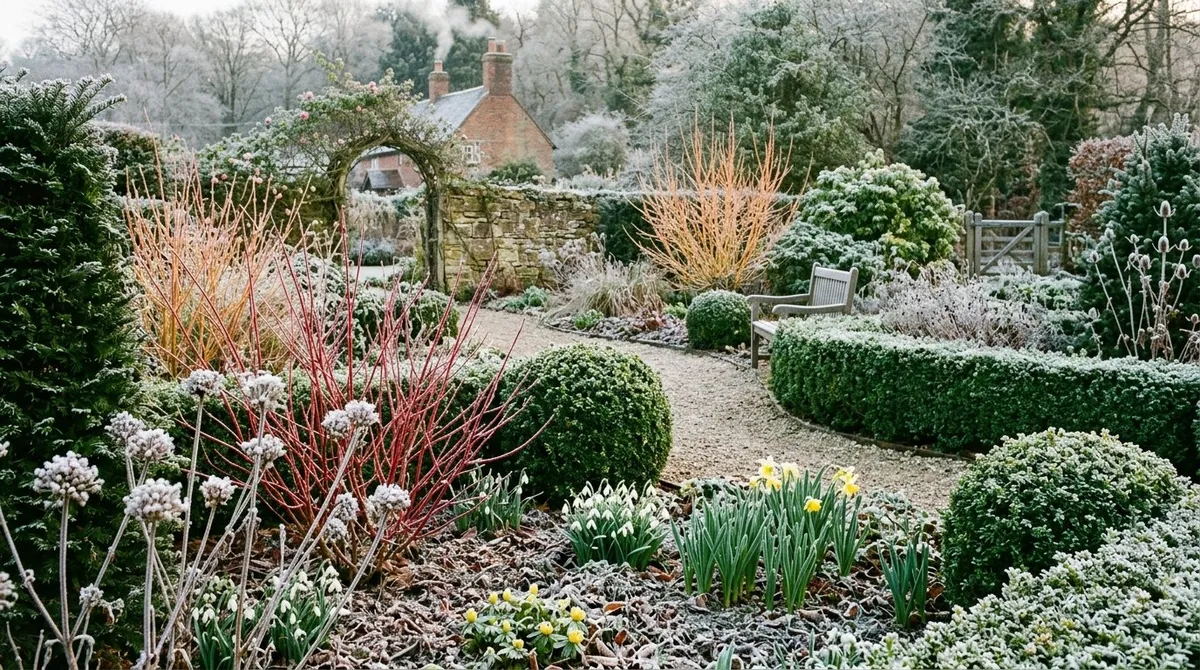
Coloured stems from deciduous shrubs provide vivid winter colour. Cornus alba ‘Sibirica’ gives crimson stems. Cornus sanguinea ‘Midwinter Fire’ provides orange and red gradients. Salix alba var. vitellina ‘Britzensis’ offers bright orange-red willow stems. Cut all of these back hard in March for the brightest new growth next winter.
Winter flowers prove the season is not dead. Mahonia x media ‘Charity’ bears sprays of yellow flowers in December and January. Chimonanthus praecox (wintersweet) fills the air with spicy scent. Viburnum x bodnantense ‘Dawn’ produces pink flowers on bare stems from November to March. Hellebores start in December and continue to April.
For more on winter performers, read our guide to winter flowering plants and winter flowering shrubs.
How do spring bulbs fill the gap?
Spring bulbs bridge the transition from winter into the growing season. Planted in autumn, they require no space in the border because they grow up through perennials that are still dormant.
The spring bulb sequence runs from January to May:
- January-February: Snowdrops (Galanthus), winter aconites (Eranthis), early crocuses (Crocus tommasinianus)
- March: Daffodils (early varieties like ‘February Gold’ and ‘Tete-a-Tete’), Chionodoxa, Scilla
- April: Tulips (early to mid-season), Muscari (grape hyacinths), Narcissus (late varieties), Fritillaria meleagris
- May: Late tulips, Allium ‘Purple Sensation’, Camassia, Nectaroscordum
Plant bulbs in layers (a bulb lasagne) in large pots for concentrated colour on patios. In borders, scatter them between emerging perennials. Daffodils and crocuses naturalise in grass for a meadow effect from February to April.
The key is variety across the months. Fifty daffodils give you two weeks of glory and then nothing. Fifty bulbs split across five species give you four months of colour. See our spring bulb care guide for keeping bulbs performing year after year, and our bulb lasagne planting guide for container displays.
What are the best summer perennials for continuous colour?
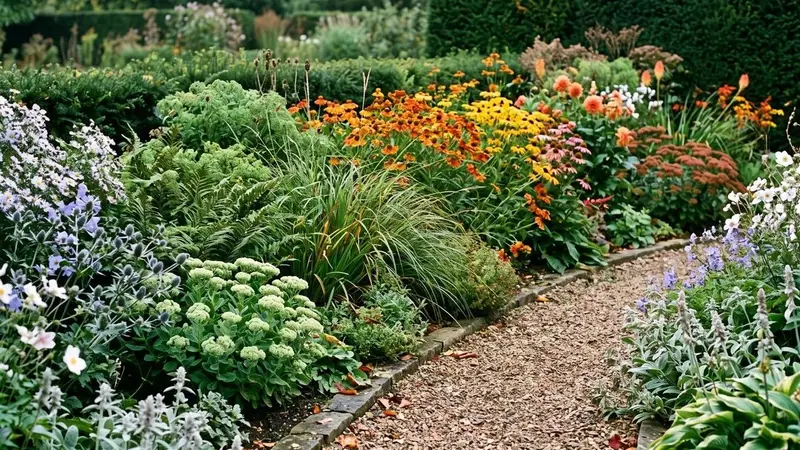
Summer is the easiest season to fill and the one most gardeners over-plant. The discipline is choosing perennials with long flowering periods and staggering their peaks across June, July, August, and September.
Long-flowering summer perennials for UK gardens:
| Plant | Flowering period | Height | Colour | Notes |
|---|---|---|---|---|
| Geranium ‘Rozanne’ | June-October | 50cm | Violet-blue | AGM. Cut back mid-season for second flush |
| Salvia nemorosa ‘Caradonna’ | June-August | 50cm | Violet | Dark stems. Deadhead for repeat flowering |
| Nepeta ‘Walker’s Low’ | May-September | 60cm | Lavender | Cut back after first flush for repeat |
| Echinacea purpurea | July-September | 80cm | Pink/purple | Seed heads provide winter interest |
| Helenium ‘Moerheim Beauty’ | July-September | 100cm | Deep red | One of the best late-summer daisy flowers |
| Penstemon ‘Andenken an Friedrich Hahn’ | June-October | 75cm | Deep red | Borderline hardy. Mulch in winter |
| Astrantia major | June-August | 60cm | Pink/white | Excellent for shade and cutting |
The trick is not planting everything that flowers in July. Spread the peaks. Early summer (June): geraniums, salvias, nepeta. Mid-summer (July-August): heleniums, echinaceas, dahlias. Late summer (September): asters, sedums, anemones.
Roses deserve a mention. A well-chosen climbing rose on a wall or arch flowers from June to October. David Austin’s English roses often give three flushes in a season. Our guide to growing roses covers the fundamentals.
How do you extend the garden into autumn?
Autumn is the bridge between the abundance of summer and the structural beauty of winter. Three elements carry it: leaf colour, berries, and late-flowering perennials.
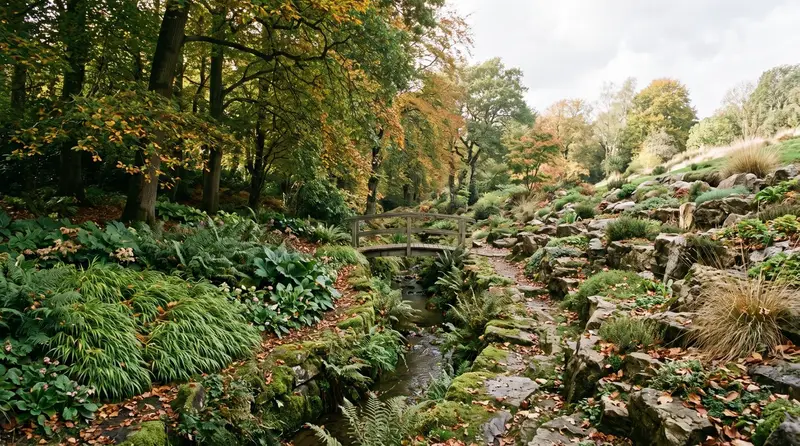
Autumn leaf colour depends on the right trees and shrubs. Acer palmatum varieties provide reds, oranges, and yellows. Liquidambar styraciflua gives deep crimson, burgundy, and orange. Cotinus coggygria turns fiery orange. Even a single specimen tree delivers weeks of colour. For smaller gardens, Euonymus alatus (compact spindle) gives brilliant pink-red and fits in a 2m x 2m space.
Berries provide food for birds and colour for gardeners. Pyracantha bears orange, red, or yellow berries from October onwards. Cotoneaster horizontalis drapes walls with red berries. Callicarpa bodinieri ‘Profusion’ produces extraordinary violet-purple berries. Malus (crab apple) varieties give miniature fruits in reds and yellows through autumn and into winter.
Late perennials and grasses push the flowering season into November. Asters (Symphyotrichum) are the stars: ‘Little Carlow’ (blue, October), ‘Veilchenkoenigin’ (violet, October), ‘Monte Cassino’ (white sprays, September-November). Ornamental grasses like Miscanthus sinensis ‘Gracillimus’ produce silky plumes in September that last through winter.
Read our guide to best trees for autumn colour for detailed recommendations.
What goes in a month-by-month planting plan?
A four-season garden plan maps at least two performers to every month. Here is a framework for a medium UK garden.
| Month | Key performers | Interest type |
|---|---|---|
| January | Snowdrops, hellebores, Mahonia, birch bark, Cornus stems | Flowers, bark, stems |
| February | Crocuses, winter aconites, Viburnum x bodnantense, Daphne | Bulbs, scent, flowers |
| March | Daffodils, Forsythia, Pulmonaria, Magnolia stellata | Bulbs, shrub blossom, ground cover |
| April | Tulips, cherry blossom, Brunnera, fresh foliage | Bulbs, blossom, emerging leaves |
| May | Alliums, Wisteria, Iris germanica, Aquilegia, Euphorbia | Bulbs, climbers, perennials |
| June | Roses, Geranium ‘Rozanne’, Nepeta, Delphiniums, Foxgloves | Peak perennials, climbers |
| July | Agapanthus, Crocosmia, Echinops, Lavender, Hemerocallis | Perennials, scent |
| August | Dahlias, Rudbeckia, Echinacea, Phlox, Hydrangea | Late perennials, shrubs |
| September | Asters, Sedum, Anemone japonica, ornamental grass plumes | Late flowers, grasses |
| October | Autumn leaf colour (Acer, Liquidambar), Nerine, berries | Foliage, bulbs, berries |
| November | Late asters, Cotoneaster berries, Cyclamen hederifolium | Late flowers, berries, bulbs |
| December | Mahonia, Sarcococca, holly berries, birch bark, Cornus stems | Scent, berries, bark, stems |
How do you tie the seasons together?
The difference between a garden with year-round interest and one with seasonal gaps is how transitions are managed. Each season should overlap the next by at least two weeks.
Winter into spring: Snowdrops and crocuses appear while Cornus stems are still showing. Hellebores flower alongside the first daffodils. There should never be a dead period in February or March.
Spring into summer: Late tulips and alliums overlap with the first geraniums and nepeta. Wisteria and early roses bridge May into June.
Summer into autumn: Dahlias, which start in July, continue until the first hard frost in October or November. Asters start in September while heleniums are still flowering. Grasses catch the September light.
Autumn into winter: As leaves fall, Cornus stems emerge. Mahonia starts flowering as the last asters fade. Holly berries ripen as autumn colour drops.
Ground cover prevents bare soil at any time of year. Geranium macrorrhizum, Epimedium, Vinca minor, and Ajuga reptans are all evergreen or semi-evergreen and fill gaps at ground level. Read our ground cover plants guide for full recommendations.
What are the best multi-season plants?
Some plants earn their place by performing across multiple seasons. These are the workhorses of a four-season garden.
- Cornus alba ‘Sibirica’: Green summer foliage, good autumn colour, brilliant crimson winter stems. Three seasons from one shrub. Cut back hard every other March.
- Hydrangea paniculata ‘Limelight’: Lime-green flowers in July, turning pink in September, drying to parchment for winter structure. Do not cut back until March.
- Rosa rugosa: Flowers June to October, large red hips from September through winter, good autumn foliage. Virtually indestructible.
- Hakonechloa macra ‘Aureola’: Golden foliage from April to October, turning russet in autumn, dried buff in winter. Beautiful at every stage.
- Amelanchier lamarckii: White blossom in April, bronze new leaves, small edible berries in June, spectacular orange-red autumn colour. The best small tree for year-round interest.
Choosing plants that perform in two or three seasons means you need fewer plants overall to cover the calendar. This is particularly valuable in small gardens where every plant must justify its space.
Frequently asked questions
What plants give year-round interest in UK gardens?
Evergreen shrubs, winter-flowering plants, and multi-season performers give year-round interest. Mahonia provides winter flowers and evergreen structure. Cornus alba gives red winter stems and autumn colour. Birch delivers white bark year-round. Hellebores flower from December to March. Spring bulbs, summer perennials, and autumn asters fill the warmer months. Aim for at least two plants performing in every month.
How many plants do I need for a four-season garden?
Thirty well-chosen plants cover twelve months in a medium garden. This includes 5-6 evergreen shrubs for structure, 3-4 winter performers, 50-100 spring bulbs, 8-10 summer perennials, and 3-4 autumn-interest plants. Quality of choice matters more than quantity. One Cornus alba provides six months of interest alone with summer foliage, autumn colour, and winter stems.
What provides winter interest in a garden?
Bark, coloured stems, evergreens, and early flowers provide winter interest. Betula utilis var. jacquemontii has brilliant white bark. Cornus alba ‘Sibirica’ has crimson stems from November to March. Mahonia x media ‘Charity’ flowers bright yellow in December. Helleborus orientalis blooms January to March. Evergreen structure from box, yew, and holly keeps the garden framework visible.
When should I plant for autumn colour?
Plant deciduous trees and shrubs in autumn or early spring for the best autumn display. Acer palmatum varieties give reds and oranges. Liquidambar provides deep crimson. Cotinus turns fiery orange. For berries, plant pyracantha, cotoneaster, and crab apples. Late perennials like asters, rudbeckias, and sedums extend flower interest into October and November.
What are the best evergreen shrubs for garden structure?
Box, yew, holly, Viburnum tinus, and Sarcococca are the top structural evergreens. Box and yew clip into formal shapes. Holly provides berries and glossy leaves year-round. Viburnum tinus flowers from November to March. Sarcococca humilis gives winter scent in shade. Choose a mix of heights and leaf textures. Space them as anchors through the garden so the structure reads clearly in every season.
Can I create a four-season garden in shade?
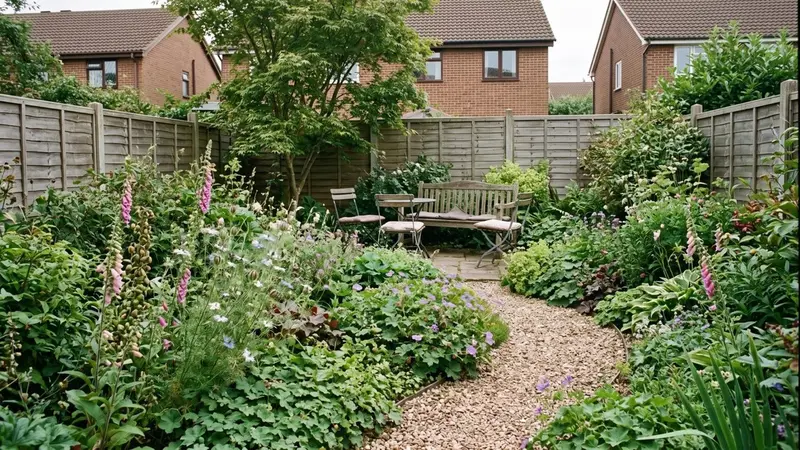
Shaded gardens can achieve four-season interest with the right plant choices. Hellebores, snowdrops, and cyclamen flower in shade from autumn through spring. Hostas and ferns cover summer. Fatsia japonica, Aucuba, and Skimmia provide evergreen structure. Hydrangea paniculata gives summer flowers and dried winter seed heads. A shaded four-season garden relies more on foliage texture and form than on flower colour.
Our team produces practical UK gardening guidance from source research, contributor records and established horticultural practice. Editorial standards are overseen by Matt W.