Key takeaways
- 10 popular UK garden plants spread 0.5-2m per year if planted unrestrained
- Mint runners reach 1m in a single summer through any open soil
- Running bamboo (Phyllostachys) can spread 5m underground in five years
- Bishop's weed (Aegopodium) regrows from any 1cm root fragment left in soil
- One vigorous plant, Crambe cordifolia, is worth the risk for its June display
- Sunken pot barriers contain most thugs but bamboo needs HDPE root barrier
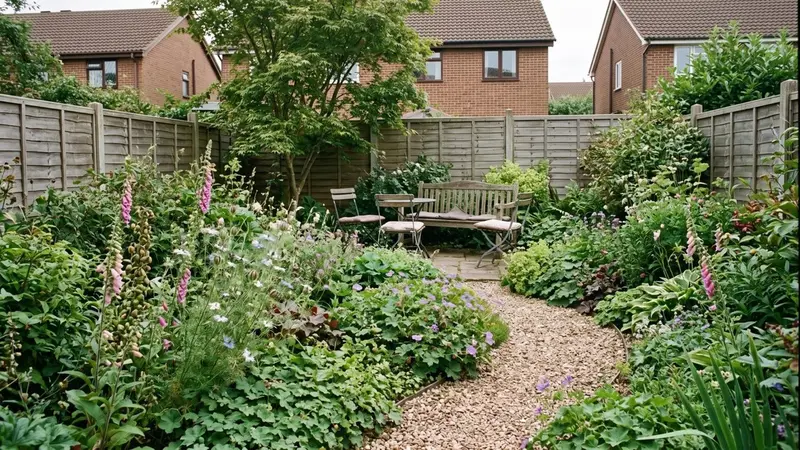
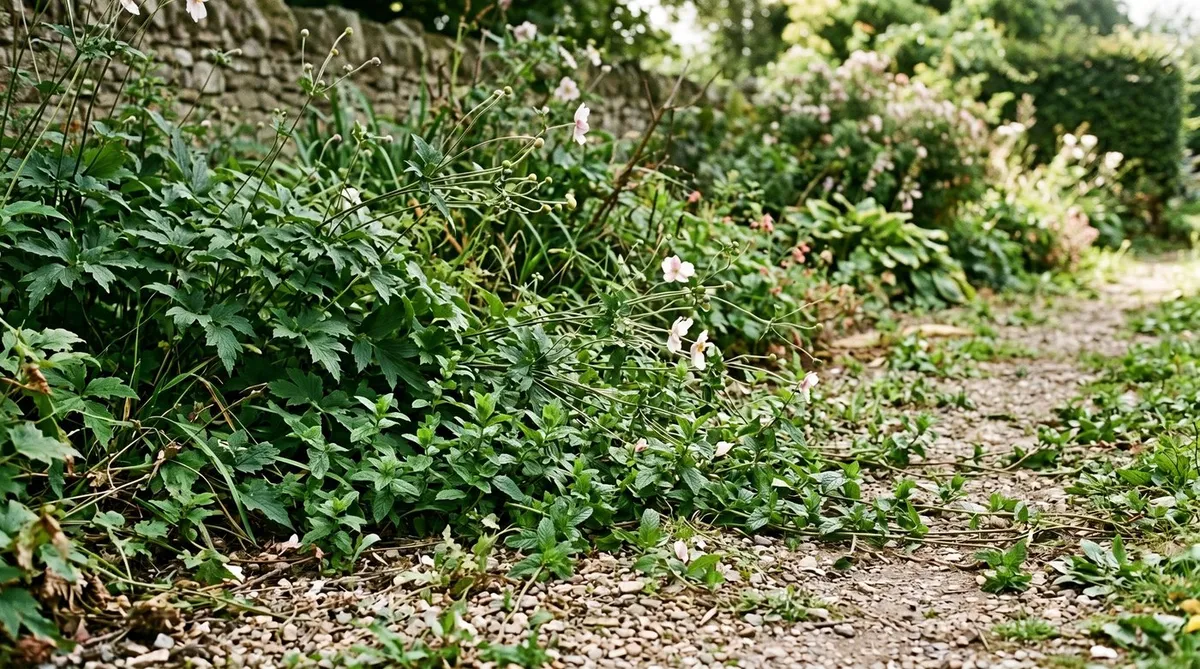
Some plants take over. In the gardening world we call them thugs. They are not legally classified as invasive like Japanese knotweed or giant hogweed, but plant them carelessly in a normal UK perennial border and they dominate within two to four years. Then the polite phrase “vigorous” stops being a compliment and becomes a warning.
How garden thugs spread
Plants colonise new ground through five mechanisms. Each demands a different containment approach.
| Mechanism | Examples | Containment method |
|---|---|---|
| Stoloniferous runners (above-ground) | Strawberry, creeping Jenny, ajuga | Trim annually, dig out runners |
| Rhizomes (below-ground stems) | Mint, lily of the valley, bamboo | Sunken pot, HDPE root barrier |
| Self-seeding | Alchemilla mollis, opium poppy, foxglove | Deadhead before seed drops |
| Root fragmentation | Bishop’s weed, Houttuynia | Total soil removal or chemical eradication |
| Layering and tip-rooting | Snowberry, Forsythia | Annual prune to prevent contact |
Knowing the mechanism tells you the only intervention that will keep the plant manageable. The wrong containment method gives the plant another two years of free reign.
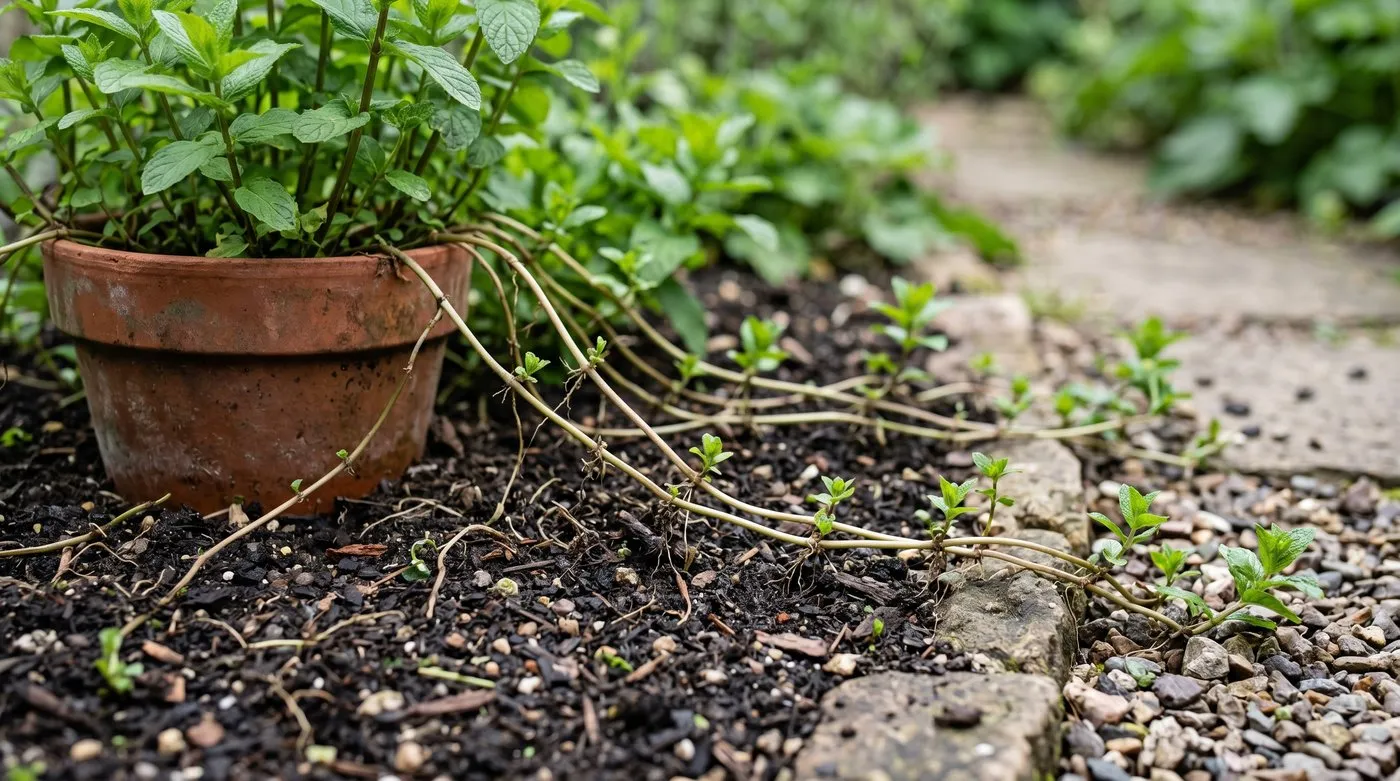 Mint runners cover ground in a single summer. The only effective containment is a sunken bottomless pot at 30L capacity, or a herb bed surrounded entirely by paths.
The 10 worst UK garden thugs
1. Mint (Mentha species)
Spread rate: 1m per year. Mechanism: rhizomes.
Mint is the textbook garden thug. Apple mint, Moroccan mint, spearmint, peppermint, and chocolate mint all spread aggressively through underground rhizomes. The runners cross open soil at 1m per season and emerge through gravel paths, lawn edges, and the cracks between paving.
Containment: sunken 30L pot, ideally a plastic pond planter with the bottom cut out, buried with the lip 5cm proud of soil level. Renewable every 5-6 years when the rootball becomes congested.
2. Japanese anemone (Anemone hupehensis, A. x hybrida)
Spread rate: 30-50cm per year in good soil. Mechanism: rhizomes and self-seeding.
In partial shade with moisture-retentive loam, Japanese anemones form a 1.5m sweep within three years. Beautiful but suppressive of neighbours. Difficult to remove because every root fragment regrows.
Containment: sunken root barrier, or accept the spread in a dedicated bed. In dry chalk or heavy clay the plant stays clump-forming and is less of a problem.
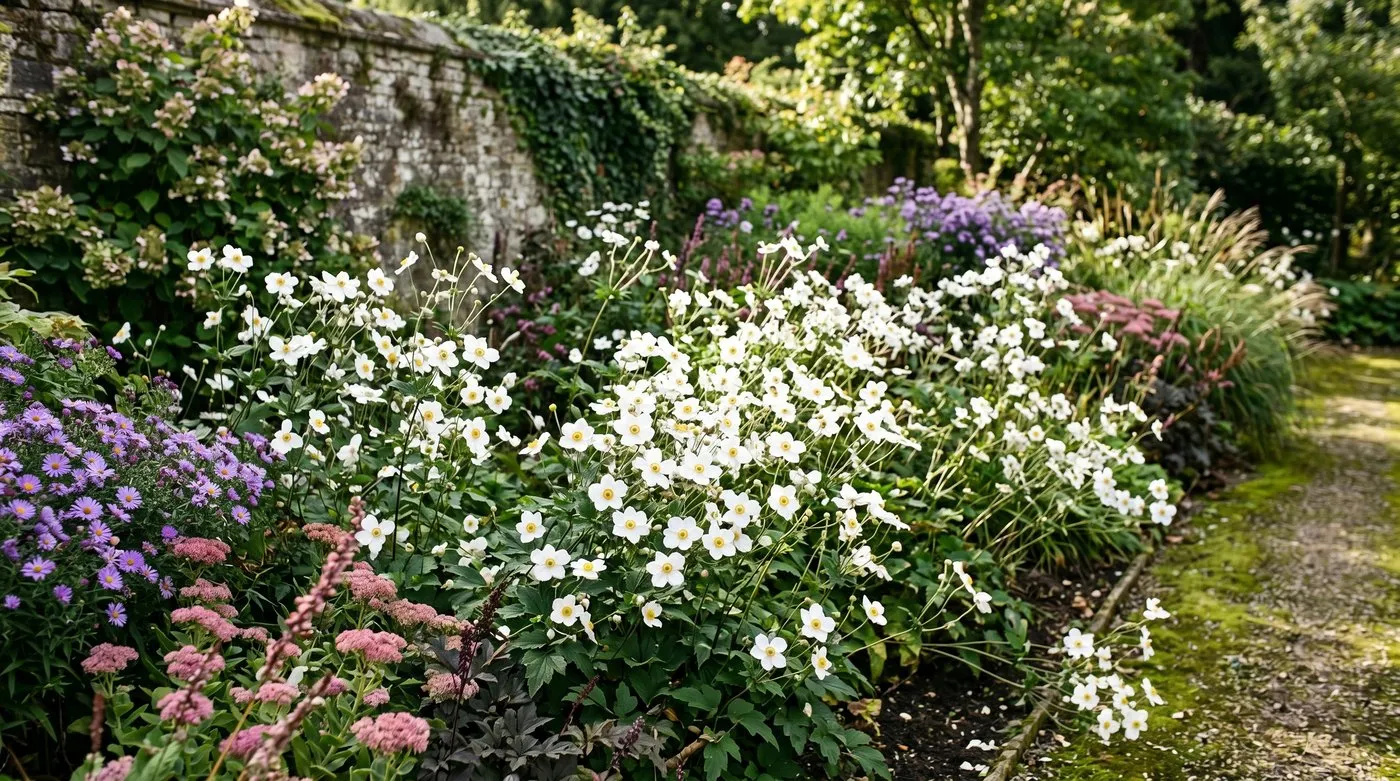 Japanese anemone (Anemone x hybrida) in good loam spreads 30-50cm per year through rhizomes. The September flowers are stunning, but unrestrained plants dominate within four years.
3. Running bamboo (Phyllostachys, Pseudosasa, Sasa)
Spread rate: 1-5m per year. Mechanism: aggressive underground rhizomes.
Phyllostachys aurea, P. nigra, and P. aureosulcata all run. They can cross 5m of lawn in five years, lift paving from beneath, and emerge in a neighbour’s garden. Once established without barrier they are extremely expensive to remove (£500 to £2,500 per stand).
Containment: HDPE root barrier 90cm deep, sealed at the seams, with a 30cm gap left above ground for inspection. Plus an annual rhizome inspection trench dug at the perimeter.
Warning: Always check the bamboo type at point of purchase. The label “bamboo” alone tells you nothing. Get the Latin name and check whether it is a runner (avoid in most gardens) or a clumper (Fargesia, safe).
4. Lemon balm (Melissa officinalis)
Spread rate: by seed, 1000+ seedlings per parent per year.
Lemon balm itself is well-behaved. Its seed is not. A single plant produces thousands of viable seeds that germinate over open soil within metres of the parent. Within four years, lemon balm seedlings appear across the whole garden.
Containment: deadhead the entire plant before seed sets in late August. Or grow in a sunken pot with the pot lip raised 10cm above soil to reduce seed dispersal.
5. Lily of the valley (Convallaria majalis)
Spread rate: 20-40cm per year. Mechanism: rhizomes.
Loved for the spring scent and the white bell flowers. Hated by anyone who plants it in a mixed border. Lily of the valley colonises slowly but completely, and outcompetes most low-level woodland perennials.
Containment: dedicated bed bounded by paving. Or sunken pot. Removal is extremely difficult once established because the rhizomes weave through neighbouring plant roots.
6. Houttuynia (Houttuynia cordata ‘Chameleon’)
Spread rate: 30-60cm per year. Mechanism: rhizomes that fragment readily.
The variegated red-green-yellow leaves are striking. The spread is intolerable. Houttuynia is the single most regretted “ground cover” planting in UK garden history.
Containment: never plant in open ground. A sunken pot is the only acceptable approach. Eradication, once established, requires complete soil replacement.
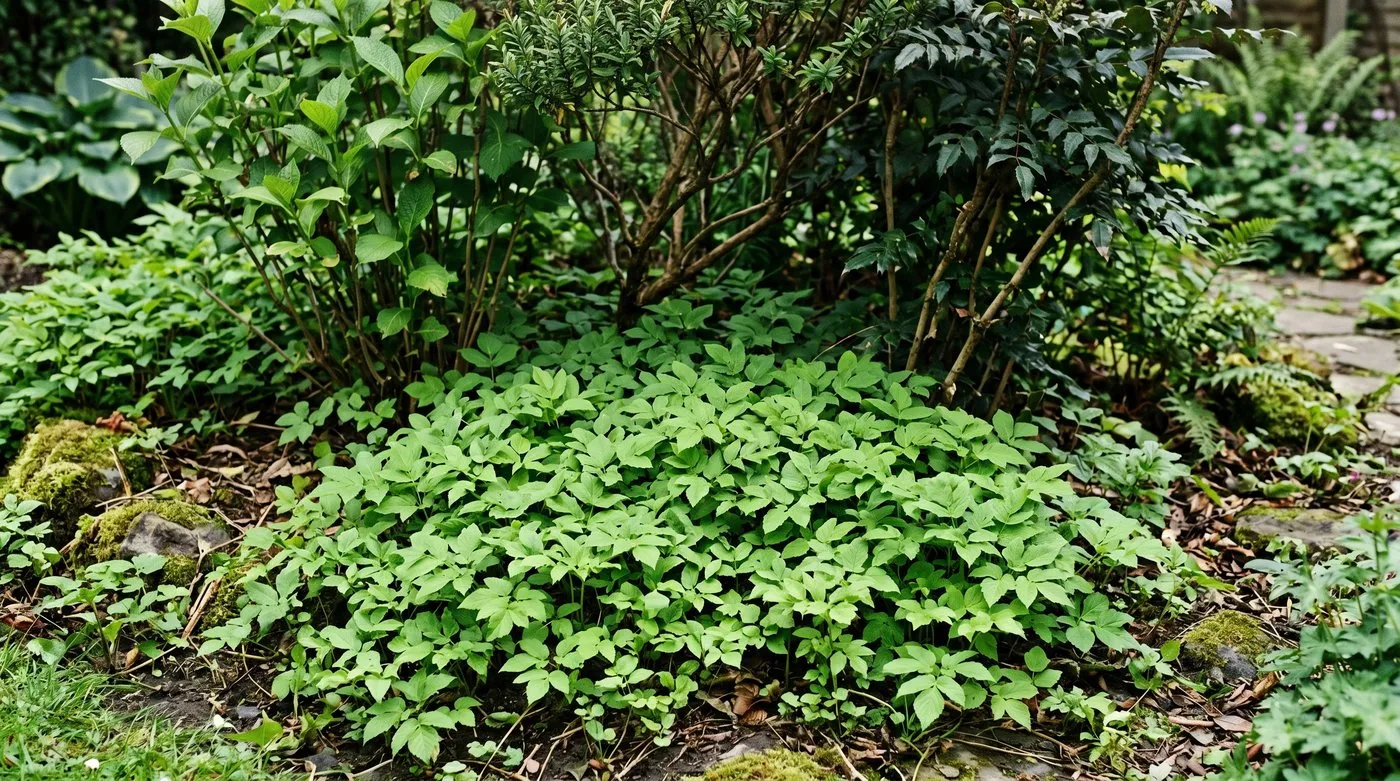 Bishop’s weed (Aegopodium podagraria) regrows from any 1cm root fragment. Even glyphosate needs 3-5 applications over two years and rarely fully eradicates the colony.
7. Bishop’s weed (Aegopodium podagraria ‘Variegatum’)
Spread rate: 50cm per year. Mechanism: rhizomes that fragment.
Also sold as variegated ground elder. The variegated form is less aggressive than the plain green Aegopodium podagraria (which is the actual ground elder weed) but still spreads. Both regrow from root fragments under 1cm.
Containment: nearly impossible once established. Use HDPE root barrier and accept long-term management. In a new garden, never plant this. If you inherit it, plan for soil replacement.
8. Comfrey ‘Bocking 14’ (Symphytum x uplandicum)
Spread rate: clump expansion of 30cm per year. Self-seeding suppressed (sterile).
The ‘Bocking 14’ cultivar is sterile, so it does not self-seed. But the rhizomes spread and the plant breaks regularly through ground cover. Roots reach 2m deep, making removal difficult.
Containment: dedicated comfrey bed, bordered by paths. The deep taproot suppresses the rest of the bed but the comfrey is valuable enough as a green manure to be worth its own space.
9. Creeping Jenny (Lysimachia nummularia ‘Aurea’)
Spread rate: 60cm per year. Mechanism: stoloniferous runners.
The golden form is sold for hanging baskets and rockeries. Plant it in a damp border and it carpets the ground. The runners trip walkers, smother low perennials, and root from every leaf joint.
Containment: hanging baskets only. Or pots. Never the ground.
10. Alchemilla mollis (lady’s mantle)
Spread rate: by seed, 200-500 seedlings per parent per year.
Beautiful chartreuse leaves and lime-green flowers. Self-seeds prolifically. A single Alchemilla becomes a colony of 50 in five years if not deadheaded.
Containment: deadhead immediately after flowering. Cut the entire flower stem to the base in mid-July. This eliminates almost all seed dispersal and rejuvenates the foliage for autumn.
The one vigorous plant worth growing
For every garden thug we ban, one vigorous plant deserves a place because the benefit outweighs the management cost.
Crambe cordifolia (giant sea kale)
The plant looks ridiculous on a nursery label. A 2L pot with a small clump of greyish leaves for £14. Plant it in spring and by year three you have a 2m wide, 2m tall cloud of tiny white flowers in June, hovering above grey-green cabbage-like leaves. Bees swarm it. The structure is dramatic from 20m away. Then it dies back cleanly in August and disappears for nine months until the next spring.
Why it works where the thugs do not:
- Forms a tight clump, no rhizomes
- Seed germinates poorly and slowly, easy to control
- Single tap root reaches 1.5m deep, drought-tolerant
- Tolerates clay, chalk, gravel, sand
- Lifespan 15-25 years from a single plant
Crambe cordifolia is the single most spectacular June flowering plant for a UK perennial border that does not behave like a thug. One plant per 4 square metres of border is the right ratio. Allow 1m clearance around it because the cloud of flowers extends well beyond the foliage footprint.
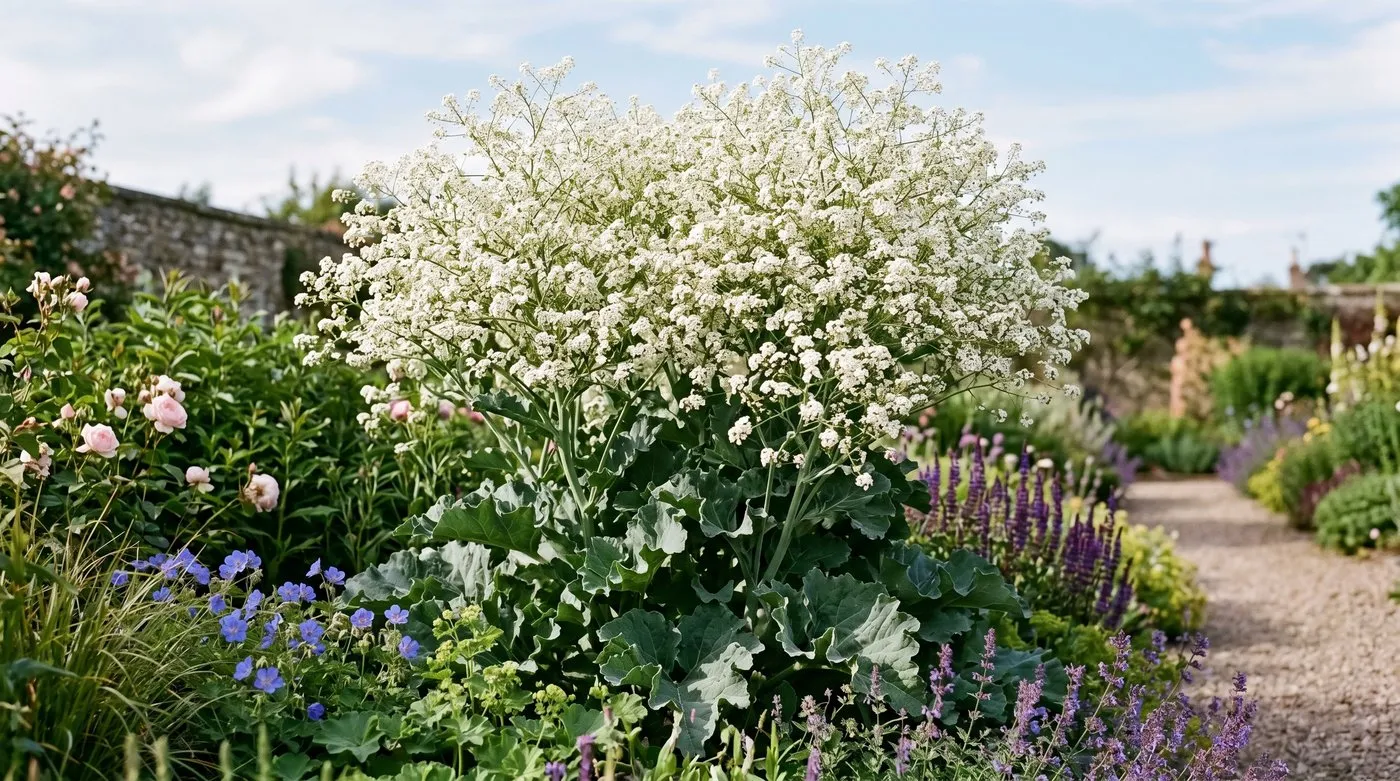 Crambe cordifolia produces a 2m by 2m cloud of tiny white June flowers above grey-green cabbage-like leaves. The plant clumps tightly, does not run, and dies back cleanly in August.
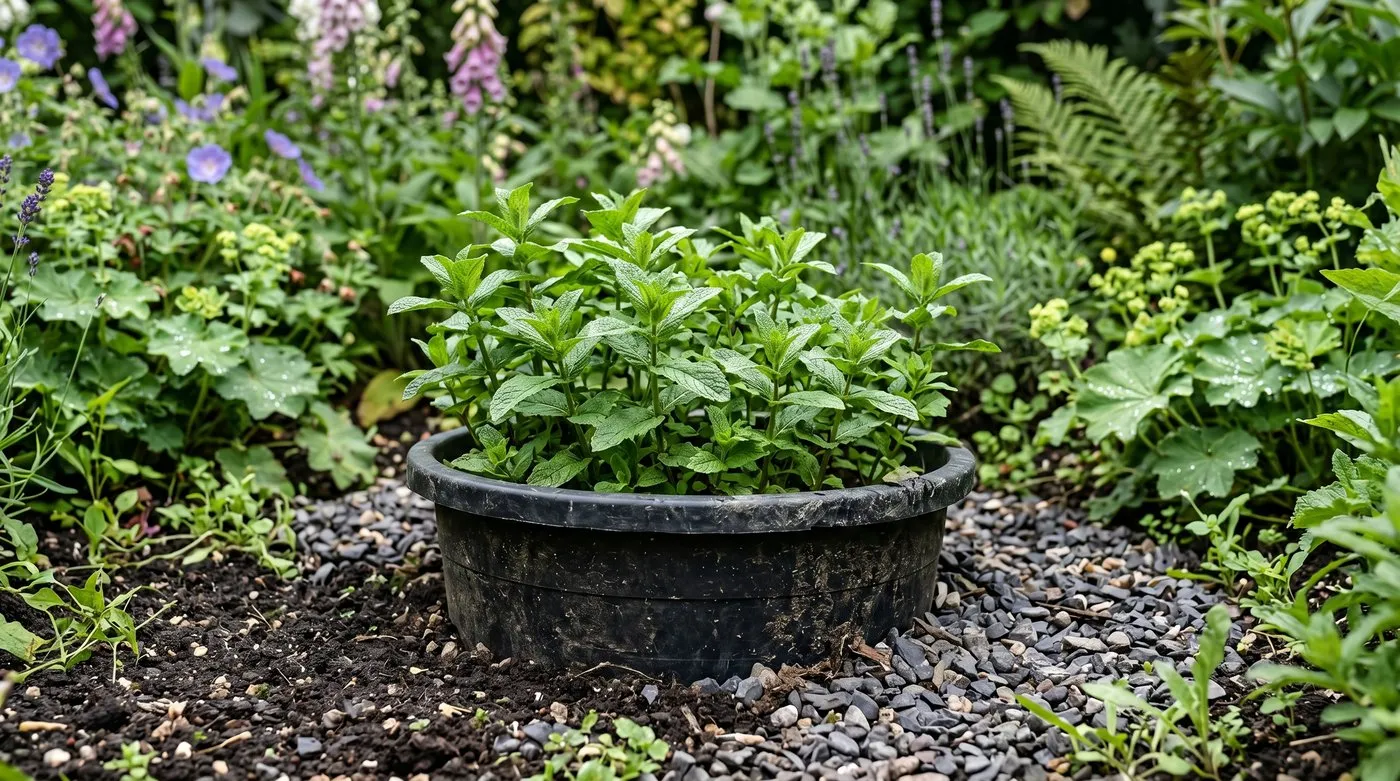 A sunken 30L plastic pot buried with the lip 5cm proud of soil level. The simplest and cheapest containment for mint, lemon balm, Houttuynia and lily of the valley.
How to contain a garden thug
Four containment methods work. The wrong choice gives the plant another two years to spread.
Method 1: sunken bottomless pot (best for most rhizome spreaders)
Use a plastic plant pot at 30L capacity, drill or cut the bottom out, bury it with the lip 5cm proud of soil level. Plant the thug inside. Renew the rootball every 5-6 years.
Works for: mint, lemon balm, Houttuynia, lily of the valley, comfrey, Japanese anemone.
Method 2: HDPE root barrier (only for serious runners)
High-density polyethylene root barrier, 60-90cm deep, sealed at the seams with bolted overlapping joins. Buried around the plant or the perimeter of a dedicated bed.
Works for: running bamboo, bishop’s weed. Required by some councils for bamboo planted within 2m of a boundary.
Cost: £45-£75 per linear metre of HDPE barrier, plus excavation. A typical 4m by 4m bamboo bed needs 16m of barrier at £720+.
Method 3: dedicated bed bounded by paths
A plant bed surrounded on all four sides by hard paving, gravel paths, or driveway. The thug spreads up to the path edge and stops because it cannot cross the hard surface.
Works for: most rhizome spreaders, including bamboo if the path is wider than 1m.
Method 4: annual deadheading
The only containment for self-seeders. Cut every flower stem to the base before seed sets. For Alchemilla mollis, cut in mid-July immediately after flowering. For lemon balm, cut in late August before the seeds darken.
Works for: Alchemilla mollis, lemon balm, foxglove, opium poppy, verbena bonariensis (where you want to control rather than encourage spread).
Comparison: thug containment effort and cost
| Plant | Containment method | First-year cost | Annual upkeep |
|---|---|---|---|
| Mint | Sunken 30L pot | £14 | 15 min July, 30 min Oct |
| Japanese anemone | Sunken root barrier | £40 | 1 hour spring tidy |
| Bamboo (running) | HDPE 90cm | £720+ | 2 hours autumn inspection |
| Lemon balm | Annual deadhead | £0 | 45 min August |
| Lily of the valley | Dedicated bed | £0 (if exists) | 1 hour spring |
| Houttuynia | Sunken pot | £14 | 30 min July |
| Bishop’s weed | HDPE + replacement | £180/sqm | 2 hours yearly |
| Comfrey ‘Bocking 14’ | Dedicated bed | £0 | 2 hours yearly |
| Creeping Jenny | Pot only | £0 | None (in pots) |
| Alchemilla mollis | Mid-July deadhead | £0 | 45 min July |
| Crambe cordifolia | None needed | £14 (plant cost) | None (worth growing) |
When a thug is worth tolerating
Some thugs earn their place if you can dedicate them their own bed.
- Comfrey ‘Bocking 14’ is the best green manure plant for a UK kitchen garden. Cut three times a year for compost activator or liquid feed.
- Mint in a dedicated 1m by 1m herb bed pays for itself in two summers of mojitos and roast lamb sauces.
- Houttuynia in a sunken pot in a shady corner adds the most striking variegated foliage of any UK garden plant.
- Japanese anemone in a dry shade bed where almost nothing else grows is a beautiful September-October filler.
The decision is always: dedicate a space, or do not grow it at all. Half measures (planting in a mixed border) end badly.
Garden thugs vs invasive species
A distinction worth making. The thugs in this guide are garden plants that spread aggressively. They are legal to plant, sell, and dispose of normally.
UK legally invasive species under Schedule 9 of the Wildlife and Countryside Act 1981 must NOT be allowed to spread into the wild. Disposal must follow regulated guidelines. The list includes:
- Japanese knotweed (Fallopia japonica)
- Giant hogweed (Heracleum mantegazzianum)
- Himalayan balsam (Impatiens glandulifera)
- Rhododendron ponticum
- New Zealand pigmyweed (Crassula helmsii)
- Floating pennywort (Hydrocotyle ranunculoides)
If you suspect any of these on your land, contact the Environment Agency or read the GOV.UK Schedule 9 guidance.
Month-by-month thug calendar
| Month | Task |
|---|---|
| February | Check HDPE bamboo barriers for breach. Trench the perimeter. |
| March | Cut back Japanese anemone, check rhizome spread. |
| April | Plant new thugs only in sunken pots or dedicated beds. |
| May | Pull bishop’s weed seedlings before flowering. |
| June | Crambe cordifolia in peak flower, no action needed. |
| July | Deadhead Alchemilla mollis immediately after flowering. Cut to base. |
| August | Cut back lemon balm before seed darkens. Harvest comfrey. |
| September | Lift and divide congested mint pots. |
| October | Lift Houttuynia pots, check for escape. |
| November | Plant bare-root Crambe (the well-behaved vigorous plant). |
Common mistakes when dealing with garden thugs
Mistake 1: assuming “ground cover” means “well-behaved”
Many garden centre labels list invasive plants under “ground cover” or “fast-growing.” These are warning words. A plant labelled “rapid spreader” or “ground cover” needs containment unless you have a dedicated bed for it.
Mistake 2: composting bishop’s weed roots
Bishop’s weed regrows from any root fragment in compost. Even hot composting at 60C+ fails to kill the roots reliably. Bin all root removals or burn them. Never compost.
Mistake 3: planting bamboo “where it can spread”
The phrase “let it spread” with running bamboo costs UK gardeners around £2,400 on average to remediate (RHS estimate). Always plant running bamboo behind a proper HDPE barrier or in a dedicated raised bed surrounded by paving.
Mistake 4: using mint runners as cuttings
Every mint runner you transplant becomes a new colony. Use stem cuttings instead. Pinch a 10cm growing tip, root in water for two weeks, transplant into a sunken pot. The colony of origin stays contained.
Where to learn more
The RHS plant problem solver covers most garden thugs with current containment advice. The Garden Organic research library covers organic management of bishop’s weed and other persistent thugs.
Frequently asked questions
What is the most invasive garden plant in the UK?
Japanese knotweed and giant hogweed are the worst legally invasive species. Among ordinary garden plants, bishop’s weed (Aegopodium podagraria ‘Variegatum’) and running bamboo (Phyllostachys) cause the most homeowner regret. Both regrow from tiny root fragments and spread 1-5m per year.
How do you stop garden thugs from spreading?
Plant in a sunken bottomless pot at 30L capacity, or behind a HDPE root barrier 60-90cm deep. Bury the lip of the pot 5cm proud of soil level. Renew once a year. Most thugs (mint, comfrey, Houttuynia) stay contained for life this way.
Can you grow mint in the ground?
Not in a normal border. Mint runners spread 1m per season and dominate a 2m by 1m bed within three years. Grow mint in a sunken 30L pot, a chimney pot, or a separate dedicated herb bed bounded on all sides by paths.
What vigorous plant is worth growing?
Crambe cordifolia, the giant sea kale. It produces a 2m by 2m cloud of white June flowers above grey-green cabbage-like leaves, then dies back cleanly without colonising the soil. The plant clumps rather than runs, so spread is by seed only and easy to control.
Will I ever get rid of bishop’s weed once it is established?
Honestly, no. Bishop’s weed (Aegopodium podagraria) regrows from any 1cm root fragment. Even glyphosate needs three to five applications across two years and rarely eradicates fully. Replace contaminated soil to 60cm depth if you need a clean bed, which costs £180-£340 per square metre.
Are all bamboos invasive in UK gardens?
No. Clumping bamboos (Fargesia species) stay tight and never run. Running bamboos (Phyllostachys, Pseudosasa, Sasa) spread 1-5m per year. Always check the type before buying. Fargesia ‘Murielae’ and Fargesia rufa are safe for most UK gardens.
Is Japanese anemone a thug?
Yes, in rich moist soil. Japanese anemone spreads 30-50cm per year through rhizomes and tolerates partial shade well. In dry chalk or heavy clay it stays clump-forming. In good loam it dominates within four years. Plant in sunken pots or accept the spread.
Now you know which to fear and which to grow
The ten thugs all have good reasons to exist somewhere - just rarely in your front border. Crambe cordifolia is the standout vigorous plant that earns its keep without the cost.
Our team produces practical UK gardening guidance from source research, contributor records and established horticultural practice. Editorial standards are overseen by Matt W.