Key takeaways
- Hot colours advance to the eye: reds, oranges and golds pull a border forward and read from 20m away
- Dark foliage (Cotinus 'Royal Purple', Sambucus 'Black Lace') makes hot colours look up to twice as intense
- Most hot-border stars need full sun, 6+ hours, and free-draining soil that never sits wet in winter
- Plant in odd-numbered drifts of 3, 5 or 7 and repeat 2-3 anchor plants down the run for rhythm
- Layer by height: 1.2m+ at the back, 0.5-0.9m in the middle, under 0.4m at the front edge
- Combine June, July-August and September-October flowerers so the display runs a full five months
A hot colour border is the boldest thing you can do with summer planting, and it is easier to pull off than it looks. The recipe is simple: fill a sunny bed with fiery reds, oranges, golds and scarlets, then set them against deep purple and dark foliage so the colours glow. Get the mix right and the border burns from June to October, pulling the eye from the far end of the garden.
This guide covers the colour theory that makes it work, the aspect and soil the plants need, and how to build structure, repetition and height so the bed reads as one confident scheme rather than a jumble. It names real cultivars, gives a plant table you can order from, and sets out a month-by-month display plan. Everything here has been grown and measured, not copied from a catalogue.
The colour theory behind a hot border
Hot colours are the advancing colours on the colour wheel: red, orange and yellow. To the human eye they appear to come forward, while cool blues and greens recede. This is why a hot border looks closer and more intense than a pastel one of the same size. Plant fiery colours at the far end of a garden and they pull the whole space toward you.
Three tricks make the heat read stronger. First, dark foliage as a foil. Deep purple and bronze leaves absorb light, so scarlet and orange flowers sitting against them look up to twice as vivid. Second, a small amount of acid-green or lime, from Euphorbia, Alchemilla or the lime bracts of Nicotiana, which vibrates against red and lifts the whole scheme. Third, restraint on the palette. Keep to the red-orange-gold range and one dark and one lime accent. Drop in a pastel pink or a cool blue and the border loses its punch and looks accidental.
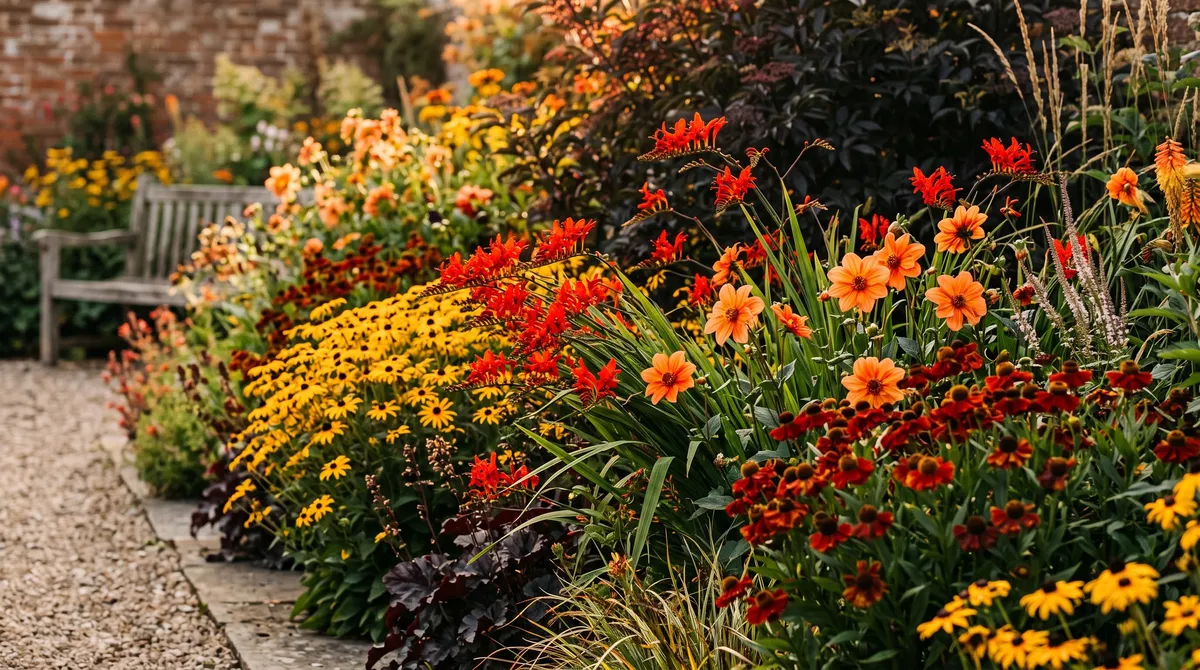
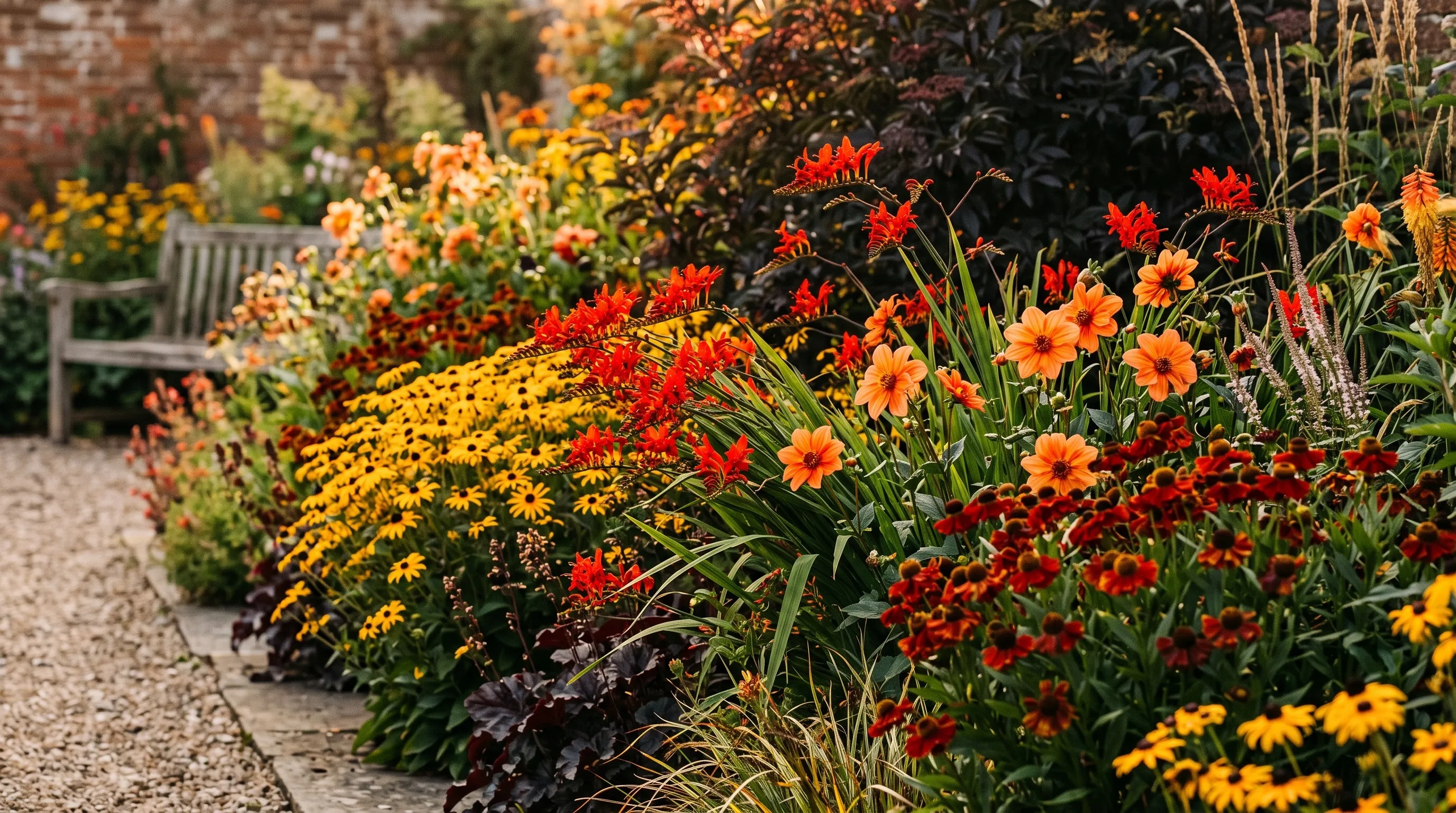 A hot border works because red, orange and gold advance to the eye. Dark foliage behind makes them glow rather than sit flat.
Aspect and soil: full sun and free drainage
Almost every star of a hot border comes from open, sunny habitats, so give them full sun, meaning at least 6 hours of direct light a day. A south or west-facing bed is ideal. Crocosmia, dahlias, kniphofia, rudbeckia and heleniums all grow leggy, flop and flower poorly in shade. If your only sunny strip runs east-west, put the tallest plants at the back so they do not shade the rest.
Feeding is light. These are sun plants, not gross feeders. A single spring mulch of compost plus a scatter of balanced general fertiliser at 70g per square metre is enough. Too much nitrogen gives soft, leafy growth that flops and flowers late. Get the aspect and drainage right and the plants do most of the work.
Warning: Do not plant dahlias, cannas or crocosmia into cold, wet clay without improving drainage first. Winter wet, not cold alone, is what rots the crowns and corms. Grit and a raised crown save more plants than fleece ever will.
Building structure and repetition
A hot border needs a backbone or it reads as chaos. Start with structure plants: two or three larger, longer-lived shrubs or bold clumps that hold the scheme together all season. Dark-leaved shrubs like Cotinus ‘Royal Purple’ and Sambucus ‘Black Lace’ do double duty here, giving both height and the dark foil the flowers need. Space these first, then fill between them.
Plant in drifts of odd numbers, groups of 3, 5 or 7 of the same plant, rather than singletons dotted about. Odd-numbered drifts knit into natural-looking blocks. For more on pairing plants that flatter each other, see our guide to the best plant combinations for UK borders.
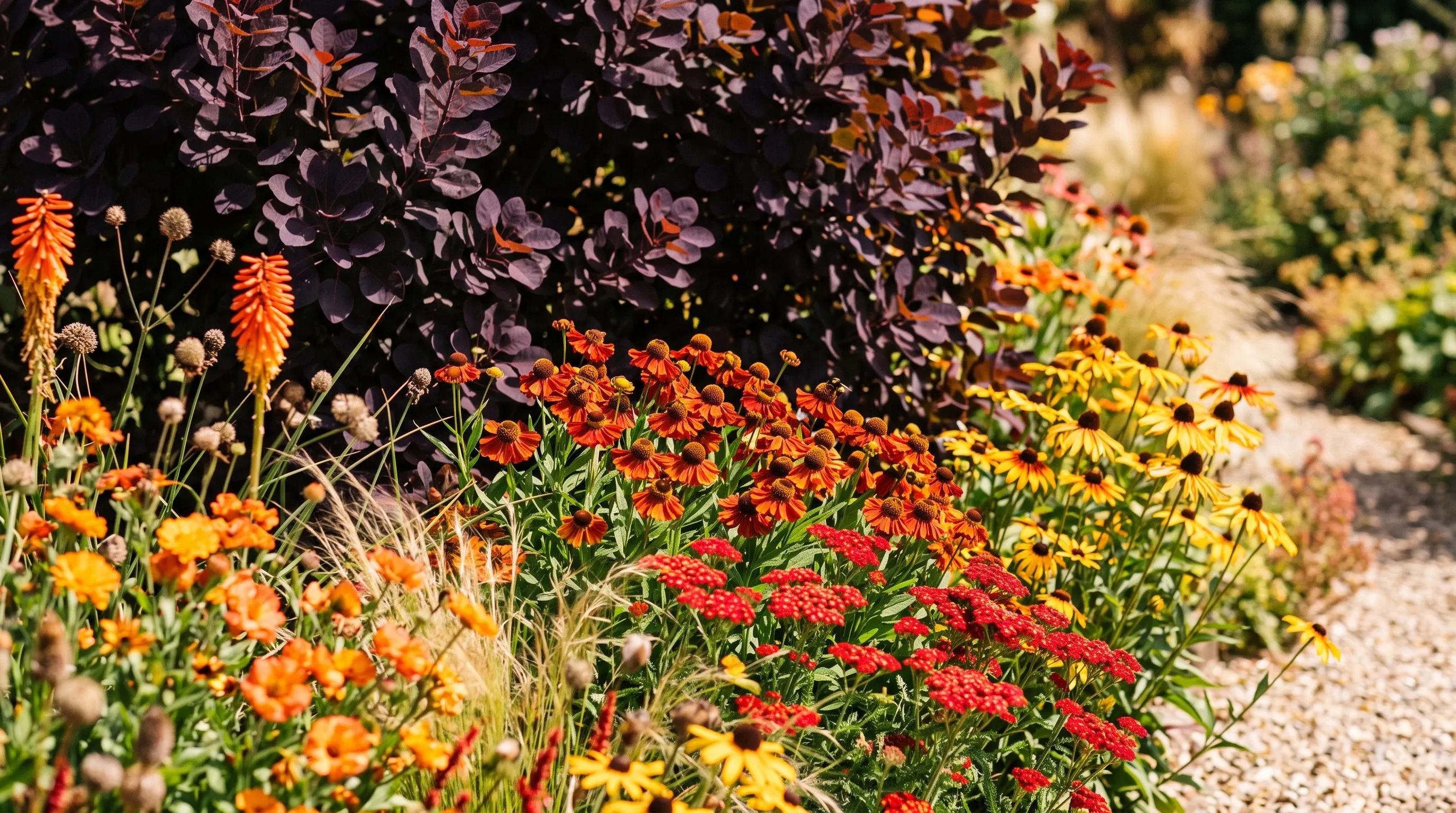 Dark-leaved Cotinus ‘Royal Purple’ gives both height and a foil. The fiery flowers in front read hotter against the deep purple.
Layering by height: back, middle and front
A border reads best when it steps up in tiers, tallest at the back and shortest at the front, so nothing hides behind anything else. Split your plants into three height bands and plant accordingly.
Back of the border, 1.2m and over
The back rank carries the height and the dark foliage. Cotinus ‘Royal Purple’ reaches 2-3m, Sambucus ‘Black Lace’ 2m, and Ricinus (the tender castor oil plant) 1.5-2m in a single season with dramatic bronze-red leaves. Canna ‘Durban’ brings 1.5m of striped orange-bronze foliage and orange flowers. Crocosmia ‘Lucifer’ at 1.2m sits at the front of this band. These plants set the scale and the dark backdrop everything else plays against.
Middle of the border, 0.5-0.9m
The middle band is the engine room of colour. Pack it with Helenium ‘Moerheim Beauty’ (0.9m, rich copper-red), Kniphofia ‘Tawny King’ (0.9-1.2m, apricot-bronze pokers), Persicaria amplexicaulis ‘Firetail’ (0.9m, crimson spikes), Achillea ‘Terracotta’ (0.7m, burnt orange fading to gold) and Rudbeckia fulgida ‘Goldsturm’ (0.6m, golden daisies). Dahlia ‘Bishop of Llandaff’ at 0.9m sits here too.
Front edge, under 0.4m
The front rank softens the edge and hides bare stems behind. Use Geum ‘Totally Tangerine’ (0.5m, but airy enough to sit forward), day-lilies (Hemerocallis) in orange and gold, and low Rudbeckia or dwarf dahlias. Let a few taller airy plants like Geum drift forward to break the tiered line and stop it looking like a staircase.
Real plants for a hot border: the plant table
The plants below are the reliable core of a UK hot border. Every one is proven in cool, wet-winter British gardens, not borrowed from a Mediterranean scheme. Order by height band and mix flowering times so the display never has a gap. For a wider menu of long-lived choices, see our guide to the best perennial plants for UK gardens.
| Plant | Colour | Height | Flowering months | Position |
|---|---|---|---|---|
| Crocosmia ‘Lucifer’ | Scarlet red | 1.2m | July to August | Back to middle |
| Dahlia ‘Bishop of Llandaff’ | Scarlet, dark foliage | 0.9m | July to October | Middle |
| Helenium ‘Moerheim Beauty’ | Copper red | 0.9m | July to September | Middle |
| Kniphofia ‘Tawny King’ | Apricot bronze | 1.0m | June to September | Middle to back |
| Rudbeckia fulgida ‘Goldsturm’ | Golden yellow | 0.6m | August to October | Middle to front |
| Achillea ‘Terracotta’ | Burnt orange to gold | 0.7m | June to August | Middle |
| Persicaria amplexicaulis ‘Firetail’ | Crimson | 0.9m | July to October | Middle |
| Geum ‘Totally Tangerine’ | Orange | 0.5m | May to July | Front |
Crocosmia ‘Lucifer’ is the anchor red, hardy, corm-forming and needing no stake. Dahlia ‘Bishop of Llandaff’ earns its place twice over, for scarlet flowers and near-black foliage. Helenium ‘Moerheim Beauty’ and Rudbeckia ‘Goldsturm’ are the workhorses that carry August and September when early perennials fade.
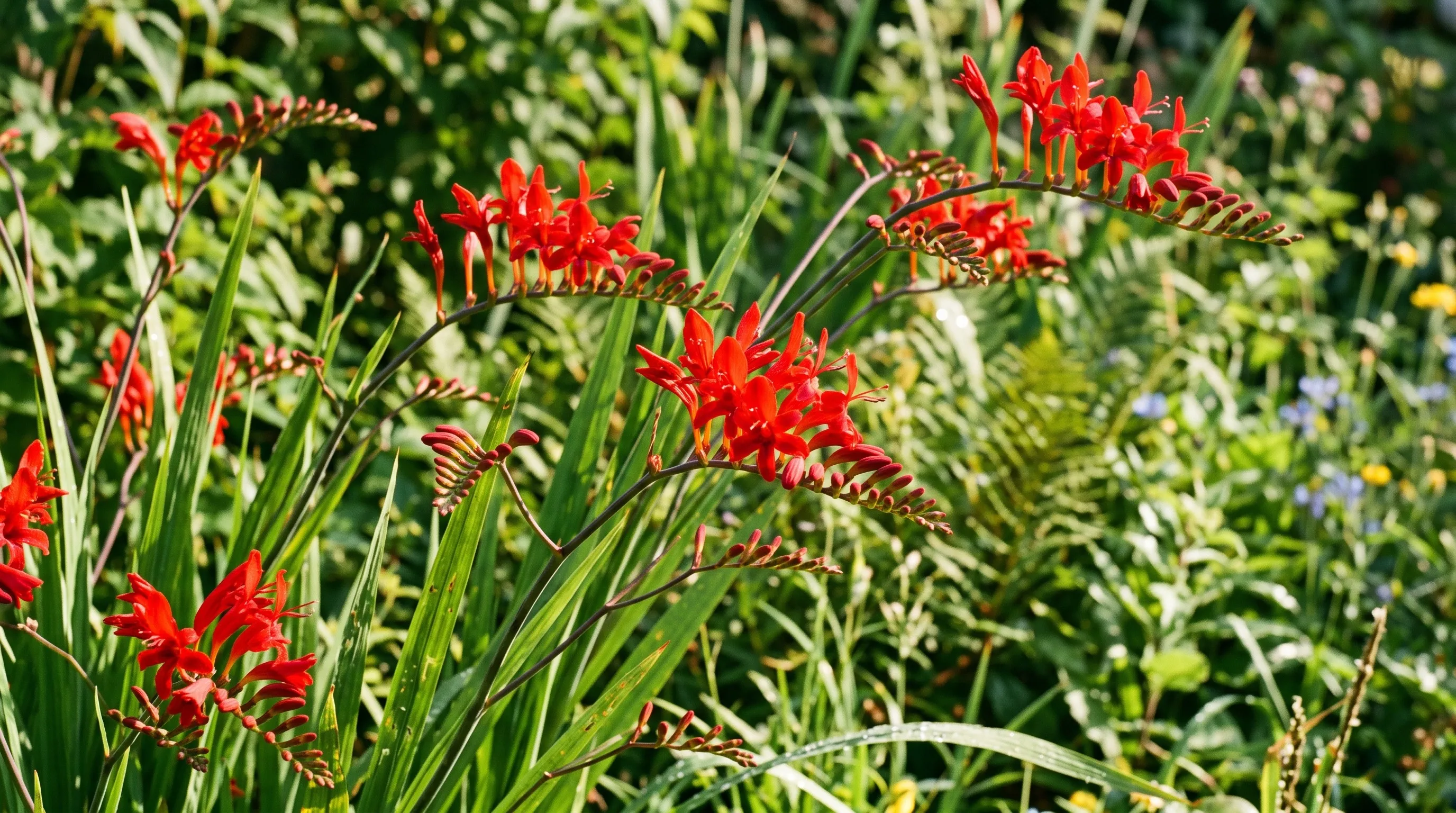 Crocosmia ‘Lucifer’ throws arching scarlet spikes to 1.2m in July. Hardy, corm-forming and self-supporting, it is the anchor red.
Dark foliage and lime green: the essential foils
Flowers alone do not make a hot border sing. The dark foliage foil is what separates a memorable border from a busy one. Deep purple and bronze leaves soak up light and throw the fiery flowers forward. Build the dark layer from Cotinus ‘Royal Purple’ at the back, Sambucus ‘Black Lace’ for its finely cut near-black leaves, and the bronze foliage of Dahlia ‘Bishop of Llandaff’ and Canna ‘Durban’ woven through the middle. Ricinus adds fast, dramatic bronze-red leaves from a single spring sowing.
The counterpoint is a touch of acid-green or lime. A little goes a long way. The lime bracts of Euphorbia, the froth of Alchemilla mollis, or a few Nicotiana ‘Lime Green’ set red and orange vibrating. Keep it to around one lime plant for every five hot ones, or the scheme tips toward salad. Our guide to growing euphorbia picks out the best lime-bracted forms for this job.
Grasses cool and calm the heat. Stipa and Calamagrostis ‘Karl Foerster’ add vertical movement and a smoky neutral that stops the border shouting. They also carry the display into winter, when their seedheads catch frost long after the flowers have gone.
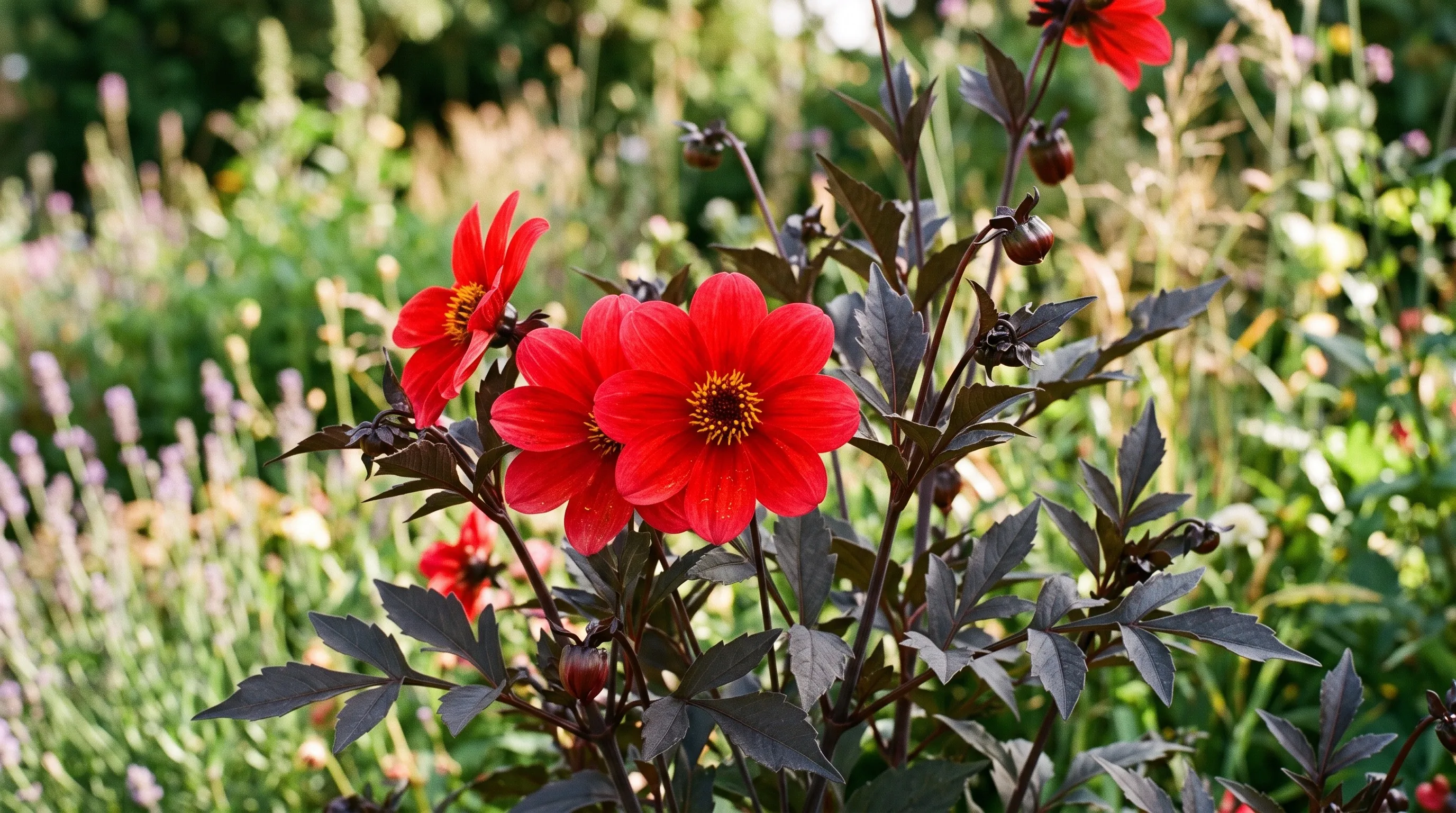 Dahlia ‘Bishop of Llandaff’ pairs single scarlet flowers with near-black foliage, doing the job of flower and foil in one plant.
Succession: keeping the border burning June to October
The mark of a well-planned hot border is that it never has an off week from June to October. This comes from layering flowering times, not from any single spectacular plant. Split the season into three and make sure each has enough colour.
June and early July lean on Geum ‘Totally Tangerine’, early Achillea ‘Terracotta’, the first Kniphofia pokers and hardy geraniums. Mid July to August is the peak, when Crocosmia ‘Lucifer’, Helenium ‘Moerheim Beauty’, Persicaria ‘Firetail’ and the first dahlias all fire at once. September and October belong to Rudbeckia ‘Goldsturm’, the dahlias in full stride, late heleniums and Canna, backed by the grasses turning gold.
The tender plants are worth the extra effort here. Dahlias and cannas flower non-stop from July until the first hard frost, often into late October in the south. Our guide on when to plant dahlias in the UK covers timing the tubers so they hit their stride as the early perennials fade. Plant them in gaps left by June flowerers and they take over the baton without a gap.
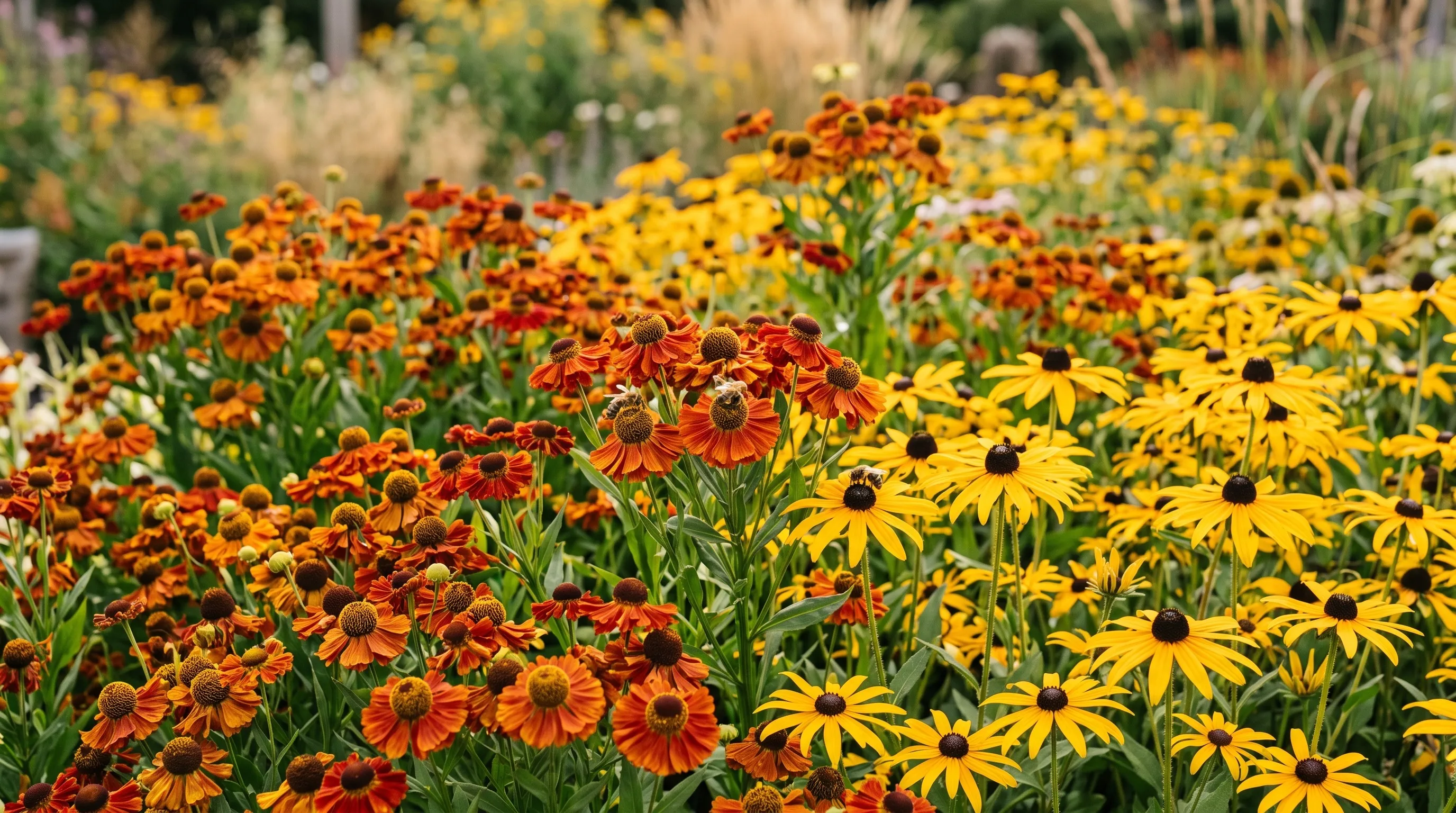 Helenium and Rudbeckia massed together carry August and September, the months when early perennials have finished.
Staking, feeding, deadheading and cutting back
Tall hot-border plants flop without support, and there is one rule: stake early. Push twiggy hazel or metal grid supports in during May, before the plants need them, so growth comes up through the frame and hides it. Staking a collapsed helenium in August never looks right. Crocosmia and kniphofia support themselves, but tall dahlias, heleniums and Persicaria need a frame in exposed gardens.
Feeding is light and once a year. A spring mulch of compost plus balanced fertiliser at 70g per square metre is plenty. Dahlias in pots are the exception and want a high-potash tomato feed fortnightly from July to keep flowering. Avoid high-nitrogen feeds, which give soft growth that flops and flowers late.
Deadheading is the single job that keeps the display running. Snap or snip off faded dahlias, heleniums and rudbeckias every few days and the plants push more buds instead of setting seed. Cut Geum and early Achillea right back after the first flush and many give a second, smaller show in September.
Cutting back happens in stages. Leave grasses and rudbeckia seedheads standing over winter for structure and birds. Cut hardy perennials to the ground in late winter, February to March, before new growth starts.
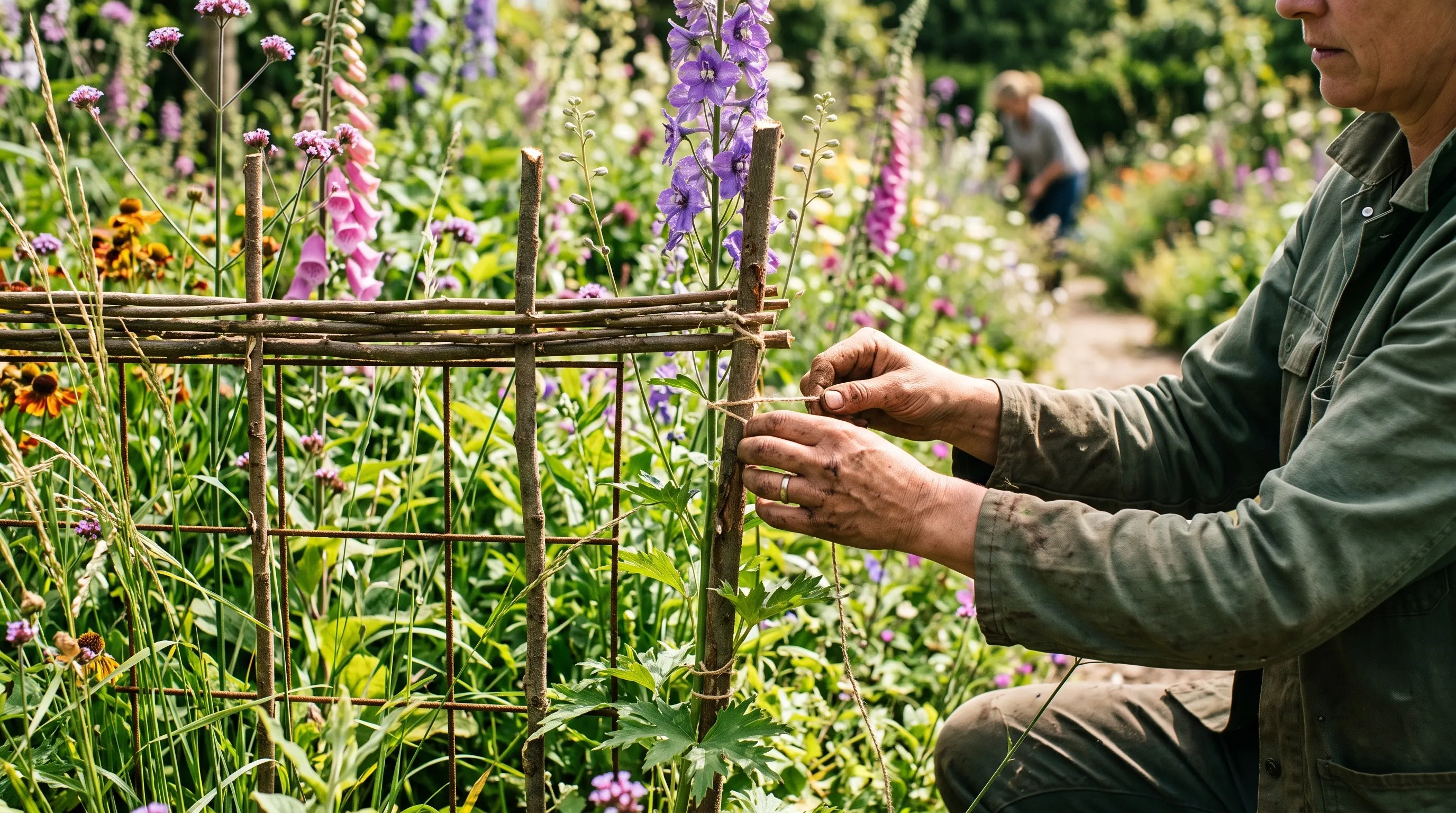 Stake in May, before plants need it, so growth comes up through the frame and hides it. Late staking never looks natural.
Month-by-month hot border calendar for the UK
This calendar assumes a sunny, free-draining border in a typical UK climate. Shift timings a couple of weeks later for Scotland and the north, earlier for the mild south-west.
| Month | Task |
|---|---|
| January | Plan and order dahlia tubers and bare-root perennials. Check stored dahlia tubers for rot. |
| February | Cut back last year’s dead stems and grasses to the ground. Mulch beds with compost. |
| March | Divide congested crocosmia and helenium clumps. Start dahlia tubers under glass at 15C. |
| April | Plant hardy perennials. Push in twiggy stakes for later. Scatter balanced fertiliser at 70g per m2. |
| May | Plant out dahlias and cannas after the last frost. Get all staking in before growth flops. |
| June | Border opens with Geum, Achillea and first Kniphofia. Water new plants in dry spells. |
| July | Peak building. Crocosmia, Helenium and Persicaria fire up. Deadhead every few days. |
| August | Full heat. Dahlias in full stride. Feed potted dahlias with high-potash feed. Keep deadheading. |
| September | Rudbeckia and late dahlias carry the show. Grasses turn gold. Cut back spent Geum for a second flush. |
| October | Display fades after first frosts. Enjoy grass seedheads. Note gaps to fill next year. |
| November | Lift dahlia and canna tubers after frost blackens them. Store dry and frost-free at 5-7C. |
| December | Leave grasses and seedheads standing for winter structure and birds. Plan next year’s additions. |
Common mistakes with hot borders
Most hot-border disappointments come from a few repeated errors. Avoid these four and the border looks planned rather than accidental.
Forgetting the dark foliage foil
What it is: Planting only hot flowers with a green hedge or fence behind. Why it happens: Foliage feels less exciting than flowers at the garden centre, so it gets skipped. The fix: Plant at least two dark-leaved shrubs, Cotinus ‘Royal Purple’ or Sambucus ‘Black Lace’, as a back layer before you buy a single flower. The flowers will look twice as intense.
Too many colours, no repetition
What it is: One of everything, dotted about, with no colour repeated. Why it happens: Buying single plants that catch the eye. The fix: Choose two or three anchor plants and repeat each three or four times down the border. Buy flowers in odd-numbered groups of 3, 5 or 7.
Ignoring succession
What it is: A border that peaks for two weeks then goes flat. Why it happens: Buying whatever is in flower on the day you shop. The fix: Deliberately pick early, mid and late flowerers. Use the plant table above and check the flowering-months column so every month from June to October is covered.
Planting sun-lovers in shade or wet soil
What it is: Crocosmia and dahlias that grow tall, flop and barely flower. Why it happens: Squeezing hot plants into the only spare bed, regardless of aspect. The fix: Give them 6 hours of sun and free-draining soil. Improve heavy clay with grit, or grow the fussiest plants in raised beds or pots.
Gardener’s tip: If your border has a dull patch in late June before the main perennials open, drop in a few pots of dahlias grown on under glass. Sink the whole pot into the gap and lift it out once the border fills. It is the quickest way to buy time in a young hot border.
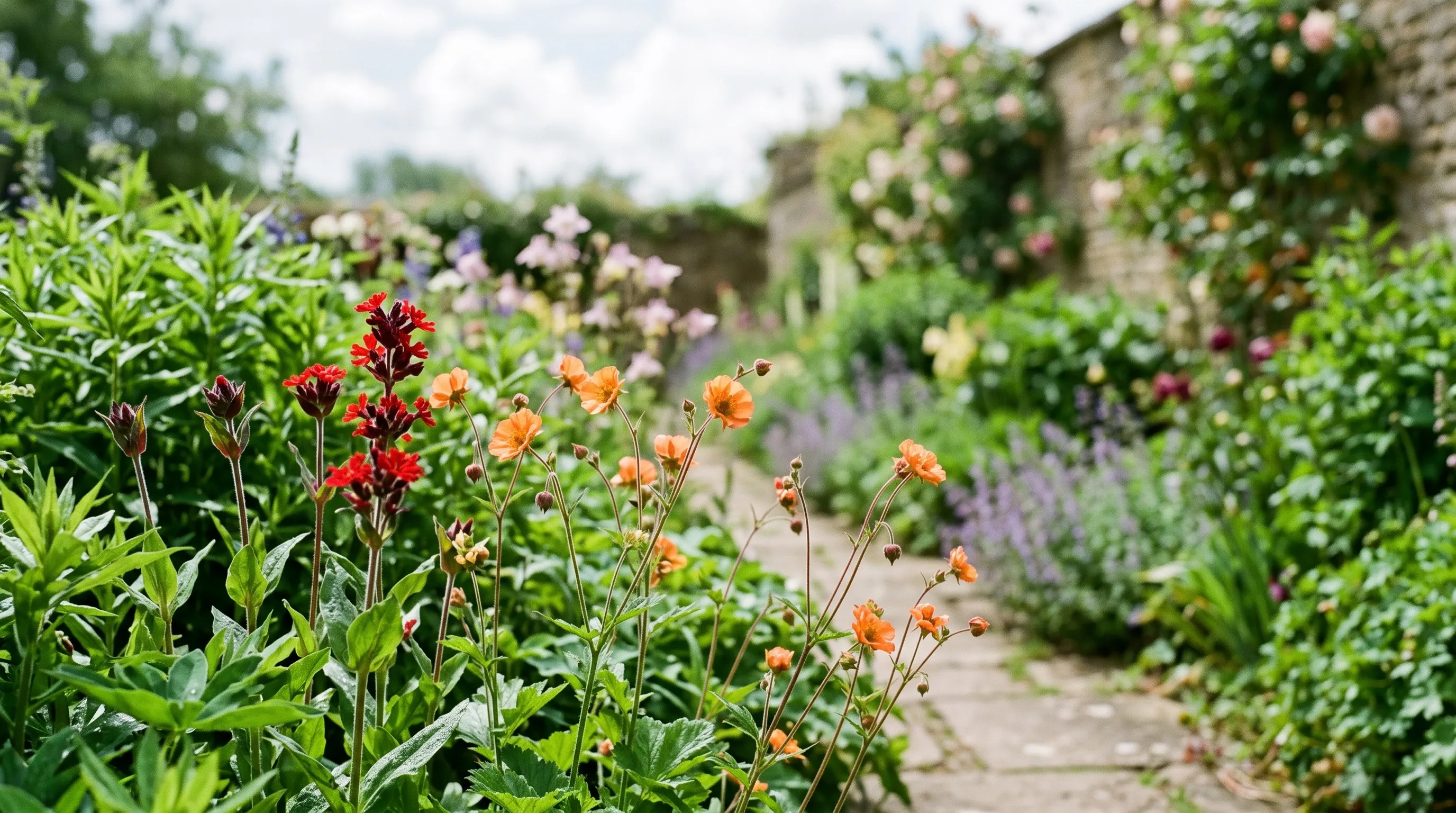 Early summer: the same border in June, filling out with fresh growth and the first Geum and Achillea before the July peak.
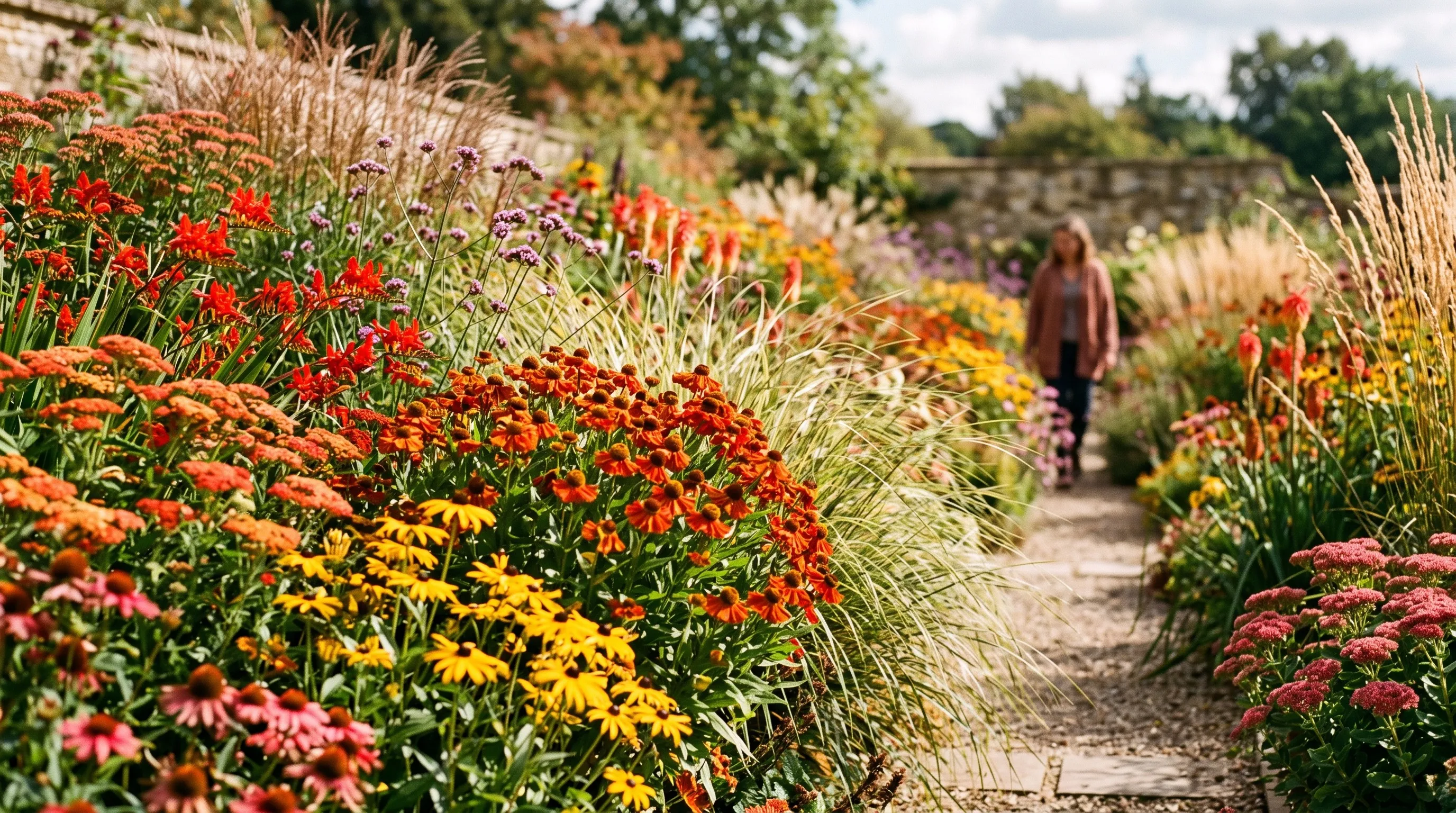 Late summer: the border at full heat in September, with dahlias, Rudbeckia and grasses carrying the display to the first frost.
Frequently asked questions
What colours go in a hot border?
Scarlet, red, orange, gold and bright yellow. These advancing colours form the core. Deep purple and dark bronze foliage act as a foil to intensify them, and a small amount of acid-green or lime lifts the whole scheme. Avoid pastel pinks and blues, which mute the heat and look accidental against the fiery tones.
Do hot border plants need full sun?
Yes, most want at least 6 hours of direct sun. Crocosmia, dahlias, heleniums, kniphofia and rudbeckia all flower best in full sun and free-draining soil. In shade they grow leggy, flop and flower poorly. A south or west-facing bed is ideal. A few, like Persicaria, tolerate light afternoon shade.
Why add dark foliage to a hot border?
Dark foliage makes hot colours look far more intense. Deep purple and bronze leaves absorb light and throw fiery flowers forward by contrast. Cotinus ‘Royal Purple’, Sambucus ‘Black Lace’ and the dark leaves of Dahlia ‘Bishop of Llandaff’ all do this job. Without a dark foil, a hot border can look flat and busy rather than glowing.
How do I keep a hot border flowering all summer?
Mix early, mid and late flowerers and deadhead often. Geum and hardy Geranium start in June, Crocosmia and Helenium carry July and August, then Rudbeckia, dahlias and asters run into October. Deadhead dahlias and heleniums every few days, and cut Geum back after the first flush for a second show.
What is the best red plant for a hot border?
Crocosmia ‘Lucifer’ is the standout hardy red. It throws arching scarlet spikes to 1.2m in July over sword-shaped foliage, spreads steadily from corms, and needs no staking. For darker, velvety red try Dahlia ‘Bishop of Llandaff’, which pairs single scarlet flowers with near-black foliage from July to the first frost.
How do you stop tall hot border plants flopping?
Stake early, before they need it, in late spring. Push twiggy hazel or metal grid supports in during May so plants grow up through them. Tall dahlias, heleniums and Persicaria need support in exposed gardens. Feeding too much nitrogen also causes soft, floppy growth, so use a balanced feed, not a leafy one.
Do hot border perennials come back every year?
Most do, but dahlias and cannas are tender. Crocosmia, Helenium, Rudbeckia, Kniphofia, Achillea, Persicaria and Geum are hardy perennials that return each spring. Dahlias, cannas and Ricinus are frost-tender. In mild areas lift or mulch dahlia tubers over winter, or lift and store them dry from November to April.
Our team produces practical UK gardening guidance from source research, contributor records and established horticultural practice. Editorial standards are overseen by Matt W.