Key takeaways
- Restrict hard materials to three or fewer: porcelain, rendered blockwork and corten steel read as calm, not busy
- Use large-format paving, 600x600mm or 600x1200mm, with 2-3mm joints for the flush modernist look
- Limit the plant list to 6-7 species, then repeat them in blocks for rhythm rather than variety
- Leave 30-40% of the design as negative space: empty paving and gravel is a deliberate design element
- Budget 150-400 pounds per square metre installed, with porcelain paving alone at 45-90 pounds per square metre in materials
- Match wall renders and paving tones to the house so the garden reads as one connected space
Modernist garden design strips a garden back to its bones: strong geometry, clean lines and a short list of good materials used with confidence. The style grew out of modernist architecture and it treats a contemporary garden as an outdoor room, not a plot to fill. Form leads. Colour and variety follow well behind.
Done well, the look is calm, bold and low-maintenance. Done badly, it turns cold and hard. The difference is discipline: how few materials you use, how much empty space you dare to leave, and how tightly you edit the planting. This guide covers the core principles, the hard landscaping materials that define the style, the architectural plants that soften it, and the mistakes that trip up most UK gardens.
The core principles behind a modernist garden
Modernist design rests on a handful of principles that work together. Learn these first and the material choices follow logically.
Strong geometry comes first. Modernist gardens are built on rectangles, squares and clean grids, with paths, walls and pools set at deliberate right angles or a single confident diagonal. Clean lines matter as much as the shapes: crisp paving edges, flush joints and level changes with sharp returns.
Line and plane is the modernist habit of reading a garden as flat surfaces and the lines where they meet. A rendered wall is a plane. Paving is a plane. Where they meet, the join should be deliberate. Repetition and rhythm give the design order: the same plant, pot or paving unit repeated at regular intervals leads the eye through the space.
Why a restrained palette does the heavy lifting
The single biggest decision in a modernist garden is what to leave out. A restrained palette applies to both materials and plants. Limit yourself to three hard materials or fewer, and six or seven plant species repeated in blocks.
This runs against instinct. Most gardeners collect: a new clematis here, a bargain slab there, a different pot each season. Modernist design asks you to resist. A garden built from porcelain, one render colour and corten steel reads as considered. The same garden with brick, block paving, timber, slate and gravel reads as an accident.
The reason is visual noise. Every extra material, colour and texture asks the eye to work harder. Strip them back and the remaining elements gain weight. A single corten planter against a plain rendered wall carries far more impact than the same planter lost among five other finishes.
How to use negative space, not fill it
Negative space is the empty ground in a design: bare paving, open gravel, still water and lawn. In a modernist garden it is not leftover space. It is a deliberate element, as important as any planting.
Beginners fill every corner. Modernist design does the opposite. It leaves generous areas of a single material undisturbed, so the eye can rest and the planted moments count for more. A wide sweep of pale porcelain with one multi-stem tree set off-centre says more than a busy border ever could.
Aim for roughly 30 to 40% of the design as negative space. That sounds like a lot until you build it, when it suddenly feels right. The empty ground gives scale, makes a small garden feel larger, and throws the architectural planting into relief.
Gardener’s tip: Before you plant, live with the empty hard landscaping for a fortnight. Walk it, sit in it, photograph it at different times of day. You will almost always want fewer plants than you first thought. In a modernist garden, restraint reads as confidence.
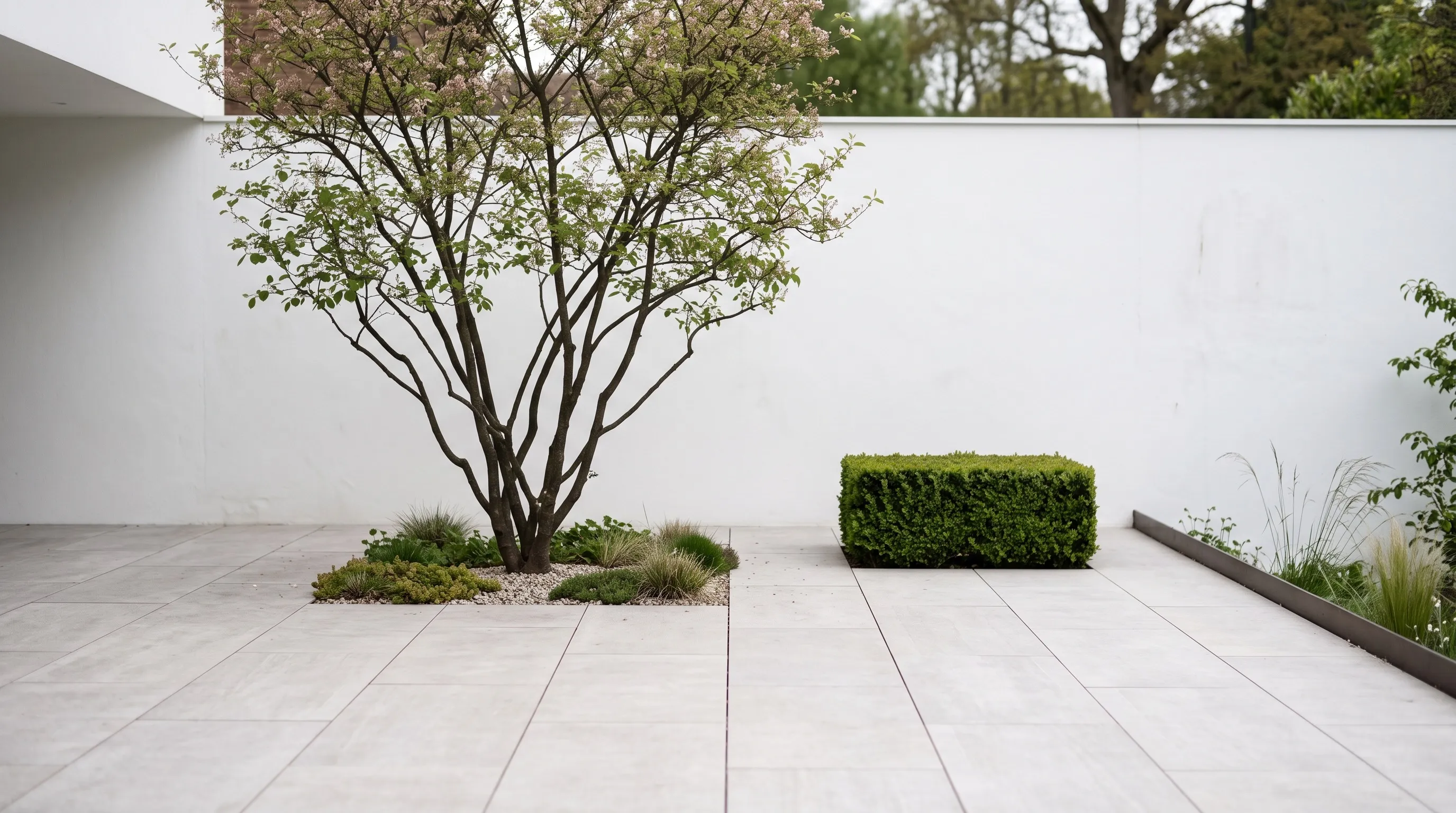 Generous negative space at work: a wide porcelain terrace with one multi-stem tree and a single clipped block. The empty ground gives the design scale and calm.
Hard landscaping materials that define the style
Hard landscaping carries a modernist garden. The materials are chosen for clean finish, flat planes and honest texture. Here are the ones that do the work.
Large-format porcelain paving is the modern default. Units of 600x600mm or 600x1200mm, laid with 2-3mm joints, give a flush, near-continuous floor. Porcelain resists frost, algae and stains, holds its colour and never needs sealing. Poured or board-marked concrete gives a monolithic, architectural surface, with board-marking leaving the grain of timber shuttering in the set concrete.
Corten weathering steel has become the signature modernist material: raised planters, screens, water features and edging in rusted orange-brown steel that develops a stable protective patina. Rendered and painted blockwork walls provide the flat planes the style depends on, finished in silicone render and painted in muted greys, charcoals or off-whites.
For warmth, hardwood or composite decking breaks up hard stone, laid in wide, clean boards. Gravel offers a cheap, permeable negative-space surface, while monolithic stone, a single large sawn block as a bench, step or water bowl, adds weight. The table below compares the main options.
| Material | Look | Rough cost (materials) | Durability |
|---|---|---|---|
| Large-format porcelain | Flush, matt, precise | 45-90 pounds per m2 | 30+ years, frost and stain proof |
| Board-marked concrete | Monolithic, textured | 80-150 pounds per m2 | 40+ years, may hairline crack |
| Corten steel | Warm rust, sculptural | 200-500 pounds per planter | 25+ years, self-protecting patina |
| Rendered blockwork | Flat painted plane | 90-160 pounds per m2 | 20-30 years, repaint every 8-10 |
| Composite decking | Warm, low-maintenance | 60-120 pounds per m2 | 25 years, no annual treating |
| Gravel | Loose, permeable, quiet | 4-8 pounds per m2 | Top up every 3-5 years |
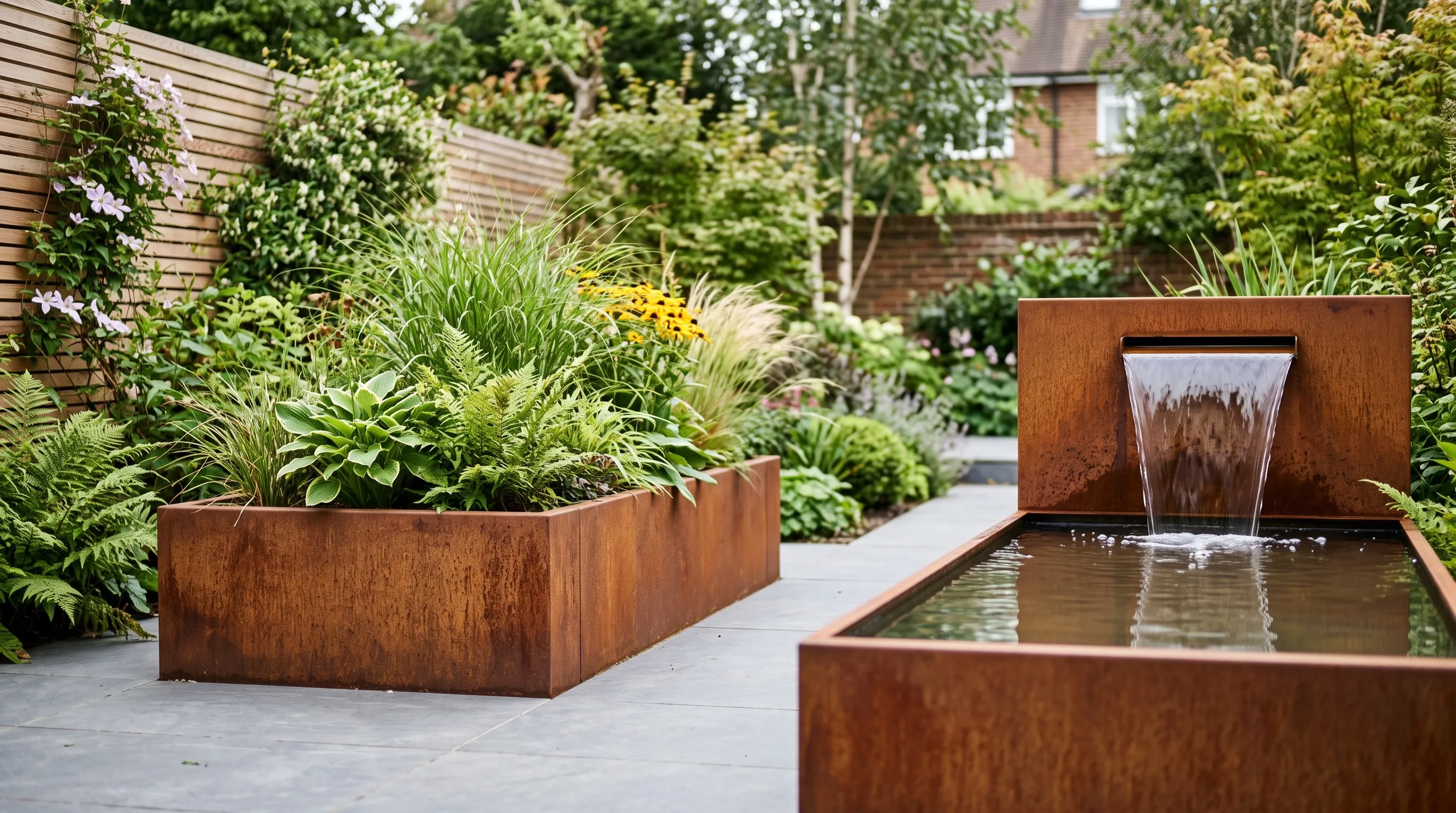 Corten steel used for a raised planter and a spill water feature. The rusted patina warms an otherwise cool palette of porcelain and render.
Using architectural planting as sculpture
In a modernist garden, plants are chosen for form, structure and texture, not flower colour. Think of each plant as a piece of sculpture placed against the hard landscaping. A short, repeated list beats a mixed collection every time.
Multi-stem trees give height and a living focal point. A multi-stem Amelanchier lamarckii or Betula utilis jacquemontii, the white-stemmed Himalayan birch, reads beautifully against a plain rendered wall. Clipped evergreen blocks provide year-round structure: Taxus baccata (yew) clipped into cubes or low hedges, or box alternatives like Ilex crenata where box blight is a risk.
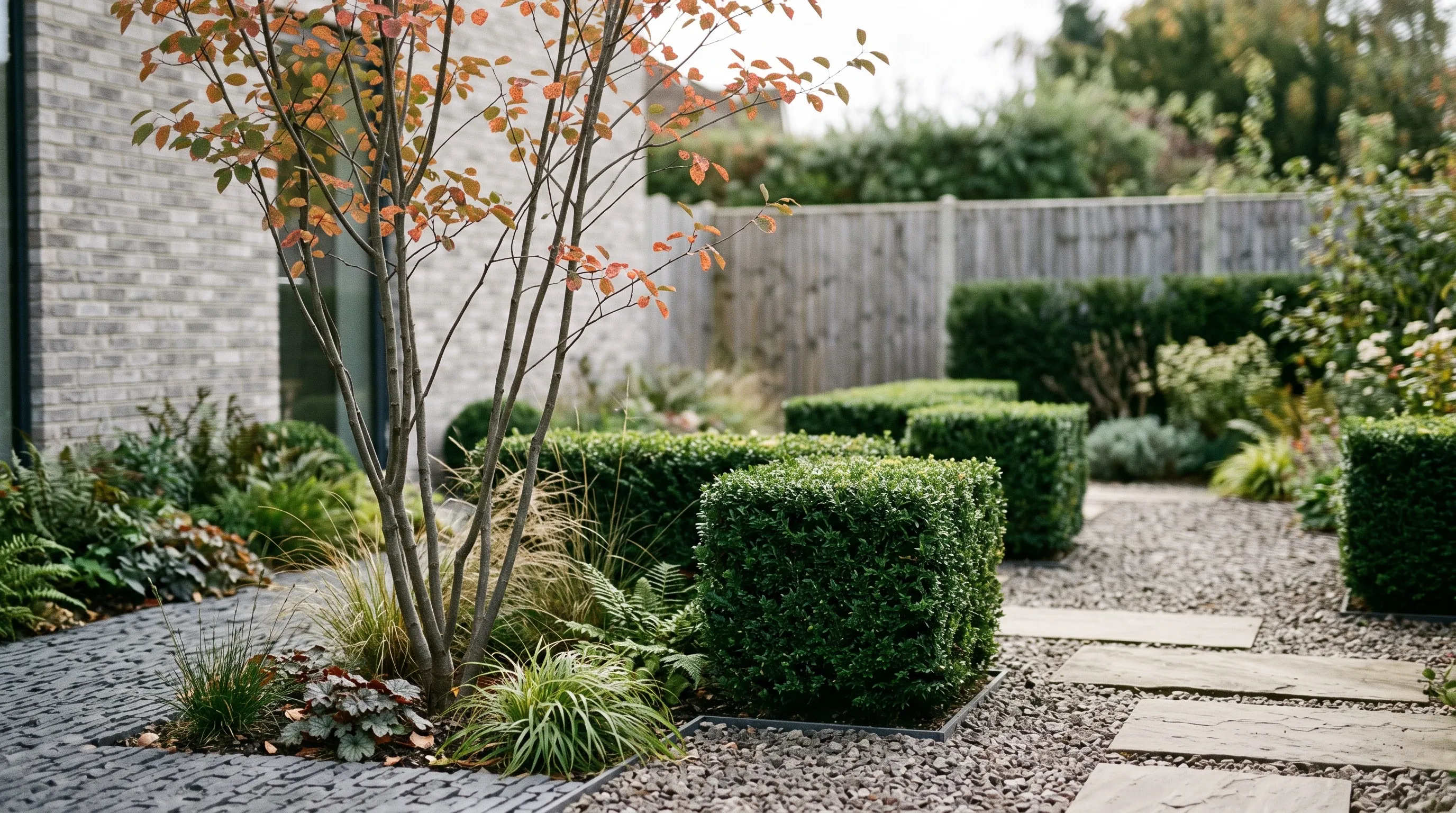 Clipped yew cubes set against a multi-stem Amelanchier. Repeated evergreen blocks give the garden structure through every month of the year.
Contained black bamboo and other screening tricks
Screening a modernist garden calls for clean, vertical structure rather than a mixed hedge. Black bamboo against a rendered wall is the classic move. The dark canes read almost graphic, and the leaves cast shifting shadows on the render behind.
The warning is real: running bamboos like Phyllostachys nigra spread by underground rhizomes and can travel several metres a year. Plant it in a root barrier membrane at least 600mm deep, or in a large raised corten or rendered container. Clumping species need less control but give a bushier, less architectural look.
Other modernist screens include slatted timber or composite panels with even gaps, corten steel laser-cut screens, and single-species hedges like yew or hornbeam kept flat and tight. The key is repetition and restraint: one screening material, used consistently, not a patchwork of fence types.
Warning: Never plant running bamboo directly into open ground near a boundary or house. Rhizomes can lift paving and push under fences, and removal is expensive. Contain it in a barrier or container from day one, and check annually for escapes.
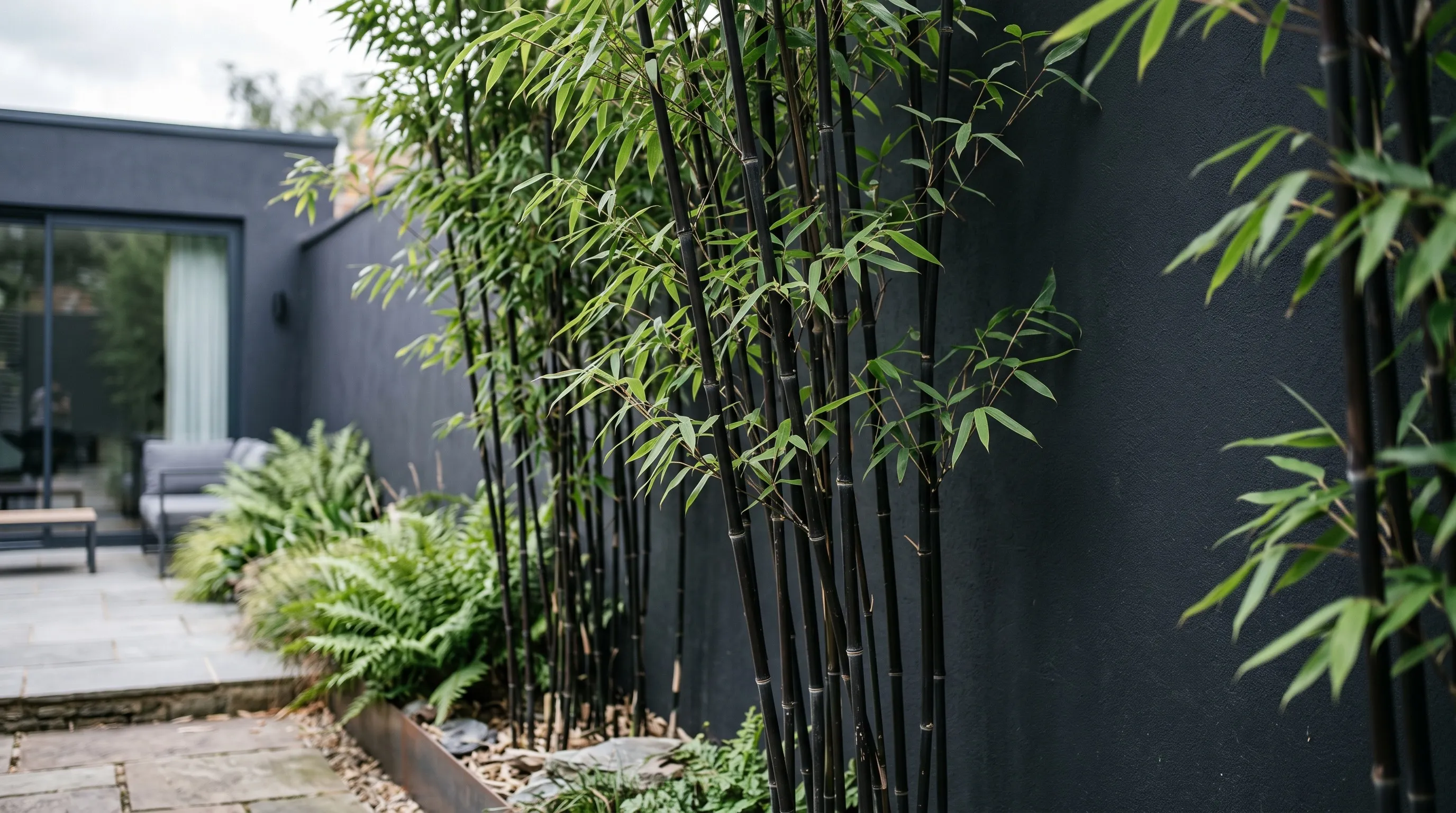 Contained black bamboo against a charcoal rendered wall. Keep running bamboo in a root barrier or container to stop it spreading.
Still water, lighting and indoor-outdoor flow
Three details lift a modernist garden from tidy to designed: water, light and flow.
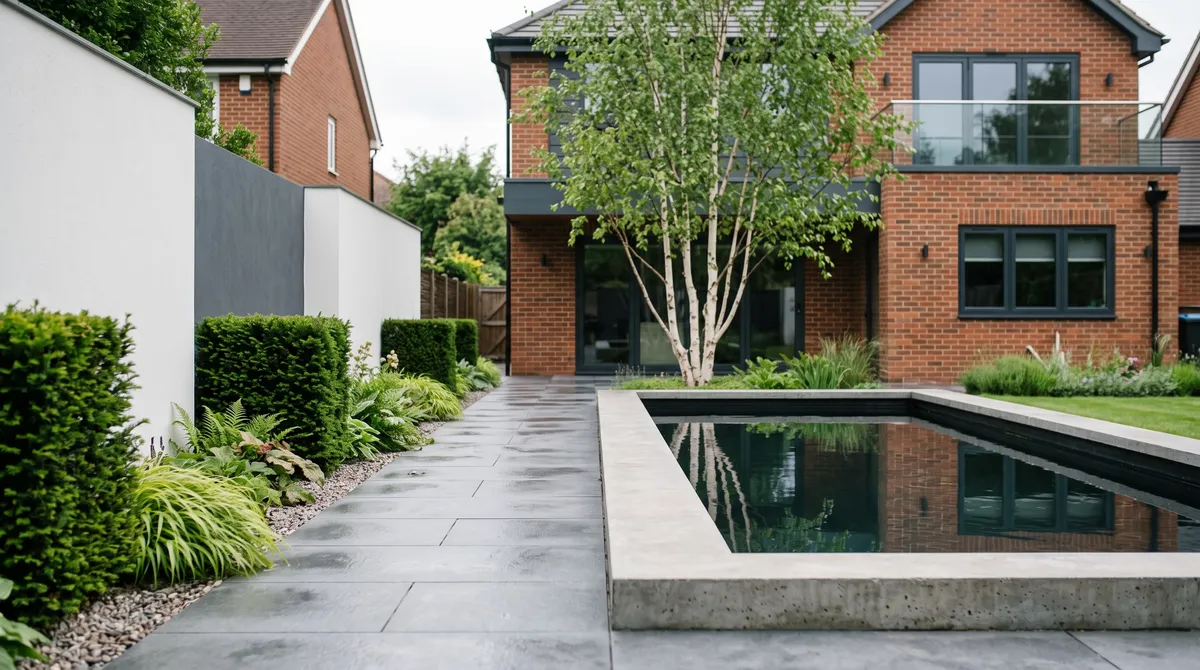
Water in this style is still and reflective, not splashy. A shallow rectangular reflecting pool, a narrow rill or a dark water bowl mirrors the sky and the planting, doubling the sense of space. Keep the water level high and the edges crisp. A dark liner or dark render to the pool base makes the surface read as a mirror.
Integrated lighting turns the garden into a night-time room. Use low-level linear washers to graze rendered walls, discreet uplighters under multi-stem trees, and recessed deck or step lights. Warm white at 2700K suits render and timber. Keep fittings hidden and the effect, not the fixture, on show.
Indoor-outdoor flow ties the garden to the house. Large sliding or bi-fold doors, a paving material that runs from inside to out, and a level threshold with no step all blur the boundary. Matching the internal floor tone to the external porcelain is the trick that makes a small garden feel like an extra room.
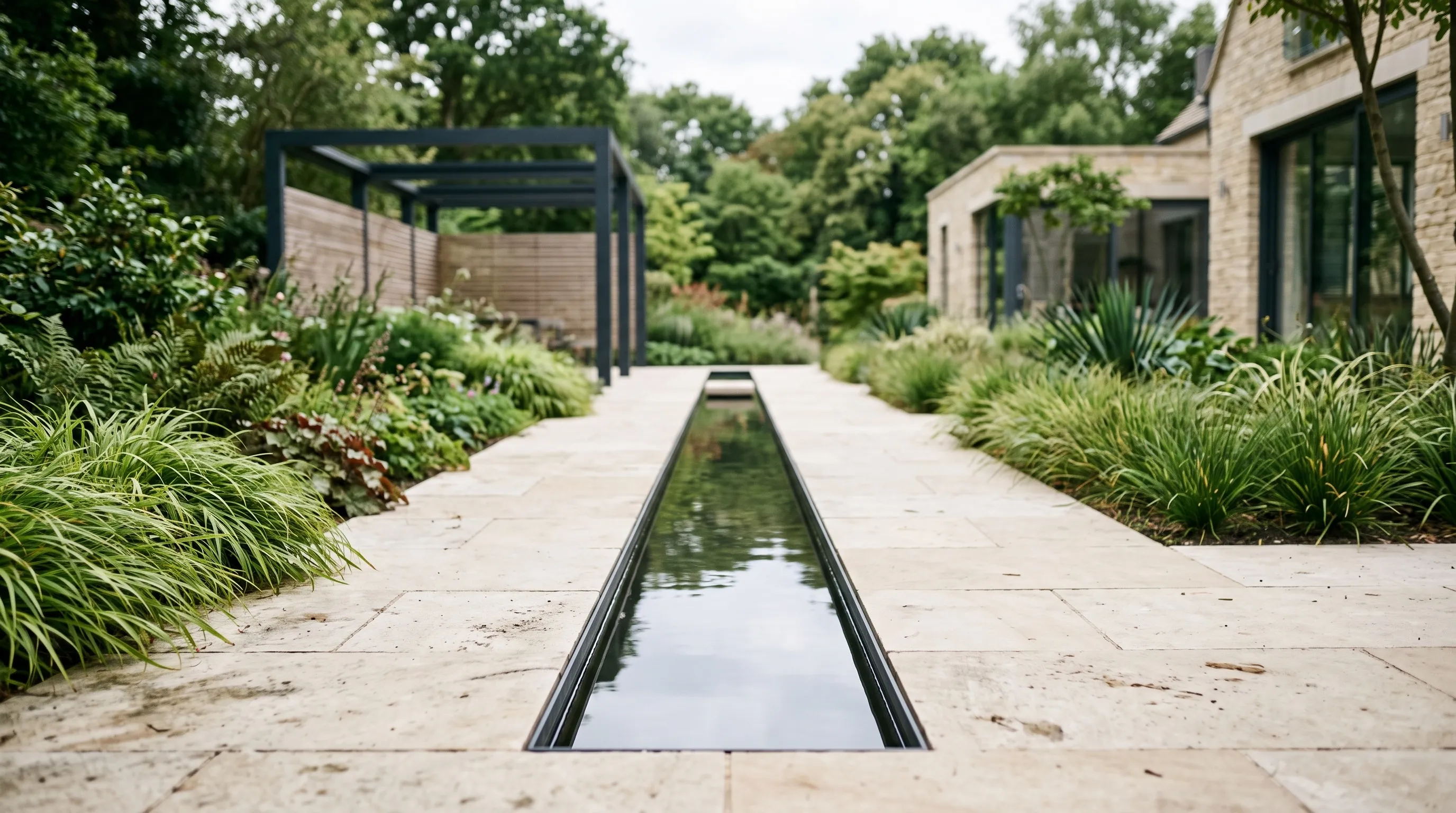 A narrow reflective rill set flush into the paving. Still water mirrors the sky and planting, adding depth without noise.
Levels, raised beds and the low-maintenance ethos
Flat sites can feel dull, so modernist gardens use levels to add interest. A change of even one or two steps creates zones, defines a seating area and gives the eye something to read. Retaining walls in rendered block or corten steel hold the levels crisply.
Raised beds suit the style perfectly. Built in rendered blockwork or corten, at a consistent height of 400 to 600mm, they double as low seating and lift the planting to eye level. Keep them rectangular and aligned to the paving grid. A single long raised bed reads better than several small ones.
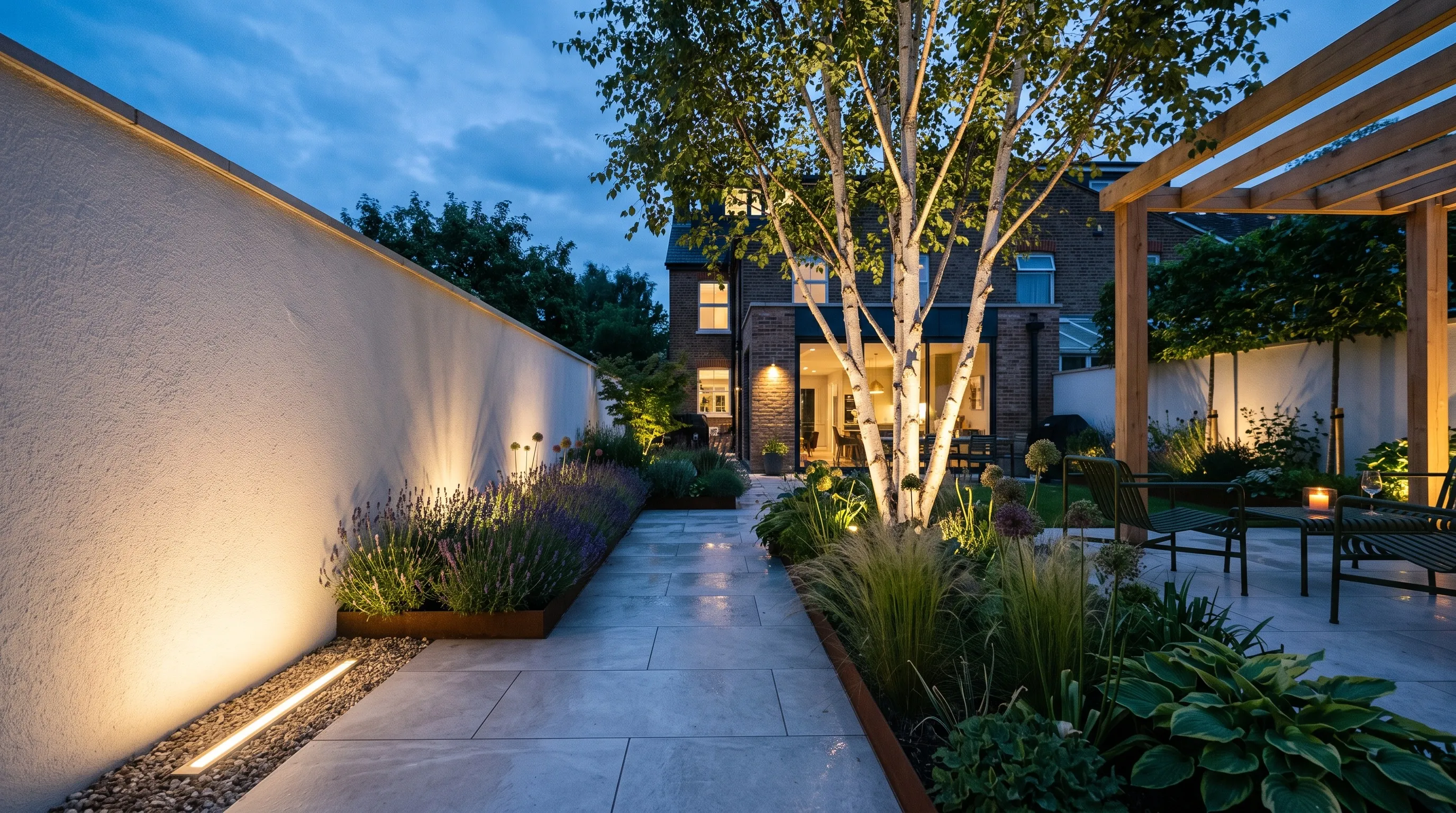 Integrated lighting at dusk. Low washers graze the render and a hidden uplighter catches the tree, turning the garden into a night-time room.
Seasonal maintenance table for a modernist garden
A modernist garden is low-input, but it is not no-input. The work is concentrated into a few key jobs rather than spread thinly across the year. This table sets out the main tasks by season for a typical UK plot.
| Season | Main tasks |
|---|---|
| Spring | Cut back grasses before new growth if not done in winter. First hedge tidy. Check irrigation. Top up gravel. |
| Summer | Light clip of yew or Ilex in June or July. Water raised beds via irrigation. Deadhead Verbena if wanted. Pressure-rinse paving if algae shows. |
| Autumn | Second, final hedge cut by early autumn. Lift and divide congested grasses. Clear leaves off porcelain to prevent staining. Check corten drainage. |
| Winter | Cut grasses to 100-150mm in late winter. Wash paving and render. Repaint rendered walls every 8-10 years. Service and test garden lighting. |
Porcelain paving is the star for low maintenance here. It never needs sealing, resists algae far better than natural stone, and a rinse with plain water lifts most dirt. Corten steel needs a free-draining base beneath it, or run-off can stain adjacent pale paving in the first year as the patina settles.
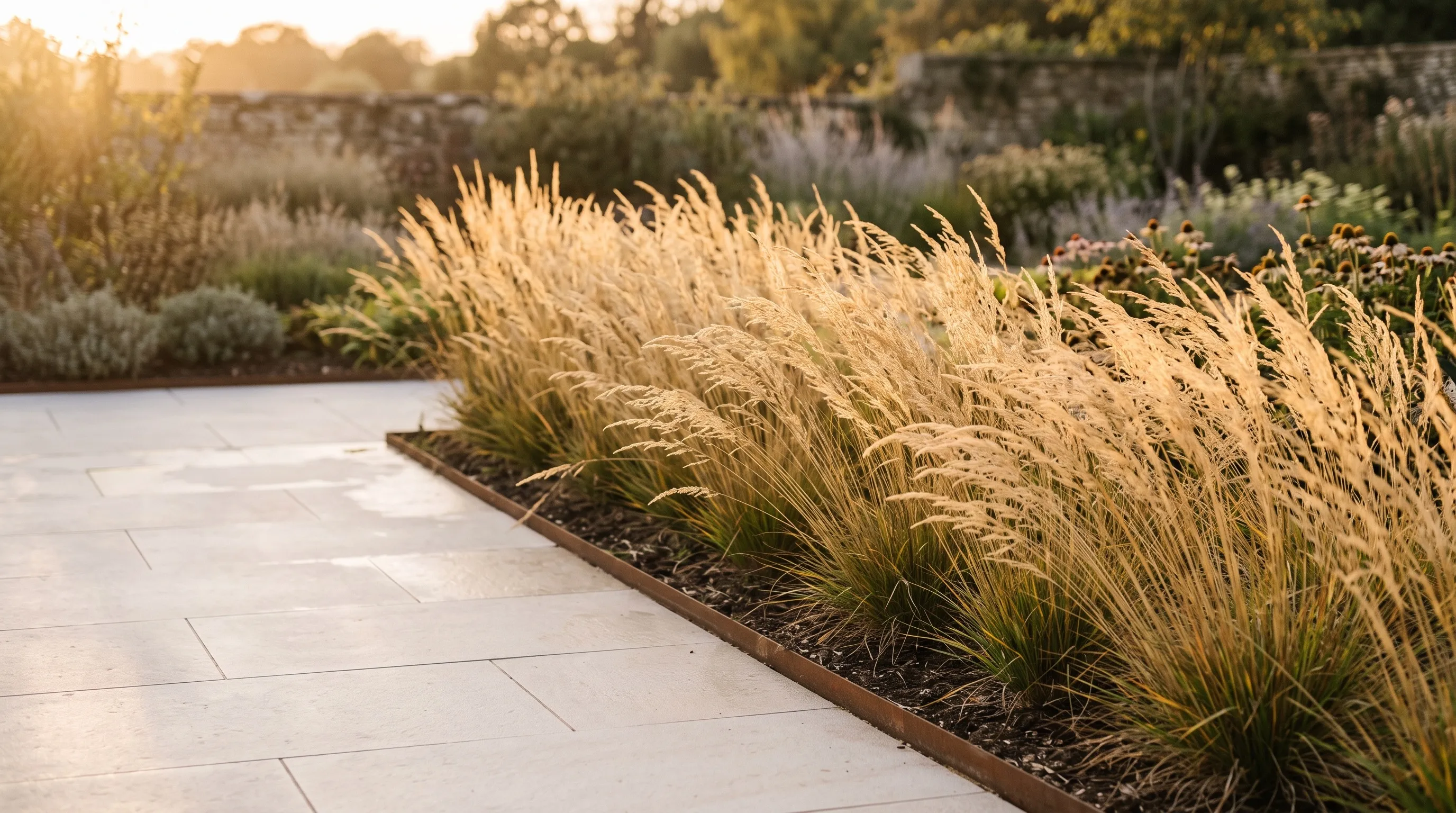 Large-format porcelain paving softened by a drift of Calamagrostis ‘Karl Foerster’. Grasses add movement and catch low light without cluttering the scene.
Common mistakes in modernist garden design
Most contemporary gardens fail for the same three reasons. Avoid these and you are most of the way to a good design.
Over-cluttering the space
The commonest error is filling every surface. Too many pots, plants, ornaments and materials crowd out the negative space the style depends on. Why it happens: gardeners fear empty ground looks unfinished. The fix: plan the empty space first, plant sparingly, and remove one thing from every arrangement. Restraint is the whole style.
Using too many materials
A garden with porcelain, brick, block paving, timber, slate and gravel reads as a sample board, not a design. Why it happens: materials get added piecemeal over years, or on offer. The fix: pick three hard materials at most, ideally two plus one feature, and repeat them throughout. Discipline here matters more than budget.
Ignoring the house architecture
A slick modernist garden bolted onto a traditional cottage jars badly. Why it happens: people copy magazine gardens without checking they suit the building. The fix: take cues from the house. Pick up its brick tone, window frame colour or render, and let the garden’s formality match the building’s. The garden should feel like it belongs.
Frequently asked questions
What is modernist garden design?
A style built on geometry, restraint and negative space. Modernist gardens use clean lines, a limited material palette and architectural planting arranged as sculpture. Form and structure lead, colour and variety follow. The look pairs hard materials like porcelain, concrete and corten steel with a short list of repeated plants, so the garden reads as calm and legible in every season.
How many materials should a modernist garden use?
Three hard materials or fewer, ideally two plus a feature. Too many finishes make the space feel busy and cheap. A common recipe is porcelain paving, one rendered wall and a corten or timber feature. Keeping the palette tight is the single biggest factor in whether a contemporary garden looks designed or muddled.
Are modernist gardens low maintenance?
Yes, once established, though not zero maintenance. Large paved areas, gravel and clipped evergreens cut weekly work sharply. Expect 20-40 minutes a week for a small garden. Clipped hedging needs one or two cuts a year, grasses one cut-back in late winter. The low-maintenance ethos is built into the style, not bolted on afterwards.
What plants work in a contemporary minimalist garden?
Architectural plants with strong form, repeated in blocks. Multi-stem Amelanchier or birch, clipped Taxus or box, black bamboo, Trachycarpus palms and grasses like Calamagrostis ‘Karl Foerster’ all suit the style. Choose plants for shape and texture, not flower colour. Repetition of a few species reads far better than a mixed collection.
What is the best paving for a modern garden?
Large-format porcelain, 600x600mm or 600x1200mm, in a matt tone. Porcelain resists stains, algae and frost, holds colour and needs no sealing. Lay it with 2-3mm joints for the flush contemporary look. Poured concrete and sawn natural stone also suit the style but cost more or weather less predictably.
How much does a modernist garden cost in the UK?
Budget 150-400 pounds per square metre installed. Porcelain paving costs 45-90 pounds per square metre in materials alone, before base preparation and laying. Corten steel, rendered walls and integrated lighting add cost. A small 40 square metre contemporary garden typically runs 8,000-20,000 pounds fully installed depending on materials and levels.
How do I make a small garden look modern?
Simplify hard, limit planting and use large paving units. Fewer, bigger materials make a small space feel larger and calmer. Repeat one or two plants, add a single rendered wall or corten panel, and leave deliberate empty space. Avoid fussy borders, mixed paving and too many pots, which shrink and clutter a small plot.
Our team produces practical UK gardening guidance from source research, contributor records and established horticultural practice. Editorial standards are overseen by Matt W.