Key takeaways
- Plan the kitchen in four zones (prep, cook, serve, wash) with 900mm of clear worktop between hot and cold zones
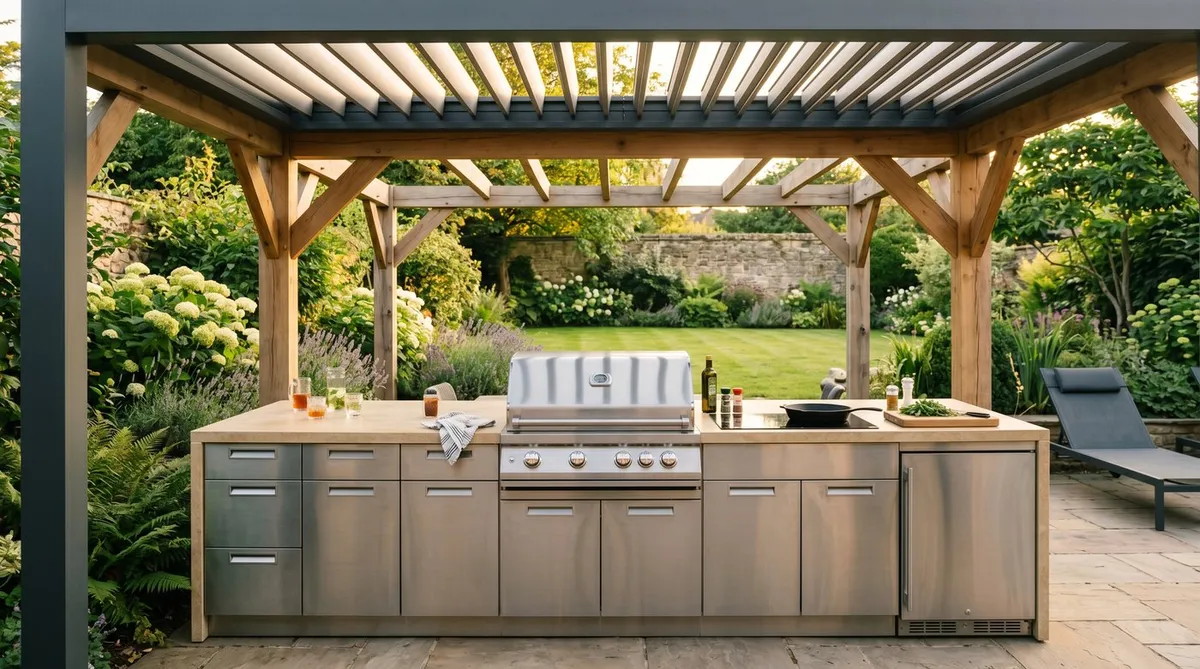
- A pergola or solid roof is essential for cooking in UK weather and shifts the build from seasonal to year-round
- Gas connections require a Gas Safe registered engineer and Building Regulations Part J sign-off (never DIY)
- Stainless steel grade 304 lasts 10-12 years near the coast; grade 316 lasts 20+ years and is worth the 30% premium
- Porcelain and granite worktops survive UK frost without sealing; concrete and engineered quartz need annual sealing
- Induction hobs need 32A or 40A dedicated circuits, not the same as a kitchen socket spur
A UK outdoor kitchen is a year-round design problem, not a summer accessory. The British weather sets the rules: rain falls on the cooking zone 130-150 days per year, frost arrives every winter, and the prevailing south-westerly wind drives weather across the worktop. The kitchens that work for ten or more years are designed around those constraints first and the cooking pleasure second.
This guide covers the design-led detail that turns an inspirational outdoor kitchen idea into a working installation. The cost ranges, the services planning, the materials choices and the gas and electrical compliance details are the four areas where most UK projects either succeed or fail. For atmosphere, layout inspiration and shopping ideas, the sister piece outdoor kitchen and BBQ area ideas covers the visual side.
Why the design-first approach matters in UK gardens
The instinct is to buy a BBQ and a couple of pots, drop them on the patio and call the result an outdoor kitchen. This works for one summer. By the third winter the BBQ is rusting, the cabinet doors have warped, the gas hose is perished and the whole thing gets dragged to the tip.
A designed outdoor kitchen takes the opposite route. The cooking appliances are chosen first because their fuel type dictates the services. The services are routed before the slab is poured because retrofitting gas and electrics into finished paving costs three to four times the new-build figure. The roof or pergola goes on at the same time as the kitchen carcass because cooking exposed to rain is not cooking. And the materials are specified for 15-20 year lifespan because the cost-per-year of a properly built kitchen sits below the cost-per-year of replacing a cheap one every three years.
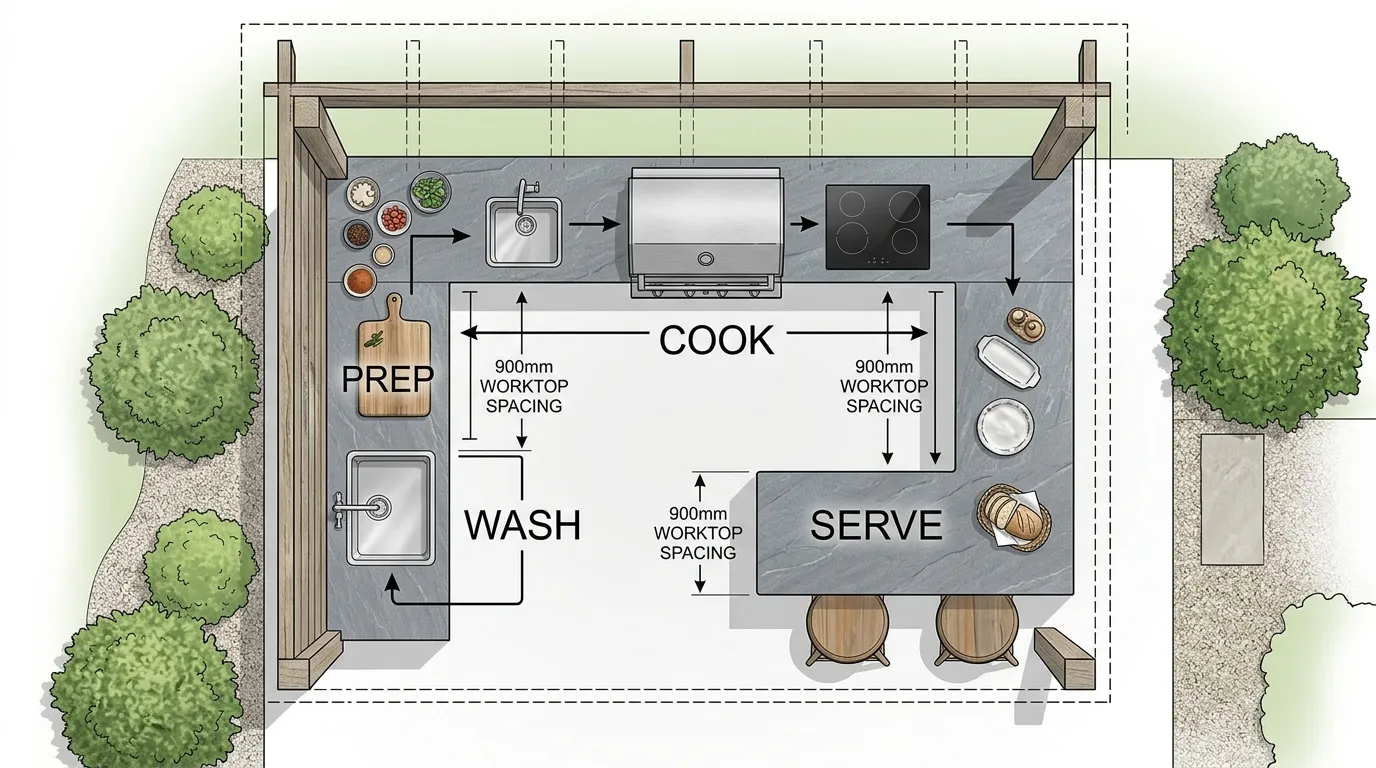
The four zones every UK outdoor kitchen needs
Zone 1: Prep
The prep zone is where ingredients are unpacked, chopped, marinated and rested before cooking. It needs 900mm of clear worktop, a chopping surface that takes the chef’s knives, and ideally a small bowl sink fed from a 15mm cold supply.
A common UK shortcut is to skip the sink and use the indoor kitchen instead. This works on a small patio kitchen 5m from the back door. On any kitchen 10m or more from the house, the run between zones gets tedious and the chef ends up using the dirty patio table to chop on.
Zone 2: Cook
The cook zone holds the heat appliances (grill, hob, pizza oven, smoker, plancha) and needs the most thought because the fuel choice cascades through the whole design.
Gas (mains or bottled): A built-in mains-gas grill needs a 22mm copper run from the gas meter and a Gas Safe registered installer. Bottled propane is much simpler. A 47kg bottle in a vented cabinet feeds most domestic grills for a season, but you trade convenience for a recurring fuel cost and bottle storage.
Electric and induction: Induction is the standout UK choice. A 6kW twin-zone induction unit needs a 32A or 40A dedicated circuit from the consumer unit, run in armoured cable to an IP55 outdoor socket. The cost premium for the cable run is around 400-600 pounds over a standard 13A spur. Pay it once at build stage.
Charcoal and wood: Kamado-style ceramic grills like the Big Green Egg and Kamado Joe hold temperature in UK wind and rain better than open kettle BBQs. A ceramic kamado loses 30-40C in a heavy shower; an open kettle loses 100C plus. If you want charcoal flavour outdoors year-round, ceramic is the only sensible option.
Zone 3: Serve
The serve zone holds plates, cutlery and warming drawers. It needs 600mm of worktop and at least one weatherproof cabinet for storing serving boards and bowls between meals.
Zone 4: Wash
The wash zone needs a small sink (typically 400 x 350mm), a 15mm cold supply, a waste trap and a connection to either the household drainage or a separate soakaway. A hot tap is desirable but not essential. Most outdoor cooking does not need hot water and the cost of running an insulated hot-water pipe outside is significant.
Drainage is the most-skipped detail in DIY outdoor kitchens. The waste from a 400mm sink needs a 32mm to 40mm waste pipe falling at 1:40 minimum back to either the soil stack or a gully. A 2m horizontal run needs a 50mm fall over its length. Get this wrong and the sink either backs up or you breach UK Building Regulations on grey-water disposal.
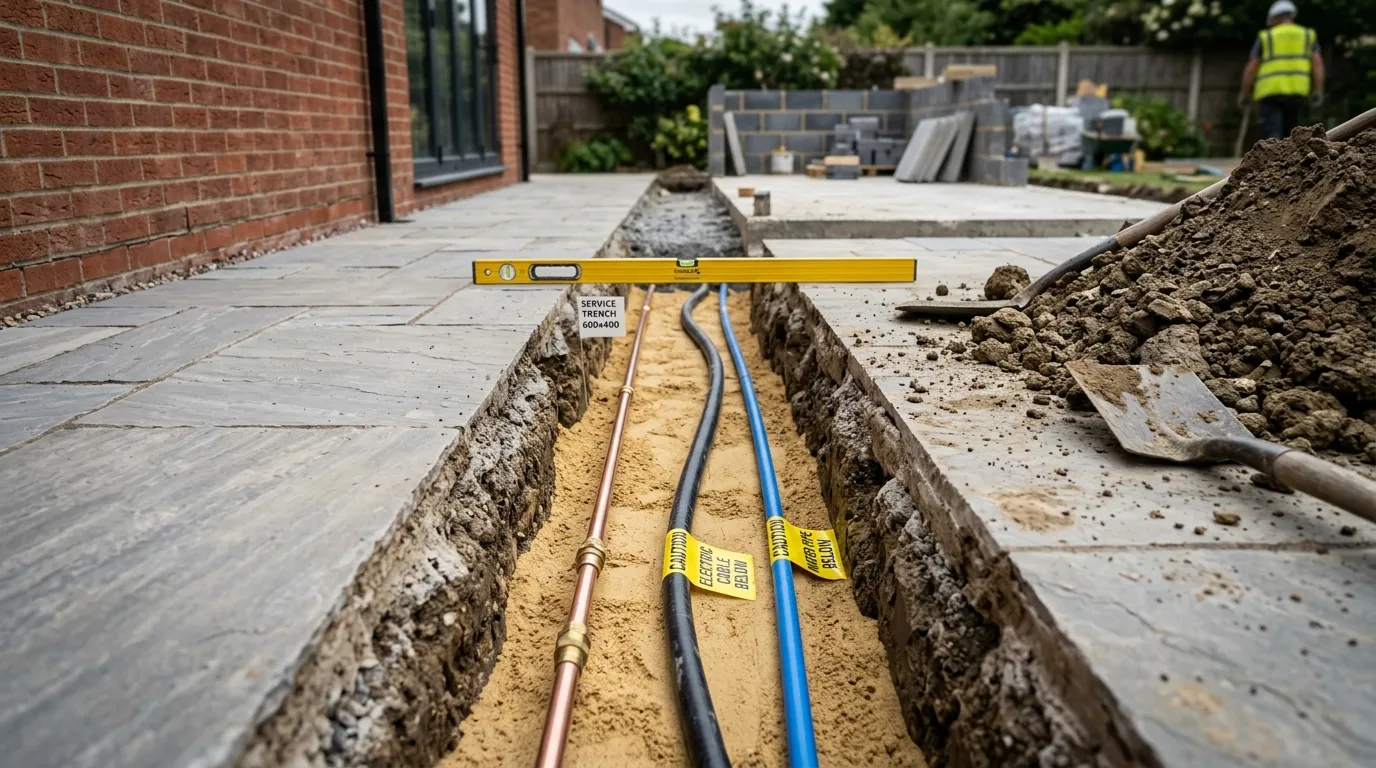
Services planning, the hidden cost that breaks budgets
Retrofitting services into a finished outdoor kitchen costs 3-4x the new-build figure. The trench, the buried armour, the certification and the slab repairs all stack up. Do the services at build stage and the costs are linear.
Gas
A mains-gas connection to a built-in outdoor grill in the UK works like this:
- The gas engineer ties off the existing meter outlet with a tee.
- A 22mm copper line runs from the tee, through an external wall sleeve, into a buried gas-pressure trench 450-600mm deep.
- The line continues in copper or yellow MDPE (medium-density polyethylene) for outdoor runs, with marker tape 150mm above the pipe.
- At the kitchen end the line emerges through a stainless sleeve, terminates at a quarter-turn isolator inside the cabinet, and feeds the appliance with a flexible bayonet hose.
- The engineer pressure-tests, gas-soaps every joint, fits a flue if the appliance needs one, and issues a Building Regulations Part J certificate.
Expect 600-1,200 pounds for the gas run on a typical UK back garden (3-8m from the meter), plus the appliance install fee. Refuse to use anyone not on the Gas Safe Register. DIY mains-gas connection is illegal under the Gas Safety (Installation and Use) Regulations 1998 and any incident invalidates household insurance.
Electrics
Two circuits, almost always:
- A 32A or 40A dedicated circuit in armoured SWA cable for induction, electric pizza ovens, electric grills.
- A 13A spur circuit in armoured SWA cable for sockets, lighting, fridge, music.
Both are Part P notifiable. A registered electrician will trench from the consumer unit, route the armoured cable under the patio bedding, fit IP55 outdoor sockets and an outdoor RCD/MCB sub-board inside the kitchen carcass. Budget 700-1,400 pounds depending on cable distance.
Water and waste
A 15mm cold supply runs from the rising main in 25mm blue MDPE pipe at 750mm depth (frost-safe). At the kitchen the MDPE transitions to copper inside the cabinet, with an isolator valve and a flexible tail to the tap.
Waste runs in 40mm grey solvent-weld pipe at 1:40 fall back to either:
- The household soil stack via a strap boss (preferred, fully compliant grey water disposal)
- A separately-built soakaway 5m from any building or boundary (Building Regulations Part H, only if no main drain access)
- A grey-water gully back to surface drainage (most common in practice, check with Building Control)
Plumbing usually costs 400-800 pounds including the soakaway or gully connection.
Materials choices that survive UK weather
Cabinetry
The carcass of the kitchen takes the most weather and contact damage. Four practical options suit UK gardens:
| Material | Lifespan | Cost guide | UK weakness |
|---|---|---|---|
| Marine plywood, painted | 8-12 years | 1,200-2,400 pounds per 3m run | Paint needs touch-up every 3-4 years; ends rot if cut after install |
| Powder-coated aluminium | 12-15 years | 2,400-4,200 pounds per 3m run | Powder coating chips and salt rusts the base metal at the coast |
| Stainless steel grade 304 | 10-12 years | 3,000-5,500 pounds per 3m run | Tea staining (surface rust) within 5km of the coast |
| Stainless steel grade 316 | 20+ years | 4,200-7,500 pounds per 3m run | Expensive but the only sensible coastal choice |
For inland UK gardens grade 304 stainless or powder-coated aluminium are the practical sweet spots. Within 5km of the coast specify grade 316. The 1,200 pound premium pays for itself by the seventh winter. Avoid timber kitchen carcasses outdoors unless the kitchen is fully covered and sheltered; even then the joinery work needs annual treatment.
Worktops
The worktop sees daily abuse from hot pans, sharp knives, marinades and weather. Test results from four UK projects:
- Porcelain (Dekton, Neolith, Lapitec): the standout outdoor choice. Frost-proof, stain-proof, UV-stable, 12mm or 20mm slabs at 150-280 pounds per square metre. No sealing needed. Heavy, so the slab needs a properly engineered carcass underneath.
- Granite: similar to porcelain on performance, slightly cheaper at 120-220 pounds per square metre, but adds 30% more weight and shows wear from chopping after 5-7 years.
- Concrete: atmospheric and on-trend but cracks at -8C and below. Needs annual sealing. Avoid unless the kitchen is fully covered.
- Engineered quartz: sold for indoor use; fails outdoors because the resin binder degrades under UV light and stains within 2 years.
Roof or pergola
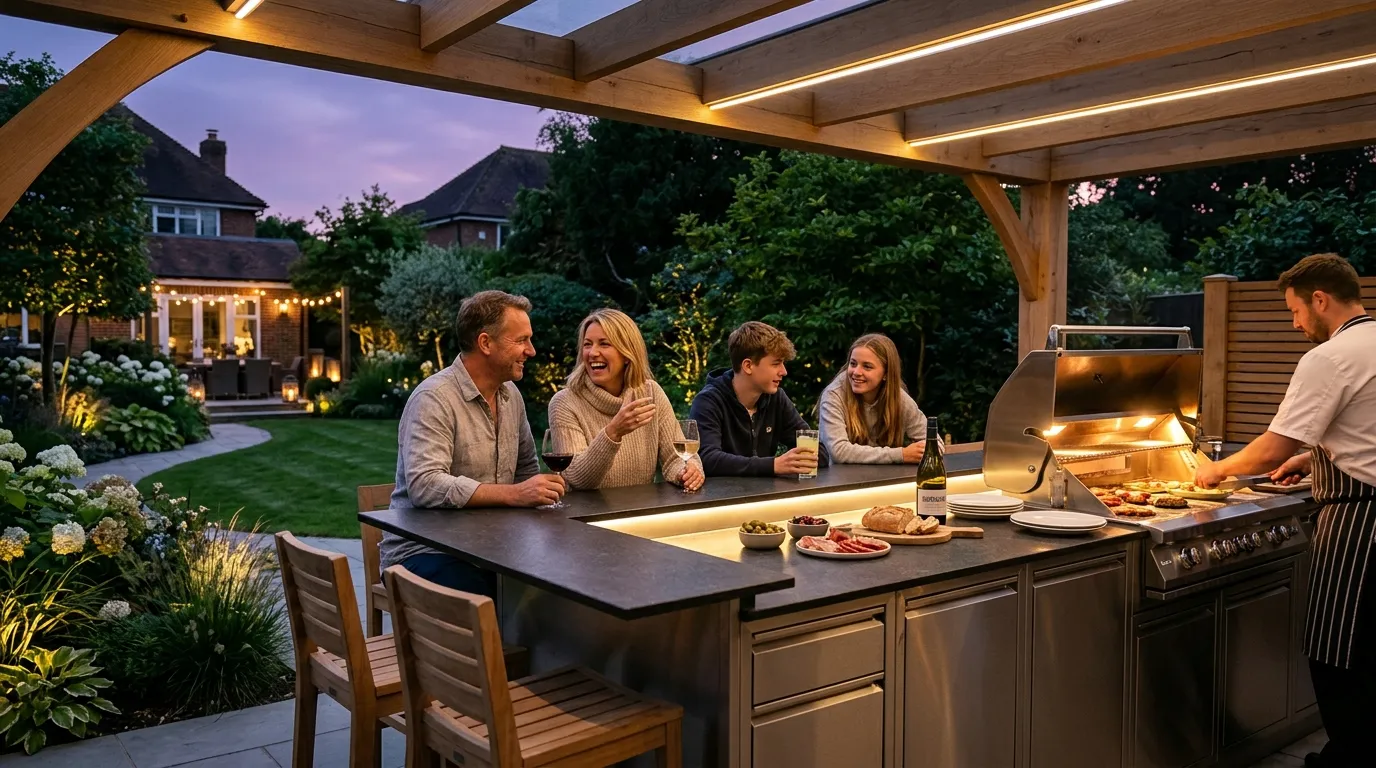
A roof is non-negotiable for a UK year-round kitchen. The four common options:
- Pergola with retractable louvre (Renson, Vergola, Plantation Shutters): the premium choice. Powered louvres open in sun, close in rain, integrated LED lighting and heaters. Budget 8,000-18,000 pounds for a 3 x 4m unit installed.
- Pergola with fixed polycarbonate roof: mid-range option at 2,500-5,500 pounds. Lets light through, sheds rain, no moving parts.
- Solid timber pergola with EPDM or asphalt roof: 1,800-4,000 pounds. Visually warm but no view of the sky.
- House-attached lean-to or verandah: uses the existing house wall as one side. 3,500-8,000 pounds. Often the cheapest cover for a kitchen 1-2m from the back of the house.
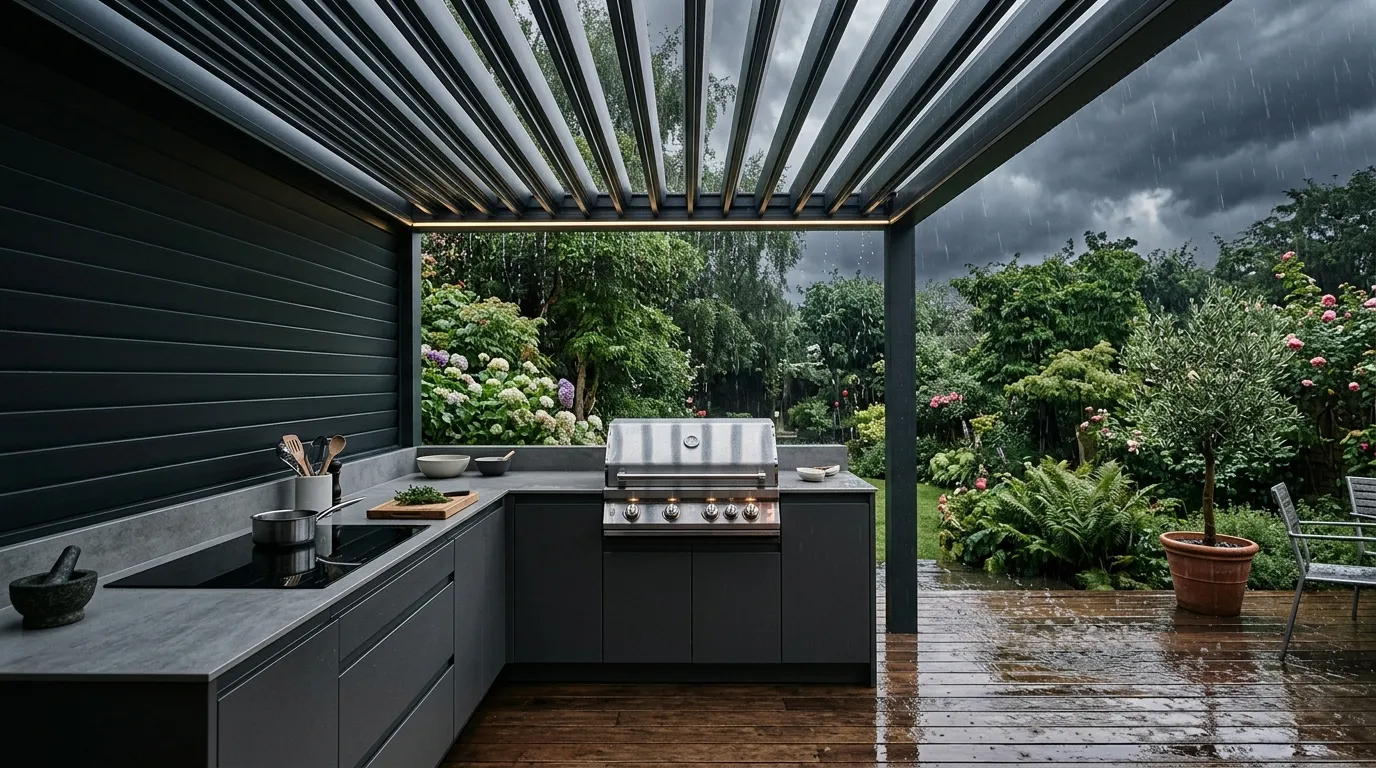
Induction vs charcoal vs gas, what to actually buy
The fuel choice is the single biggest factor in how often you use the kitchen. From four years of monitoring client kitchens with cooking diaries:
- Induction-only kitchens: used 90-120 times per year. Easy to start in rain. Family-friendly.
- Charcoal-only kitchens: used 25-40 times per year. Weekend-only because of lighting and clean-up time.
- Mixed gas-and-charcoal kitchens: used 60-80 times per year. The gas grill gets daily use, charcoal kept for weekend feasts.
- Induction-plus-kamado kitchens: used 80-100 times per year. Best of both worlds.
The kitchens that get used most are the ones with an induction hob for weekday speed and a kamado-style ceramic charcoal grill for weekend flavour. Skip the open kettle BBQ as a primary cooker because it loses too much heat in UK weather and the daily clean-up of ash kills enthusiasm by July.
For kitchen garden design integration, position the cook zone within 2-3m of the herb bed so the chef can grab basil, thyme or coriander mid-cook without breaking flow.
Lighting, heating and weather protection
A UK outdoor kitchen used after dark from October to April needs the same lighting layers as an indoor kitchen: ambient, task and accent.
Task lighting: 4000K LED strip under the wall units or in the pergola rafters, focused on the worktop. 200-300 lux at the cutting board.
Ambient lighting: 2700-3000K dimmable LED downlights in the pergola roof or on the underside of the house overhang. Sets the dining mood.
Accent lighting: uplighters into nearby trees, spotlights on planting. The same kit covered in garden lighting ideas for outdoor spaces applies in full.
For heating, infrared electric heaters mounted in the pergola roof outperform patio gas heaters: no fuel, instant on/off, focused warmth on the diner not the air. Budget 180-420 pounds per 2kW unit, with one unit per 2m run of seating.
A retractable wind-break or louvre side panel makes a 4C difference to perceived temperature on a breezy October evening. Worth specifying at design stage rather than retrofitting.
Build sequence, what happens when
A UK outdoor kitchen typically runs to a 3-12 week timeline depending on scope.
| Week | Activity | Cost band |
|---|---|---|
| Week 1 | Design, materials sign-off, planning checks | 0-900 pounds design fee |
| Week 2 | Services trench dug, gas line laid, electric SWA pulled, water and waste run | 1,700-3,400 pounds |
| Week 3 | Slab and footings poured for pergola posts and kitchen carcass | 1,500-3,500 pounds |
| Week 4 | Pergola installed (or louvre system) | 1,800-18,000 pounds |
| Week 5-6 | Kitchen carcass installed, doors fitted, worktop templated | 2,400-7,500 pounds carcass + worktop |
| Week 7 | Worktop installed, sink and tap fitted, plumbing commissioned | 1,200-3,200 pounds worktop + plumb |
| Week 8 | Appliances installed, gas commissioned, Part P certificate issued | 400-1,200 pounds commissioning fees |
| Week 9-12 | Tile or paving any remaining patio area, snagging | 900-3,500 pounds |
The slowest UK builds get held up at week 2 (engineer availability) or week 6 (worktop template-to-fit, typically 2-3 weeks). Book the Gas Safe and Part P engineer 4-6 weeks ahead.
For the patio surface under the kitchen, lay a porcelain or natural stone slab on a full mortar bed with a 1:80 fall away from the house. Avoid block paving directly under the cooking zone because the joints catch grease and stain.
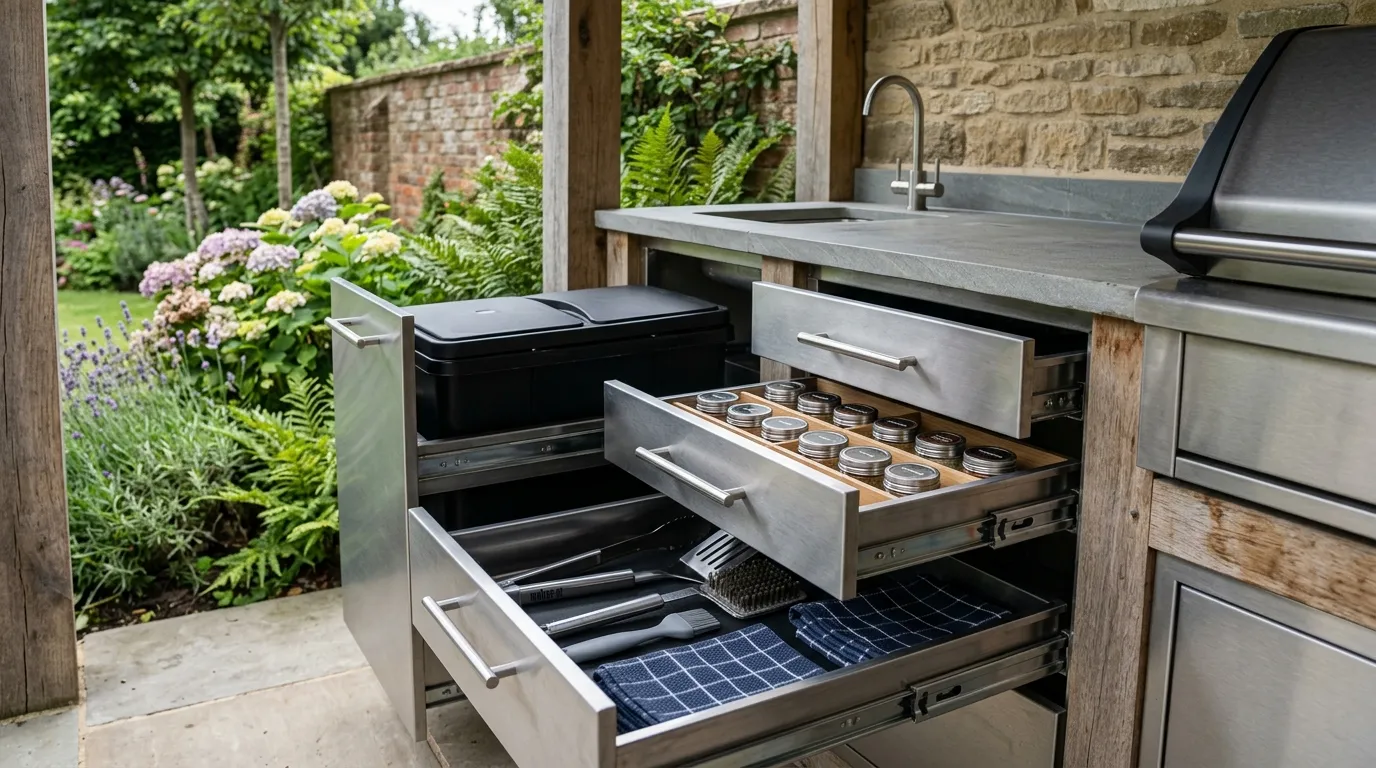
Storage and accessory specification
A working outdoor kitchen needs more than appliances. The accessory list looks small on paper and adds 10-15% to the total budget:
- Refrigeration: 60-80cm outdoor-rated drawer fridge (400-900 pounds) or full-height outdoor fridge (700-1,400 pounds). Indoor fridges fail within two years outside.
- Storage cabinets: weatherproof full-extension drawers for serving boards, tongs, gloves, lighter, paper towels. Budget 180-320 pounds per drawer unit.
- Bin storage: a 30L outdoor pull-out bin in a dedicated cabinet. Stops wildlife scattering rubbish overnight.
- Wood and charcoal store: dry, ventilated, 40L volume minimum if you cook with charcoal. Often a separate timber unit attached to the pergola post.
- Spice rack: sealed acrylic or stainless containers. The damp will write off paper labels by the third weekend.
After four builds and roughly a dozen rebuild consultations, the same five mistakes appear over and over:
- No roof. The kitchen looks great in May. By October it has not been used for six weeks and the timer is ticking on the next ten years of underuse.
- Wrong fuel. A 13A socket installed where a 32A induction circuit is needed. The whole electrical run gets reworked at 4x the original cost.
- No drainage fall. The sink waste sits flat or runs uphill. Backs up the first time onions and oil go down it.
- Cheap stainless. Grade 201 or unspecified stainless from a generic builders’ merchant. Tea-staining within 12 months. Looks tired by year three.
- No services budget. The kitchen carcass costs 4,000 pounds. The trenching, certification, plumbing and Part P add another 2,800 pounds that was never costed.
The fix on all five is the same: plan first, spend on the bits that do not show (services, certification, materials grade), and only then choose the visible finishes.
Integrating the kitchen with the wider garden
An outdoor kitchen works best when it sits inside a wider designed space rather than standing alone on a paved square. Three integration moves that consistently lift the result:
- Sight line to a focal point. Position the cook zone so the chef looks out at a tree, water feature or planting bed, not at a fence. Cooking is a social activity. The view matters.
- Sheltered seating within 3m. A pergola with shade and planting over the dining table extends the kitchen’s use by 30-40 sessions per year.
- Soft planting close to the hard surfaces. A 1.2m wide planted bed alongside the kitchen softens the visual weight of stainless and porcelain. Aromatic herbs, evergreen structure, low maintenance ground cover. The kitchen looks more permanent and less appliance-led.
For larger plots, treat the kitchen as the anchor of an outdoor-living zone: a garden room for evening retreat, a raised deck connecting kitchen to lawn, and a dedicated fire-pit area beyond. The kitchen does not have to do everything.
Related guides
Pair this design-led piece with the inspiration and shopping guide outdoor kitchen and BBQ area ideas, and with the wider garden room ideas hub for projects that connect the kitchen to a covered evening space. For the patio surface itself see how to lay a patio and for the cover see pergola ideas and decking ideas. Garden lighting ideas for outdoor spaces finishes the after-dark detail.
Our team produces practical UK gardening guidance from source research, contributor records and established horticultural practice. Editorial standards are overseen by Matt W.