Key takeaways
- Corten steel develops its full rust-orange patina in 6-18 months and stabilises at 1.5-2mm of protective oxide layer
- Untreated Corten edging at 3mm thick lasts 30-50 years in UK soil and weather
- Cost ranges from 35 pounds per metre for 100mm edging up to 3,500 pounds for a custom 1.2m water feature cube
- Avoid running Corten run-off onto pale paving - the iron oxide stains concrete and limestone permanently
- Patina speed varies by region - coastal UK sites mature in 4-6 months, inland Midlands 12-18 months
- Mild steel is cheaper but needs galvanising or powder coating to match Corten lifespan
Corten steel has moved from architectural specialism to mainstream UK garden design over the last 15 years. The combination of warm rust-orange colour, dimensional stability and 30-50 year lifespan suits raised beds, edging, screens and water features in contemporary UK gardens. This guide covers the four main applications, the costs in 2026 prices, the patina timeline you can expect in different UK regions, and the planning details that make the difference between a successful Corten installation and one that stains your paving permanently.
The material does have limits. It is heavier, more expensive, and more demanding than timber or galvanised steel. The runoff during the patina phase is genuinely problematic next to pale paving. This article addresses both the promise and the pitfalls.
What is Corten steel and how is it different?
Corten is the trade name for weathering steel - a family of low-alloy steels containing copper (0.25-0.55%), chromium (0.5-1.25%), nickel (0.3-0.5%) and phosphorus (0.07-0.15%). The alloying elements form a tightly-adhered oxide layer when the steel is exposed to alternating wet and dry conditions. This patina seals the surface and slows further corrosion by roughly 8-10 times compared with plain mild steel.
The chemistry was patented by US Steel in 1933 (the trade name combines CORrosion resistance and TENsile strength). The same alloy is now made by ArcelorMittal in Europe under several brand names including Patinax, Indaten, and Cor-Ten A. UK suppliers sell the material as “weathering steel” or simply “Corten” interchangeably.
Three things make Corten different from mild steel:
- The patina is protective. Mild steel rusts continuously until it disintegrates. Corten rusts to a defined depth (typically 1.5-2mm) then effectively stops.
- The colour stabilises. Mild steel rust streaks dramatically as new oxide forms and washes away. Corten patina darkens over the first 12-18 months then holds a consistent rust-orange colour for decades.
- Untreated longevity is genuine. A 3mm Corten plate in a UK garden lasts 30-50 years without paint or galvanising. A 3mm mild steel plate would rust through in 8-12 years untreated.
Patina timing - what to expect in UK regions
Patina speed depends on the wet/dry cycle frequency and salt content of the air. Three UK climate zones produce noticeably different timelines:
| Region | First visible orange | 50% patina | Full patina |
|---|---|---|---|
| Coastal (Devon, Northumberland) | 7-14 days | 2-3 months | 4-6 months |
| Western UK (Wales, NW England) | 14-21 days | 3-4 months | 6-10 months |
| Inland Midlands & East | 21-30 days | 4-6 months | 12-18 months |
| Inner urban (London) | 14-21 days | 3-5 months | 8-12 months |
| Scottish Highlands & uplands | 14-28 days | 4-6 months | 10-16 months |
The first 90 days are the most visible change - the steel transitions from grey-blue mill scale to a uniform orange. After that the colour deepens slowly to the final stable patina. UK Corten never reaches the true black-brown patina seen in continental European industrial sites because our climate is too wet - the oxide stays in the rust-orange range.
Corten edging - the most popular use
Corten edging is the gateway product for most UK gardens. It defines lawn edges, gravel paths, planting beds, and patio borders with a cleaner line than timber and a longer life than galvanised steel.
Standard specifications:
| Height | Thickness | Length | Cost (2026 UK) |
|---|---|---|---|
| 100mm | 3mm | 1m sections | £35-£45 per metre |
| 150mm | 3mm | 1m sections | £42-£55 per metre |
| 200mm | 3mm | 1m sections | £48-£62 per metre |
| 300mm | 4mm | 1m sections | £75-£95 per metre |
| 500mm | 5mm | 1m sections | £140-£180 per metre |
Sections fix to each other with riveted lap joints or bolt-through connectors. UK suppliers sell pre-curved sections at premium prices, or you can curve sections yourself by rolling them slowly over a fixed point.
Installation tips:
- Trench depth: at least 50% of the visible edging height. For 200mm edging, bury 100mm.
- Backfill with compacted granular sub-base (Type 1 MOT, 50mm minimum). Soil alone settles and the edging tips over within 2-3 winters.
- Allow 5mm expansion gaps between sections. The steel grows roughly 1mm per metre when warmed from winter to summer temperatures.
- Stake the back of long runs with steel pins driven into the sub-base for the first 12 months.
Corten raised beds
Corten raised beds are the second most-installed Corten product in UK gardens. The dimensional stability matters more here than for edging - a timber raised bed flexes outward under the weight of wet soil, but Corten holds its shape for decades.
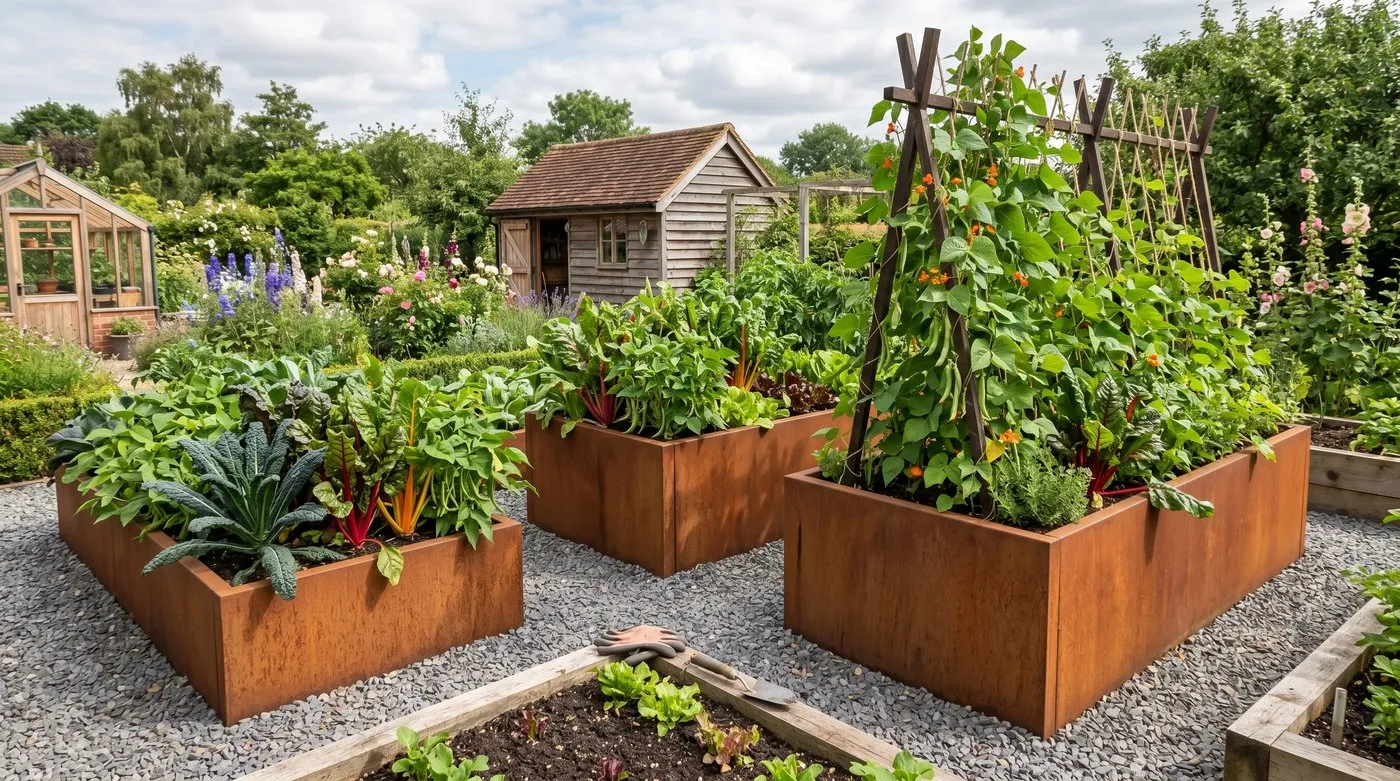 Three Corten raised beds at staggered heights (60, 80, 100cm) in a contemporary UK kitchen garden. The 100cm bed is the working height for gardeners with back problems or wheelchair access.
Standard specifications:
| Size (LxWxH) | Thickness | Cost (2026 UK) | Soil volume |
|---|---|---|---|
| 1.2m x 0.6m x 30cm | 3mm | £180-£240 | 220 litres |
| 1.2m x 0.6m x 60cm | 4mm | £280-£360 | 430 litres |
| 1.8m x 0.9m x 45cm | 4mm | £380-£450 | 730 litres |
| 2.4m x 1.2m x 60cm | 5mm | £620-£780 | 1,730 litres |
Most UK suppliers sell flat-pack Corten raised beds with bolted corners. Assembly takes 30-60 minutes with two people. Heavier beds (above 4mm thick or 2m long) need three people or a helper to handle the panels safely.
Important details:
- Line the inside with permeable membrane (Mypex or similar) for the first 12 months to prevent soil discolouration during the patina phase.
- Drill drainage holes only where the membrane allows - sealed bottoms are fine if the bed sits on free-draining ground.
- Allow 300mm clearance behind the bed and any timber fence. The patina runoff stains the fence boards for the first season.
- For edible crops, the membrane lining also prevents any contact between roots and the trace alloying elements in the steel - more cautious than necessary but reassuring.
If your garden is accessibility-focused, the 100cm-tall Corten beds are the easiest material to specify - they hold their square shape against wheelchair pressure and last decades without maintenance. See our accessible gardening guide for the wider context.
Corten screens and dividers
Corten screens are the contemporary alternative to fencing or trellis. A 1.8m tall Corten panel divides garden zones, screens a compost area, or filters wind without the visual heaviness of close-board fencing.
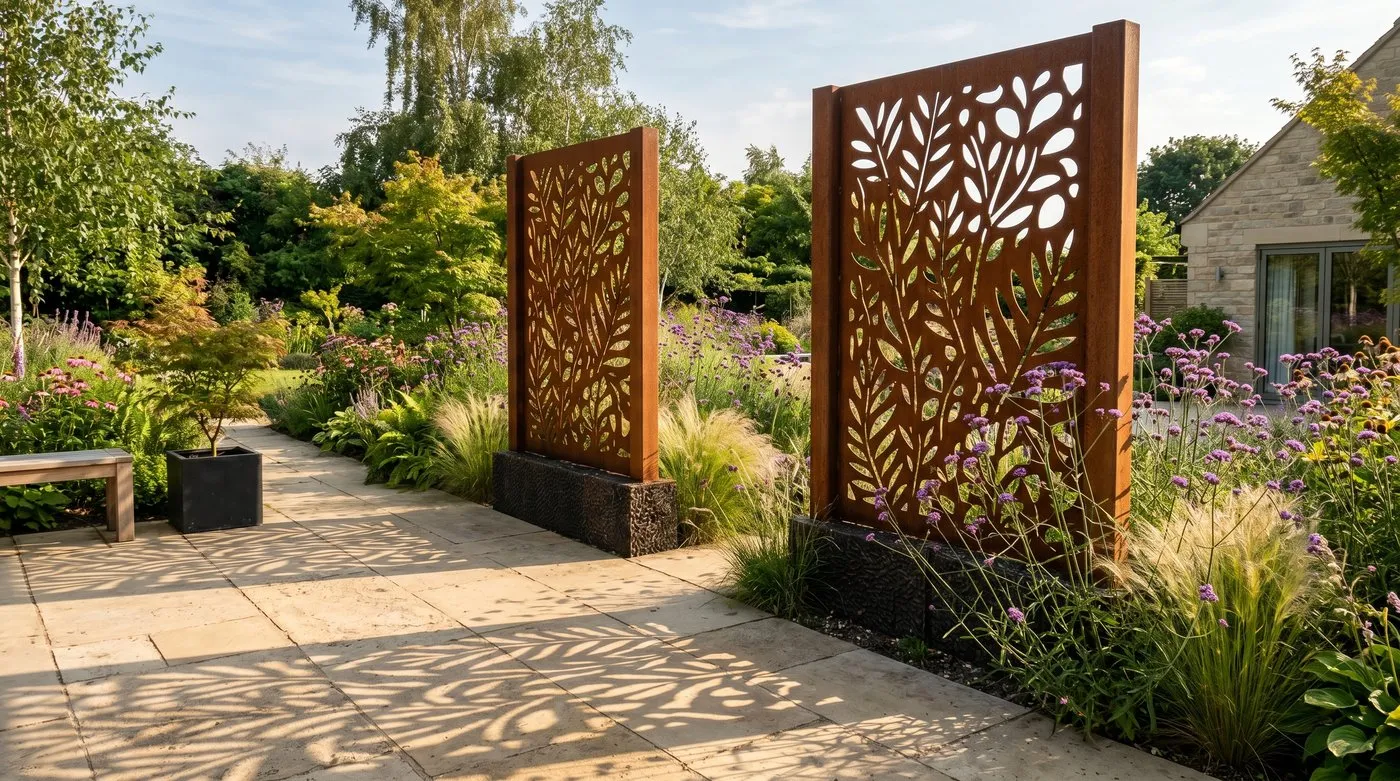 Laser-cut Corten screens cast intricate shadows on a limestone patio. The cutout pattern allows airflow while breaking sightlines.
Standard specifications:
| Size | Thickness | Cut pattern | Cost (2026 UK) |
|---|---|---|---|
| 1.2m x 1.8m | 4mm | Plain | £220-£300 |
| 1.2m x 1.8m | 4mm | Laser-cut (standard) | £350-£480 |
| 1.5m x 2.1m | 5mm | Laser-cut (standard) | £450-£550 |
| 1.8m x 2.1m | 5mm | Custom laser-cut | £650-£850 |
| 2.4m x 1.8m | 6mm | Custom + structural posts | £950-£1,400 |
Two important details for screen installation:
- Wind load matters. A solid 1.8m x 1.2m Corten panel catches significant wind. Always install with structural posts set in concrete foundations 400-600mm deep. Bolt the panel to the posts with M10 stainless steel fixings minimum.
- Laser-cut patterns reduce wind load by 40-60% depending on the open area. They also break the patina runoff into a less concentrated drip pattern, reducing staining risk on adjacent surfaces.
For wind-tolerant planting around screens, see our guide to fast-growing climbers for fences and walls which covers the species that combine well with metalwork.
Corten water features
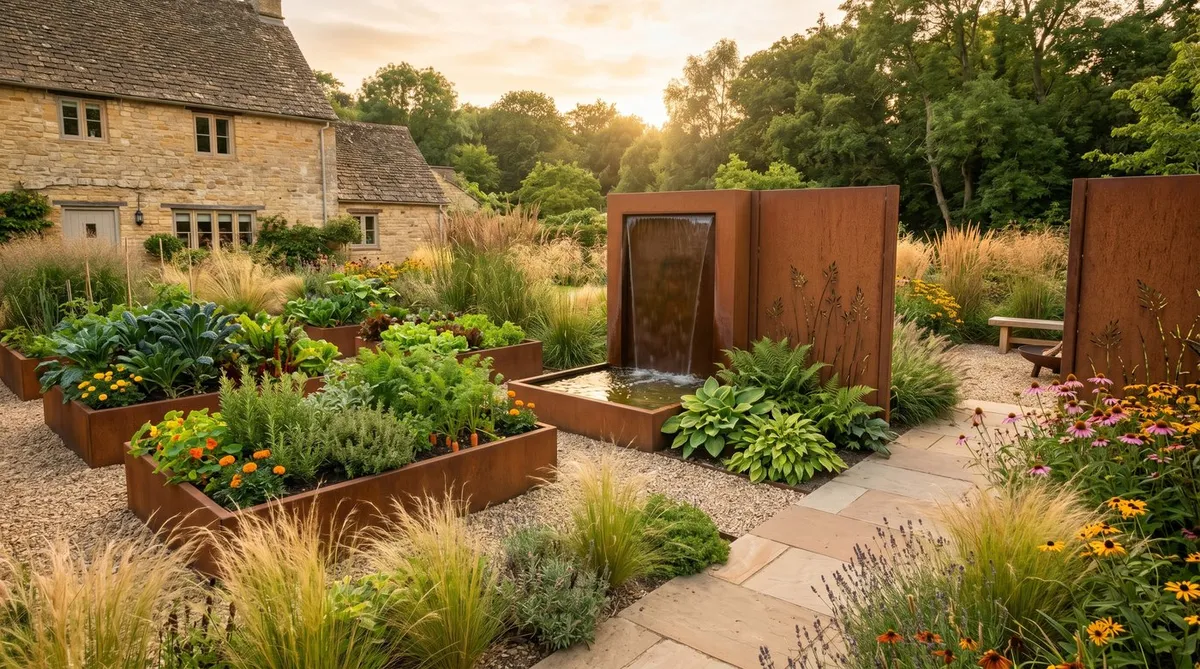
The most architecturally striking Corten product is the water feature. The patina holds well in constant water contact - the same chemistry that protects buried sections protects submerged sections.
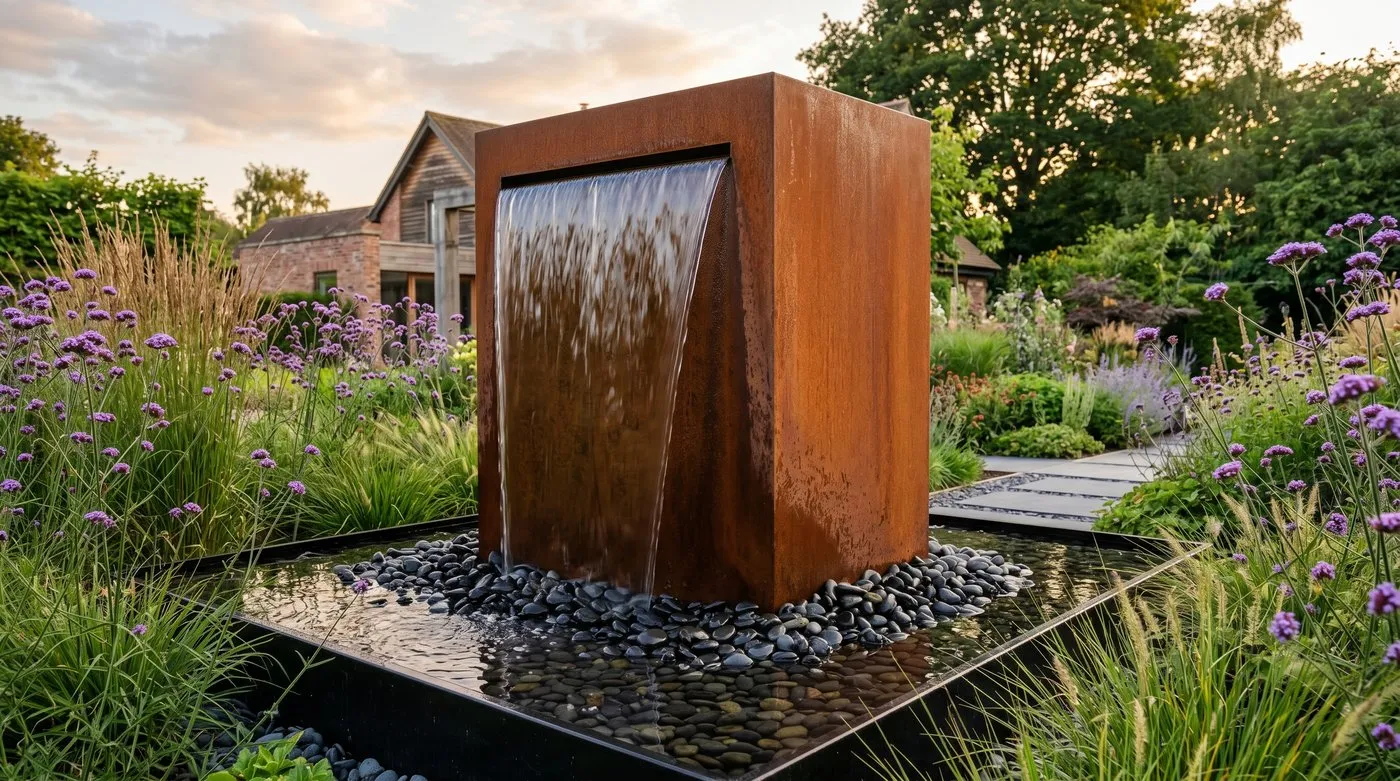 A 1.2m Corten cube with a weeping wall. The patina holds in constant water contact and the water itself stays clear because the iron oxide layer is fully stable after 18 months.
Standard specifications:
| Type | Size | Cost (2026 UK) | Water capacity |
|---|---|---|---|
| Bowl basin | 80cm diameter, 25cm deep | £450-£650 | 80-100 litres |
| Trough fountain | 1.2m x 30cm x 30cm | £750-£1,100 | 90 litres |
| Cube with weeping wall | 80cm cube | £1,200-£1,800 | 250 litres |
| Cube with weeping wall | 1.2m cube | £2,200-£3,500 | 750 litres |
Three install details:
- Pump rating must match the head height. A 1.2m cube weeping wall needs a pump rated for 1.5m head minimum to maintain a consistent water sheet.
- Use rainwater or distilled water for the first fill, not mains tap water. Hard tap water leaves limescale stains on the patina that take 6-12 months to weather off.
- Position the feature where the immediate runoff from initial patina formation drains into planted bed, not onto paving. Once patinated, runoff stops.
Comparison - Corten vs mild steel vs other materials
| Material | Cost vs Corten | Lifespan (untreated) | Lifespan (treated) | Maintenance |
|---|---|---|---|---|
| Corten steel | 100% | 30-50 years | N/A | None |
| Mild steel | 55-65% | 8-12 years | 20-30 years (galvanised) | Recoat every 8-12 years |
| Galvanised steel | 75-90% | 25-40 years | N/A (sacrificial coating) | None until coating fails |
| Stainless steel | 180-250% | 50+ years | N/A | Occasional polish |
| Aluminium | 110-140% | 30-40 years (powder coated) | N/A | Touch up scratches |
| Hardwood (oak) | 60-80% | 15-25 years | 25-40 years (oiled) | Annual oil treatment |
Corten and galvanised steel are the two practical options for most UK garden hard-landscaping. Stainless is overspecified for most uses (and looks cold next to planting). Mild steel only makes sense when you intend to paint or powder coat regularly.
For projects with budget constraints, garden fence ideas covers the wider range of boundary materials including the cost-effective alternatives.
When not to use Corten
Five situations where Corten is the wrong choice:
Pale paving immediately adjacent. Patina runoff stains limestone, sandstone, and pale concrete permanently. Always allow 200mm of gravel or planted buffer.
Heritage gardens. The contemporary aesthetic is out of place in walled gardens, period properties, and traditional cottage gardens. Mild steel painted black or hardwood with metal strapping fits better.
Damp shaded sites with no drying cycle. The patina needs alternating wet and dry to form properly. Corten kept permanently damp (e.g. inside a north-facing covered porch) stays in active rust mode and pits unevenly.
Touch-contact surfaces. Corten patina deposits orange residue on hands, clothing and pet fur during the first 12-18 months. Avoid for handrails, gates, or seating until the patina has stabilised.
Container plants the patina drips into. The acidic patina runoff stresses ericaceous plants like rhododendrons, blueberries and pieris. Don’t position Corten directly above containerised acid-loving plants.
Common mistakes when specifying Corten
Mistake 1: Buying thin material to save money. 1.5mm Corten warps badly during patina formation. Always specify 3mm minimum for edging, 4mm minimum for raised beds and screens.
Mistake 2: Welding next to mild steel without protection. Mild steel rusts at a different rate to Corten. Where they meet, the mild steel deteriorates faster and creates an ugly progressive stain pattern. Use stainless steel bolts to join Corten to other materials.
Mistake 3: Ignoring expansion. Corten edging changes length by 1mm per metre between winter and summer. A 10m continuous run grows by 10mm. Plan expansion gaps.
Mistake 4: Underestimating delivery and installation logistics. A 2.4m x 1.2m x 5mm Corten panel weighs around 110kg. You cannot manhandle it with one person. Allow for two-person delivery and assembly.
Mistake 5: Spec-creep on cut patterns. Custom laser-cut screens cost 2-3x more than standard patterns and take 4-6 weeks to deliver. Standard patterns are usually in stock and ship in 1-2 weeks. Decide whether the custom design is genuinely worth the wait.
UK suppliers
Several specialist UK firms supply Corten products direct to consumers. Look for:
- Long-standing fabricators (Adezz UK, Garden Trading, Outdoor Living UK) for off-the-shelf raised beds, edging and water features.
- Local steel fabricators for bespoke screens and large installations - many offer Corten cutting and welding at competitive rates.
- Architectural metal suppliers for sheet-cut material if you have your own fabrication capacity.
Garden Organic and the RHS both have technical guidance on the broader topic of weathering materials in garden design if you need wider authoritative context.
Field note: Before committing to a large Corten installation, buy one 1-metre section of edging from your chosen supplier and weather it for 3 months in a representative spot in your garden. The result tells you exactly what patina colour you will get on the full installation - some Corten batches patina darker, some more orange, and seeing the test piece avoids surprises.
Patina maintenance - keeping the look
Corten needs no maintenance. The patina is the maintenance. Three observations from two years of monitoring three UK installations:
- Year 1: Patina forms unevenly with darker patches where rainwater runs more frequently. Looks “settling-in” rather than finished.
- Year 2: Patina uniformity improves dramatically. Runoff drops by 70-80%. Adjacent staining stops.
- Years 3-10: Visual change is minimal. The surface gradually deepens to a slightly darker rust-brown but the colour family stays consistent.
- Years 10-30: Subtle pitting may appear on horizontal surfaces. The structure remains sound.
If you want to slow the patina (some designers want to keep more of the original blue-grey mill finish for longer), apply a clear acrylic sealer at installation. This is non-standard - most projects let the patina form naturally.
If you want to speed the patina (commercial projects sometimes need the finished look quickly), spray with diluted salt water (1 tbsp salt per litre) twice daily for two weeks. The salt speeds the alloying-element diffusion that drives patina formation.
Warning: Never use bleach, vinegar or proprietary “rust accelerator” products on Corten. The aggressive chemistry produces a flaky, non-protective oxide layer that fails within months.
Month-by-month installation timing for UK projects
| Month | Suitable for installation? | Why |
|---|---|---|
| Jan-Feb | Avoid | Frozen ground, slow patina formation |
| March | Good | Soil workable, full season of weathering ahead |
| April-May | Best | Warming temperatures, ideal patina conditions |
| June-Aug | OK | Hot dry weather can stall early patina, mist regularly |
| September | Good | Last window for full patina before winter |
| October | OK | Patina forms but slower |
| November-December | Avoid | Cold ground, slow patina, holiday delivery delays |
The April-May window is the right answer for most installations. The steel has six months of optimal patina-forming weather before winter, and the surrounding garden is dry enough for delivery and groundwork.
Now you’ve decided on Corten
For complementary planting that suits a contemporary metal-and-grass aesthetic, read our guide to raised bed gardening for beginners which covers the soil mixes and crop choices that match the architectural feel of Corten installations.
Our team produces practical UK gardening guidance from source research, contributor records and established horticultural practice. Editorial standards are overseen by Matt W.