Key takeaways
- Dig test holes to 60cm depth before planning anything — most new build gardens hide rubble and compacted subsoil below a thin topsoil layer
- Break compaction with a rotavator or double digging to restore drainage — machinery squeezes air from soil, reducing permeability by up to 90%
- Import topsoil if depth is under 20cm — most rear gardens need 3-5 cubic metres at 30-50 pounds per cubic metre delivered
- Install drainage before any planting if water pools on the surface for more than 4 hours after rain
- Plant structure first in year one — hedging, trees, and evergreen shrubs give the garden bones while borders mature
- Budget 2,000-5,000 pounds for a full rear garden transformation spread over three years
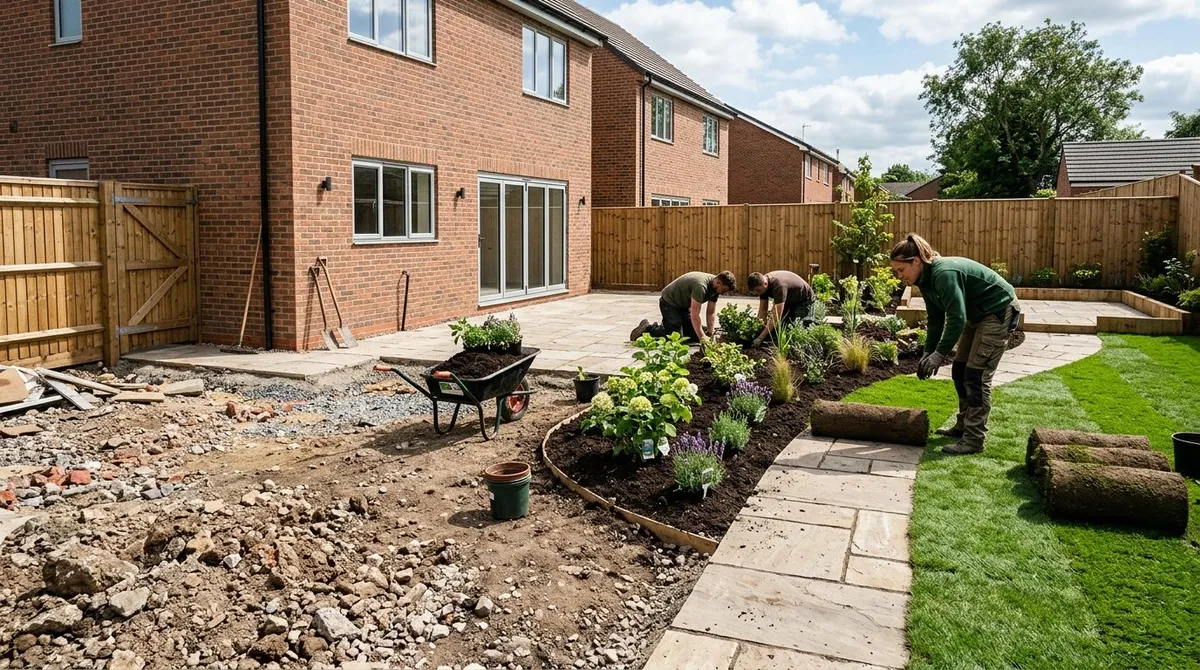
Every new build garden in the UK starts with the same lie. The developer lays a rectangle of turf, maybe drops a few shrubs by the back door, and calls it a garden. Underneath that turf sits 10-15cm of topsoil over compacted subsoil, builder’s rubble, and sometimes materials that should have gone to a skip.
This is normal. It happens on every development, from starter homes to executive estates. The good news: a new build garden is a blank canvas. No inherited problems, no overgrown disasters, no neighbour’s leylandii to negotiate. The bad news: you are starting from scratch with soil that has been abused by heavy machinery for months or years.
What is actually wrong with new build garden soil?
Construction machinery compacts subsoil to the point where drainage drops by up to 90%, turning what should be permeable ground into an almost waterproof layer. Concrete mixers, delivery lorries, and excavators drive back and forth across your future garden for the entire build period. The weight crushes air pockets out of the soil structure.
On top of this compacted layer, developers spread a thin skin of topsoil, often just 10-15cm, sometimes less. The minimum recommended depth for a healthy lawn is 15cm. For border planting, you need at least 30cm.
How do I assess my new build garden soil?
Dig three test holes to 60cm depth in different parts of the garden. Use a spade, not a trowel. You need to see what is happening below the topsoil layer, not just on the surface.
Record what you find at each depth:
- 0-15cm: Topsoil quality, root depth of existing turf, rubble content
- 15-30cm: Transition to subsoil, compaction level, rubble presence
- 30-60cm: Subsoil type (clay, sand, chalk), drainage capability, water table level
Fill each hole with water and time how long it takes to drain. In healthy soil, a 30cm-deep pool drains within 4 hours. If water sits for longer than 12 hours, you have a serious drainage problem that must be fixed before planting. Our soil drainage guide explains percolation testing in detail.
Take a soil sample for pH testing. New build sites often have alkaline soil because of concrete and mortar dust mixed into the topsoil. A pH above 7.5 limits what you can grow. Our guide to soil testing and pH adjustment covers how to correct this.
How do I fix compacted new build soil?
Break compaction by rotavating or double digging to a depth of at least 30cm across the entire garden. This is the single most important step. Skip it and every plant you put in will struggle with waterlogging, poor root development, and nutrient deficiency.
For gardens under 50 square metres, double digging by hand is practical. Remove one spade-depth trench, fork over the base to break the compacted subsoil, then move along. It takes a full weekend for a small rear garden. Hard work, but thorough.
For larger plots, hire a rotavator. A medium machine costs 50-80 pounds per day. Work the ground twice, in two directions. Rotavators break up the top 20-25cm but may not reach deeper compaction. Follow up with a border fork in planting areas to break any remaining hard pan.
Remove all rubble as you go. Pick out anything larger than a fist. Smaller stones can stay, they actually improve drainage in clay soils. Bag the rubble and take it to your local household waste recycling centre.
How much topsoil does a new build garden need?
Calculate volume as length x width x required depth. Most new build rear gardens need 3-5 cubic metres of imported topsoil to reach a workable 20-30cm depth across borders and lawn areas.
| Garden size | Existing topsoil | Top-up depth needed | Volume required | Approximate cost |
|---|---|---|---|---|
| 30 sq m (small terrace) | 10cm | 10cm | 3 cubic metres | 90-150 pounds |
| 48 sq m (typical semi) | 10cm | 15cm | 7.2 cubic metres | 216-360 pounds |
| 80 sq m (detached) | 15cm | 15cm | 12 cubic metres | 360-600 pounds |
| 120 sq m (large plot) | 10cm | 20cm | 24 cubic metres | 720-1,200 pounds |
Buy certified BS3882 topsoil from a reputable supplier. Cheap topsoil from unknown sources often contains weed seeds, pesticide residues, or industrial contaminants. Ask for a certificate of analysis before ordering.
One cubic metre weighs approximately 1.3 tonnes. Most suppliers deliver in bulk bags (0.75-1 cubic metre each) by lorry with a mechanical arm. Make sure the lorry can access your property. If rear access is impossible, you may need to barrow soil through the house, budget extra time and cover floors.
Should I install drainage in my new build garden?
Install drainage if water pools on the surface for more than 4 hours after moderate rainfall. On heavy clay sites with severe compaction, drainage may be the difference between a garden and a swamp.
The simplest option is a French drain: a gravel-filled trench running across the lowest point of the garden to a soakaway or surface water drain. Dig a trench 30-45cm deep, line with geotextile membrane, fill with 20mm gravel, and wrap the membrane over the top. Cover with topsoil.
For severe waterlogging, install perforated land drains in a herringbone pattern across the garden. Pipes run at a 1:100 fall towards a soakaway pit filled with clean rubble. This is a bigger job, budget 500-1,500 pounds for professional installation on a typical rear garden.
Check your drainage plan against your plot’s surface water management scheme. Many new build developments use permeable paving and rain gardens to manage runoff. Installing additional drainage that feeds into the main sewer may require building control approval.
What should I plant first in a new build garden?
Plant structure first: hedging, trees, and evergreen shrubs in year one. These give the garden its bones. Everything else, perennials, bulbs, ground cover, can follow in years two and three once the structure is established.
Hedging is the highest priority on most new builds. Developer fence panels last 5-10 years at best. A properly planted hedge gives permanent, attractive, wildlife-friendly screening that improves with age. Bare-root whips planted in November cost as little as one to two pounds each. A native hedgerow mix of hawthorn, blackthorn, field maple, and hazel grows 30-60cm per year on decent soil.
For borders, use tough, fast-growing shrubs that tolerate poor soil while you improve it over time. Cotoneaster, buddleia, potentilla, and spiraea all establish well on new build sites. Fill gaps with clay-tolerant perennials if your soil tests heavy.
How do I create a lawn on a new build plot?
Strip the developer turf, fix the soil underneath, then re-turf or sow seed on properly prepared ground. Patching and feeding developer turf rarely works because the problems are below the surface, not on it.
Turf gives instant results. Buy quality turf from a specialist grower, not a DIY shed. Lay on a prepared surface raked to fine tilth with at least 15cm of topsoil. September and March are the best months. Our guide to laying turf covers the full method.
Seed is cheaper but slower. A good lawn mix for new build gardens contains 40% perennial ryegrass for fast establishment, 40% creeping red fescue for density, and 20% smooth-stalked meadow grass for durability. Sow at 35g per square metre in April or September. Our growing grass from seed guide walks through each step.
Whichever method you choose, prepare the surface properly. Rake to remove stones larger than a marble. Firm by treading with overlapping footsteps. Rake again to create a fine, level tilth. Do not skip the firming step, new build soil settles unevenly and creates dips that collect water. Feed new lawns six weeks after establishment with a balanced lawn feed.
Year-by-year new build garden plan
Spread the work and budget over three years for the best results. Trying to do everything in year one leads to overspending on plants that die in unprepared soil.
| Priority | Year 1: Structure | Year 2: Planting | Year 3: Refinement |
|---|---|---|---|
| Soil | Test, decompact, import topsoil | Add compost to all borders | Mulch annually, build compost system |
| Drainage | Install French drains if needed | Monitor and adjust | Maintain soakaways |
| Boundaries | Plant hedging or repair fences | Fill gaps, add climbers | First hedge trim to shape |
| Trees | Plant 1-2 specimen trees | Underplant with bulbs | Formative prune |
| Lawn | Prepare soil, turf or seed | First scarify and aerate | Overseed thin patches |
| Borders | Plant shrub framework | Add perennials and bulbs | Divide and fill gaps |
| Hard landscaping | Path and patio | Raised beds if wanted | Lighting, ornamental details |
| Budget | 1,000-2,500 pounds | 500-1,500 pounds | 300-800 pounds |
Year one is the least glamorous but most important. Soil remediation, drainage, and structural planting are invisible work that determines everything else. Resist the urge to buy pretty perennials before the soil is ready for them.
What developers should leave you but rarely do
The NHBC (National House Building Council) warranty covers garden drainage and levels, but enforcement is inconsistent. Here is what your developer should provide versus what you typically get.
The plot should have a minimum 150mm topsoil depth across all garden areas. In practice, many sites scrape by with 100mm or less. The ground should drain freely without ponding. Compaction from construction traffic makes this impossible without remediation.
Retaining walls should have weep holes and proper drainage behind them. Check that water is not building up behind any retaining structures. Boundary fences should be the quality specified in your purchase contract, check the small print on who is responsible for maintaining which panels.
Take photographs of any standing water, rubble on the surface, or obvious soil problems within your first year. Report issues to the developer through your snagging list. NHBC warranty claims on garden drainage are possible but require evidence of the problem existing from completion, not developing later. For guidance on starting from a blank slate, our gardening for beginners guide covers the fundamentals.
Frequently asked questions
How long does it take for a new build garden to look established?
Most new build gardens look established after three full growing seasons. Trees and hedging planted in year one need 2-3 years to fill out. Perennials reach full size in year two. Lawns from turf look mature within 6-12 months. From seed, lawns take 18 months to thicken fully.
How much topsoil do I need for a new build garden?
Calculate length x width x required depth in metres for volume in cubic metres. A typical 8m x 6m rear garden with only 10cm existing topsoil needs approximately 7 cubic metres to bring depth up to 25cm. Budget 30-50 pounds per cubic metre delivered. Buy certified BS3882 topsoil to avoid importing weed seeds or contaminated soil.
Why does water pool on my new build lawn?
Construction machinery compacts subsoil, reducing drainage by up to 90%. Heavy plant vehicles, concrete mixers, and material storage crush soil structure flat. The thin turf layer sits on what is effectively an impermeable pan. Breaking this compaction with deep digging or a rotavator is the only lasting fix.
Should I keep the turf that came with my new build?
Strip it if the soil underneath is poor. Developer turf is typically the cheapest grade, laid on minimal topsoil with no soil preparation. If test holes reveal less than 10cm of topsoil or heavy rubble, strip the turf, fix the soil, and either re-turf or sow seed on properly prepared ground.
What trees grow well in new build gardens?
Start with tough, fast-establishing species like birch, rowan, and amelanchier. These tolerate poor, compacted soil better than most trees. Avoid specimen trees like magnolia or Japanese maple until the soil is improved. Plant bare-root trees in November for the best establishment rate and lowest cost.
How do I stop my new build fence panels blowing down?
Developer fence posts are often set in shallow concrete with no gravel boards. Replace concrete spur posts with properly concreted 100mm timber posts set 600mm deep. Add gravel boards at the base to stop panels sitting in wet soil. Expect to replace at least some panels within the first three years.
Can I plant a hedge instead of using fence panels?
Yes, and hedging gives better wind protection than solid fencing. A mixed native hedge of hawthorn, blackthorn, field maple, and hazel filters wind rather than creating turbulence. Plant bare-root whips at 6 per metre in November. A hedge reaches 1.5m in 3-4 years on decent soil. See boundary rules before planting. Start by learning what you have actually got: the 60-minute garden audit maps sun, wind and soil before you spend a pound.
Our team produces practical UK gardening guidance from source research, contributor records and established horticultural practice. Editorial standards are overseen by Matt W.