Key takeaways
- Sow traditional sweet william in June for flowers the following May to July - this is the biennial pattern
- Annual strains like Summer Sundae Mix and Noverna Series flower in the first year from a February sowing
- Sweet williams prefer alkaline soil (pH 6.5-7.5) and perform poorly on acidic clay below pH 6.0
- The clove-scented flowers are excellent cut flowers, lasting 10-14 days in water when cut at one-third open
- Pinching out growing tips in April produces bushier plants with 30-50% more flower stems per plant
- Bi-colour and picotee varieties are the most popular for UK cottage gardens, with Auricula-Eyed Mixed the classic choice
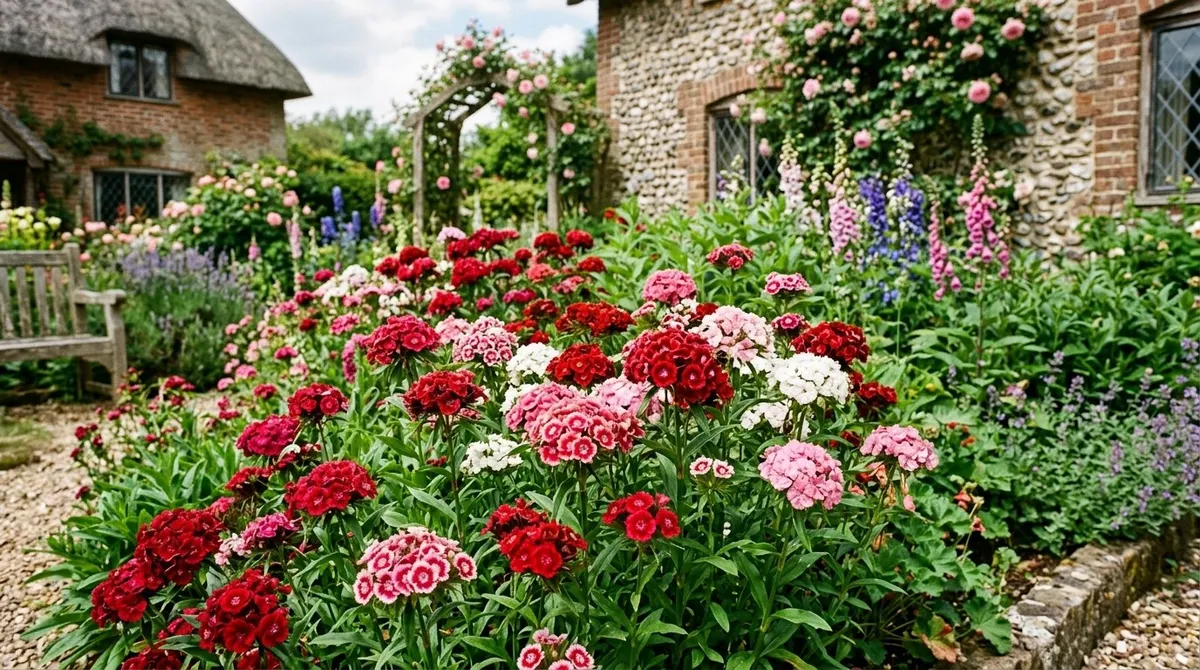
Sweet williams are one of the most fragrant flowers you can grow in a British garden. The clove-scented flower clusters, borne on strong stems in shades of red, pink, white, and bi-colour, have defined cottage planting since Tudor times. They appear in every old English cottage garden painting because they have been there for 450 years without interruption.
Traditional sweet williams are biennials: sow in June, plant out in October, and flower the following May-July before dying. Modern breeders have created annual strains that flower in the first year from February sowings, useful for gardeners who cannot wait 12 months. Both types deserve a place in cottage borders, cutting beds, and any garden where fragrance matters as much as colour.
This guide covers the best biennial and annual varieties, the alkaline soil preference that trips up gardeners on clay, the pinching technique that doubles flower production, and how to use sweet williams as cut flowers for bouquets and old-fashioned arrangements.
What are sweet williams and where do they come from?
Sweet william (Dianthus barbatus) is a short-lived perennial usually grown as a biennial. It belongs to the pink family alongside carnations, dianthus, and gypsophila. The species is native to southern Europe and was brought to England in the early Tudor period. Records show sweet williams growing in Henry VIII’s gardens at Hampton Court in 1533.
The plant forms rosettes of lance-shaped green leaves in its first year, then sends up flowering stems to 40-60cm in its second year. Each stem bears a dense flattened cluster of 20-30 small flowers, each with fringed petals. The clove fragrance is strongest on warm evenings and carries several metres on still air.
Colours include white, pink, red, crimson, mauve, and countless bi-colour combinations with contrasting eyes and picotee edges. The variety ‘Sooty’ has near-black flowers, while ‘Green Trick’ has unusual pom-pom flower heads without visible petals. Most traditional varieties remain the true biennial form. Modern F1 hybrids like Noverna have been bred to flower in their first year.
Sweet williams prefer alkaline conditions inherited from their Mediterranean limestone origins. They tolerate acid soil but perform poorly on it. This single factor determines success or failure in most UK gardens.
Which sweet william variety is best for UK gardens?
Auricula-Eyed Mixed
Noverna Series
A modern annual F1 strain that flowers in the first year from February sowings under glass. Reaches 40-50cm. Colours include Nova (crimson), Noverna Purple, Noverna Rose, and Noverna White. Uniform plants with strong stems. Excellent for bedding schemes and cut flowers. Less fragrant than heritage biennials.
Sooty
A dramatic near-black variety with deep maroon flowers so dark they appear black in shade. Grows 45-55cm on strong stems. Flowers May to July as a biennial. Best planted in groups of 5-7 with pale companions like cream calendula or white nigella. The colour pairs with silver-leafed artemisia and green euphorbia.
Summer Sundae Mix
A modern annual strain with bi-colour fringed flowers in pink and red combinations. Sows in February and flowers June to August the same year. Reaches 35-45cm. More compact than traditional varieties. Good for mixed annual borders and cutting beds where speed matters over fragrance. Moderate clove scent.
Green Trick
An unusual novelty variety with green pom-pom flower heads that lack visible petals. Reaches 50-60cm as a biennial. Popular with florists for fresh and dried arrangements because the “flowers” last 3 weeks in water. Flowers May to July. Not fragrant. More of a novelty than a traditional cottage plant but very useful for mixed bouquets.
Festival Series
A compact annual F1 strain growing only 25-30cm tall. Flowers June to September from February sowings. Ideal for containers, window boxes, and front-of-border edging. Available in single colours (red, pink, white, purple) or mixed. Less fragrant than taller varieties. The best choice for small gardens and patio planting.
Best sweet william varieties compared
| Variety | Type | Height | Flowering | Fragrance | Cut flower |
|---|---|---|---|---|---|
| Auricula-Eyed Mixed | Biennial | 45-60cm | May-Jul yr 2 | Strong | Excellent |
| Noverna Series | F1 annual | 40-50cm | Jul-Sep yr 1 | Moderate | Very good |
| Sooty | Biennial | 45-55cm | May-Jul yr 2 | Strong | Excellent |
| Summer Sundae Mix | Annual | 35-45cm | Jun-Aug yr 1 | Moderate | Very good |
| Green Trick | Biennial | 50-60cm | May-Jul yr 2 | None | Outstanding |
| Festival Series | F1 annual | 25-30cm | Jun-Sep yr 1 | Light | Fair |
When to sow sweet william seeds in the UK
Traditional biennials sow in June or early July for flowers the following May-July. Modern annual strains sow in February under glass for first-year flowers. The two methods produce different results.
Biennial sowing method (June)
- Sow in late June or early July into a nursery bed or seed trays
- Cover seed with 5mm of sieved compost or vermiculite
- Germinate at 15-18C - seedlings appear in 10-14 days
- Prick out into module trays when true leaves appear
- Grow on in a sheltered outdoor spot through summer
- Plant out in final positions in October at 25-30cm spacing
- Protect crowns with a mulch of straw if hard frost is forecast
- Flowers appear May-July the following year
Biennial-grown plants produce the strongest, most fragrant flowers with the longest stems. This is the method that gives the best cottage garden results but requires planning a year in advance.
Annual sowing method (February)
- Sow in February into seed trays of multipurpose compost
- Germinate at 18-20C on a warm windowsill or heated propagator
- Prick out into modules when true leaves appear
- Grow on at 12-15C under glass until late April
- Harden off over 10-14 days before planting out in early May
- Plant out 25-30cm apart in final positions
- Flowers appear June-August the same year
Annual-grown plants flower faster but rarely match the size or fragrance of biennial plants. Use only F1 annual strains like Noverna, Summer Sundae, or Festival Series for this method. Traditional varieties will not flower in their first year. Read our seed sowing calendar for the full timing of hardy annuals and biennials.
How to grow sweet williams in the UK
Sweet williams need full sun, alkaline soil, and good drainage. Getting the soil pH right is the single most important step for success.
Choosing the right spot
Plant in a sunny, open position with 6-8 hours of direct sun daily. Sweet williams tolerate light afternoon shade but produce fewer flowers with weaker stems. Avoid north-facing borders, damp hollows, and areas where water sits after rain.
Soil preparation and pH
Sweet williams prefer alkaline soil with a pH of 6.5-7.5. On acidic clay soils below pH 6.0 they grow poorly. Add garden lime at 100g per square metre 4-6 weeks before planting and work into the top 15cm of soil. Test soil pH with a cheap kit from a garden centre before adding lime. Read more about alkaline-loving plants if your soil is naturally chalky.
Dig in 5cm of garden compost before planting to improve drainage on heavy soils. Do not add manure or high-nitrogen fertiliser. Rich soil produces leafy growth and fewer flowers.
Planting out
Space plants 25-30cm apart in drifts of 10 or more for best visual impact. Plant at the original soil level, never deeper. Water in well with 2 litres per plant. Apply a 3cm mulch of compost or well-rotted manure around the plants, keeping it clear of the crowns.
Watering and feeding
Water weekly through dry spells in spring. Once flowering begins, water at soil level only to prevent mildew on foliage. Do not feed. Sweet williams thrive on average soil and produce more flowers with less fertility. Overfeeding produces floppy plants with reduced flowering.
Pinching for bushier plants
In April when plants are 15cm tall, pinch out the main growing tip of each plant. Remove the top 3cm with clean secateurs. This produces bushier plants with 30-50% more flowering stems. Pinching delays first flowers by 1-2 weeks but total flower production increases significantly. Do not pinch compact varieties like Festival Series or Summer Sundae.
How to use sweet williams as cut flowers
Sweet williams are among the top 10 UK cut flowers for their long vase life, strong fragrance, and cottage garden appeal. A row 3 metres long produces 50-70 cutting stems in the second year.
Harvesting technique
- Cut when one-third of florets in each cluster have opened - never when fully open
- Harvest early in the morning when stems are turgid
- Cut with sharp scissors at a 45-degree angle
- Strip all foliage below the waterline
- Plunge stems immediately into cold water
- Condition in a cool dark place for 4-6 hours before arranging
- Recut stems by 2cm each time water is changed
Properly conditioned sweet williams last 10-14 days in a vase. Change water every 2-3 days and recut stems at each change. The clove fragrance fills a room and intensifies in warm conditions. For more cutting techniques, see our cut flower conditioning guide.
Classic cottage bouquet recipe
Sweet williams pair with other cottage garden favourites to make traditional mixed bouquets:
- 3 stems sweet william (bi-colour or red)
- 5 stems larkspur (blue or white)
- 5 stems nigella (blue or white)
- 3 stems calendula (orange)
- 3 stems cornflower (blue)
- 1 stem lady’s mantle (chartreuse)
Condition all flowers separately before arranging. The sweet william clove fragrance carries the whole bouquet. Vase life 7-10 days. Well suited to jam jars and enamel jugs on a kitchen table.
How to use sweet williams in cottage borders
Sweet williams excel as mid-border cottage plants. The dense flat flower clusters contrast with the vertical spires of larkspur, the soft mist of nigella, and the rounded heads of old-fashioned roses.
Classic cottage combinations
| Partner plant | Height | Flowers | Why it works with sweet william |
|---|---|---|---|
| Larkspur | 90-120cm | Jun-Aug | Tall spires rise above flat clusters |
| Old-fashioned roses | 120-180cm | Jun-Jul | Classic Victorian combination |
| Foxgloves | 120-150cm | May-Jul | Spires contrast with flat sweet william heads |
| Lady’s mantle | 40cm | Jun-Aug | Chartreuse foam at the front |
| Alliums | 80-100cm | May-Jun | Purple globes with pink sweet williams |
| Lavender | 45-60cm | Jun-Aug | Silver foliage, aromatic combination |
Plant sweet williams in drifts of 7 or more. Mixed colours create authentic cottage charm, while single-colour drifts give a more refined look. For a traditional Victorian effect, plant red and white bi-colours together with white foxgloves and pink old roses behind.
Month-by-month sweet william care calendar
| Month | Task |
|---|---|
| February | Sow F1 annual strains under glass at 18C |
| March | Prick out February sowings. Order biennial seed |
| April | Pinch out growing tips on biennials at 15cm |
| May | Peak flowering begins on biennials. Harvest cut flowers |
| June | Main flowering. Sow biennials for next year |
| July | Flowering continues. Prick out June sowings |
| August | Biennials finishing. Grow on June seedlings |
| September | Prepare planting bed with lime if acidic |
| October | Plant out biennial seedlings to final positions |
| November | Water in well. Mulch crowns for frost protection |
| December | No action needed |
Common mistakes when growing sweet williams
Sowing biennials in spring
Spring-sown traditional sweet williams produce only foliage in the first year and flower the next. Many gardeners assume they have failed and dig them up. Always sow biennials in June-July, not spring.
Planting on acid soil
Sweet williams on acid clay stay small and produce few flowers. Check soil pH first and add lime if below 6.5. This is the single most common cause of failure in UK gardens.
Planting too close together
Crowded plants develop mildew and produce weaker stems. Space 25-30cm apart without exception.
Cutting flowers when fully open
Fully open flower clusters give only 3-4 days vase life. Cut when one-third open for 10-14 day cut flower life.
Expecting perennial returns
Traditional sweet williams die after flowering in their second year. Do not expect them to return. Sow fresh seed each June or allow some plants to self-seed for the next generation.
Frequently asked questions
When do you sow sweet william seeds in the UK?
Sow traditional sweet williams in June or early July for flowers the following May-July. Direct sow into a nursery bed or trays at 15-18C. Germination takes 10-14 days. Plant out into final positions in October, spaced 25-30cm apart. Annual strains like Summer Sundae Mix sow in February under glass at 18C and flower the same year. Both methods work but give slightly different plant habits and flowering times.
Are sweet williams annual or biennial?
Traditional sweet williams are biennials, flowering in their second year and then dying. Sow in June, plant out in October, flower the following May-July. Modern breeding has created annual strains like Noverna Series, Summer Sundae Mix, and Festival Series that flower within 12-16 weeks of sowing. These behave as first-year annuals. Both types are useful - biennials give earlier, stronger flowers, annuals give faster results.
Do sweet williams come back every year?
Traditional sweet williams die after flowering in their second year but often self-seed freely. The self-sown seedlings can provide a rolling display if you allow some plants to set seed each summer. Some biennials persist as short-lived perennials for 2-3 years in cool positions but flowering drops sharply in year 3. For a reliable annual display, sow fresh seed every June and treat as a true biennial rather than relying on plants returning.
Why are my sweet williams not flowering?
Sweet williams need alkaline soil and full sun to flower well. On acid soil below pH 6.0 they stay small and produce few flowers. Add garden lime at 100g per square metre before planting if your soil is acidic. Other causes include shade (needs 6 hours of sun), overcrowding (space 25-30cm apart), planting too late (October is the latest for biennials), and over-rich soil promoting foliage over flowers. Check soil pH first.
How do you grow sweet williams as cut flowers?
Sweet williams are top-tier cut flowers, lasting 10-14 days in water with strong clove fragrance. Cut when one-third of the florets in each cluster have opened. Harvest in the cool of early morning. Strip all lower foliage below the waterline. Plunge stems immediately into cold water and condition for 4 hours before arranging. Sweet williams respond well to flower food. They also work well in mixed cottage bouquets with larkspur, nigella, and cornflowers.
What soil do sweet williams like?
Sweet williams prefer alkaline, well-drained soil with a pH of 6.5-7.5. They grow in most UK soil types but perform best on chalky or limestone ground. On acidic clay, add garden lime at 100g per square metre before planting. Dig in garden compost for drainage on heavy soils. Avoid waterlogged positions, which cause crown rot. Sweet williams do not need rich feeding and perform well on average soil with good drainage and neutral-to-alkaline pH.
Should I pinch out sweet william growing tips?
Yes, pinch out the main growing tips in April when plants are 15cm tall. This produces bushier plants with 30-50% more flowering stems. Remove the top 3cm of each stem with clean secateurs. Pinching delays first flowers by 1-2 weeks but the greater number of stems more than compensates. Pinch only once - further pinching delays flowering too much. This technique works on all sweet williams over 40cm tall but not on compact Festival Series.
Now that you know how to grow sweet williams, read our guide on how to grow dianthus and pinks in the UK for more fragrant members of the same family. The Royal Horticultural Society also has detailed advice on their full range of dianthus cultivars.
Our team produces practical UK gardening guidance from source research, contributor records and established horticultural practice. Editorial standards are overseen by Matt W.