Key takeaways
- A 50cm container holds enough soil for 12 months of layered interest
- 35 bulbs deliver Jan through May colour from a single pot
- 6 summer perennials extend the season to October
- 2 evergreens (1 ball, 1 conifer) give December-January structure
- Total plant cost £42-£68 for full first-year planting
- Refresh top 8cm of compost annually plus 5-10 fresh bulbs
This guide is the full plan: which container, which plants, which order to layer them, how to refresh year on year, and the timing for every UK month. Total year-one cost £42 to £68. Annual upkeep £8 to £12.
The container
The single most important decision. Get the pot wrong and the planting fails regardless of how good the plants are.
Size
50cm wide by 45cm deep is the minimum for year-round planting in the UK. The pot holds 70 litres of compost. Below this size, the root zone freezes solid in mid-winter and bakes dry in summer.
| Pot size | Compost litres | Year-round viability |
|---|---|---|
| 30cm x 25cm | 18L | Spring only, dries out in summer |
| 40cm x 35cm | 38L | Spring to autumn, struggles in winter |
| 50cm x 45cm | 70L | Full year-round |
| 60cm x 55cm | 120L | Full year-round, more capacity |
| 80cm x 60cm | 210L | Full year-round, can take small shrubs |
A 50cm pot is the sweet spot for cost, weight, and planting capacity. Above 60cm the pot becomes harder to move and the soil mass slows temperature response in spring.
Material
Frost-proof terracotta or glazed ceramic for visual appeal. Plastic for low cost and frost-resistance. Fibre cement (cast concrete look) for modern gardens. Avoid thin terracotta - it cracks in the first hard frost.
| Material | Cost (50cm) | Frost-proof | Weight (empty) |
|---|---|---|---|
| Frost-proof terracotta | £45-£75 | Yes (check rating) | 14-22kg |
| Standard terracotta | £18-£25 | Usually not | 12-18kg |
| Glazed ceramic | £55-£95 | Most rated | 15-22kg |
| Plastic (heavy gauge) | £18-£30 | Yes | 3-6kg |
| Fibre cement | £85-£140 | Yes | 8-12kg |
Drainage
A 50cm pot needs at least 25mm of drainage. Use 50mm of broken terracotta crocks or coarse grit at the base. A fine wire mesh over the drainage hole stops compost washing out.
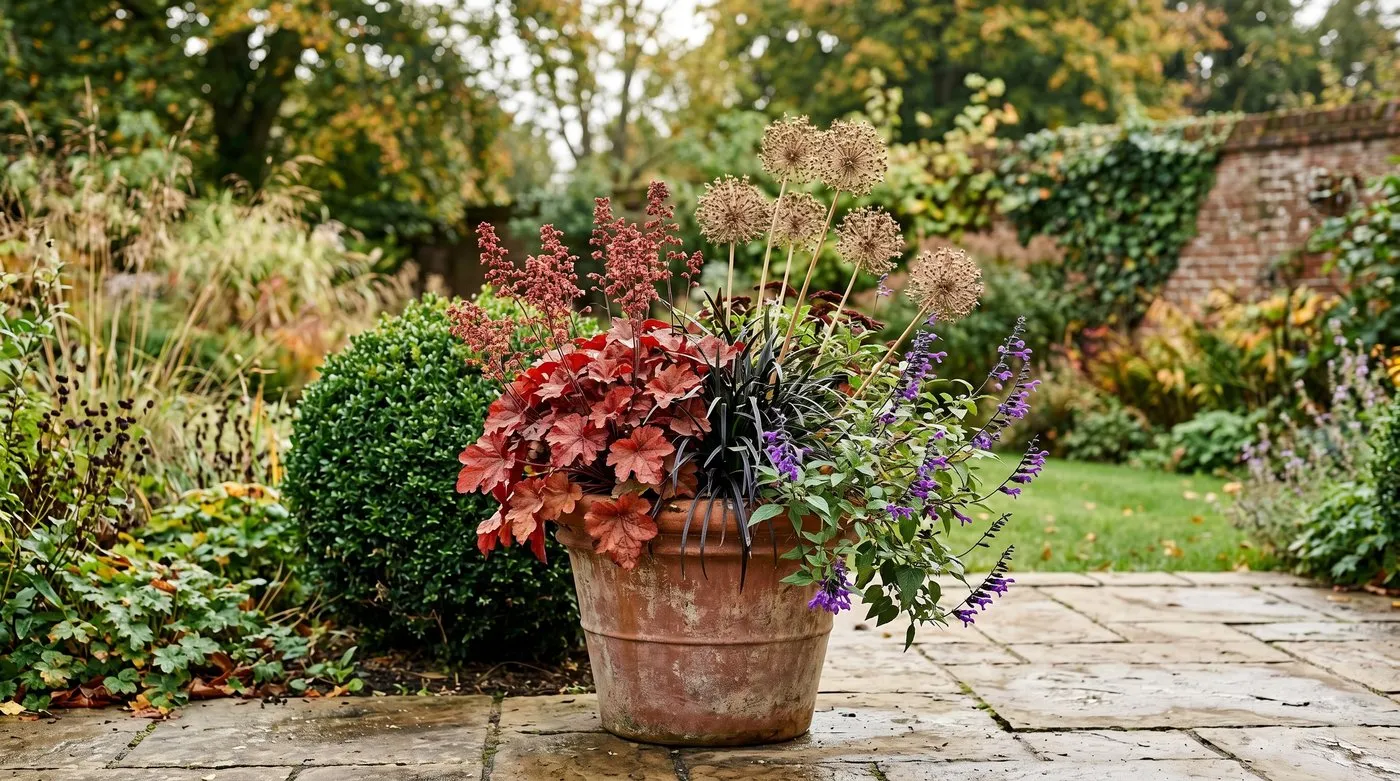 A 50cm frost-proof terracotta container holds 70 litres of compost. The base allows year-round root protection in any UK garden, from the Highlands to the south coast.
The compost mix
A long-lived container needs a compost mix that holds nutrients, drains freely, and resists collapse over multiple seasons.
- 50% John Innes No. 3 (loam-based, holds nutrients)
- 30% peat-free multipurpose compost (provides bulk and water retention)
- 20% horticultural grit (drains free, prevents compaction)
A 70 litre pot needs:
- 35 litres John Innes No. 3
- 21 litres peat-free multipurpose
- 14 litres horticultural grit
Total cost: £14 to £22 for a one-off fill. Refresh the top 8cm in February each year (about 12 litres) at £4 to £6 extra.
The bulb layer (planted October)
Bulbs deliver January to May colour and need to go in first, deepest, in autumn.
The lasagne method
Plant in three layers at different depths.
Cover with 3cm of compost and grit.
Middle layer (15cm depth): 5 allium bulbs. Allium ‘Purple Sensation’ is the standard. Flowers late May into June, then the seedheads persist into autumn.
Cover with 3cm of compost.
Top layer (8cm depth): 12 crocus, 6 dwarf narcissus ‘Tete-a-Tete’. These flower first in February and March, before the deeper bulbs emerge.
Cover with 3cm of compost.
Bulb shopping list
| Bulb | Quantity | UK supplier | Cost |
|---|---|---|---|
| Tulip ‘Queen of Night’ | 6 | Peter Nyssen | £4.50 |
| Tulip ‘Ballerina’ | 6 | Peter Nyssen | £4.50 |
| Allium ‘Purple Sensation’ | 5 | J Parker’s | £6.50 |
| Crocus chrysanthus ‘Cream Beauty’ | 12 | Peter Nyssen | £3.80 |
| Narcissus ‘Tete-a-Tete’ | 6 | Peter Nyssen | £3.20 |
| Total bulb cost | 35 bulbs | £22.50 |
Peter Nyssen, J Parker’s, and Sarah Raven all ship bulbs to UK addresses for September and October planting.
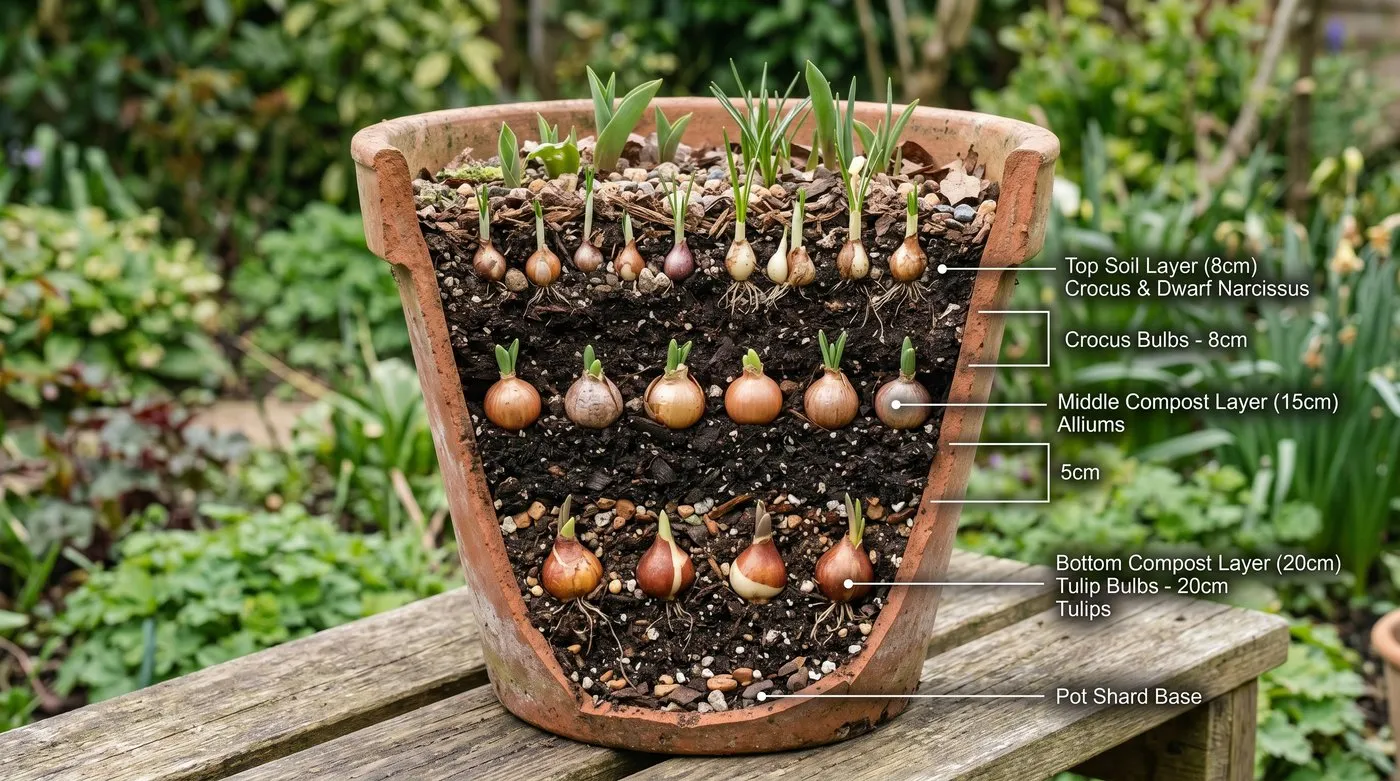 The lasagne bulb method. Tulips deepest at 20cm, alliums next at 15cm, crocus and dwarf narcissus at 8cm. Each layer flowers in sequence from February through May.
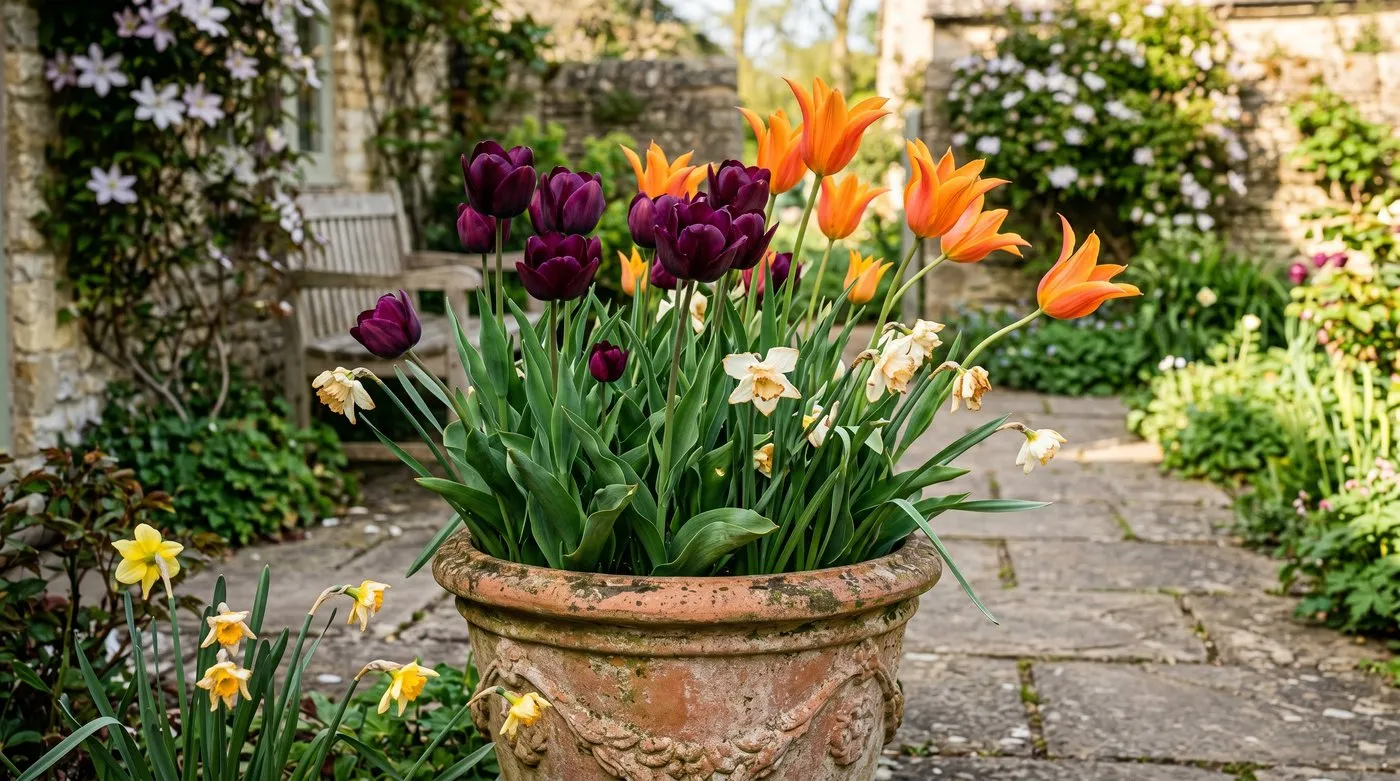 The pot in late April. Tulip ‘Queen of Night’ (deep purple) and ‘Ballerina’ (orange) at their peak, with the late narcissus fading and the allium buds forming below.
The perennial layer (planted in March)
After the spring bulbs flower and die back, the perennials take over for summer interest.
Plant choices
| Plant | Role | Cost |
|---|---|---|
| Heuchera ‘Lime Marmalade’ | Bright foliage, year-round | £8.50 |
| Geranium ‘Rozanne’ | Long flowering, May to October | £9.50 |
| Salvia ‘Hot Lips’ | July to October, bee magnet | £7.50 |
| Nepeta ‘Six Hills Giant’ | June to September, hazy purple | £6.50 |
| Ophiopogon planiscapus ‘Nigrescens’ | Black grass, year-round | £6.50 |
| Ajuga reptans ‘Black Scallop’ | Trailing edge, year-round | £5.50 |
| Total perennial cost | 6 plants | £44.00 |
The six perennials cover the centre and edges of the pot. They sit between the bulb depths and grow up through the planting in late spring.
Why these six
Each plant earns its place by either flowering through summer (Geranium, Salvia, Nepeta) or holding structural colour year-round (Heuchera, Ophiopogon, Ajuga). The combination gives 8 months of active growth and 4 months of evergreen interest.
Tip: Buy perennials from a Plant Heritage National Collection holder or a specialist nursery, not a garden centre. The plants are larger, healthier, and roughly the same price.
The structural element (planted in March)
One small evergreen anchors the pot through winter when bulbs are dormant and perennials are cut back.
Options:
- Box ball (Buxus sempervirens), 25cm clipped. Cost £14-£22. Lasts 7-10 years before needing replacement.
- Dwarf pine (Pinus mugo ‘Mops’), 20cm. Cost £18-£26. Lasts 10+ years.
- Dwarf yew (Taxus baccata, small clipped form). Cost £18-£28. Lasts 15+ years.
The box ball is the easiest first choice. Place it at the back of the pot (the side away from the main viewing angle) so it forms a backdrop to the bulbs and perennials.
Putting it all together
The plan once planted:
October (Year 1)
- Fill pot with compost mix
- Plant tulips at 20cm depth
- Plant alliums at 15cm depth
- Plant crocus and dwarf narcissus at 8cm depth
- Cover with final compost layer
March (Year 1)
- Plant the box ball at the back
- Plant Heuchera, Geranium, Salvia, Nepeta, Ophiopogon, Ajuga around the bulbs
- Mulch with 2cm of horticultural grit
- Total time: 1 hour
Year 1 month-by-month interest
| Month | What is in flower or showing |
|---|---|
| January | Box ball structure, Heuchera and Ophiopogon foliage |
| February | First crocus, Ajuga foliage, box ball |
| March | Crocus peak, Tete-a-Tete narcissus, Heuchera new growth |
| April | Tulip ‘Ballerina’ opening, late narcissus |
| May | Tulip ‘Queen of Night’ opening, allium bud forming |
| June | Allium ‘Purple Sensation’ flowering, Geranium ‘Rozanne’ starting |
| July | Salvia ‘Hot Lips’ starting, Geranium peak, Nepeta peak |
| August | Salvia continuing, Geranium ongoing, allium seedheads |
| September | Salvia tailing, Heuchera flushing with autumn colour |
| October | Heuchera autumn colour, Ophiopogon black foliage, last Salvia |
| November | Frosted Heuchera, Ophiopogon, box ball, allium seedheads |
| December | Box ball structure, Ophiopogon black grass, Ajuga purple-black foliage |
A pot that flowers somewhere or shows interesting foliage every single month of the year.
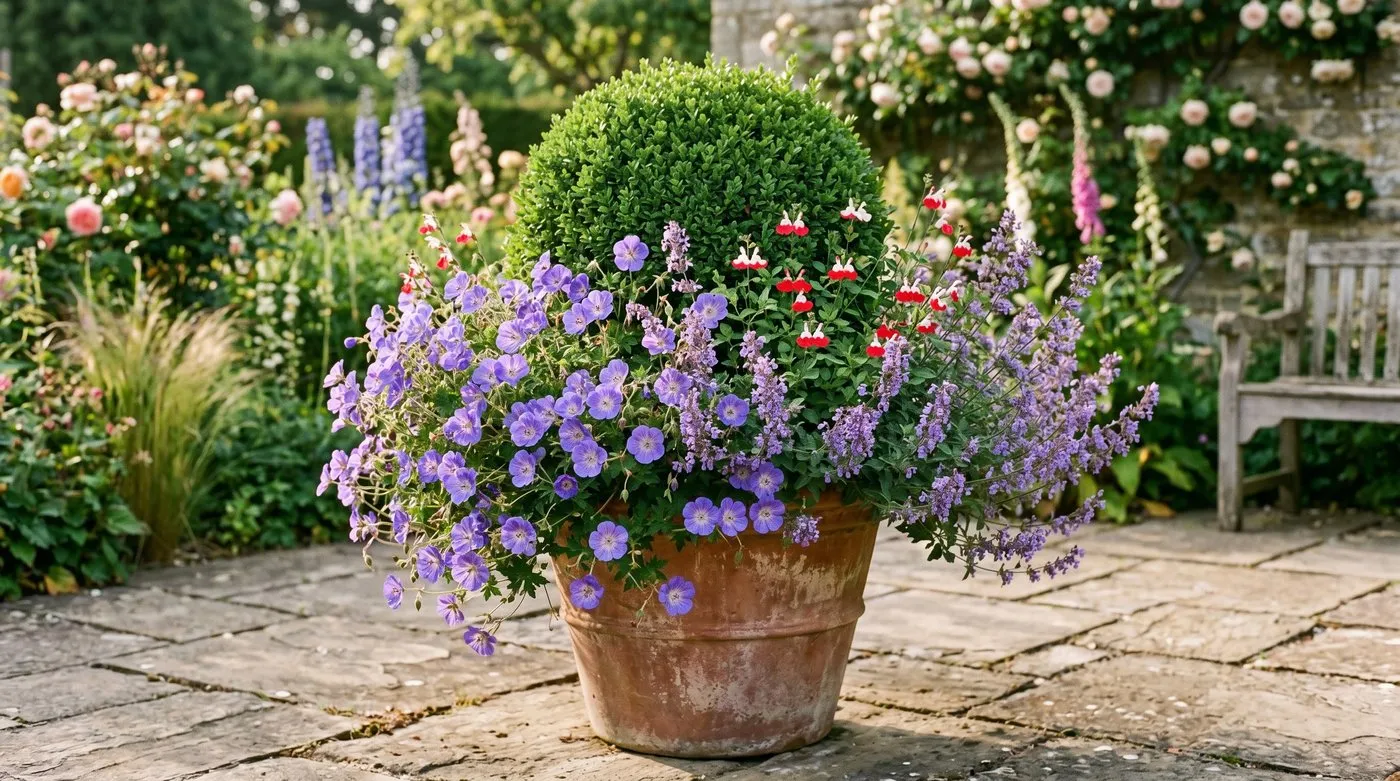 The pot in July, with Geranium ‘Rozanne’, Salvia ‘Hot Lips’ and Nepeta in full flower around the structural box ball. Bulbs underneath are dormant but invisible.
Annual refresh routine
Each year the pot needs a small amount of work.
February
- Top up with 8cm of fresh compost mix
- Add 5-10 fresh bulbs in any gaps (replace tulips, which fade after 2-3 years)
March
- Cut back Geranium, Salvia, Nepeta to 5cm above soil
- Lift and divide Heuchera if it has filled the centre
- Apply slow-release granular feed at 30g for the whole pot
June
- Begin fortnightly liquid feed for flowering perennials
- Deadhead Geranium and Salvia weekly
August
- Continue liquid feed
- Cut Nepeta back hard for second flush
October
- Stop feeding
- Plant any replacement bulbs
November
- Mulch top of compost with 2cm of horticultural grit (frost protection and looks neat)
Total annual time: about 2 hours spread across the year.
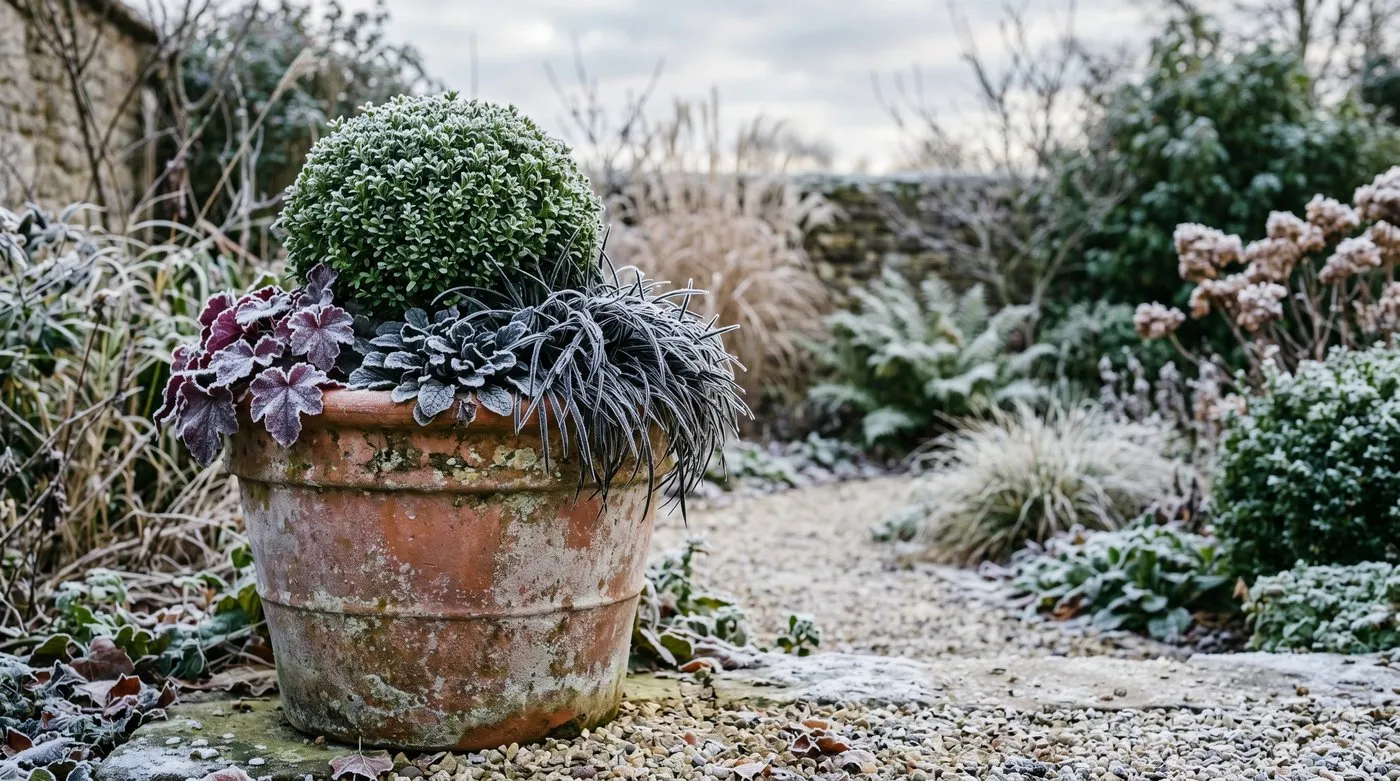 The pot in late December. Box ball, black Ophiopogon grass, frosted Heuchera and Ajuga foliage give structural interest while the bulbs sleep beneath.
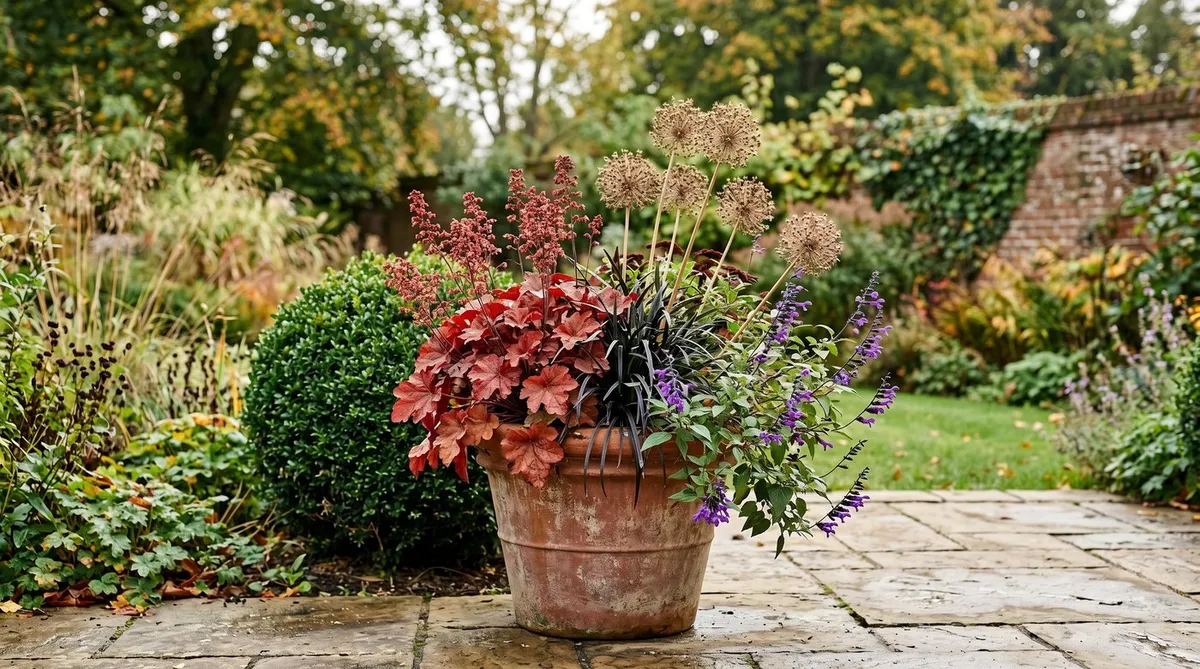
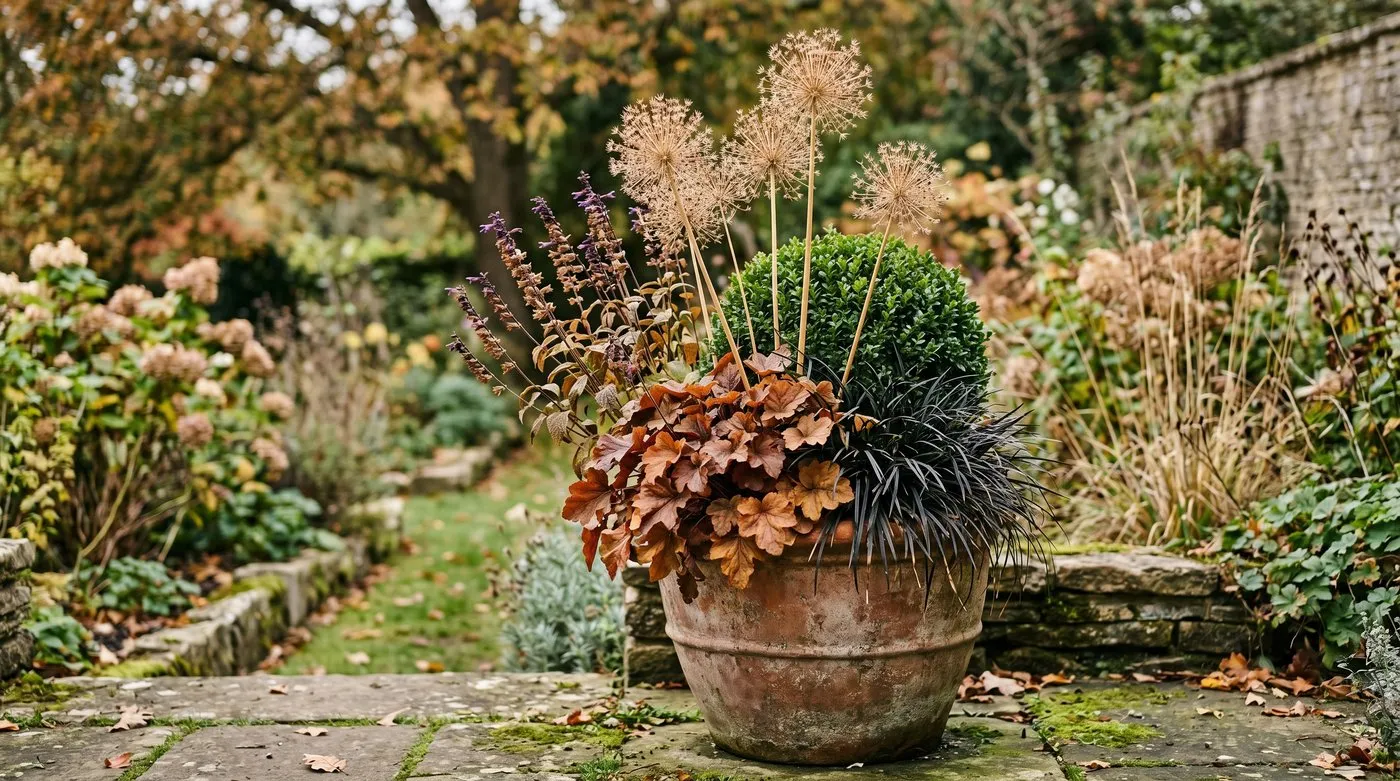 The pot in October. Allium seedheads as straw-coloured globes, Heuchera in russet autumn colour, last flowers on Salvia ‘Hot Lips’, the box ball steady behind.
Cost breakdown
Year 1 total
| Item | Cost |
|---|---|
| 50cm terracotta pot | £45-£75 |
| Compost mix (70L) | £14-£22 |
| Drainage crocks/grit | £3-£5 |
| 35 bulbs | £22.50 |
| 6 perennials | £44.00 |
| 1 box ball | £14-£22 |
| Liquid feed (Tomorite or similar) | £4 |
| Slow-release feed | £6 |
| Total Year 1 | £152-£200 |
The £42-£68 figure in the introduction is the plant cost alone (35 bulbs + 6 perennials + 1 box ball). Including the pot itself and the compost makes Year 1 total £152-£200.
Year 2+ annual costs
| Item | Cost |
|---|---|
| Top-up compost (12L) | £4-£6 |
| Replacement bulbs (5-10) | £4-£8 |
| Liquid feed (annual share) | £2 |
| Slow-release granular | £1 |
| Total Year 2+ | £11-£17 |
Annual upkeep settles at £11-£17 from Year 2 onward.
Mistakes to avoid
Mistake 1: planting bulbs at the wrong depth
The lasagne method only works if the depths are correct. Tulips at 20cm, alliums at 15cm, crocus at 8cm. Plant them all at the same depth and they flower simultaneously then leave the pot empty for the next 9 months.
Mistake 2: choosing a pot under 50cm wide
A 40cm pot lacks the soil mass to buffer summer dryness and winter freezing. The root zone of a 40cm pot can drop to -5C in a hard February frost, killing many perennials.
Mistake 3: feeding through winter
Container plants need a 5-month rest from feeding (October to February). Continuing to feed produces soft new growth that frost damages.
Mistake 4: using only one type of bulb
Twelve daffodils in a pot gives you 2-3 weeks of interest. Twelve bulbs from 4 types staggered gives 14-16 weeks. Always mix bulb types for staggered flowering.
Variations on the plan
The basic plan can be adjusted for different garden styles.
Shady patio plan
Replace Salvia and Nepeta with Brunnera ‘Jack Frost’ and Hosta ‘June’. Replace tulips with Camassia and Cyclamen hederifolium. Keep box ball, Heuchera, Ajuga.
Bee and butterfly plan
Replace Heuchera and Ophiopogon with Aster ‘Little Carlow’ and Verbena bonariensis. Keep Geranium, Salvia, Nepeta. Add Echinops as the structural element.
Edible mini plan
Replace the box ball with a small bay tree. Replace Nepeta with thyme. Replace Ophiopogon with chives. The structural plants double as kitchen herbs.
Drought-resistant Mediterranean plan
Replace Geranium with Sedum ‘Autumn Joy’. Replace Heuchera with Phlomis. Add an olive tree as the structural element (in larger pot).
Where to read more
The Royal Horticultural Society Container Gardening pages cover detailed compost mixes and seasonal care. The Sarah Raven seasonal pot collections inspire variations on the layered method with different colour palettes.
Related reading: Bring a pot inside for December colour using our guide to forcing paperwhites without chilling.
Frequently asked questions
What size pot do I need for year-round planting?
Minimum 50cm wide by 45cm deep. Smaller pots dry out too fast in summer and freeze through in winter, killing roots. A 50cm container holds 70 litres of compost, which buffers temperature and moisture enough to keep planting alive year-round in the UK.
How do I plant bulbs in layers in a pot?
Largest bulbs go deepest. Plant tulips at 20cm depth. Cover with 3cm of grit and compost. Plant alliums at 15cm. Cover. Plant crocus and dwarf narcissus at 8cm. Top off with compost. The bulbs flower in sequence from February to May without growing into each other.
Can I keep a container planted with the same plants for years?
Yes, with refresh. Replace the top 8cm of compost each February. Add 5-10 fresh bulbs each October. Divide the heuchera every three years. Replace the box ball every 7-10 years. Most container plantings last 5-7 years before needing a full rebuild.
What perennials work best in containers?
Heuchera, hardy geranium, salvia, nepeta, ophiopogon, ajuga, and dwarf hosta. Avoid deep-rooted perennials like lupins and delphiniums. Stick to clump-forming plants with shallow fibrous roots. Most container perennials live 4-7 years before needing renewal.
Do containers need feeding in winter?
No. Feed from March to September only. Use a slow-release granular feed in March (Osmocote or similar) at half the recommended rate, plus a fortnightly liquid feed for summer flowering plants. Winter feeding wastes nutrients and weakens roots before the next active season.
Which bulbs give the longest pot display?
Snowdrops, crocus, dwarf narcissus ‘Tete-a-Tete’, tulips (multiple types), and alliums in sequence give 14-16 weeks of flowering from late January through mid-May. Layer them at different depths and the pot keeps flowering as one type fades and the next emerges.
How often should I water a 50cm container?
Twice a week in May to September if no rain, daily in heatwaves above 28C. Once a week from October to March. The 70L compost capacity buffers most short dry spells. Stick a finger 5cm into the compost to check moisture before watering.
Now you can plan your own
One 50cm pot, layered correctly, runs a 12-month UK garden display from a single corner of the patio. Buy the bulbs in September. Plant in October. Add perennials in March. By year three the pot will be the most reliable source of seasonal interest in your garden.
Our team produces practical UK gardening guidance from source research, contributor records and established horticultural practice. Editorial standards are overseen by Matt W.