Key takeaways
- A cold hose-fed garden shower costs from 40 pounds and needs only a tap and a hose
- A fully plumbed hot shower runs from 500 pounds and usually needs a plumber
- Drainage decides everything: a 1m by 1m gravel soakaway, at least 5 metres from foundations
- Stainless steel grade 316 and solid brass survive UK winters; plastic fittings split when frozen
- Drain and isolate every pipe before the first frost or trapped water will burst the fittings
- Most domestic garden showers are permitted development, but greywater must not run to a watercourse
Outdoor shower ideas have moved from holiday-villa fantasy to a practical UK garden feature, and a basic one costs less than a single weekend away. A garden shower rinses off salt after a coastal swim, mud after the allotment, chlorine after the paddling pool, or sweat after a run. It keeps the worst of the dirt outside the house. This guide ranks the realistic options, from a 40 pound cold hose unit to a fully plumbed hot shower, and covers the parts most articles skip: drainage, winterising and the materials that actually survive a British winter.
The advice here comes from building and using a cold-then-solar shower across three Staffordshire summers, with water temperatures logged and the soakaway watched through three wet winters. Get the drainage and the frost protection right and an outdoor shower lasts decades. Get them wrong and you have a bog and a split pipe by February.
The five types of outdoor shower ranked for UK gardens
There are five sensible builds, and they sort cleanly by cost and effort. The right one depends on whether you want hot water and how much you want to spend. Here they are, simplest first.
A cold hose-fed wall shower is the entry point. You screw a shower head onto a wall bracket, run a garden hose from an outside tap, and you are done. It costs 40 to 90 pounds and goes up in an afternoon. Cold only, but in a July heatwave that is exactly what you want.
A solar-heated shower adds free warmth. A black solar bag or a coil of black pipe sits in the sun and warms the water to 38 to 41C over an afternoon. The bag version costs 15 to 35 pounds. It gives a warm two-minute rinse with no running cost.
A freestanding portable shower needs no plumbing at all. It connects to a hose or holds its own water, and you wheel it away in winter. These run 60 to 200 pounds and suit renters or anyone who does not want to drill a wall.
A wall-mounted plumbed cold shower is the permanent cold option. A 15mm pipe is teed off the mains and run up the wall to a proper mixer or push valve. Expect 150 to 400 pounds with parts and a plumber.
A fully plumbed hot shower is the luxury build. Hot and cold feeds run to a thermostatic mixer, fed from the combi boiler or an electric instant heater. This is a 500 to 2,000 pound job and almost always needs a plumber, and an electrician for the heater.
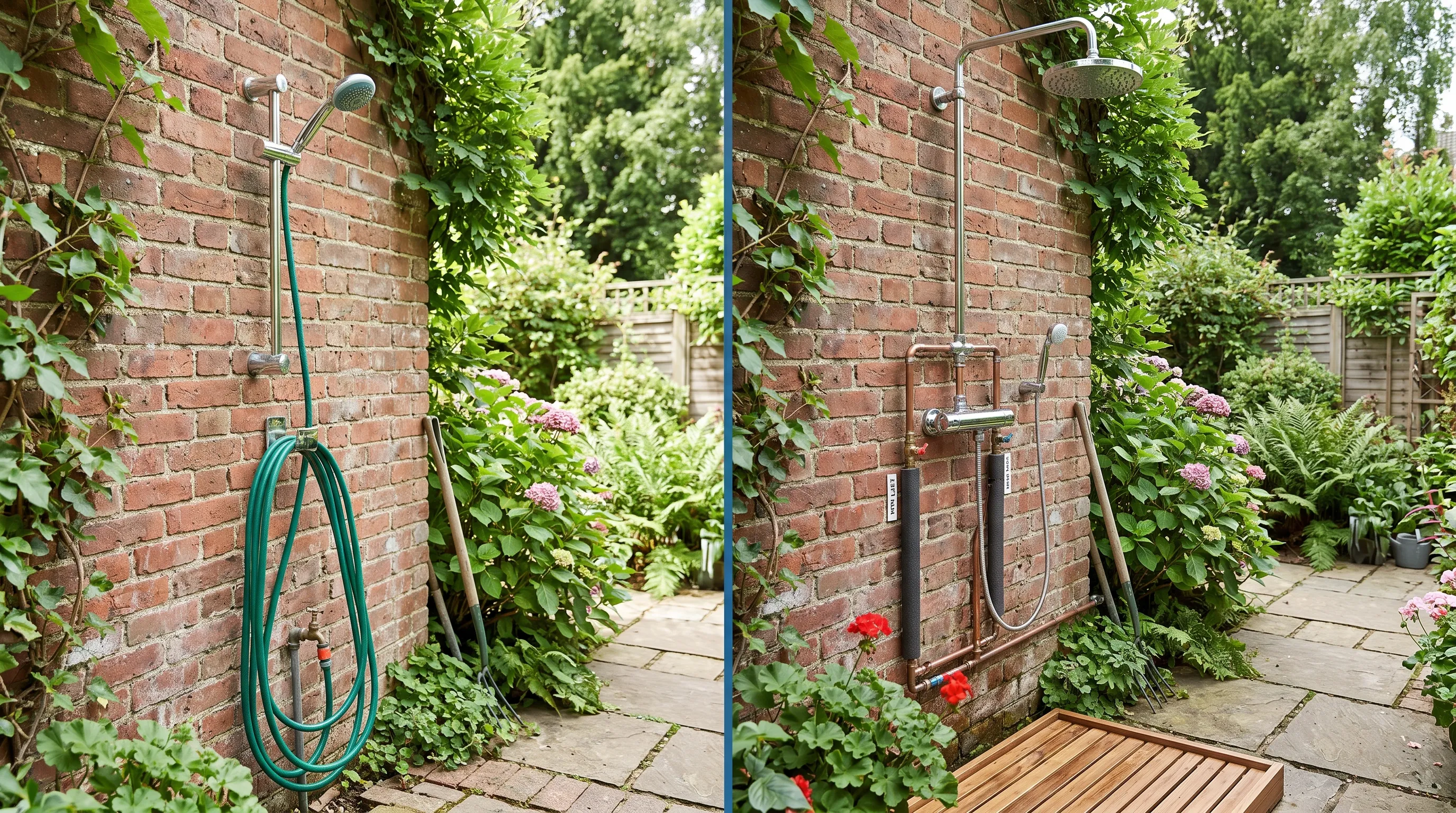 Left, the simplest cold hose-fed setup off a garden tap. Right, a plumbed hot build with separate hot and cold feeds to a thermostatic mixer.
Outdoor shower types compared by cost and difficulty
The table below ranks the five builds by overall effort, cheapest and easiest first. Use it to match a shower to your budget and your DIY confidence before you buy any fittings.
| Shower type | Hot or cold | Install difficulty | Cost | Best for |
|---|---|---|---|---|
| Cold hose-fed wall shower | Cold | Easy, 1 hour | 40 to 90 pounds | Quick summer rinse, paddling pool |
| Solar-heated bag or pipe | Warm | Easy, 1 hour | 15 to 35 pounds | Off-grid warmth, allotments, campsites |
| Freestanding portable | Cold or warm | None, plug and play | 60 to 200 pounds | Renters, patios, no drilling |
| Wall-mounted plumbed cold | Cold | Moderate, half a day | 150 to 400 pounds | A permanent fixture, coastal homes |
| Fully plumbed hot | Hot | Hard, plumber needed | 500 to 2,000 pounds | Daily use, spa feel, hot tubs nearby |
The two cold options at the top deliver 80% of the usefulness for under 100 pounds. Most UK gardens never need more than a plumbed cold shower, because outdoor showering happens in warm weather when cold water is welcome. Spend the big money on a hot build only if you will use it spring and autumn too, or beside a garden room with its own water supply.
Getting water to the shower: tap, hose or plumbed feed
Every outdoor shower starts with a water supply, and you have three routes. The route you pick sets the cost and the permanence of the whole build.
The garden tap and hose is the no-tools option. Run a standard hose from an existing outside tap to a shower head on a bracket. A quick-release connector lets you disconnect for winter in seconds. This carries cold mains water at roughly 10 to 14C year-round in the UK.
A dedicated plumbed feed taps a 15mm pipe off the rising main or an existing outside-tap supply. Fit an isolation valve indoors or in an accessible box so you can shut the line off and drain it. This is the proper permanent answer and the one to choose if the shower stays up for years. A push valve or lever mixer at the head controls the flow.
Water pressure rarely disappoints. UK mains pressure typically runs 1 to 3 bar, which is plenty for a single shower head. The only common problem is a long, narrow hose run, which drops pressure over distance. Keep the run under 15 metres and use 15mm pipe rather than a thin hose for a strong, steady spray.
Gardener’s tip: Fit a brass quick-release coupling at the tap, not a plastic one. The plastic versions crack at the threads within two summers of UV exposure and start to weep. A brass coupling costs about 6 pounds and outlasts the rest of the kit.
Hot water options for a garden shower
Cold water suits a summer rinse, but a warm shower extends the season and the comfort. There are four ways to get hot water outdoors, and they range from free to a proper plumbing job.
A solar shower bag or coil is the cheapest warmth. Black PVC absorbs sunlight and a 15 to 20 litre bag reaches 38 to 41C after four to six hours in direct sun. It gives a genuinely warm two-minute rinse and costs nothing to run. The catch is obvious: no sun, no heat. It also empties fast.
A gas patio-style water heater uses a propane bottle to heat water on demand, like a caravan unit. These deliver hot water anywhere with no electricity, but they must run in open air and never near the spray. A unit costs 100 to 250 pounds plus the gas.
An electric instant water heater is the cleanest permanent answer for a stand-alone shower. A weatherproof, RCD-protected unit rated 7 to 9kW heats water as it flows. It needs a dedicated electrical circuit installed by a qualified electrician, which is the real cost. Budget 200 to 500 pounds for the heater plus the wiring.
Connecting to the house hot water gives the best shower of all. A plumber runs a hot and a cold feed from your combi boiler to an outdoor-rated thermostatic mixer. The thermostatic part stops scalding if someone runs a tap indoors. This is the 500 pounds-plus build, but the result is an indoor-quality shower in the garden.
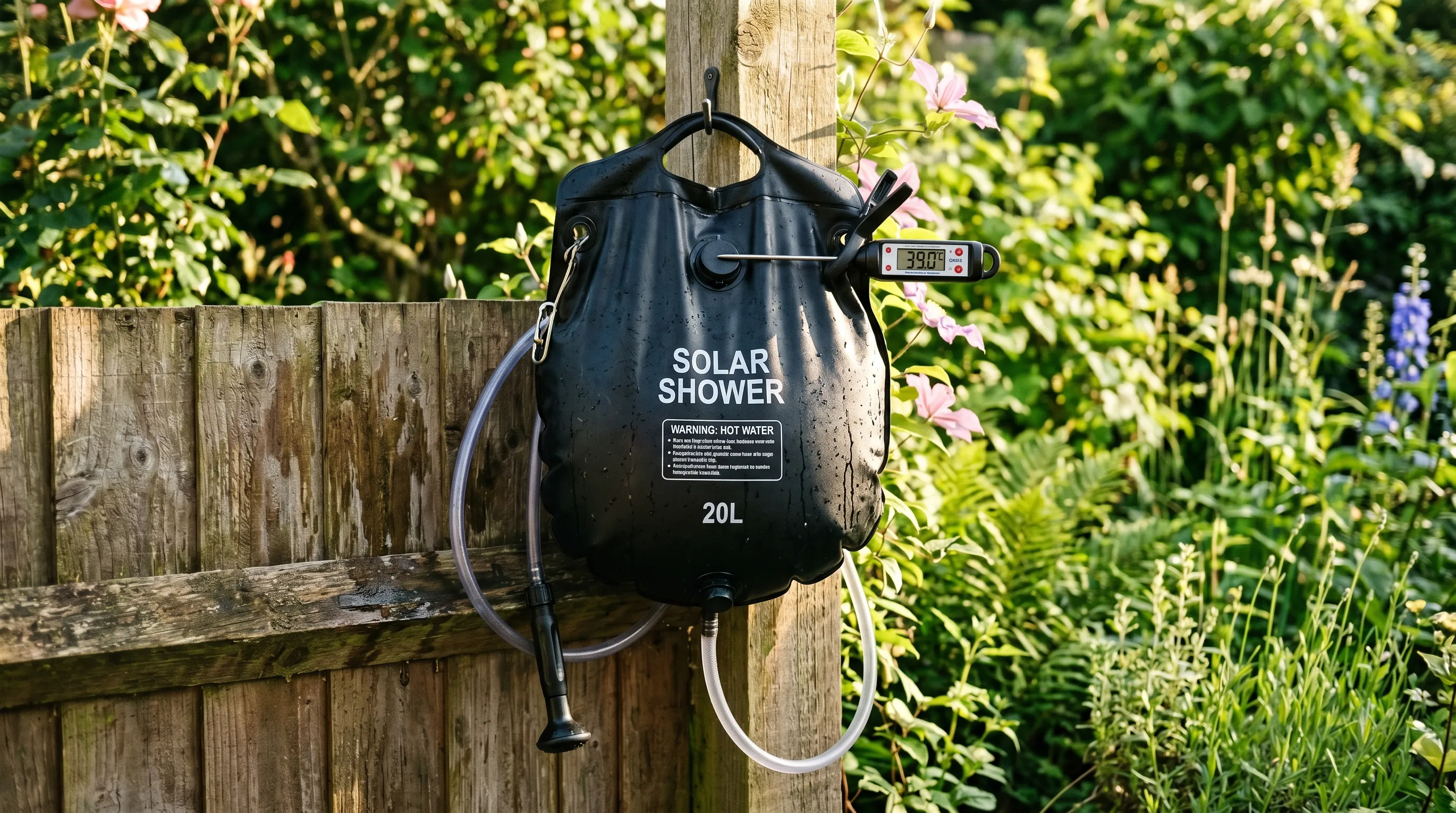 A 15-litre solar bag reached 39C after a sunny Staffordshire afternoon, enough for a warm two-minute rinse at no running cost.
Drainage: where the water actually goes
Drainage is the part that decides whether your shower lasts or turns the lawn into a swamp. A shower runs 8 to 12 litres a minute, so a five-minute shower puts 40 to 60 litres of water into the ground. That water has to go somewhere safe.
The standard answer is a soakaway, a pit dug below the shower base and filled with clean gravel. Dig roughly 1 metre by 1 metre and 600mm deep, line it with permeable membrane, and fill it with 20mm clean gravel. Water drains down through the gravel and disperses into the surrounding soil. This handles a domestic shower easily on free-draining ground.
Site the soakaway at least 5 metres from the house foundations. Water pooling against footings causes damp and, over years, can undermine them. Keep it clear of boundaries and any drains too.
On heavy clay a simple soakaway fills and backs up, because clay drains slowly. Here a French drain carries the water away: a gravel-filled trench with a perforated pipe running to a lower point in the garden or a larger soakaway. A plain gravel pit under a freestanding shower works for light use, but check it does not pond after heavy use.
Greywater rules matter. Plain water and small amounts of biodegradable soap can soak away on your own land. You must not pipe shower water to a stream, ditch, or surface-water drain. The Environment Agency greywater guidance explains the binding rules. Keep it simple: a soakaway, your own soil, gentle soap.
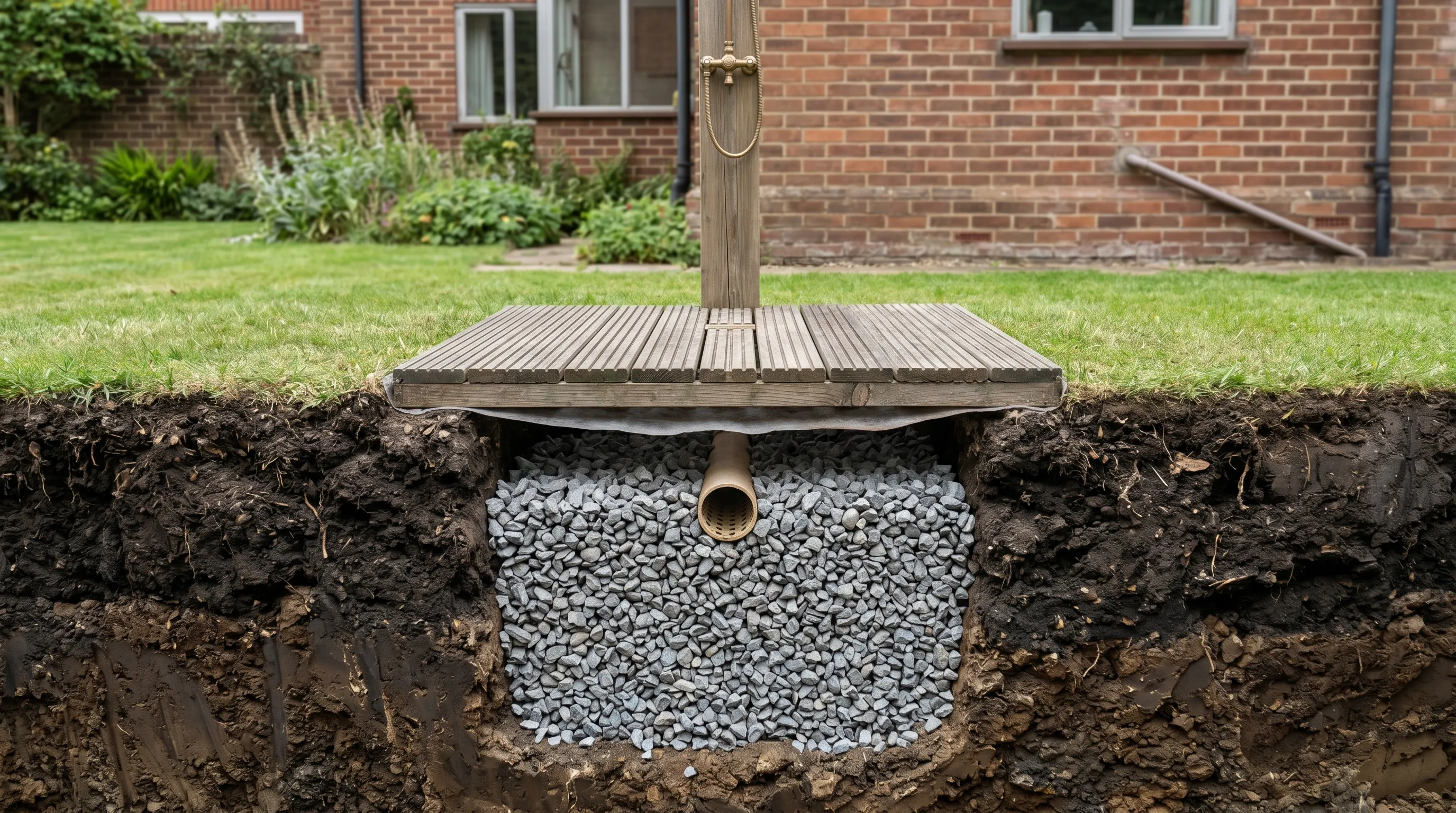 A soakaway cross-section: membrane-lined pit, 20mm clean gravel, sited at least 5 metres from the house foundations.
Building the base and decking under the shower
The base does two jobs: it gives you a clean, non-slip footing and it feeds water to the drainage below. A muddy patch under the shower head defeats the point of washing off mud.
Slatted timber decking is the most popular base. Gaps between the boards let water fall straight through to a gravel pit or soakaway beneath. Use pressure-treated softwood or, better, a hardwood like iroko that handles constant wet. Leave 8 to 10mm gaps between boards so water drains and the timber dries between uses. A small decking platform sized 1.2m by 1.2m gives plenty of standing room.
Gravel or pebbles make the cheapest base. A bed of 20mm pebbles over membrane drains freely and feels fine underfoot if you shower with sandals. It costs little and links straight into the soakaway below.
Stone or porcelain paving laid to a fall works for a smarter finish. Lay the slabs with a slight slope towards a channel drain or a gap that feeds the soakaway. Choose a textured, anti-slip finish, because smooth wet stone is treacherous. If you are laying paving anyway, our guide on how to lay a patio covers the falls and bedding you need to get the drainage right.
Whatever the base, build in a fall of about 1 in 80 towards the drainage so water never sits where you stand.
Privacy screening and enclosures
Most people want some screening before they will use a garden shower, even in swimwear. The level of cover ranges from a single panel to a full roofed cubicle.
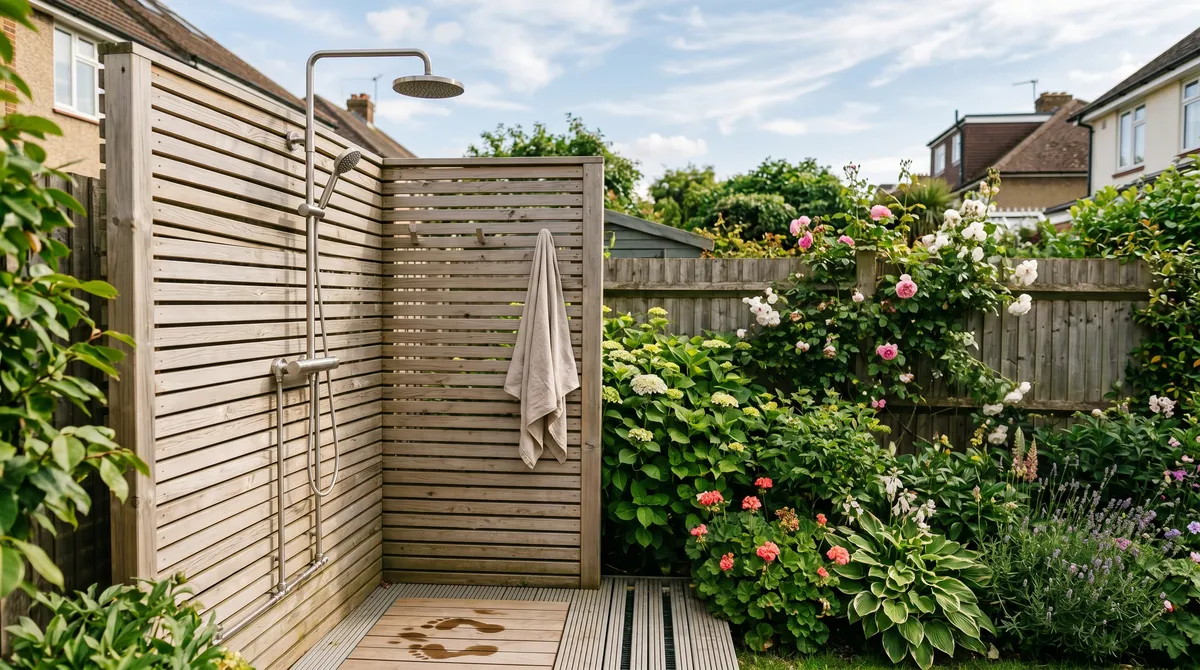
A single timber screen is the simplest privacy fix. One slatted panel, around 1.8 metres tall, set on the exposed side blocks the main sightline while keeping the open, airy feel. Slatted panels let air through, so the timber dries and you avoid a damp, mossy box.
A three-sided enclosure gives proper privacy for a permanent shower. Build it from treated timber, composite slats, or even glass for a modern look. Leave the top open so it never feels enclosed and stays bright. A drainage gap at the base lets water escape.
Planting softens any structure and adds a living screen. Tall grasses, bamboo in a root barrier, or an evergreen hedge give cover that improves each year. For a fast, permanent screen, our guide to the best trees for privacy lists species that suit a tight garden corner.
Gardener’s tip: Face the open side of the shower towards a wall, fence, or dense planting, not towards a neighbour’s window. Plan the sightlines before you fix anything. Moving a screen after the fact means re-drilling masonry and patching holes.
Materials that survive UK weather
UK weather punishes outdoor fittings. Rain, frost, and UV destroy the wrong materials within a couple of seasons. The right ones last decades, so the small extra cost up front saves replacing the lot.
Grade 316 stainless steel is the top choice for the shower head and valves. The 316 grade resists corrosion better than the cheaper 304, and it shrugs off salt air, so it is the only sensible pick for a coastal garden where spray pits lesser metal within a year. A 316 shower head costs 80 to 200 pounds and looks new for years.
Solid brass valves and connectors are the workhorse. Brass copes with constant wet and repeated freezing far better than chrome-plated zinc, which flakes and seizes. Insist on solid brass, not brass-plated.
Treated timber and stone handle the structure. Pressure-treated softwood, hardwoods like iroko or oak, and natural stone all weather gracefully. Re-oil hardwood once a year to keep it from greying if you prefer the warm colour.
Avoid plastic and zinc fittings entirely on anything that holds water. They go brittle under UV and, worse, they split the instant trapped water freezes. The cheap chrome-plated kit sold for indoor bathrooms is the wrong tool here.
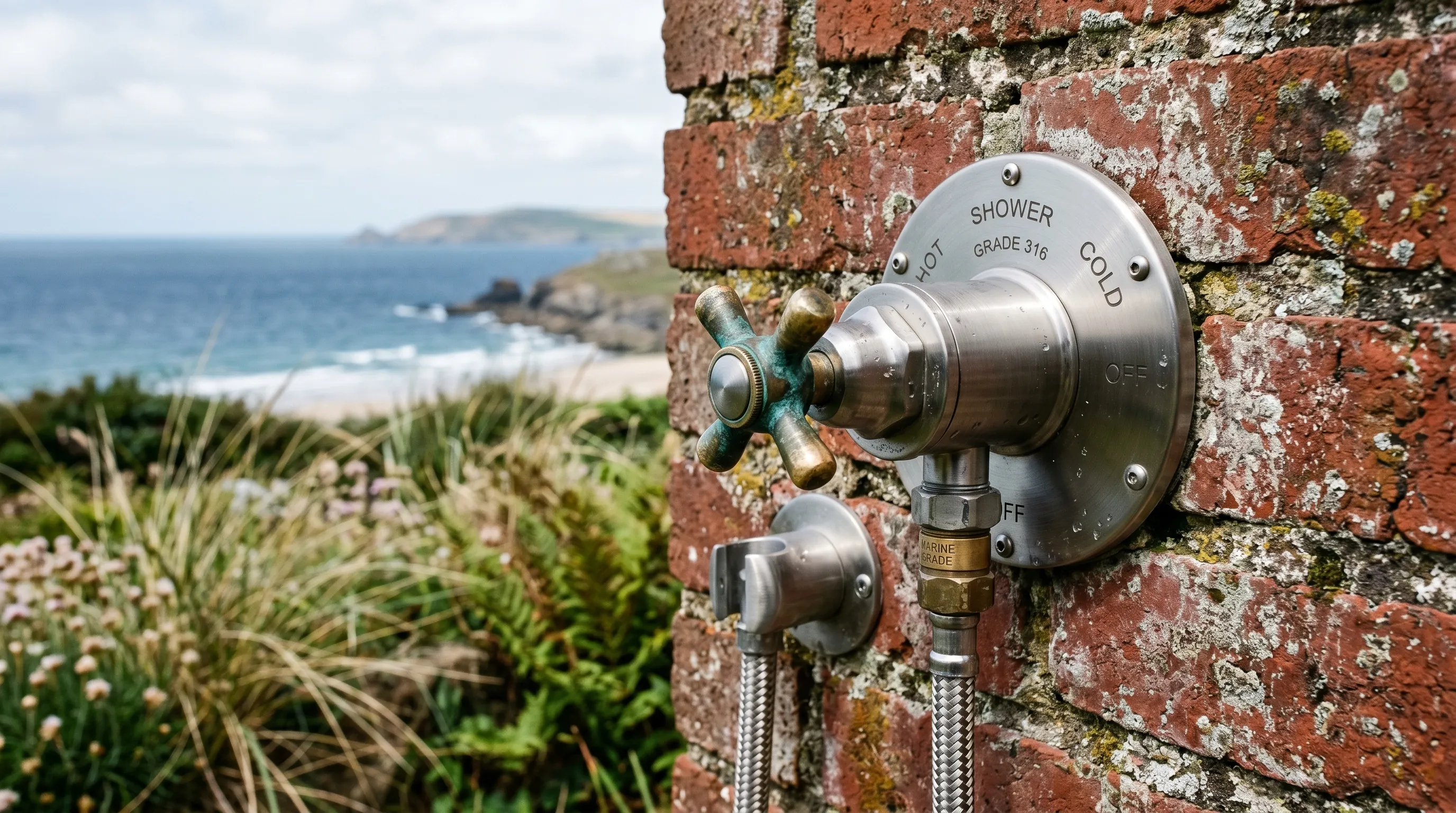 Grade 316 stainless and solid brass on a coastal wall: the only metals that resist salt-air corrosion long term.
Winterising: stop your pipes freezing and splitting
This is the section that saves you money. Water expands by about 9% when it freezes, and that force splits any pipe or valve holding trapped water. A single hard frost on a forgotten outdoor pipe means a burst fitting and a flood when it thaws.
The fix is simple and free: drain the system before the first frost, usually late October to November in most of the UK. The steps are:
- Shut off the isolation valve indoors or at the supply point, so no new water can enter the line.
- Open the shower head and any drain point at the lowest part of the run to let gravity empty the pipe.
- Blow the line clear with a compressor or hand pump if you can, to clear water trapped in low spots and the mixer body.
- Disconnect a hose-fed shower entirely and store the head and hose in the shed or garage.
A plumbed shower benefits from a drain-down valve fitted at the lowest point during install. Open it and the line empties itself. For belt and braces, lag any exposed pipe with foam pipe insulation, but lagging only slows freezing, it does not prevent it. Draining is the only reliable method.
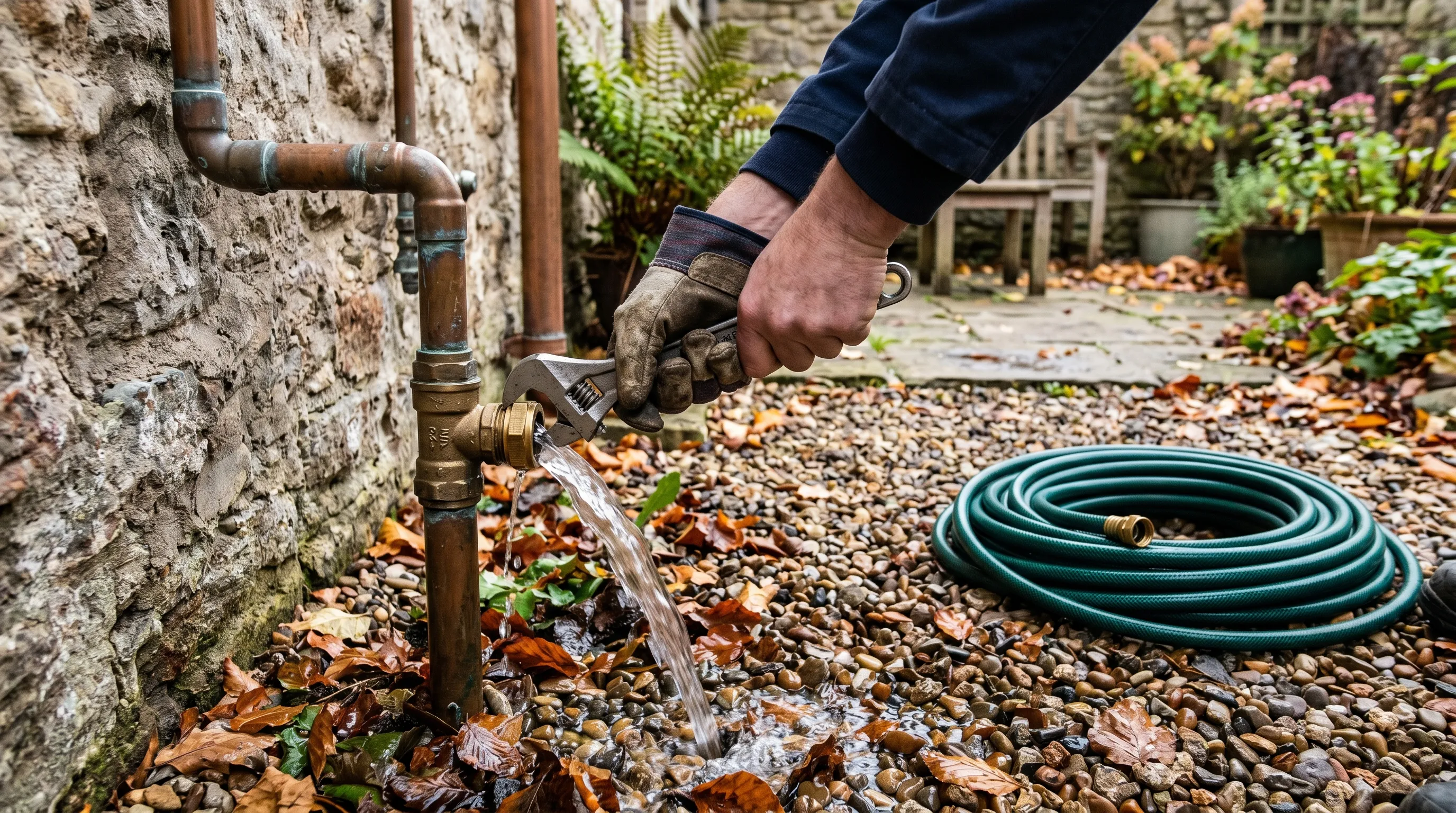 Opening the drain-down valve in late autumn empties the line completely, the only reliable way to stop a frost splitting the fittings.
Warning: Never leave water in an outdoor pipe over winter. Trapped water freezes, expands, and splits fittings, often inside the mixer where you cannot see it until it floods on the thaw. Plastic and chrome-plated parts split first. Drain and isolate every line before the first frost, every year, with no exceptions.
Realistic UK costs: DIY versus a plumber
Cost depends almost entirely on hot water and permanence. A cold DIY shower is pocket money. A plumbed hot one is a proper project. Here is what to budget.
A DIY cold hose shower costs 40 to 90 pounds: a shower head, a wall bracket, a brass coupling, and a hose you probably own. An afternoon’s work, no trades needed.
A DIY plumbed cold shower runs 150 to 400 pounds if you are confident with 15mm pipe and an isolation valve. Pay a plumber and add 150 to 300 pounds in labour for half a day.
A plumbed hot shower is 500 to 2,000 pounds all in. The thermostatic mixer alone is 150 to 400 pounds. A plumber to run hot and cold feeds is 300 to 600 pounds. An electric instant heater adds the heater plus an electrician’s day, another 200 to 500 pounds.
Hidden costs catch people out. Drainage is the big one: gravel, membrane, and digging a soakaway add 50 to 150 pounds. A decking or paving base adds 80 to 300 pounds. Privacy screening runs 60 to 250 pounds. Budget for the whole project, not just the shiny shower head, or you end up with a smart mixer over a mud patch. Saving rainwater nearby with a rainwater harvesting system can offset the running cost of a cold shower if you fit a pump.
Planning permission and building regulations notes
The legal side is reassuringly light for most gardens, but two points need care. Get these right and you stay on the right side of the rules.
Planning permission is rarely needed. A domestic outdoor shower fed from your own supply is permitted development in England. A simple wall-mounted or freestanding shower needs no application. A roofed enclosure can trip the rules if it exceeds 2.5 metres in height near a boundary, or if you live in a conservation area or listed building, so check with your local planning office first in those cases.
Building regulations mainly concern the water and electrical work, not the shower itself. New plumbing must not contaminate the mains, so an outside tap or feed needs a double-check valve to prevent backflow, which is a building regs requirement. Any electrical heater or socket outdoors must be installed by a qualified electrician under Part P and protected by an RCD. The gov.uk drainage and sewage rules govern where greywater can go.
Keep it domestic, keep greywater on your own land, and use a registered plumber and electrician for the hot and electric builds. That covers the regulations for almost every garden shower.
Common mistakes that ruin an outdoor shower
A handful of predictable errors wreck more garden showers than anything else. Avoid these five and yours will work for years.
No proper drainage. The biggest mistake by far. People fit the shower, run it, and watch the ground turn to bog within a week. Dig the soakaway or gravel pit first, before the shower goes in, sized for the water you will actually use.
Plastic fittings that freeze and split. Cheap plastic push-fit and chrome-plated zinc parts crack the first hard frost if water is left in them. Use brass and stainless, and always drain the line for winter.
No privacy planning. A shower in full view of the neighbours never gets used. Work out the sightlines and fix a screen or plant cover before you commit to a position.
Cheap fittings that rust. A bargain indoor shower head rusts and seizes outdoors within two seasons. The chrome flakes, the valve sticks, and you replace the lot. Buy 316 stainless and solid brass once.
Siting too close to the house. A shower draining against the foundations causes damp and, over years, structural trouble. Keep the drainage at least 5 metres clear of footings, and angle the base to carry water away from the wall.
When to use an outdoor shower in the UK
An outdoor shower earns its keep from May to September, when warm days make cold or solar-warmed water pleasant. July and August are the peak, with long evenings and water temperatures from the tap sitting around 14C and solar bags hitting the low 40s.
A plumbed hot shower stretches the season into April and October, and a few hardy souls use one year-round after a sea swim or a cold-water plunge. For most gardens, treat it as a summer feature. Drain it down in late autumn, store the loose parts, and bring it back to life in spring. Pair it with a garden water feature and a sheltered seating corner and the shower becomes part of a proper summer garden, not just a utility.
Frequently asked questions
Do I need planning permission for an outdoor shower in the UK?
No, most domestic garden showers are permitted development. A simple wall-mounted or freestanding shower fed off your own water supply does not need planning permission in England. Building a roofed enclosure over 2.5 metres tall, or one near a boundary, can change that. Greywater must drain to a soakaway, never to a stream, ditch or storm drain.
How do you get hot water to an outdoor shower?
Tee a hot feed off the house plumbing, or fit an electric instant heater. The cheapest warm option is a solar shower bag at 38 to 41C. For a true hot shower, run a plumbed hot and cold feed from a combi boiler through a single mixer, or fit a weatherproof electric instant heater rated around 7 to 9kW. Both jobs are best done by a plumber or electrician.
Where does the water from an outdoor shower go?
Into a soakaway or gravel drainage pit, never near the foundations. Dig a pit roughly 1m by 1m and 600mm deep, fill it with clean 20mm gravel, and site it at least 5 metres from the house. Plain water and biodegradable soap can soak away on most free-draining soils. On heavy clay you may need a French drain to carry water further off.
How do I stop my outdoor shower pipes freezing in winter?
Drain and isolate every pipe before the first frost. Fit an isolation valve indoors, shut it off, then open the shower and a low drain point to empty the line completely. Trapped water expands when it freezes and splits fittings. Blow the line through with a compressor or pump if you can. Plastic push-fit and cheap chrome splits first; brass and stainless cope better.
What is the best material for an outdoor shower in the UK?
Grade 316 stainless steel or solid brass last longest outdoors. Grade 316 resists corrosion better than 304 and suits coastal gardens where salt air pits cheaper metal. Solid brass valves outlast chrome-plated ones, which flake within a few seasons. Avoid plastic and zinc fittings: they go brittle in UV light and crack when frozen.
Our team produces practical UK gardening guidance from source research, contributor records and established horticultural practice. Editorial standards are overseen by Matt W.