Key takeaways
- Almonds flower in early March in the UK, before most pollinators are active
- South-facing walls and frost pockets must be avoided for any chance of a crop
- Three cultivars work in UK gardens: Robijn, Ingrid and Mandaline
- All UK almonds need cross-pollination from a compatible variety within 30 metres
- Trees fruit at 3-5 years and yield 2-8kg per tree at maturity
- Peach leaf curl is the biggest UK disease threat; copper sprays or covered training prevent it
Almonds in UK gardens are the ambitious cropper’s challenge. Spain grows 80% of UK supermarket almonds. The climate there is dry, warm, and the trees flower in late February or early March without late frost concerns. Britain has the wrong half of that equation: damp early springs, late frosts, and pollinators that have not yet woken up when almond blossom opens. None of this stops the experiment working.
This guide explains the three cultivars that crop in UK gardens with the right siting, the pollination workaround that turns sparse blossom into actual fruit, and the peach leaf curl protocol that keeps trees alive. You will find the wall orientation that gives the best chance of a harvest, the hand-pollination method that doubles yield, and the 7-year planting plan from sapling to full crop. Pair this with our growing citrus trees for the wider warm-climate fruit cluster and our how to grow hazel/cobnut guide for a true UK-native nut.
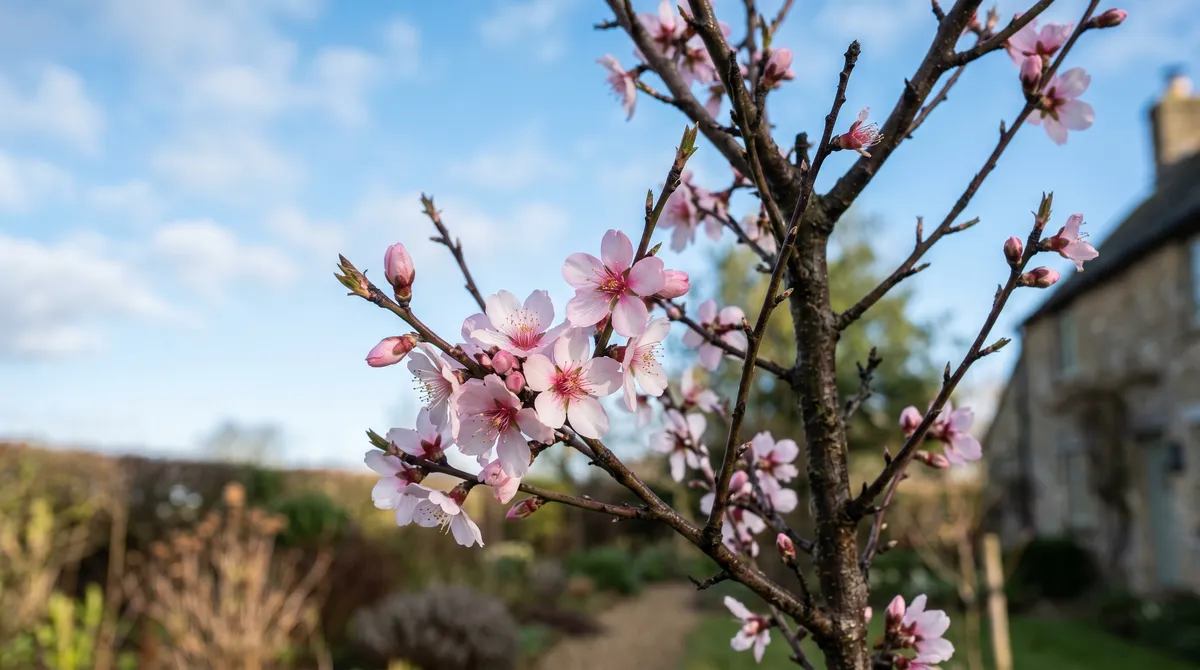
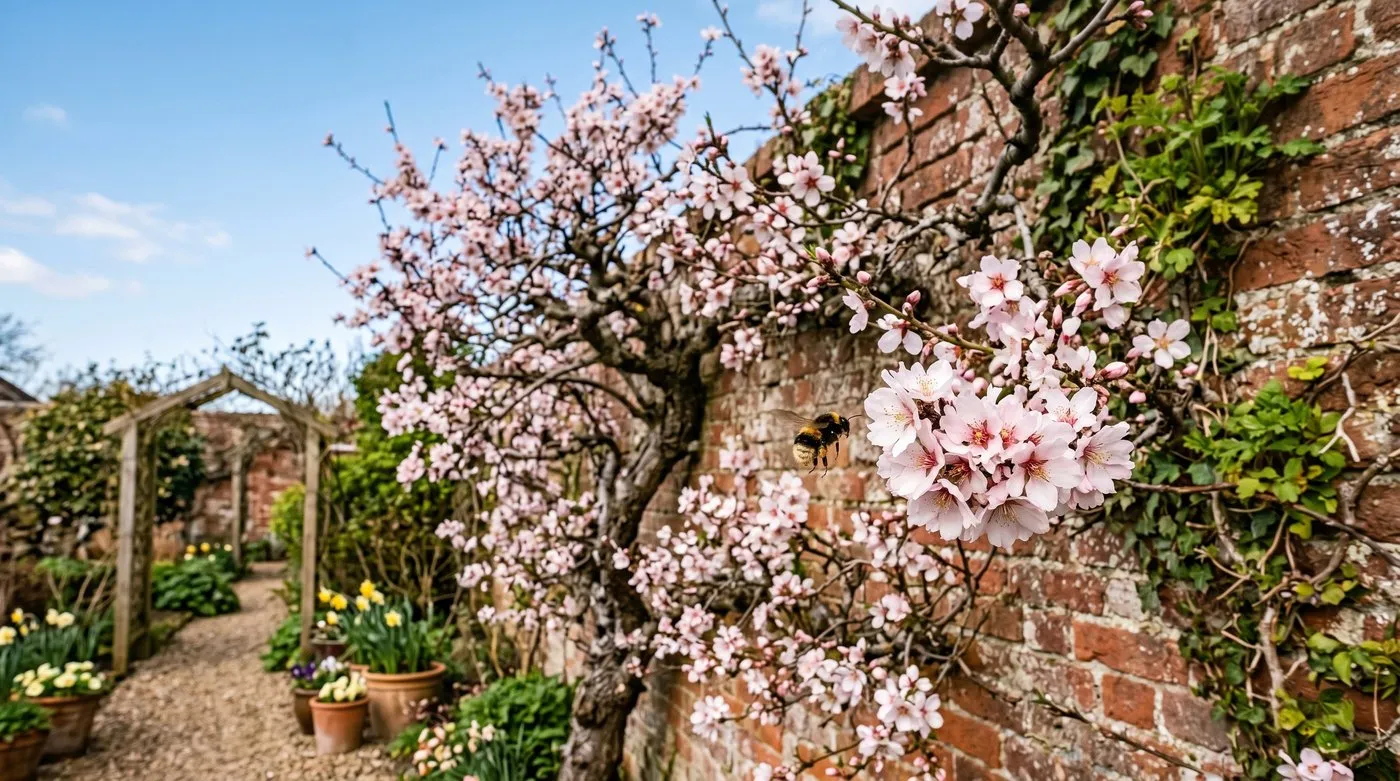 Early March blossom on a fan-trained Robijn almond. Bumblebee activity is the bottleneck; on cold days hand-pollination delivers the only viable fruit set
Why almonds are difficult in the UK
Almond blossom opens in early March, weeks before peach or apple. UK average for almond bud break is around 1-10 March in southern England, 7-21 March in the Midlands, 15-30 March in northern England and Scotland. This is the warmest February-March in 30 years; in colder springs the dates shift later.
The problem is timing. Late frost is common in March across most of the UK. A single -2C night during open blossom destroys 60-90% of flowers. Even sub-freezing temperatures on closed buds reduce yield significantly.
The second problem is pollinators. Honeybees do not forage below 12-14C. Bumblebees fly from 7-8C but only on still days. Most UK March days fail one or both conditions during almond flowering.
The third problem is rain. Heavy rain during open blossom washes pollen off anthers and degrades stigma viability. Almonds need 3-5 dry hours per day during the 7-10 day flowering window to set fruit.
The fourth problem is disease. Peach leaf curl (Taphrina deformans) thrives in cool wet conditions exactly when UK almonds are leafing out. Without protection, trees lose 60-80% of first-flush leaves by May.
None of this is fatal. South-facing walls trap heat and protect from late frost. Polythene canopies keep blossom dry and warm. Hand-pollination guarantees fruit set on warm hours. The right cultivars resist disease. UK almonds work; they need different management to Spanish or Californian almonds.
| UK challenge | Solution |
|---|---|
| Early-March blossom | South wall, frost-free site, sheltered position |
| Late frost | Polythene canopy or horticultural fleece |
| Cold pollinator weather | Hand-pollination with soft brush on warm hours |
| Spring rain | Overhead cover during flowering |
| Peach leaf curl | Polythene canopy from February to April, or copper spray |
The three UK cultivars that work
Robijn (Netherlands, 1980s) is the most reliable UK almond. Bred for cool-climate cropping. Flowers slightly later than most almonds (around 7-14 March in southern England). Produces medium-sized sweet kernels. Self-fertile in name but yield doubles with cross-pollination. UK trial yield of 3.2kg average from a 5-year tree.
Ingrid (Netherlands) is the heavy cropper. Similar flowering time to Robijn. Bigger kernels but slightly thinner shells. Needs a pollinator partner. UK trial yield 3.6kg average from a 5-year tree.
Mandaline (France) is the late-flowering option. Flowers around 14-21 March, missing many late frosts. Smaller kernels but more reliable cropper in colder UK sites. UK trial yield 2.8kg average.
Other named varieties (Marcona, Nonpareil, Texas, Carmel) are not recommended for UK cropping. Bred for Spanish or Californian climates. Flower too early for UK frost protection to keep pace with bud break.
All three UK-recommended cultivars need a different cultivar within 30 metres for pollination. A solo tree of any cultivar gives minimal fruit. Two of the same cultivar give minimal fruit. Plant at least two different cultivars from the recommended three.
| Cultivar | Origin | UK flowering | Kernel size | Yield 5-yr UK tree |
|---|---|---|---|---|
| Robijn | Netherlands | 7-14 March | Medium sweet | 3.2kg average |
| Ingrid | Netherlands | 7-14 March | Large sweet | 3.6kg average |
| Mandaline | France | 14-21 March | Small sweet | 2.8kg average |
| Marcona | Spain | Late February | Round sweet | Rare UK crop |
| Nonpareil | California | Late February | Soft sweet | Almost never crops UK |
Siting and planting
A south or south-west-facing brick or stone wall is the gold standard UK site. The wall traps heat, raises overnight temperatures 3-5C, and provides anchor for fan training. A free-standing tree in open ground rarely crops north of the M4.
Frost pocket avoidance is critical. Cold air pools in valley bottoms and dips. Plant almonds on a slope, on raised ground, or on a wall that captures all-day sun. A two-degree warmer site shifts blossom timing by 5-7 days and often pulls it past last frost.
Shelter from north and east winds. Cold spring winds dry blossom and reduce pollinator activity. Plant in the lee of a hedge, fence or building.
Soil pH 6.5-7.5, well-drained, sandy loam ideal. Wet ground rots roots. Heavy clay can be improved with deep planting holes filled with grit and compost.
Spacing 4-5m between trees for fan-trained wall culture. Free-standing trees need 6-8m. The trio fan-trained on a 12-15m wall gives good cross-pollination and easy management.
Plant November to March in dormant season. Bare-root trees from specialist nurseries. Container trees can plant any time but autumn establishment is best.
Stake firmly for 3 years. Almonds rock in wind and break new root contact. Use a stout angled stake on the leeward side.
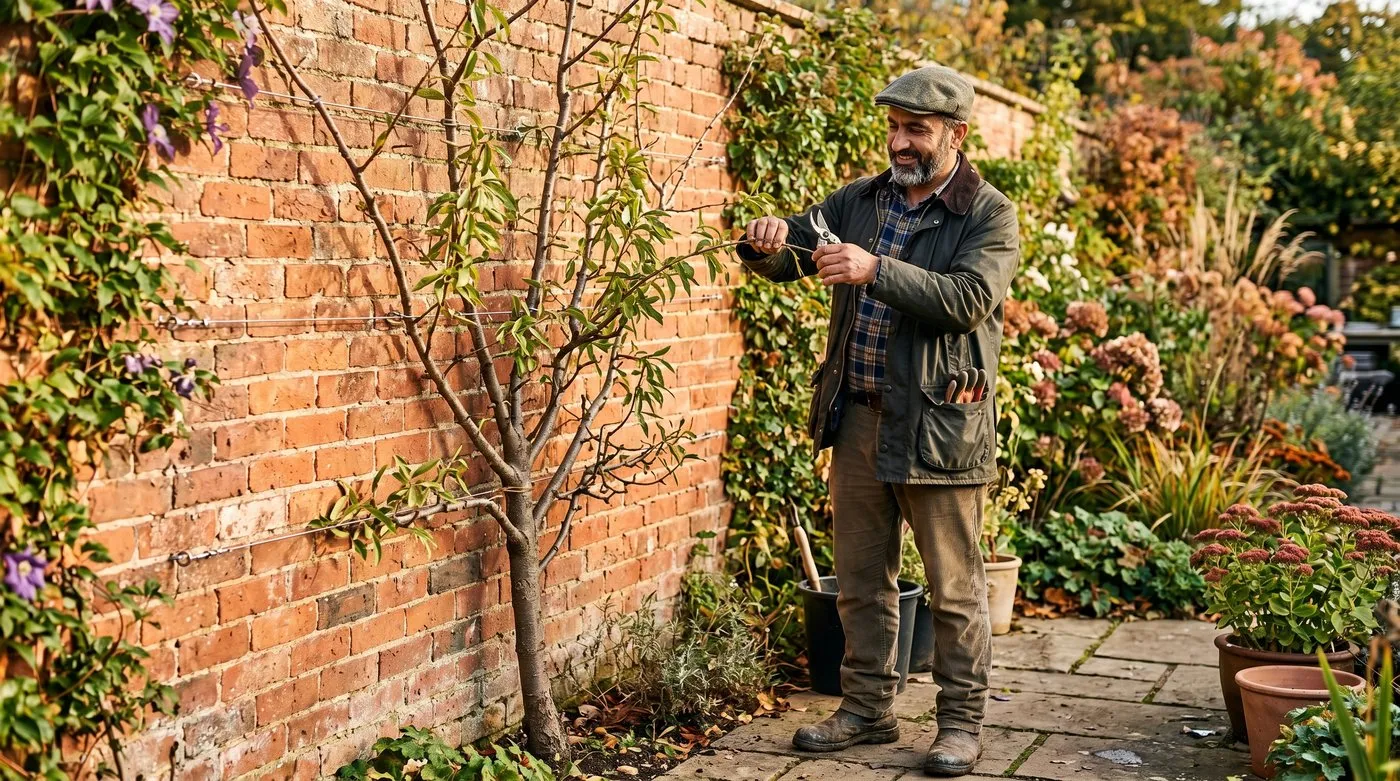 Fan training on a south-facing brick wall, the only practical UK form for cropping. Tie new growth horizontally to wire supports in summer
Pollination: the hand-brush method
Almonds are self-sterile. All cultivars need a pollinator from a different cultivar within 30 metres. Pollen transfer happens normally by bee. In the UK, bees are often unavailable during March blossom.
Hand-pollination doubles UK yield. Use a soft sable artist’s paintbrush, size 6-10. Brush the centre of each open flower lightly. Transfer pollen between cultivars by working back and forth between trees.
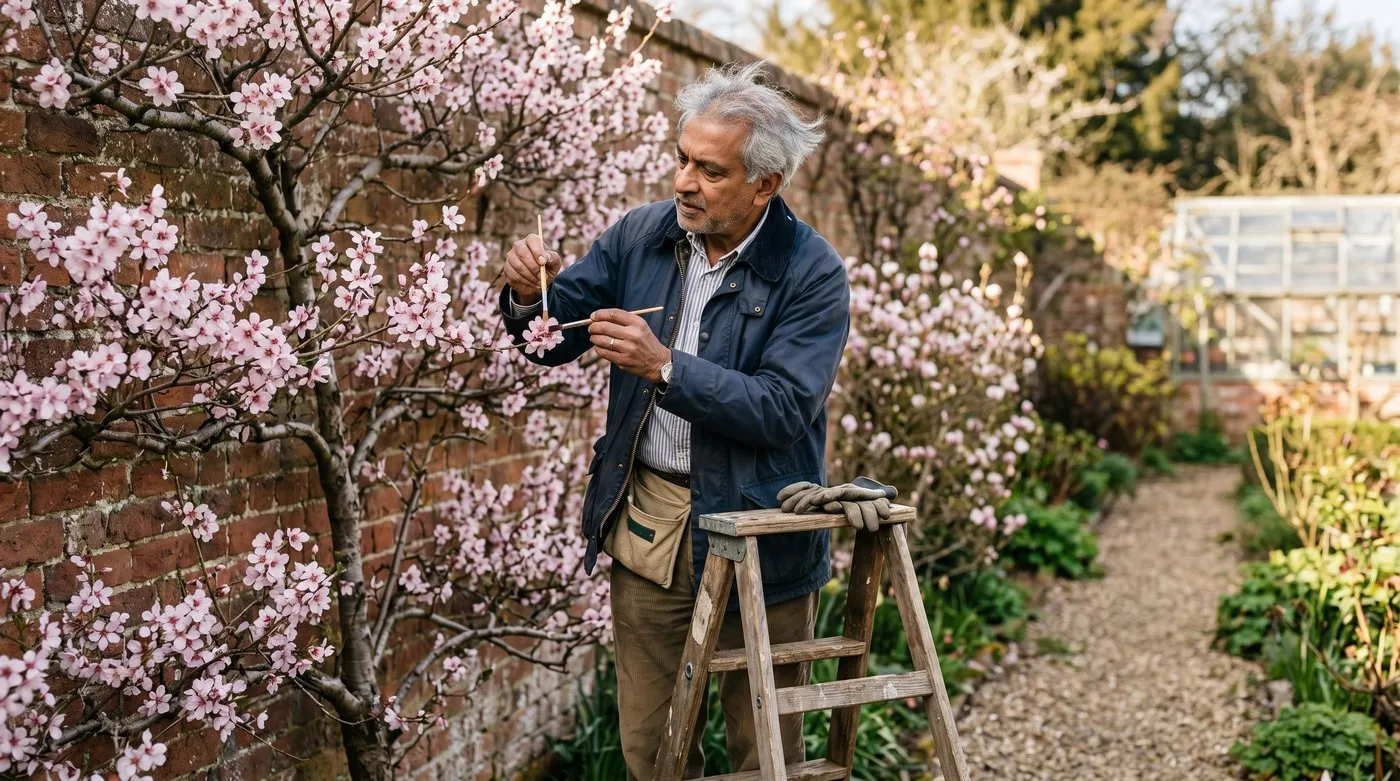 Hand-pollination with a soft sable paintbrush. Two daily sessions during the 7-10 day flowering window double UK yields
Do this twice daily during flowering: morning and afternoon. Each session takes 15-20 minutes for three small trees. The flowering window is 7-10 days. Total time investment is 4-6 hours per spring.
Hand-pollinate on warm dry hours. Above 8C, no rain forecast for 2 hours, no strong wind. Below 5C, pollen does not germinate on the stigma even if transferred.
Hand-pollination matters more in cold springs. In warm springs with active bees, the trees set fruit naturally and hand-pollination adds 10-20%. In cold springs, hand-pollination is the difference between zero fruit and a partial crop.
Mark trees with cultivar labels. Confusion between cultivars during pollination is wasted effort. Permanent metal tags on the main stem keep the rotation correct.
Gardener’s tip: A small electric toothbrush set to vibrate against open flowers releases pollen in a fine cloud. This is the technique used in glasshouse tomato pollination. For almonds, brush the stamens of one cultivar, hold the buzzing brush against the stigma of another cultivar, and pollen transfer is instant. Faster than a sable brush over a row of trees.
Peach leaf curl and the polythene canopy
Peach leaf curl (Taphrina deformans) is the biggest UK disease threat to almonds. The fungus infects new leaves during cool wet weather at bud break. Leaves blister, redden, distort, and drop. A heavily affected tree loses 60-80% of first-flush leaves.
The spores need water on the leaf to germinate. Cover the tree from January to early April with clear polythene or rigid plastic and the spores cannot infect. This is the gold standard UK control.
Build the canopy on a simple wooden frame. 2x2 timber uprights, horizontal rails, clear polythene stretched over and weighted down. Open the sides on dry days for airflow. Close before any rain.
Copper sprays are the alternative. Apply at bud burst (January or early February) and again 14 days later. Effective but not curative; copper protects undeveloped buds, does not save already-infected leaves.
Resistant rootstocks help marginally. Most UK almonds graft onto seedling almond or peach rootstock. Some nurseries offer ‘St Julien A’ plum rootstock; resistance is partial.
Affected leaves must be removed and binned. Composting spreads spores. Bag and dispose with household waste.
Trees recover from a peach leaf curl attack but yield drops significantly. Affected trees set fewer flowers the following year because energy went into a second flush of leaves rather than fruit bud formation.
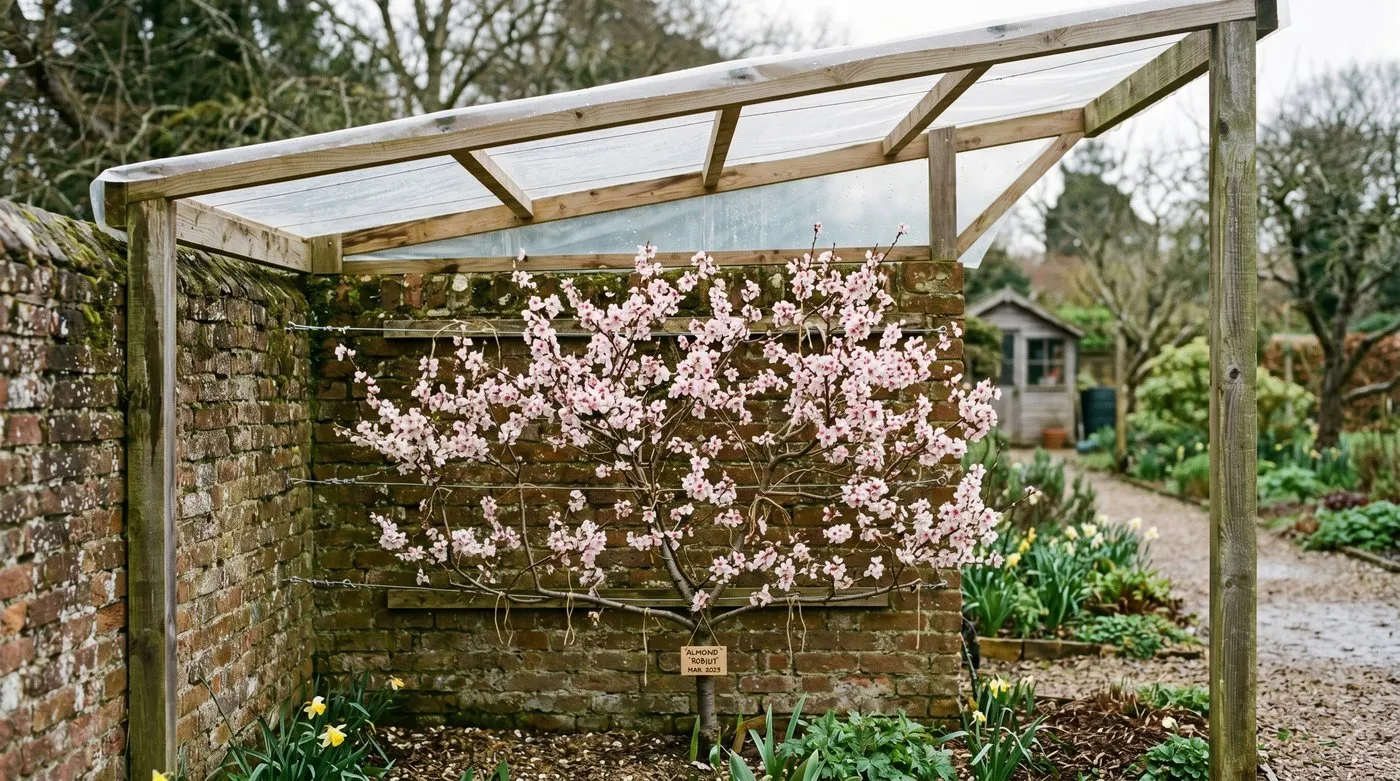 Polythene canopy installed January through April. The clear plastic keeps blossom dry, stops peach leaf curl, and shelters early flowers from late frost
Pruning and training
Fan training is the standard UK form for wall-grown almonds. Maximum sun on every branch, minimum overall height, easier protection and hand-pollination.
Initial fan: two ribs at 30-45 degrees from vertical, building out to 4-6 main ribs over 3 years. Tie growth to wire supports horizontal on the wall at 30cm intervals.
Summer prune July-August. Pinch back side shoots to 4-5 leaves above the basal cluster. This builds fruiting spurs and keeps the tree compact.
Winter prune January-February. Remove dead, diseased and crossing branches. Thin out crowded growth. Cut back to outward-facing buds.
Almonds fruit on previous year’s wood and 1-2 year-old spurs. Avoid removing all the previous year’s shoots. Renewal pruning replaces older wood every 4-6 years.
Keep height under 3m for fan culture. Easier protection, easier picking, easier pollination. Free-standing trees can reach 5-7m but are harder to manage in UK conditions.
| Year | Pruning work | Goal |
|---|---|---|
| Year 1 | Reduce to 3-4 main shoots, tie at 30-45 degrees | Establish fan framework |
| Year 2 | Tie new growth horizontal, summer pinch shoots | Build secondary ribs |
| Year 3 | Continue framework, leave fruiting wood | First fruits |
| Year 4-6 | Annual summer pinch, winter thin | Productive maturity |
| Year 7+ | Renewal pruning, replace older wood | Maintain vigour |
Year-by-year plan
Year 1-2: establishment. Tree settles into site. Minimal cropping expected. Focus on framework training and watering through dry weather.
Year 3: first fruits. Small crop of 100-500g per tree. Validate cultivar choice and pollination success.
Year 4-5: ramp up. Trees reach productive maturity. Yields rise to 1-3kg per tree.
Year 6-7: full crop. Mature trees yield 2-8kg per tree depending on cultivar and season. Crop varies year to year with spring weather.
Year 8+: maintenance. Renewal pruning replaces older wood. Trees can live 50-100 years in suitable UK sites.
Harvest, drying and storage
Almonds ripen August to October in the UK. The fleshy outer husk dries and splits, revealing the hard shell inside. Harvest when 80% of husks have split.
Pick by hand or shake gently onto sheets. Trees fruit on multiple branches simultaneously but ripen unevenly. Two or three picks across 2-3 weeks catch all the crop.
Remove the husk immediately after picking. The husk holds moisture and encourages mould on the shell. Dry the shell-on nuts on racks for 5-7 days in a warm, dry place.
Crack and store kernels in airtight jars. Kernels keep 12-18 months at room temperature, longer in the fridge or freezer.
UK kernels are smaller than Spanish almonds. Expect 1.2-1.8g per kernel versus 1.6-2.0g for Spanish supermarket almonds. The flavour is sweeter and more intense; many home growers prefer the UK kernel.
Common mistakes to avoid
Planting in a frost pocket. Cold air pools in dips. Almonds in dips lose blossom every year. Plant on a slope or on a wall.
Single tree. Almonds are self-sterile. One tree of any cultivar gives almost no fruit. Always plant at least two different cultivars within 30 metres.
No frost or rain protection during flowering. A single -2C night destroys 60-90% of open blossom. A wet week prevents pollination. Polythene canopy is the answer.
Choosing Marcona or Nonpareil. These are Spanish and Californian cultivars that flower too early for UK frost protection. Choose Robijn, Ingrid or Mandaline.
Skipping peach leaf curl prevention. First-year tree damage from peach leaf curl sets cropping back 2-3 years. Cover or spray from year one.
Planting in heavy unimproved clay. Almonds rot. Improve drainage with grit, compost, and a raised planting mound.
Frequently asked questions
Can almonds grow in the UK?
Yes, in southern and central England on protected south-facing walls or in cold frames during flowering. The limiting factor is the very early March blossom, often before pollinators are active and during late frost season. Three cultivars (Robijn, Ingrid, Mandaline) and a sheltered site give the best chance of a UK crop. Free-standing trees in open ground rarely fruit reliably north of the M4.
Do almonds need pollination?
Yes, almonds are self-sterile and need cross-pollination from a different compatible cultivar within 30 metres. Two trees of the same variety give no fruit. Hand-pollination with a soft paintbrush helps in the UK because the early March blossom often opens before bumblebees and honeybees are active. Hand-pollinate twice daily during the 7-10 day flowering window.
How long do almond trees take to fruit in the UK?
UK almond trees produce their first fruits at 3-5 years from planting. Container-grown trees from a nursery are usually 2-3 years old at sale, so first fruits arrive 1-3 years after planting. Mature trees crop reliably from year 6-7 onwards if blossom is protected from frost. Yield rises from 100-500g in year 3 to 2-8kg per tree at full maturity.
What is the best almond variety for UK gardens?
Is peach leaf curl a problem on UK almonds?
Yes, almonds are highly susceptible to peach leaf curl in UK conditions. Wet weather during leaf bud break (February-March) spreads the fungal spores. Prevention: overhead polythene protection through February-April keeps leaves dry. Copper-based sprays at bud burst control the disease where covers are not practical. Affected leaves must be removed and binned to prevent spore release.
Now you have an exotic nut in the plan, see our growing citrus trees guide for the wider Mediterranean fruit experiment and our how to grow hazel/cobnut guide for a true UK-native alternative that crops reliably without canopies. The Agroforestry Research Trust supplies specialist UK nut trees including all three recommended almond cultivars.
Our team produces practical UK gardening guidance from source research, contributor records and established horticultural practice. Editorial standards are overseen by Matt W.