Key takeaways
- Stella is the safest first-choice cherry: self-fertile, reliable, sweet, hardy across the UK
- For small gardens, choose Gisela 5 rootstock which limits tree height to 2.5 to 3m
- Sour cherries (Morello, Kentish Red) tolerate north-facing walls and partial shade
- Self-fertile varieties skip the need for a pollinator partner: Stella, Sunburst, Lapins, Morello
- Bird netting from late June is non-negotiable, or blackbirds take the whole crop
- Sweet cherries crop late June to July, sour cherries crop late July to August
- Avoid Mazzard or wild rootstock for a domestic garden, they grow 7m plus
Cherry trees are one of the few fruit trees where the wrong variety choice can mean zero fruit for years. Pick a self-sterile variety with no pollinator nearby and the tree will flower beautifully every May and crop nothing. Pick the wrong rootstock and the tree will outgrow a small garden by year five and become impossible to net. Pick the wrong location and bullfinches will strip the buds in February before the tree even gets to flower.
Sweet versus sour: the first decision
Before picking a variety, decide whether you want sweet eating cherries or sour cooking cherries. The two categories grow differently, need different positions, and crop at different times.
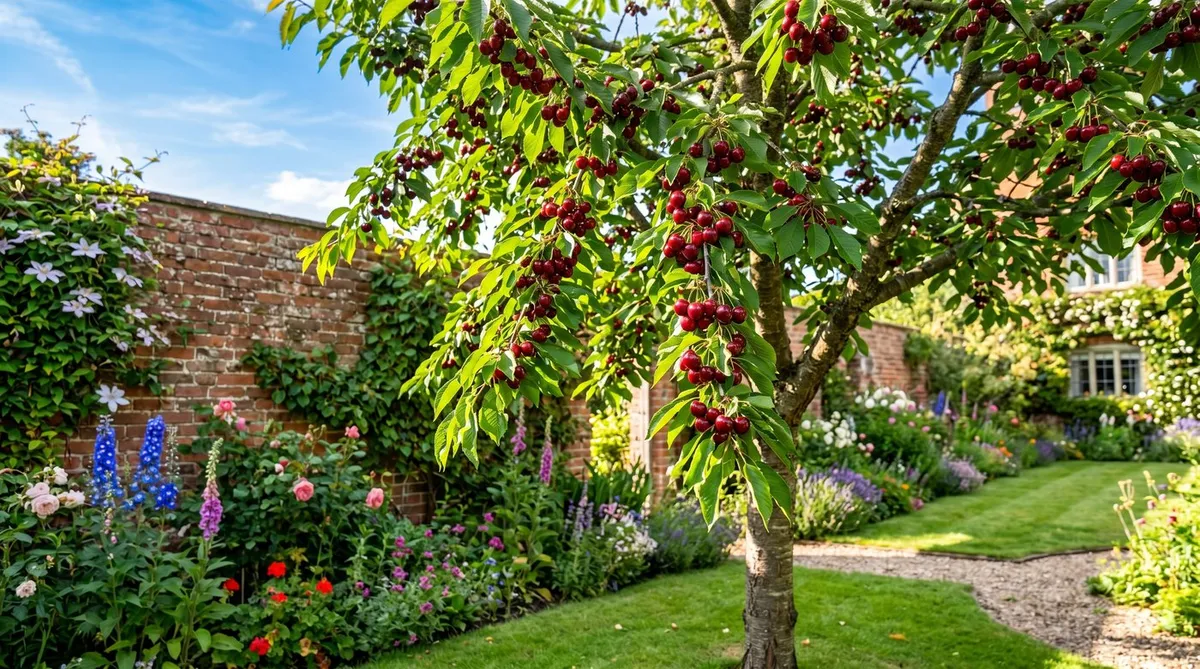
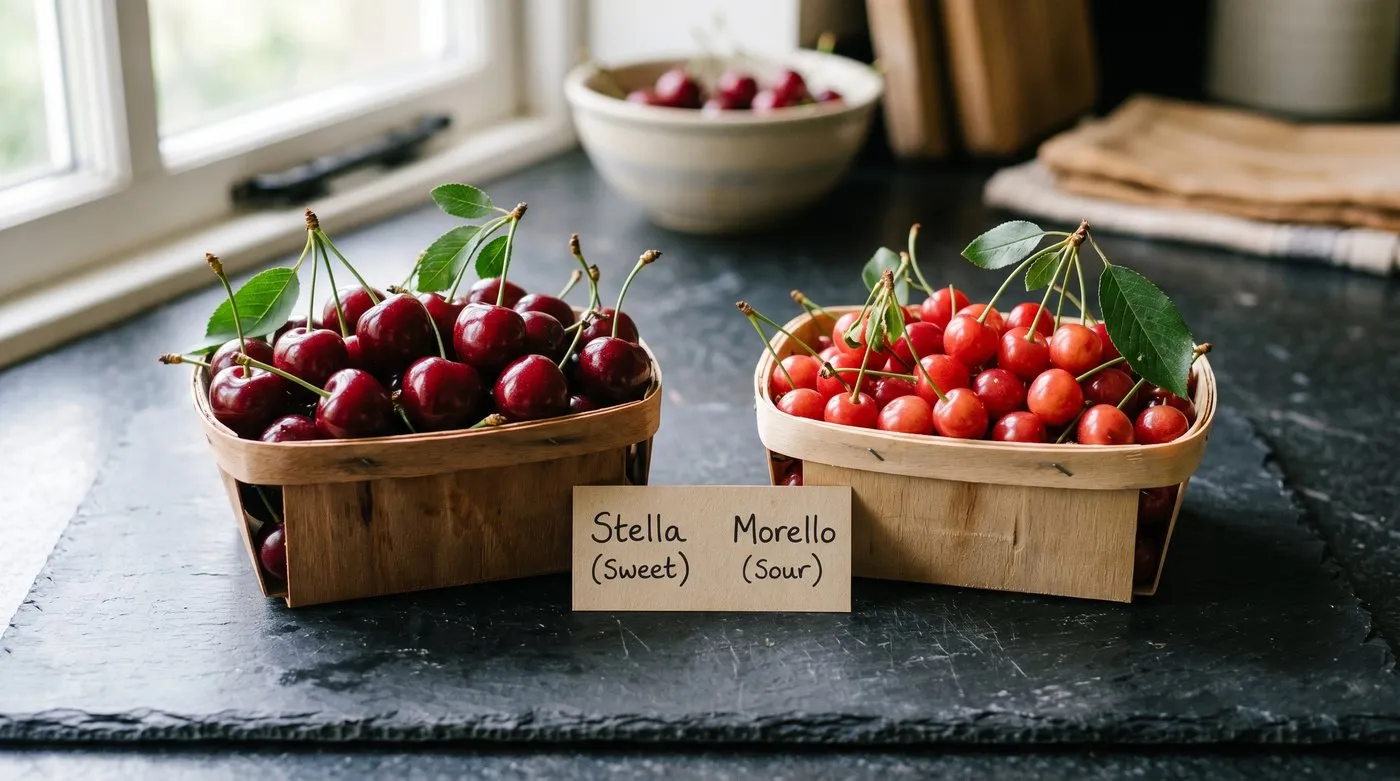
Sweet cherries (Prunus avium) are the dessert cherries you eat fresh. They need a sunny south or south-west aspect, well-drained soil, and shelter from strong winds. They crop late June into July. Most modern UK sweet varieties are self-fertile. Yields from a mature tree on Gisela 5 rootstock run 8 to 15kg per year with netting.
Sour cherries (Prunus cerasus) are the cooking and preserving cherries used in pies, jams, and brandy. They tolerate north-facing walls and partial shade, which is unusual for fruit trees. They crop later, from late July into August. They are self-fertile, almost without exception. Yields are typically 6 to 10kg per year on a mature tree.
For most UK gardens with space for one cherry tree, sweet is the obvious choice. For gardens with a north-facing wall doing nothing, planting a Morello against it is a productive use of difficult space.
The varieties that actually work in UK gardens
The four self-fertile sweet varieties at the top of the list cover almost every domestic UK situation. The sour section is dominated by Morello, which is the only cherry that genuinely thrives on a north-facing wall.
1. Stella
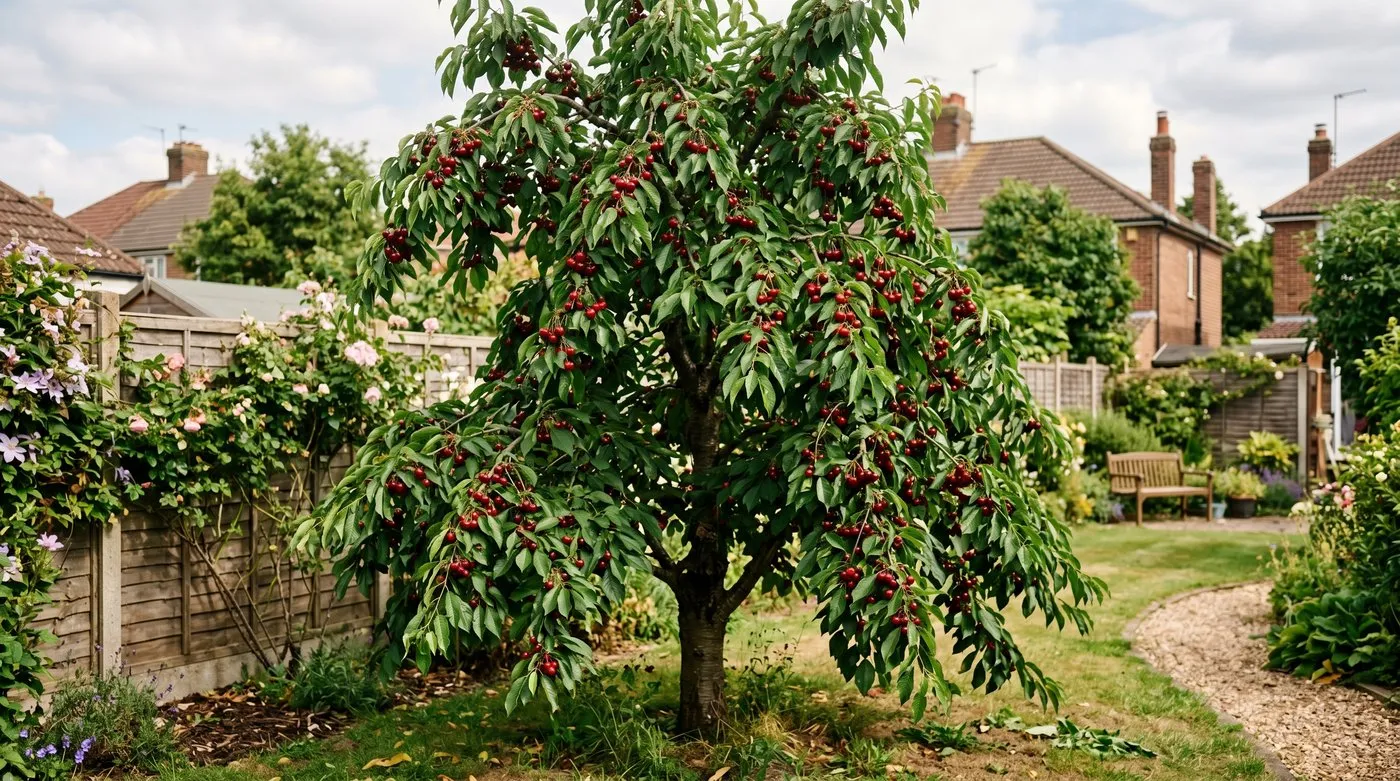
The standard recommendation. Bred in Canada in 1968 specifically as a self-fertile sweet cherry. Crops reliably across the whole UK from southern England to Scottish lowlands. Fruit is medium-large, deep red, sweet, with reasonable crack resistance. On Gisela 5 rootstock the tree matures at 2.5 to 3m. First crop typically at year 3 from planting, full crop by year 5 or 6.
If you have never grown cherries before, plant a Stella. The Royal Horticultural Society awards it an AGM (Award of Garden Merit), which confirms reliability in UK gardens.
2. Sunburst
Larger fruit than Stella, slightly later, also self-fertile. Bred in British Columbia in 1983. Crop is darker, sweeter, with that classic cherry intensity. Slightly more prone to cracking in heavy rain than Stella. Works well in southern and central England, less reliable in the north and Scotland.
3. Lapins
Self-fertile sweet cherry bred in Canada and released 1984. The best crack resistance of the self-fertile group, which matters in wet UK summers. Crops mid to late July with large, firm, dark red fruit. Heavy cropper, often needing thinning to stop branch breakage. For Welsh, Cumbrian, and Scottish gardens where rain at ripening is reliable, Lapins is the safest sweet choice.
4. Sweetheart
Self-fertile, later than Stella and Lapins. Crops late July into early August. Smaller fruit but huge volumes. Useful as a second tree to extend the harvest into August if you already have Stella for early-July eating. On Gisela 6 rootstock matures at 3 to 3.5m.
5. Kordia
Czech-bred (1991) sweet variety, not self-fertile. Needs a pollinator from compatibility group 4 (Sunburst, Sweetheart, Lapins all work). Excellent dark deep-red fruit, large, with intense flavour and very good crack resistance. Choose Kordia only if you have room for two trees or know a neighbour has a compatible pollinator within 18m.
6. Merton Glory
Pale yellow-blushed-pink heritage variety bred at the East Malling Research Station in 1947. Not self-fertile. The unusual yellow-blush fruit is striking and crops early July. Plant only for the heritage angle and the colour interest, as productive yield is lower than Stella.
7. Morello
For fan-training against a wall (the highest-yield method for sour cherries), see our fan-training fruit trees guide.
8. Kentish Red
Traditional English sour variety, smaller and brighter red than Morello. Self-fertile. Excellent for jam-making, where the more delicate red colour holds in the jar better than darker Morello. Less productive than Morello (typically 5 to 7kg from a mature tree) but more characterful flavour.
9. Nabella
Newer sour variety from Romania, naturally compact, self-fertile. On Gisela 5 stays at 2 to 2.5m. Useful for pot growing or very small gardens where Morello on Colt rootstock would be too large.
10. Bigarreau Napoleon
Heritage pale-blush variety from the 18th century. Not self-fertile, group 4 pollinator. Stunning fruit colour, traditionally the cherry of choice for glacé cherries. Plant only as part of a heritage orchard alongside compatible varieties.
Rootstocks: the second decision
The rootstock matters as much as the variety. The same Stella cherry will be a 3m garden tree on Gisela 5 and a 7m orchard tree on Colt or Mazzard.
| Rootstock | Mature height | Years to crop | Best for |
|---|---|---|---|
| Gisela 5 | 2.5 to 3m | 3 | Small gardens, pots, fan-train |
| Gisela 6 | 3 to 4m | 3 to 4 | Mid-size gardens, half-standards |
| Colt | 4 to 5m | 4 to 5 | Larger gardens, wall fans |
| Mazzard (F12-1) | 6 to 8m | 6 to 8 | Orchards, not domestic |
| Wild cherry seedling | 7m plus | 8 plus | Avoid for domestic gardens |
For 90 percent of UK gardens, Gisela 5 is the right rootstock. It crops earlier, stays small enough to net easily, and works in containers. Gisela 6 is a good middle ground for a slightly larger lawn specimen. Colt is appropriate only if you genuinely have a large garden or want a heavy-yielding fan against a 4m-plus wall.
For more on dwarf fruit trees generally, our dwarf fruit trees for small gardens guide covers apples, pears, plums, and cherries together.
Cherries in pots: what works
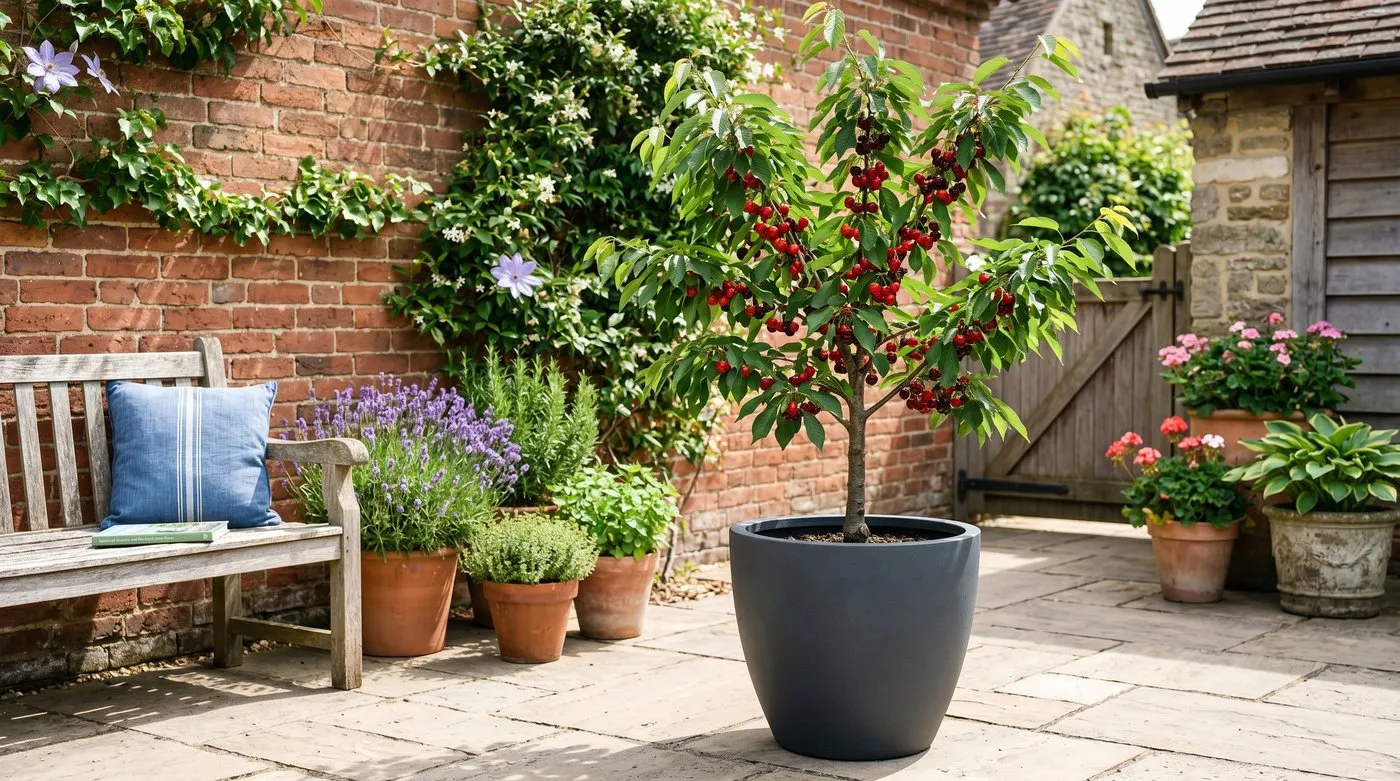
Cherry trees grow happily in large containers if you choose Gisela 5 rootstock and a self-fertile variety. Stella, Sunburst, Lapins, and Morello all work.
You will need:
- A pot at least 60cm diameter and 50cm deep
- John Innes No 3 compost (loam-based, not multi-purpose)
- A sunny south or south-west aspect, sheltered from strong wind
- A drip tray for hard surfaces
- A liquid feed (general fruit feed) monthly from April to August
- Annual top-dressing in March with fresh compost
- Repotting every 3 to 4 years
Expected pot life is 10 to 15 years before the tree outgrows the container. Yield from a potted cherry is lower than from a ground-planted tree, typically 3 to 6kg from a mature potted Stella versus 8 to 15kg in the ground.
The bird problem: net or lose the crop
Of all the fruit trees in a UK garden, cherries are the most attractive to blackbirds. A mature tree without netting will be 90 to 100 percent stripped within four to five days of fruit starting to colour. This is not a maybe. It is a certainty.
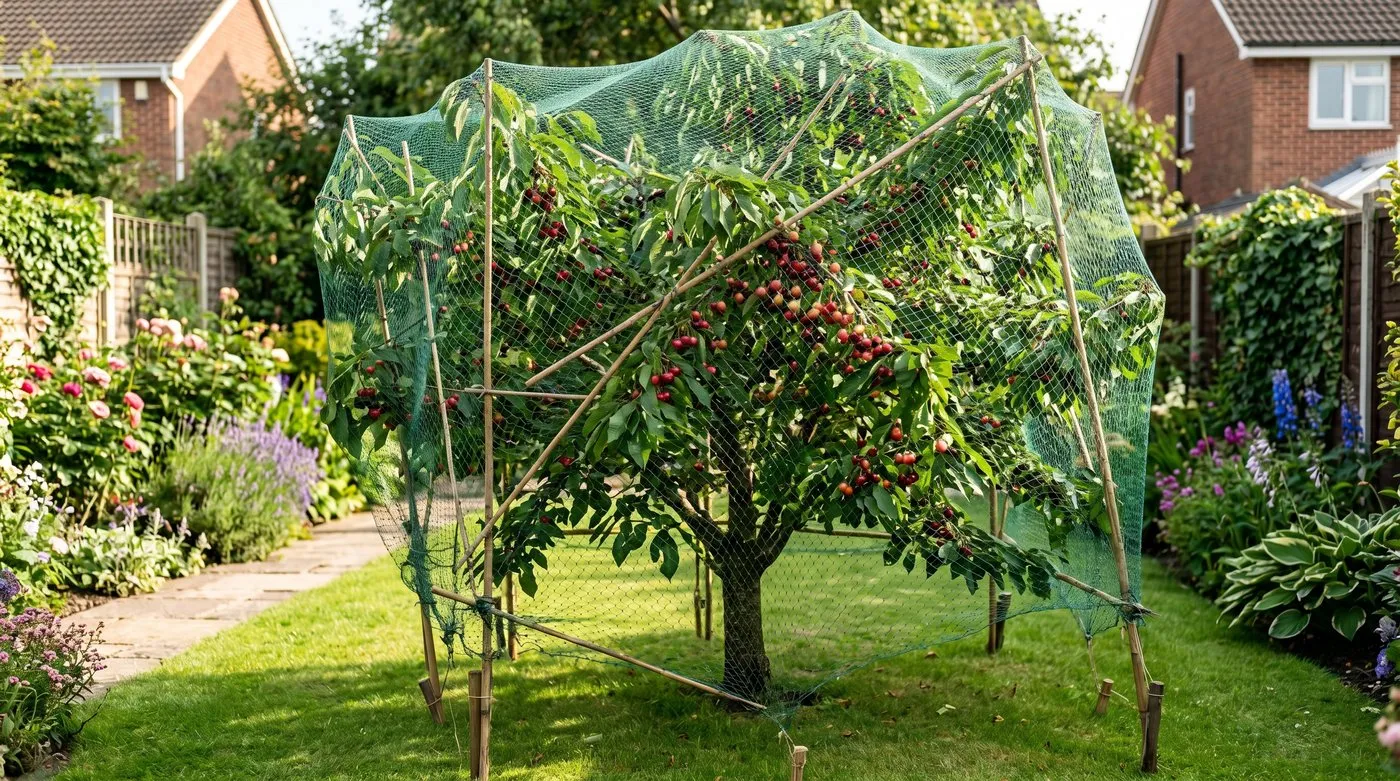
The fix is bird netting. Use 12 to 14mm green mesh, draped over the canopy from late June (or whenever the first cherries colour from green to amber), supported by bamboo canes or a fruit cage frame. The net must reach the ground and be pegged down, as blackbirds walk in from below.
For fan-trained Morellos against a wall, a simple net curtain pulled over the fan and pinned to the wall works. For half-standards in the lawn, a temporary fruit cage built from canes and the same net is the standard.
Site, soil, and planting
Cherries need a sunny south or south-west aspect with shelter from cold east winds in spring (which can damage blossom and reduce fruit set). Cold winds at flowering are a common cause of cherry fruit drop, where young cherries yellow and fall before they ripen. Well-drained soil is essential. They will not tolerate winter waterlogging.
Soil pH: slightly acid to neutral (pH 6.0 to 7.0). Most UK garden soils are fine. On chalky soils you may see iron deficiency on the leaves, which a top-dressing of sequestered iron in spring corrects.
Plant a bare-root tree between November and March. Dig a hole 60cm wide and 40cm deep. Mix the excavated soil 50:50 with well-rotted compost. Stake the tree at planting with a strong post angled at 45 degrees driven in away from the trunk. Tie with a flexible rubber tie.
Water in well, then mulch with 5cm of compost or bark, keeping the mulch 5cm clear of the trunk.
In the first year, water deeply (5 litres per tree) once a week between April and September if the weather is dry. From year 2 onwards, water only in prolonged drought.
Disease and problem watch
Cherry trees in UK gardens face three main problems.
Canker. Bacterial disease causing sunken lesions on bark and dieback of branches. Worst in wet UK summers. Prune in dry summer weather (never winter or spring) to limit infection. Our fruit tree canker treatment guide covers identification and recovery.
Cherry blackfly. A specialist aphid that curls young leaves in spring. Damages new growth but rarely kills the tree. Wash off with a strong jet of water in May, or spray with horticultural soap. Birds (blue tits especially) eat large numbers if a feeder is nearby.
Bullfinches. Winter bud strippers as noted above. Netting from January or a fruit cage is the only reliable defence.
Cracking. Sweet cherries crack if heavy rain falls when fruit is ripening. Lapins and Sweetheart are the most crack-resistant. There is no chemical fix. Net to delay birds and pick at first colour change if heavy rain is forecast.
A two-tree plan for a typical UK garden
If you have space for two cherry trees, the optimal plan is:
- One self-fertile sweet on Gisela 5 in the sunniest spot (Stella, Sunburst, or Lapins)
- One Morello sour on Colt fan-trained against a north or east wall
This gives you fresh sweet cherries late June to mid-July and cooking cherries late July into August. Two trees, complementary positions, no pollinator problem, a five to seven week total harvest window.
If you only have space for one, plant Stella. It is the most reliable single-tree cherry for any UK garden. Pair with bird netting, water in dry spells for the first three years, and from year 4 onwards you will be eating cherries every summer.
Frequently asked questions
The questions below cover the points most often asked when choosing a cherry tree for a UK garden.
Our team produces practical UK gardening guidance from source research, contributor records and established horticultural practice. Editorial standards are overseen by Matt W.