Key takeaways
- Calabrese gives one large central head plus 6-8 weeks of side spears from the same plant
- Sow direct in modules March to July for UK harvests June to October
- Plant spacing of 45cm row by 30cm gives the highest single-head weight
- Marathon F1 holds tight heads for 14 days; cheaper varieties bolt in 5-7 days
- Side spears keep coming if you cut the main head with 10cm of stem attached
- Each plant yields 800-1,200g total across the full crop, double the supermarket pack
Calabrese is the green broccoli supermarkets sell. It is not the purple sprouting broccoli that crops in February. The two are confused often enough that UK gardeners overlook calabrese, plant the wrong crop for the season, and miss the easiest summer brassica on the plot. This guide gives the sowing dates, spacing, harvest method, and side-spear technique that doubles yield from each plant.
You will find the variety choice that holds tight heads for 14 days at harvest, the spacing that builds the heaviest central head, and the cutting method that triggers a second 6-8 week side-spear flush. Pair this with our how to grow broccoli guide and our companion planting guide for brassica neighbours.
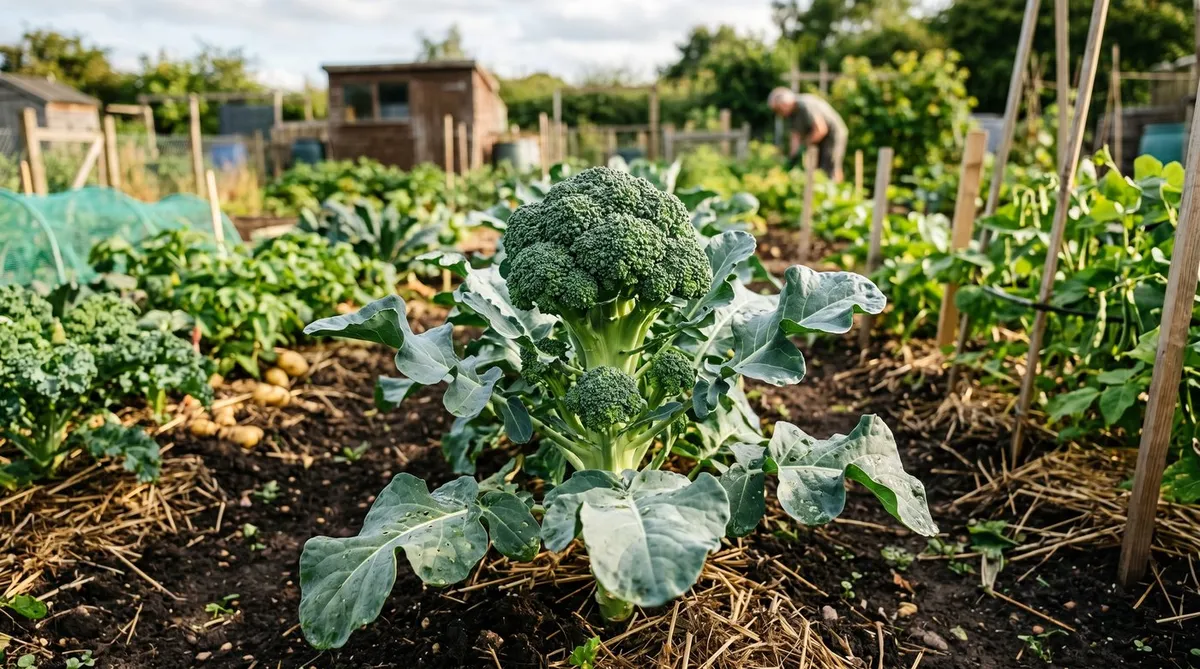
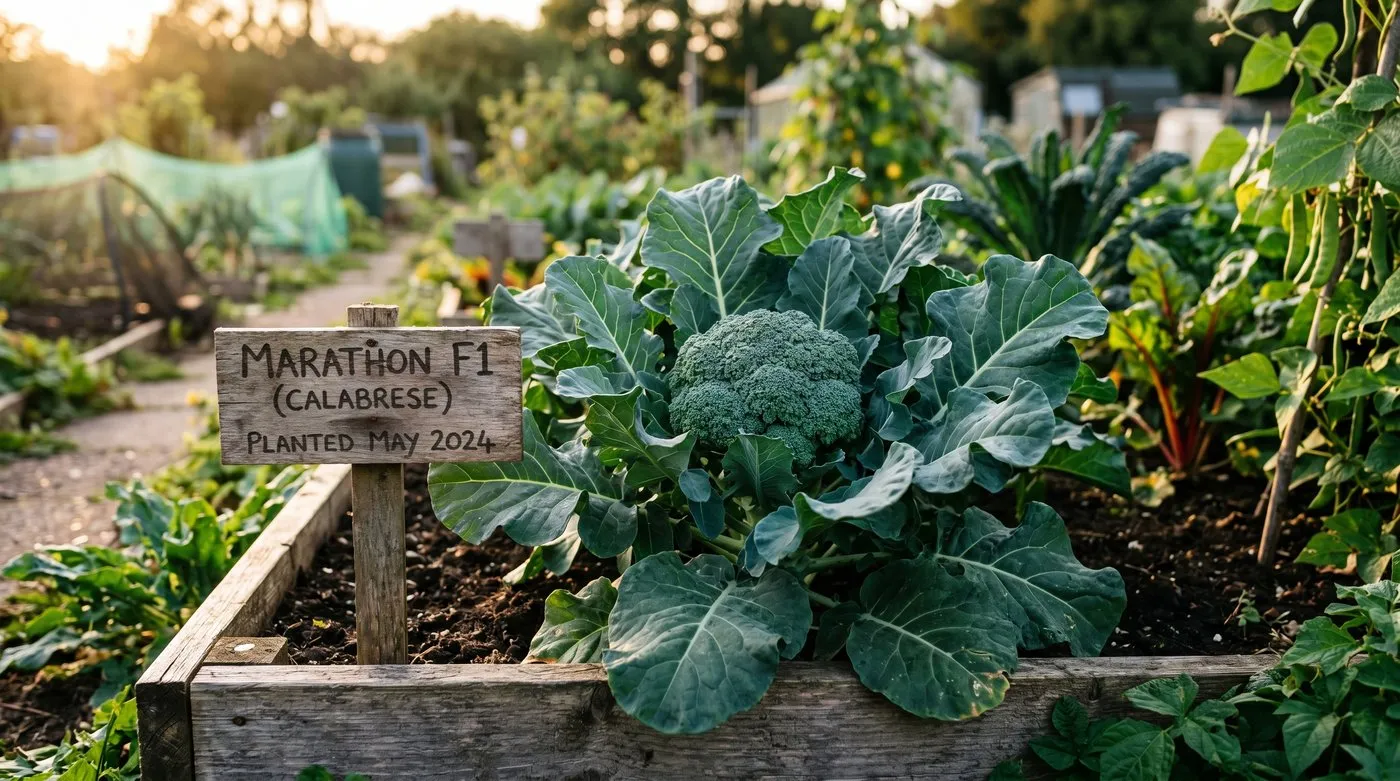 Marathon F1 calabrese 88 days from a May sowing, the tight glaucous head ready for cutting before any of the buds start to open
What calabrese is and what it is not
Calabrese (Brassica oleracea var. italica) is the green-headed Italian broccoli grown for one large central head followed by smaller side spears. The name comes from Calabria, the southern Italian region where the crop was selected and exported in the early 20th century. UK supermarket broccoli is almost always calabrese.
Calabrese is not sprouting broccoli. Sprouting broccoli (purple sprouting and white sprouting) is hardier, crops over winter and early spring, and produces many small spears rather than one head. Sprouting broccoli takes 9-12 months from sowing; calabrese takes 11-16 weeks. Different season, different cultivation, different purpose.
Calabrese is not Romanesco. Romanesco is a separate selection with spiralled lime-green heads. It needs 100-120 days, prefers cooler conditions, and has firmer texture. Use Romanesco for show; calabrese for kitchen volume.
Calabrese suits UK summers because it tolerates moderate heat. Heads stay tight up to 24C. Above that, flowers open within 3-5 days. Late sowings that flower in September or October give the cleanest heads because temperatures drop into the perfect range.
Calabrese gives two harvests from each plant. This is the feature that separates it from cauliflower or cabbage. Cut the main head and side spears develop from leaf axils for 6-8 weeks. Total yield from one plant runs 800-1,200g, roughly double a supermarket pack.
| Crop | Days to harvest | Main yield | Season |
|---|---|---|---|
| Calabrese | 75-110 | 1 head plus side spears | Summer to autumn |
| Sprouting broccoli | 240-300 | Many spears, no head | Late winter to spring |
| Romanesco | 100-120 | Single firm spiralled head | Autumn |
| Cauliflower | 100-200 | Single white curd | Summer to autumn (or winter) |
Sowing dates and successional planning
Sow calabrese in modules March to July for UK harvests June to October. Direct sowing works but transplanting from modules gives better even rows and cuts slug damage in the early stages.
The 21-day stagger is the key to continuous harvest. One sowing gives 8-12 plants ready over a 14-day window. Three sowings 21 days apart give 36 plants across 8 weeks. The peak harvest never bunches and you eat broccoli for months not days.
Soil temperature minimum is 7-10C for germination. March sowings under glass or in a cool propagator at 15-18C germinate in 7-10 days. April-May sowings outside in cells germinate in 5-7 days. July sowings sometimes overheat; partial shade or evening shading helps.
Module sowing technique: 1-2 seeds per cell in a 6-cell tray with peat-free compost. Cover 5mm. Water from below. Thin to one seedling per cell at first true leaf stage. Plant out at 4-5 true leaves, 4-6 weeks after sowing.
Direct sowing works on light soils. Sow 2cm deep, 3cm apart, in rows 45cm apart. Thin to final 30cm spacing at 5 true leaves. Cover with fleece to deter cabbage white from day one.
| Sowing date | Transplant date | Main head harvest | Notes |
|---|---|---|---|
| Mid-March (under glass) | Late April | Late June | Cloche after planting |
| Late April | Late May | Mid-July | Fleece against cabbage white |
| Late May | Late June | Mid-August | Water consistently, heat risk |
| Late June | Late July | Late September | Cooler conditions, tight heads |
| Early July | Early August | Late October | Final sowing for autumn cut |
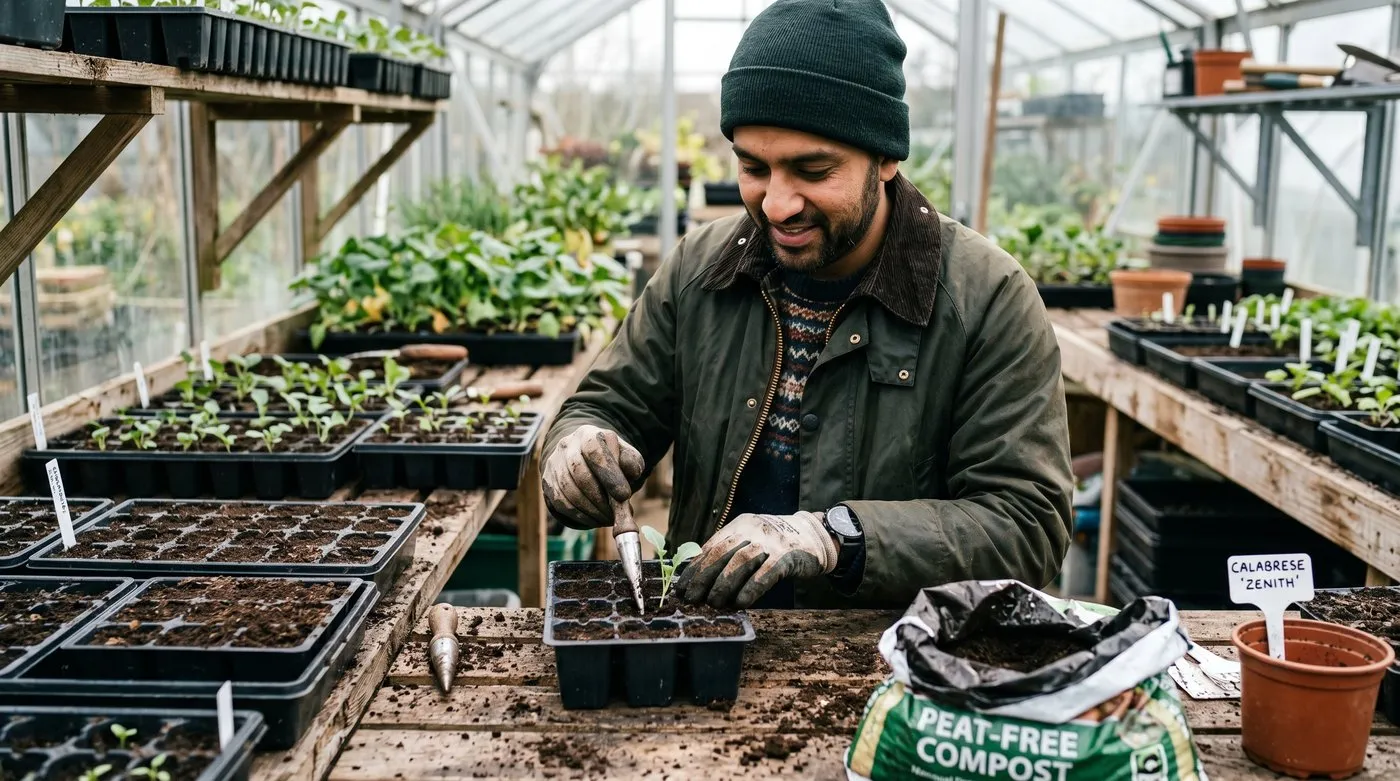 Module-sown calabrese at the 4-leaf stage ready for hardening off, the modular approach gives a head start over slug-vulnerable direct sowings
Spacing, depth and soil preparation
Plant calabrese 45cm between rows and 30cm in the row. This is the spacing that builds the heaviest single head. Closer spacing (30 x 20cm) gives smaller heads but more plants per square metre. Wider spacing (60 x 45cm) wastes ground without increasing head weight.
Plant deep with 5cm of lower stem buried. Calabrese roots into the buried stem and stands firmer against wind. Standing plants resist top-loading from a heavy head better than shallow-planted ones.
Soil pH 6.5-7.0 is the target. Acid soils below pH 6.0 develop club root and stunted growth. Apply garden lime in autumn at 100g per square metre on acid plots. Check pH with a kit or council soil sample.
Brassica nitrogen needs are high. Top-dress with 50g per square metre of fish, blood and bone before planting. Mulch with composted manure or homemade compost in spring. Side-dress with diluted seaweed feed at head formation stage for the heaviest harvest.
Firm soil works better than fluffy soil. Brassicas need anchorage to support 200-400g of head plus stem weight. After digging, tread the bed gently before planting. Loose freshly-cultivated soil pulls plants over once heads weight up.
Crop rotation matters. Avoid planting calabrese where any brassica grew in the previous 3 years. Club root persists in soil for 20+ years. See our crop rotation planner for a 4-year scheme.
Pest and disease protection
Three pests damage calabrese in UK plots: cabbage white butterfly, flea beetle, and cabbage moth. Without protection, expect 40-70% leaf damage by mid-July.
Cabbage white butterfly is the biggest threat. The white caterpillars eat the head and stem from May onwards. Cover plants with insect mesh (Enviromesh 1.35mm) from planting to harvest. Hand-pick yellow eggs from leaf undersides weekly if mesh is not fitted.
Flea beetle creates pinhole damage on young leaves. Tiny black beetles jump when disturbed. Damage cosmetic on calabrese (the head not the leaves is the crop) but slows growth on small plants. Cover with fleece for the first 4-6 weeks after planting. See our flea beetle protection guide for the full method.
Cabbage moth larvae bore into the head from late July. Pheromone traps detect first flight. Once detected, hand-inspect heads twice a week. Crush eggs and remove young caterpillars before they enter the head.
Club root is the soil-borne disease that ends calabrese growing on infected plots. Symptoms: stunted plants, swollen knobbly roots, wilting in mid-summer. No cure. Lime soil to pH 7.0 to suppress symptoms. Use raised beds with fresh soil if a plot is known club-root positive.
Pigeons strip mature plants in autumn. Bird netting over hoops once plants are 30cm tall. Plastic snake decoys provide 2-3 weeks of protection only; netting is the durable answer.
Gardener’s tip: Avoid the temptation to lift the mesh during dry spells to water. The 60 seconds with mesh off is enough for cabbage white to land and lay. Water through the mesh with a fine rose; the holes pass enough water at low pressure.
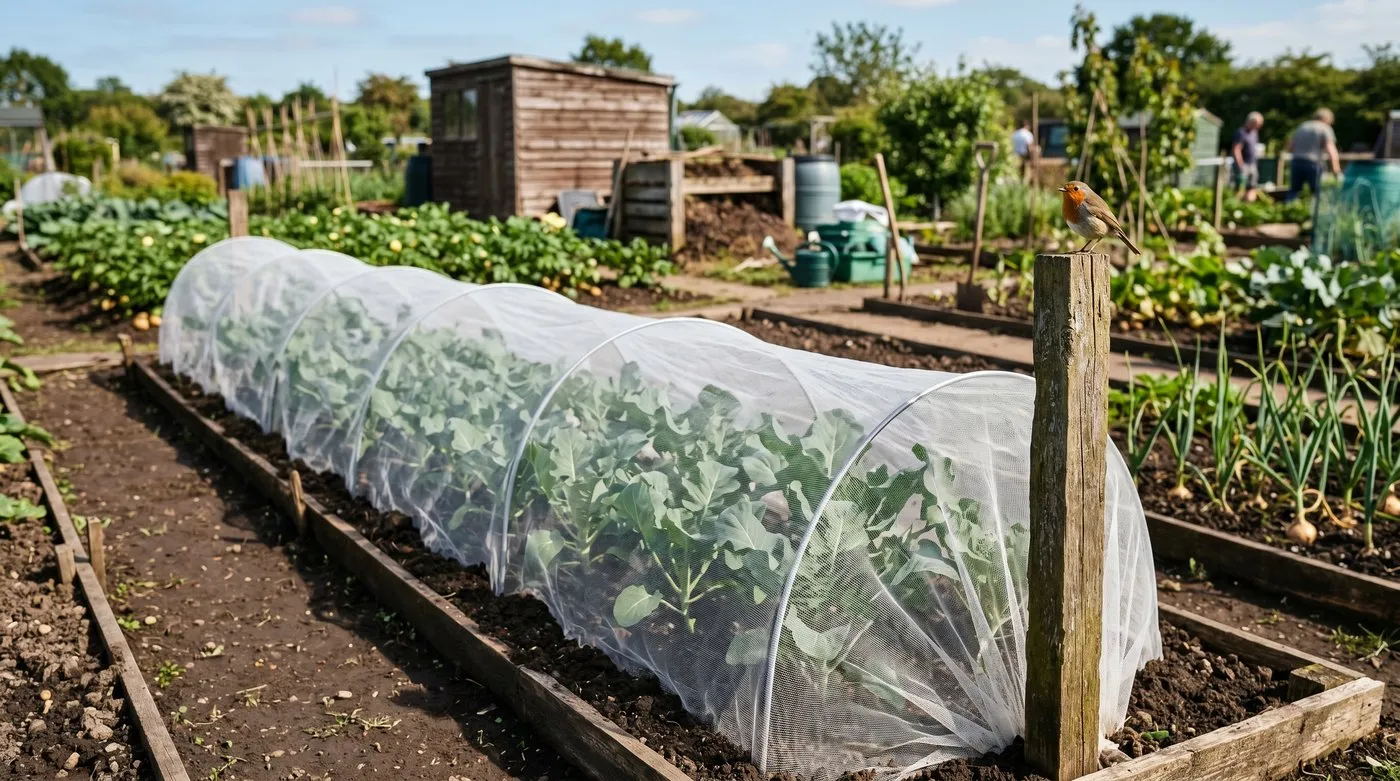 Insect mesh fitted from transplanting to harvest, the only practical defence against cabbage white in a UK plot
Harvest timing and the side-spear technique
Cut the main head when the buds are tight, bud clusters small, and head feels firm. Hold a 200-400g head shape. Buds opening yellow means you are 24-48 hours too late.
Use a sharp knife and cut the main stem 10cm below the head. Leave the leaves and stem standing. The side-spear flush comes from leaf axils on the standing stem.
Side spears develop within 14-21 days. The first flush is 4-6 small heads of 50-80g each. Cut these the same way, leaving 5cm of stem. A second flush of 6-12 even smaller spears follows 14 days later. The crop continues for 6-8 weeks after the main cut.
Cool, moist conditions extend the side-spear window. Hot dry weather closes the second harvest within 4 weeks. Mulch heavily after the main cut and water consistently to maintain side-spear production.
Harvest in the cool of the morning. Stems plump up overnight; head density peaks before midday heat. Refrigerate immediately and use within 5 days. Calabrese loses flavour fast at room temperature.
The total yield per plant from main head plus side spears is 800-1,200g. Six plants well managed yield 5-7kg over the season. A standard supermarket calabrese pack is 350-400g. Six plants replace 15-18 supermarket packs.
| Cut sequence | Days after main cut | Approximate weight | Best use |
|---|---|---|---|
| Main central head | Day 0 | 200-400g | Roast, steam, raw |
| First side spears | 14-21 days | 4-6 spears at 50-80g each | Stir fry, pasta |
| Second flush | 28-42 days | 6-12 small spears | Pickle, soups |
| Late finishing | 42-56 days | Small open spears | Pickle, last cuts |
Ironman F1 runs a close second. Slightly smaller main head, 12-day holding. Side-spear yield similar to Marathon. Best for early sowings; tolerates cooler conditions better. Around 920g per plant average.
Aquiles F1 is the best mid-summer variety. Holds 10-12 days, resists heat-induced bolting better than Marathon in July. Side-spear flush slightly shorter at 5-6 weeks. Around 880g per plant average.
Belstar F1 is reliable but unremarkable. Smaller heads (250-300g), 7-9 day holding. Recommend only if Marathon is unavailable. Average yield 720g per plant.
Pacman is the budget F1 option. Smaller heads still, 5-7 day holding. Variability between plants is high. Average yield 650g. Worth growing only if seed price matters.
Non-F1 ‘Italian Sprouting’ calabrese is best avoided in UK plots. Heads open within 5-7 days, side spears variable, weight 400-700g per plant. The 30p price saving costs you a full harvest. Skip.
| Variety | Type | Avg total yield | Holding window | Best for |
|---|---|---|---|---|
| Marathon F1 | F1 | 1,050g | 14 days | All UK sites, gold standard |
| Ironman F1 | F1 | 920g | 12 days | Early and late sowings |
| Aquiles F1 | F1 | 880g | 10-12 days | Mid-summer heat |
| Belstar F1 | F1 | 720g | 7-9 days | Backup option |
| Pacman | F1 | 650g | 5-7 days | Budget seed only |
| Italian Sprouting | Non-F1 | 500g | 5 days | Avoid |
Month-by-month calendar
| Month | Job |
|---|---|
| February | Order seed packets, check soil pH, lime if needed |
| March | First sowing in modules under cover |
| April | Plant out first sowing under cloche, sow second batch |
| May | Plant out second batch, sow third batch, install mesh |
| June | Harvest first main heads, sow fourth batch |
| July | Cut side spears from earliest plants, sow final batch |
| August | Plant out final batch, side spears continuing |
| September | Mid-season harvests, watch for pigeons |
| October | Final main heads, side spears finishing |
| November | Clear plants to compost, dig over bed |
| December | Rest, plan next year’s rotation |
| January | Soil pH check, order seed |
Common mistakes to avoid
Cutting the main head too short. Five-cm stems give no side spears. Always leave 10cm minimum below the cut.
Skipping mesh during the cabbage white season. May to mid-September is the egg-laying window. Plants without mesh lose 40-70% of leaf area.
Direct sowing in slug country without protection. Slugs eat young calabrese seedlings to ground level overnight. Use modules and harden off thoroughly, or use slug deterrents from day one.
Wide spacing for “bigger heads”. 60 x 45cm wastes ground. The plant cannot use the extra space to build a bigger head. Stick to 45 x 30cm.
Letting heads open. Yellow buds mean the head has flowered. Eat-quality drops fast. Cut at the first sign of looseness in the bud clusters.
Skipping the side-spear water and feed. After main-head cut, the plant needs feed and water to push the second flush. Mulch, water, and side-dress with seaweed.
Step-by-step: sowing a calabrese row
Step 1: prepare the bed. Dig over, remove weeds, work in 50g per square metre fish, blood and bone. Lime to pH 6.5-7.0 if needed. Tread firm.
Step 2: sow in modules. 6-cell trays, peat-free compost, 1-2 seeds per cell, 5mm cover. Water from below. Cover with clear lid or place in propagator at 15-18C.
Step 3: thin and grow on. When seedlings show first true leaf, thin to one per cell. Move to cooler conditions (12-15C) to prevent leggy growth.
Step 4: harden off. Move trays outside in a sheltered spot for 7-10 days before final planting.
Step 5: plant out. 45cm row spacing, 30cm in the row. Bury 5cm of lower stem. Firm in well. Water immediately.
Step 6: install mesh. Hoops at 1m intervals, Enviromesh 1.35mm draped over and tucked into soil along both sides.
Step 7: water and mulch. Mulch with 5cm of compost. Water deeply twice a week in dry weather.
Step 8: monitor. Lift mesh every 7-10 days to inspect for caterpillars or signs of club root.
Step 9: harvest main head. When buds are tight, cut 10cm below the head.
Step 10: continue cropping. Mulch and water after main cut. Harvest side spears as they form, leaving 5cm stem on each cut.
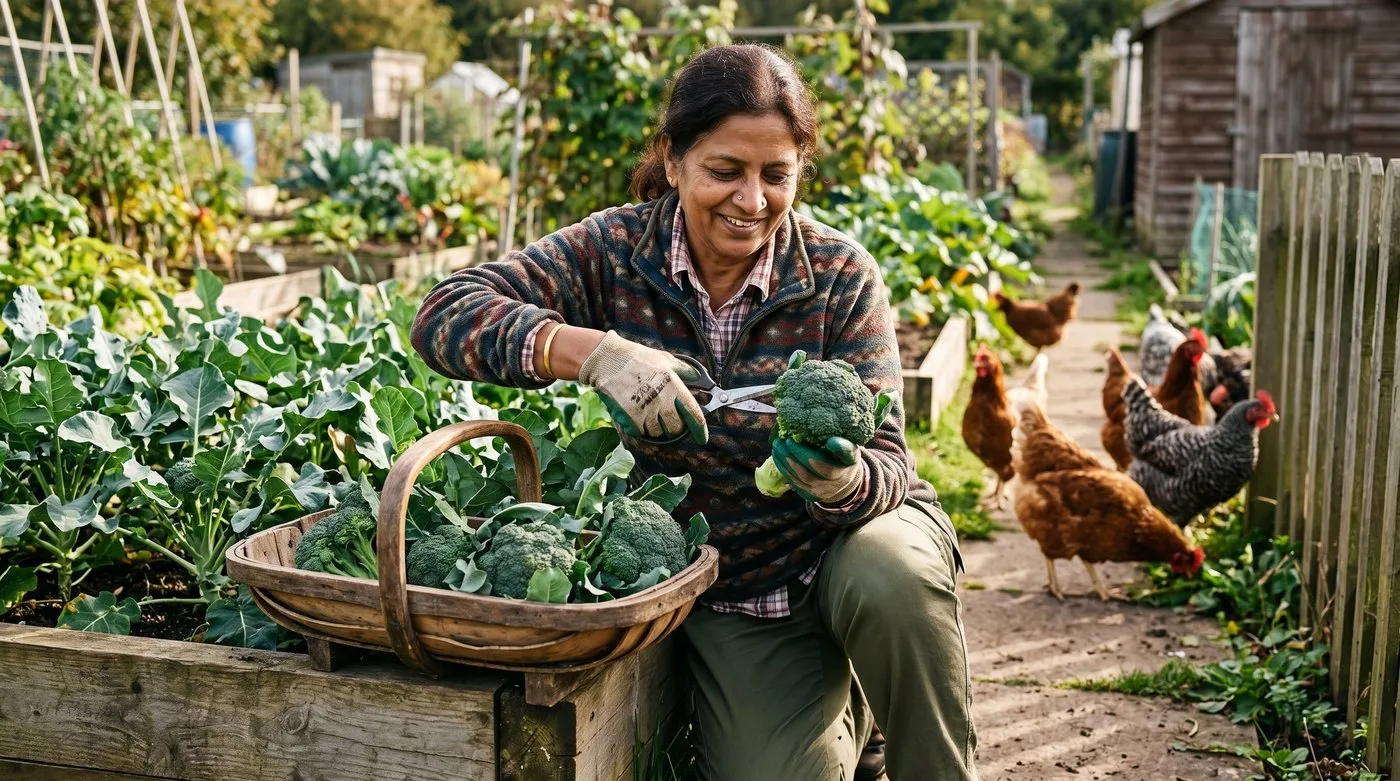 Morning harvest with kitchen scissors. Cut the main head 10cm below the buds and leave the leaf rosette standing for the side-spear flush
Frequently asked questions
What is the difference between calabrese and broccoli?
Calabrese is one type of broccoli, specifically the Italian green form with a single large central head followed by side spears. The UK calls the smaller multi-spear plant ‘sprouting broccoli’ (purple or white), which is hardier and crops in late winter. Supermarket broccoli is almost always calabrese. The two need different sowing seasons and different positions on the plot.
When should I sow calabrese in the UK?
Sow calabrese in modules March to July for UK harvests June to October. The earliest sowings need cloche protection. Late June and July sowings give the cleanest side-spear harvests before frost. Stagger sowings every 21 days for continuous cropping across the full season. Avoid August sowings; plants do not mature before serious frost in most of the UK.
How long does calabrese take to grow?
Calabrese matures in 75-110 days from sowing. Early sowings under cover are slower (95-110 days). Mid-summer sowings hit the shorter 75-85 day window because heat speeds development. After the main head is cut, side spears continue cropping for 6-8 weeks. Total active cropping per plant runs 12-16 weeks across the main head and side spear cycle.
Why is my calabrese flowering early?
Calabrese bolts (flowers) when stressed by heat, drought, or check after transplanting. Soil temperatures over 24C in July trigger early flowering. Direct-sow into final positions where possible, or use module-grown plants with intact rootballs. F1 varieties like Marathon resist bolting longer than non-F1 alternatives. Mulch and water consistently in July to keep root zone cool.
Do I need to support calabrese plants?
No, calabrese is self-supporting on the main stem. Plant deep (cover the lower 5cm of stem) and firm in well. Stake only on exposed windy sites or if the soil is light. Plants firm-rooted develop the strongest single-head weight. Loose soil and wide spacing both lead to plants leaning before harvest.
Now you have the timing and variety choice sorted, see our how to grow broccoli guide for the wider brassica family and our crop rotation planner for the right bed each year. The Royal Horticultural Society broccoli growing guide covers the wider RHS recommendations for UK plots.
Our team produces practical UK gardening guidance from source research, contributor records and established horticultural practice. Editorial standards are overseen by Matt W.