Key takeaways
- Cumin needs 25-30C summer heat and 100-120 days of growth; UK growing requires glass
- Sow seed March-April direct into final pots or large modules
- Each plant yields 5-15g of dried seed; 20 plants give 100-300g household supply
- Seeds ripen September-October when umbels turn brown and seeds rattle
- Harvest whole umbels, dry indoors, rub seeds free, store airtight
- Self-saved seed germinates poorly after year 2; refresh stock every other season
Cumin is the spice most UK home growers never attempt. The crop needs heat the British climate rarely supplies, and the yields per plant are modest even at best. None of this stops it being one of the most rewarding curry-cabinet crops to grow under glass. Home-dried cumin seed has roughly twice the volatile oil content of supermarket spice and gives recipes a depth that ground supermarket cumin loses.
This guide explains why UK cumin is a greenhouse crop, how to coax the heat needed for seed set, the 100-day growing cycle from sowing to harvest, and the seed-saving method that turns garden plants into kitchen ingredients. You will find the pre-soak germination technique, the temperature management protocol, and the umbel harvest method. Pair this with our how to grow coriander and how to grow herbs guides for the wider spice and herb cluster, and read the grow Indian and Eastern spices in the UK overview if you are building a full home curry-cabinet bed.
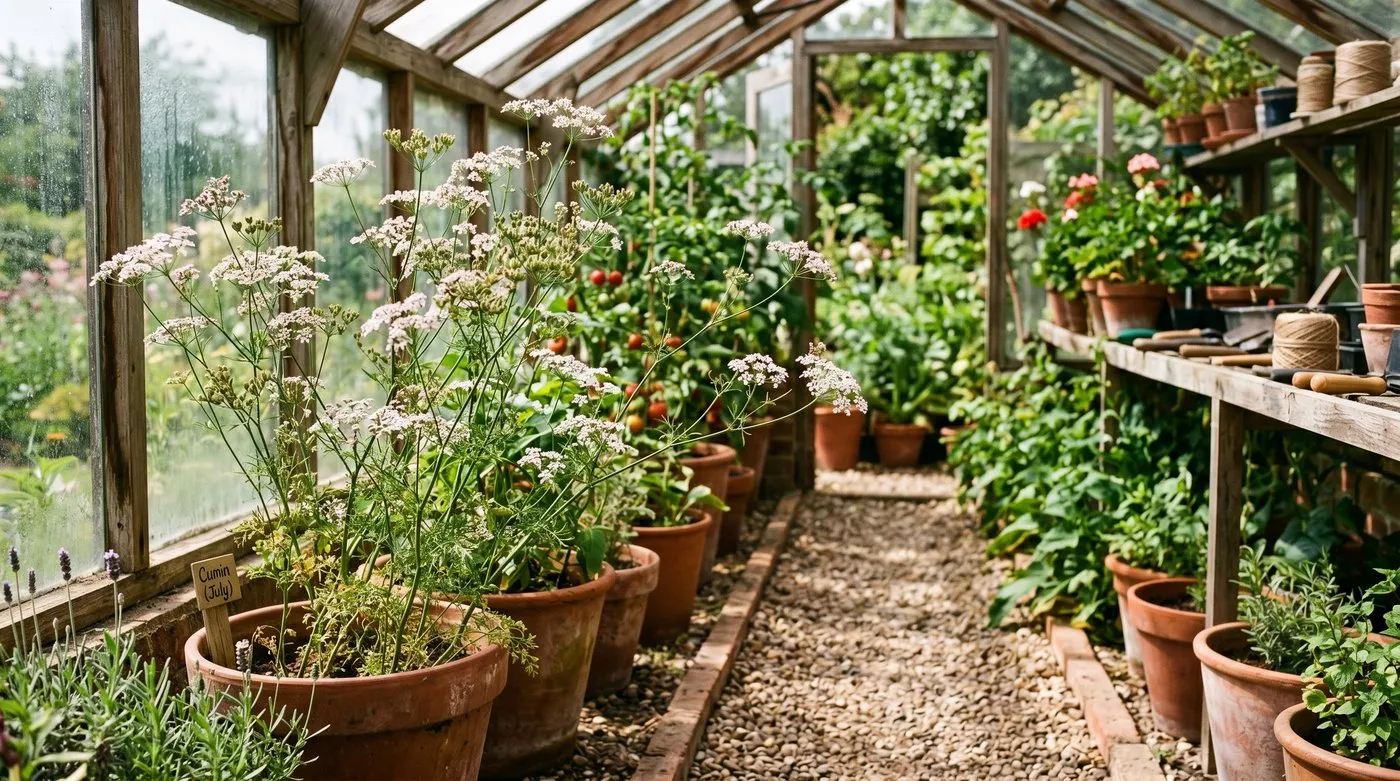
Why UK cumin is a greenhouse crop
Cumin (Cuminum cyminum) is native to Iran, India, and the Eastern Mediterranean. Wild origins are dry hot climates with summer temperatures of 28-35C and minimal rainfall during the seed-setting period.
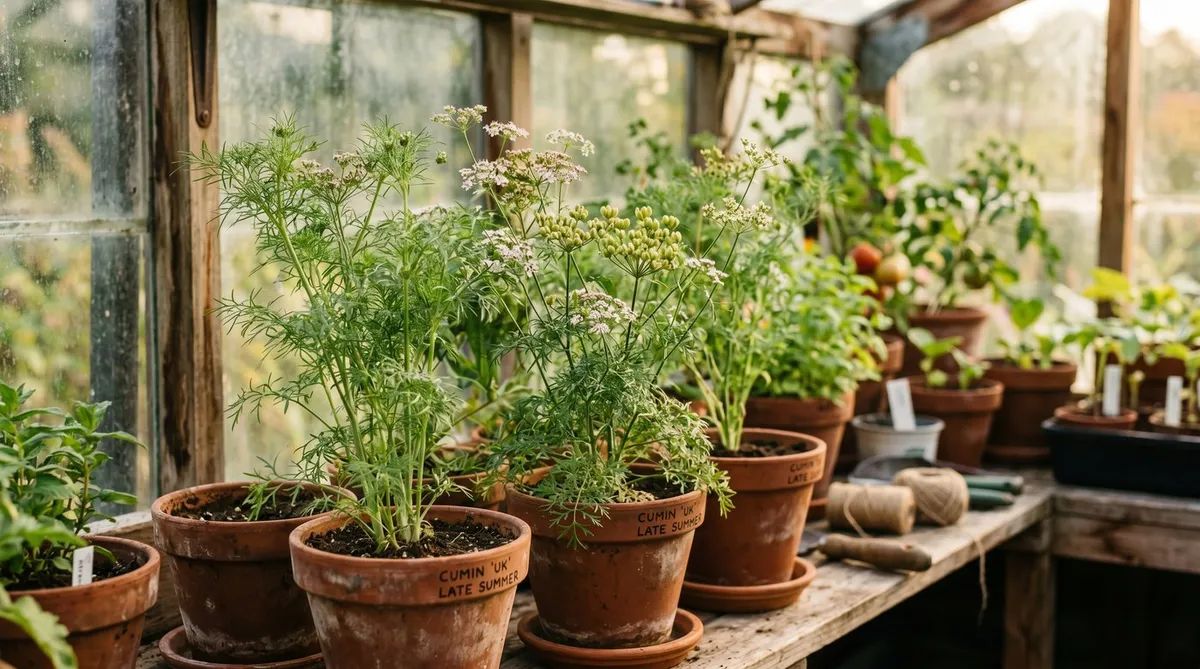
The plant demands sustained 25-30C heat to flower and set seed. UK summer temperatures average 16-22C outdoors. Outdoor cumin in the UK grows feathery foliage but produces few or no seeds. Heat is the limiting factor, not light or day length.
A south-facing greenhouse, conservatory, or polytunnel solves the heat problem. Daytime temperatures inside reach 25-35C in UK summers, matching the cumin requirement. A cold-frame works marginally for early stages but not for seed-set.
Sowing date is mid-March to mid-April under protection. This gives enough heat hours to complete the 100-120 day cycle before autumn cooling stops flowering. May sowings rarely set seed before October cool sets in.
Yields are modest by commercial standards. A 20-plant row in a 6x4m greenhouse yields 100-300g of dried seed across the season. Commercial Iranian cumin yields 800-1200kg per hectare, equivalent to 80-120g per square metre. UK greenhouse yields are roughly half that on a per-square-metre basis.
Companion plants in the same greenhouse: tomatoes, peppers, aubergines, basil, and coriander. Cumin slots into the same protected cropping calendar as those crops.
| UK cumin requirement | Detail |
|---|---|
| Native range | Iran, India, Mediterranean |
| Heat requirement | 25-30C sustained summer |
| UK position | South-facing greenhouse only |
| Sowing date | March-April under glass |
| Days to harvest | 100-120 |
| Yield per plant | 5-15g dried seed |
| Yield per square metre | 80-150g (UK greenhouse) |
Sowing, germination and the warm soak
Cumin seed germinates slowly and erratically. Standard untreated seed at 18C germinates over 14-21 days with 50-70% success. Pre-soaking and higher temperatures both speed germination significantly.
Pre-soak seed in warm water (35-40C) for 12 hours before sowing. The hot water softens the seed coat and triggers earlier germination. Soaked seed at 22C germinates over 7-10 days with 80-90% success.
Sow direct into final pots or large modules. Cumin dislikes root disturbance. A 15-20cm pot per plant is ideal. Larger pots (25-30cm) give heavier yields but take more space.
Seed depth 5-8mm. Cover lightly with sieved compost. Water with a fine rose. Cover the pot with cling film or place in a propagator to maintain warmth and humidity.
Maintain 20-22C until germination. A heated propagator on a south-facing windowsill works. Below 18C germination drops significantly; above 25C it stops.
Once germinated, remove the cover and grow on at 18-22C. Move to final greenhouse position when daytime temperatures stay above 18C consistently.
Thin to one strong seedling per pot at the 2-leaf stage. Cumin self-thins poorly; multiple seedlings per pot all produce weak plants.
| Sowing stage | Temperature | Days | Action |
|---|---|---|---|
| Pre-soak | 35-40C water | 12 hours | Hot soak |
| Sowing | 20-22C soil | Day 0 | Sow 5-8mm deep |
| Germination | 20-22C | 7-10 days | Maintain humidity |
| Seedling | 18-22C | 14-21 days | Remove cover, grow on |
| Final pot | 18-25C | 28-42 days | Move to greenhouse |
Growing conditions and heat management
Cumin needs maximum sun exposure under glass. Position pots against the south-facing wall or in the warmest corner of the greenhouse.
Daytime temperatures of 28-32C during flowering and seed-set are optimal. Below 24C, flowering is reduced and seed set is poor.
Close vents from mid-June to mid-September in cooler UK summers. Trap heat overnight to maintain night-time temperatures above 18C. Open vents only on days exceeding 35C to prevent leaf scorch.
Water consistently but never waterlog. Cumin tolerates dry soil better than wet. A 15cm pot needs 100-200ml of water every 3-5 days in active growth.
Use peat-free compost mixed with 20% sharp sand or perlite for drainage. Free-draining compost is essential.
Feed weekly with diluted seaweed or tomato fertiliser from week 6. The plant uses most of its energy on seed set in the final 6 weeks; feed supports good kernel development.
Stake plants if they reach 50cm tall. Cumin stems are slender and bend under the weight of seed heads. Use a thin bamboo cane per plant or surround a group with twine.
Pollination happens inside the greenhouse with no insect help in many cases. Cumin is largely self-pollinating but gentle daily flicks of the flower umbels with a soft brush or finger improve seed set by 10-20%.
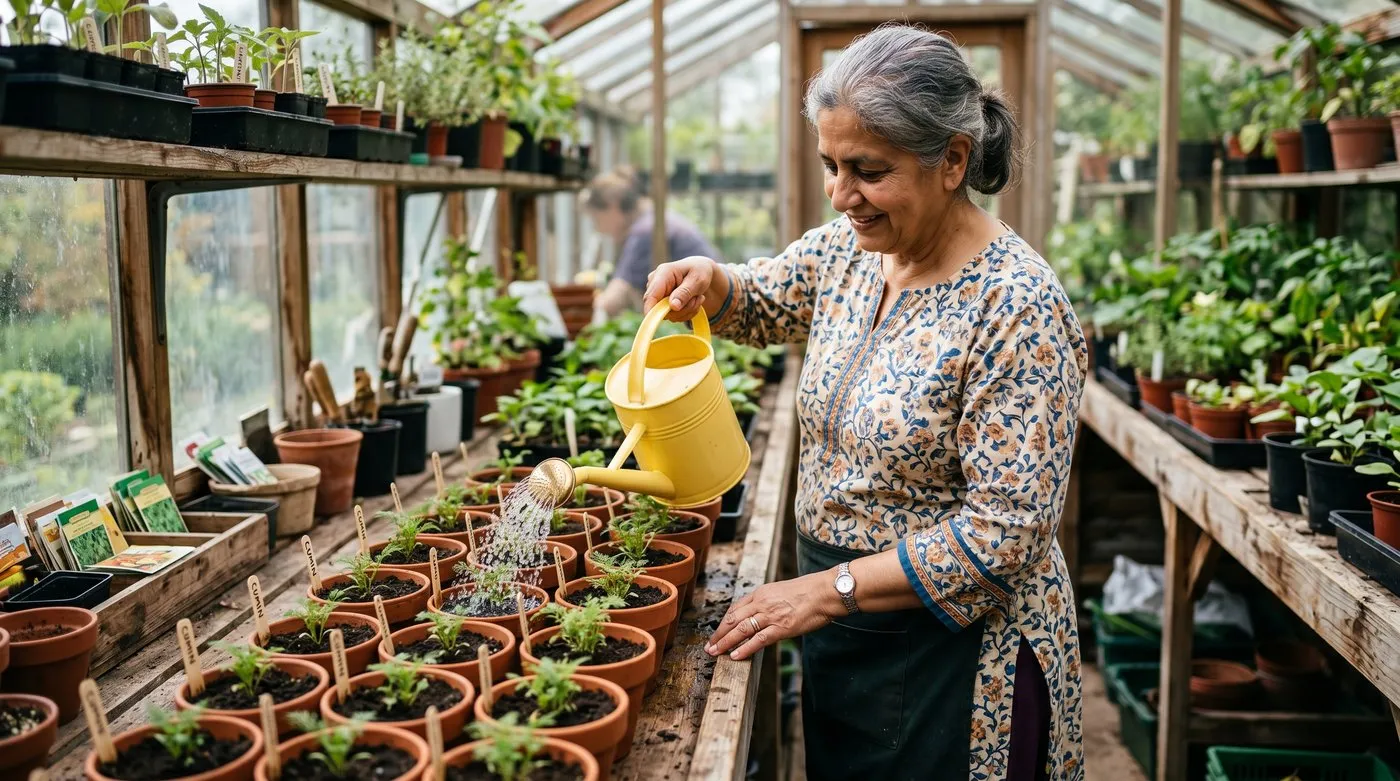 Mid-May watering on young cumin plants. Consistent moisture without waterlogging is key during the rapid growth phase from May to mid-July
Pests and diseases
Cumin pest pressure is low under glass. Aphids and red spider mite are the main UK greenhouse threats.
Aphids cluster on growing tips in early summer. Wipe off with damp cloth or use a soap-water spray. Severe infestations are rare.
Red spider mite thrives in dry hot greenhouse conditions. Symptoms: yellow stippling on leaves, fine webs on undersides. Increase greenhouse humidity by misting daily; introduce predatory mites (Phytoseiulus persimilis) at first sign of damage.
Damping off can kill seedlings. Sterilise pots between sowings; do not overwater; use peat-free compost not garden soil.
Powdery mildew can develop in cool damp greenhouse periods. Improve ventilation; remove affected leaves.
Fusarium wilt is the worst cumin disease worldwide but rarely encountered in UK greenhouse conditions. Use fresh peat-free compost each season; rotate pot positions.
Harvest and drying
Cumin seeds ripen September-October in UK greenhouses. The seed umbels turn from green to brown and the seeds rattle when shaken.
Harvest whole umbels when 80% have turned brown. Cut umbels with sharp scissors, leaving 5cm of stem attached. Place in paper bags or on a clean sheet to dry.
Dry indoors for 7-14 days in a warm dry place. Greenhouse bench, airing cupboard, or windowsill. Avoid damp areas.
Rub seeds free from umbels by hand or thresh by enclosing in a paper bag and gently squeezing. Larger debris (stems, calyces) sieves out.
Winnow on a still warm day. Pour seeds slowly from one container to another; chaff blows away leaving clean seed.
Final drying for 2-3 days in single layer. Seeds should crackle when bitten. Soft pliable seeds need more drying.
Store in airtight glass jars in a dark cupboard. Whole cumin keeps flavour for 12-18 months. Ground cumin keeps only 3-6 months; grind as needed.
Yield per plant: 5-15g of cleaned dried seed. A 20-plant row yields 100-300g. A household supply for 6-12 months of typical curry, chilli, and falafel use.
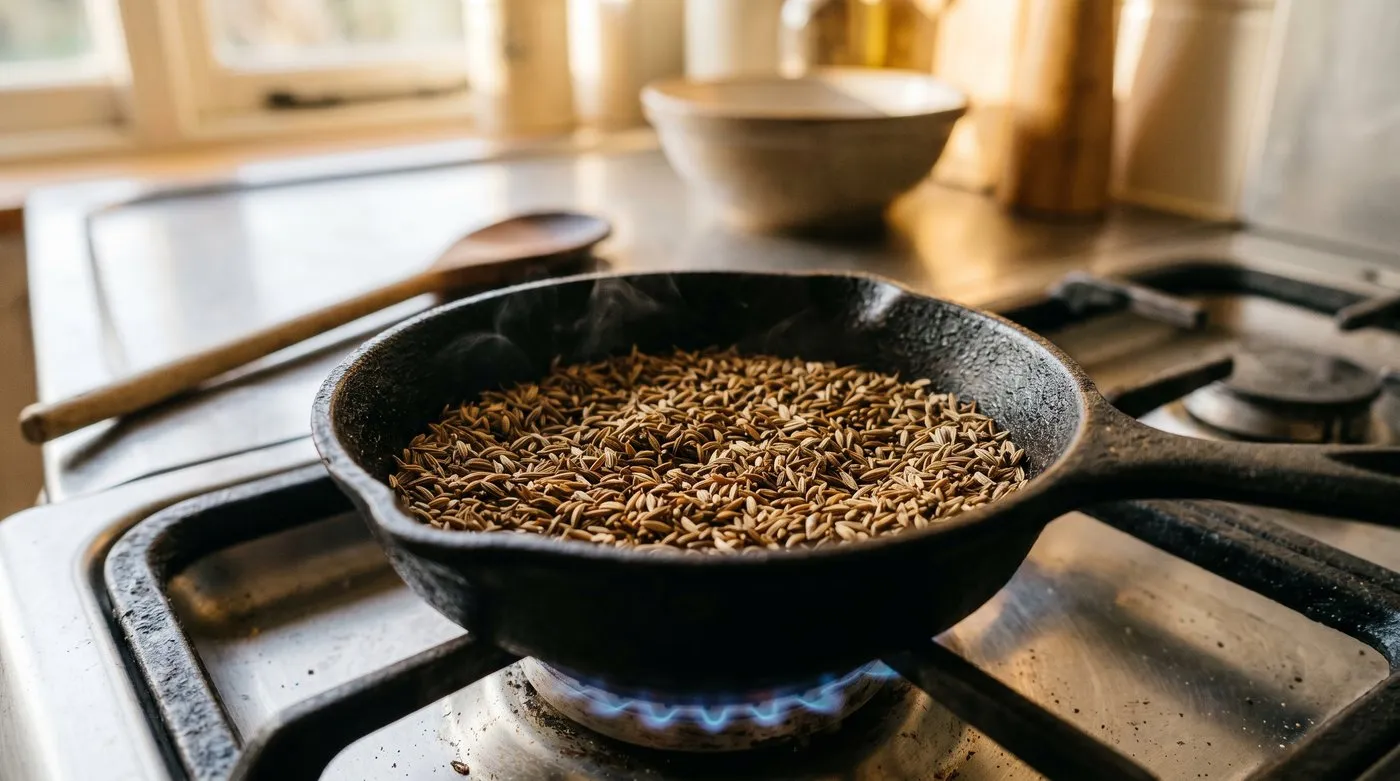 Dry-toasting home-grown cumin seeds in a cast iron pan. 60-90 seconds at medium heat releases the volatile oils that give twice the flavour of supermarket spice
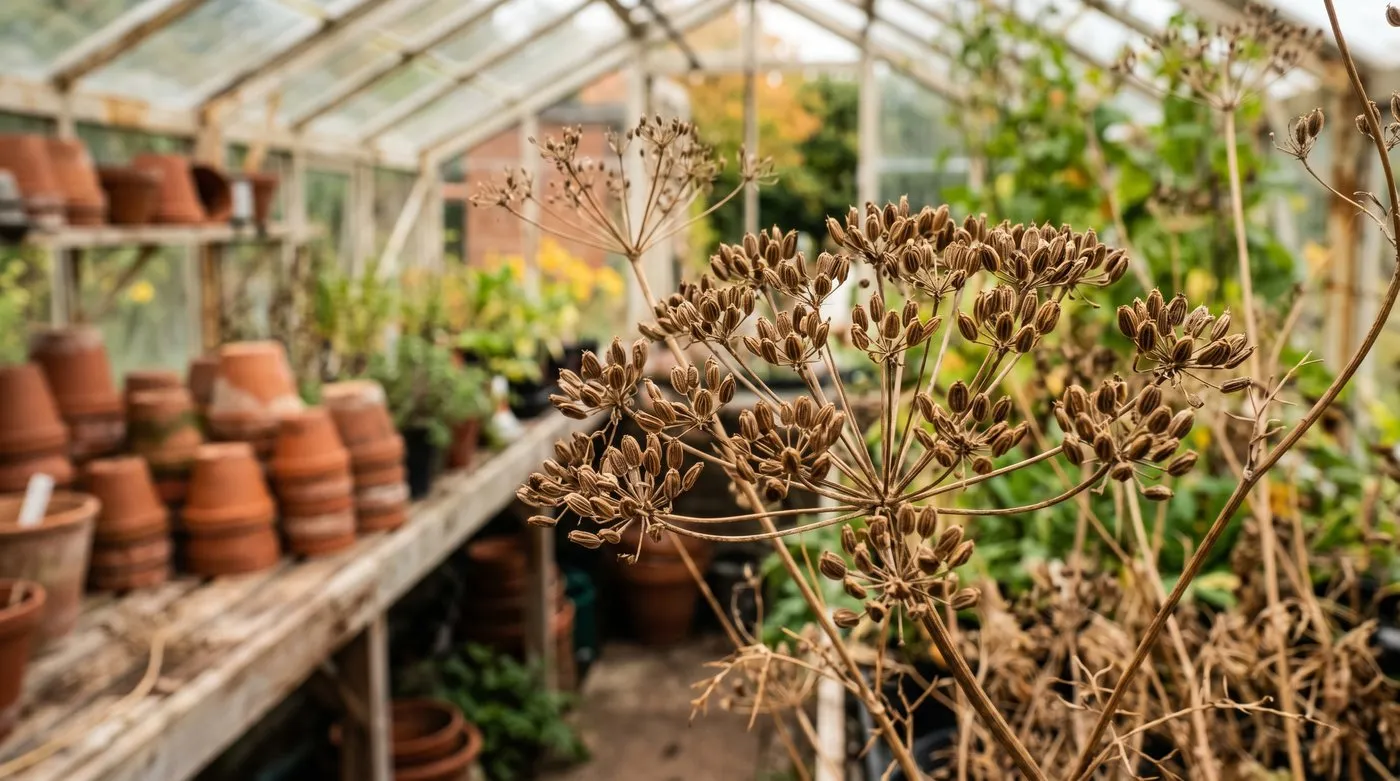 Late September seed umbels ready for harvest. Brown rattling seeds indicate readiness; cut whole umbels and dry indoors for 7-14 days
Variety choice and seed saving
Most UK seed suppliers stock generic Cuminum cyminum without named varieties. The species is grown commercially in roughly 20 countries; cultivar selection is minimal.
‘Local’ or ‘Iranian’ types are slightly bolder-flavoured. Available from specialist suppliers like Realseeds and Magic Garden Seeds. £2.50-£4 per packet of 200-500 seeds.
Bulk seed from the spice rack works for sowing if untreated. Whole cumin from a health food shop or Indian grocer germinates at 40-60% rate after pre-soaking. Useful as a cheap seed source.
Save seed from your own plants for the next season. Keep the largest darkest umbels separately as seed stock; consume the rest.
Self-saved seed germination drops after 2 years. Refresh seed stock every other season to maintain vigour.
Cross-pollination between cumin plants is normal. Saving seed from a single greenhouse population gives stable seed for several generations.
Kitchen uses for home-dried cumin
Cumin is one of the world’s most-used spices. Essential in Indian curry, Mexican chilli con carne, Moroccan tagine, Middle Eastern falafel and hummus, and Tex-Mex cooking.
Whole vs ground: whole cumin keeps flavour 12-18 months; ground keeps 3-6 months. Toast whole seeds in a dry pan for 1-2 minutes before grinding to release maximum flavour.
Dry-toasting method: heat a small frying pan over medium heat, add 1-2 teaspoons of whole cumin, shake the pan, toast for 60-90 seconds until fragrant and slightly darker. Cool, grind in a mortar or spice mill.
Home-dried cumin is roughly twice as strong as supermarket cumin. Reduce quantities in recipes by 30-50% when using freshly home-grown.
Cumin pairs particularly well with onion, garlic, coriander seed, paprika, chilli, and lemon. The classic curry spice base.
Roast veg with home cumin is the simplest test: 500g chopped root veg, 1 teaspoon home-toasted ground cumin, olive oil, salt, roast at 200C for 35 minutes.
Common mistakes to avoid
Outdoor growing. UK outdoor temperatures rarely support seed set. Always use a greenhouse, conservatory, or polytunnel.
Sowing too late. May or June sowings rarely complete the 100-120 day cycle before autumn cooling stops flowering. Sow March-April.
Not pre-soaking seed. Untreated dry seed germinates poorly. Twelve hours in 35-40C water transforms germination rates.
Overwatering. Cumin prefers dry-side soil. Wet roots cause damping off and fungal issues.
Single-pot multiple seedlings. Thin to one strong seedling per pot at 2-leaf stage. Multiple seedlings compete and all produce weak plants.
Skipping the temperature management. Cool greenhouse seasons (below 24C average daytime in July-August) give few or no seeds. Trap heat aggressively.
Step-by-step: growing 20 cumin plants
Step 1: order seed by mid-February. Realseeds, Plants of Distinction, or Magic Garden Seeds. One 200-seed packet is enough.
Step 2: pre-soak 30 seeds in 35-40C water for 12 hours in mid-March. Slightly oversow for thinning losses.
Step 3: sow 30 individual 15cm pots with peat-free compost mixed with 20% sand. One seed per pot, 5-8mm deep.
Step 4: place pots in heated propagator at 20-22C. Cover with cling film. Maintain humidity.
Step 5: remove cover at germination (7-10 days). Move to bright greenhouse bench at 18-22C.
Step 6: thin to 20 strongest plants by 2-leaf stage. Compost the rest.
Step 7: move to final positions in greenhouse by mid-May. South-facing bench, full sun.
Step 8: water every 3-5 days from May to mid-September. Avoid waterlogging.
Step 9: feed weekly with diluted seaweed or tomato fertiliser from June. Half-strength is plenty.
Step 10: close vents overnight in July-August. Maintain night temperatures above 18C.
Step 11: harvest umbels September-October when 80% have turned brown. Cut with scissors, place in paper bags.
Step 12: dry indoors 7-14 days, thresh, winnow, final-dry, store. 100-300g of seed for the kitchen.
Frequently asked questions
Can cumin grow in the UK?
Cumin grows in UK greenhouses, conservatories, and polytunnels but not outdoors. The plant needs sustained 25-30C summer heat to flower and set seed. UK outdoor temperatures rarely sustain those levels for long enough. South-facing protected cropping is essential for any meaningful seed harvest. Cold frames work marginally for early stages but not for seed-setting.
When should I sow cumin in the UK?
Sow cumin seed March to April in pots or large modules. Soak seed in warm water for 12 hours before sowing to speed germination. Germinate at 20-22C. Transplant or thin to final pot at the 4-leaf stage. Outdoor harvest is impossible; sow only if you have a heated greenhouse, conservatory, or polytunnel. May sowings often fail to set seed before autumn cooling.
How long does cumin take to grow?
Cumin matures in 100-120 days from sowing. UK greenhouse plants sown March germinate by mid-April, flower in July, and ripen seed in September-October. Cool UK summers extend the cycle by 14-21 days compared with the Mediterranean. Plants finish at first hard frost; bring pots indoors if needed. The cycle is sown-to-harvest-to-storage in a single calendar year.
How much cumin does one plant yield?
A well-grown cumin plant yields 5-15g of dried seed in UK conditions. A row of 20 plants in a small greenhouse gives 100-300g per year, roughly 6-12 months of household spice use. UK yields are lower than Iranian or Indian commercial yields because of cooler summers and shorter heat hours. Larger pots (25cm+) give the heaviest individual yields.
Is home-grown cumin worth it?
Home-grown cumin is more about flavour than economy. Freshly dried home seed has roughly twice the volatile oil content of supermarket cumin, giving stronger flavour from smaller amounts. The yield per plant is small. Most UK growers also produce coriander and fenugreek in the same protected space for a wider home spice rack. The price comparison with supermarket cumin is unfavourable; the flavour comparison is strongly in favour of home-grown.
Now you have UK-grown cumin in the spice rack, see our how to grow coriander for the complementary spice seed crop and our how to grow herbs guide for the wider UK herb cluster. The Royal Horticultural Society herb growing guide covers the broader herb category and protected-cropping context.
Our team produces practical UK gardening guidance from source research, contributor records and established horticultural practice. Editorial standards are overseen by Matt W.