Key takeaways
- Lift onions when 50% of tops fall over; garlic when 5-6 lower leaves yellow; shallots when foliage browns
- Cure for 14-21 days on a slatted bench in a dry airy space until necks rustle dry (the press test)
- Store at 0-5C in a cool dark larder; never below freezing and never in plastic bags or sealed boxes
- Soft-neck garlic like 'Solent Wight' plaits well and keeps 9-10 months; hard-neck like 'Lautrec' keeps 6 months
- Best UK keepers: onion 'Sturon' and 'Centurion' (6-8 months); shallot 'Longor' and 'Jermor' (8-10 months)
- Check stores weekly; remove any bulb with soft patches, neck mould or sprouting before it spoils the rest
A good store of cured onions, garlic and shallots is the quiet engine of a UK kitchen garden. Three rows of well-grown ‘Sturon’ and one row of ‘Solent Wight’ garlic gives a family enough alliums to cook with from August through to the following May, and shallots from the same beds plug the gap from spring onwards. The difference between a store that lasts ten weeks and one that lasts ten months is almost entirely down to how the bulbs are lifted, cured and held in storage, not how they were grown.
This guide is a practical UK record of what works. It covers the lift window for each crop, the curing test that tells you when a bulb is genuinely ready to store, the temperatures and storage forms that protect the cure, and the variety-by-variety keeping records from five seasons across two gardens. For getting these crops into the ground in the first place, the how to grow onions and how to grow garlic pages cover sowing through to summer care.
When to lift onions, garlic and shallots in the UK
The biggest single mistake on UK allotments is lifting too early. The bulb adds its final 20-30% of size in the two weeks before the tops fall, so a panic lift in mid-July robs the harvest of a quarter of its weight. Wait for the plant to tell you it is ready.
Onions. Watch the foliage. When around half of the tops have folded over at the neck of their own accord, the bulbs are mature and ready to lift within seven to ten days. Do not bend the tops over by hand; this old advice is a hangover from wet seasons and damages the neck, the very part of the bulb that needs to stay sound for storage. Lift on the next dry day with a fork, lifting from below so the basal plate stays intact.
Garlic. The leaf-count rule beats any calendar date. Lift when five to six of the lower leaves have yellowed and dried, while the upper three or four leaves are still green. This usually falls between late June and late July in southern UK gardens, and into early August on northern allotments. Leave garlic in the ground too long and the wrapper splits, exposing cloves and shortening storage life from months to weeks.
Shallots. Foliage is the only signal. When the leaves brown and collapse, the clump has finished swelling. Lift in late July to mid-August with a fork, ease the clump out whole, and only break it into individual bulbs once the necks are fully cured.
For variety-specific lift windows by region the best UK onion varieties compared page covers what to expect from each cultivar, and the how to grow shallots guide has the same for shallot timing.
How to cure onions, garlic and shallots (the curing test)
Curing is the active drying of the neck and skin that seals the bulb against rot. Skip it or cut it short and the store will collapse by Christmas. Get it right and ‘Sturon’ keeps to April.
Where to cure
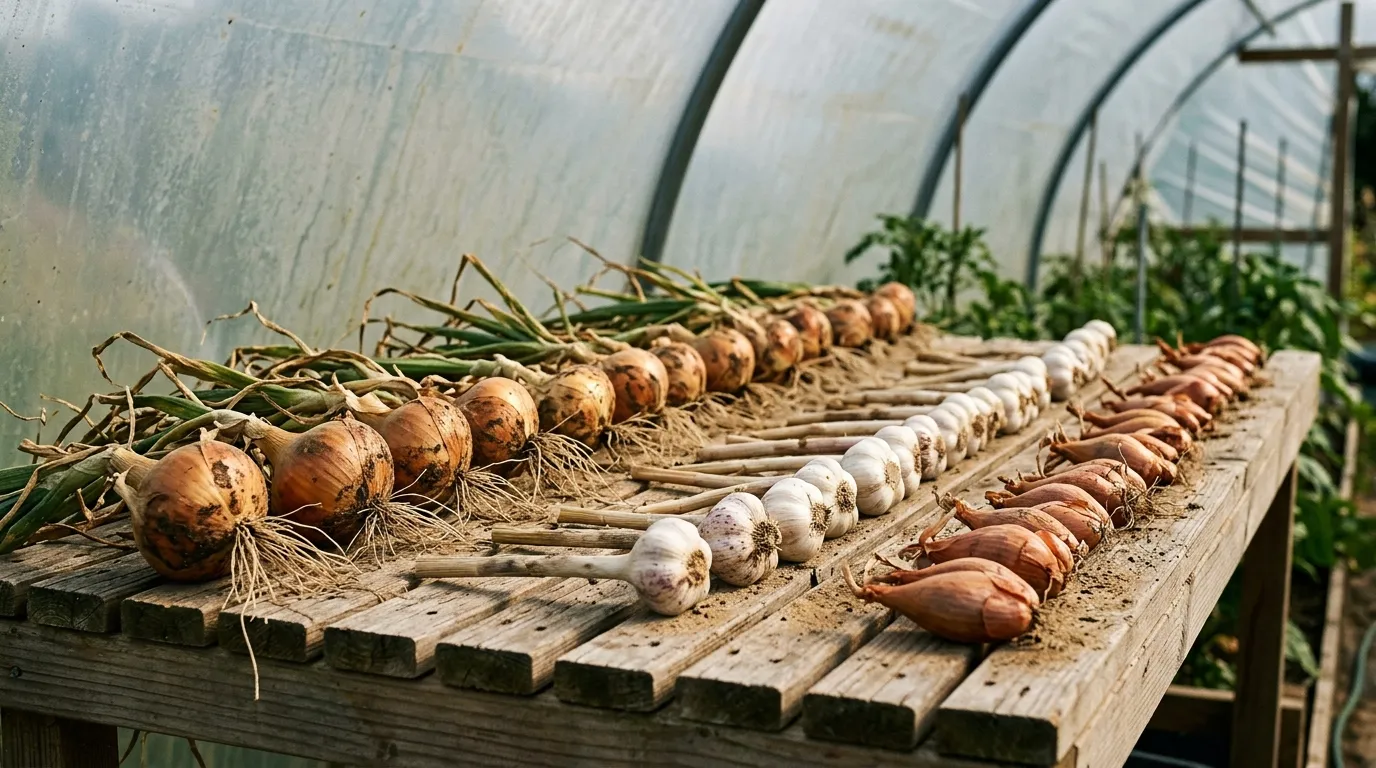
Lay the lifted bulbs in single layers on a slatted bench (slats give airflow on both sides), in a place that is dry, airy, frost-free and shaded from direct hot sun. Three UK options work well:
- Polytunnel benches in late summer: the standard choice. Warm air, shaded by mesh or fleece if the sun is fierce, and dry. Open both doors for cross-ventilation.
- Open shed or garage with a fan: works when the weather turns wet during the cure. A small desk fan placed at one end of the bench, on a low setting, moves air and dries necks in 14 days even in a humid August.
- Greenhouse staging: acceptable but watch the heat; if midday temperatures pass 30C the skins crack and the bulb dries unevenly. Whitewash the glass or fleece the staging.
Direct sun on the bulbs themselves is fine for the first 48 hours if the weather is dry and you can lift them in the evening. Beyond that move them under cover. Sunburn turns the outer scales green and bitter and is the single biggest cause of split skins later.
How long to cure
Plan on 14 to 21 days. Shallots and small onions cure in 10-14 days. Large ‘Robinson’s Mammoth’ show onions can need 21-28 days for the thick necks to dry through.
The press test
The reliable way to know a bulb is cured is to press the neck gently between thumb and forefinger.
- Hollow, rustling dry: cured, ready to store.
- Soft, springy or damp: still wet inside; give it another seven days.
- Hard but slightly leathery: very nearly cured; another two to three days will finish it.
The skin and root signs
Two other visible signals back up the press test. First, the outer scales should be papery, dry to the touch and the colour of straw or copper depending on variety. If you can hear a soft rustle when you handle the bulb, the skin is sealed. Second, the roots on the basal plate should be brittle and crumble between fingers; soft, white or springy roots mean the bulb is still alive and metabolising water, which is fatal to long storage.
A useful field check on a warm day: pick up a sample bulb, hold it to your ear and roll the neck between thumb and finger. Cured bulbs rustle audibly. Uncured ones make a duller, softer sound. Sample five bulbs from different parts of the bench; if four out of five rustle, the cure is done. If only two do, give it another week and re-sample.
Trimming and tidying after the cure
Once cured, trim the roots back to 3-5mm of stub using sharp scissors. For onions going into nets or crates, cut tops to 25mm above the bulb. For plaited onions and soft-neck garlic, leave tops long but rub off any loose flaky outer skin so the plait sits clean. Hard-neck garlic gets the scape stub trimmed to 15mm. Brush the worst of the soil off with a dry painter’s brush; never wash, never wipe with a damp cloth.
UK storage spaces compared
Once cured, the bulbs need a steady cool dark home with airflow. Five common UK options, ranked by how reliably they hold a store from September through to spring:
| Storage space | Temperature | Humidity | Best for | UK weakness |
|---|---|---|---|---|
| North-facing larder (cool stone or concrete) | 0-5C | 55-65% | Onions, garlic, shallots long term | Hard to retrofit in modern houses |
| Frost-free garage with airflow | 5-10C | 60-70% | Onions and shallots for 4-6 months | Petrol fumes and damp in winter |
| Hung in a porch or boot room | 4-8C | 60-65% | Plaited onions and garlic | Sunlight from a glass door triggers sprouting |
| Allotment shed | -2 to 12C | 70-80%+ | Short-term holding only | Frost in January; rodents; damp |
| Fridge crisper drawer | 2-4C | 90-95% | Loose garlic cloves up to 2 weeks | Whole onions soften and sprout; humidity too high |
The best result by a wide margin is a north-facing cool larder or pantry holding a steady 4-6C with low humidity and gentle air movement. In a 1980s semi without a larder, an unheated cloakroom, the back of a stairs cupboard against a north wall, or a fitted cabinet in an unheated garage all approximate the same conditions if airflow is good.
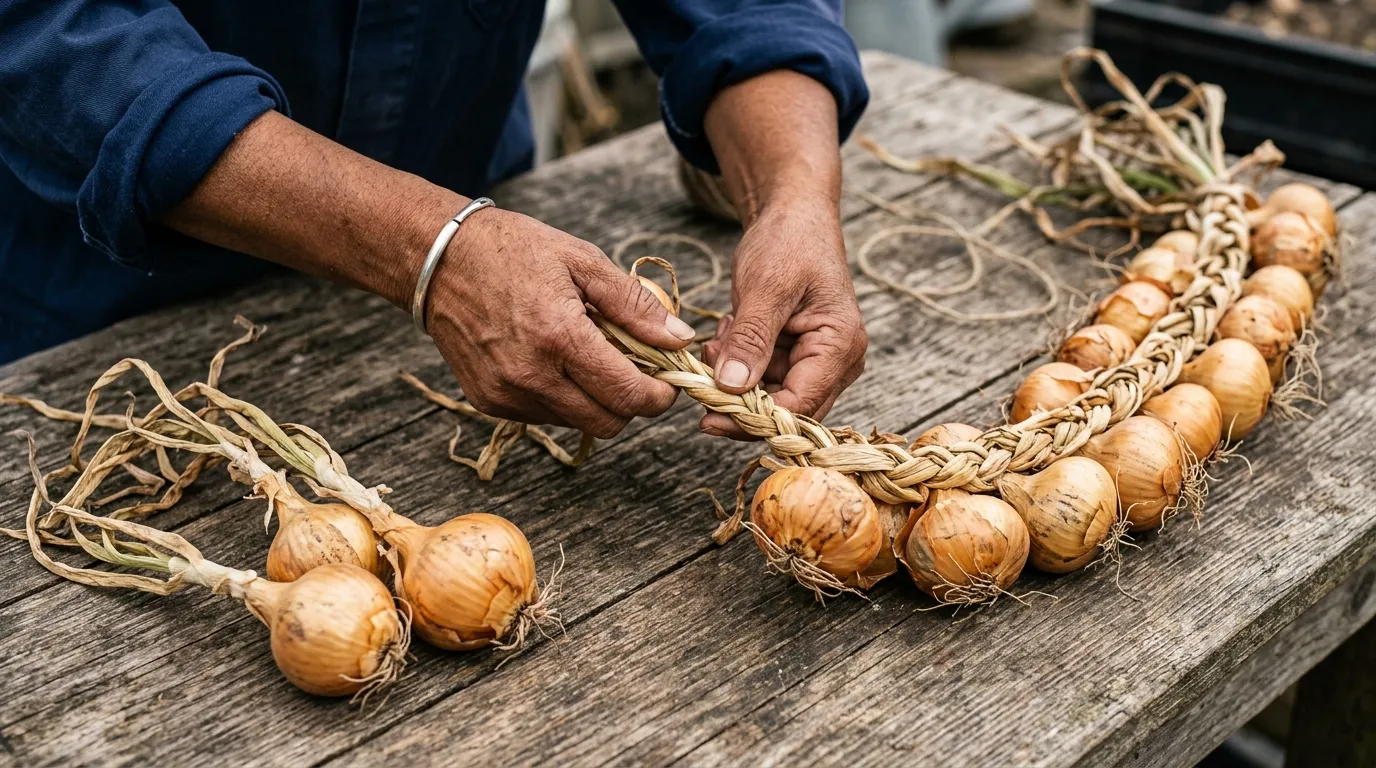
Forms of storage: plaits, nets, crates and trays
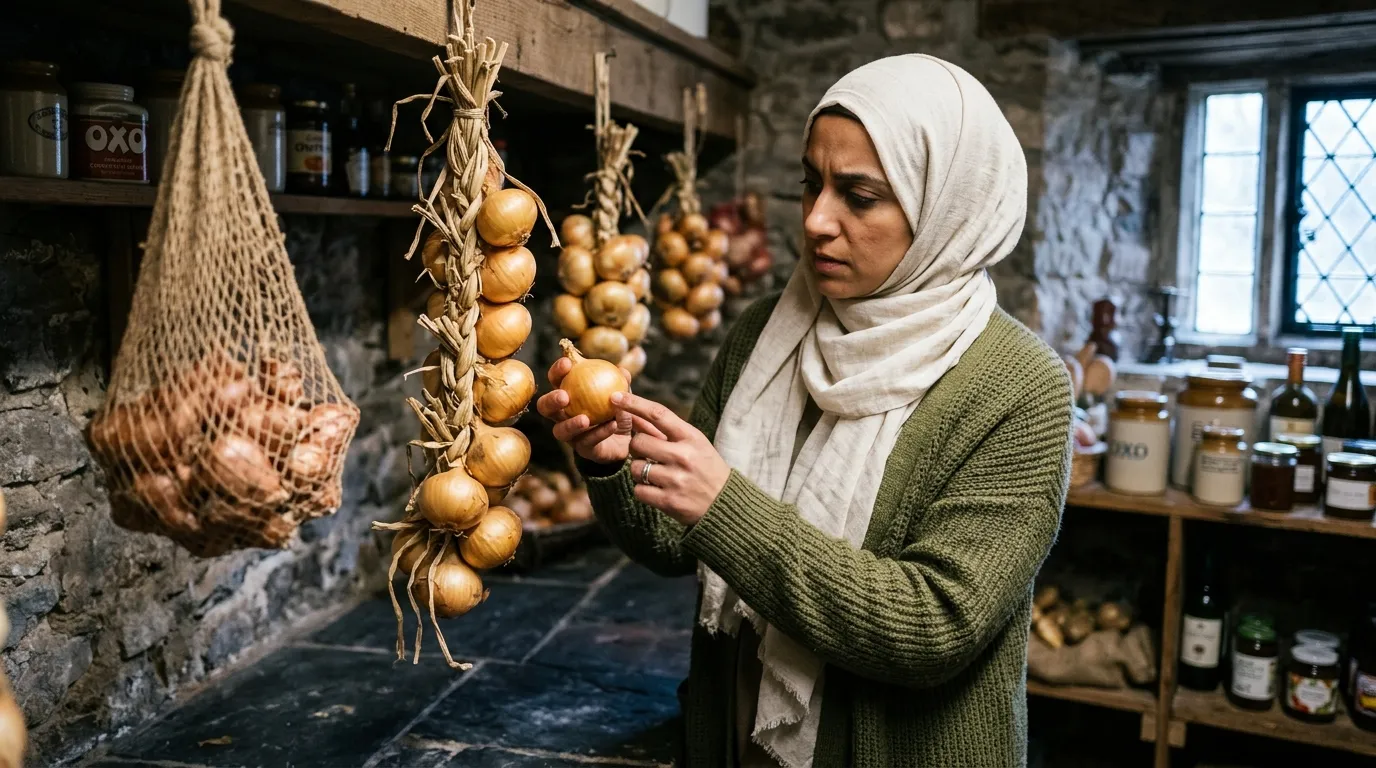
The container is half the storage system; airflow is the other half. Five forms that work in UK conditions:
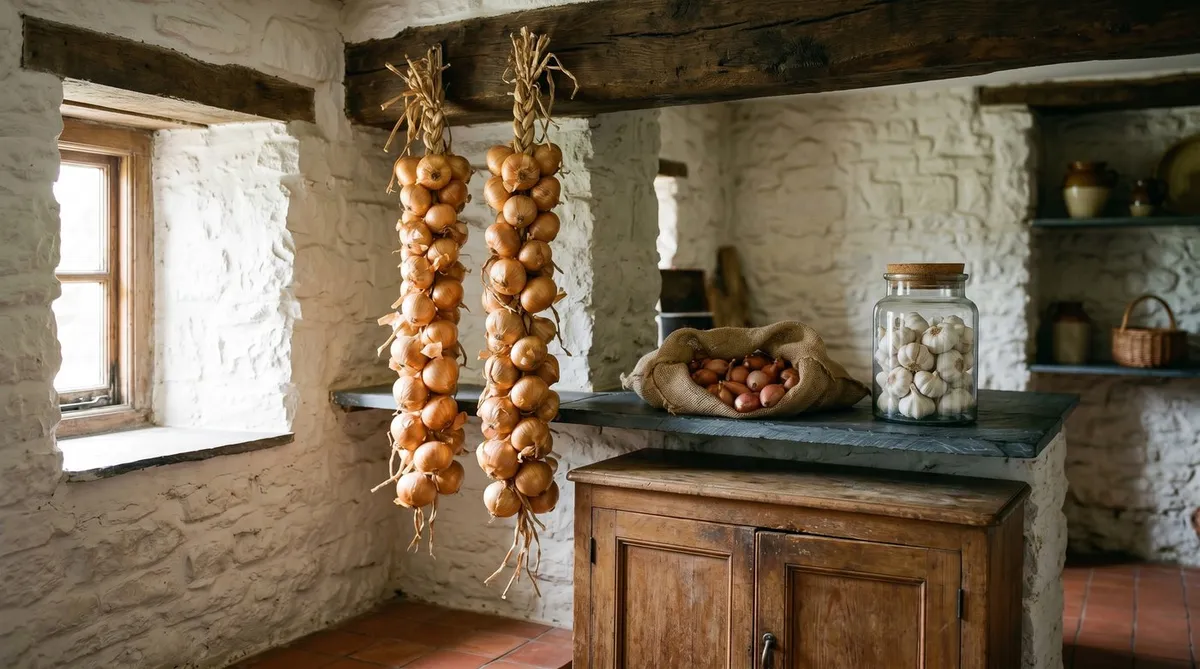
- Plaited string: the classic. Three to five tops twisted together at a time into a continuous braid 80-120cm long, hung from a beam or hook. Visual, practical (you pull bulbs from the bottom up), and gives every onion airflow on five sides. Best for soft-neck garlic and softer onion varieties.
- Hessian net (jute mesh): the easy choice. Drop 20-30 bulbs into a 5kg net, tie the top, hang from a hook. Air gets in through the mesh; the net keeps the bulbs from rolling onto each other. Best for shallots and trimmed onions.
- Slatted wooden crate: old apple crate, mushroom box, or purpose-made nesting tray. Single layer of bulbs per crate, never piled deeper than two. Stackable, easy to inspect.
- Suspended chicken-wire tray: a wooden frame strung with chicken wire (12mm mesh) and hung at 1.8m. Every bulb sits on mesh so air circulates underneath. The best result for very long-term storage of large onions.
- Tights or stockings: the allotment improvisation. Drop one bulb per leg, tie a knot, drop another bulb, tie another knot. Hang the lot from a beam. Each bulb is isolated; one rotting onion does not contaminate its neighbours. Looks odd but works.
Avoid plastic bags, cardboard boxes with closed lids, sealed plastic tubs and bin liners. All of them trap moisture against the skin and accelerate neck rot. The cardinal storage rule: if a bulb cannot feel a breeze, it is going to spoil.
How to plait onions (step by step)
A plait keeps onions visible, airflow-rich and ready to use. The technique is simple once you have done two; the first one always looks scruffy.
- Start with cured onions with intact, flexible tops. Brittle tops snap when twisted; if they have dried hard, soak them in water for 10 minutes to soften before plaiting.
- Tie the first three tops together about 25mm above the bulbs using garden twine, knotted in a figure-of-eight so it grips. Lay the three onions on a table with the bulbs splayed and the tops pointing away.
- Add a fourth onion by laying its top across the three existing ones at the knot. Twist the top of the centre onion over the fourth onion’s top to hold it in place.
- Continue adding onions, one at a time, alternating sides. Each new onion’s top is laid across the bunch and bound in by twisting the existing tops over it. Pull each addition snug; a loose plait sags and the onions fall out by November.
- Finish the plait with the last 80mm of tops twisted together and tied off with another loop of twine. Bend a hanging loop into the end. A finished plait should hold 25-35 onions and weigh 4-6kg.
The full plait wants 30-40 minutes once you are practised, and an hour first time. Store finished plaits in a cool larder, hung from oak or pine beam hooks; metal hooks transfer cold into the topmost onion and trigger spot rot.
Storing garlic: soft-neck vs hard-neck
Garlic splits into two camps with different storage habits and different best forms.
Soft-neck garlic (e.g. ‘Solent Wight’, ‘Picardy Wight’, ‘Iberian Wight’). Soft, pliable tops once cured. Plait beautifully into long strings of 12-15 heads. The strongest UK keeper category; ‘Solent Wight’ regularly holds to May or even June in a cool larder, which is 9-10 months from a July lift. Mild, sweet flavour. Best buy for storage gardens.
Hard-neck garlic (e.g. ‘Lautrec Wight’, ‘Chesnok Red’, ‘Carcassonne Wight’, ‘Elephant’). Tough woody central stem from the original flower scape. Cannot be plaited; the stem snaps and the head falls away. Trim the scape down to 15mm above the head once cured, then either net or hang from twine looped under the stem stub. Storage life is 4-6 months. Stronger, more complex flavour. Best buy for cooks rather than storers.
A practical UK garlic store mixes both: two-thirds soft-neck for the long winter run, one-third hard-neck to use first while the flavour is at its peak.

For the planting and growing side, the how to grow garlic guide covers clove sizing, autumn versus spring planting and feeding for big heads.
Storing shallots: small bulb, long keeper
Shallots store better than onions, gram for gram, because their lower water content and smaller bulb size dry faster and resist mould. Three storage rules that matter most:
- Break the clump only after curing. Cure shallots as intact clumps for 10-14 days. Once the skins are papery, snap each bulb off and store individually.
- Net or crate in single layers. A 1kg hessian net of ‘Longor’ holds 30-40 bulbs and dries through within a week of being hung. Crates work too but never deeper than one layer.
- Save the biggest for spring planting. Set aside the largest 10-15% of the harvest as next year’s sets. Store them at 0-5C in a paper bag in a cool larder; do not put them in the fridge or they break dormancy.
UK shallot ‘Longor’ and ‘Jermor’ both keep 8-10 months reliably in a cool larder. ‘Red Sun’ is shorter at 4-6 months but worth growing for kitchen quality.
UK variety storage chart
Two patterns are worth pulling out. First, hybrid F1 onions and traditional Dutch-bred onions both store well; the choice is on flavour preference, not keeping. Second, anything sold as a “show” variety has a soft neck and short store life by design; grow them for the exhibition, not the larder.
Spotting spoilage before it spreads
Check the store every week from October onwards. Five warning signs to look for:
- Soft patches on the bulb. Press gently. A spongy spot means rot has set in. Pull that bulb out and use it within 48 hours if the rest of the bulb is sound, or compost it if the rot has run through.
- Brown or black mould at the neck. Neck rot fungus (Botrytis allii) starts as a dark grey-brown patch where the tops were trimmed, then spreads down the bulb. Remove infected bulbs immediately; spores travel.
- Green or white shoots emerging from the top. Sprouting means temperature is too warm or dormancy has broken. Use sprouting bulbs first; the bulb itself is still edible but flavour fades fast.
- Roots regrowing from the basal plate. Humidity too high. Move the store to a drier spot, increase airflow, and use the rooting bulbs in the next two weeks.
- Skin lifting or peeling away. Cure was too short. The bulb may still be sound inside; check by pressing the neck. If firm, use within a month.
A weekly five-minute check pulls maybe one bulb in twenty out of a well-cured store, and that small loss prevents the kind of cascade where one rotten onion takes a whole plait down by Christmas.
For comparing how alliums sit alongside other root-crop storage, the how to store root vegetables in winter page covers parsnips, carrots, beetroot and celeriac alongside the alliums.
Salvage tactics when a bulb starts to go
A bulb does not have to be wasted just because storage is failing. Three reliable UK salvage routes:
- Pickled shallots. The classic British pickle. Peel sound shallots, soak in brine for 24 hours, drain, pack into sterilised jars and cover with spiced malt vinegar. Keeps two years in a cool larder. Good use for the smaller end of the shallot crop in January when storage life starts to wobble.
- Blitzed and frozen onion paste. Peel, chop and blitz onions to a coarse paste; freeze in 50g portions in ice-cube trays or flat in zip bags. Use straight from frozen in casseroles, curries and soups. Keeps 12 months. Works for any onion variety; especially good for ‘Red Baron’ as it fades in February.
- Garlic confit (refrigerated). Peel cloves, cover in extra-virgin olive oil, cook at 90C for 45 minutes, cool, decant into sterilised jars and store in the fridge. Use within seven days. Do not store garlic in oil at room temperature: Clostridium botulinum can grow in the anaerobic oil environment, producing a serious neurotoxin. Pressure-canning to a pH below 4.6 is the only safe room-temperature route.
The botulism point matters because home garlic-in-oil is a known UK food safety risk. Either freeze peeled cloves whole, or store the confit in the fridge for a week and use it. Never on the shelf in oil.
Five common UK storage mistakes
After five seasons of records and a fair few rebuilds of clients’ allium stores, the same mistakes appear over and over:
- Storing in plastic. Plastic bags, plastic tubs, lidded boxes. All trap respiration moisture against the skin and accelerate neck rot. Use hessian, jute mesh, slatted crates or chicken-wire trays. Anything that breathes.
- Washing before storing. The dry papery skin is the bulb’s main defence. Washing dissolves the surface wax and forces moisture into the neck. Brush off loose soil with a soft brush instead and leave the rest of the dust on the bulbs.
- Fridge storage for whole onions. Fridges run at 90-95% humidity which is fine for soft fruit but disastrous for cured alliums. The skins absorb water, the basal plates soften and the bulbs sprout within four weeks. Reserve the fridge for peeled cloves and short-term use only.
- Leaving the cure in a damp shed. Curing needs dry air. A wet shed in an August downpour grows surface mould on the necks within 72 hours, ruining the cure. If the weather goes wet, move the bulbs into a polytunnel or garage with a fan running.
- Skipping the weekly check. A single neck-rot bulb in a hessian net will infect every bulb it touches within ten days. The check is five minutes; the loss without it is half a net.
For a wider how-to background on growing strong-skinned, storage-grade alliums in the first place, the how to grow onions and how to grow shallots pages cover soil prep, feeding and watering for cure-ready bulbs, and the onion root fly prevention guide covers the main pest that damages necks during the final growing weeks.
Year-round allium calendar
A working UK allium calendar from a 25 square-metre plot in zone 8b:
- Late October to mid-November: plant garlic cloves and overwintering onion sets.
- Mid-February to mid-March: plant spring-planted onion sets and shallot sets.
- Late June to late July: lift garlic.
- Late July to early September: lift onions and shallots.
- August to September: cure in polytunnel or shed for 14-21 days.
- September onwards: move into larder; plait, net or crate as appropriate.
- October to April: weekly store check; use plaits from the bottom upward, nets from the top down.
- April to May: finish the last of the soft-neck garlic and the long-keeping onions before the new crop matures.
A well-run store from a 25 sq m plot covers a family of four for cooking onions and garlic from September to April with around 35-50kg of cured bulbs in the larder. The home-grown flavour difference is most noticeable on raw use in salads and chutneys; the cooked use difference is subtler but the texture of a properly cured ‘Sturon’ in a slow casserole is night and day from a bagged supermarket onion.
Beyond the larder: feeding the next crop
The store has another job: providing the next year’s planting stock. For shallots, set aside 100-150 of the largest cured bulbs from the August harvest, keep them at 0-5C in a paper bag in the larder, and plant them out in February. For garlic, save the biggest cloves from the biggest bulbs (never the smaller cloves) and replant in November. Onion sets are usually bought in rather than saved, because saved sets often bolt the following season, but if you do save them keep them in a hessian net at 4-6C and reject anything that sprouts before February.
For a wider rotation context, plant alliums where peas or beans grew the previous year to use the residual nitrogen, and follow them with brassicas or a winter green-manure. A liquid feed of comfrey or nettle feed at half-strength every fortnight from May to June helps build the final bulb size, but stop feeding four weeks before the lift to encourage the skins to harden off.
External authorities worth reading
For a second opinion on the principles in this guide, the RHS guide to growing onions covers the official horticultural society’s stance on lift timing and cure, and the Garden Organic expert advice covers organic-grower practice on curing and store rotation. Both back up the lift-late, cure-long, store-cool approach this guide uses.
Related guides
- How to grow onions - sowing through to harvest
- How to grow garlic - autumn cloves to summer lift
- How to grow shallots - sets, spacing and lift timing
- Best UK onion varieties compared - cultivar-by-cultivar yield and flavour notes
- How to store root vegetables in winter - parsnips, carrots, beetroot
- Onion root fly prevention - the main pest threat to neck-sound bulbs
- Comfrey and nettle feed - the homemade liquid feed for bigger bulbs
- Storing garden produce: the complete plan - the pillar reference covering every store type
- Freezing vegetables UK - blanching times for the surplus that does not cure well
Our team produces practical UK gardening guidance from source research, contributor records and established horticultural practice. Editorial standards are overseen by Matt W.