Key takeaways
- M27 keeps an apple to 1.5-2m and fruits in 2-3 years but needs a stake for life
- MM106 is the UK's most widely sold all-rounder at 3.5-5m, good for a bush tree
- M25 makes a 5-8m standard that can wait 5-8 years for a first real crop
- Pears grow on quince, plums on St Julien A or Pixy, cherries on Gisela 5 or Colt
- Vigorous rootstocks suit poor soil; dwarf rootstocks suit fertile ground
- The graft union must sit 8-10cm clear of the soil or the variety will self-root
Fruit tree rootstocks decide how big a tree gets, how soon it fruits, and how far apart you plant. The rootstock is the root system your chosen variety is grafted onto, and it matters more than the variety for the size of the finished tree. A ‘Cox’ apple on M27 stays a 1.8m pot tree. The same ‘Cox’ on M25 becomes an 8m orchard standard. Same fruit, same flavour, wildly different tree. This guide explains what a rootstock does, then sets out the apple, pear, plum and cherry options used in UK gardens, with real heights, spacings and cropping ages.
Get the rootstock right and the tree fits your space for life. Get it wrong and you spend every winter fighting a tree that wants to be twice the size of your plot.
What a fruit tree rootstock actually is
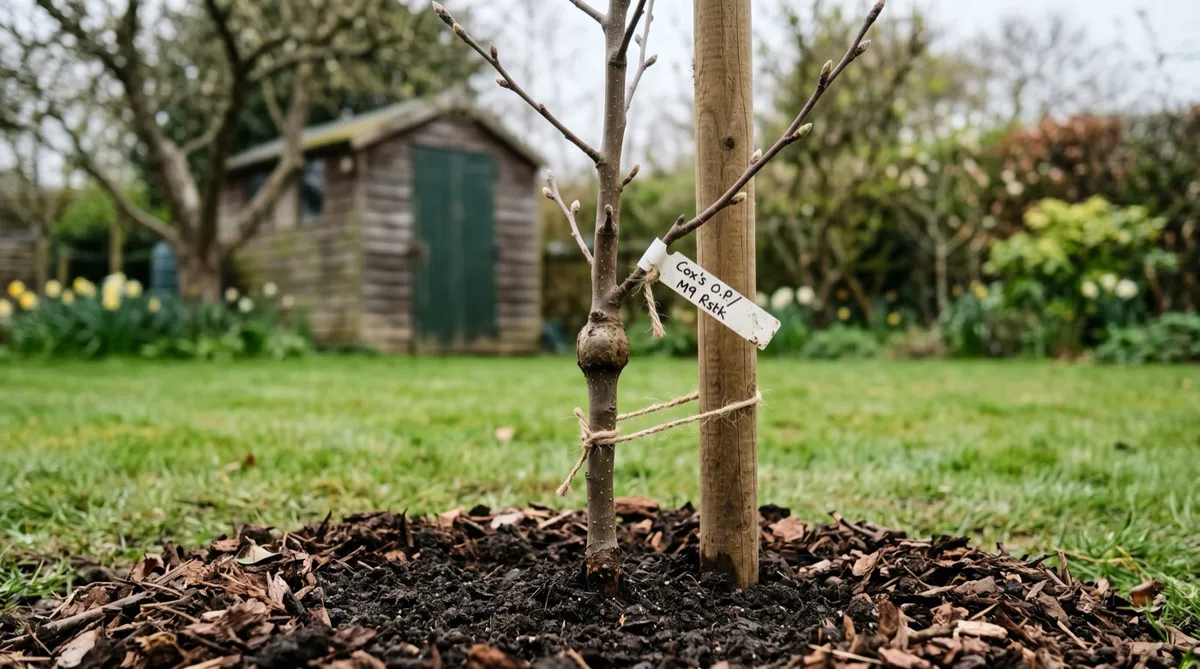
A rootstock is the lower part of a grafted fruit tree: the roots and the base of the trunk. The fruiting variety, called the scion, is grafted on top. Where the two join you see a swollen kink low on the trunk, the graft union. Almost every fruit tree sold in Britain is made this way, because most varieties do not come true or root well from cuttings.
The rootstock controls four things. First, vigour and final size, by limiting or boosting how much water and nutrient the roots push up. Second, time to first fruit: dwarfing roots stress the tree slightly, which makes it flower younger. Third, spacing, because a smaller tree needs less room. Fourth, soil tolerance, since some rootstocks shrug off wet clay while others sulk in it.
Rootstocks are bred and numbered. Apple stocks carry an M or MM code from the East Malling research station in Kent, where most were developed. The number is a catalogue reference, not a size, so M27 is tiny while M25 is huge despite the close numbers.
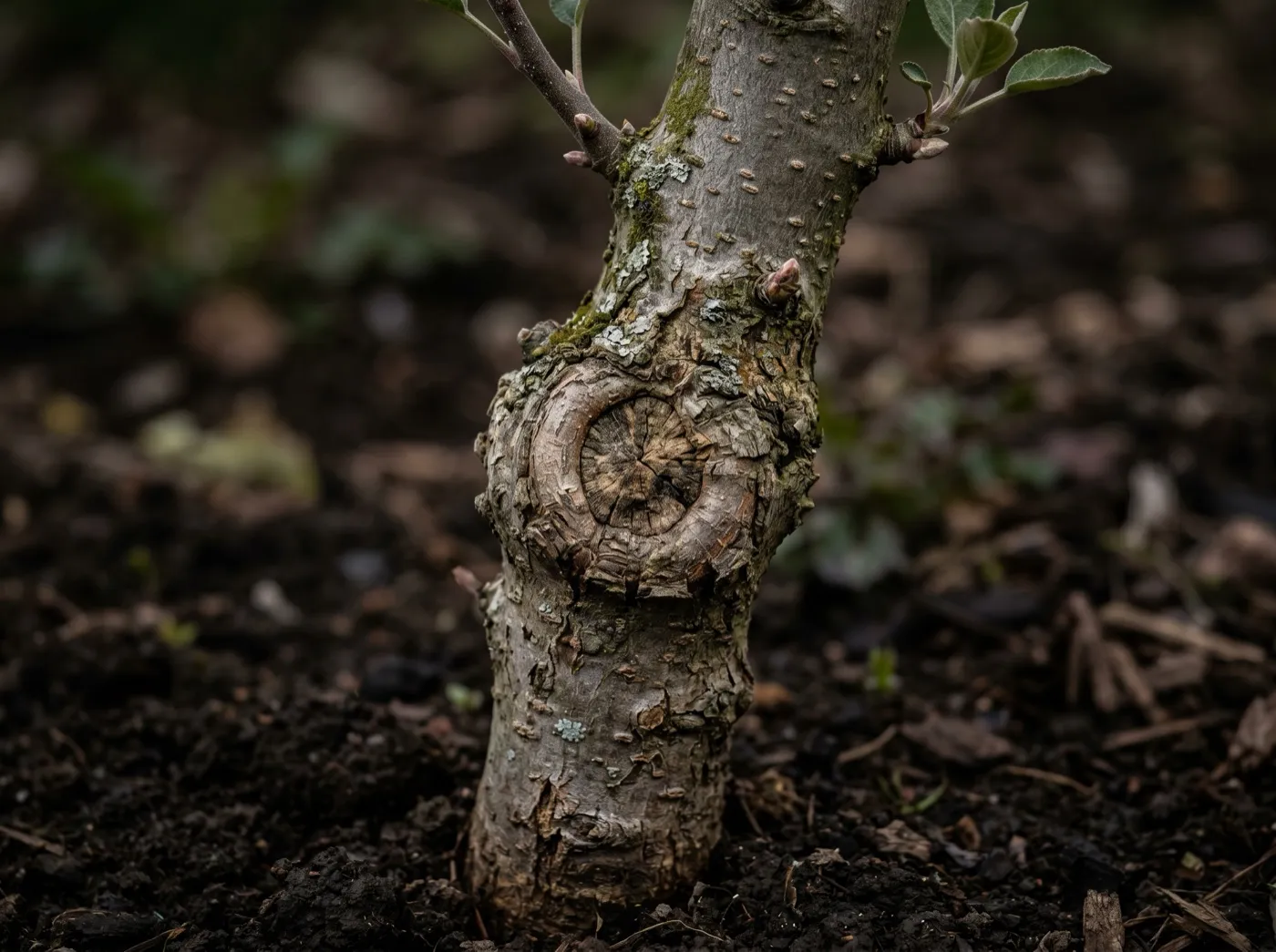 The graft union is the swollen kink low on the trunk. It must sit 8-10cm above the soil for life so the variety never sets its own roots.
The apple rootstock ladder from smallest to largest
Apples have the widest rootstock choice of any fruit, running from a 1.5m patio tree to an 8m standard. This is the core table to work from. The rootstocks are ordered smallest to largest, which is also roughly the order from quickest-cropping to slowest.
| Rootstock | Vigour | Mature height | Years to fruit | Staking | Best use |
|---|---|---|---|---|---|
| M27 | Very dwarfing | 1.5-2m | 2-3 | Permanent stake | Pots, stepover cordons, tiny gardens |
| M9 | Dwarfing | 2.5-3m | 3-4 | Stake for life | Intensive rows, spindle, small gardens |
| M26 | Semi-dwarfing | 3-3.5m | 3-4 | Stake 5 years | Cordons, espaliers, small gardens |
| MM106 | Semi-vigorous | 3.5-5m | 4-5 | Stake when young | Bush, half-standard, average gardens |
| MM111 | Vigorous | 5-6m | 5-7 | Stake when young | Larger gardens, poor or dry soil |
| M25 | Very vigorous | 5-8m | 5-8 | Stake when young | Traditional orchard standards, grass |
M27 is the dwarf of dwarfs. It keeps a tree to 1.5-2m and crops in two to three years, but the weak roots cannot anchor the tree or hunt for water. It demands a permanent stake, rich soil, and a clear weed-free circle. Treat it like a large container plant in the ground.
M9 is the workhorse of commercial orchards. At 2.5-3m it crops young and heavily for its size, but like M27 it needs a stake for its whole life. It is ideal for an intensive row of spindle trees or a productive small garden.
M26 sits a notch up at 3-3.5m and is the best all-rounder for a small garden tree, cordon or espalier. It stakes for about five years, then stands alone. MM106 is the most widely sold rootstock in Britain. It makes a manageable 3.5-5m bush, copes with average soil, and is the default a nursery will offer if you do not specify.
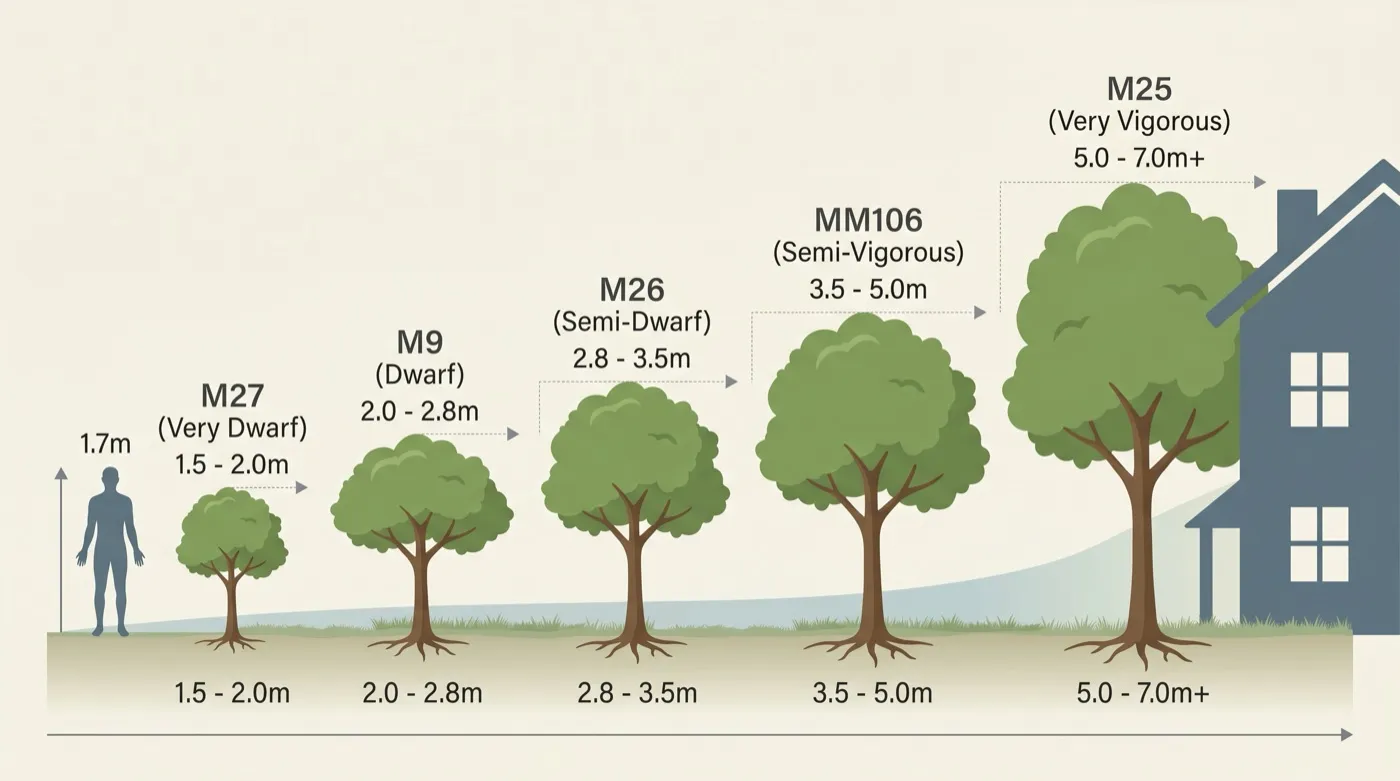 The same apple variety on five rootstocks. M27 reaches a person’s head height; M25 dwarfs a two-storey house. The rootstock, not the variety, sets this scale.
Pear rootstocks: why pears grow on quince
Pears are not grafted onto pear seedling for garden trees. They grow on quince, a related but separate species, because quince roots restrict vigour and bring pears into fruit far sooner. A pear on its own seedling roots can take fifteen years to crop and reach 12m.
There are two common quince rootstocks. Quince C is the more dwarfing, giving a 3-4m tree that fruits in four to five years. It suits cordons, espaliers and small gardens, but needs good soil to thrive. Quince A is semi-vigorous at 4-6m and is the standard choice for a free-standing pear bush or half-standard. It is more forgiving of poorer ground.
There is one catch. Some pear varieties, including ‘Williams’ and ‘Doyenne du Comice’, are graft-incompatible with quince and will not bond directly. Nurseries get round this with an interstem, a short length of a compatible pear like ‘Beurre Hardy’ grafted between the quince root and the chosen variety. If you buy one of these pears, check it has the interstem. Our pear tree growing guide covers variety choice and pollination groups in full.
Gardener’s tip: When you buy a pear, ask the nursery which quince rootstock and whether an interstem was used. A ‘Comice’ sold without an interstem on bare quince may fail at the union years later, long after the receipt is gone.
Plum, gage and damson rootstocks
Plums, gages and damsons share a smaller set of rootstocks than apples, but the size range still spans a patio tree to a 5m orchard tree. All three fruits use the same stocks.
| Rootstock | Vigour | Mature height | Years to fruit | Best use |
|---|---|---|---|---|
| Pixy | Dwarfing | 2.5-3m | 3-4 | Small gardens, pots, fans |
| VVA-1 | Dwarfing | 2.5-3.5m | 3-4 | Small gardens, free-draining soil |
| St Julien A | Semi-vigorous | 3.5-4.5m | 4-5 | Bush, fan, the common all-round choice |
| Myrobalan B | Vigorous | 4.5-6m | 5-6 | Large gardens, poor soil, standards |
Pixy is the dwarfing option at 2.5-3m, good for a small garden or a fan against a wall, though it needs decent soil and dislikes drought. VVA-1 is a newer dwarfing stock with similar size and slightly better tolerance of dry ground.
St Julien A is the rootstock most UK plums are sold on. At 3.5-4.5m it makes a sensible garden tree, trains as a fan, and copes with a range of soils. It is the safe default if you are unsure. Myrobalan B is vigorous at 4.5-6m and best kept for large gardens, grass orchards, or poor soil where a dwarf stock would struggle. Our plum tree growing guide pairs these stocks with the right varieties and pollination partners.
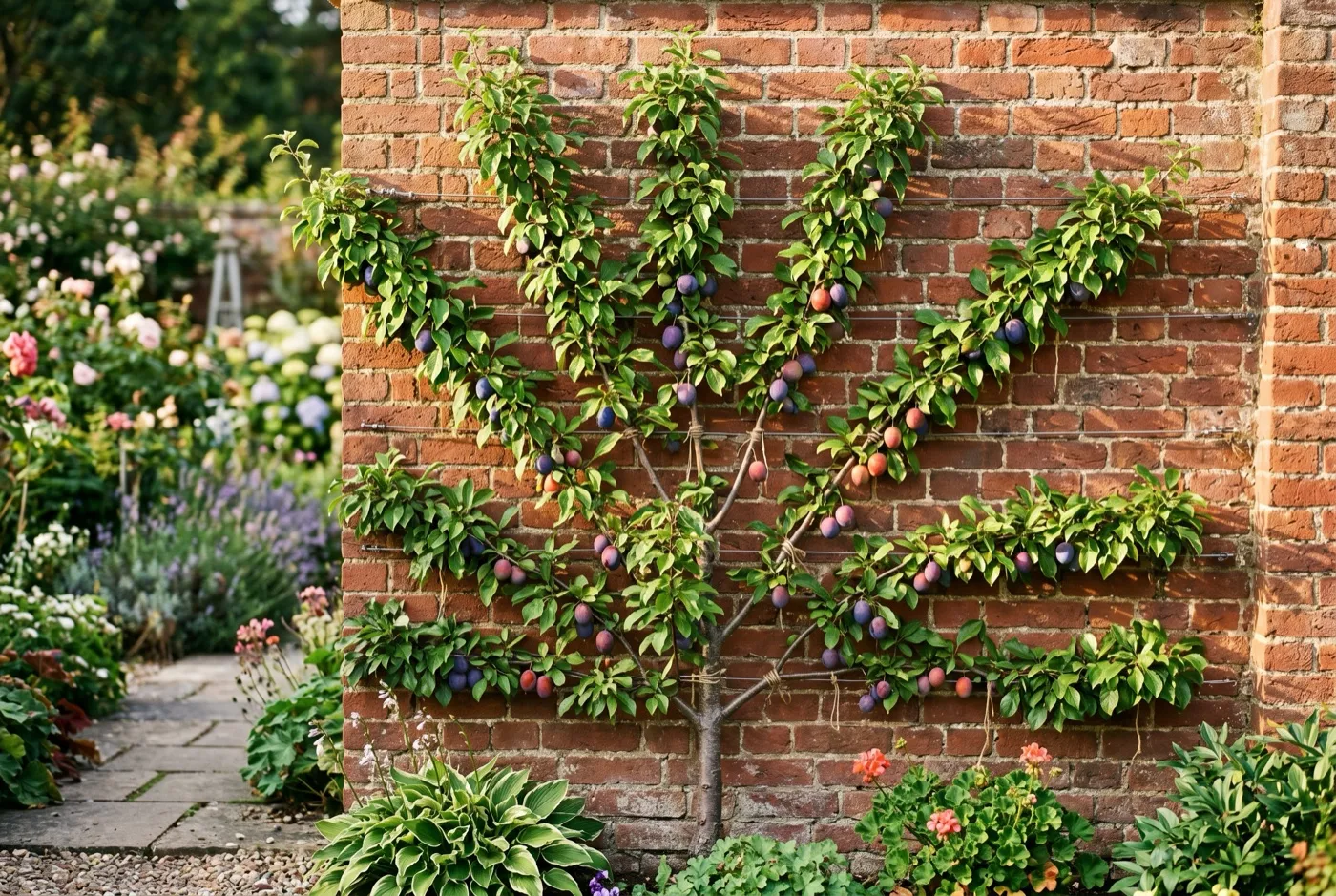 A plum fan on St Julien A against a sunny wall. The semi-vigorous rootstock supplies enough vigour to fill the framework without overwhelming the space.
Cherry rootstocks: from giant Mazzard to dwarfing Gisela 5
Cherries were once impossible in small gardens. Old trees grew on Mazzard (wild cherry seedling), which made 8-12m monsters far too big to net against birds. Modern dwarfing rootstocks changed that completely.
Gisela 5 is the dwarfing rootstock that made garden cherries practical. It keeps a tree to 2.5-3m, crops in three to four years, and is small enough to drape with netting before the blackbirds strip it. It needs good soil and a stake when young, but it is the rootstock to ask for in any normal garden.
Colt is semi-vigorous at 4-5m, a sensible choice for a larger garden or where you want a free-standing tree with no stake. It tolerates a wider range of soils than Gisela 5. Avoid seedling Mazzard unless you are planting a field orchard with room for a giant.
Both common cherry stocks crop far sooner than the old Mazzard trees, which often took eight years or more. A Gisela 5 cherry can give a useful pick in its third summer.
Choosing the right rootstock for your space
Work from your space and soil outwards, not from the variety inwards. The single biggest mistake is falling for a variety name, then discovering the only stock available makes a tree twice your plot’s size.
Start with the space. A courtyard or balcony wants M27, Pixy or Gisela 5. A typical suburban bed wants M26, M9, Pixy or Gisela 5. A larger garden with a lawn suits MM106, St Julien A or Colt. A field or paddock for a traditional orchard wants MM111, M25, Myrobalan B and seedling stocks.
Then check the soil. This rule catches people out: choose a more vigorous rootstock for poor, thin or dry soil, and a more dwarfing rootstock for rich, fertile ground. A dwarf stock on poor soil simply starves and sulks. A vigorous stock on rich soil grows away too strongly and delays fruiting. The roots and the ground have to match.
Finally, match the training form to the stock. Cordons and espaliers need restrictive stocks like M9, M26 or Quince C to stay disciplined. A free-standing bush wants MM106 or St Julien A. You can read more on training shapes in our guide to espalier and fan-trained fruit trees, and for the smallest plots see our dwarf fruit trees for small gardens guide.
Warning: Never bury the graft union to make a tree look tidier or to hide a leaning stem. If the scion roots above the union, the rootstock is bypassed and the tree reverts to full uncontrolled vigour. Keep the union 8-10cm clear of the soil for the tree’s whole life.
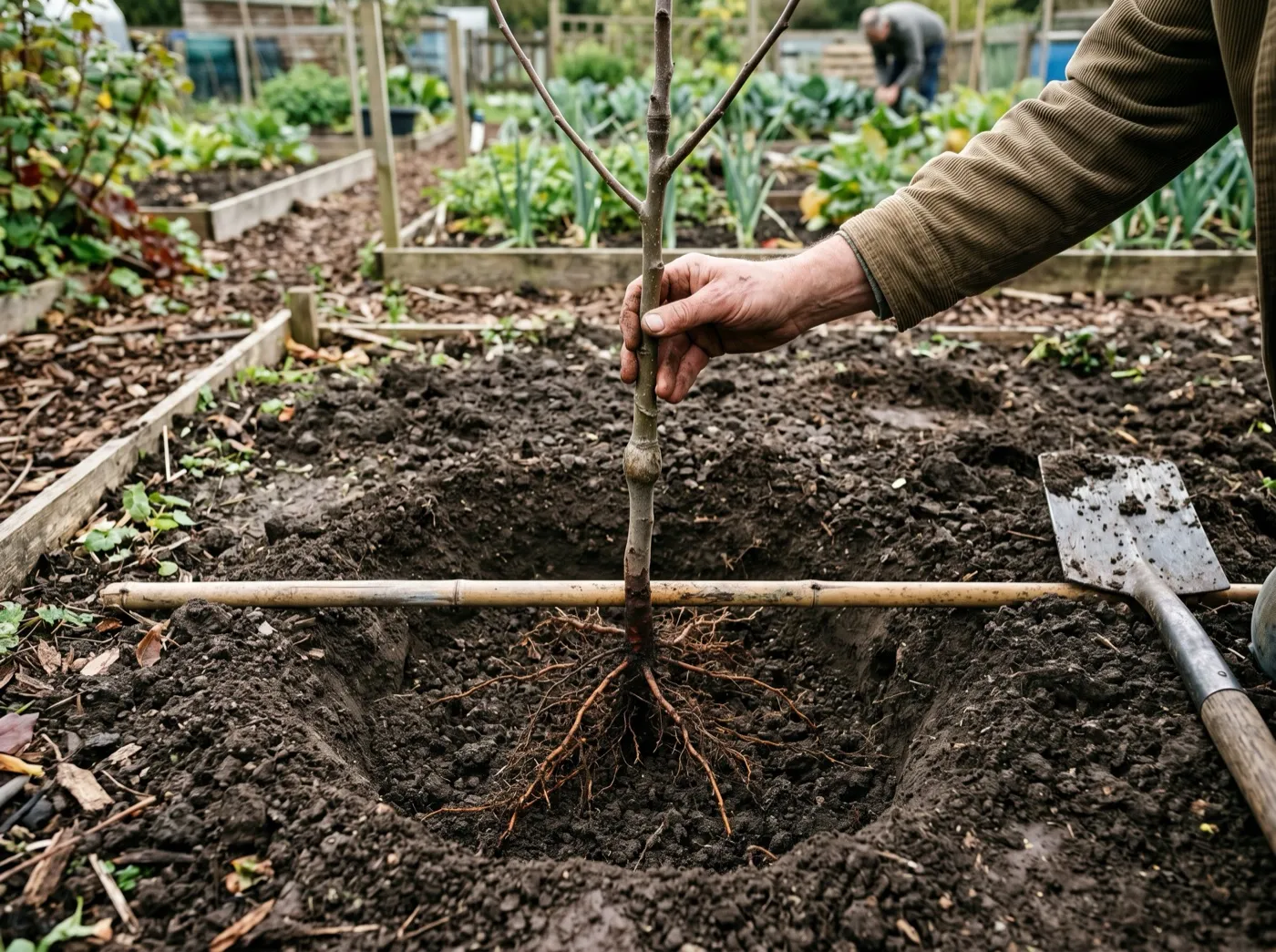 Lay a cane across the hole to check the graft union sits 8-10cm above the finished soil level before backfilling. Planting too deep undoes all the size control the rootstock provides.
How rootstock changes the planting calendar
Bare-root fruit trees, the cheapest and best-establishing form, are only sold and planted in the dormant season. The rootstock changes the spacing and the staking, but the timing is the same across all of them.
| Month | Task |
|---|---|
| November | Best planting month for bare-root trees as soil is warm and moist |
| December | Continue planting; drive a permanent stake for M27 and M9 trees |
| January | Plant in open weather; avoid frozen or waterlogged ground |
| February | Last reliable bare-root planting; firm any trees lifted by frost |
| March | Plant container trees; mulch and water in newly planted trees |
| April | Check ties on staked dwarf stocks; keep a weed-free circle |
| May to August | Water dwarf-stock trees weekly in dry spells; their roots cannot hunt |
| September | Order bare-root trees by rootstock for winter delivery |
| October | Prepare planting holes; clear a 1m weed-free circle |
Dwarf stocks like M27 and M9 need the most attention through summer because their small root systems cannot draw water from far. A vigorous M25 tree, by contrast, looks after itself once established. For step-by-step planting and aftercare, see the apple tree growing guide.
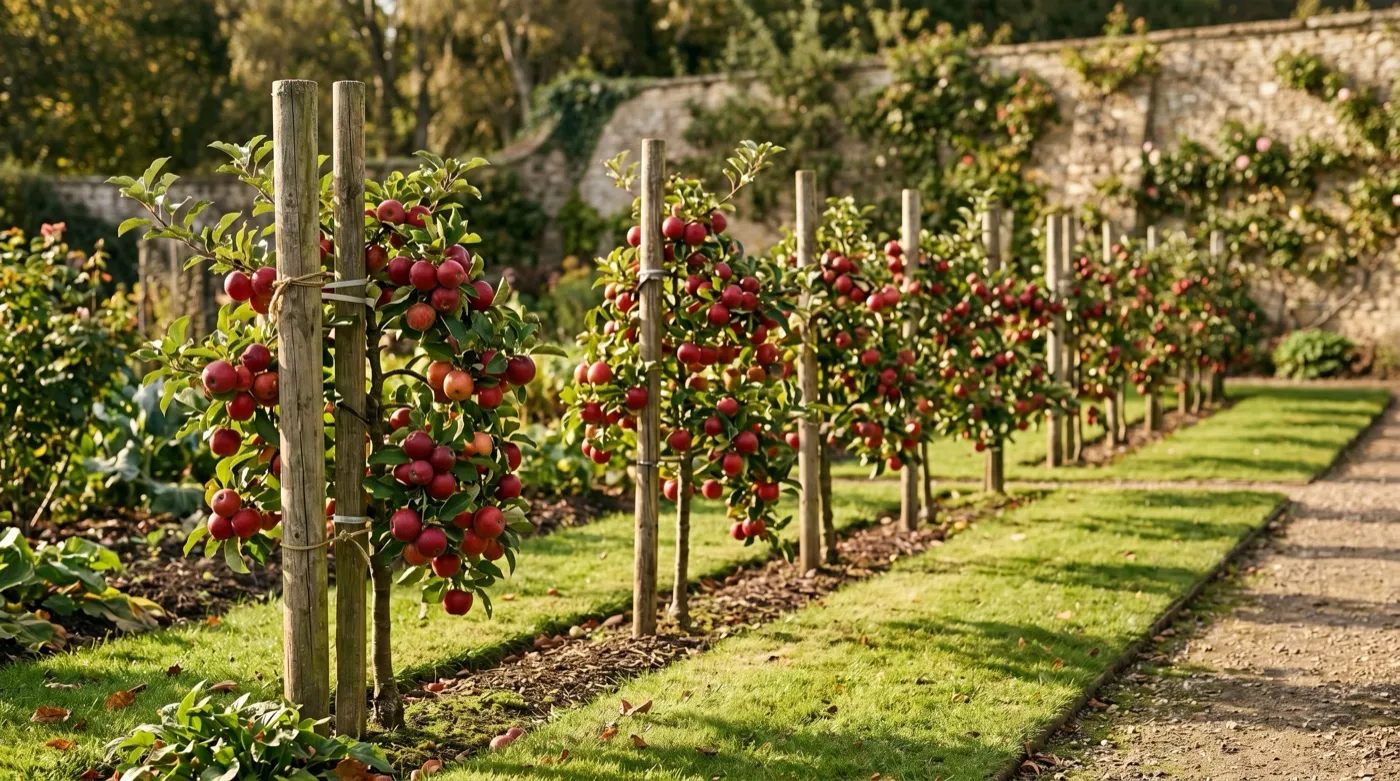 Dwarf M9 trees staked and cropping heavily in mown grass. A dwarfing rootstock lets a small garden hold several varieties in the space one standard tree would fill.
Rootstock mistakes that ruin a fruit tree
- Buying for the variety, not the size. People pick ‘Cox’ or ‘Victoria’ first, then accept whatever rootstock is in stock. Always specify the rootstock for your space, then find that variety on it.
- Planting the graft union too deep. A buried union lets the scion root and the size control vanishes. Set it 8-10cm above soil and keep it there.
- Skipping the stake on M9 or M27. These stocks never anchor themselves. A tree left unstaked leans, rocks, and can blow over in fruit. Stake at planting and leave it for life.
- A dwarf stock on poor soil. M9 or M27 on thin, dry ground starves and barely grows. Match dwarf stocks to rich soil and vigorous stocks to poor soil.
- Expecting pruning to shrink a vigorous tree. Hard-pruning an M25 tree triggers vigorous water shoots and delays fruiting. Pruning shapes a tree; it cannot override the rootstock.
This is the heart of it. The rootstock is the one decision you cannot change after planting. The variety can be top-worked or replaced. The roots are forever. Browse the full set of fruit-growing guides in our growing section to plan a tree that fits.
Grafting your own trees onto a chosen rootstock
You do not have to buy a finished tree. Many gardeners buy a bare maiden rootstock for a few pounds and graft their own variety onto it in late winter. This lets you put a favourite or rare apple onto exactly the size of root you want.
The technique is a whip-and-tongue graft in March, joining a dormant scion of your variety to the rootstock with matching cuts and tight binding. Done well, the union heals in a single season and you have a custom tree at a fraction of the nursery price. It also lets you add a pollination partner to an existing tree by grafting a second variety into the canopy.
If you fancy trying it, our grafting fruit trees guide walks through the cuts, timing and aftercare. Pair grafting with good pruning, covered in our pruning fruit trees guide, and you can shape a tree from the union up. The Royal Horticultural Society’s advice on rootstocks explains the East Malling numbering in more detail.
Frequently asked questions
What is the most dwarfing apple rootstock in the UK?
M27 is the most dwarfing apple rootstock sold here. It keeps a tree to 1.5-2m and fruits in two to three years. It needs permanent staking and rich, weed-free soil to perform. Use it for pots, stepover cordons, or the smallest courtyard gardens.
What rootstock should I choose for a small garden?
M26 or M9 suits most small gardens. M26 gives a 3-3.5m tree that trains well as a cordon or espalier. M9 stays smaller at 2.5-3m but needs a permanent stake. Both crop young, within three to four years of planting.
Which apple rootstock is best for a normal garden tree?
MM106 is the standard all-round choice for a free-standing bush. It makes a 3.5-5m tree, copes with average soil, and needs staking only for the first few years. It is the rootstock most UK fruit nurseries sell as their default option.
Why does the graft union have to stay above the soil?
Burying the graft lets the variety root past the rootstock. If the scion sets its own roots, you lose all size control and the tree reverts to full vigour. Plant so the union sits 8-10cm clear of the finished soil level and keep it that way.
What rootstock do pears grow on?
Pears are grafted onto quince, not pear seedling. Quince C is the more dwarfing option at 3-4m, while Quince A makes a larger 4-6m tree. Some pear varieties are incompatible with quince and need a compatible interstem grafted between the two.
Can I make a tree smaller by pruning instead of using a dwarf rootstock?
No, pruning cannot override a vigorous rootstock. Hard pruning a tree on M25 simply triggers strong regrowth and delays fruiting. The rootstock sets the genetic size potential. Choose the right one at purchase rather than fighting the tree every winter.
Our team produces practical UK gardening guidance from source research, contributor records and established horticultural practice. Editorial standards are overseen by Matt W.