Key takeaways
- Sweet alyssum is Lobularia maritima, an annual; gold dust alyssum is Aurinia saxatilis, a perennial
- Seed needs light to germinate, so surface sow at 15 to 18C and never cover it
- Plants reach 8 to 15cm tall and spread 20 to 30cm, so space them 15cm apart
- A hard shear to 5cm in mid-July brings a second flush in 18 to 21 days
- Our counts averaged 11 hoverflies per square metre of alyssum against 2 on bare soil
- A packet of 1,000 seeds costs about £2 and fills 8 metres of path edging
Alyssum is the easiest scented annual you can sow, and most gardeners get one flush out of it instead of two. Learning how to grow alyssum well comes down to three things: getting the right plant, sowing it uncovered at the right temperature, and shearing it back in July. The honey scent carries several metres on a still evening. The flowers pull in hoverflies that then clear aphids off your beans. This guide covers cultivar choice, sowing temperatures, spacing, the mid-summer cut that resets the plant, and how alyssum earns its keep beside vegetables in a British garden.
Sweet alyssum and gold dust alyssum are not the same plant
This is the first thing that trips people up, and seed catalogues do not help. Sweet alyssum is Lobularia maritima. It is a low, spreading annual in the cabbage family, 8 to 15cm tall, covered in tiny four-petalled flowers that smell of honey. It flowers from June until the first hard frost and dies over winter.
Gold dust alyssum is Aurinia saxatilis, still sold under its old name Alyssum saxatile. It is a woody, evergreen perennial for walls and rockeries, 20 to 30cm tall, with grey-green leaves and a solid sheet of egg-yolk yellow flowers in April and May. It lives for five to eight years and flowers once a season.
The practical difference matters. If you buy Aurinia expecting a summer-long white edging, you get three weeks of yellow in spring and a scruffy grey mound for the rest of the year. If you buy Lobularia expecting a permanent rockery plant, it is dead by February. Check the botanical name on the packet. Everything else in this guide is about Lobularia maritima.
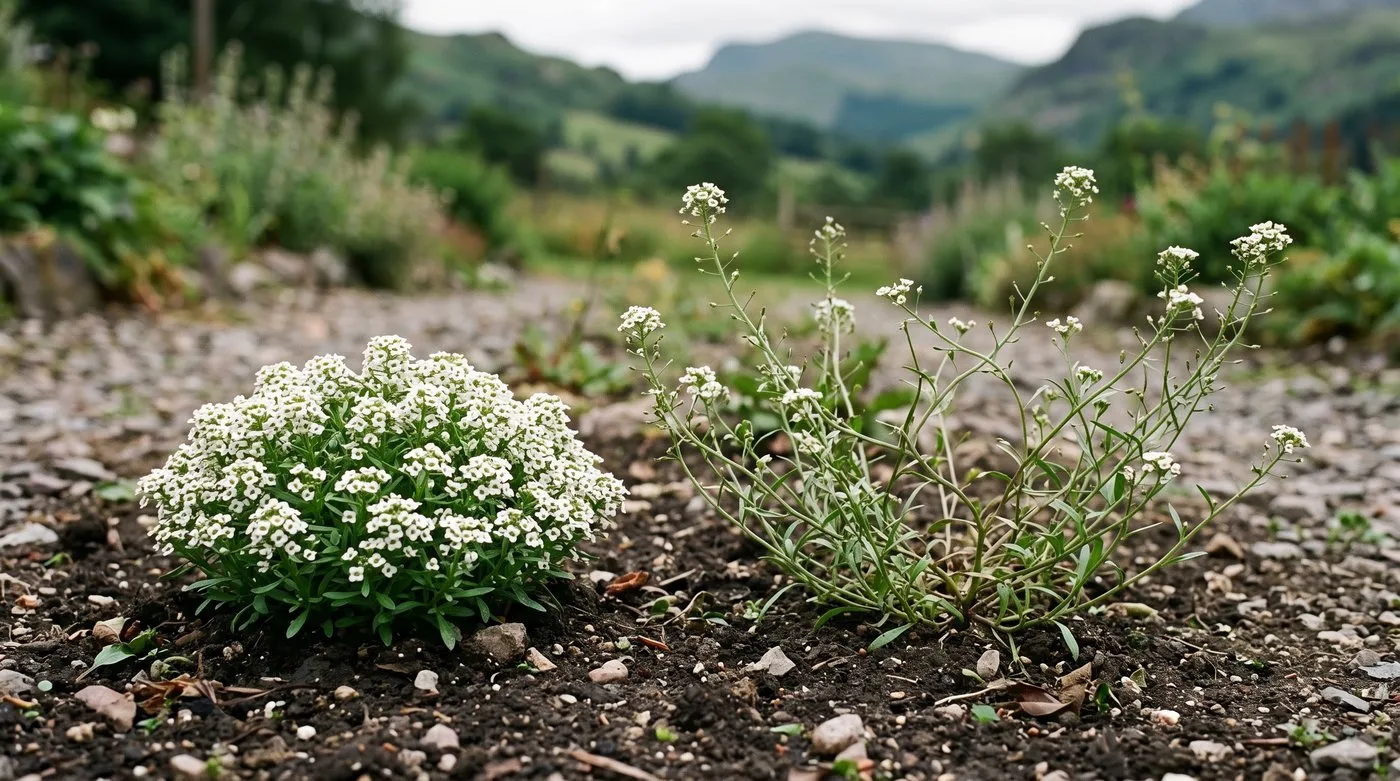
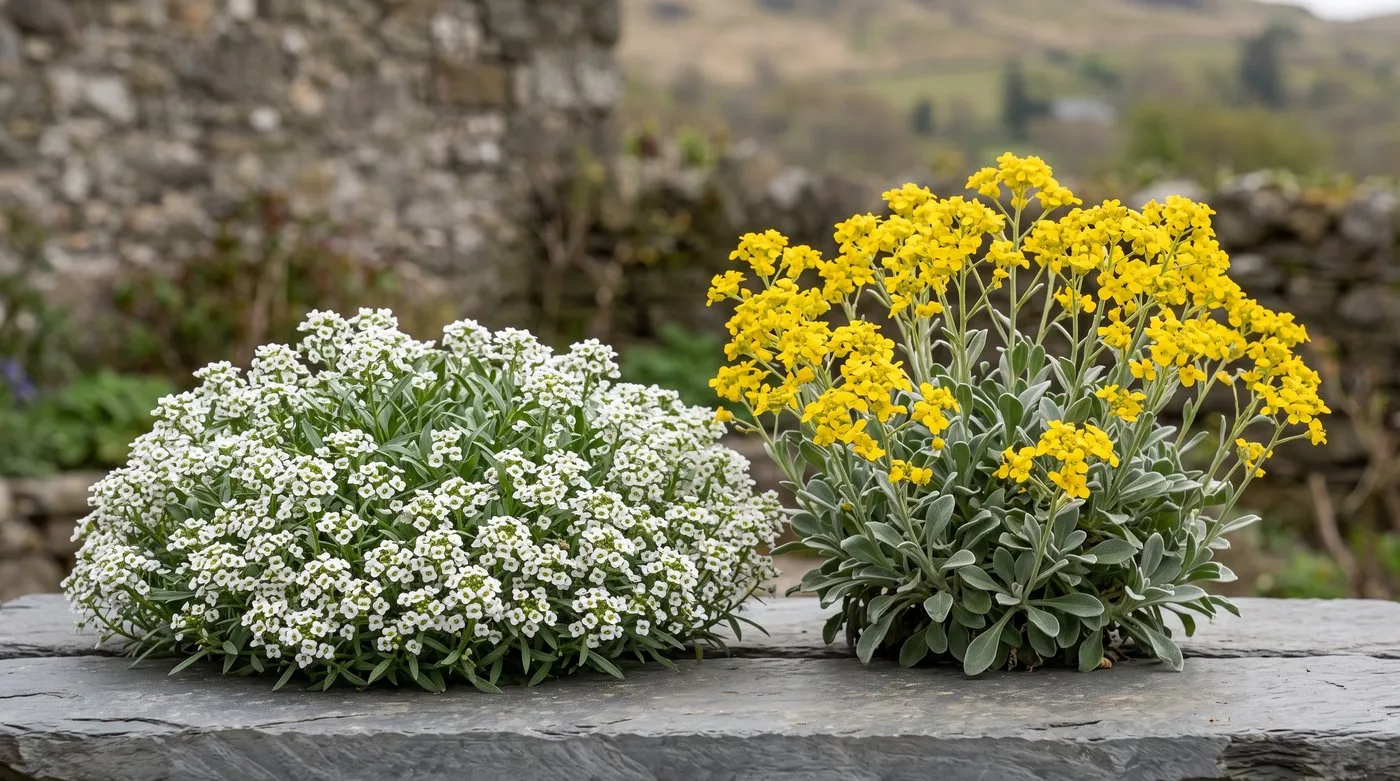 Left, sweet alyssum (Lobularia maritima): white, low, annual. Right, gold dust alyssum (Aurinia saxatilis): yellow, woody, perennial. Two unrelated plants sharing a common name.
Which alyssum varieties are worth growing in the UK
‘Snow Crystals’ is the gold standard for UK ground-level use. Its flowers are roughly twice the size of ‘Carpet of Snow’ at about 5mm across, and the plant holds a domed shape for six weeks rather than three before it starts to open in the middle. It is also the most forgiving of a hard shear.
‘Snow Princess’ is a sterile hybrid sold as young plants, not seed. It never sets seed, so it never stops flowering and needs no shearing. It costs around £4 a plug against £2 for 1,000 seeds. Use it in baskets where you want one plant to fill 60cm. Use seed everywhere else.
Sowing alyssum seed: light, temperature and timing
Alyssum seed is tiny, roughly 0.5mm, and it needs light to germinate. Covering it with compost is the single most common reason a tray fails. Sow it on the surface, press it down with a flat piece of wood, and do not cover it at all.
The temperature band is 15 to 18C. Below 12C germination stretches out to three weeks and gets patchy. Above 22C germination drops away sharply, which is why an airing cupboard is the wrong place for this one. A windowsill in an unheated room in March is close to ideal.
Sow into moist multipurpose compost in a seed tray or, better, into 24-cell modules with three or four seeds per cell. Water from below by standing the tray in 2cm of water for ten minutes, because overhead watering washes surface-sown seed into corners. Expect the first seedlings in 7 to 14 days.
There is no need to thin a module down to one seedling. Alyssum grows happily as a clump of three or four and plants out as a single unit, which gives a fuller carpet faster. Our own trays run at 80 to 90 percent germination on fresh seed and drop to around 55 percent on seed kept a second year.
Gardener’s tip: Sow one module tray in early March for planting out in May, and a second in early May for direct planting in late June. The second batch comes into flower as the first is being sheared, so the edging never has a gap. Two sowings from one 2 pound packet cover a 12 metre path.
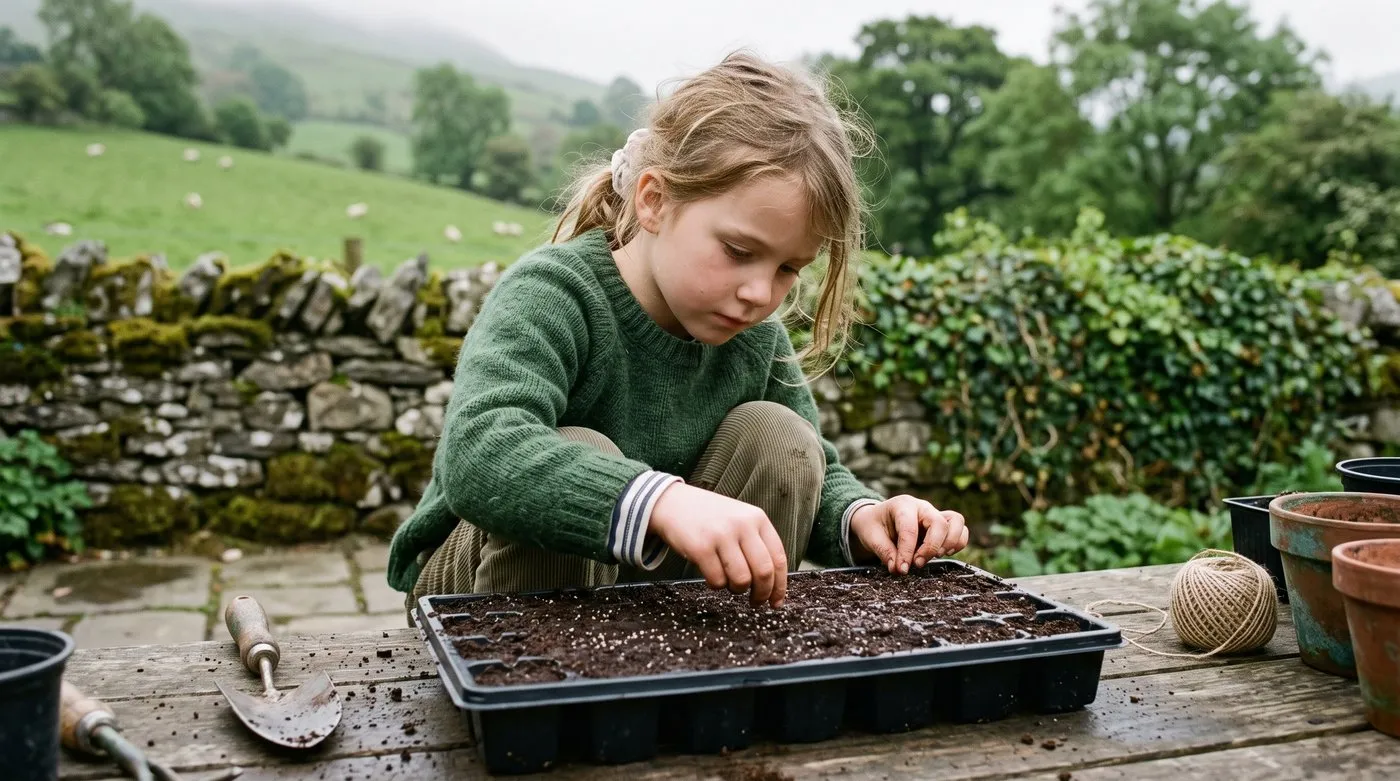 Surface sowing alyssum in a Snowdonia foothills garden. The seed sits on top of the compost and is pressed down, never covered, because it needs light to germinate.
From seed to first flower: the six week timeline
Understanding the sequence tells you exactly when to intervene. Alyssum runs through five stages, and the whole cycle from sowing to first open flower takes six to eight weeks in a UK spring.
- Imbibition, days 0 to 3. The seed takes up water. Light striking the seed coat triggers germination. Compost must stay damp but not wet.
- Germination, days 3 to 14. The root emerges first, then two rounded seed leaves. Optimum 15 to 18C. Below 10C this stage stalls entirely.
- Rosette building, days 14 to 35. Four to six true leaves form, narrow and slightly grey. Growth looks slow and gardeners often assume failure here. It is normal.
- Bud initiation, days 35 to 45. Once the plant has eight or more leaves and daylength passes 14 hours, flower buds form at every shoot tip. In north Staffordshire that daylength arrives around 25 April.
- Flowering and seed set, day 45 onwards. Flowers open over 6 to 8 weeks. As soon as the first seed pods swell, the plant begins shutting flower production down.
The critical mistake sits in stage five. People deadhead individual flowers, which is impossible on a plant carrying 400 blooms, or they simply let it run. Once seed pods form, hormone signals stop new bud initiation across the whole plant. The only practical reset is to remove everything at once with shears. Understand stage five and the July shear stops being optional.
Where to plant alyssum for edging and gap filling
Alyssum’s real job in a garden is horizontal. It spreads 20 to 30cm and stays under 15cm tall, so it fills the awkward strip where a border meets a path and nothing else wants to grow.
Plant it 15cm apart in a single row for a continuous edge, or 15cm apart in a staggered double row for a 40cm band. The carpet closes up around six weeks after planting out. Closer than 10cm and the crowns stay damp in a wet British summer, which is how downy mildew starts as a whitish purple-tinged film on the leaves.
It also works as a gap filler. Drop three plants into the hole left by lifted spring bulbs, or into the front of a border where oriental poppies have collapsed in July. The soil needs to be free draining. On our heavy clay-loam we fork 5cm of horticultural grit into the top 15cm of any strip destined for alyssum, and losses to rot dropped from about a third of plants to under one in twenty.
Containers suit it well. In a 30cm pot, five plants around the rim will spill 20cm over the edge by late July. It tolerates drying out far better than lobelia, which is its usual competitor for that job.
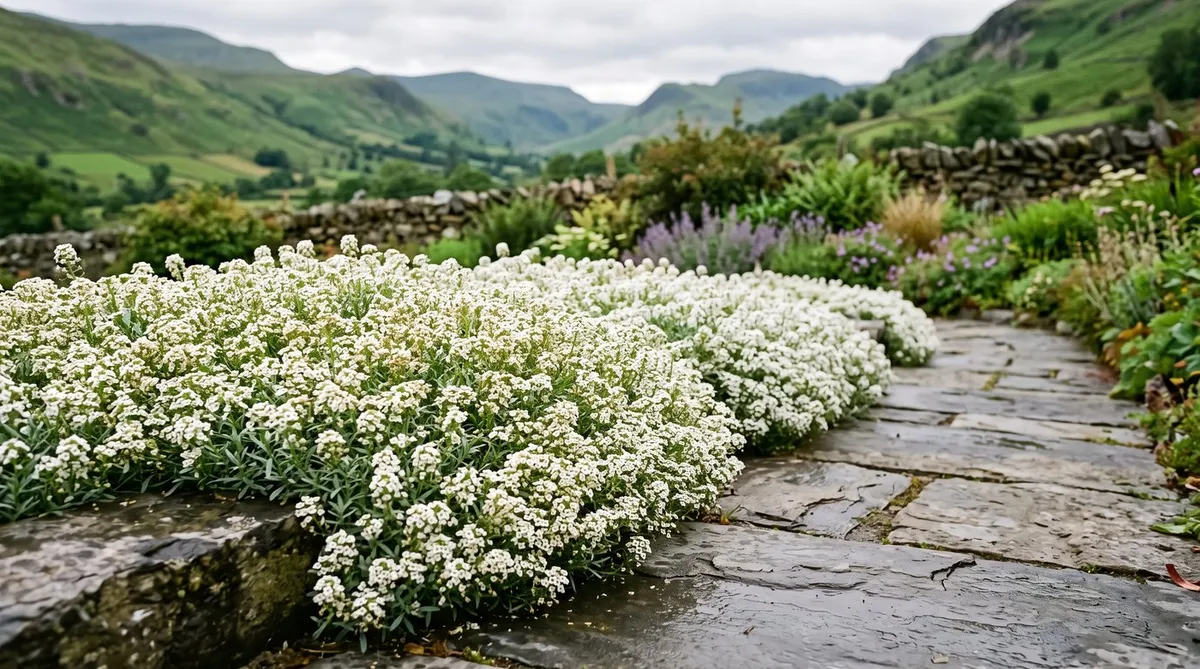
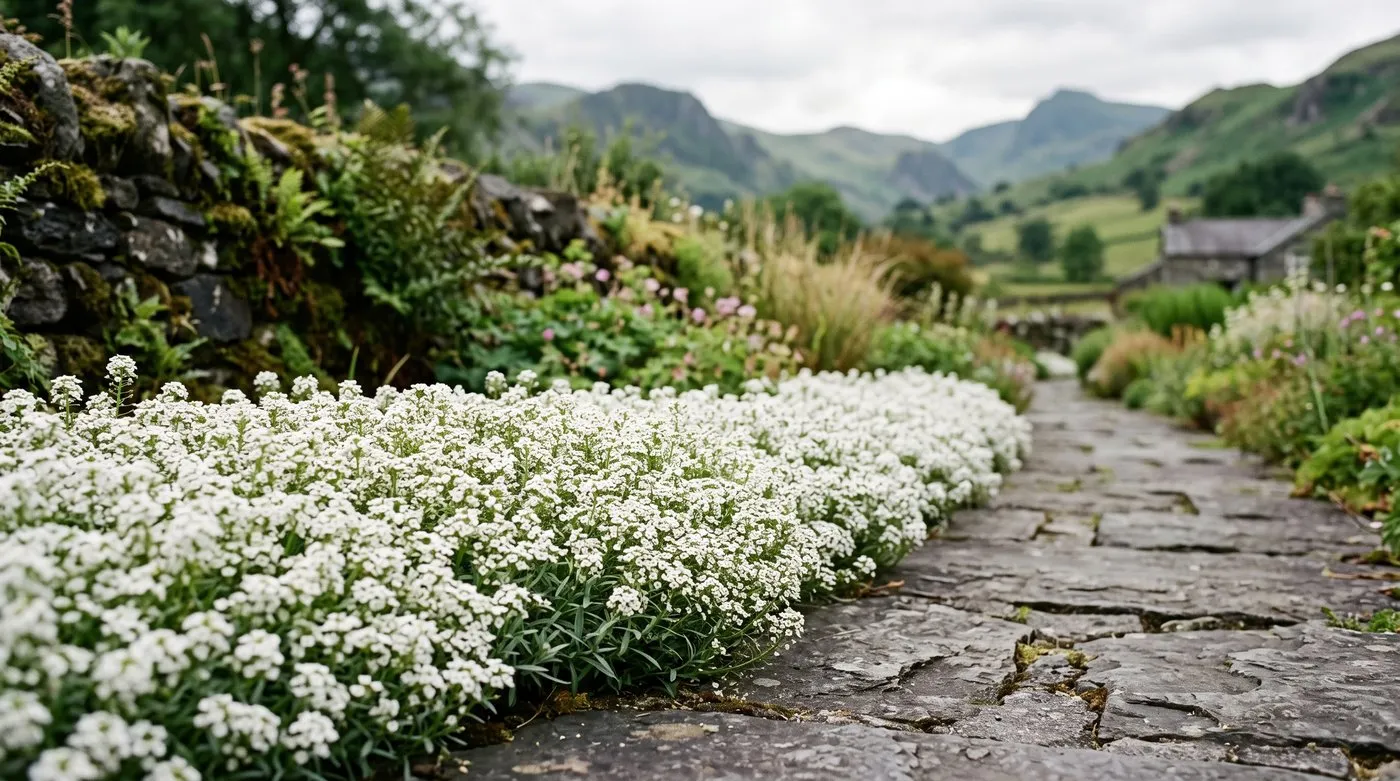 A single row of ‘Snow Crystals’ planted 15cm apart closes into a continuous edge by early July in a Snowdonia foothills garden.
The mid-July shear that gives you a second flush
This is the technique that separates a good alyssum year from a poor one, and almost no seed packet mentions it.
Around the second week of July, most alyssum starts to look tired. The centre opens out, flowering thins, and small green seed pods appear along the stems. At that point take a pair of hand shears and cut the entire plant back to about 5cm, removing roughly half its bulk. It looks brutal. It looks like you have killed it.
Water it in thoroughly and, on poor soil, scatter a general fertiliser at 30g per square metre. New shoots break from the base within five days. Flowering restarts in 18 to 21 days and runs until the first hard frost, typically late October in the Midlands.
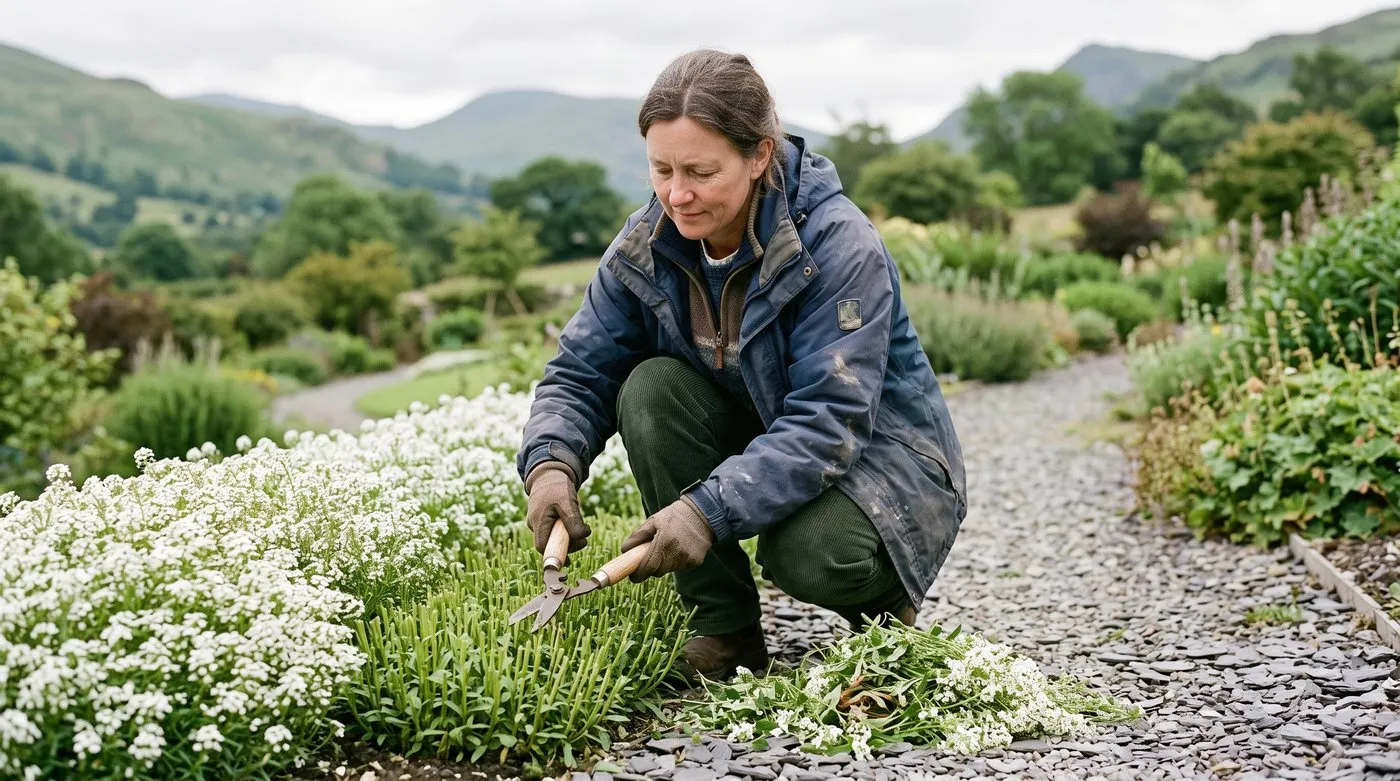 The mid-July shear. Cutting the whole plant to about 5cm before seed pods harden triggers a second flush of flower within three weeks.
Alyssum as a hoverfly magnet beside vegetables
Alyssum flowers are flat, open and only 4 to 5mm across. That shape matters. Short-tongued insects that cannot feed from deep tubular flowers can reach the nectar easily, which makes alyssum one of the strongest small annuals for hoverflies, parasitic wasps and mining bees.
The payoff is biological. Adult hoverflies feed on nectar, then lay eggs near aphid colonies. A single hoverfly larva eats 200 to 400 aphids before pupating. Planting a strip of alyssum along a bed of broad beans or brassicas puts the adults exactly where you want their offspring.
Practical layout: a 30cm alyssum band down one side of a 1.2m veg bed costs you about 4 percent of growing area. Sow it in modules in March so it is flowering by the time the first aphid colonies build in late May. Our guide to companion flowers for UK veg beds sets out the wider planting, and hoverflies in the garden covers identifying the adults and larvae.
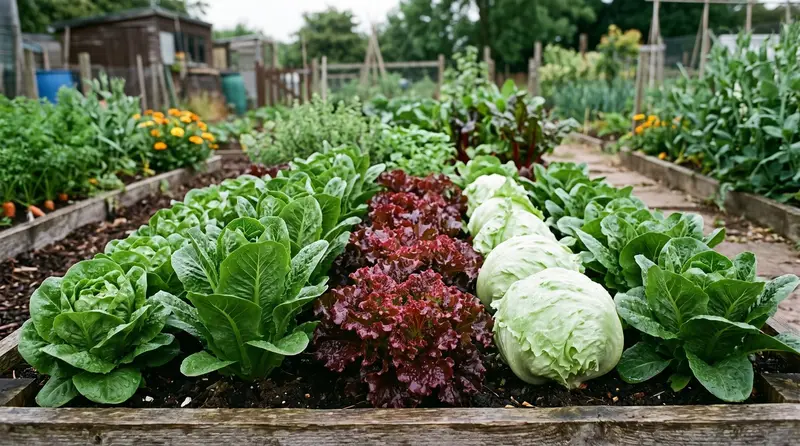
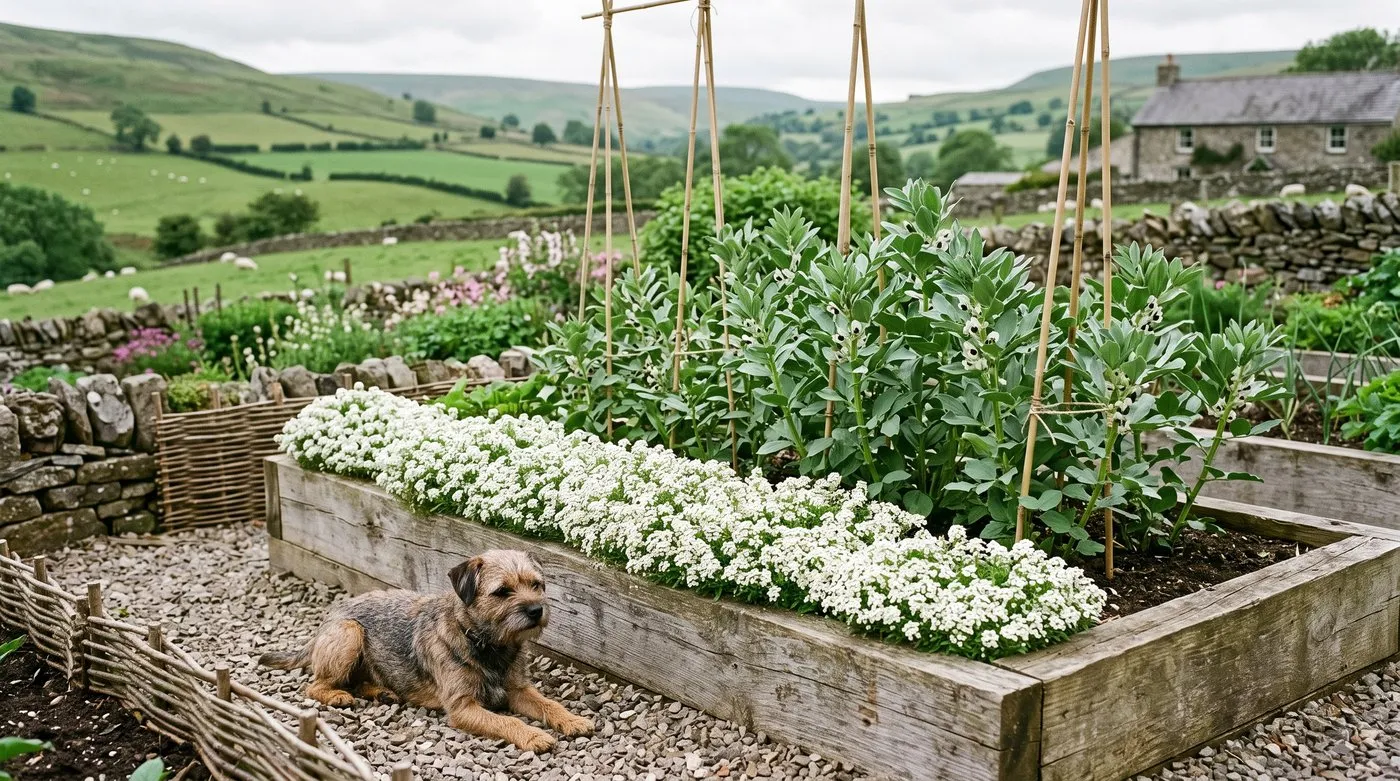 A 30cm alyssum band beside broad beans. The open flowers feed adult hoverflies, whose larvae then clear aphid colonies off the bean tips.
Why alyssum goes leggy and stops flowering
The root cause of failed alyssum is almost never disease. It is seed set combined with too little light.
Seed set is the bigger factor. Alyssum is programmed to flower, set seed and stop. Once pods swell, the plant redirects resources and bud initiation halts. Gardeners read this as the plant dying and pull it out in early August, six weeks before it needed to go. The permanent fix is mechanical: shear the whole plant before pods harden, every year, in the second week of July.
Light is the second factor. Alyssum needs a minimum of five to six hours of direct sun to stay compact. Under three hours the stems stretch, internodes lengthen from about 5mm to 15mm, and the plant flops open with sparse flower. This is why alyssum tucked behind taller bedding disappoints while the same cultivar at a path edge thrives. Site it where nothing shades it after 10am.
The third and least common cause is over-rich soil. On beds heavily fed with nitrogen, alyssum makes leaf at the expense of flower. It evolved on dry Mediterranean coasts and performs best on lean, gritty ground. Skip the fertiliser at planting and only feed after the July shear.
 Left, a plant in six hours of direct sun holding a tight dome. Right, the same cultivar in under three hours of light, stretched at the internodes and flowering thinly.
Alyssum month by month in the UK
| Month | Task |
|---|---|
| January | Order seed. Check the packet says Lobularia maritima, not Aurinia saxatilis. |
| February | Sow the first batch indoors from late February, surface sown at 15 to 18C. |
| March | Main sowing month. Germination in 7 to 14 days on a cool bright windowsill. |
| April | Pot on or space modules out. Start hardening off in the last week. |
| May | Plant out from mid-May, 15cm apart. Direct sow outdoors once soil hits 12C. |
| June | First flowers open. Water new plants weekly in dry spells until established. |
| July | Shear everything to 5cm in the second week. Water in and feed at 30g per square metre. |
| August | Second flush opens around three weeks after the shear. No further work needed. |
| September | Peak hoverfly activity. Leave some plants unsheared now if you want self-seeding. |
| October | Flowering continues until the first hard frost, usually late in the month. |
| November | Pull frosted plants. Leave the seed that has already dropped where it fell. |
| December | Nothing to do. Self-sown seedlings appear the following April in gravel and cracks. |
What alyssum actually costs to grow
Alyssum is one of the cheapest ways to fill space, but the real cost includes the compost and the bed preparation, not just the packet.
- Seed: £1.95 to £2.95 for a packet of around 1,000 seeds. Enough for 8 to 10 metres of edging with seed left over.
- Module trays and compost: about £4 for a 24-cell tray plus 10 litres of multipurpose compost, covering three sowings.
- Horticultural grit for clay beds: a 20kg bag costs £8 to £12 and improves roughly 3 metres of edging strip. This is the hidden cost most guides skip, and on heavy soil it is the difference between a carpet and a rot.
- Fertiliser after shearing: a 1.5kg tub of general fertiliser at around £7 treats far more than a domestic garden needs.
- Bought plug plants: £4 to £6 for six plugs, or about £4 each for ‘Snow Princess’. Seven times the cost of seed for the same result.
A realistic first-year total for 10 metres of alyssum edging on clay is £14 to £20, dropping to under £3 in following years once the grit is in and self-sown seedlings appear. Compare that with lobelia plugs at roughly £25 for the same run.
Common mistakes with alyssum
- Covering the seed. Alyssum needs light to germinate, and a 5mm layer of compost cuts germination from around 85 percent to under 20 percent. It happens because every other seed packet says cover lightly. Surface sow, press down, do not cover.
- Buying the wrong plant. Gold dust alyssum (Aurinia saxatilis) is a spring-flowering perennial and will never give a summer carpet. The shared common name causes this constantly. Read the botanical name before you buy.
- Skipping the July shear. Waiting for the plant to recover on its own wastes ten weeks of season. It happens because the cut looks destructive. Shear to 5cm in the second week of July and it reflowers in under three weeks.
- Planting too close. Spacing at 5 to 8cm to get a fast carpet keeps the crowns permanently damp and invites downy mildew. Stick to 15cm and accept that the gaps close by early July.
- Feeding it well. Rich soil produces soft leafy growth and thin flowering. Alyssum wants lean, free-draining ground. Only feed after shearing, and only lightly.
Warning: Alyssum self-seeds freely into gravel, paving cracks and neighbouring beds, and seedlings appear 3 to 5 metres from the parent. This is welcome at a path edge and a nuisance in a tightly planted alpine bed or a gravel drive you keep clean. If you want it contained, shear before seed sets and clear frosted plants in November rather than leaving them to shed.
Alyssum in a wider annual planting
Alyssum works hardest when it is doing the ground-level job and something else supplies height. Pair it with a taller hardy annual and you get two layers from one bed. Our list of the easiest flowers to grow from seed in the UK covers the reliable partners, and candytuft is the closest alternative if you want a similar low edging that self-sows more predictably.
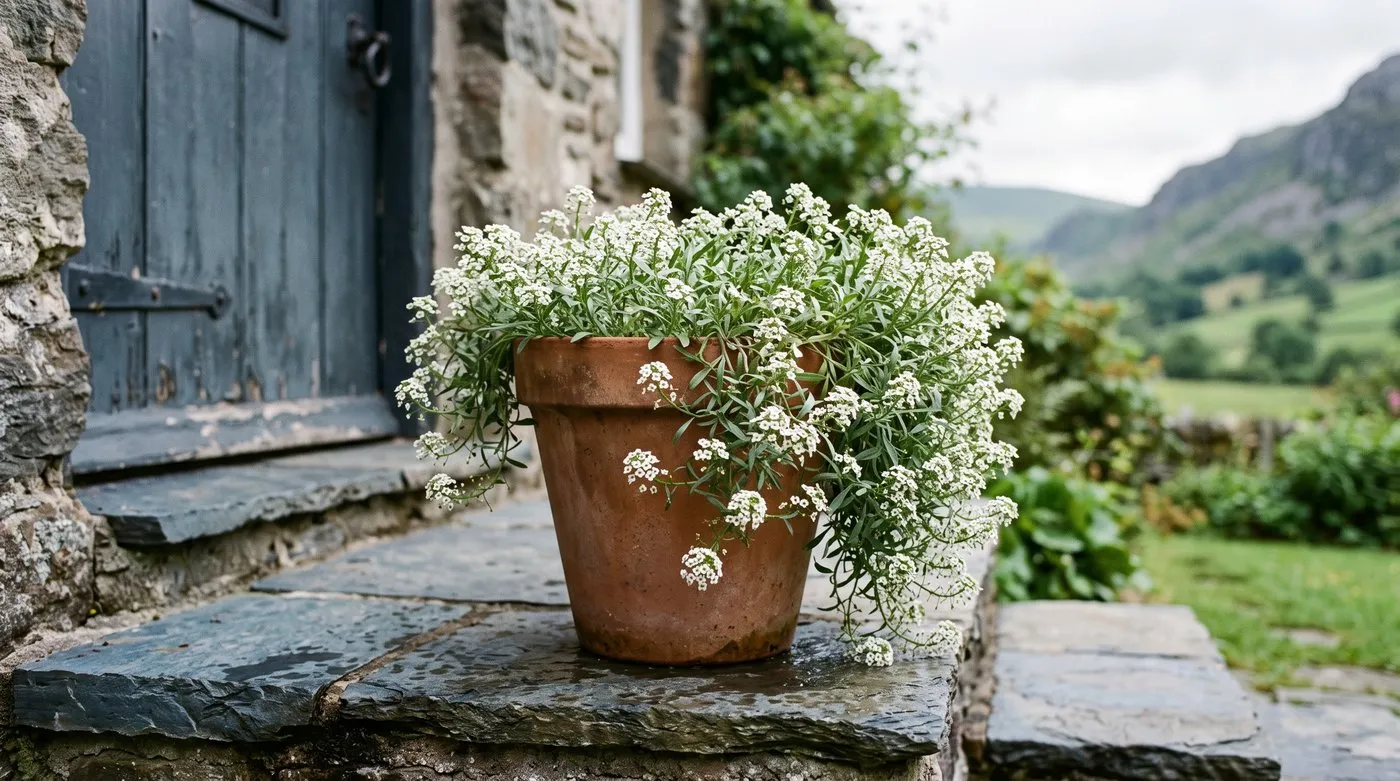 Five plants around the rim of a 30cm pot spill 20cm over the edge by late July. Alyssum copes with drying out far better than lobelia in the same position.
Now you have alyssum sorted at ground level, build the layer above it by browsing our growing guides for the full sowing calendar.
Frequently asked questions
Is alyssum an annual or a perennial?
Sweet alyssum is an annual in the UK, though it often self-seeds. Lobularia maritima is grown fresh from seed each year and dies in a hard winter. The perennial sold as gold dust alyssum is a different plant, Aurinia saxatilis, which lives for years.
When should I sow alyssum seed in the UK?
Sow indoors from late February to April, or direct outdoors in May. Indoor sowing at 15 to 18C gives plants ready to set out in mid-May. Direct sowing into warm soil above 12C works well but flowers about four weeks later.
Why has my alyssum stopped flowering in midsummer?
It has set seed, which shuts flower production down. Once seed pods form the plant treats its job as finished. Shear the whole plant back to about 5cm in mid-July, water it, and it reflowers within three weeks.
Does alyssum need full sun?
Full sun gives the best flowering, but alyssum tolerates light shade. In sun it stays compact and flowers heavily from June to October. In shade under three hours of direct light it stretches, flowers thinly and is more prone to downy mildew.
How far apart should alyssum plants be spaced?
Space plants 15cm apart for a solid carpet with airflow. Closer than 10cm and the crowns stay damp, which invites downy mildew. Wider than 20cm and the carpet takes until late July to close up.
Is alyssum good for bees and hoverflies?
Yes, alyssum is one of the best small annuals for hoverflies. The shallow four-petalled flowers suit short-tongued insects that cannot reach into deep tubular flowers. Hoverfly larvae then eat aphids, so a strip beside beans or brassicas pays for itself.
Can alyssum survive a UK winter?
Occasionally, in mild coastal gardens, but treat it as an annual. Plants take a light frost to about minus 3C and may limp through a mild winter. Anything below minus 5C on wet clay kills them, and self-sown seedlings usually replace them anyway.
Our team produces practical UK gardening guidance from source research, contributor records and established horticultural practice. Editorial standards are overseen by Matt W.