Key takeaways
- Amaranthus is tender and dies at 0C, so never plant out before the last local frost
- Seed needs 20 to 22C to germinate reliably, far warmer than most hardy annuals
- A. caudatus tassels hang 40 to 60cm; A. cruentus holds its plumes upright
- A plant in full flower can weigh 1.5kg wet, so stake it at 40cm tall
- Cut when two-thirds of the tassel has coloured for 8 to 12 days of vase life
- Young leaves cook like spinach and the seed is a gluten-free grain at 14% protein
Amaranthus is the most dramatic annual most British gardeners never quite manage. Learning how to grow amaranthus successfully in the UK is almost entirely a question of heat and timing, because this is a tender plant from Central and South America being asked to perform in a cool maritime summer. Get it in the ground too early and a single May ground frost wipes out the row. Get it right and you have 120cm plants trailing crimson ropes 60cm long from late July until October. It is also a dual-purpose crop. The leaves cook like spinach and the seed is a genuine grain, which is the half of amaranthus that ornamental guides leave out entirely.
What love-lies-bleeding actually is
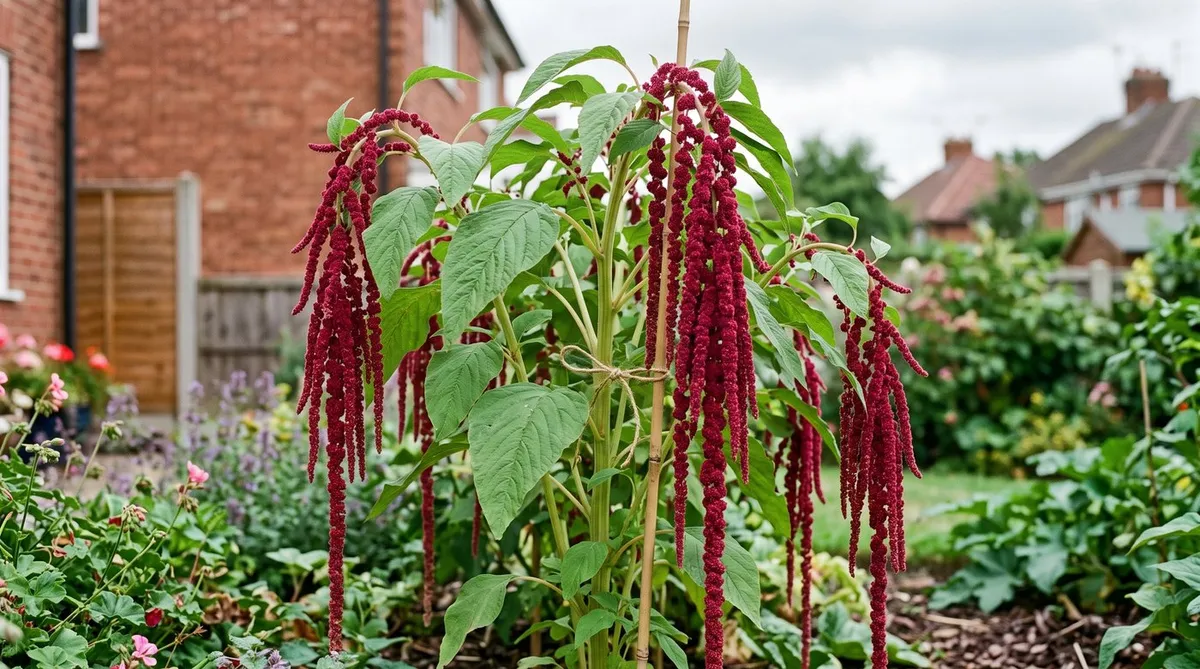
Amaranthus caudatus is the plant almost everyone means by love-lies-bleeding. It grows 90 to 120cm tall with thick pale green stems, broad oval leaves up to 15cm long, and long unbranched flower tassels that hang straight down. Those tassels are made of thousands of tiny flowers packed into a rope 40 to 60cm long and about 2cm thick. They are usually deep crimson, though ‘Viridis’ gives a pale lime green.
The name has nothing to do with harm. It comes from the way the tassels bleed colour down the plant. The Greek amarantos means unfading, which is why the dried flowers hold colour so well.
Amaranthus cruentus is the other garden species and behaves differently. It carries stiff, branched plumes that stand upright rather than hanging, on plants of similar height. ‘Hot Biscuits’ is the cultivar most UK growers know, a warm bronze-tan that has become a florist’s staple. Because the plumes are upright and lighter, cruentus stands up to wind far better than caudatus on an exposed plot.
| Species and cultivar | Habit | Height | Tassel or plume | Best use |
|---|---|---|---|---|
| A. caudatus (species) | Hanging tassels | 90-120cm | Crimson, 40-60cm | Gold standard for drama and drying |
| A. caudatus ‘Viridis’ | Hanging tassels | 80-100cm | Lime green, 30-50cm | Cutting, mixes with anything |
| A. cruentus ‘Hot Biscuits’ | Upright plumes | 100-150cm | Bronze-tan, 25-40cm | Windy sites, florist work |
| A. cruentus ‘Velvet Curtains’ | Semi-upright | 100-120cm | Deep burgundy, 30cm | Border structure |
| A. tricolor | Leafy, few flowers | 50-80cm | Insignificant | Grown for edible red and green leaves |
Amaranthus caudatus is the gold standard for garden drama, because nothing else in a British border produces a 60cm hanging rope of colour from a March sowing. It is the weakest of the four in wind, which is the trade you make.
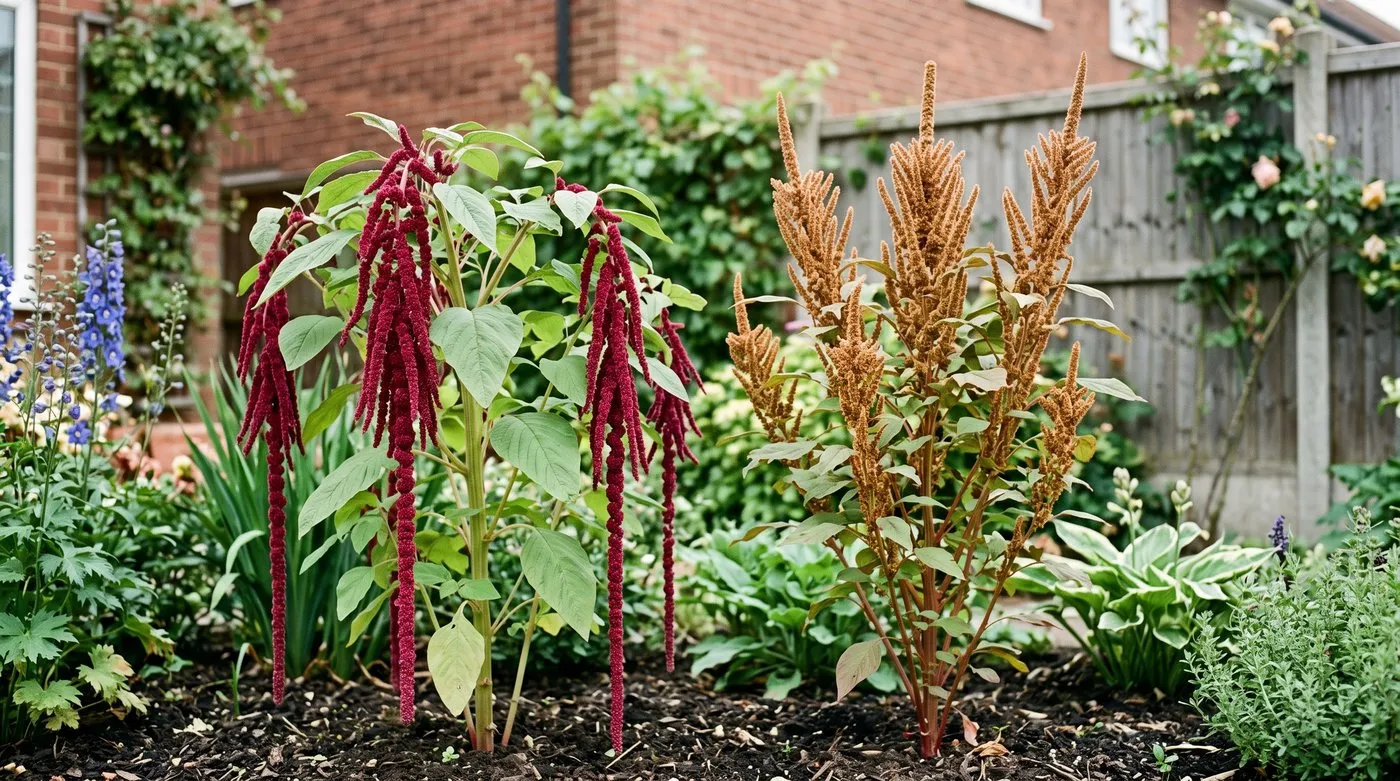 Left, Amaranthus caudatus with tassels hanging 50cm clear of the stem. Right, A. cruentus ‘Hot Biscuits’ holding its bronze plumes upright, which is why it copes far better with wind.
The tender-annual timing that catches UK growers out
This is where most amaranthus attempts fail, and it fails in two directions.
The first trap is sowing too early. Amaranthus grows extremely fast once warm, roughly 15 to 20cm a fortnight in June. Sow in early February and you have a 40cm plant in a 9cm pot by late April with nowhere to go. It becomes root-bound, checks badly, and never fully recovers. Mid-March to mid-April is the correct window for almost all of England and Wales.
The second trap is planting out too early. Amaranthus is killed outright by frost. Leaves blacken within hours at 0C and the plant collapses below minus 1C. A warm fortnight in early May tempts everyone, and a clear night on 14 May takes the lot. The safe date is the last local frost plus one week: roughly 10 to 20 May in coastal southern England, late May in the Midlands, and the first week of June above 150m or in Scotland.
There is no penalty for waiting. Our 2 June replant in 2022 still reached 105cm and flowered from 28 July, only ten days behind a normal season.
Sowing amaranthus under cover
Amaranthus seed is tiny, about 1mm, roughly 1,000 seeds to a gram. It needs light and warmth, and it hates being buried.
Fill 9cm pots or a module tray with moist multipurpose compost and firm it lightly. Scatter the seed thinly on the surface. Do not cover with compost. A dusting of vermiculite no more than 2mm deep is acceptable and helps stop the surface drying. Cover the tray with a propagator lid or clear polythene.
Hold the temperature at 20 to 22C. This is the single most important number in the whole process. At 20C, germination takes 7 to 10 days and runs at 80 to 90 percent on fresh seed. At 15C it takes 18 to 25 days and our trays have run as low as 30 percent. A heated propagator on a bench is the reliable answer. A south-facing windowsill in mid-April usually works.
Prick out into individual 9cm pots when the seedlings have two true leaves, at around 3cm tall. Handle by a leaf, never the stem, because the stem at that stage crushes easily. Grow on at 15 to 18C, cooler than germination, to keep the plants stocky rather than drawn.
Gardener’s tip: Sow a reserve tray of six plants a fortnight after your main sowing and keep it under glass until mid-June. Amaranthus is the crop most likely to be lost to a late frost, and a reserve tray costs you one module tray and ten minutes. Ours has been needed twice in five seasons.
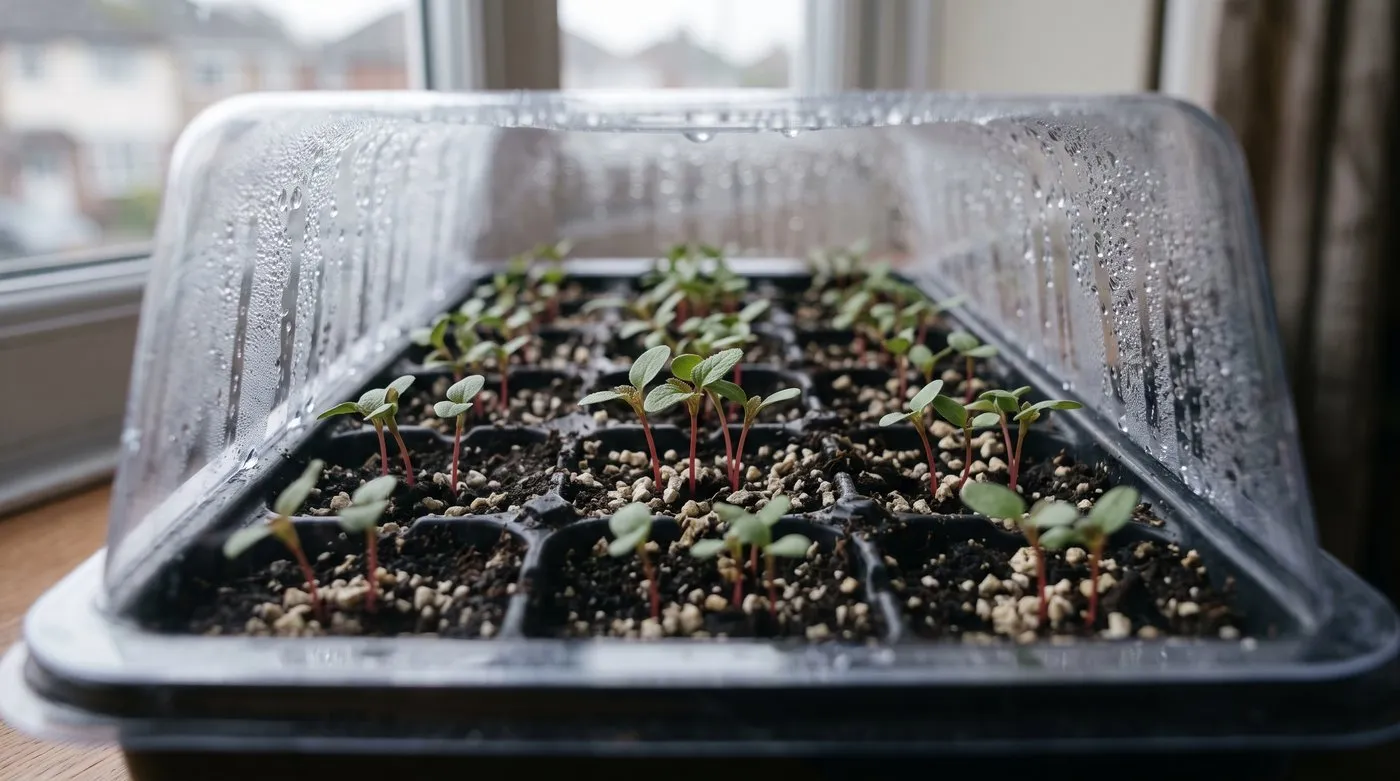 Amaranthus seedlings at the pricking-out stage, about 3cm tall with two true leaves. Held at 20 to 22C the seed germinates in 7 to 10 days.
Hardening off and planting into open ground
Plants that go straight from 18C indoors into a British June wind stall for a fortnight. Hardening off is not optional with amaranthus, because the soft, water-filled stems scorch and check badly.
Run a seven to ten day programme. Days one to three, stand the pots outside in a sheltered spot for four hours in the middle of the day and bring them back in. Days four to seven, leave them out all day and bring them in at night. Days eight to ten, leave them out overnight if no frost is forecast. Our guide to hardening off bedding plants and half-hardies covers the process across a whole tray of tender plants.
Plant at 45cm spacing for A. caudatus and 50 to 60cm for the taller cruentus cultivars. Closer than 35cm and the lower leaves yellow and drop from shading, which spoils the plant as a cut flower because the bare stem shows.
Water in well, then water weekly for the first three weeks. After that amaranthus is notably drought tolerant, with a taproot reaching 60cm or more.
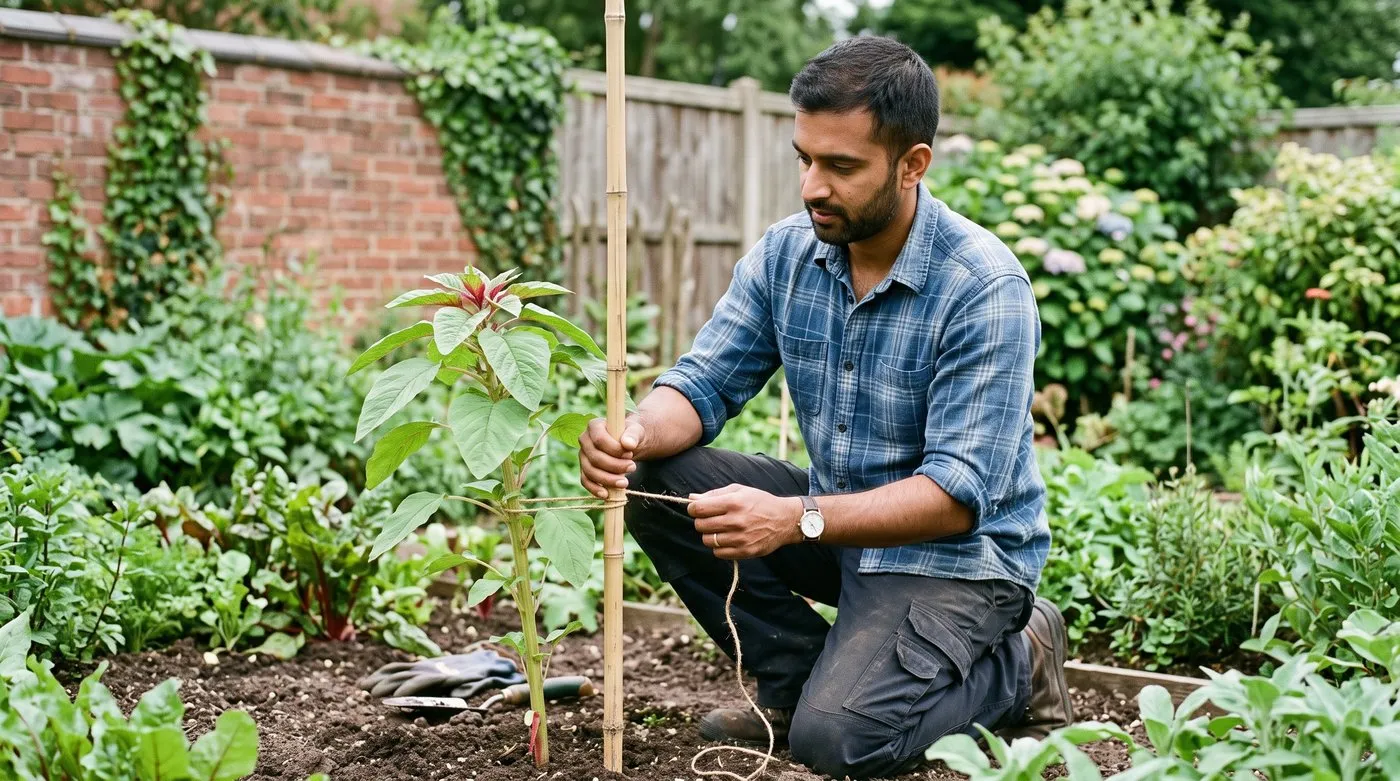 Staking early, at around 40cm tall, in a Leicester suburban garden. One cane per plant with two soft ties holds a stem that will eventually carry 1.5kg of wet tassel.
Holding up 1.5kg of wet tassel
Support is the practical problem nobody warns you about. A mature A. caudatus in full flower after rain weighs around 1.5kg, and almost all of that weight hangs off the top 30cm of a soft, hollow stem. An August thunderstorm flattens an unstaked row in an hour.
Stake early. Put a 150cm bamboo cane in beside each plant when it reaches 40cm tall, driven 30cm into the soil. Tie with soft twine at 40cm and again at 80cm, in a figure of eight so the tie does not cut into the stem. Adding a cane later, once the plant is 90cm and top heavy, means driving a cane through the root plate.
Wind exposure decides the species. On an open plot or a windy corner, grow A. cruentus ‘Hot Biscuits’. Its upright plumes present far less sail area than a hanging tassel and it stands with lighter support.
Warning: Do not tie amaranthus stems tightly with wire ties or plastic-coated wire. The stems swell rapidly, up to 3cm thick at the base, and a tight tie girdles the stem within a fortnight. The plant then snaps at the tie in the first storm. Use soft jute twine tied loosely, and check ties every three weeks through July and August.
Cutting and conditioning amaranthus for the vase
Amaranthus is a strong cut flower, but only if you cut at the right stage and condition it properly. Cut too early and the tassel wilts and never colours. Cut too late and it drops seed all over the table.
Cut when two-thirds of the tassel has coloured and the top third is still developing. Take stems in the cool of early morning, before 9am, when the plant is fully turgid. Use a sharp knife or secateurs and cut at an angle. Take the stem as long as you can while leaving two or three leaves on the plant so it can produce side shoots.
Strip every leaf that would sit below the waterline. Amaranthus leaves rot fast and foul the water within two days. Stand the stripped stems in a bucket of cool water at 10 to 15C, deep enough to cover two-thirds of the stem, in a dark cool place for four hours. That soak is what gives you 8 to 12 days of vase life instead of three or four. The full method is in our guide to conditioning cut flowers for longer vase life.
Change the water every two days. A drop of household bleach, about 2ml in 5 litres, slows bacterial growth in the vase and is more effective than sugar-based flower food for amaranthus.
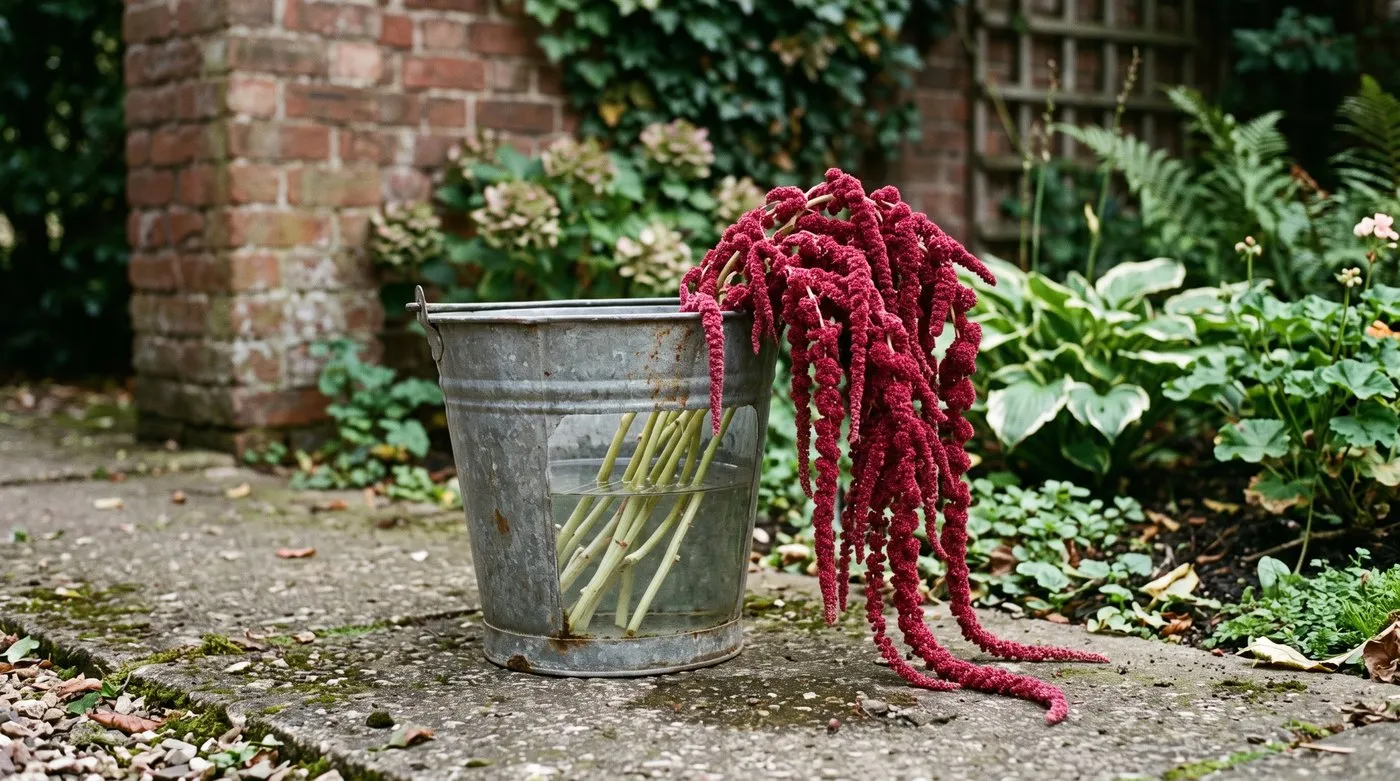 Cut stems with all lower leaves stripped, standing in deep cool water for a four hour conditioning soak. This step trebles vase life.
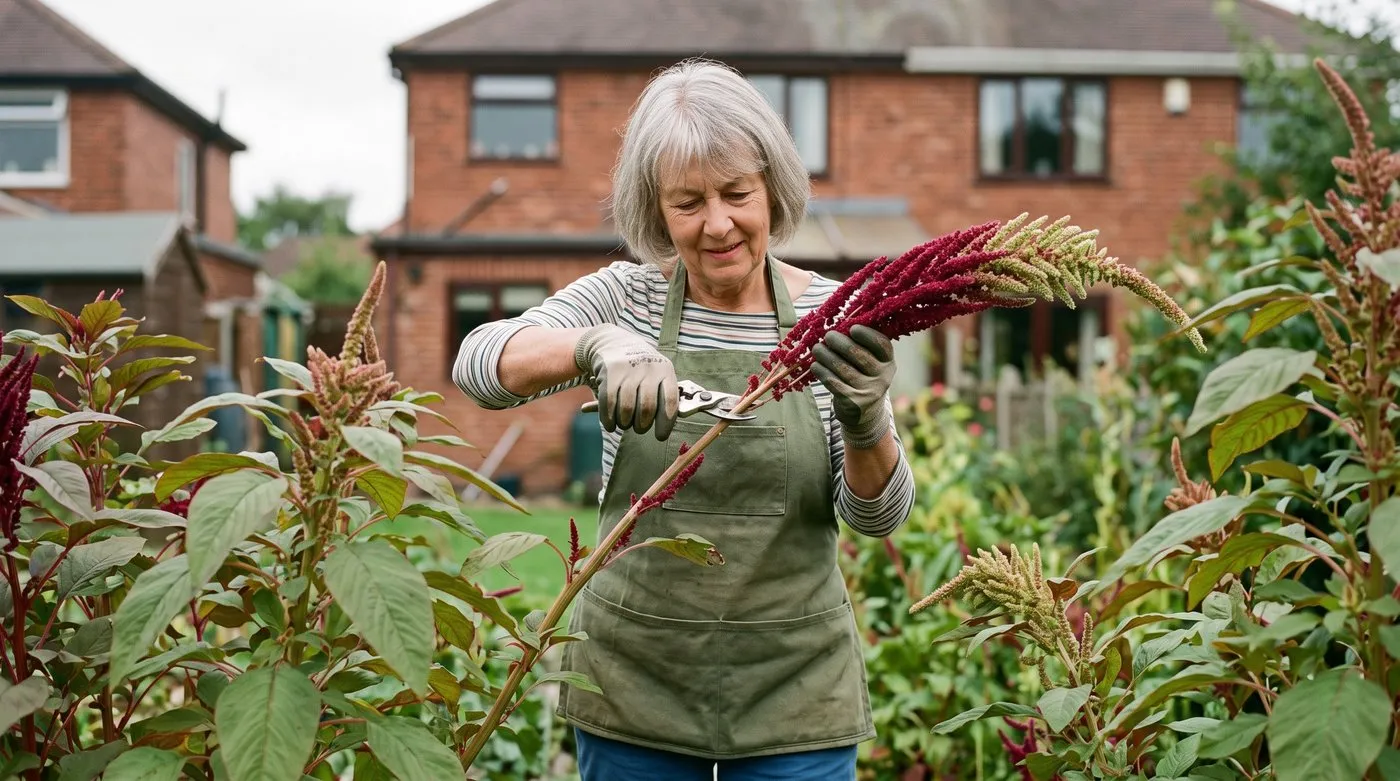 Cutting for the vase in a Leicester suburban garden. The tassel is about two-thirds coloured, with the tip still developing, which is the correct stage.
Drying tassels for everlasting arrangements
Amaranthus dries better than almost any other annual, and the dried tassels hold usable colour for two years.
Cut for drying slightly later than for the vase, once the whole tassel has coloured but before the seed starts to shed. Squeeze a section between finger and thumb. If seed rains out, you have left it a week too long.
Strip all the leaves off, because leaves shrivel and crumble while the tassel stays intact. Tie stems in bunches of no more than three, with soft twine at the cut end, and hang them upside down in a dark, dry, airy space. A garage rafter, an unheated spare room or a garden shed with ventilation all work. Darkness is what preserves the colour. Sunlight fades crimson to a dull straw within weeks.
Drying takes 14 to 21 days depending on humidity. The stem is dry when it snaps cleanly rather than bending. Crimson caudatus holds its colour best, staying a deep dusky red. ‘Hot Biscuits’ dries to a lovely warm tan. The green ‘Viridis’ fades most, dropping to a pale cream within a season.
Expect some seed drop regardless. Hang bunches over an old sheet or a tray and you can collect the seed, which is your sowing stock for next year and free.
Eating amaranthus leaves and grain
This is the half of the plant that ornamental guides ignore. Amaranthus was a staple grain crop for the Aztecs and remains one across parts of Africa, India and South America. Every part above ground on the species covered here is edible.
Leaves. Pick young leaves under 10cm long from June onwards. They taste like a slightly earthier spinach and cook in around three minutes in a pan with a little oil. Picking the growing tips also makes the plant branch, which gives you more, shorter tassels. Do not strip a plant you want for cut flowers; take a leaf or two from each. Like spinach and chard, amaranthus leaves contain oxalates, so cook them rather than eating large quantities raw. Treat them exactly as you would spinach or chard from the same bed.
Grain. One mature A. cruentus plant produces 30 to 60g of seed. The seed is around 1mm, gluten free, and runs at roughly 14 percent protein, higher than wheat. Harvest by bending the dried head into a paper bag and rubbing it between gloved hands in September, then winnow the chaff off in a light breeze. Cook it like quinoa at one part grain to two and a half parts water for 20 minutes, or pop it dry in a hot pan. The method is close to the one in our guide to growing quinoa in the UK, which is a related crop with the same winnowing problem.
Yields in a British summer are modest. Our best plant gave 52g of clean grain in 2024. This is a novelty crop here, not a staple, but it is real food from a plant most people grow purely for looks.
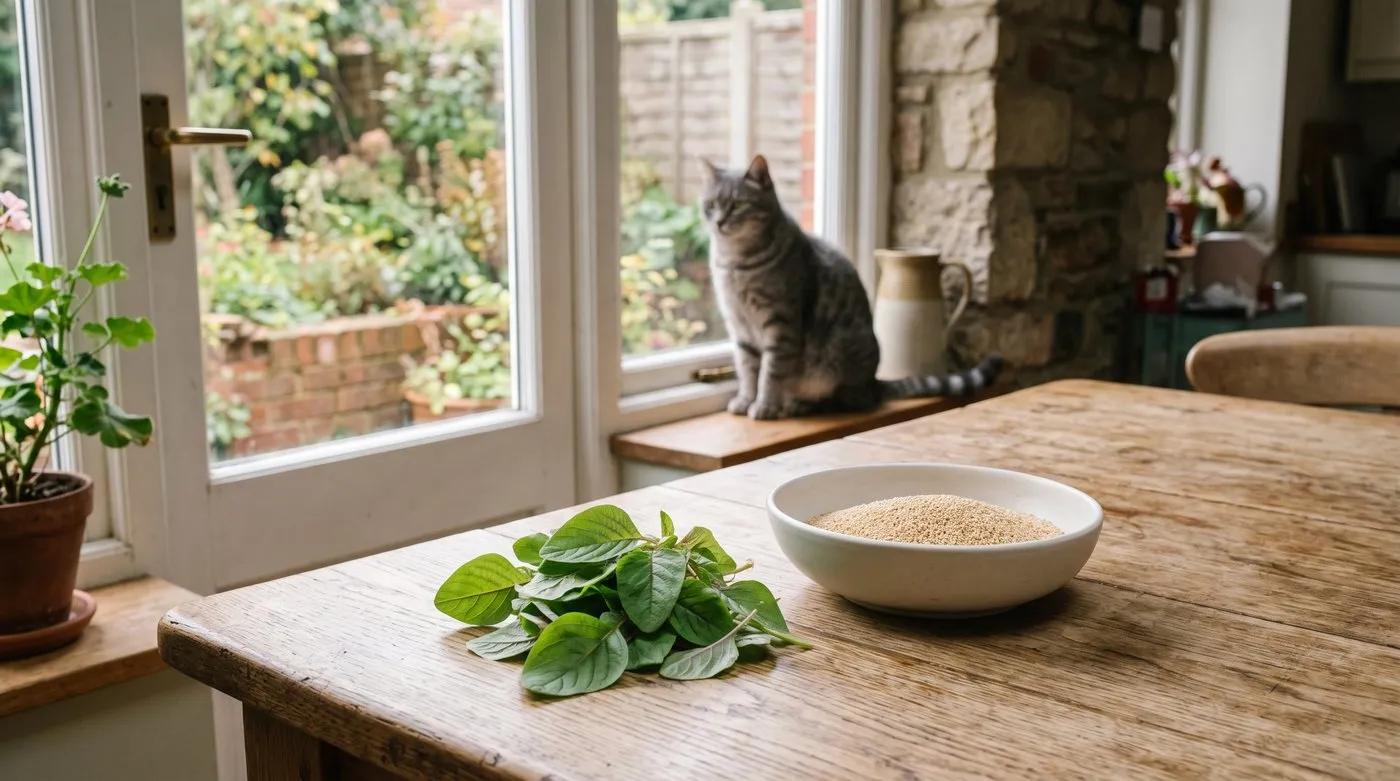 Young amaranthus leaves and cleaned grain from one plant. A single Amaranthus cruentus plant yields 30 to 60g of seed at around 14 percent protein.
Why amaranthus collapses in August
The root cause of a mid-season collapse is nearly always structural, not disease, and it is misread constantly.
Amaranthus builds its stem fast and soft in June and July, when growth is driven by nitrogen and water. The stem is hollow and its walls are thin relative to the weight it will eventually carry. By early August, the tassels are at full size and hold water like a sponge. A single heavy shower can add 40 percent to the weight hanging on that stem in twenty minutes. The stem does not break. It bends at soil level and the whole plant lays over.
Gardeners see a flattened row and assume wind damage or root disease. The real cause is that the plant was fed and watered into soft growth and then staked too late, if at all.
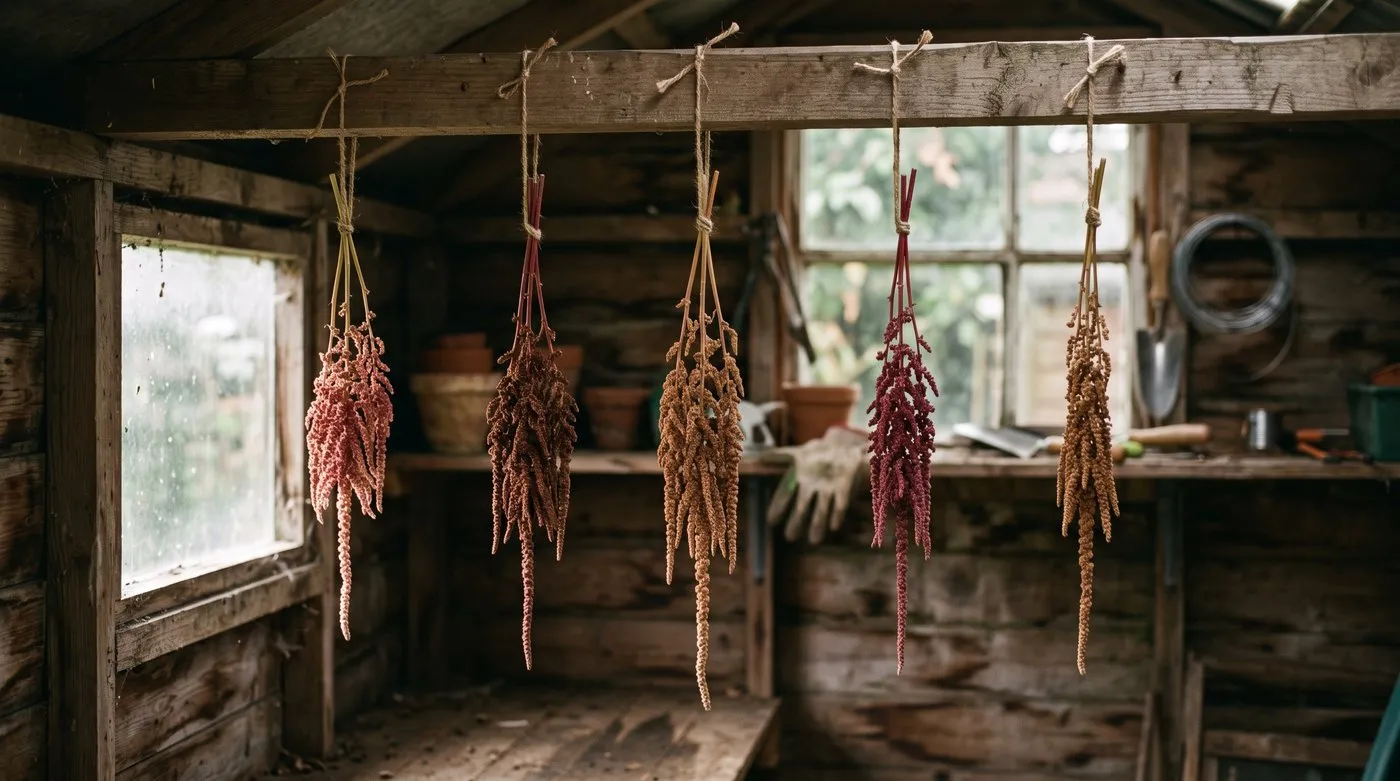 Bunches of three, hung upside down in a dark airy shed. Drying takes 14 to 21 days and darkness is what stops the crimson fading to straw.
Amaranthus month by month in the UK
| Month | Task |
|---|---|
| January | Order seed. Choose caudatus for drama, cruentus for a windy or exposed plot. |
| February | Nothing to sow yet. Sowing now produces root-bound plants by late April. |
| March | Main sowing from mid-March, surface sown at 20 to 22C in a heated propagator. |
| April | Prick out at two true leaves into 9cm pots. Grow on cooler at 15 to 18C. |
| May | Start hardening off mid-month. Plant out in the south only after the last frost. |
| June | Plant out in the Midlands and north in the first week. Stake at 40cm tall. |
| July | Water weekly only in drought. Pick young leaves for the kitchen. Check ties. |
| August | Tassels colour. Cut for the vase at two-thirds coloured. Watch for storms. |
| September | Cut for drying once fully coloured. Harvest grain from dried heads late month. |
| October | Flowering continues until the first frost. Collect seed for next year. |
| November | Frost kills the plants. Pull and compost the stems; they break down slowly. |
| December | Clean and label saved seed. Store cool and dry; it stays viable four years. |
What amaranthus costs to grow
- Seed: £2.50 to £3.50 for a packet of 200 to 500 seeds from Chiltern Seeds, Higgledy Garden or Sarah Raven. That is 20 plants with plenty spare, and saved seed makes every later year free.
- Heated propagator: £25 to £45 for a basic 52cm heated tray, or nothing if you have a warm airing cupboard shelf and a bright windowsill for immediately afterwards. This is the hidden cost. Without steady 20C, germination drops from 85 percent to around 30 percent.
- Canes and twine: 150cm bamboo canes at roughly £0.60 each, so about £12 for a row of 20 plants. Canes last five seasons.
- Compost and pots: around £8 for 40 litres of multipurpose and a set of 9cm pots.
- Netting: a 5m by 2m roll of 15cm mesh support netting costs £9 to £14 and covers a cutting bed for several years.
First-year total for a 20 plant row with a new propagator is £55 to £80. Repeat years drop to under £5 with saved seed and reused canes. Compare that with florist prices of £3 to £5 a stem for cut amaranthus in September.
Common mistakes with amaranthus
- Planting out before the last frost. A single ground frost at minus 1C kills the whole row within 36 hours. It happens because a warm early May feels safe. Wait until the last local frost date plus a week, and keep a reserve tray under glass.
- Burying the seed. Amaranthus seed needs light and is only 1mm across. Sowing at 5mm depth cuts germination below 20 percent. Surface sow and dust with no more than 2mm of vermiculite.
- Feeding it. Rich soil gives 150cm of soft leafy growth, weak colour and stems that fall over. It happens because tall plants look like they need feeding. Grow on lean ground and skip fertiliser altogether.
- Staking too late. Adding a cane at 90cm tall means driving it through established roots, and the plant is already top heavy. Stake at 40cm, before support is needed.
- Cutting for the vase too late. A fully mature tassel sheds seed continuously indoors. Cut when two-thirds has coloured, not when the whole rope is at peak.
Amaranthus sits at the back of a bed and needs something at ground level in front of it. The low white carpet of alyssum does that job well, and the airy white umbels of Ammi majus fill the middle layer between them. For the wider tender-annual picture, Garden Organic has sound guidance on frost dates and protecting tender crops.
Now you can time amaranthus properly, work through the rest of the sowing year with our guide to growing annuals from seed in the UK, or browse every growing guide on the site.
Frequently asked questions
When should I sow amaranthus seed in the UK?
Sow indoors from mid-March to mid-April at 20 to 22C. Amaranthus is tender and germinates poorly below 18C, so a heated propagator or warm windowsill is needed. Direct sowing outdoors only works in late May in southern England.
Is love-lies-bleeding hardy in the UK?
No, love-lies-bleeding is a tender annual killed by the first frost. Amaranthus caudatus blackens at 0C and dies completely below minus 1C. Plant out only after the last local frost, which is mid-May in the south and early June in northern and upland gardens.
Does amaranthus need staking?
Yes, most amaranthus needs support once it passes 40cm tall. A plant in full flower carries 1.5kg of wet tassel on a soft stem. One bamboo cane per plant with two ties, or a grid of netting at 40cm, prevents the whole row going over in an August storm.
Can you eat amaranthus leaves and seeds?
Yes, both the young leaves and the seed are edible. Leaves picked under 10cm long cook like spinach in three minutes. The tiny seed is a gluten-free grain at around 14 percent protein and is popped or boiled like quinoa.
How long does cut amaranthus last in a vase?
Eight to twelve days when cut and conditioned properly. Cut in the cool of early morning when two-thirds of the tassel has coloured. Strip all lower leaves, and stand the stems in deep cool water for four hours before arranging.
How do you dry amaranthus tassels?
Hang them upside down in small bunches somewhere dark, dry and airy. Cut when the tassel is fully coloured but before seed drops, tie in bunches of three, and hang for 14 to 21 days. Colour holds for two years away from direct sun.
What is the difference between Amaranthus caudatus and cruentus?
Caudatus hangs its tassels; cruentus holds its plumes upright. Amaranthus caudatus is the classic love-lies-bleeding with 40 to 60cm ropes. Amaranthus cruentus, including ‘Hot Biscuits’, carries stiff upright plumes and is the better choice for windy sites.
Our team produces practical UK gardening guidance from source research, contributor records and established horticultural practice. Editorial standards are overseen by Matt W.