
Key takeaways
- Build a bunch on roughly 30 percent focal, 45 percent filler, 25 percent foliage
- Ammi majus is the highest-yielding UK filler at 25 to 35 stems per plant
- Bupleurum needs cool dark germination and takes 14 to 21 days to appear
- Sow fillers every 3 weeks from March to early July for unbroken supply
- Cut umbellifers when 70 percent of florets are open, never in full bloom
Most home-grown bunches fail for the same reason. The dahlias, sweet peas and cosmos are all there, and the arrangement still looks like a fistful of stems shoved in a jar. What is missing is the middle third. Filler flowers for the cutting garden are the airy connecting stems that hold a bunch together, and they are the part beginners skip because nobody sells them as a headline plant.
This guide teaches the florist’s focal, filler and foliage framework, then goes deep on the two-thirds most people neglect. It covers 11 fillers that grow well in UK conditions, with sowing times, stem lengths and measured vase life for each, a succession plan and a ratio for building a bunch that works.
The florist’s rule of focal, filler and foliage
Every professional arrangement is built from three jobs, not three plant types. Learn the jobs and you can substitute freely from whatever the patch is giving you that week.
Focal flowers are the large, visually heavy blooms the eye lands on first. Dahlias, peonies, sunflowers, zinnias and large roses do this work. They usually make up the smallest count of stems in a bunch because each one carries so much weight.
Filler stems are small-flowered, airy or textural. Their job is spatial: they fill the volume between focals, hide the mechanics, and give the eye somewhere to travel. Umbellifers like Ammi and Orlaya, seed pods, grasses and small daisy flowers all qualify.
Foliage sets the outline and the colour base. It goes in first in a hand tie and defines the shape everything else sits inside. Alchemilla, pittosporum, ninebark and mint all work.
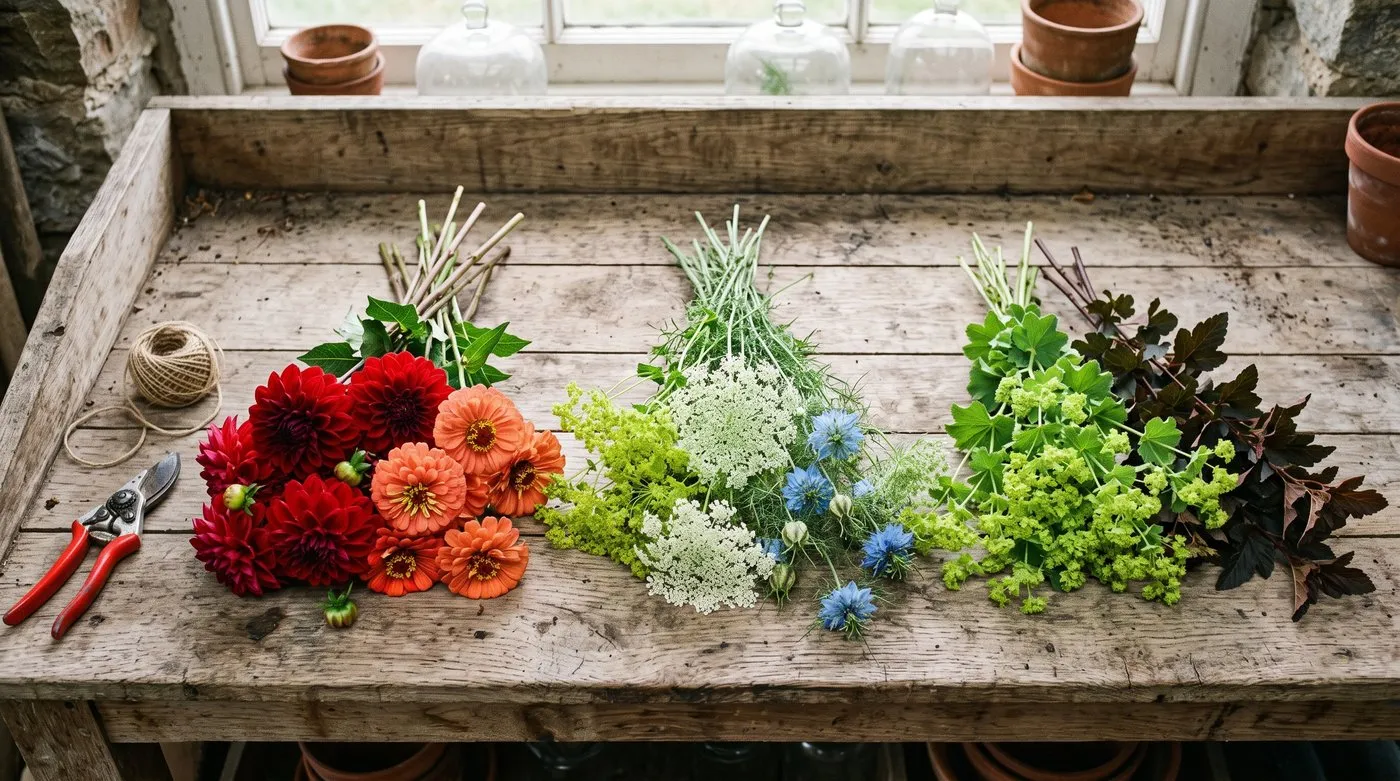 The three jobs laid out on a Scottish Borders potting bench. Focals on the left, airy lacy fillers in the middle, structural foliage on the right. The middle group is the one most home patches lack.
11 filler flowers worth growing in a UK cutting patch
Ammi majus is the gold standard for a first filler bed. Nothing else on the list combines that stem count, that height and that reliability on ordinary UK soil. If you plant one filler, plant this.
Two entries need a warning attached. Euphorbia oblongata bleeds a milky latex that irritates skin and eyes badly, so wear gloves and seal every cut end in near-boiling water for 10 seconds. Cerinthe has the shortest vase life on the list and needs the same searing treatment to get past five days.
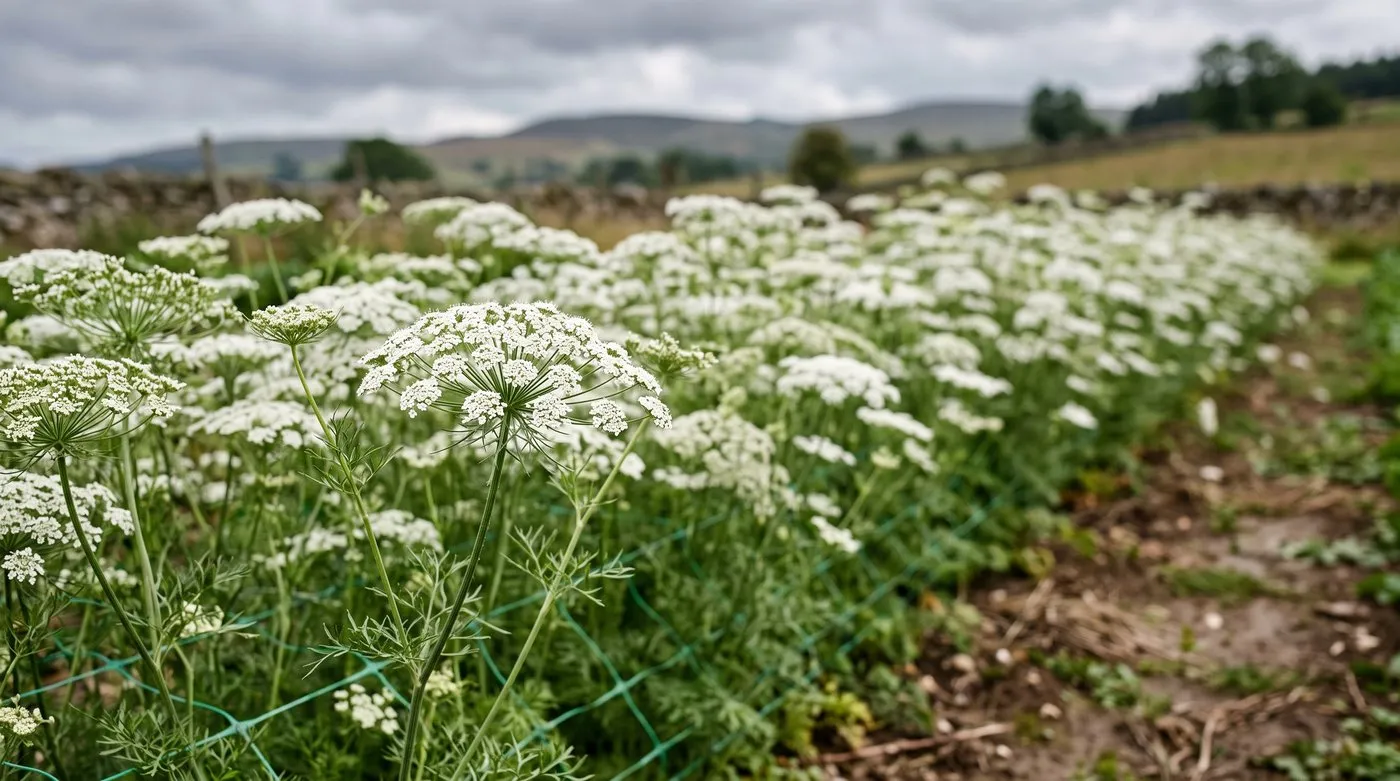 Ammi majus in the cutting rows in early July. The flat lacy heads are made of dozens of tiny white florets, and these stems will cut at 80cm with a further flush of side shoots behind them.
How the top three fillers actually differ
The three lace-cap umbellifers get lumped together constantly, and they do different jobs.
Ammi majus is the workhorse. Flat, loose, bright white heads 6 to 10cm across on tall wiry stems. It is the cheapest per stem and the most forgiving of a mediocre spring. It will lean badly in wind, so net it at 30cm.
Orlaya grandiflora is the refined version. The head is smaller, around 4 to 6cm, but the outer ring of florets has enlarged outer petals that catch light and give a distinct scalloped edge. It is shorter, slower and lower yielding, and it lasts two days longer in water than anything else on the umbellifer list. Grow it for the bunches that matter.
Bupleurum rotundifolium is not white at all. It carries small yellow-green flowers held in rounded lime bracts, on wiry branching stems. Its job is to bridge colours that clash, because acid green sits between almost anything. Germination is the fiddly part: it needs cool, dark conditions at 12 to 15C and takes 14 to 21 days, roughly twice as long as Ammi. Sow it in a shaded frame, not a warm windowsill.
Daucus carota ‘Dara’ brings the colour that the white umbellifers cannot, opening white and deepening to dusky plum as the head ages. The details of getting good stem length from it are in our Daucus ‘Dara’ growing guide.
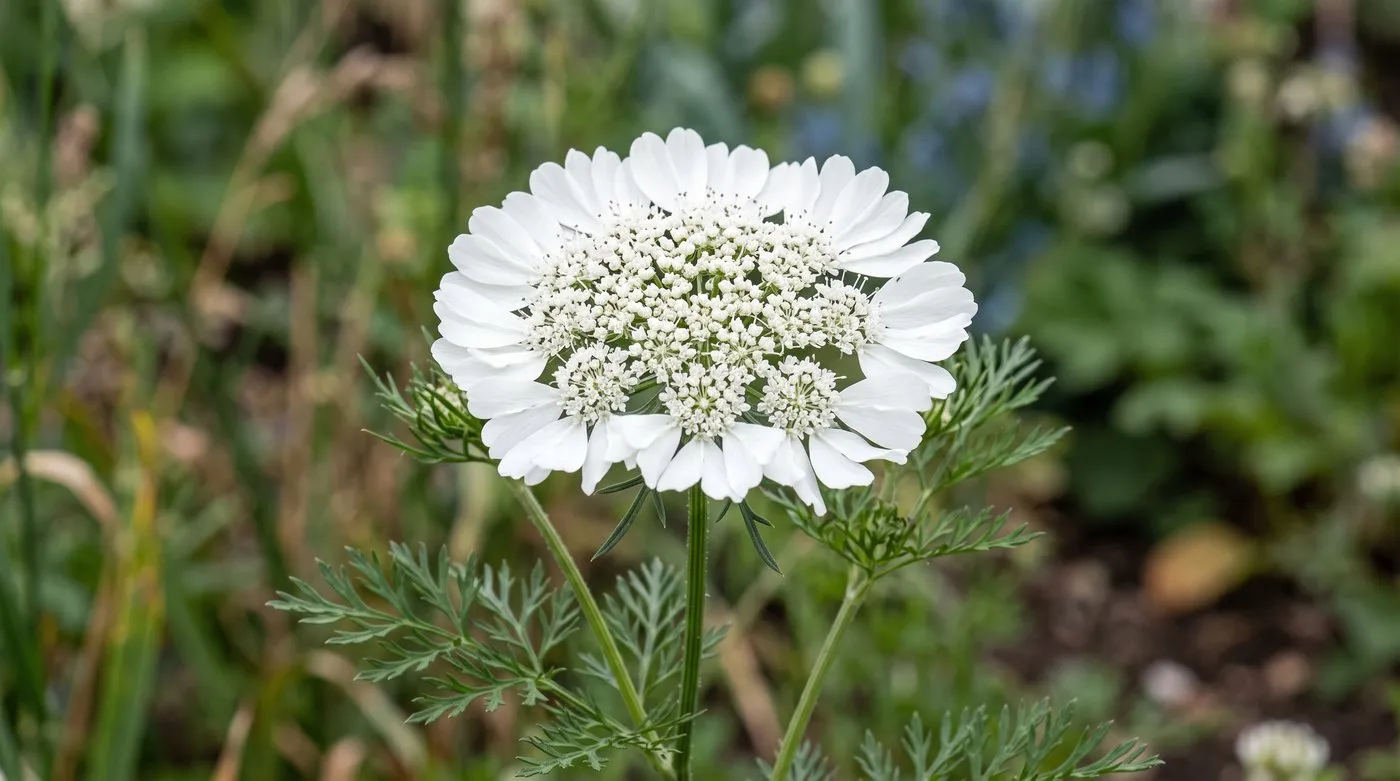 Orlaya grandiflora in close-up. The enlarged outer petals on each floret give the head its scalloped edge, and this is the visible difference from Ammi at a glance.
The ratio that makes a hand-tied bunch work
Ratios beat instinct when you are standing at a bench with a bucket of stems. For a domestic bunch of about 30 stems in a 20cm vase, work to this build.
- Foliage first, 7 to 8 stems. Lay the outline. Cross the stems in one hand at a consistent angle so a spiral forms. This sets the width.
- Filler next, 13 to 14 stems. Add in threes, turning the bunch a quarter turn after each addition. This is the step home arrangers rush.
- Focals last, 8 to 9 stems. Push them in at slightly different depths so no two heads sit level. Odd numbers read better than even.
- Two or three accent stems. A single tall spire or a seed pod breaking the dome stops the bunch looking machine-made.
The most useful thing to know is that filler should outnumber focal by roughly three to two. A bunch with more focals than fillers reads as expensive and stiff. A bunch with more fillers reads as garden-grown, which is the whole point of growing your own.
Tall spire flowers count as accents rather than focals in this build. Canterbury bells work particularly well in that role in June, because the stiff vertical breaks a dome of lace.
Gardener’s tip: Cut filler stems 15 to 20cm longer than you think you need. Umbellifer stems are hollow and you will almost always recut them shorter once you see them in the vase, but you cannot add length back. Always cut down to a leaf node or side shoot so the plant knows where to branch from.
 Building a spiral hand tie on a Scottish Borders plot. Foliage sets the outline first, then filler goes in in threes with a quarter turn between each, and focals come last.
Succession sowing so the fillers never run out
A single spring sowing of Ammi gives about five weeks of cutting and then stops. That is the standard beginner outcome and it is entirely avoidable. Hardy annual fillers respond to succession sowing better than almost any other cut flower group.
Sow a new batch every three weeks from mid March to early July. In practice that is six or seven sowings a season. Each batch takes roughly 12 to 14 weeks from sowing to first cut in UK conditions, longer for the earliest cold sowings and shorter for June ones.
Pinching matters for the branching fillers but not the umbellifers. Pinch Cerinthe, Nigella and Panicum out at 20 to 25cm to force side shoots. Leave Ammi, Orlaya, Bupleurum and Daucus alone: they build a main head and branch beneath it naturally, and pinching only delays the first cut by 10 to 14 days. The full logic is in our guide to pinching out cut flowers.
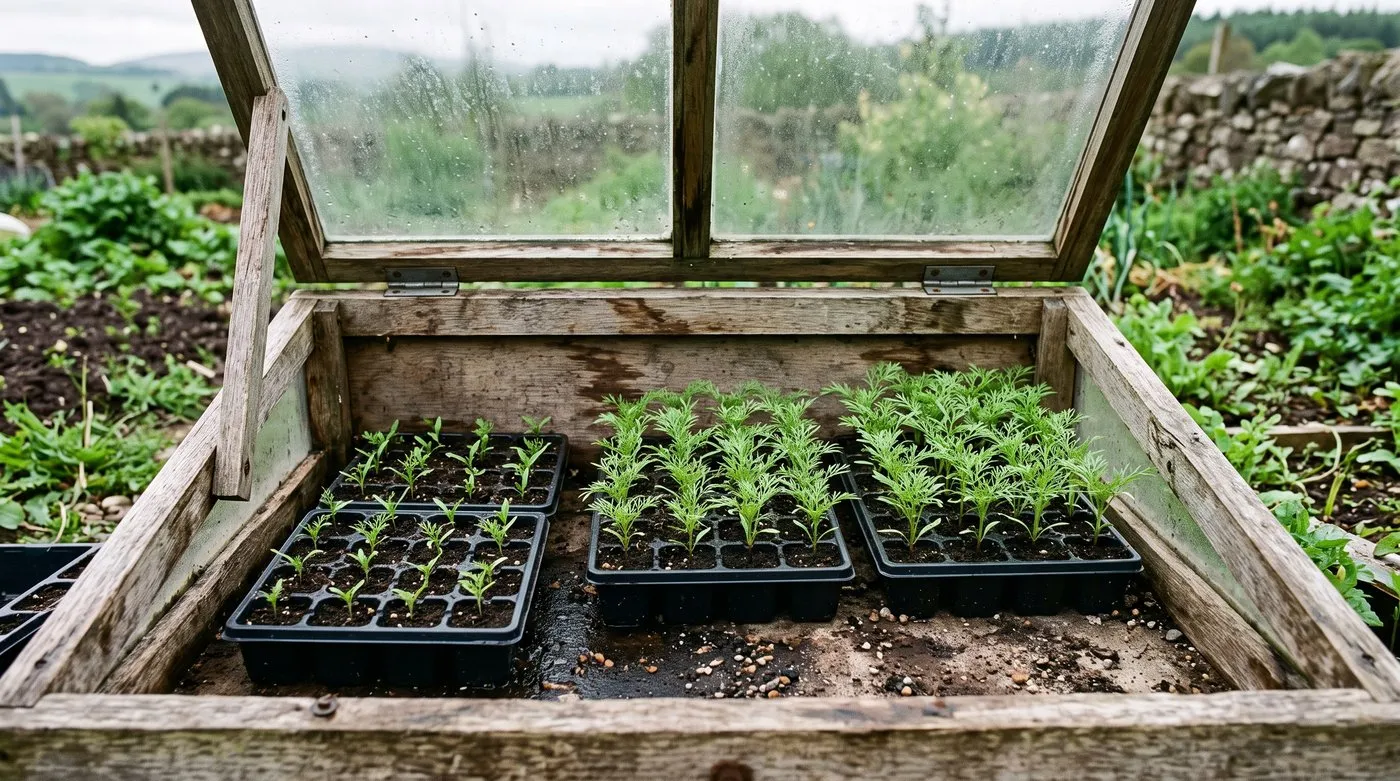 One of six succession batches in a cold frame on a Borders plot. Sowing every three weeks from March to July keeps the cutting rows producing instead of gluting and stopping.
Netting is not optional with any tall umbellifer. One layer of 15cm mesh laid flat at 30cm above soil and lifted as the crop grows costs about £12 for a 5m run and saves the whole row in a June gale.
Month-by-month filler flower calendar
| Month | Task |
|---|---|
| January | Order seed. Plan six succession slots and mark them in the diary now. |
| February | Prepare beds. Warm soil under black plastic if your ground is cold and wet. |
| March | First sowing of Ammi, Orlaya, Bupleurum, Nigella, Daucus and Euphorbia. |
| April | Second sowing. Sow Cerinthe and Panicum now. Plant out March-sown hardy fillers. |
| May | Third sowing. Net rows at 30cm. Pinch Cerinthe and Nigella at 20 to 25cm. |
| June | First cuts from autumn-sown plants. Fourth sowing. Cut every three days. |
| July | Peak cutting. Fifth sowing by the first week. Cut before 8am for best vase life. |
| August | Cut hard and keep cutting. Any head left to set seed shuts the plant down. |
| September | Sow the overwintering batch under cover. This is the highest-value sowing. |
| October | Collect Nigella and Panicum seed heads for dried work. Clear spent rows. |
| November | Fleece or cold-frame the September sowing. Ventilate on mild days. |
| December | Mulch cleared beds. Check overwintering modules weekly for slug damage. |
Why fillers collapse in the vase before the focals do
Filler stems usually die first, and it is almost never the plant’s fault. The root cause is stem anatomy combined with harvest timing, and it gets misdiagnosed as poor variety choice constantly.
Umbellifer stems are hollow and thin-walled. They lose water faster than a thick dahlia stem and they refill more slowly once an air lock forms. The failure runs through four stages.
- Cut. The moment the blade goes through, sap pressure drops and air is drawn into the hollow stem. An embolism forms within 30 to 60 seconds in a warm greenhouse.
- Blockage. Within 2 to 4 hours the cut surface begins sealing with callus and bacteria colonise the wound. Uptake drops measurably.
- Bacterial load. Any leaf left below the water line rots. Bacterial counts in the vase water rise sharply by day 2, and those bacteria plug the xylem from the outside.
- Collapse. With uptake below transpiration the stem loses turgor. The head droops from the neck, usually on day 4 or 5 rather than fading gradually.
The critical mistake is treating conditioning as an optional extra. It is the whole ball game for hollow-stemmed fillers. Cut into a bucket of water carried to the row, not into a trug. Strip every leaf below the water line before the stems go into the bucket. Stand them in deep cool water at 4 to 10C for a minimum of four hours, ideally overnight, before you arrange anything. Our guide to conditioning cut flowers for longer vase life has the searing and hot-water methods for the awkward ones.
Harvest stage matters just as much. Cut umbellifers when about 70 percent of the florets on the head are open. A fully open head has already started setting seed and it will drop within four days. A head under half open never opens properly in water.
Warning: Ammi, Daucus and other umbellifer sap can cause phytophotodermatitis, a blistering skin burn triggered by sunlight after contact. Cut and strip these plants in long sleeves and gloves, and wash your forearms before working in the sun. The reaction shows up 24 to 48 hours later and leaves marks that last months.
 Cutting into a water bucket carried down the row at 6am. Stems that go straight into deep water lose far less to embolism than stems laid in a dry trug.
What a filler flower patch costs to set up
A 5m by 1.2m filler bed is enough to supply a household with weekly bunches from June to October. The costs are modest and mostly one-off.
- Seed: six packets covering the core species, £15 to £22 total. Most packets hold 100 to 500 seeds, so this is two or three seasons of sowing.
- Modules and compost: 6 module trays plus two 40 litre bags of peat-free seed compost, around £22 to £28.
- Support netting: one 5m run of 15cm mesh with canes, £12 to £18, reusable for many years.
- Buckets: four food-grade buckets for cutting and conditioning, £16 to £24. Cleanliness matters more than looks.
- Cold frame or fleece: fleece from £8, a small cold frame from £60 to £120 for the September sowing.
The hidden cost nobody mentions is time in the first fortnight of July. A productive filler bed needs cutting every two or three days at peak, or the plants set seed and stop. Budget 30 to 40 minutes twice a week. Skipping a fortnight in July can end a row’s season a full six weeks early.
Total first-year outlay is roughly £65 to £95 with fleece, or up to £215 with a cold frame. Against supermarket filler bunches at £4 to £6 a time, the bed pays back inside its first season.
Common mistakes with filler flowers
- Planting too few filler plants. People sow one packet of Ammi and 40 dahlia tubers, then run out of filler in week two. Plant fillers at roughly one and a half times the number of focal plants, matching the bunch ratio.
- One sowing instead of six. A single March sowing crops for about five weeks. Sowing every three weeks from March to early July turns that into four months of cutting from the same bed area.
- Cutting in the afternoon. Stems cut in warm afternoon sun lose around 38 percent of their vase life against the same plants cut at 6am. Cut early, cut into water, and condition before arranging.
- Leaving leaves below the water line. Ammi and Daucus foliage rots within 48 hours and fouls the water. Strip every leaf that will sit under water before the stems reach the bucket, not afterwards.
- Skipping the umbellifers because they look like weeds. Ammi and Daucus are close relatives of cow parsley and get dismissed on sight. They are the single biggest upgrade available to a home-grown bunch, and they are the cheapest thing in the bed.
 Lime-green Bupleurum and blue Nigella in adjacent rows on a Borders plot, both held upright by a single layer of mesh netting lifted as the crop grew.
Fillers that feed pollinators as well as the vase
There is a second reason to plant the umbellifers, and it has nothing to do with arrangements. Flat open flower heads are among the most accessible nectar sources in a garden, because short-tongued insects can reach the nectar without specialised mouthparts.
Nigella and Cerinthe both draw bumblebees hard, Cerinthe in particular. Leave a proportion of every filler row uncut and going to seed from late August. It costs a small share of stems and gives you self-sown volunteers plus a late nectar source. The Wildlife Trusts have good guidance on which garden flower shapes support which insect groups, and the RHS Plants for Pollinators list flags several of these species directly.
If you are still building the basics of the patch, our beginner guide to growing cut flowers in the UK covers bed prep and the focal flowers these fillers are designed to sit around. For the easiest filler to start with, Nigella germinates almost anywhere and gives you flowers and seed pods off one sowing.
Now you know what the missing third of a bunch is, work through the rest of our growing guides and get the September sowing in while it still counts for next June.
Frequently asked questions
What are filler flowers in an arrangement?
Fillers are the airy secondary stems that link and support the main blooms. They occupy space between focal flowers, soften hard outlines and stop an arrangement looking like a bunch of separate stems. Lacy umbellifers, small-flowered annuals and seed heads all count as fillers.
What is the best filler flower to grow in the UK?
Ammi majus is the best all-round UK filler for yield and reliability. It gives 25 to 35 cutting stems per plant at 70 to 90cm with a vase life of 8 to 10 days. Orlaya grandiflora lasts longer in water but yields around half as many stems.
What is the focal, filler, foliage rule?
It splits an arrangement into three jobs: focal, filler and foliage. Focals are the large eye-catching blooms, fillers are airy connecting stems, foliage sets the outline and colour base. A useful UK working ratio is 30 percent focal, 45 percent filler and 25 percent foliage.
When should I sow filler flowers in the UK?
Sow hardy annual fillers from March to early July, or in September. Autumn sowing under cover gives stronger plants and stems 20 to 30cm longer the following June. Sow every three weeks through spring for continuous cutting rather than one glut.
How do I make cut Ammi last longer in a vase?
Cut Ammi in the early morning when 70 percent of florets are open. Strip all leaves below the water line, then stand the stems in deep cool water for at least four hours before arranging. Ammi leaves rot fast and foul the water within two days if left on.
Can I use garden foliage as a filler?
Yes, and mature foliage outlasts most flowers in the vase. Alchemilla mollis, pittosporum, ninebark and hardy geranium leaves all condition well. Avoid soft new spring growth, which wilts within hours no matter how you condition it.
Do filler flowers need pinching out?
Most branching fillers do, but umbellifers do not. Pinch Cerinthe, Nigella and Panicum at 20 to 25cm to force side shoots. Ammi, Orlaya, Bupleurum and Daucus produce a natural main head and branch on their own, so pinching just delays them.
Our team produces practical UK gardening guidance from source research, contributor records and established horticultural practice. Editorial standards are overseen by Matt W.