Key takeaways
- Apricots need a warm south or south-west facing wall for reliable fruiting in the UK
- Moorpark is the classic UK variety with the richest flavour but needs good conditions
- Tomcot is the most reliable modern variety with heavy crops and good disease resistance
- Frost protection during February and March flowering is critical for fruit set
- Prune only in summer to prevent silver leaf disease entering through winter cuts
- Container growing on dwarfing rootstock suits small gardens and moves indoors for frost
Apricots are the most ambitious fruit tree a UK gardener can attempt outdoors. They flower earlier than any other tree fruit, need more warmth, and demand more attention. They also produce some of the finest-flavoured fruit you will ever eat. A tree-ripened apricot from a south-facing English wall has a depth of flavour, a richness and perfume, that no import can match.
The UK has a longer history of growing apricots than most people realise. Hampton Court Palace had apricot trees trained against its south-facing walls in the sixteenth century. The challenge has always been the same: early flowering meets late frosts. Modern varieties and simple protection techniques have made apricots more accessible than ever. This guide covers everything from variety selection to harvesting. For the general principles of fruit growing, start with our guide to growing fruit trees.
Which apricot varieties grow best in the UK?
Variety choice determines success or failure more than any other factor. The wrong variety in a cold garden will flower, freeze, and never fruit. The right one crops for decades.
| Variety | Flavour | Fruit size | Ripens | Disease resistance | Best for |
|---|---|---|---|---|---|
| Moorpark | Excellent, rich | Large | Late August | Moderate | Warm walls, connoisseurs |
| Tomcot | Very good | Medium-large | Late July | Good | Most reliable UK choice |
| Flavourcot | Good, sweet | Medium | Early August | Good | All-round performer |
| Alfred | Good | Medium | Late July | Moderate | Compact growth |
| New Large Early | Very good | Large | Mid-July | Low | Warm southern gardens |
| Goldcot | Good, firm | Medium | Early August | Good | Cooking and preserving |
Moorpark has been grown in UK gardens since the eighteenth century. The flavour is outstanding. Large, deep orange fruit with a red blush. Juicy, sweet, and intensely aromatic. The drawback is that Moorpark is less forgiving of cold conditions and less reliable in wet springs. Save it for the best south-facing wall you have.
Flavourcot bridges the gap. Better flavour than Tomcot, more reliable than Moorpark. A sensible choice for Midlands and northern gardens where conditions are marginal.
Why do apricots need a south-facing wall?
Apricots originate from continental climates with cold, dry winters and hot summers. The UK provides neither extreme consistently. A south-facing wall compensates.
The wall does three things. First, it reflects heat onto the tree during the day, raising the temperature by 2-4 degrees Celsius compared to open ground. This extra warmth is the difference between fruit ripening and staying green. Second, it stores heat during the day and releases it at night. This moderates overnight temperatures during the critical flowering period. Third, it provides shelter from cold winds that desiccate blossom and prevent pollination.
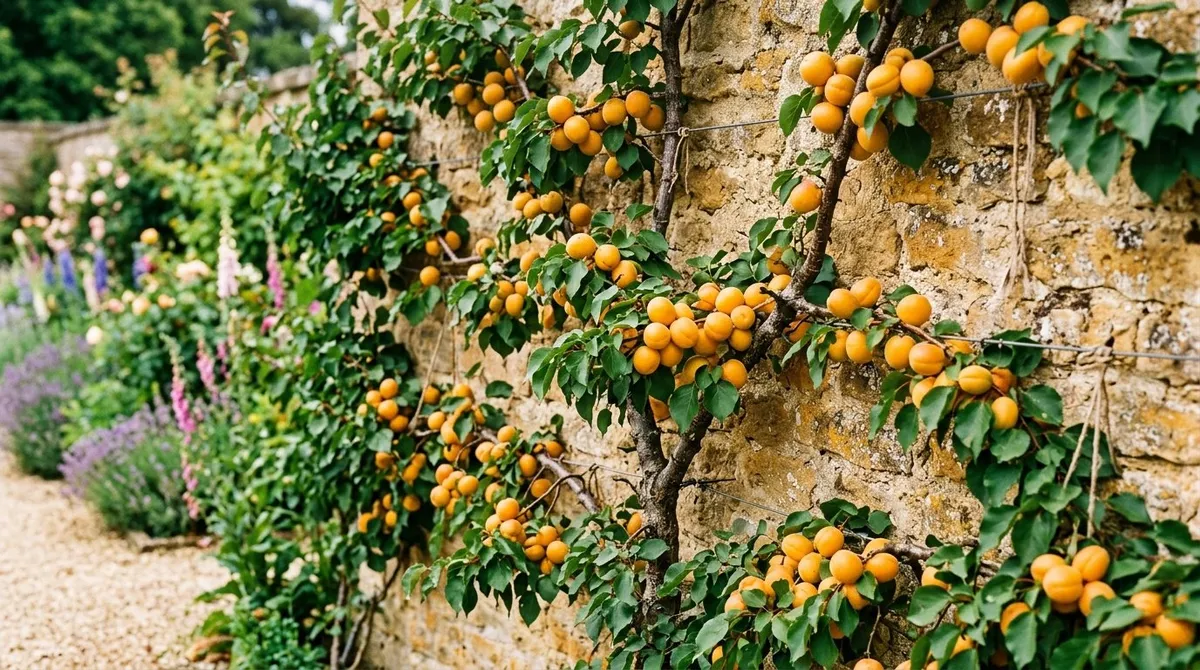
Wall specifications: Brick or stone, south or south-west facing. Minimum 3 metres wide and 2.5 metres tall. A wall that catches morning sun is ideal as it warms the tree early. Fix horizontal training wires at 15cm intervals using vine eyes.
South-west facing walls are acceptable but slightly less productive. West-facing walls are marginal for apricots in most of the UK. East and north-facing walls should never be used.
If you lack a suitable wall, a greenhouse or polytunnel provides an alternative. Unheated glass protection gives apricots all the warmth they need. See our greenhouse growing guide for what else thrives under glass.
How do you fan-train an apricot tree?
Fan training is the standard method for UK apricots because it maximises wall coverage and light exposure. The technique is similar to training peach trees but with some differences in pruning timing.
Year one: Plant a maiden whip (single stem) in November. Cut to 60cm in February. In summer, select two strong side shoots and tie them to canes at 45-degree angles. Remove all other growth.
Year two: In February, shorten each arm by one-third to an upward-facing bud. During summer, select 3-4 shoots from each arm and tie them in to fill the wall space. You should have 6-8 ribs by late summer.
Year three: Continue filling the fan framework. Allow fruiting spurs to develop along the ribs. First fruit may appear this year. Do not allow more than a handful to develop. The tree needs to build structure before cropping heavily.
Established fans: Maintain by removing inward-growing and outward-growing shoots in summer. Tie in replacement shoots where needed. Remove congested growth to keep the centre open to light and air.
Rootstock choice: St. Julien A is the standard semi-vigorous rootstock, producing a tree that fills a 4m wall. Torinel is more dwarfing and suits walls of 2.5-3m or large containers. Pixy is the most dwarfing for containers.
How do you protect apricot blossom from frost?
Frost protection is the most important skill for UK apricot growers. Apricots flower from mid-February in mild years. Open blossom is killed at minus 2 degrees Celsius. Tiny developing fruitlets are killed at minus 1 degree Celsius.
Fleece protection is the simplest method. Drape a double layer of horticultural fleece over the tree at dusk when frost is forecast. Secure the edges with clips or weights. Remove it each morning by 9am so pollinating insects can access the flowers and air circulates freely.
Fleece provides approximately 2-3 degrees Celsius of frost protection. This is sufficient for most UK spring frosts, which rarely drop below minus 4 degrees Celsius in March.
Monitor forecasts daily from mid-February to late March. The Met Office provides detailed local forecasts. Frost tends to occur on clear, still nights. Cloudy or windy nights rarely bring damaging frost.
Alternative methods:
- Move container trees into an unheated greenhouse or porch during flowering.
- Build a temporary polycarbonate shelter over wall-trained trees (similar to a peach rain shelter but primarily for frost, not rain).
- Plant later-flowering varieties like Moorpark, which flowers 7-10 days later than Tomcot.
A single night of unprotected frost during peak bloom can destroy an entire year’s crop. This is not negotiable in the Midlands and northern regions.
How do you hand-pollinate apricot flowers?
Apricots are self-fertile, meaning a single tree can produce fruit without a pollination partner. However, the early flowering time means almost no insects are available to carry pollen. Hand pollination is essential for reliable crops in the UK.
Method: Use a soft artist’s paintbrush (size 8-12) or a ball of cotton wool on a stick. On dry, sunny mornings when the temperature is above 8 degrees Celsius, gently brush the centre of each open flower. Work methodically from one side of the fan to the other. The pollen is a fine yellow powder visible on the brush.
Visit every open flower and transfer pollen between them by brushing flower to flower. Repeat every other day throughout the flowering period, which lasts approximately two to three weeks.
Timing matters. Each individual flower is receptive to pollen for approximately 3-5 days after opening. The stigma is ready when it looks moist and sticky. Pollen is viable on dry, warm days.
A well-pollinated apricot tree sets far more fruit than it can support. Thin fruitlets in May to 8-10cm apart for full-sized fruit with the best flavour. Without thinning, you get numerous small, bland apricots. Our guide to growing cherry trees covers pollination for other stone fruit.
How do you prune apricot trees in the UK?
Pruning apricots differs from apples and pears in one critical respect: never prune in winter. Silver leaf disease (Chondrostereum purpureum) enters through pruning wounds between September and May. All pruning must happen in summer.
Summer pruning (June-August):
- Remove dead, damaged, or diseased wood first.
- Cut out any branches growing directly towards or away from the wall.
- Remove crossing branches that rub against each other.
- Shorten new side shoots to 6 leaves to encourage fruiting spur formation.
- After harvest, cut fruited wood back to the replacement shoot you identified earlier in the season.
- Thin congested growth to keep the centre of the fan open.
Spur management: Apricots fruit on spurs (short, knobbly side branches) and on one-year-old wood. Spur systems build up over years. When spurs become overcrowded, thin them by removing the weakest or most congested.
Wound care: All pruning cuts over 2cm diameter should be sealed with a wound paint formulated for fruit trees. This reduces the risk of silver leaf and bacterial canker entering the wound.
Never be tempted to prune in autumn, even lightly. One infected cut can kill a mature branch. Read our fruit tree pruning guide for the general principles.
Can you grow apricot trees in containers?
Container growing is an excellent option for gardeners without a south-facing wall, those with small gardens, or anyone in a cold region who needs to move the tree under cover during frost.
Rootstock: Choose Torinel for a tree of 2-2.5m in a 50-80 litre pot. Pixy gives a smaller tree of 1.5-2m for a 40-50 litre pot. St. Julien A is too vigorous for long-term container culture.
Container setup:
- Pot size: 50 litres minimum, ideally 80 litres for a mature tree. Use a pot with drainage holes and stand it on pot feet.
- Compost: John Innes No. 3 provides weight and stability. Mix in 20% horticultural grit or perlite for drainage.
- Position: Full sun, ideally against a south-facing wall. On castors or a pot mover for easy relocation.
Care routine:
- Water: Daily in summer, twice daily in heatwaves. Inconsistent watering causes fruit drop. Check the compost every morning.
- Feed: High-potash liquid fertiliser (tomato food) fortnightly from March to August. A slow-release general feed in March provides the base.
- Repotting: Every 3-4 years, repot into a slightly larger container with fresh compost. Or root-prune by 25% and replant in the same pot.
- Winter: Move against a south-facing wall for frost protection. Cover with fleece during hard frosts. Do not bring into a heated room.
The great advantage of containers is mobility. Move the tree under a porch roof or into an unheated greenhouse during flowering to protect from frost. Move it back into full sun once fruitlets are set.
When do you harvest UK apricots?
UK apricots ripen from mid-July to late August depending on variety and location. In the West Midlands, expect Tomcot in late July and Moorpark in late August.
Signs of ripeness:
- The skin turns from green to deep orange or orange-red.
- The fruit gives slightly when gently squeezed.
- A ripe apricot pulls away from the branch with a gentle twist.
- The aroma is sweet and strong near the fruit.
- The flesh around the stem end softens last, so test there for firmness.
Harvesting tips: Pick every two days as fruit ripens unevenly. Handle gently to avoid bruising. Cup the fruit in your palm rather than gripping with fingertips. Place harvested fruit in a single layer, not stacked.
Yields: A mature fan-trained Tomcot on St. Julien A produces 8-12kg per year in a good season. Container trees produce 3-5kg. A frost-damaged year may yield nothing.
Using the harvest: Eat fresh apricots within 2-3 days of picking. For preserving, apricots make outstanding jam, can be dried in halves, or frozen for later use. Stone the fruit before freezing. Apricot jam needs less sugar than most fruits because apricots have naturally high pectin and acidity.
What problems affect UK apricot trees?
Apricots share most problems with other stone fruit. The early flowering adds frost as a primary concern.
Silver leaf: The most serious disease. Causes a silvery sheen on leaves and dieback of branches. Enters through pruning wounds made in the dormant season. Prevention: prune only in summer. Treatment: cut infected branches back to healthy wood showing no brown stain in the cross-section.
Bacterial canker: Sunken, oozing lesions on bark. Common on stone fruit in wet climates. Spray with copper fungicide at leaf fall. Remove badly affected branches in summer. Our canker guide covers identification and treatment.
Brown rot: Attacks ripening fruit. Brown patches spread rapidly in wet weather. Remove affected fruit immediately. Do not leave fallen fruit beneath the tree. Good air circulation through the fan reduces risk.
Aphids: Greenfly cluster on new shoots in spring. Squash by hand or spray with soapy water. Encourage natural predators like ladybirds and hoverflies.
Birds: Bullfinches eat flower buds in winter, reducing the potential crop before it begins. Net the tree from January to March if bullfinch damage is a problem.
Frequently asked questions
Can you grow apricots in the UK?
Yes, apricots grow and fruit in most of England and Wales with wall protection. Fan-training against a south-facing wall provides the reflected heat and shelter apricots need. UK gardens have grown apricots since the sixteenth century. Modern varieties like Tomcot are more reliable than heritage types. Northern England and Scotland require a greenhouse or polytunnel for consistent crops.
What is the best apricot tree for UK gardens?
Tomcot is the most reliable apricot for UK gardens. It produces heavy crops of medium-sized, orange-red fruit with good flavour. Tomcot has better disease resistance than older varieties and crops more consistently in the UK climate. Moorpark remains the connoisseur’s choice for flavour but is less forgiving of poor conditions. Flavourcot is a good compromise between the two.
Why do apricot trees not fruit in the UK?
Frost damage during February flowering is the main reason apricots fail to fruit. Apricots flower three weeks earlier than peaches, when overnight frosts are still common. A single frost during open bloom destroys the crop. Lack of pollination is the second cause, as few insects fly in February. Both problems are solved by fleece protection and hand pollination.
How do you protect apricot blossom from frost?
Drape double-layered horticultural fleece over the tree at night during flowering. Remove it each morning to allow pollination and air circulation. Fleece gives 2-3 degrees of frost protection, enough for most UK spring frosts. Alternatively, grow in a cold greenhouse or polytunnel where blossom is naturally protected. Monitor weather forecasts daily from mid-February to late March.
When do you prune apricot trees?
Prune apricots only in summer, from June to August. Winter pruning exposes cuts to silver leaf disease spores, which are active from September to May. Remove dead, damaged, or crossing branches first. On fan-trained trees, cut back fruited shoots to replacement growth after harvest. Keep the centre of the fan open to light and air.
Can you grow apricot trees in pots?
Apricot trees grow well in large containers on dwarfing rootstock. Choose Torinel or Pixy rootstock for restricted growth. Use a 50-litre pot minimum with John Innes No. 3 compost. Water daily in summer and feed fortnightly with tomato food from March to August. The main advantage of container growing is mobility, as you can move the tree under cover during frost and flowering.
How long do apricot trees take to fruit?
Apricot trees produce their first crop 3-4 years after planting. Fan-trained trees on St. Julien A rootstock begin cropping in year three. Full production is reached by year five or six. Container trees on dwarfing rootstock may fruit a year earlier but produce smaller overall yields. Patience in the early years pays off with decades of cropping once established.
Our team produces practical UK gardening guidance from source research, contributor records and established horticultural practice. Editorial standards are overseen by Matt W.