Key takeaways
- Target 12-inch (305mm) minimum pod length at UK village shows
- Stenner is the dominant UK show variety since 1990s
- Hand-pollinate every flower for straight, even pods
- Train on 2.7m canes with cordon side-shoot removal
- Pick 12-24 hours before show, store in damp newspaper
- Allow 80-100 candidate pods to select 6 matched winners
Exhibition runner beans are the cornerstone vegetable class at UK village and county shows in late August and early September. A winning dish of six 12-inch-plus pods of Stenner, all matched within 5mm, is the result of variety choice, vertical cordon training, daily hand-pollination, and careful lift-day selection. Kitchen and low-risk pollination choices appear in our wider guide to the best runner bean varieties.
After 4 seasons of runner bean classes on the Staffordshire show circuit, the patterns are clear. Variety choice decides 50% of the outcome. Hand-pollination decides another 25%. Training and selection cover the remaining 25%.
What UK Show Judges Want From Runner Beans
The NVS specification for the 12-inch class:
- Length: minimum 305mm (12 inches); winning pods 380-450mm
- Straightness: minimum bend, no kinks
- Colour: fresh uniform green, no scarring or yellow patches
- Pod swelling: peas just visible as outline, never bulging
- Pod taper: smooth and even from base to tip
- Stalk: 15-25mm of clean stalk attached
- Bloom: pale natural surface coating intact
- Dish size: 5 or 6 pods per dish (sometimes 9 at county level)
Pods are scored out of 140 across length (up to 35), straightness (up to 25), uniformity (up to 25), colour (up to 25), freshness (up to 15), and presentation (up to 15).
Best UK Exhibition Runner Bean Varieties
Four varieties dominate the UK show bench. Each has a strong case.
| Variety | Pod length | Pod number | Wins at | Notes |
|---|---|---|---|---|
| Stenner | 400-450mm | 80-120 per plant | Village + county | Dominant since 1990s |
| Enorma | 350-450mm | 80-110 per plant | Village + county | Easier to grow than Stenner |
| Liberty | 380-450mm | 80-110 per plant | County + national | Best straightness |
| Achievement Merit | 350-420mm | 70-100 per plant | Village | Older variety, still wins |
| Polestar | 250-300mm | 100-130 per plant | Avoid (too short) | Kitchen bean |
| Painted Lady | 250-320mm | 80-100 per plant | Avoid (too short) | Heritage variety |
Stenner is the safe choice for any first-time UK runner bean exhibitor. Selected by Joe Stenner in the 1980s specifically for show length and straightness. Pods reach 400-450mm with reliable set. Seed available from specialist UK suppliers (Robinson’s, Medwyn’s Seeds, Owl’s Acre) at £3-£5 per 50-seed packet. Less commonly stocked at mainstream UK retailers.
Enorma is the most widely available show variety in UK garden centres. Pods reach 350-450mm. Slightly easier to grow than Stenner but slightly less uniform.
Liberty is the choice for county and national-level shows. Produces the straightest pods of any UK variety but needs careful feeding and watering to reach full length. Sometimes hard to source; check specialist UK suppliers.
Achievement Merit is an older traditional show variety still grown in Yorkshire and the North West. Performs well in cooler climates and produces deep colour.
Avoid Polestar, Painted Lady, and most commercial garden-centre varieties. Pods are 250-320mm and judges deduct heavily for short length even when colour and uniformity are perfect.
Sowing Date for UK Show Dates
UK runner bean shows fall mostly in mid-August to mid-September. Show runner beans take 75-90 days from sowing to peak picking.
| Show date | Sow indoors | Plant out | Notes |
|---|---|---|---|
| Last Saturday August | 5-10 May | 30 May - 5 June | Optimal for most UK regions |
| First Saturday September | 12-17 May | 6-12 June | Most reliable timing |
| Second Saturday September | 19-24 May | 13-19 June | Best for southern England |
| Late September shows | 26 May - 1 June | 20-25 June | Risk of cold nights affecting pod fill |
Always sow two batches one week apart. Variable UK spring weather means a single sowing rarely peaks on the exact show day. The second batch is your insurance dish.
Sowing technique:
- Use 9cm pots filled with peat-free seed compost.
- Sow one seed per pot, 25mm deep.
- Keep at 15-18C for the 7-12 day germination window.
- Move to 12-15C once cotyledons open.
- Plant out at 4-leaf stage with strong root system.
Harden off over 7-10 days before planting. Plant 200-250mm apart at the base of 2.7m canes, with cordon training planned from the start.
Cordon Training for Show Pods
Show runner beans are grown as single cordon vertical, not bushy. Same principle as cordon tomato training: remove every side-shoot to concentrate pod growth on the main stem.
Training method:
- Install 2.7m bamboo canes at planting. Lash to a horizontal wire 2.5m up.
- Tie the main stem loosely to the cane every 200mm using soft twine.
- Remove every side-shoot as it appears. Each leaf axil produces a side-shoot.
- Remove the first 4-6 trusses of flower buds. This concentrates energy on the upper trusses where the longest pods set.
- Pinch out the growing tip when the cordon reaches the top of the cane (around mid-July).
The cordon system produces 80-120 large, well-filled pods per plant versus 200-300 small uneven pods on an untrained plant. Pod length increases by 50-100mm versus uncordoned growth.
Spacing:
Plant 200-250mm apart in a single row, with cordon canes 2-2.5m above the ground for show. A 6-plant row gives 6-12 candidate dishes per show.
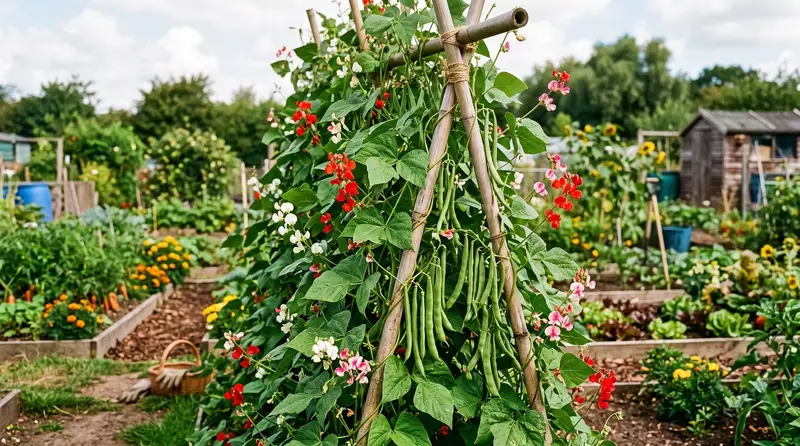
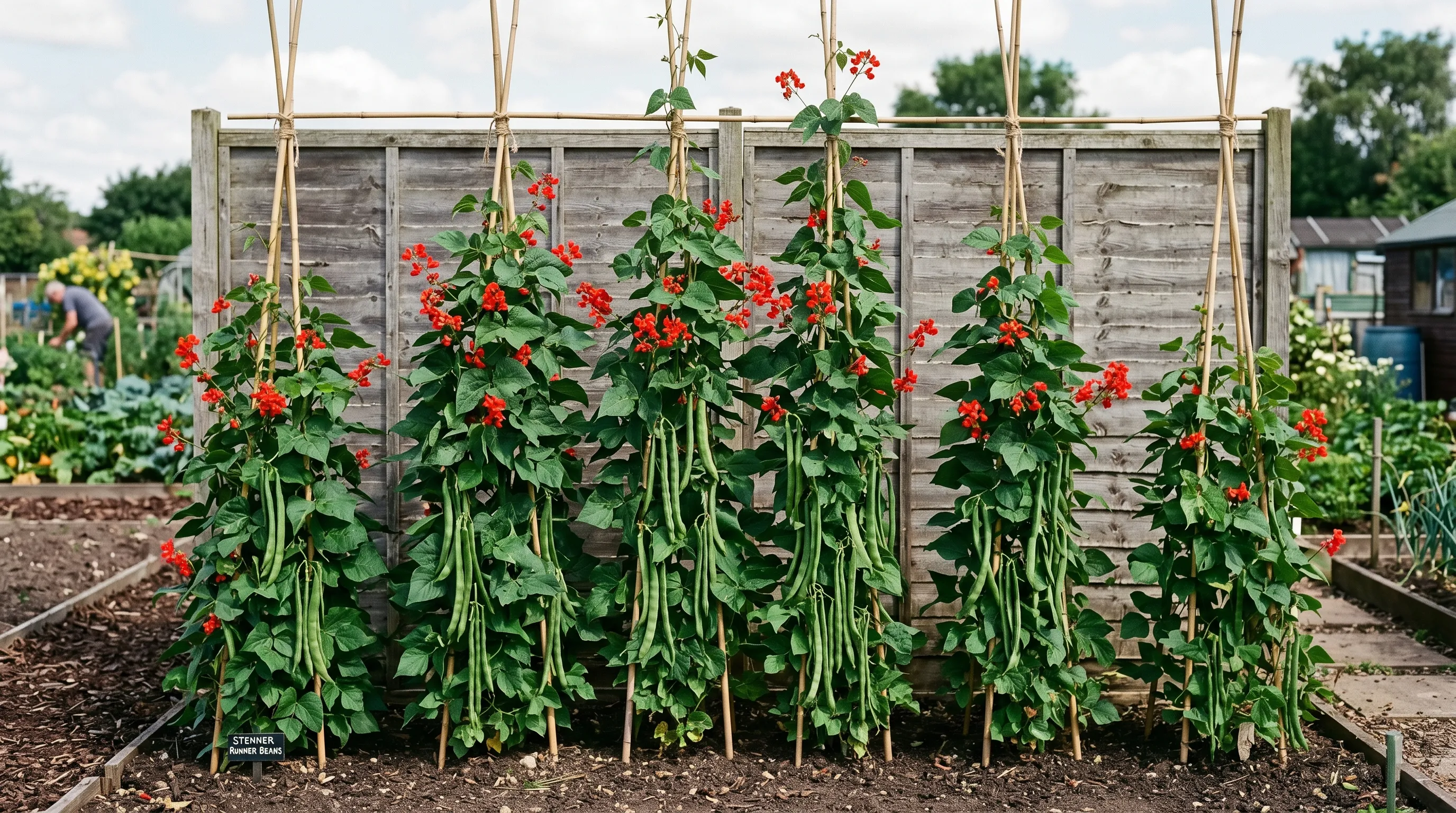 Cordon-trained Stenner runner beans in mid-July. Side-shoots and excess trusses removed. The plants carry 30-40 large straight pods each at this stage. Yield per plant drops but pod length and quality rise sharply.
Hand-Pollination: The Step Most Growers Skip
Runner bean flowers depend heavily on bees and bumblebees for pollination. UK summer weather can fail this. A wet, cool June reduces bee activity, leaving partial pod set and shorter pods.
Hand-pollination technique:
- Wait until the flower is fully open and bright red (or white for white-flowered varieties).
- Use a soft watercolour brush (size 4-6).
- Insert the brush gently into the keel petal at the base of the flower.
- Move the brush from flower to flower across the plant.
- Repeat every morning between 06:00 and 09:00 for the 14-21 day flowering window.
A single 20-minute pollination session covers 8-12 plants. Time investment for a show entry: 5-7 hours across the flowering window.
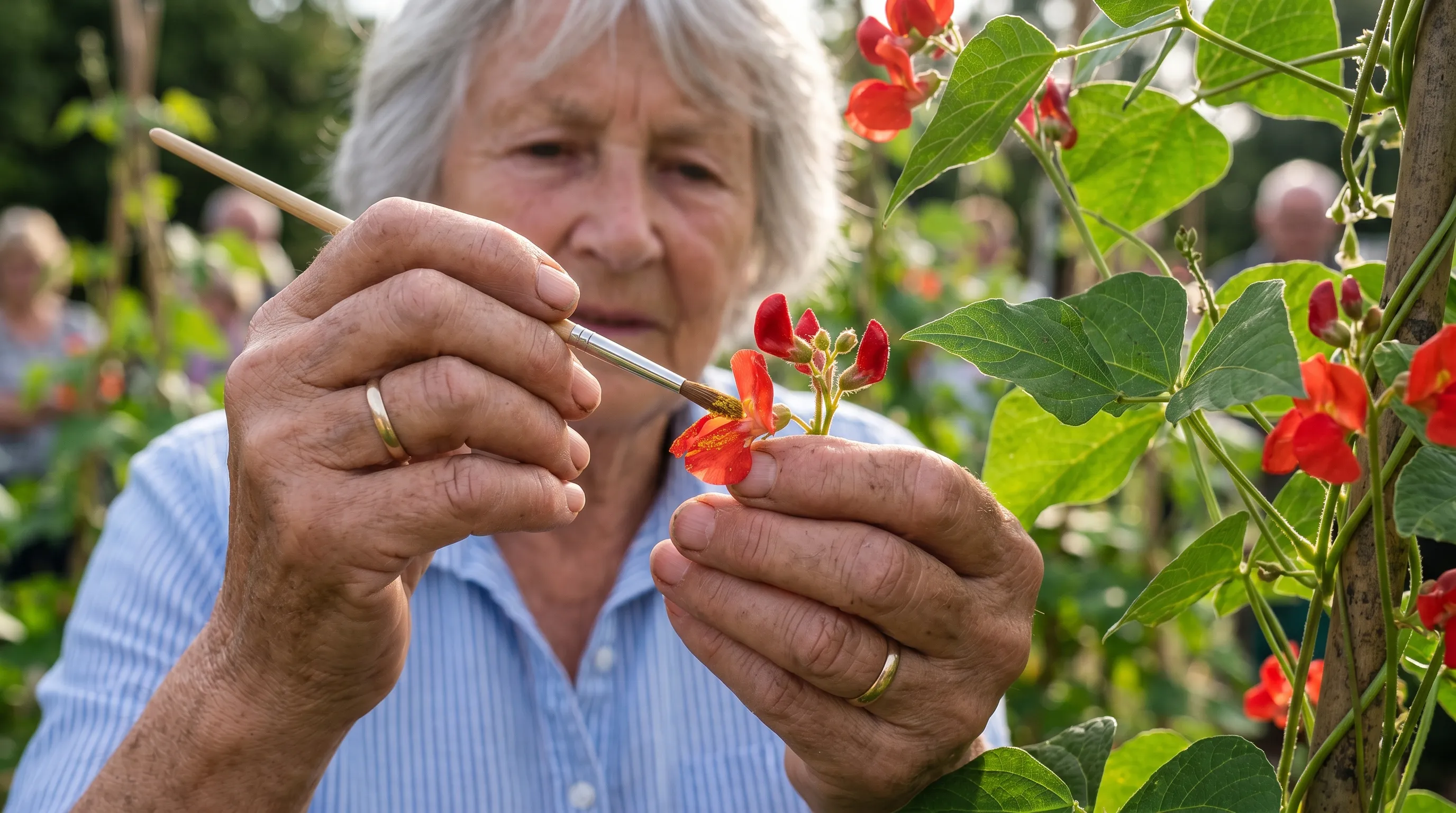 Hand-pollinating a Stenner runner bean flower with a size 5 watercolour brush. The technique adds 22-30% more set pods in wet UK summers when bee activity drops. Repeat every morning for the 14-21 day flowering window.
For the full runner bean cultivation guide, our standard growing article covers the kitchen-bean version of the same plant. Show technique builds on that base.
Feeding and Watering Show Runner Beans
Show runner beans need consistent, controlled feeding. Nitrogen builds the plant; potassium builds the pods.
Base feed: Dig in 5-6kg of well-rotted manure per square metre the autumn before planting. Add 70g of Vitax Q4 per metre of row at planting.
Liquid feeds:
- Weeks 1-3 after planting: water only, no feed
- Weeks 4-6 (vegetative growth): half-strength general feed once weekly
- Weeks 6-8 (flowering): full-strength tomato feed weekly (high potassium)
- Weeks 8-12 (pod fill): full-strength tomato feed twice weekly, plus weekly seaweed extract
Watering:
Runner beans need 20-30 litres per plant per week at peak pod fill. Apply at the base, between 06:00 and 09:00. Drip irrigation outperforms hand watering for evenness. Mulch with 75mm of grass clippings after each watering to hold moisture.
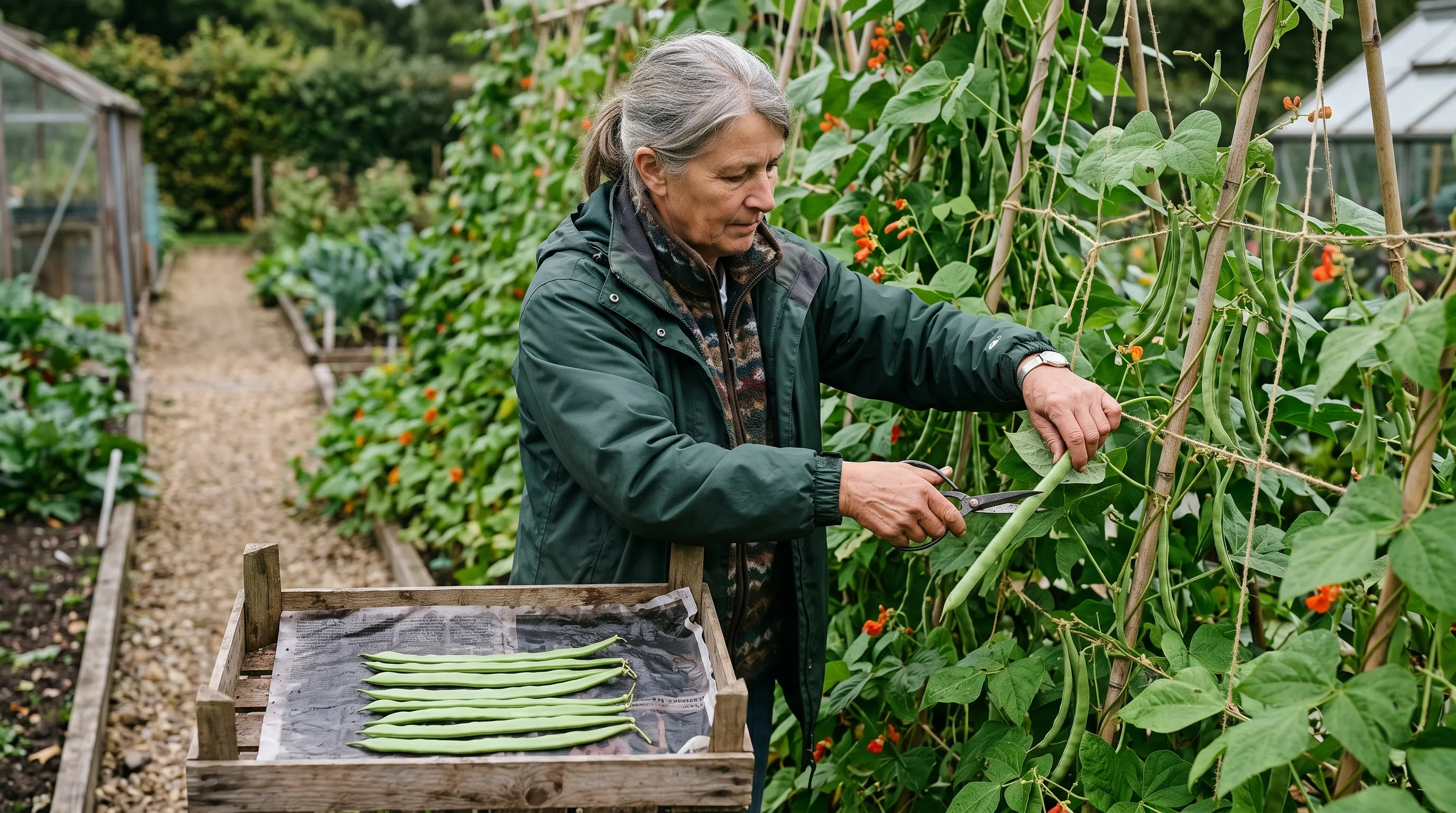 Pre-show picking technique: sharp scissors cut the stalk cleanly leaving 15-25mm attached. Picked pods go straight into a shallow tray on damp newspaper. Never stack pods or carry in a bag.
Picking and Selecting a Show Dish of Six
The selection process decides 30-40% of show success.
Pick 12-24 hours before the show. Runner beans hold their freshness for one day at 8-12C in damp newspaper. Earlier picks lose colour and bloom. Same-day picks risk bruising during transport.
Use sharp scissors and cut the stalk cleanly, leaving 15-25mm attached to the pod. Pulling damages the trellis and bruises the stem end.
Carry the picked pods in a single layer in a shallow tray on damp kitchen paper, in the shade. Never stack pods or carry in a bag.
Lay out all candidate pods on a clean tea towel on the kitchen table. Sort by length first. Group all pods within a 5mm length range together.
Within each length group, sort by straightness. Hold each pod horizontal and check for bow or kink. Discard any pod with visible curvature beyond 10mm over its length.
Within each straightness group, sort by colour. Most varieties produce 80% of pods in a single shade with bloom intact.
Pick the 6 matching pods. Look for pods matching on length to within 5mm, straightness within 5mm, colour exactly, and pod fill stage exactly.
The winning 6 almost always come from an 80-100 pod candidate pool. Plan to grow 6-8 cordon plants per show dish entry.
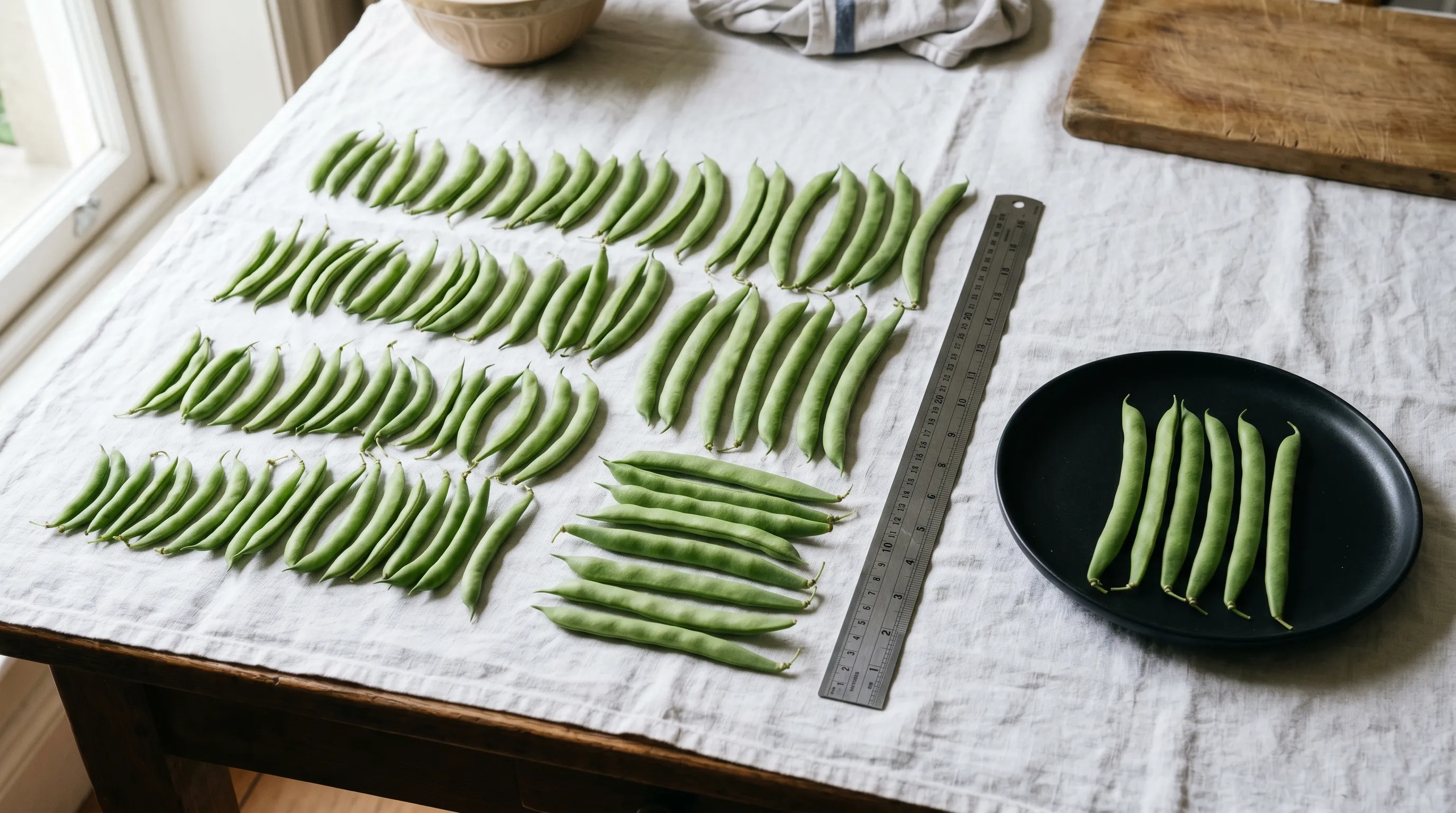 The Saturday morning selection process. All 80 candidate pods graded by length first, then straightness, then colour. The winning six (on the black plate) all match within 5mm length and identical fill.
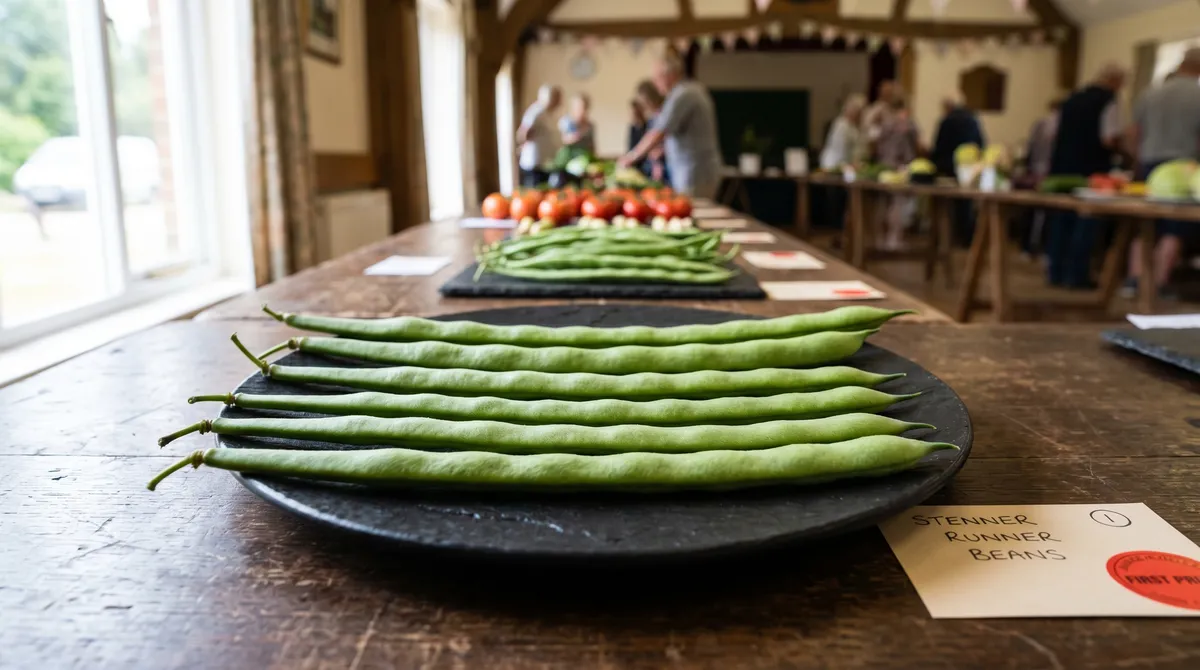
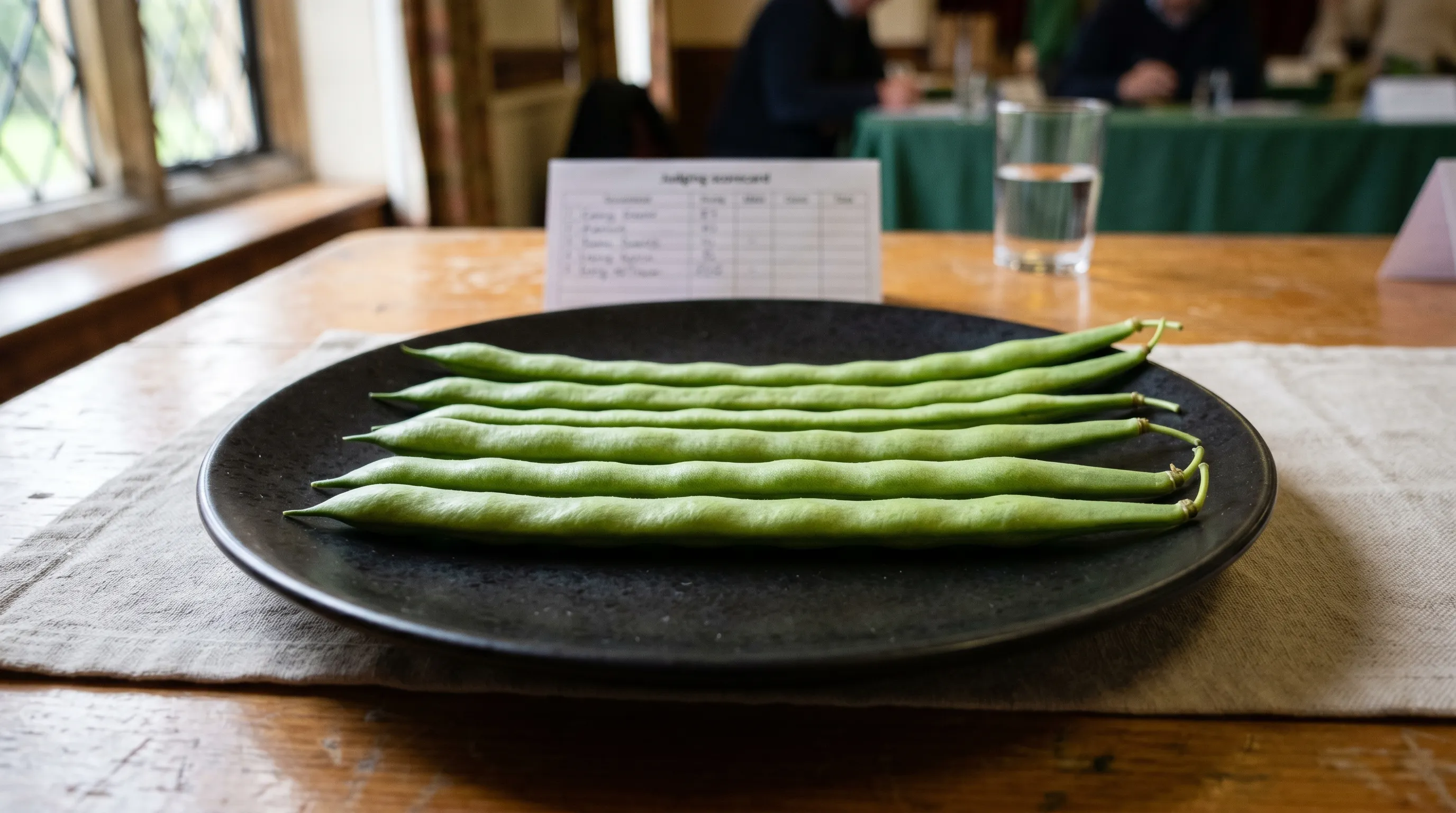 The winning six. Pods matched within 5mm on length, identical straightness, single colour shade, stalks pointing toward the judge. Six pods arranged parallel, longest at the back. Standard NVS staging.
NVS Staging for Show Runner Beans
The National Vegetable Society sets the staging standard followed by 90%+ of UK village and county shows.
- Dish of 5 or 6 pods for class entry (some classes specify 9)
- Pods presented on a black show plate supplied by the show
- Stalks pointing toward the judge, away from the back of the bench
- Arranged side by side, parallel, longest at the back
- Pods should touch but not overlap
- Stalk intact, 15-25mm cut clean
- No washing, no oiling
Judging looks for: length (35 points), straightness (25), uniformity (25), colour (25), freshness (15), presentation (15). Total out of 140. A winning village dish typically scores 110-125. A county-winning dish scores 125-135.
Common Mistakes With Show Runner Beans
Mistake 1: choosing a kitchen variety. Polestar, Painted Lady and Scarlet Emperor all produce 250-320mm pods. The 12-inch class requires 305mm minimum and rewards pods over 380mm. Use Stenner, Enorma, Liberty or Achievement Merit.
Mistake 2: skipping hand-pollination. A wet UK summer can drop bee activity to 30-40% of normal. Without hand-pollination, pod set falls and pods are shorter and more curved. The 20 minutes per morning is the single most cost-effective use of time on the show plot.
Mistake 3: leaving side-shoots. Untrained plants produce 200-300 small pods instead of 80-120 large ones. The cordon training is what gives show pods their length.
Mistake 4: picking on show morning. Same-day picks bruise during transport. Pick 12-24 hours before, store in damp newspaper at 8-12C.
Mistake 5: under-growing. Six plants will not produce a winning dish. Grow 8-10 cordon plants per show dish entry. The non-winners go to the kitchen.
For the rest of the show bench, our exhibition peas guide covers the dish-of-nine pea class. The long carrots for show guide covers the 600mm-plus carrot class. The exhibition onions guide covers the dressed-onion class.
Show Runner Bean Calendar UK Month-by-Month
| Month | Show runner bean task |
|---|---|
| January | Order Stenner, Enorma seed from specialist suppliers |
| February | Prepare row: dig in 5-6kg/m² manure plus 70g/m² Vitax Q4 |
| March | Build cane structure: 2.7m canes, horizontal wire 2.5m up |
| April | No outdoor sowing yet. Check feed schedule |
| May | Sow indoors 5-24 May depending on show target |
| June | Plant out after frost risk. Begin cordon training |
| July | Hand-pollinate every morning. Continue cordon training |
| August | Pod fill stage. Twice-weekly tomato feed. 30L water per plant per week. Show season |
| September | Late shows. Continue picking for kitchen and seed saving |
| October | Pull plants, compost. Save best pods for next year’s seed |
| November | Plan next year’s variety mix and order seed |
| December | Plan show calendar and class entries |
Frequently asked questions
What is a 12-inch class runner bean at UK shows?
The 12-inch class judges runner beans by length, straightness, colour and freshness. Pods must be at least 305mm (12 inches) long. Top exhibitors aim for 350-450mm pods. The class is the most-entered runner bean class at UK village and county shows.
What is the best variety for exhibition runner beans UK?
Stenner is the dominant UK show runner bean since the 1990s. Pods reach 400-450mm with straight, even fill. Enorma, Liberty and Achievement also win regularly. Avoid commercial varieties like Painted Lady or Polestar which produce shorter pods.
How do you hand-pollinate runner beans for showing?
Use a soft watercolour brush to gently transfer pollen between open flowers each morning during flowering (May-July). Hand-pollination produces 25-35% more set pods and straighter pod development. Essential in wet UK summers when bee activity drops.
When do you pick exhibition runner beans for a show?
Pick 12-24 hours before show day. Earlier picks lose freshness; later picks risk bruising during transport. Store picked pods in damp newspaper in a cool dark box at 8-12C. Never refrigerate; runner beans turn limp below 6C.
How are exhibition runner beans staged at UK shows?
Present 6 pods (5 or 9 in some classes) on a black show plate, side by side, parallel, longest at the back. Stalks toward the judge. Pods must not touch but should be close. Match length to within 5mm, colour to single shade, no scarring or swellings.
Now plan the rest of the show bench
Our team produces practical UK gardening guidance from source research, contributor records and established horticultural practice. Editorial standards are overseen by Matt W.