Key takeaways
- Sow cucamelon seeds indoors in April at 20-22C — germination takes 7-14 days
- Plant out after the last frost in late May with vertical support up to 3m
- Harvest at grape size (2-3cm) for the best flavour — overripe fruits turn bitter and mushy
- Each plant produces 200-300 fruits from July to October in a good UK summer
- Tubers survive mild UK winters underground and regrow the following spring
- Almost pest-free — no cucumber mosaic virus, no powdery mildew, no red spider mite problems
Cucamelon is one of the most rewarding unusual crops you can grow in a UK garden. These grape-sized fruits look like miniature watermelons, taste of cucumber with a sharp lime tang, and grow on vigorous climbing vines that crop heavily from July to October. The plant is almost pest-free, drought-tolerant, and thrives in the same conditions as outdoor tomatoes.
Melothria scabra goes by several names: mouse melon, Mexican sour gherkin, and sandita. It is native to Mexico and Central America but grows surprisingly well in British summers. This guide covers everything from sowing to pickling, including how to save the tubers for free plants next year. For timing alongside other crops, see our greenhouse planting calendar.
When to sow cucamelon seeds
Sow cucamelon seeds indoors in April at 20-22C. Do not sow before April, seedlings grow slowly in low light and become leggy. Seeds need warmth to germinate and take 7-14 days at the right temperature.
How to sow: Fill 7cm pots with multipurpose peat-free compost. Sow two seeds per pot, 1cm deep. Water from below. Place in a heated propagator or on a warm windowsill. Once both seeds germinate, remove the weaker seedling.
Growing on: Keep seedlings at 18-20C in bright light. Pot on into 1-litre pots when roots fill the original pot, usually after 3-4 weeks. Feed fortnightly with a balanced liquid fertiliser from the pot-on stage.
Do not direct sow. UK soil temperatures rarely reach the 18C minimum that cucamelon seeds need for germination. Indoor sowing is the only reliable method in Britain.
| Stage | Timing | Temperature |
|---|---|---|
| Sow indoors | Early-mid April | 20-22C |
| Pot on | Late April-early May | 18-20C |
| Harden off | Mid-late May | Daytime 15C+ |
| Plant out | Late May-early June | Soil 15C+ |
| First harvest | Mid-July | , |
| Last harvest | Mid-October (before first frost) | , |
For general seed-starting techniques, see our guide on how to sow seeds indoors.
How to plant out cucamelons
Plant out after the last frost, typically late May in southern England or early June in the Midlands and north. Cucamelons are half-hardy and killed by frost. Harden off seedlings for 10-14 days before planting.
Site: Choose a warm, sheltered, south-facing position. Against a sunny wall or fence is ideal. Cucamelons need at least 6 hours of direct sunlight daily. They tolerate partial shade but crop less heavily.
Soil: Any well-drained soil works. On heavy clay, add grit and compost to improve drainage. Cucamelons are less fussy about soil than cucumbers, they do not need the rich, moisture-retentive conditions that cucumbers demand.
Spacing: Plant 40-50cm apart if growing multiple plants along a trellis. In containers, one plant per 30-40 litre pot is sufficient.
Greenhouse growing: Cucamelons grow well in an unheated greenhouse or polytunnel. This extends the season by 3-4 weeks at each end. Train vines up strings attached to the greenhouse roof. Ventilate well in summer, cucamelons prefer lower humidity than cucumbers.
Cucamelon seedlings planted at the base of a trellis in late May
Supporting and training cucamelon vines
Cucamelon vines reach 2.5-3m in a UK season and must have vertical support. The thin, wiry stems produce curling tendrils that grip any thin support. Without support, plants sprawl across the ground, fruits rot, and slugs feast.
Trellis or netting: Fix a 2m panel of trellis or pea netting against a wall, fence, or between posts. The tendrils attach themselves, no tying is needed. This is the easiest method for most gardens.
String training: Run vertical strings from ground-level pegs to a horizontal wire at 2m. Space strings 40cm apart. This method works well in greenhouses. Wrap the main stem around the string as it grows.
Wigwam: Push four 2.4m bamboo canes into the ground in a square, tie at the top, and wrap with string at 15cm intervals. Plant one cucamelon at the base of each cane. This creates an attractive feature for a border or patio.
Pinching: Cucamelons do not need regular pinching or side-shoot removal. The plants branch naturally and produce fruit on lateral stems. If growth becomes very dense, thin out some stems to improve air circulation and make harvesting easier.
When and how to harvest cucamelons
Pick cucamelons when they reach 2-3cm long, about the size of a large grape. This is the key to good flavour. Small fruits are crunchy and taste of cucumber with a citrus kick. Larger fruits (over 3cm) go soft, seedy, and bitter.
Check plants every 2-3 days during peak cropping from August onwards. Fruits ripen quickly in warm weather. Regular picking encourages the plant to set more fruit. A neglected vine stops producing if fruits are left to over-ripen.
Harvest method: Snip or twist fruits from the vine. They detach easily when ripe. Handle gently, the thin skin bruises if squeezed. Drop straight into a bowl rather than a pocket.
Yield: Each plant produces 200-300 fruits over a 12-week season. Peak cropping runs from early August to mid-September. Three plants provide enough for fresh eating plus several jars of pickles.
Storage: Fresh cucamelons keep for 5-7 days in the fridge in a sealed container. They do not freeze well raw but pickle brilliantly (see below).
Cucamelon fruits at the perfect grape-sized stage for picking
How to pickle cucamelons
Pickling is the best way to preserve a cucamelon glut. The firm flesh holds its crunch in vinegar far better than cucumber.
Quick pickle (fridge pickle): Pack whole cucamelons into a clean jar. Bring 200ml white wine vinegar, 100ml water, 1 tablespoon sugar, and 1 teaspoon salt to the boil. Add flavourings: a sprig of dill, a sliced garlic clove, and half a teaspoon of mustard seeds. Pour the hot liquid over the cucamelons. Seal and refrigerate. Ready in 48 hours. Keeps for 3 months in the fridge.
Flavour combinations: Cucamelons pair well with dill and garlic (classic), chilli and lime (Mexican-style), or coriander and cumin. They also work sliced into gin and tonic as a garnish, halved in summer salads, or tossed through stir-fries in the last 30 seconds of cooking.
Saving tubers for next year
Cucamelons form small, dahlia-like tubers underground. These tubers can overwinter and produce earlier crops the following year, tuber-grown plants start cropping 3-4 weeks before seed-grown ones.
In mild areas (RHS zones H4-H5): After the first frost kills the top growth, cut stems to ground level. Cover the planting area with 15cm of straw or bark mulch. In sheltered urban gardens and along the south coast, tubers often survive in the ground over winter.
In cold areas or heavy clay: Dig tubers in October before the first hard frost. Allow them to dry for 24 hours in a cool, airy place. Store in a paper bag filled with dry compost in a frost-free shed or garage. Check monthly and discard any that have gone soft. Replant in May once soil reaches 15C.
Container growing: If growing in pots, move the whole container into a frost-free greenhouse or porch over winter. Do not water during dormancy. Resume watering in April when new shoots appear.
Companion planting for cucamelons
Cucamelons are good neighbours in the vegetable garden. They share the same growing season and conditions as tomatoes, peppers, and beans.
Good companions: Tomatoes, basil, marigolds, nasturtiums, and spring onions. Marigolds deter whitefly. Basil is said to improve flavour (though the evidence is anecdotal). Nasturtiums act as a trap crop for blackfly.
Avoid: Do not plant next to other cucurbits (cucumbers, courgettes, squash). Although cucamelons are a different genus and will not cross-pollinate, they share some soil-borne pathogens. Rotate the planting position each year.
Interplanting: Cucamelon vines on a trellis create dappled shade. Plant lettuce or other salad crops at the base for a productive vertical garden. The vines also look attractive on an ornamental obelisk in a mixed border.
Pests and problems
Cucamelons are remarkably pest-free in the UK. They do not suffer from cucumber mosaic virus, powdery mildew, or the red spider mite problems that plague cucumbers. This is one of their biggest advantages as a crop.
Slugs: Young transplants are vulnerable in the first two weeks after planting out. Use organic slug pellets (ferric phosphate) or copper tape around containers. Once stems toughen and plants climb above ground level, slugs are no longer an issue.
Aphids: Occasional greenfly colonies form on shoot tips in July. Squash by hand or spray with a strong jet of water. Ladybirds and hoverflies usually control aphids naturally within a week.
Poor fruit set: Cold weather below 15C reduces pollination. In cool summers, hand-pollinate by dabbing a small paintbrush inside each flower. This is rarely needed in most of England.
Overwatering: Cucamelons are more drought-tolerant than cucumbers. Waterlogged soil causes root rot. Water when the top 3cm of compost is dry. In containers, check daily in summer but allow the surface to dry between waterings.
For a wider look at growing unusual edibles alongside cucamelons, see our guide to growing tomatoes for beginners, they share the same season and conditions.
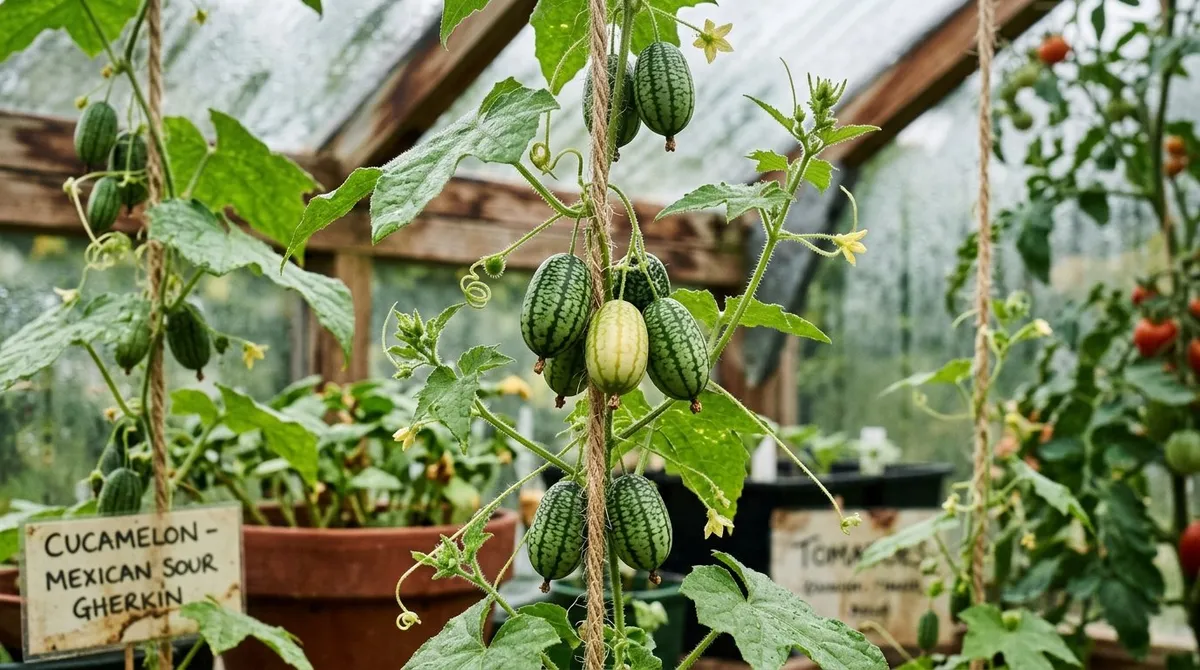
A cucamelon vine trained up string supports in a greenhouse, loaded with fruit
Growing cucamelons in containers
Container growing suits cucamelons well. Use a pot of at least 30 litres filled with multipurpose compost. Insert a 2m cane or small obelisk for support. Position in full sun against a warm wall.
Feeding: Start feeding with a balanced liquid fertiliser every 10 days once flowers appear. Switch to a high-potash tomato feed from July to encourage fruiting. Container-grown plants produce slightly fewer fruits than those in the ground but the quality is identical.
Watering: Water when the top 3cm feels dry. Do not let containers sit in saucers of water. Cucamelons tolerate short dry spells better than cucumbers but will drop flowers and immature fruits if severely drought-stressed.
Overwintering in pots: At season’s end, cut back dead top growth and move the whole container to a frost-free spot. Resume watering in April when shoots emerge. Container-grown tubers overwinter well because the pot insulates them from the worst cold.
For more container vegetable ideas, see our French bean growing guide, another productive climber for patio pots.
Frequently asked questions
When should I sow cucamelon seeds in the UK?
Sow indoors from early to mid-April at 20-22C. Seeds germinate in 7-14 days. Sow two seeds per 7cm pot, 1cm deep, and remove the weaker seedling after germination. Do not sow outdoors, UK soil temperatures are too low for reliable germination. Harden off in late May and plant out after the last frost.
Do cucamelons need a greenhouse in the UK?
No, cucamelons crop well outdoors in most of England. A sheltered, south-facing wall or fence with trellis support is ideal. A greenhouse or polytunnel extends the season by 3-4 weeks at each end and increases yield by around 30%. In Scotland and northern England, greenhouse growing is more reliable.
What do cucamelons taste like?
Cucamelons taste of cucumber with a sharp citrus tang, often described as cucumber-lime. The skin has a slightly sour bite. They are crunchy when picked small at 2cm. Overripe fruits at 3cm or larger become soft and bitter. They are excellent raw in salads, pickled in vinegar, or added to gin and tonic as a garnish.
Can I save cucamelon tubers for next year?
Yes. Cucamelons form small tuberous roots that can survive UK winters in mild areas. After the first frost kills the top growth, cover the planting area with 15cm of straw mulch. In colder regions or heavy clay, dig tubers in October, dry them for a day, and store in dry compost in a frost-free shed. Replant in May. Tuber-grown plants crop 3-4 weeks earlier than seed-grown ones.
How do I support cucamelon vines?
Cucamelon vines reach 2.5-3m and need vertical support. Use trellis, netting, or string tied to a frame. The tendrils grip thin supports easily. A wigwam of bamboo canes also works. Without support, plants sprawl across the ground and fruits are harder to find and more prone to slug damage.
Are cucamelons the same as regular cucumbers?
No. Cucamelons (Melothria scabra) belong to a different genus from cucumbers (Cucumis sativus). They look like miniature watermelons but are not melons either. They do not cross-pollinate with cucumbers, courgettes, or squash. They are much hardier, more pest-resistant, and more drought-tolerant than cucumbers.
How many cucamelon plants do I need?
Two or three plants are enough for a household. Each plant produces 200-300 fruits over a 12-week season. One plant in a large container provides a steady supply for salads. Three plants on a trellis give enough for fresh eating plus pickling a few jars for winter.
Our team produces practical UK gardening guidance from source research, contributor records and established horticultural practice. Editorial standards are overseen by Matt W.