Key takeaways
- Hardy fuchsias survive -10C and grow as permanent garden shrubs — 'Mrs Popple' and 'Riccartonii' are the most reliable
- Tender fuchsias must be brought indoors before the first frost and kept at 5-7C through winter
- Prune hardy fuchsias hard to 15cm in late April or May — never in autumn, as old stems protect the crown from frost
- Softwood cuttings in April-June root in 2-3 weeks with 90%+ success rate, making fuchsias one of the easiest plants to propagate
- Fuchsia gall mite has no chemical cure — prune out distorted growth and destroy affected material immediately
- A single 'Mrs Popple' reaches 1.2m x 1.2m within 3 years, producing flowers from June until the first frosts
Fuchsias are among the most rewarding flowering plants for UK gardens, producing thousands of pendant blooms from June until the first frosts stop them. The critical distinction every grower must understand is between hardy fuchsias, which survive UK winters outdoors as permanent shrubs, and tender fuchsias, which die at the first frost unless brought under cover. Get the hardiness right and fuchsias are one of the easiest plants in the garden.
This guide covers both types, from choosing varieties through pruning, overwintering, and propagation. For more flowering shrub options, see our guide to the best flowering shrubs for UK gardens.
‘Mrs Popple’ is the most reliable hardy fuchsia for UK gardens, flowering from June until the first frosts without any winter protection.
Hardy vs tender fuchsias: what is the difference?
Hardy fuchsias survive winter outdoors across most of the UK, dying back to ground level and regrowing each spring. Tender fuchsias are killed by any frost and must be overwintered indoors at 5-7C. This distinction determines everything about how you grow them.
Hardy fuchsias are treated as herbaceous shrubs. In mild winters, they retain some woody framework. In cold winters, they die back to the crown but regrow vigorously. Most reach 1-1.5m in a single season. They tolerate temperatures down to -10C, and in sheltered spots, some survive -15C. Once established (after the first 2-3 years), they are extremely resilient.
Tender fuchsias are the ones with the most flamboyant, largest flowers, the doubles and fancy bicolours seen in hanging baskets and show benches. They make superb container and basket plants but need frost-free storage from October to May. Even a single night of -2C kills them outright.
Some fuchsias sit in a borderline zone. ‘Dollar Princess’, ‘Alice Hoffman’, and ‘Army Nurse’ are marketed as half-hardy but survive most UK winters in sheltered positions with a deep mulch over the crown. They are worth a gamble if your garden is not severely exposed.
| Type | Winter Hardiness | Height | Typical Use | Examples |
|---|---|---|---|---|
| Hardy | -10C to -15C | 1-1.5m | Borders, hedging | Mrs Popple, Riccartonii |
| Half-hardy | -5C with protection | 60-90cm | Borders, containers | Dollar Princess, Alice Hoffman |
| Tender | Killed by frost | 30-60cm (trailing) | Baskets, pots | Swingtime, Marinka |
Best hardy fuchsia varieties
Six hardy varieties have proven themselves over multiple UK winters, surviving temperatures below -10C without any protection. These are permanent garden plants that grow bigger and better with each passing year.
‘Mrs Popple’ is the gold standard. It produces masses of medium-sized flowers with scarlet sepals and violet petals from June until frost. It reaches 1.2m x 1.2m within 3 years and makes a superb specimen shrub or informal hedge. RHS AGM.
‘Riccartonii’ (F. magellanica var. gracilis) is the hedging fuchsia of western Ireland and coastal Scotland. It grows to 1.5m in sheltered spots and produces small, elegant red and purple flowers. It is the hardiest of all fuchsias, surviving -15C in exposed positions. Used as a flowering hedge across the west coast.
‘Tom Thumb’ is a compact hardy at just 30-40cm tall. Small red and violet flowers cover the plant from June to October. Ideal for the front of borders, rockeries, and containers that stay outdoors year-round.
‘Lady Thumb’ is even smaller at 25-30cm with semi-double red and white flowers. A neat edging plant that pairs well with other low perennials. RHS AGM.
‘Hawkshead’ produces elegant white flowers tinged with green. It reaches 90cm and has a more upright, narrower habit than ‘Mrs Popple’. Shows partial resistance to fuchsia gall mite, which is increasingly valuable in southern England.
‘Delta’s Sarah’ has double purple and red flowers on a compact 50cm bush. It bridges the gap between the toughness of a hardy fuchsia and the flower size of a tender variety. Fully hardy to -10C.
Best tender fuchsias for baskets and containers
Tender fuchsias produce the showiest flowers of any basket plant, with trailing stems that create cascading curtains of colour from June to October. They need overwintering indoors but repay the effort with a display no other annual can match.
‘Swingtime’ is the classic basket fuchsia. Large double flowers with red sepals and fluffy white petals on trailing stems 40-60cm long. Prolific and reliable.
‘Marinka’ produces masses of single red flowers on long trailing stems. The all-red colour makes a strong statement. It is more vigorous than most trailing types, quickly filling a 35cm basket.
‘Annabel’ has double white flowers flushed with pale pink. A softer look than red varieties. The delicate colouring shows best in shade, in full sun, it can look washed out.
‘Dark Eyes’ has striking double flowers with red sepals and deep violet-blue petals. Compact and upright-trailing, it works in both baskets and containers.
‘Pink Marshmallow’ produces enormous double pink and white flowers. Each bloom can be 7cm across, individual flowers are eye-catching rather than the mass effect of smaller varieties.
For companion planting in baskets, tender fuchsias combine well with trailing Lobelia, Bacopa, and Dichondra ‘Silver Falls’. See our guide to bedding plants for more basket companions.
How to plant fuchsias
Plant hardy fuchsias in late May or early June, after the last frost, setting the crown 5cm below soil level for extra winter protection. This deeper planting is specific to hardy fuchsias and protects the dormant buds from freeze damage.
Choose a position in partial shade or dappled light. East-facing borders are ideal. Fuchsias tolerate full sun in northern UK gardens, but in southern England, afternoon shade prevents leaf scorch. North-facing positions work well, fuchsias are one of the best flowering shrubs for shade. See our shade planting guide for more options.
Dig a hole twice the pot width and mix the excavated soil with plenty of garden compost. Fuchsias are greedy plants that flower best in fertile, moisture-retentive soil. On heavy clay, add grit to improve drainage, but fuchsias tolerate clay better than most shrubs.
Space hardy fuchsias 60-90cm apart for border planting. For an informal flowering hedge, plant ‘Riccartonii’ at 45cm spacing. Water thoroughly after planting and mulch with a 5cm layer of bark or compost.
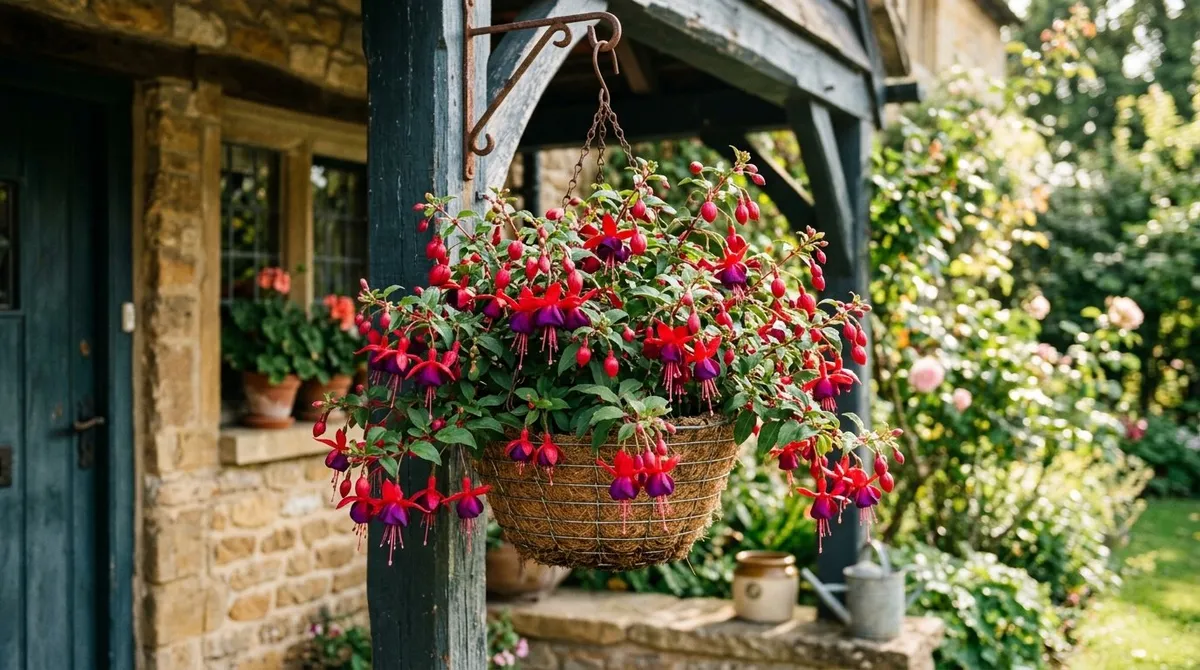
‘Swingtime’ is the classic trailing fuchsia for hanging baskets, large double red and white flowers on stems that cascade 40-60cm.
How to plant fuchsia hanging baskets
Plant tender fuchsia baskets in late May, using 3 plants per 35cm basket in multipurpose compost with added slow-release fertiliser. This gives the trailing stems time to cascade before the main flowering season in July-August.
Line wire baskets with moss or a coir liner. Fill with good multipurpose compost mixed with water-retaining gel crystals and slow-release fertiliser granules. Set 3 trailing fuchsias evenly spaced around the edge, tilting them outwards so the stems trail from the start.
Water daily in summer, twice daily in hot weather. Baskets dry out faster than any other container. A drip tray or self-watering reservoir built into modern baskets helps enormously.
Feed weekly with high-potash liquid fertiliser (tomato feed) from June to September. The high potash promotes flower production over leaf growth. Stop feeding in September as growth slows.
Pinch out the growing tips of young plants twice (when they have 3 pairs of leaves, then again when side shoots have 2 pairs) to encourage bushy, well-branched plants. Each pinch delays flowering by about 2 weeks, so start pinching in April for flowers from late June.
How to prune fuchsias
The pruning timing for fuchsias is counter-intuitive: prune hardy types hard in late spring, not autumn. Leaving old stems through winter protects the crown from frost damage. This is the single most important care rule for hardy fuchsias.
Hardy fuchsias
Wait until late April or early May, when you can see new buds breaking low on the old stems or from the base. Cut all stems to 15cm above ground level. Remove any dead, blackened stems entirely. In mild winters where stems have survived intact, you can prune less severely, cutting back by one-third to strong outward-facing buds.
After hard pruning, the plant looks sparse for 2-3 weeks. Then new growth erupts rapidly and the plant reaches full size by mid-June, flowering from late June onwards. Feed with general-purpose fertiliser after pruning to fuel regrowth.
Our spring pruning guide covers timing for roses and other shrubs alongside fuchsias.
Tender fuchsias
Lightly trim tender fuchsias by one-third before bringing indoors in October. This reduces the size for storage and removes soft growth prone to grey mould. In early spring (March), prune harder, cutting back to 2-3 nodes on each stem. This stimulates fresh, bushy growth. Pinch out growing tips twice in April-May.
How to overwinter fuchsias
Tender fuchsias need frost-free storage at 5-7C from October to May to survive UK winters. This is the main commitment with tender varieties, without it, they die at the first frost.
Bring containers and baskets indoors before the first frost (watch local forecasts from mid-October). An unheated greenhouse, cold conservatory, cool porch, or frost-free garage with a window all work. The ideal temperature is 5-7C, warm enough to prevent freezing, cool enough to keep the plant dormant.
Reduce watering to barely moist through winter. The compost should not dry out completely but should never be wet. Overwatering in winter causes root rot, which kills more overwintered fuchsias than anything else.
In February-March, increase temperature, light, and watering gradually. Prune hard, repot in fresh compost, and start feeding when new growth appears. Move outdoors only after the last frost (late May in most of the UK). Harden off over 7-10 days first, our hardening off guide covers the process.
Hardy fuchsias outdoors: No action needed except leaving old stems standing. In very cold, exposed gardens (below -12C regularly), apply a 10-15cm mulch of bark chips, straw, or bracken over the crown in November. Remove in April before new growth appears.
How to take fuchsia cuttings
Fuchsia cuttings are among the easiest of all softwood cuttings, rooting in 2-3 weeks with a 90%+ success rate. This makes it free and simple to produce dozens of plants from a single parent. April to June is the best period.
Select non-flowering shoot tips 7-10cm long. Cut cleanly just below a leaf node with a sharp blade. Remove the lower 2-3 pairs of leaves, keeping 2-3 pairs at the tip. If any flower buds are present, pinch them out, energy should go to root production.
Insert cuttings around the edge of a 9cm pot filled with moist perlite or a 50:50 mix of perlite and seed compost. You can fit 4-5 cuttings per pot. Do not use rooting hormone, fuchsia cuttings root readily without it.
Cover with a clear polythene bag or place in a heated propagator at 18-21C. Keep in bright light but out of direct sun. Mist daily or whenever condensation stops forming on the cover.
Roots form in 2-3 weeks. Test by tugging gently, if there is resistance, roots have formed. Pot each rooted cutting individually into 9cm pots of multipurpose compost. Pinch out the growing tip when the cutting has 3 pairs of leaves to encourage branching.
Cuttings taken in April flower from August of the same year. Cuttings taken in June flower the following spring. By the second year, cutting-grown plants are indistinguishable from their parent. If you want to go a step further and breed new varieties, our guide explains how to hybridise your own fuchsias by hand-pollinating and raising seedlings.
Training fuchsias as standards
A standard fuchsia, a clear stem topped with a rounded head of flowers, takes 18 months to 2 years to grow from a cutting but makes a striking centrepiece for a patio or border. Both hardy and tender varieties can be trained as standards.
Start with a strong, vigorous cutting or young plant with a single straight stem. Insert a cane and tie the main stem at 10cm intervals as it grows. Remove all side shoots, but keep the leaves on the main stem, they feed the plant while the trunk thickens.
Allow the main stem to grow 15-20cm above your desired head height. Then pinch out the growing tip. This forces side shoots from the top, which form the head. Pinch these side shoots after 2-3 pairs of leaves to encourage a dense, bushy head.
Once the head is well formed, gradually remove the remaining leaves from the trunk below. The clear stem should be at least pencil-thick before you do this. Stakes remain permanently, fuchsia wood is brittle and snaps in wind.
Hardy varieties like ‘Riccartonii’ and ‘Mrs Popple’ make permanent garden standards in sheltered spots. Tender standards need winter storage, lay them on their side in a frost-free shed, or store upright in an unheated greenhouse.
Fuchsia standards take 18 months to train but create striking centre pieces for patios, borders, and formal entrances.
Fuchsia gall mite: identification and control
Fuchsia gall mite (Aculops fuchsiae) is the most serious pest affecting fuchsias in the UK, with no chemical cure available to gardeners. First detected in Britain in 2007, it has spread across southern England and is moving north.
The mite is microscopic, you will never see it. Instead, look for the symptoms: distorted, swollen, reddened, and sometimes yellowish growth at shoot tips, flowers, and developing buds. Affected growth takes on a cauliflower-like, lumpy appearance. Flowers fail to develop properly.
Control measures:
- Prune out all affected growth to at least 15cm below any visible symptoms. Burn or bin the prunings, do not compost them.
- Inspect plants regularly from April onwards. Early detection limits spread.
- Avoid planting affected material near healthy fuchsias. The mite spreads by wind and on clothing.
- Some varieties show partial resistance: ‘Hawkshead’, ‘Baby Blue Eyes’, and some F. magellanica forms are less severely affected.
- There is no approved insecticide for fuchsia gall mite in the UK. Some gardeners report success with winter washes and physical removal, but no method is fully reliable.
If a plant is severely affected, the kindest approach is to remove and destroy it entirely. Replace with a resistant variety or a different plant altogether. For other pest management strategies, see our organic pest control guide. Not every visitor is trouble, though: the elephant hawk moth caterpillar feeds on fuchsia leaves in late summer, does little lasting harm, and turns into one of Britain’s most recognisable pink moths.
Common problems with fuchsias
Beyond gall mite, fuchsias face several other challenges in UK gardens, most of which respond well to simple cultural adjustments. Keeping plants well-watered, well-fed, and in the right light levels prevents the majority of problems.
Capsid bugs: Distorted shoot tips and ragged holes in young leaves. Caused by sap-sucking capsid bugs feeding in spring. Damage looks similar to gall mite but without the swollen, reddened growth. Pinch out affected tips and the plant grows through it.
Vine weevil: Grubs eat roots in containers, causing sudden wilting and collapse. Water containers with vine weevil nematodes (Steinernema kraussei) in spring and autumn. Use compost containing vine weevil protection for basket and container planting.
Grey mould (Botrytis): Fluffy grey mould on dead flowers and foliage, especially in damp, still conditions. Remove spent flowers regularly. Improve air circulation. Most common on overwintered plants in stuffy, damp storage.
Whitefly: Small white flying insects on leaf undersides. Shake the plant and a cloud of white flies rises. Persistent but rarely fatal. Introduce Encarsia formosa biological control in greenhouses, or use soft soap spray outdoors.
Rust: Orange pustules on leaf undersides. Remove affected leaves. Improve air circulation. More common in wet summers. Rarely kills the plant but weakens it if severe.
Fuchsias month-by-month calendar
A seasonal guide to the key tasks ensures your fuchsias perform at their best year-round. Hardy and tender types need different attention at different times.
| Month | Hardy Fuchsias | Tender Fuchsias |
|---|---|---|
| January | Leave undisturbed | Check overwintering plants, water sparingly |
| February | Remove winter mulch if new growth appears | Increase light gradually |
| March | Watch for buds breaking on old stems | Prune hard, start watering, repot |
| April | Prune hard to 15cm when buds visible | Take cuttings, pinch out tips |
| May | Feed after pruning, mulch | Plant baskets after last frost |
| June | Flowering begins, feed monthly | Flowering begins, feed weekly |
| July-Aug | Deadhead, water in dry spells | Deadhead, water daily, feed weekly |
| September | Enjoy late flowers | Reduce feeding |
| October | Leave stems standing | Bring indoors before frost |
| November | Apply winter mulch if exposed | Reduce watering to barely moist |
| December | Leave undisturbed | Keep at 5-7C, check for rot |
Frequently asked questions
When should I prune hardy fuchsias?
Prune hardy fuchsias hard in late April or early May. Wait until new buds break at the base of old stems. Cut to 15cm above ground. Never prune in autumn, old stems protect the dormant crown from frost through winter. In mild years where stems survive, prune less severely to one-third.
How do I overwinter tender fuchsias?
Move tender fuchsias indoors before the first frost in October. Store at 5-7C in a frost-free greenhouse, cool porch, or garage with natural light. Water sparingly, keeping compost barely moist. In March, prune hard, repot, increase watering, and move outdoors after the last frost in late May.
Can fuchsias grow in shade?
Fuchsias prefer partial shade or dappled light and flower well in north-facing borders. Full sun works in northern UK gardens, but in southern England, afternoon shade prevents leaf scorch and wilting. They are one of the best flowering plants for shaded positions in any UK garden.
How do I take fuchsia cuttings?
Take 7-10cm softwood cuttings from non-flowering shoots in April-June. Remove lower leaves, insert in moist perlite, and cover with a clear bag or propagator at 18-21C. Roots form in 2-3 weeks. Pinch tips when 3 pairs of leaves develop. Fuchsias root so easily that hormone powder is unnecessary.
What is fuchsia gall mite?
Fuchsia gall mite causes distorted, swollen, reddened growth at shoot tips. It is a microscopic mite widespread across southern England since 2007. There is no chemical cure. Prune out affected growth 15cm below symptoms and burn prunings. ‘Hawkshead’ shows partial resistance.
Are fuchsias perennial in the UK?
Hardy fuchsias are fully perennial, dying back in winter and regrowing each spring from the base. They survive -10C without protection. Tender fuchsias are perennial only if overwintered indoors in frost-free conditions at 5-7C. In mild coastal south-west England, some tender types survive outdoors.
Which fuchsia is best for hanging baskets?
‘Marinka’ (red) and ‘Swingtime’ (red and white) are the top choices for trailing baskets. Both produce cascading stems 40-60cm long covered in flowers from June to October. Plant 3 per 35cm basket in multipurpose compost. Feed weekly with tomato food and water daily.
Our team produces practical UK gardening guidance from source research, contributor records and established horticultural practice. Editorial standards are overseen by Matt W.