Key takeaways
- Lingonberries are native to UK upland moors and tolerate winter lows of minus 40C, so any UK garden can grow them
- Soil pH must sit between 4.0 and 5.5. Container culture in peat-free ericaceous compost gives the most reliable results
- 'Koralle' is the best all-round UK cultivar for crops. 'Red Pearl', 'Sussi' and 'Linnea' work well in smaller pots
- Plants produce two flushes a year, in June and again in late August to September, with first useful pickings from year two
- Water with rainwater only.
- A mature 35cm pot yields 200 to 450g of berries a year, enough for one to two small jars of jam per pot
Lingonberries are one of the easiest fruiting shrubs to grow in a UK garden, yet almost nobody does. The plant is small, evergreen, fully hardy, and native to our own uplands. It crops twice a year, lives for decades, and produces a berry with so much natural pectin that the jam sets without added sugar. The reason it stays a curiosity is that lingonberries need strictly acidic conditions, and most British soils are far too neutral or alkaline to grow them in the ground.
The good news is that container culture solves the problem completely. A 35cm pot of peat-free ericaceous compost, a rainwater butt, and a young ‘Koralle’ or ‘Sussi’ plant from a specialist nursery is everything you need to get a working lingonberry patio in two seasons. This guide walks through every decision: cultivar choice, compost mix, watering, feeding, the annual rhythm of two flushes, propagation, common pH mistakes, and what the berries are actually worth in the kitchen.
What is a lingonberry?
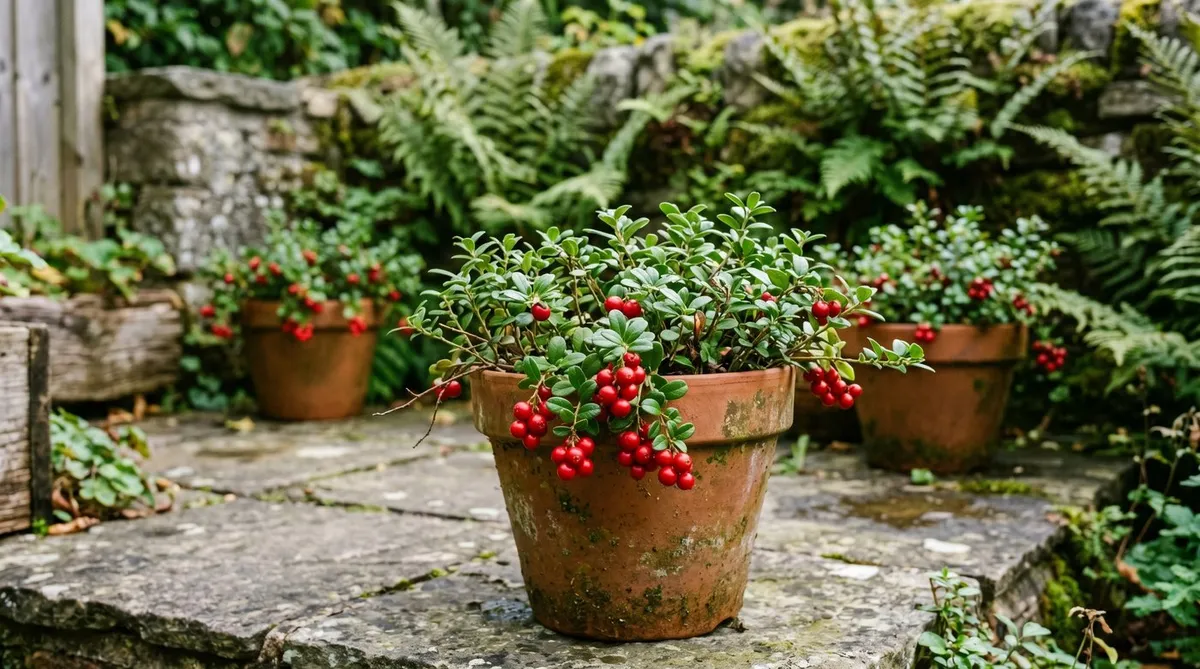
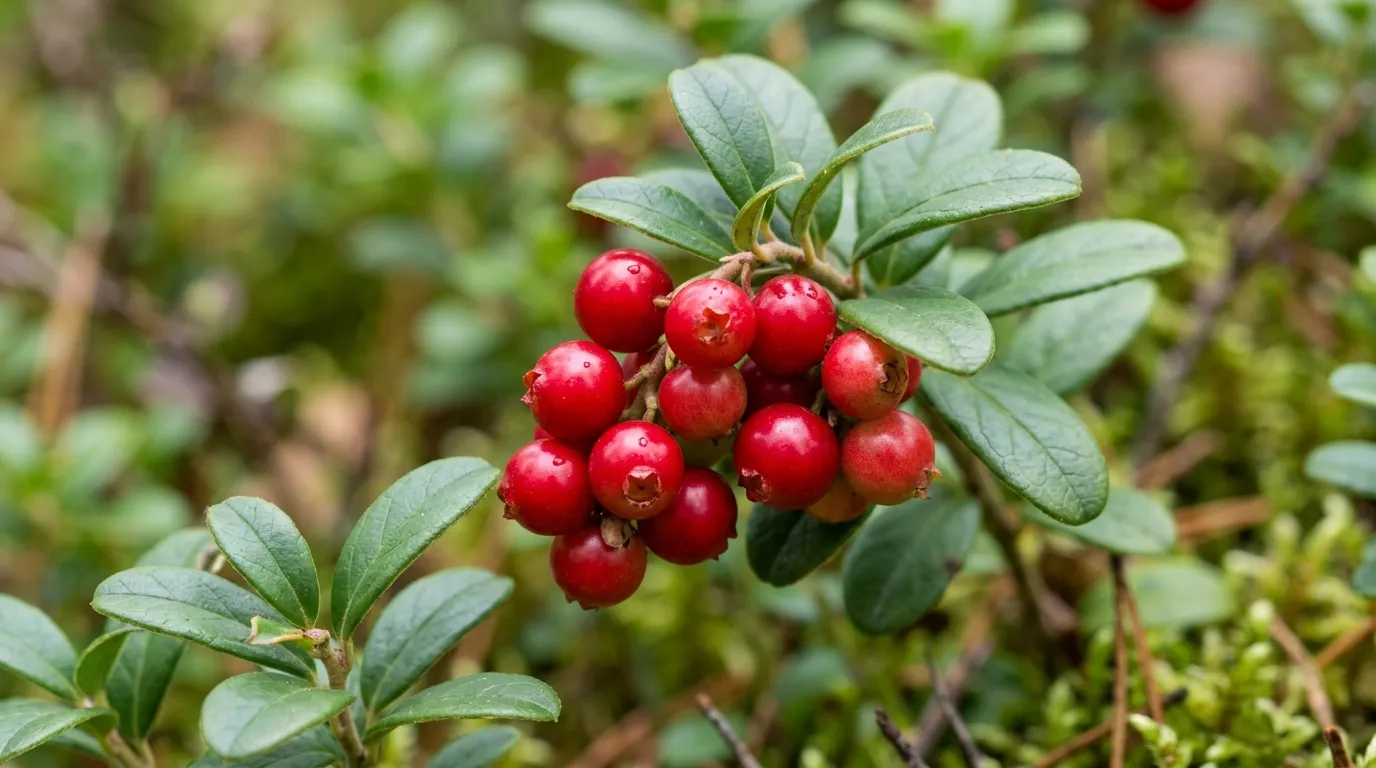
A lingonberry is the cultivated form of Vaccinium vitis-idaea, a low evergreen shrub in the heather family. It grows 15 to 30cm tall and spreads by underground stems (rhizomes) to form a dense mat 60 to 100cm across after several years. The leaves are small, oval, leathery and dark glossy green, with a slight roll at the edge. The flowers are tiny urn-shaped bells in white or palest pink, pollinated by bumblebees and solitary bees in spring and again in midsummer. The fruit is a round 6 to 9mm berry that ripens to a vivid scarlet.
The species is native to the UK, where it grows wild as cowberry on acid moorland in Scotland, the Pennines, the North York Moors, Dartmoor and parts of Wales. The Scandinavian and Baltic countries developed the cultivated selections during the 20th century, and the James Hutton Institute in Scotland has carried out research on native fruit species including Vaccinium vitis-idaea as part of its wider berry breeding work. The RHS plant profile for Vaccinium vitis-idaea lists it as fully hardy throughout the UK with no special protection needed.
The two practical points that matter for UK gardeners are these: the plant is a native, so it suits our climate. And it absolutely will not grow in alkaline soil, which rules out direct planting in most southern and eastern gardens where pH runs above 6.5.
Climate and hardiness across the UK
Lingonberries are hardy to about minus 40C, which is roughly 30C colder than any UK winter on record. Cold is not the problem anywhere in Britain. The problem is heat, drought and alkaline tap water in southern gardens. The plant evolved on cool, damp, acid moors with cloud cover and long winters. The closer you are to that environment, the easier the plant is to grow.
By region, the picture looks like this. In Scotland and the north of England, lingonberries grow easily in full sun in raised acid beds or pots. Cool summers and reliable rainfall suit the plant perfectly. In Wales and the south-west, full sun is fine in coastal counties but inland gardens benefit from light afternoon shade. In the Midlands and the south-east, container culture in dappled shade or a position with morning sun is the most reliable approach. In London and the home counties, where summer heat is most pronounced, an east-facing position with five hours of morning sun gives a much better result than full midday exposure.
Wind is the other UK factor worth mentioning. Lingonberries dislike persistent drying winds, which strip moisture from the small leaves and slow growth. A position sheltered by a fence, hedge or wall works far better than an exposed garden corner.
Best lingonberry cultivars for UK growers
There are four cultivars worth seeking out for UK conditions. All four are now stocked by specialist soft fruit nurseries and a few mainstream online plant suppliers.
| Cultivar | Origin | Berry size | Yield (mature pot) | Best UK use |
|---|---|---|---|---|
| ’Koralle’ | Netherlands, 1969 | 8 to 9mm | 200 to 450g | All-round UK choice, heaviest cropper |
| ’Red Pearl’ | Netherlands | 7 to 8mm | 150 to 300g | Compact, ornamental, small patios |
| ’Sussi’ | Sweden | 7 to 9mm | 180 to 350g | Medium pots, good flavour |
| ’Linnea’ | Sweden | 8 to 10mm | 200 to 400g | Productive, slightly tarter |
| Wild cowberry seedling | UK native | 4 to 6mm | 50 to 100g | Ground cover, lower crops |
The wild cowberry seedling is worth a mention for context. Native plants from a reputable upland nursery are perfectly happy in a UK garden, but the berries are smaller, the runners spread more aggressively, and the yield is roughly a quarter of ‘Koralle’ from the same sized pot. Grow wild cowberry for ground cover or as a curiosity, and grow ‘Koralle’ for jam.
A practical buying note: most UK garden centres still do not stock lingonberries, even in their ericaceous section. The plants come almost exclusively from specialist soft fruit nurseries, native plant nurseries, and a small number of online suppliers. A two to three year old plant in a 2 litre pot sits at around 12 to 18 pounds in 2026 money. A small one in a 9cm pot runs at 6 to 9 pounds and is the cheaper way to build up a batch of six pots if you are happy to wait an extra season for first cropping. Bare-root plants are rarely offered because the evergreen foliage struggles to recover from out-of-pot transit.
Soil and compost: getting the pH right
This is the single most important section in the article. Get the pH right and the plant grows itself. Get it wrong and nothing else you do matters.
The target range is pH 4.0 to 5.5. Below 4.0 the plant struggles to take up nutrients. Above 5.5 the leaves yellow, growth stalls, and the plant gradually fades. Any UK garden with chalk or limestone underneath, or with London clay above pH 7, is the wrong place for ground planting. Use containers instead. The same logic applies to the wider acid-loving plant family, and the best plants for acid soil guide covers the supporting cast of heathers, rhododendrons and pieris that share these requirements.
- 70% peat-free ericaceous compost
- 30% chunky pine bark (10 to 20mm grade)
- A small handful of horticultural grit per 10 litres for drainage
The bark fraction is important. Pure ericaceous compost compacts after two seasons and starts to hold too much water. The bark keeps the mix open, mimics the natural leaf-litter layer of an upland moor, and slowly breaks down to feed the plant. For the bulk of the mix itself, the peat-free compost guide covers the ingredients that work in an ericaceous pot.
If you want to reduce cost, replace some of the ericaceous compost with composted bark made on the heap rather than bought in. Avoid coir as the main ingredient as it tends to push the mix above pH 6 over time. Avoid garden compost made from a mix of household greenwaste, which is almost always neutral to alkaline. If you make your own bark-and-leaf compost on the heap, a slow home composting routine using pine needles and ericaceous prunings works extremely well as a top-dressing once the heap has matured for two years.
For raised beds rather than pots, dig out the existing soil to 40cm, line the sides (not the base) with a thick polythene membrane to slow alkaline leaching in from surrounding soil, and refill with the same compost mix above. Top up with sulphur chips at 30 to 40g per square metre every spring to maintain pH.
Container setup, step by step
The standard pot for one mature plant is 35cm in diameter and at least 25cm deep, made of terracotta or thick frost-proof plastic. Terracotta is heavier and dries faster but breathes well and looks the part. Plastic holds moisture better in southern gardens and is lighter to move.
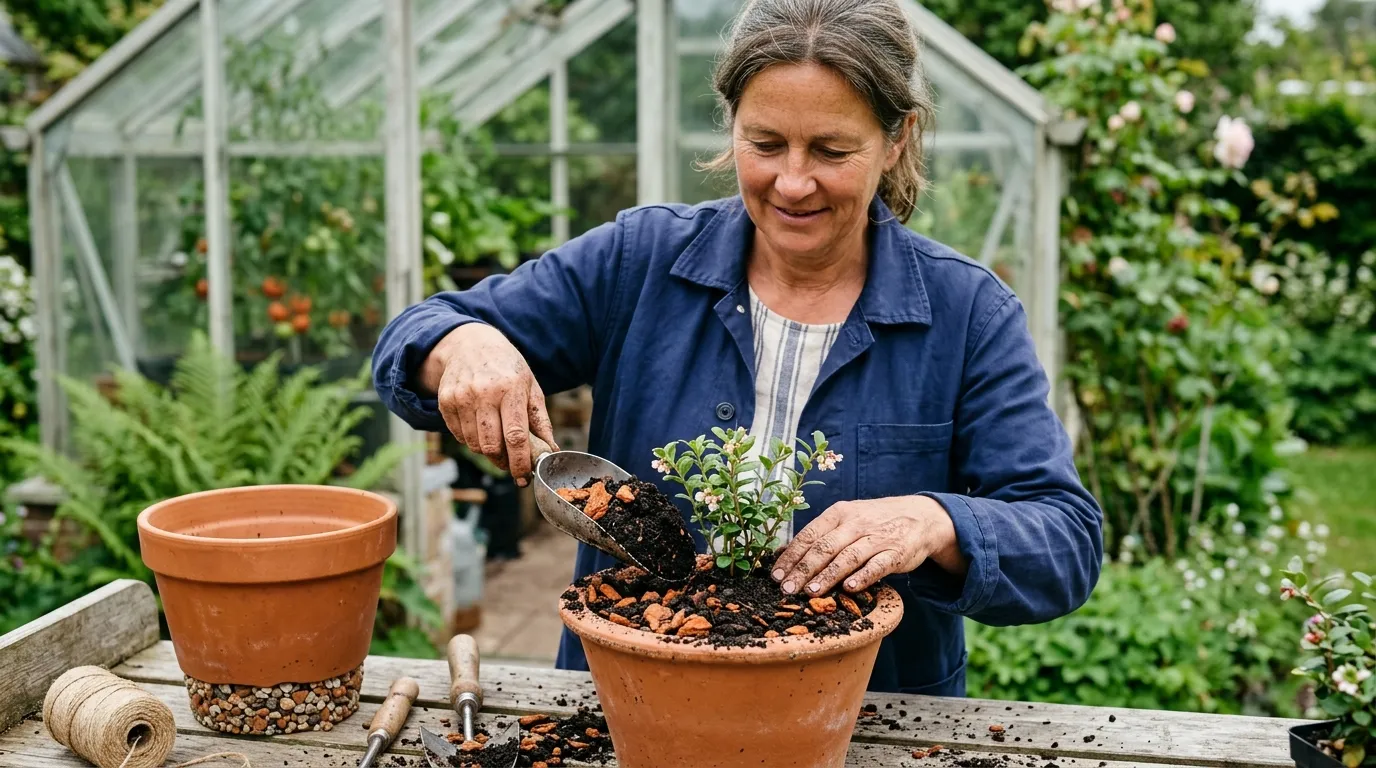
The planting sequence:
- Cover the drainage holes with broken crocks or a layer of large grit, 3 to 5cm deep.
- Half-fill the pot with the ericaceous and bark mix.
- Soak the nursery rootball in a bucket of rainwater for ten minutes until air bubbles stop rising.
- Set the plant on the half-filled mix so the original soil surface sits 2cm below the pot rim.
- Backfill around the rootball with more mix and firm gently with the fingertips.
- Top-dress with 2 to 3cm of pine bark or rough leaf mould to suppress weeds and slow evaporation.
- Water in slowly with rainwater until water runs out of the base.
The best time to plant in the UK is March to May or September to early October. Avoid midsummer planting and avoid hard frost periods. After planting, the pot needs four to six weeks of careful watering and dappled shade to establish before being moved to its final position.
Watering: rainwater only
UK tap water typically runs between pH 7.0 and pH 8.5. In the Midlands and southern England, where mains water is harder, pH usually sits at pH 7.5 to 8.0. Using mains water on lingonberries raises the pH of the compost by about 0.2 units per month during the growing season. Within one summer of regular tap watering, a pot that started at pH 4.6 can drift to pH 6.0, and the plant will start showing pale new growth, weak flowers and a poor crop.
A water butt connected to the shed or greenhouse downpipe is the simplest fix. UK rainwater sits at pH 5.0 to 6.0, well within the acceptable range for lingonberries. A 200 litre butt collects enough rain in an average UK month to water six 35cm pots through the entire summer. If a butt empties in a long dry spell, supplement with bottled distilled water rather than tap water, or accept slow growth for the duration of the drought.
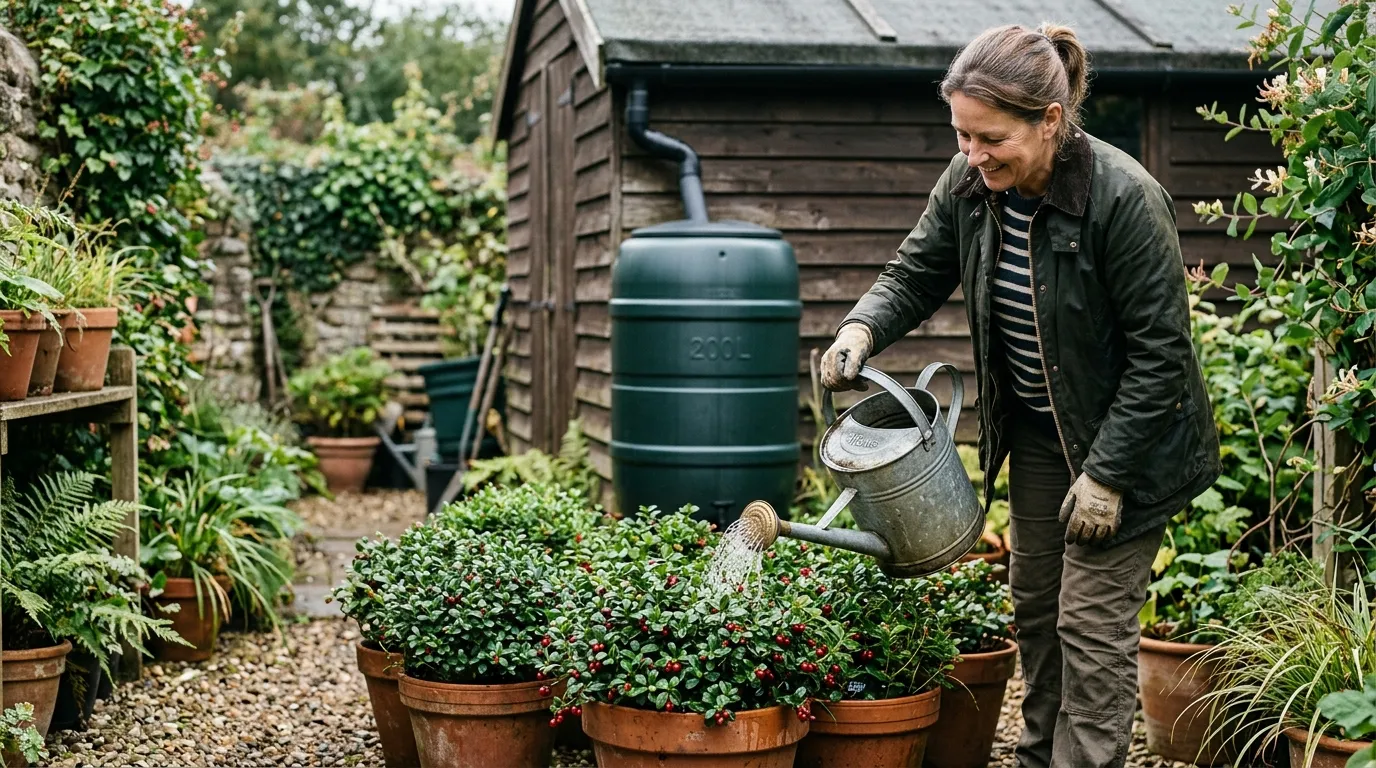
The watering rule is steady moisture, never sodden and never bone dry. The compost should feel like a wrung-out sponge at finger depth. In an average UK summer that works out at one good soak (2 to 3 litres per 35cm pot) every two to three days. In a heatwave, daily. In winter, once a fortnight if rainfall is light.
Feeding and the annual rhythm
Lingonberries are not heavy feeders. One spring feed is enough for the whole year. In early March, apply a slow-release ericaceous fertiliser at the rate on the bag, usually around 30g per square metre or one level tablespoon per 35cm pot. Sulphate of ammonia at the same rate is the traditional alternative and works well, with the bonus that it gently lowers compost pH over time.
After the spring feed, the plant goes through this annual rhythm in a typical UK year:
- March to April: new shoots push from the previous year’s wood and from the runners under the surface.
- Late May to early June: first flush of flowers opens, urn-shaped white-pink bells, pollinated by bumblebees.
- Mid to late June: first flush of berries ripens to scarlet. Pick when fully red.
- July to early August: brief rest period. Foliage thickens.
- Mid August to mid September: second flush of flowers and a heavier crop of berries. This is the main pickle for jam.
- October to November: foliage takes on a slight bronze tinge with the first frosts.
- December to February: dormant. Pots can stay outside in any UK winter. Move terracotta pots off paving if hard frost is forecast to avoid the pot cracking.
The two-flush pattern is one of the things that makes lingonberries unusual. Most UK soft fruits give one annual crop. Lingonberries deliver in both early summer and late summer, which gives a more useful flow of fruit into the kitchen.
Propagation: more plants for free
Lingonberries propagate easily by three methods.
Stem cuttings taken in July are the most reliable home method. Cut 8 to 10cm of the current year’s growth, strip the lower leaves, dip the base in hormone rooting powder and push into a 50/50 mix of perlite and ericaceous compost. Cover with a clear plastic bag or place in a propagator. Roots form in six to eight weeks. By the following spring the rooted cuttings are ready for a 9cm pot.
Layering works because the underground runners root naturally as they spread. Find a runner that has produced its own small clump, slice it free from the parent plant with a sharp knife, and pot it up in fresh ericaceous mix. Best done in early spring or autumn.
Division of a mature mat is the bulk-up method. Tip the mature pot out in March or October, divide the rooted mat into four or six pieces with a sharp knife, and replant each piece into its own pot with fresh compost.
Whichever method you use, water exclusively with rainwater for the first season and feed nothing in the establishment year.
Pests, diseases and what actually goes wrong
The realistic UK problems are these:
- pH drift is by far the most common cause of failure. Symptoms: pale new growth, weak flowering, very low yield. Fix: rainwater only, top up with sulphur chips at 30g per square metre, refresh the compost mix.
- Phytophthora root rot can appear if the pot is waterlogged. Symptoms: sudden wilt despite damp compost, dark roots. Fix: improve drainage, add grit, lift the pot off saucers in winter.
- Sunscorch on the leaves of southern-UK plants in midsummer. Symptoms: pale yellow patches on the upper leaves. Fix: move to a position with afternoon shade.
- Winter pot cracking if the compost stays waterlogged through hard frost and ice expands inside terracotta. Symptoms: hairline cracks running down the pot. Fix: lift the pot onto pot feet for winter and shelter from prolonged rain.
- Birds taking the berries before you do. Symptoms: an empty pot in mid June. Fix: a light netting frame for the two-week pickle window.
For comparison with related crops, blueberries and cranberries share the same acid soil requirements but suffer more from UK pests. The how to grow blueberries guide covers the much bigger pest load on that species, and the how to grow cranberries guide covers a closer relative with similar moisture demands. Lingonberries sit in the easiest position of the three in pest terms, but the most demanding in pH terms.
Building an ericaceous corner around the lingonberries
A single lingonberry pot on a patio works perfectly well in isolation. Six pots grouped together start to look like a deliberate piece of garden design. With a small amount of further planting the same acid corner becomes a year-round feature.
The companion plants that share the lingonberry’s pH and moisture preferences are easy to source. Heather (Calluna vulgaris and Erica carnea) gives long flowering across summer and winter respectively. Compact rhododendrons such as the Yakushimanum hybrids stay below 1m and flower in late spring. Pieris japonica gives bronze new growth and white spring flowers. Compact azaleas, dwarf conifers and ericaceous-tolerant ferns such as Blechnum spicant round out the planting. The result is a year-round acid bed with the lingonberries giving working fruit and the other plants giving flower and structure.
If you have the room and the inclination to take this further, a small bog area planted with cranberries, sundews, sphagnum and creeping snowberry alongside the lingonberry group makes a striking native-plus-cultivated demonstration of what acid wetland growing can look like in a UK garden. The water demands are higher, but the visual reward is significant.
One last cost note for the full ericaceous corner: a working six-pot lingonberry group with two companion heathers and a single Yakushimanum rhododendron costs about 180 to 260 pounds to set up in 2026, including pots and compost. By year four, the same group produces roughly 600 to 800g of lingonberries a year. Compared to shop-bought lingonberry jam at 5 to 7 pounds per 220g jar from Scandinavian importers, the patch pays back in fruit alone inside eight to ten seasons, while also adding evergreen foliage, spring flower and winter colour to the garden.
Harvest, yield and what the berries taste like
The first pickle of fruit comes in June from the first flush of flowers. It is usually the smaller crop, perhaps 60 to 150g per mature pot, ready when the berries turn fully scarlet. Pick by gripping the cluster and rolling the ripe berries gently with the thumb. Underripe berries are pale pink and stay on the stem.
The second pickle comes in late August into September from the second flush. This is the main crop, 140 to 300g per mature pot, and is what fills the jam jars. Pick on a dry day and refrigerate within two hours. Lingonberries keep raw in the fridge for three weeks because of their high natural pectin and benzoic acid content.
The flavour is closest to a cross between a cranberry and a redcurrant. Bright, tart, slightly resinous, with a long finish. They are not a dessert fruit eaten raw by the handful. They come into their own as a preserve, a sauce or a ferment.
Lingonberries in the UK kitchen
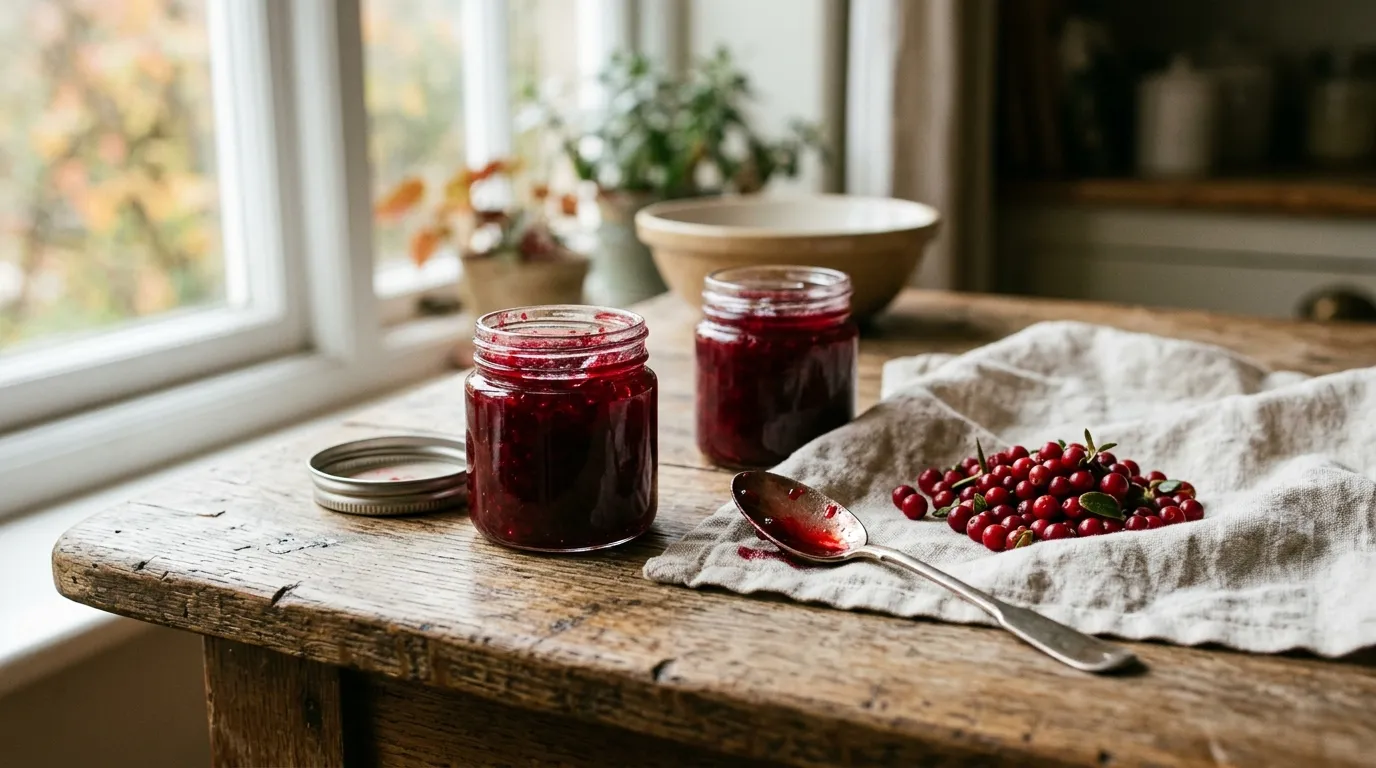
The single best use is jam. Lingonberry jam (the Swedish lingonsylt) uses half the sugar of a cranberry equivalent because the natural pectin and acidity do most of the setting work. A basic ratio is 500g lingonberries to 250g sugar, simmered for six to eight minutes, with no added pectin. The jam stores for a year in sterilised jars and accompanies game, venison, meatballs and roast pork.
Other uses worth trying:
- Sauce for game. Reduce 250g lingonberries with 100ml port and a sprig of thyme to a thick glossy sauce. Good with pheasant, partridge or duck.
- Swedish meatballs. A spoonful of jam on the side of köttbullar is the classic Scandinavian plate.
- Baking. Lingonberries fold into a muffin batter without bleeding the way blackberries do. The colour stays bright.
- Ferment. Wild fermenting whole lingonberries with a 3% salt brine for two weeks gives a sharp, savoury condiment that works alongside cured meats and cheese.
If you grow other unusual fruit, the same kitchen logic applies. The boysenberry and loganberry guide covers the more familiar UK hybrid berries, which complement lingonberries nicely in mixed jams.
A five-year UK growing log
The pattern is consistent with what specialist nurseries quote. Year one is establishment with no real crop. Year two gives a token pickle. Year three is the first useful harvest. By year four to five the pots reach full capacity and stay there for two decades or more, assuming the pH is maintained.
Related guides
Once you have a working lingonberry patio, the rest of the acid-loving garden falls into place. Pair this guide with how to grow blueberries, how to grow cranberries, the best plants for acid soil overview, and the peat-free compost guide primer for the pot mix. For the heap routine that produces the leaf-mould and bark for the annual top-dressing, the how to make compost guide covers the basics, and the boysenberry and loganberry guide extends the unusual-fruit theme into the wider summer kitchen. The full set turns one curiosity in a pot into a working acid-soil corner that produces fruit, ornament and ground cover for decades.
Our team produces practical UK gardening guidance from source research, contributor records and established horticultural practice. Editorial standards are overseen by Matt W.