Key takeaways
- Shropshire Prune gives the best damson flavour but smaller fruit; Farleigh cropper outyields it 2 to 1
- Merryweather is the only fully self-fertile damson, so a single tree still crops well
- Prune in July or August, never in winter, because silver leaf fungus enters through winter cuts
- St Julien A rootstock keeps trees to 4m and is the standard UK choice for a garden orchard
- Mature trees yield 9-18kg per year and are productive for 15-20 seasons before replacement
- Harvest when fruit is slightly soft, freeze whole within 24 hours or jam within 48 hours
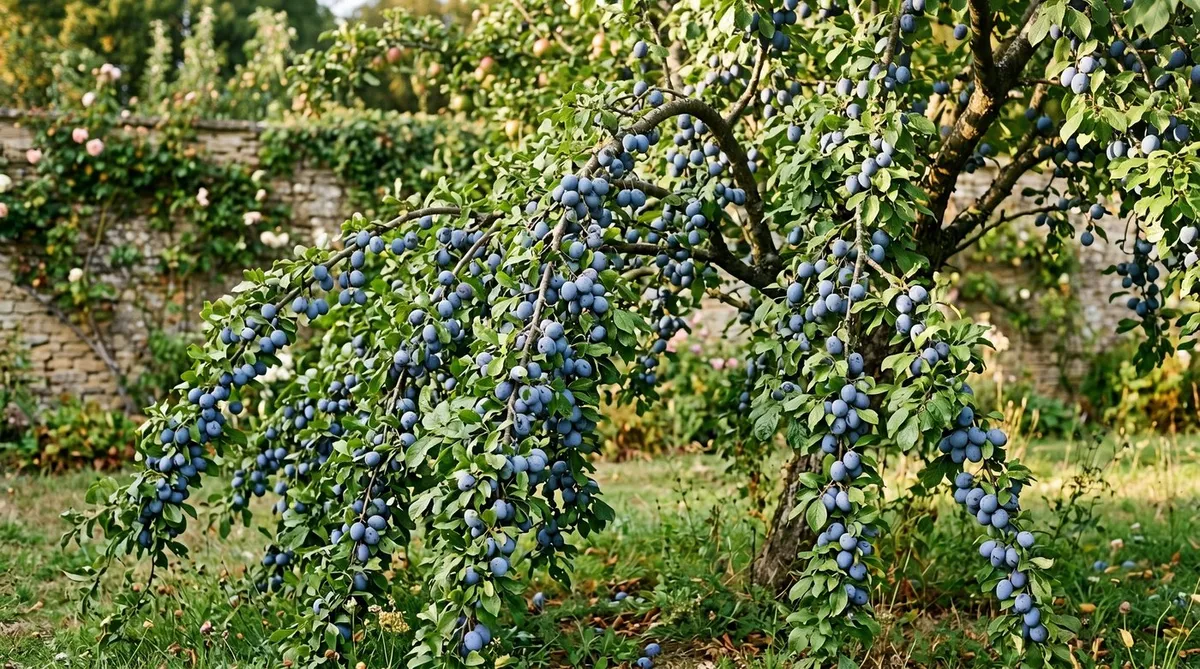
Damsons are the underrated star of the UK orchard. They crop reliably in wet summers when dessert plums sulk, tolerate heavy clay better than almost any other fruit tree, and the fruit itself is one of the great regional ingredients of British cooking. A single mature tree gives 9 to 18kg of fruit a year, enough for several batches of damson gin, a winter store of jam, and a tray of crumbles in the freezer.
What a damson actually is
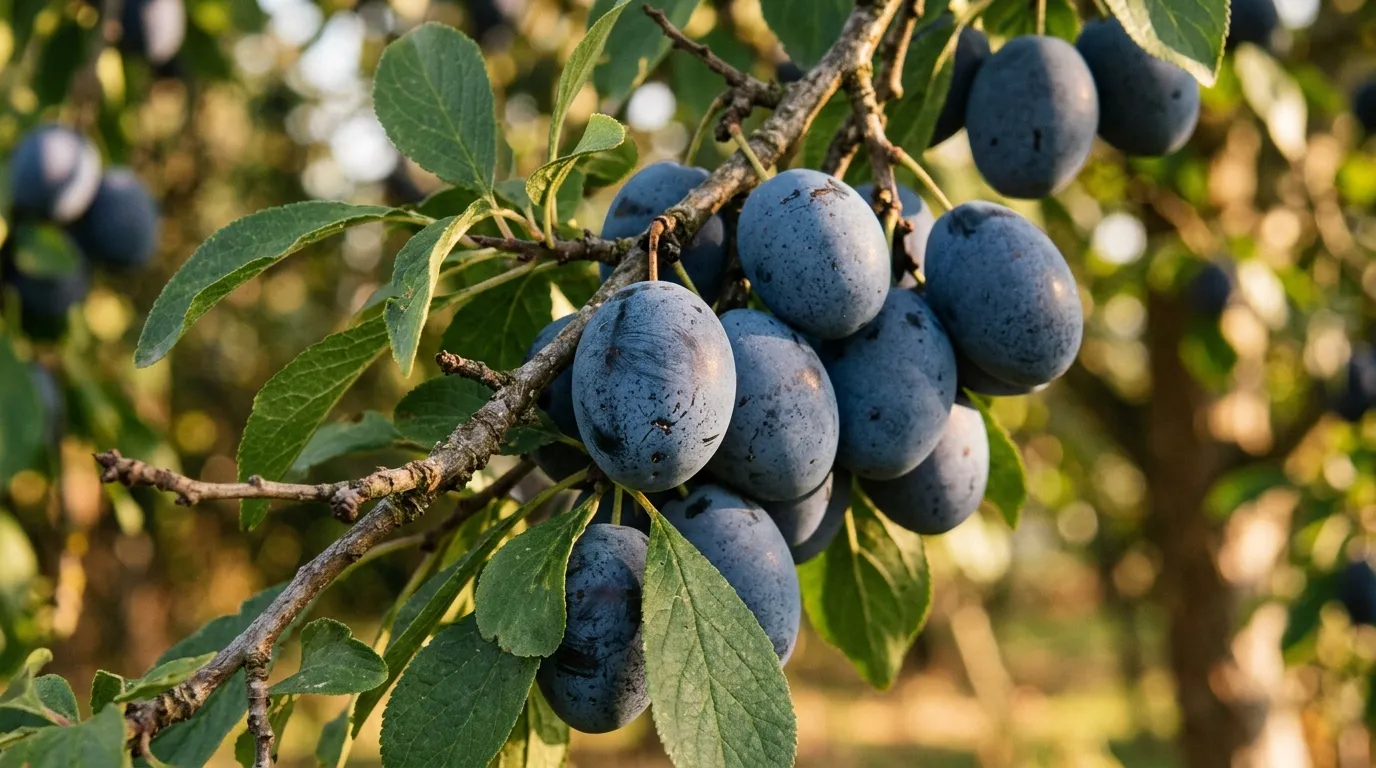
A damson is Prunus insititia, a subspecies of Prunus domestica (the dessert plum). The fruit is smaller than a plum (typically 25 to 35mm long), oval rather than round, dark blue or purple-black with a heavy pale waxy bloom on the skin. The flesh is greenish-yellow, astringent, and freestone in some cultivars (the flesh parts cleanly from the stone) and clingstone in others. Raw damsons make most people screw their face up. Cooked with sugar, or infused in gin, they release one of the most distinctive flavours in British preserving.
The species is closely related to bullaces and mirabelles. A bullace is rounder, smaller and even tarter; a mirabelle is yellow or red. Both crop on similar trees in similar UK conditions but the damson sits in the middle for flavour, size and culinary usefulness.
Damsons are tougher than plums. The trees crop on heavier wetter soils, cope with exposed sites where dessert plums fail, and have a shorter dormancy so flowers come a week or two later than dessert plums (a useful frost-dodge in cold UK valleys).
The botanical name Prunus insititia comes from a Latin root meaning “grafted onto”, a reference to the species being historically cultivated by grafting onto wild plum and blackthorn rootstocks. Wild damsons still grow in hedgerows across the West Midlands, Cumbria and parts of the Welsh borders, often hard to tell apart from the cultivated forms. If you find a hedgerow damson with a flavour you like, take cuttings or a graft and propagate it; many of the named varieties started as roadside finds in the 19th century.
A useful way to tell a damson from a small wild plum at a glance: damson skin holds its waxy bloom even when wiped firmly with a cloth, where the bloom on plums and bullaces rubs off easily. The flesh is also greener and the stone is more pointed at one end than a plum stone.
UK damson heritage
The damson is one of the oldest cultivated fruits in the British Isles. The Shropshire Prune (also called the Prune Damson) holds Protected Geographical Indication status, the same legal protection that covers Melton Mowbray pork pies and Stilton cheese. Damson orchards once filled the Lyth Valley in Cumbria, the Welsh Marches around Shropshire, and the Vale of Aylesbury. Damson gin and damson cheese were staples of farmhouse autumn work from the 18th century through to the Second World War.
The decline of British damson orchards from 1950 onwards mirrors the decline of all UK soft fruit and orchard fruit growing. Imported Eastern European damson concentrate replaced fresh UK fruit in the jam trade. Today most surviving damson trees in the UK are in domestic gardens, smallholdings and a handful of revived orchards in Shropshire and Cumbria.
There is a slow revival underway. Small-scale gin distilleries from Sipsmith to Burleighs have brought damson gin back into mainstream drinks lists, which has pushed up demand for fresh fruit. A handful of Cumbrian and Shropshire farms are now replanting commercial damson orchards on St Julien A rootstock with 200 to 400 trees at a time. For a home grower the revival means better access to good rootstock and to certified disease-free trees through nurseries such as Frank P. Matthews, Keepers Nursery, Welsh Fruit Trees and the Walcot Organic Nursery in Worcestershire.
Best UK damson varieties compared
Four varieties cover almost every UK garden situation. The choice depends on yield, flavour, ripening date and whether the tree will stand alone or with a pollination partner.
| Variety | Fruit size | Ripening | Flavour | Yield | Pollination | Best use |
|---|---|---|---|---|---|---|
| Shropshire Prune | Small, 25mm oval | Mid to late September | Outstanding, complex | Modest (9-12kg mature) | Partly self-fertile, group 3 | Damson gin, damson cheese |
| Farleigh Damson | Small to medium, 28mm | Late August to early September | Good, less complex | Heavy (14-22kg mature) | Partly self-fertile, group 3 | Jam, chutney, crumble |
| Merryweather | Large, 35mm round-oval | Late September | Good, sweet when fully ripe | Heavy (12-18kg mature) | Fully self-fertile, group 3 | Single-tree gardens, eating ripe |
| Bradley’s King (bullace) | Very small, 20mm round | October | Sharp, intense | Modest (8-12kg) | Partly self-fertile, group 4 | Late-season preserves |
Shropshire Prune (the original gin damson)
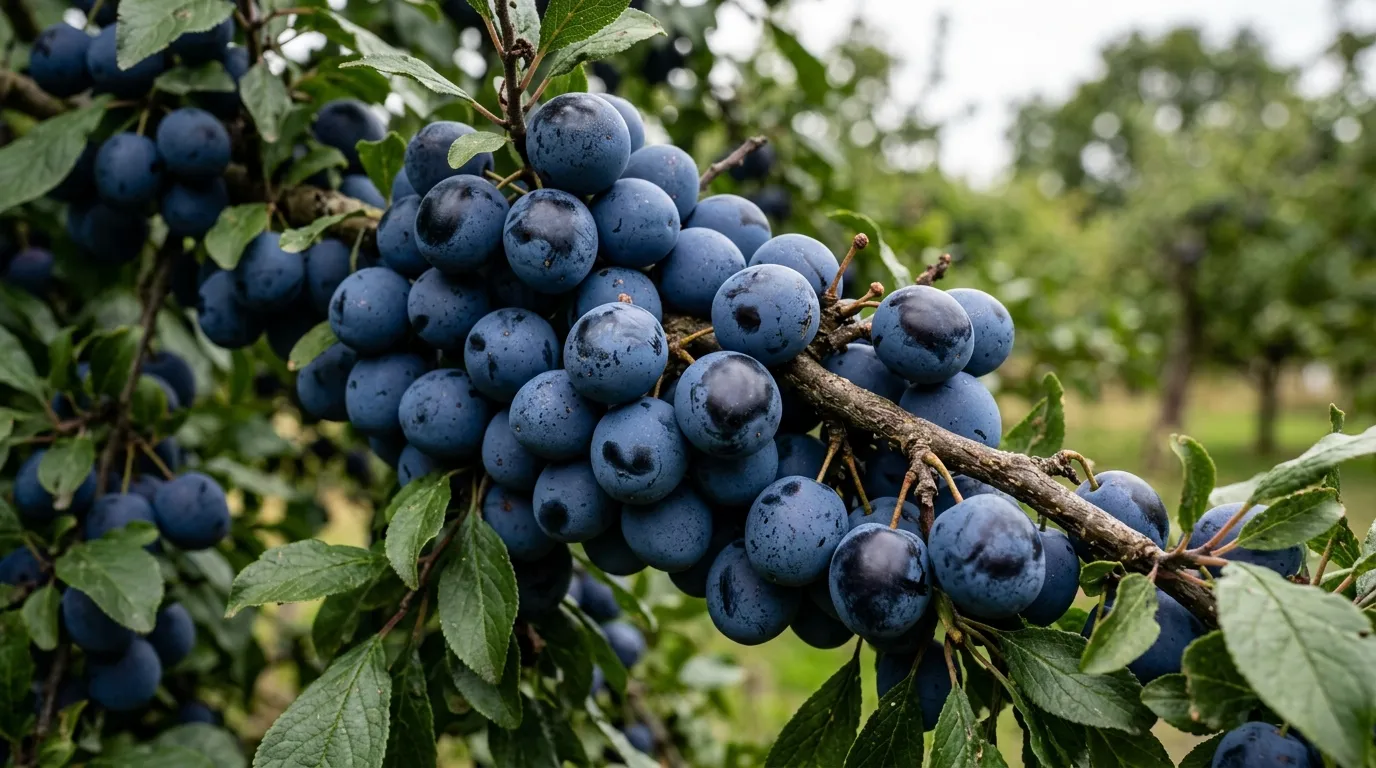
The Shropshire Prune is the gold standard for flavour. The fruit is small (25mm), deep blue-black with heavy bloom, and the cooked flavour is darker, spicier and more complex than any other damson variety. It is the variety the Lyth Valley orchards were built on and the variety the PGI protects. Crop is modest at 9 to 12kg on a mature tree on St Julien A, ripening mid to late September. Partly self-fertile but yields jump 40 to 50% with a Farleigh or Merryweather as a partner.
If the kitchen plan involves damson gin, damson cheese or any preserve where flavour matters more than volume, the Shropshire Prune is the only sensible choice.
Farleigh Damson (the heavy cropper)
Farleigh is the workhorse. Heavy reliable crops of 14 to 22kg on a mature tree, ripening late August to early September (two to three weeks before Shropshire Prune). Flavour is good but not exceptional, which makes it ideal for jam, chutney and the slower-cooked preserves where sugar and spices carry the dish. Partly self-fertile and crops better with a partner.
Merryweather (the single-tree garden choice)
Merryweather is the only fully self-fertile UK damson. A single tree crops well without a partner, which makes it the obvious choice for a small garden where a pollination pair is not possible. The fruit is larger (35mm), almost plum-sized, slightly sweeter and even palatable to eat fresh when fully ripe in late September. Yields 12 to 18kg on a mature tree.
Bradley’s King and other bullaces
Bullaces ripen later (October), with smaller rounder fruit and a sharper intensity. Bradley’s King and Langley Bullace extend the season into mid-autumn. Use them for late preserving when the rest of the orchard has finished. Plant only if you already have a mainstream damson and want a season-extender.
Older and rarer varieties worth knowing
A handful of regional varieties turn up at specialist nurseries and on heritage tree sales. Blue Violet is a small old Welsh Marches damson with intense flavour and shy cropping (best for a collector). Cheshire Damson is a slightly larger Farleigh-type now mostly absorbed into the trade name. White Damson and Mirabelle de Nancy sit on the edge of the species and behave more like small plums. None of these are practical first choices for a single-tree UK garden but they are worth knowing about if you inherit an old tree and need to identify it. Brogdale National Fruit Collection can confirm variety from a leaf, twig and fruit sample sent in season.
Pollination and flowering groups
Damsons flower in pollination groups 3 and 4 on the standard UK scale. Most varieties sit in group 3, which means they cross-pollinate with each other and with most dessert plums (Victoria, Czar, Opal) that share the group. A Merryweather will pollinate a Shropshire Prune; a Farleigh will pollinate a Merryweather; a Victoria plum nearby will help all three.
The 18m planting distance for cross-pollination assumes bees can travel freely. In a sheltered garden with hedges and walls in the way, 12 to 15m is a safer working distance. If neighbours have plum or damson trees within 25m the pollination problem solves itself.
The fully self-fertile Merryweather is the simplest single-tree solution. Bradley’s King bullace is in group 4 and partly self-fertile but yields much more with a group 3 or 4 partner.
A point that catches new growers out: blackthorn (Prunus spinosa) in a nearby hedgerow flowers two to three weeks before damsons and does not pollinate them. Wild bullaces in a hedge, on the other hand, often share group 3 or 4 with cultivated damsons and contribute pollen. The local bee population also matters: honeybees are slow to fly below 12C and damson blossom often opens in early April when daytime temperatures are marginal. Encouraging mason bees and bumblebees with bee boxes inside 20m of the tree can lift fruit set by 15 to 25% in cold springs.
Rootstocks for UK gardens
The rootstock controls the mature tree size, not the variety. Three rootstocks cover almost every UK damson planting:
- St Julien A: the standard UK choice. Semi-vigorous. Mature tree height 4m, spread 4m. Productive at year 4, full crop year 7 to 8. Tolerates heavy wet soils. Lives 15 to 20 productive years. The right answer for almost every UK garden orchard with space for a tree.
- Pixy: semi-dwarfing. Mature tree height 2.5m, spread 2.5m. Productive at year 3, full crop year 5 to 6. Needs better-drained soil and staking for the first 5 years. Shorter productive life, around 12 to 15 years. Useful for small gardens, large pots and trained forms.
- VVA-1: newer Russian rootstock. Slightly less vigorous than St Julien A. Better cold tolerance. Available from specialist nurseries but less proven in long UK trials.
Avoid Brompton (too vigorous for most gardens) and Myrobalan B (very vigorous, reserved for hedgerow planting). For very small spaces the dwarf fruit trees for small gardens guide covers the Pixy and VVA-1 options in more detail.
Soil and aspect
Damsons tolerate a wider range of soils than dessert plums but prefer a moist deep loam over either heavy clay or fast-draining sand. The species was bred from wild Eastern European stock that grew on slow-draining valley bottoms, which is why damsons do not sulk on clay in the way that cherries and pears do. The compromise soil for almost every UK garden is a moisture-retentive loam with a pH of 6.5 to 7.0. Below pH 5.8 the tree shows pale leaves and weak crops; above pH 7.5 iron deficiency starts to bite.
Aspect matters less than soil. A south or west-facing site ripens fruit a week earlier and gives slightly higher sugar levels. North or east-facing sites still produce good crops but flowering is later and crops can run a week into October. The single position to avoid is a frost pocket: a damp dip at the bottom of a slope where cold air collects on still nights. Frost damage to early blossom is the single biggest cause of a missed crop year in cold UK gardens.
Planting a damson tree
Bare-root planting from November to March is the right window for UK gardens. Pot-grown trees can go in year-round but bare-root stock establishes faster, costs 40 to 60% less, and the planting window matches the dormant pruning rule (no winter pruning of damsons).
- Dig a 60 x 60cm hole, 50cm deep. Square the sides, fork over the base.
- Mix the spoil with one bucket of well-rotted compost (no more, or the tree grows roots into the hole and stops there).
- Drive a 1.5m hardwood stake 60cm into the base of the hole, on the windward side of where the trunk will go.
- Set the tree so the graft union sits 75 to 100mm above the finished soil level.
- Spread the roots in all four directions. Backfill in layers, firming each layer with the heel.
- Tie the trunk loosely to the stake with a rubber tree tie and a buffer.
- Water in with 10 to 15 litres regardless of weather.
- Mulch a 1m circle around the trunk with 75mm of bark or wood chip, kept 50mm clear of the trunk itself.
Stake for the first three years; after that the root system carries the wind load. Water weekly through the first two summers if rainfall drops below 25mm a week.
For the broader planting routine across all fruit species the how to grow plum trees guide covers the same method in finer detail.
Year one care
The first growing season is about root establishment, not top growth. Three jobs make the difference between a tree that crops at year four and one that stalls and needs replacing:
- Remove all blossom in year one. A young tree’s energy budget cannot afford fruit. Snip blossom off as soon as it opens. The tree puts that energy into roots instead.
- Mulch top-up in midsummer. The original 75mm bark mulch settles to 30 to 40mm by July. Top it back up. The mulch holds moisture, suppresses weeds and feeds the soil microbiology that damson roots colonise.
- Check the stake tie every six weeks. A tight tree tie strangles the trunk within a single season. Loosen it as the trunk thickens, and replace any tie that has been chewed by squirrels or weathered to dust.
A first-year damson should put on 300 to 600mm of new top growth. Anything less suggests a problem at the roots (poor drainage, planted too deep, or compaction in the planting hole). Anything more (a metre of soft sappy growth) suggests too much compost in the planting hole and the tree will need careful summer pruning in year two to settle it down.
Pruning damsons (the single most important rule)
Prune in July or August. Never in winter.
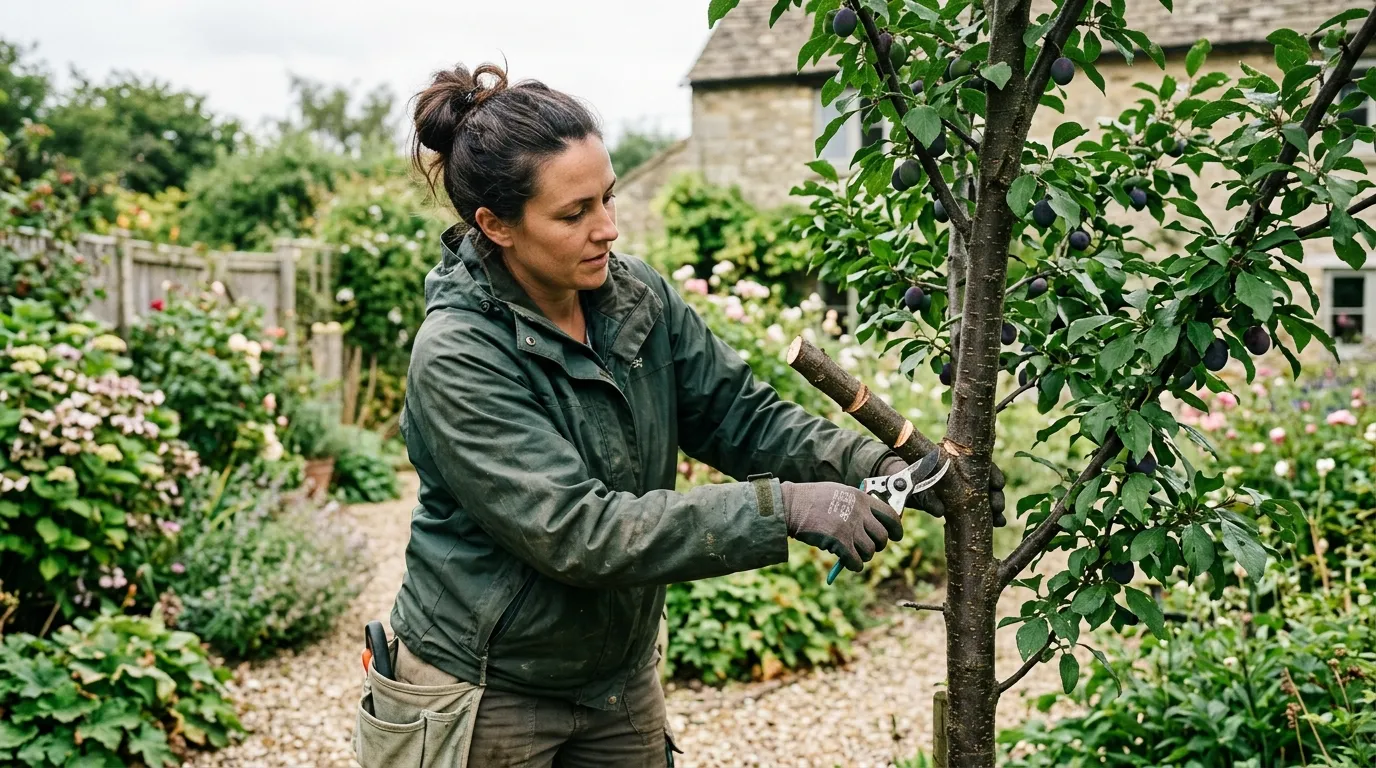
Damsons are Prunus family trees and are vulnerable to silver leaf disease (Chondrostereum purpureum). The fungus enters fresh cuts through autumn and winter spores. By the following summer infected branches show silvery leaves and die back within 18 months. A whole tree can be lost in three or four years.
Summer pruning while the tree is in full leaf works because:
- Sap is flowing and seals cuts within days.
- Silver leaf spore release is low between June and September.
- Active growth tissue lays down callus over the cut quickly.
The pruning routine for a young damson (years 1 to 4):
- Year 1 (planting): no pruning. Let the tree establish.
- Year 2 (July): select 3 to 4 main framework branches at 45 to 60 degrees from vertical. Remove competing leaders cleanly. Shorten the main leader by a third to encourage side branching.
- Year 3 (July): shorten the framework branches by a third to a strong outward-facing bud. Remove crossing growth and any branch growing into the centre.
- Year 4 (August): light tip-prune the framework. Remove any crossing or rubbing branches. Open the centre to let light through.
For mature trees (years 5+), summer pruning is mostly removing dead wood, opening congested areas and shortening any over-extended branches. A mature damson is allowed to look slightly wild because heavy pruning provokes water shoots and reduces crop.
The three-cut method for branches over 25mm
Any branch thicker than 25mm needs the three-cut method to stop the bark tearing as the branch falls:
- First cut (undercut): saw 200 to 300mm out from the trunk, cutting upward into the underside of the branch. Stop at one third of the branch diameter.
- Second cut (top cut): saw down from the top, 50mm further out than the first cut. The branch falls cleanly because the undercut stops the bark tearing back.
- Third cut (clean stub cut): remove the remaining stub flush to the branch collar (the swollen ring of tissue where the branch meets the trunk). Cut just outside the collar, never into it.
The clean stub cut is the one that heals. Cuts made into the collar damage the tree’s natural sealing zone and become entry points for silver leaf and brown rot.
For full pruning theory across the orchard the how to prune fruit trees guide covers the same principles applied across species.
Pests and diseases (UK-specific)
Five problems account for almost every UK damson loss. None of them is fatal if caught early.
Silver leaf (Chondrostereum purpureum)
The most serious damson disease. Enters through wounds, mainly winter pruning cuts. Leaves take on a silvery sheen, branches die back, fruiting on infected branches drops sharply. Cut out infected branches 150mm below the visible damage and burn them. Never prune in winter, full stop. The canker and fruit tree disease guide covers silver leaf identification and the related canker problem in more detail.
Brown rot (Monilinia laxa and M. fructigena)
The mummified fruit hanging on the tree over winter is the classic sign. Spores spread from the mummies to the next year’s blossom and fruit. Remove every mummy in autumn and burn them. Brown rot fruit develops a brown bullseye pattern of fungal pustules and softens rapidly. Cut out infected fruit and dispose of it away from the compost heap.
Plum sawfly (Hoplocampa flava)
Adult sawflies lay eggs in flowers. Larvae tunnel into developing fruit in late May, leaving a sticky brown frass on the skin. Affected fruit drops in June. Pheromone traps from late April pick up the adult flight and identify spray timing. Encouraging ground beetles and ladybirds in the orchard understorey reduces sawfly populations naturally.
Aphids
Mealy plum aphid and leaf-curling plum aphid both attack damsons in May and June. Sticky leaves and distorted growth are the signs. Squash colonies by hand or spray with a soft soap solution. Predator populations (ladybirds, lacewings, hoverflies) usually catch up by midsummer.
Bullfinch bud strip
Bullfinches strip fruit buds in February and March, especially in rural UK gardens near woodland. A bad year can take 40 to 60% of the next crop before the tree even flowers. Netting the tree over winter works for small trees; rotating shiny tape and scarecrow decoys helps on bigger trees. Bullfinches learn quickly so vary the deterrent.
Realistic yield expectations
From the two trees on St Julien A in Staffordshire, planted in March 2018:
| Year | Shropshire Prune yield | Farleigh yield | Notes |
|---|---|---|---|
| 2019 (year 2) | 0 | 0 | Establishment, all blossom removed |
| 2020 (year 3) | 0.4kg | 0.6kg | Light first crop, fruit thinned to 25 |
| 2021 (year 4) | 2.1kg | 3.4kg | Frost damage to early blossom |
| 2022 (year 5) | 4.2kg | 7.1kg | First proper crop |
| 2023 (year 6) | 6.8kg | 11.4kg | Good summer, low brown rot |
| 2024 (year 7) | 8.1kg | 12.9kg | Heavy June rain caused some splitting |
| 2025 (year 8) | 9.4kg | 14.0kg | Mature crop reached, sawfly pressure |
A mature tree on St Julien A in average UK conditions settles at 9 to 18kg per year, varying with summer weather and pest pressure. Pixy rootstock cuts those numbers to roughly half. Merryweather and Farleigh tend to crop more heavily than Shropshire Prune by a margin of 30 to 50%.
For training options to maximise yield on small plots the how to fan train a fruit tree guide adapts the same principles to damsons against a south or west-facing wall.
Harvesting and storage
Damsons ripen over a two to three week window. Pick when:
- The skin colour is fully blue-black with thick pale bloom.
- The fruit yields very slightly to gentle thumb pressure.
- A test fruit splits cleanly from the stone if you pull it apart (in freestone varieties).
- The taste is sharp but no longer green or astringent.
Pick into shallow trays (not deep buckets) to avoid bruising. A mature tree drops fruit naturally when ripe, so morning ground picks pay off in early September. Wash and dry within 24 hours of picking.
Damsons are one of the best fruit for freezing. Wash, pat dry, freeze whole on trays then bag once solid. Frozen damsons keep flavour for 12 months and skip the de-stoning step (the stones lift out after cooking). For jam, work within 48 hours of picking because the pectin levels drop noticeably after that point.
The classic UK preserves all work:
- Damson gin: 500g damsons, 200g sugar, 1 litre gin, pricked fruit, 3 months minimum, 6 months better.
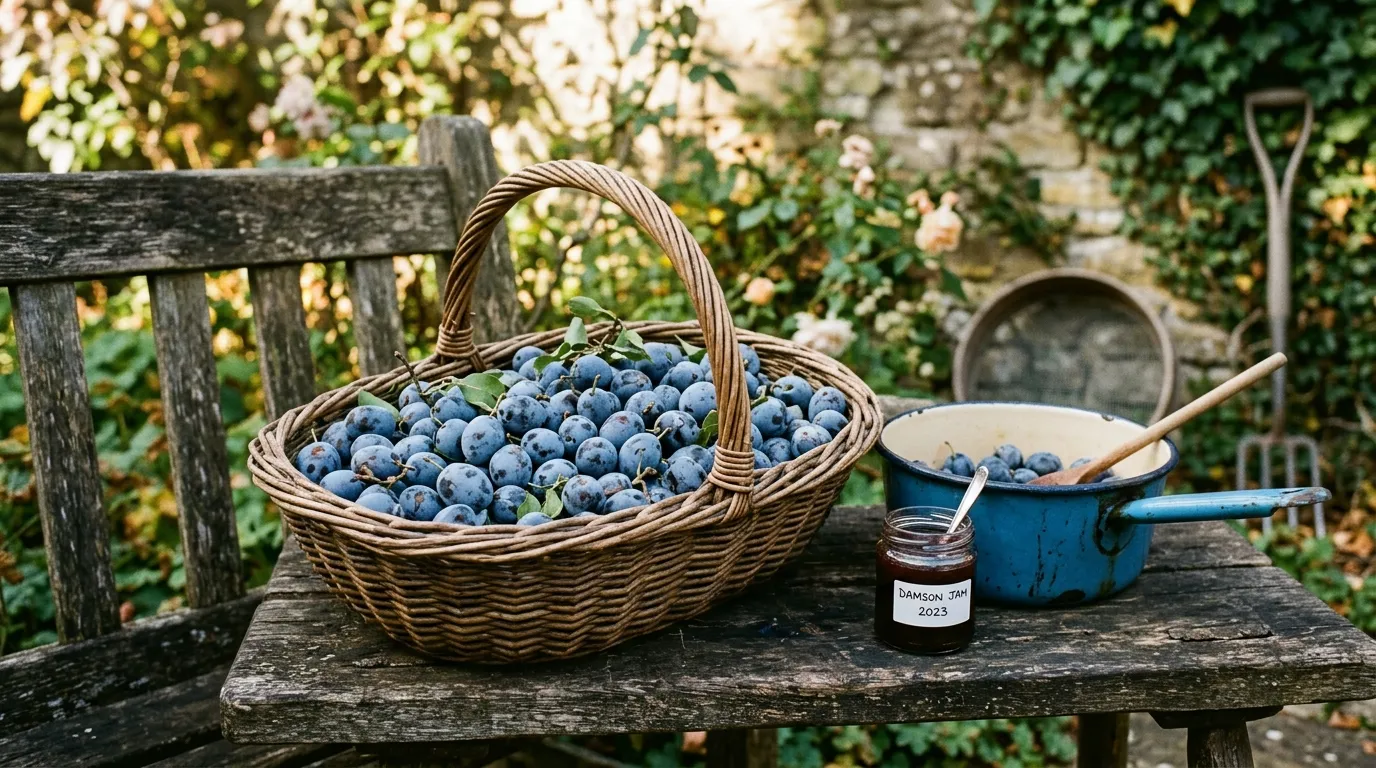
- Damson jam: 1kg damsons, 1kg sugar, 200ml water, simmer to setting point. The stones float to the surface and lift out with a slotted spoon.
- Damson cheese: the firm fruit paste cousin of Spanish membrillo. Cooked damson purée reduced for 90 minutes with equal weight of sugar, then set in shallow trays. Serves with cold meat or strong cheddar.
- Damson vodka: same method as gin but milder, more fragrant. Better with Shropshire Prune than Farleigh.
- Damson chutney: with onions, sultanas, vinegar and brown sugar. Best made with Farleigh.
- Damson crumble: the easiest weeknight dish from a frozen bag.
A damson tree at year 15 and beyond
Damsons are not long-lived productive trees. By year 15 most St Julien A trees are showing some branch dieback, brown rot pressure rises, and yields start to fall. By year 20 the tree is past its prime. A replacement planted in year 15 overlaps with the old tree’s last five productive seasons and takes over before yields collapse.
The replacement does not have to be the same variety. After a Farleigh tree finishes, plant a Shropshire Prune to add the gin flavour to the harvest pattern. After a Merryweather, plant another single-tree self-fertile variety unless a pollination partner has appeared nearby.
The compost heap loves damson prunings. The wood is dense, the leaves break down fast, and the trimmings shred easily for mulch. The only thing not to compost is any branch with silver leaf signs or brown rot fruit; both go to the burn pile.
Related guides
For the broader orchard system see how to grow fruit trees and the variety-focused how to grow plum trees. For pruning theory across species the how to prune fruit trees hub goes deeper, and the trained-form fan training method adapts well to wall-grown damsons. For grafting your own rootstock and scion pairing see how to graft fruit trees. Smaller-plot growers should also read dwarf fruit trees for small gardens and the parallel how to grow cherry trees piece for the same species family treatment.
Our team produces practical UK gardening guidance from source research, contributor records and established horticultural practice. Editorial standards are overseen by Matt W.