Key takeaways
- Bocking 14 is the sterile Russian comfrey cultivar bred by Lawrence D Hills at HDRA in the 1950s, the only sensible choice for the modern UK garden
- Comfrey leaves contain 3.4% potassium plus calcium, magnesium and phosphorus - the highest natural potash source in temperate gardening
- Plant 75-100mm root cuttings 50mm deep at 60-90cm spacing in March or September, expect light cropping in year one and full production from year two
- Six plants on a 75cm grid yield 60-80kg of fresh leaves per season - enough liquid feed, mulch and compost activator for a 50-square-metre plot
- Bocking 14 does not self-seed but root fragments resprout - never rotavate near a clump, and sieve every fragment if you move it
Comfrey is the closest thing UK gardening has to a single-plant fertiliser factory. A mature Bocking 14 clump pushes a tap root 2-3 metres into the subsoil, mines minerals that surface plants cannot reach, and stacks them in 60cm leaves that test at 3.4% potassium - higher than farmyard manure tea and most shop-bought tomato feeds. The leaves regrow four to five times a season, which means a planting decision made once delivers free liquid feed, mulch and compost activator for twenty years.
For the recipe-level detail on processing leaves into liquid feed, see the existing comfrey and nettle feed recipe. For the wider context on plant feeding, the best fertilisers for UK gardens guide compares comfrey with the alternatives.
Which comfrey to grow in a UK garden
There are four comfreys you will encounter in the UK. Picking the right one matters because three of them self-seed and one does not.
| Species or cultivar | Common name | Seeds in UK? | Leaf potash (%K) | Mature size | Frost hardiness |
|---|---|---|---|---|---|
| Symphytum officinale | Common comfrey | Yes (aggressive self-seeder) | 2.4-2.8% | 90cm wide x 1.2m tall | Hardy to -20C |
| Symphytum x uplandicum | Russian comfrey (fertile forms) | Yes (less aggressive) | 2.8-3.2% | 90cm wide x 1.2m tall | Hardy to -20C |
| Bocking 14 | Sterile Russian comfrey | No (sterile cultivar) | 3.2-3.6% | 60cm wide x 1m tall | Hardy to -20C |
| Symphytum grandiflorum | Dwarf comfrey | Yes | 1.8-2.2% | 30cm wide x 30cm tall | Hardy to -15C |
For a working UK garden Bocking 14 wins on every count that matters: highest potash, no self-seeding, and a slightly more compact habit. Common comfrey is fine in a wild corner or wildlife meadow but unforgiving on a small plot because the seedlings appear everywhere within three seasons. Symphytum grandiflorum is a quiet ground cover plant for shade, useful under fruit trees but with too little biomass to feed a veg plot.
Bocking 14 was selected at the Bocking research station at HDRA (now Garden Organic) in the 1950s by Lawrence D Hills. The number reflects the trial plot, not the variety order. Hills crossed Russian comfreys, screened for sterility, vigour and high potash, and released Bocking 14 as the gardener’s strain. Garden Organic still supplies root cuttings from the original stock - this is the source most UK growers buy from.
A short note on the Bocking research
Hills ran sixteen numbered Bocking lines through the 1950s and 1960s. Bocking 4 was originally promoted as the best yielder, but field reports through the 1970s showed Bocking 14 outperformed it on potash content and showed better resistance to comfrey rust in damp UK seasons. By the time HDRA rebranded as Garden Organic in 2005 the other Bocking lines had been quietly dropped from the commercial offer. Any cutting sold today as “Bocking variety, number unspecified” is almost certainly Bocking 14. The few specialist suppliers offering Bocking 4 are reselling stock from old HDRA member exchanges.
How comfrey performs on different UK soils
The pattern is consistent: clay holds water better, so Bocking 14 puts more energy into leaf production. On sandy and chalk soils the deep tap root still mines the subsoil but more of the plant’s photosynthesis goes into root maintenance. The fix on free-draining soils is an annual mulch of well-rotted manure or compost across the bed in late winter, which holds spring moisture in the top 100mm where the surface roots feed.
For acidic peaty ground the slow start is offset by strong year-three growth once the root system has established. Liming is not needed - Bocking 14 tolerates a pH range from 5.5 to 7.5 without complaint.
Why comfrey is the dynamic accumulator of UK gardening
A dynamic accumulator is a plant that pulls minerals from deep in the soil and stockpiles them in foliage, where they become available to the wider garden when the leaves are cut, mulched or composted. Comfrey is the standout example for British growers because the tap root reaches further than almost any garden plant.
Three things make this work:
- Root depth. A mature Bocking 14 clump has a primary tap root 2-3m deep, branching laterally below 50cm into the subsoil layer where most cultivated plants do not reach. This is where the residual minerals from old farming, lost calcium, weathered potash and trace magnesium sit.
- Mineral preference. Comfrey actively accumulates potassium - leaf tissue tests at 3.4% K on average against 1.1% for nettles and 0.5% for grass clippings. It also accumulates calcium (1.0%) and phosphorus (0.7%), making the leaf a near-complete fertiliser when broken down.
- Biomass. Each cut from a mature plant returns 2-4kg of fresh leaves. Across five cuts per season that is 10-20kg of mineral-rich material per plant per year, multiplied across a small bed of six plants.
The mechanism is not unique to comfrey - any deep-rooted perennial mines subsoil to some extent. What makes comfrey special is the combination of root depth, potash preference and harvestable yield. For the soil-building context see no dig on heavy clay soil, which uses living mulch on a similar principle.
Planting Bocking 14 root cuttings
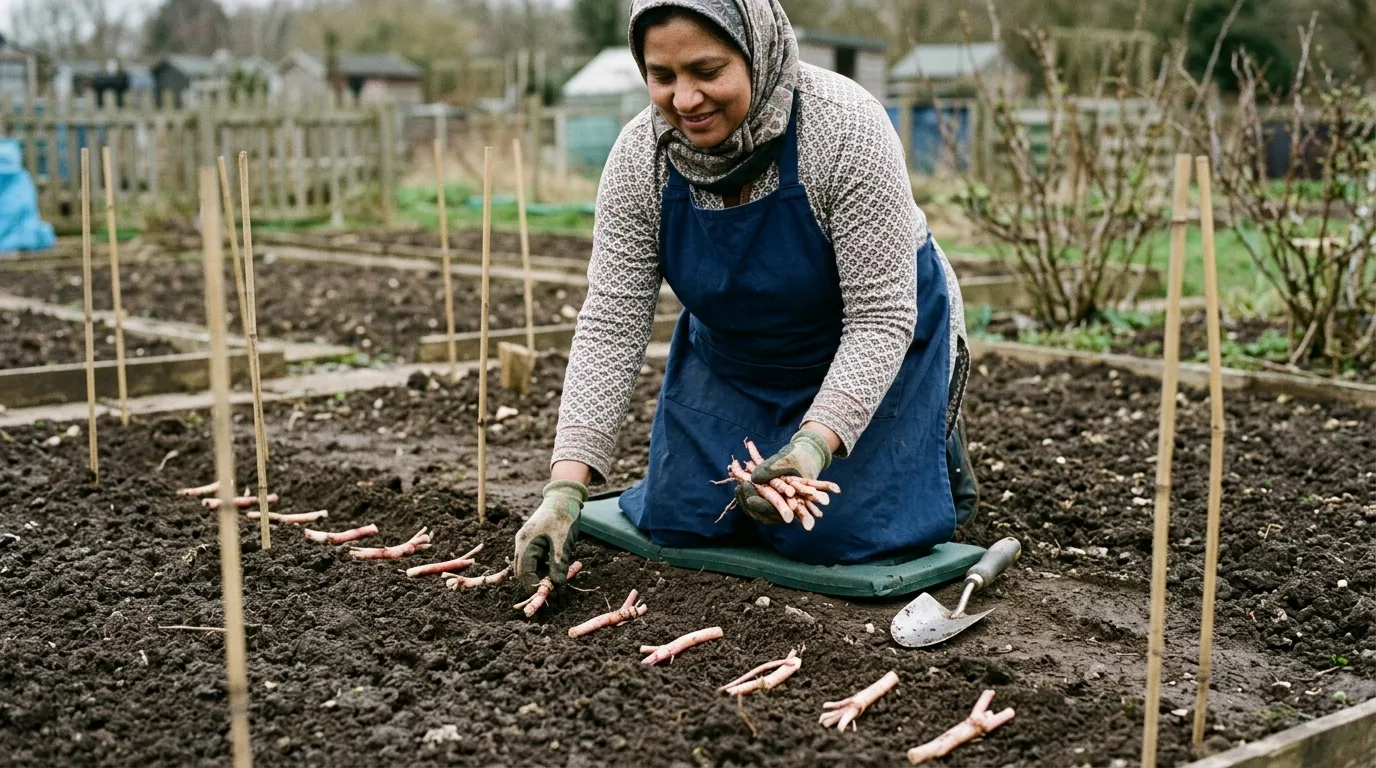
Bocking 14 is bought as bare root cuttings (sometimes called offsets or root pieces) from Garden Organic, the Organic Gardening Catalogue or a small number of organic nurseries. A typical order is 5 or 10 cuttings, each 75-100mm long and the thickness of a pencil. They look like creamy-pink lengths of root with no visible top growth.
The planting routine:
A first-year clump throws 20-30cm leaves and a couple of flower spikes. Do not cut hard in year one - take a single light trim in late summer to encourage rooting. Year two doubles the size and supports two or three cuts. Year three the plant reaches mature production at four to five cuts per season.
Multiplying your own Bocking 14
Once a bed is established, you do not need to buy more. From year three onwards each clump can be lifted in February or November and divided into 5-8 new plants. The reliable division method:
- Lift the entire crown with a fork (do not cut around it - you want every root piece).
- Wash off the soil so you can see the root structure clearly.
- Cut the crown into pieces using a sharp knife. Each piece needs at least one visible growing point and a 50-75mm section of root.
- Replant immediately at the same depth as the original crown, water in, and treat as a year-one plant for the first season.
This is how Garden Organic propagates its stock for sale and how the cultivar has been multiplied since 1953. Because Bocking 14 is sterile and only multiplied vegetatively, every plant in the UK is technically a clone of the original Hills selection.
The annual harvest cycle
Once established, Bocking 14 follows the same pattern every year in the UK:
| Month | Stage | Action |
|---|---|---|
| March | Crown breaks dormancy, 50mm rosette | Apply mulch around base, no cutting |
| Late April / early May | First leaves at 30cm | Light pull-pick of older outer leaves (optional) |
| Mid-May | Plant at 50cm, first flower buds | Cut 1: full cut to 50mm above crown, 2-4kg per plant |
| Late June | Regrowth at 40-50cm | Cut 2: full cut, 2-3kg per plant |
| Early August | Regrowth, hot dry weather | Cut 3: full cut, 2-3kg per plant |
| Mid-September | Regrowth, slower in shortening days | Cut 4: lighter cut, 1-2kg per plant |
| Late October | Plant going into dormancy | Optional Cut 5 (only in mild autumns) |
| November to February | Dormant | Mulch with leaves or compost, do not disturb |
The first cut in mid-May is the heaviest of the year and produces the highest-potash leaves because the plant has been storing reserves over winter. By the August cut the K% is similar but the biomass is lower. The September cut is small enough that some growers skip it and let the plant fatten the crown for winter.
Cut with hand shears or a sharp sickle 50mm above the crown - leave the central growing point intact. Stripping all the way to soil level kills the regrowth response and the plant takes a season to recover.
Use gloves. Comfrey leaves are rough with stiff hairs that can irritate sensitive skin within minutes.

Ten proven uses for comfrey in the UK garden
This is the pillar value of the plant. Once you have a bed producing 60-80kg of leaves a year, the question is what to do with all of it.
1. Liquid feed (the classic use)
A bucket of comfrey leaves topped with water and left to rot for 4-6 weeks produces a foul-smelling liquid feed with NPK roughly 0.7-0.1-2.4 - close to a commercial high-potash tomato food. Dilute 1 part feed to 10 parts water before applying. The full recipe with measurements is in how to make comfrey and nettle feed.
2. Comfrey concentrate (no water method)
Pack a container with leaves under a weighted board with a drainage hole at the base. Over 2-3 weeks the leaves collapse and a small amount of dark, treacle-thick black liquid drips out. This is comfrey concentrate, roughly five times stronger than bucket feed and easier to store. Dilute 1 part concentrate to 20-30 parts water.
3. Compost activator
A 50mm layer of fresh comfrey leaves placed every 200mm in a building compost heap accelerates the breakdown of brown material (cardboard, straw, dry leaves). The leaves heat fast because of the high nitrogen relative to carbon. A heap with three or four comfrey layers can hit 60C within a week in summer. The principles match those in how to make compost and the peat-free compost guide.
4. Potato trench mulch
A 50mm layer of wilted comfrey leaves laid in a potato trench at planting feeds the developing tubers directly. The potash content suits potatoes well and the leaves break down within 8-10 weeks - in step with tuber formation. This is the oldest organic gardening use of comfrey, predating the Bocking work.
5. Tomato bed mulch
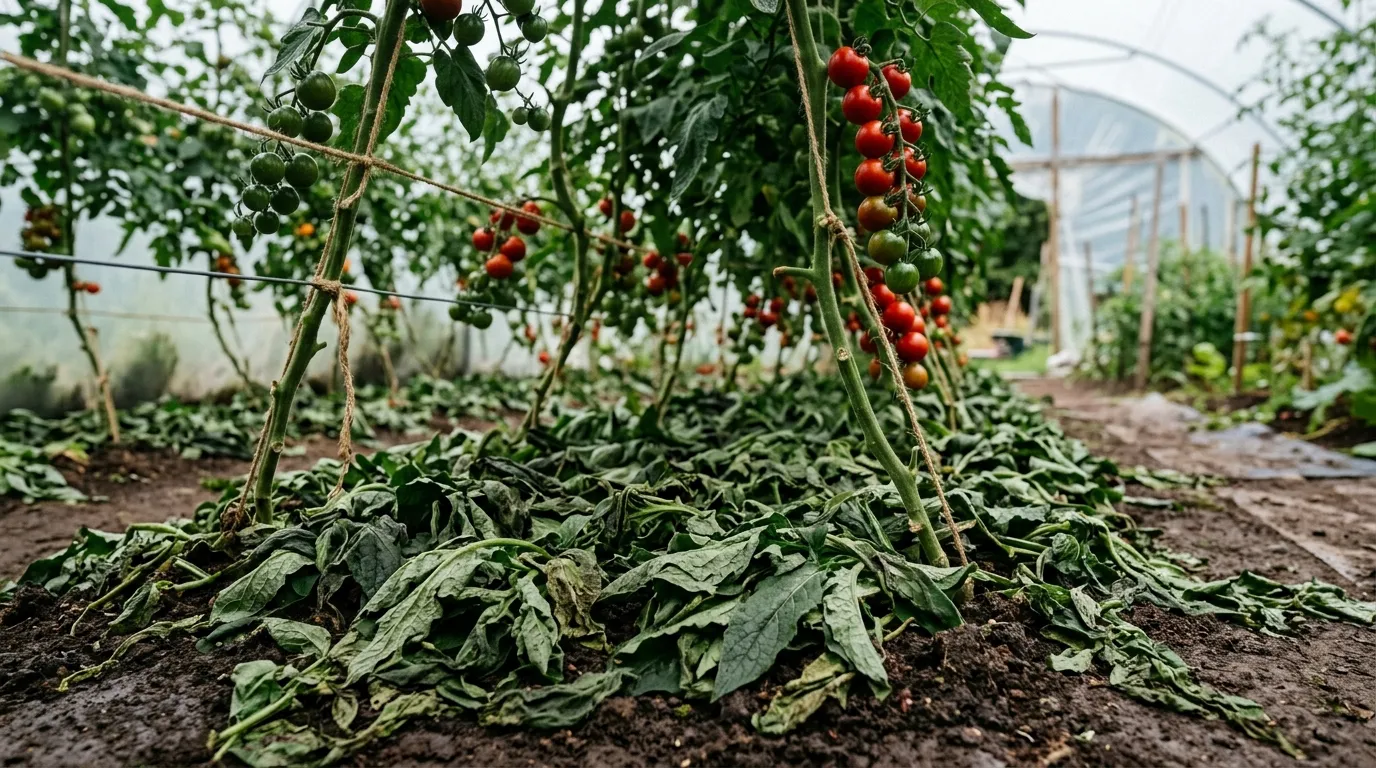
The same wilting principle applies to tomato beds. Wilt cut leaves for 24-48 hours to release a little potash into the soil surface, then lay 30-50mm thick around the base of each tomato plant after the first truss has set. Reapply after each cut from the comfrey bed.
6. Cut-and-drop mulch in no-dig beds
Where a no-dig bed sits within 5m of the comfrey patch, the simplest use is to cut leaves and drop them straight on the bed surface. Earthworms pull the leaf material down within 2-3 weeks. The system works particularly well for brassicas and leeks on the heavier UK soils.
7. Underplanting fruit trees
A circle of three or four Bocking 14 plants under each fruit tree acts as a permanent living mulch and feed source. Cut the leaves twice a season and drop in place. The deep tap roots also condition the soil under the tree without competing with the fruit roots, which run in the top 30cm. Apple and pear trees on standard rootstock are the best candidates.
8. Wilted fodder for chickens and rabbits
Wilted comfrey (cut and left 24 hours to soften the leaf hairs) is eaten readily by chickens and rabbits. It is not a complete feed but supplements layers’ diets with calcium and is a useful addition in the hungry gap of late spring. Limit to 10-15% of total feed by weight because of the pyrrolizidine alkaloid content.
9. Compost layering in three-bin systems
In a classic three-bin compost system the middle bin holds the heating compost. A 50mm layer of comfrey leaves between every 200mm of kitchen and garden waste accelerates the process and improves the finished compost’s potash content. The full bin builds in 8-10 weeks against 16-20 weeks without comfrey.
10. Wildlife support
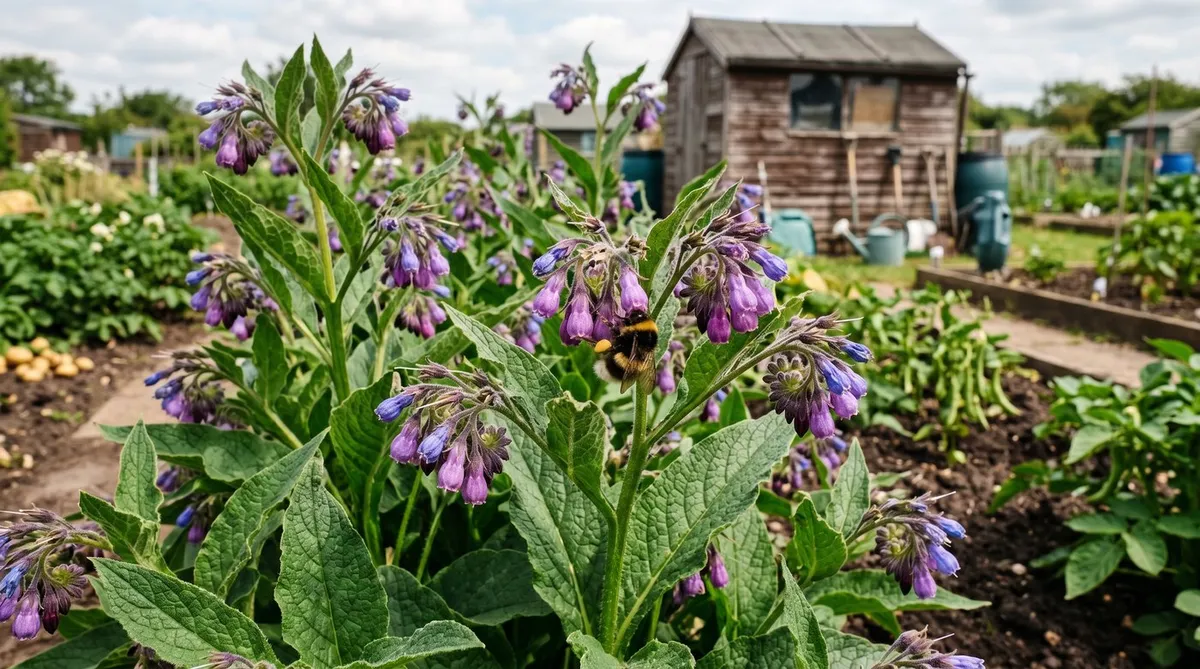
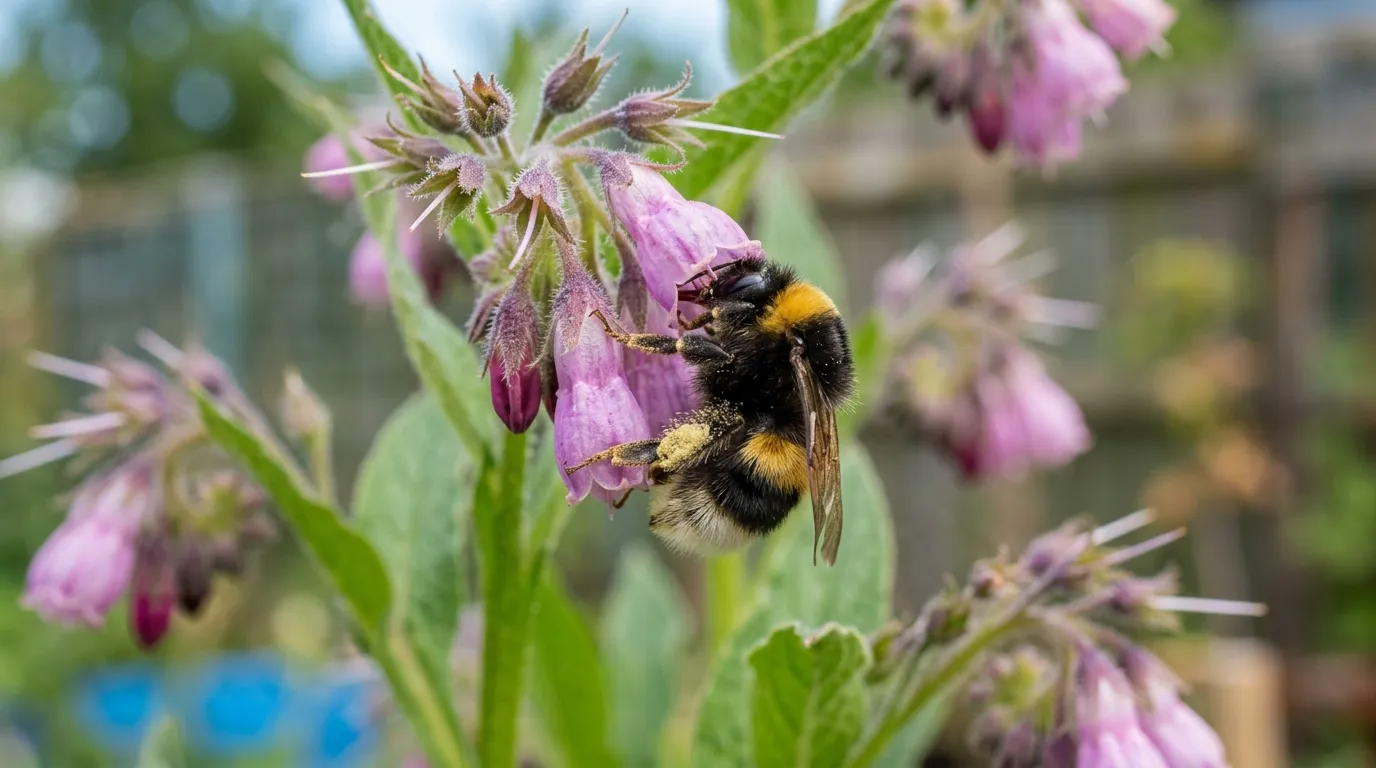
Bocking 14 flowers from late May to early August in the UK and the pinkish-purple bells are a magnet for bumblebees including buff-tailed bumblebees (Bombus terrestris), garden bumblebees (B. hortorum) and red-tailed bumblebees (B. lapidarius). Letting one or two plants flower fully (rather than cutting all the foliage) provides three months of nectar in the gap between spring blossom and late-summer wildflowers.
How NPK compares with the alternatives
For potash-hungry crops (tomatoes, potatoes, peppers, fruit) comfrey liquid feed beats every alternative on K-to-N ratio. For leaf crops (lettuce, brassicas, herbs) nettle feed or balanced manure tea suits better because the higher nitrogen drives leaf growth. The two together make a complete fertiliser system - the basis of the recipe in our comfrey and nettle feed guide and the broader detail in the NPK fundamentals at the RHS.
When and how to apply comfrey liquid feed
Making the feed is the easy part. Getting the timing and dilution right across different crops is what turns a bucket of stinky liquid into a productive feeding system.
The working rules from six seasons of trial:
- Tomatoes: start weekly liquid feed at 1:10 dilution once the first truss has set fruit. Continue weekly until late September. A 9-litre watering can of dilute feed covers six plants. Stop the moment the leaves yellow from the bottom (sign of excess feed).
- Potatoes: comfrey is better used as mulch than as liquid feed for potatoes - the soil contact gives the tubers a slow release through the growing season. If using liquid, apply once at flowering only.
- Peppers, chillies and aubergines: weekly 1:10 feed from first flower until late August. These tropical originals love the high K and respond with thicker walls and stronger fruit set.
- Courgettes, marrows and squash: fortnightly 1:10 feed from first female flower. Avoid weekly because the high K can suppress nitrogen-driven leaf growth in cooler UK seasons.
- Fruit bushes: once at flowering and once at fruit set, at 1:10. Particularly effective on gooseberries and currants, where the potash improves fruit size and sweetness.
- Lawns and leafy crops: do not use comfrey feed. The K-skewed NPK suppresses leaf growth - use nettle feed or balanced manure tea instead.
Apply to damp soil, never to bone-dry ground (it scorches surface roots). Morning or early evening is best - midday application in summer evaporates before the roots can take it up. Wear gloves: the diluted feed smells fine on hands at first but the odour lingers for days.
Storage and shelf life
Bucket-method liquid feed keeps for 3-4 months in a sealed container. After that the smell stays the same but the K content drops as the brew anaerobically breaks down further. The treacle-thick “concentrate” produced by the no-water method keeps for 12-18 months in a sealed bottle, which makes it the better option for gardeners who only use feed seasonally.
Both formats are stable in UK winter temperatures - frost does not damage either. Store in a shed or garage rather than the house because the smell carries through cardboard, plastic and even some glass seals.
Bed design for a working comfrey patch
- 2 plants: enough for liquid feed on 6 tomato plants in pots, plus occasional compost activation.
- 4 plants: liquid feed for a small veg bed (25 square metres) and regular compost layering.
- 6 plants on a 75cm grid: liquid feed, mulch and compost activator for a 50-square-metre allotment plot.
- 10-12 plants: enough biomass for cut-and-drop mulching on no-dig beds plus the above.
A working “comfrey corner” of 6 plants takes a 2m x 2m square. Position it where it gets full sun for at least 6 hours, on the edge of the productive area so the leaves do not have to be carried far at harvest time, and ideally near the compost bays.
Mulch the bed annually in late winter with a 50mm layer of leaf mould or well-rotted manure. This is the only feeding comfrey ever needs and pays back in the biomass yield. For general advice on feeding garden plants, comfrey sits in the same category as nettles and seaweed - a leaf-derived feed rather than a synthetic NPK product.
The dark side - removing a Bocking 14 clump
Bocking 14 does not self-seed, but every fragment of root left in the soil resprouts. A clump that has been in place for five years will be 1m across and the tap root will reach 60cm down. Removing it is the hardest part of growing the plant.
The reliable removal method:
If the clump is in the wrong place but you cannot fully remove it, the alternative is to commit to permanent occupation. Cover the area with cardboard, lay 200mm of well-rotted compost, plant a vigorous perennial (rhubarb, gooseberry, raspberry cane) and accept that the comfrey will fight on for a few seasons before being shaded out.
Never rotavate near an established comfrey clump. Every chopped root fragment becomes a new plant.
Regional considerations across the UK
Comfrey grows nationwide but the calendar shifts with latitude and altitude. Working notes from clients across the UK:
The general rule across the UK: the first cut moves later by roughly two days for every 50 miles north and for every 100m of elevation, and the last cut moves earlier by the same. Six cuts is a south-east figure, four cuts is the upland and northern norm.
Pests, diseases and trouble shooting
Comfrey is unusually free of UK garden problems. The full list of things that occasionally go wrong:
- Comfrey rust (Melampsorella symphyti): orange pustules on the underside of leaves in damp summers. Cut affected leaves to the crown and bin them. The plant regrows clean.
- Slugs on young divisions: newly planted root cuttings can be eaten flat by slugs in the first 6-8 weeks. Use beer traps or a ring of grit until the plant is established.
- Powdery mildew in dry years: appears in late August on overcrowded plants. Cut hard, water well, regrows clean.
- Weed competition in year one: bindweed and couch grass outpace young comfrey. Hand-weed for the first season then let the canopy close.
- Birds on young growth: corvids (ravens, crows, jackdaws) and pigeons strip tender new leaves in spring, particularly in the first season when plants are small. Chicken wire is rarely enough - ravens in particular are strong enough to rip lightweight mesh off. Cages made from concrete reinforcing mesh or weld mesh (50mm aperture, anchored with ground pegs or rebar) are the reliable fix. Mature leaves are tough enough that birds lose interest, but fresh regrowth after each cut is vulnerable until the leaves reach 20-25cm.
There are no significant insect pests. Aphids occasionally appear on the flower spikes but lacewings and ladybirds clear them within a fortnight. Deer and rabbits ignore comfrey because of the leaf hairs and the alkaloid taste.
Safety - pyrrolizidine alkaloids
Comfrey contains pyrrolizidine alkaloids (PAs), naturally occurring compounds that the UK Medicines and Healthcare products Regulatory Agency (MHRA) has linked to liver damage when consumed orally over long periods. Garden use of comfrey - liquid feed, mulch, compost activator - is not affected because PAs do not transfer to edible crops in measurable amounts.
The cautions that do apply:
- Do not eat comfrey leaves or roots. The Victorian “comfrey omelette” tradition is not safe.
- Do not feed comfrey heavily to grazing animals (over 10-15% of diet) for the same reason.
- Topical use on unbroken skin for bruises and sprains is the traditional application. Limit to short courses (under two weeks) and not on broken skin where absorption increases.
- Wear gloves when cutting because the leaf hairs irritate sensitive skin.
The full discussion of medicinal use, dosage and the regulatory position is beyond the scope of this growing guide. Refer to the Garden Organic safety guidance and Royal Botanic Garden Kew’s profile on Symphytum officinale for current detail.
Sourcing Bocking 14
There are three reliable UK sources of true Bocking 14 root cuttings:
- Garden Organic / HDRA: the original holders of the cultivar. Sells 5 or 10 root cuttings by mail order in spring and autumn. The most reliable provenance.
- The Organic Gardening Catalogue: retail arm of Garden Organic, same stock, often easier to order online.
- Smaller specialist permaculture and organic nurseries: check the source - some sell mislabelled Russian comfrey or common comfrey under the Bocking 14 name. If the supplier does not mention Garden Organic or HDRA in the listing, treat with caution.
Avoid garden centres for Bocking 14. Most sell ornamental comfreys (Symphytum grandiflorum or Symphytum officinale ‘Hidcote Pink’) which are fertile and will self-seed across the garden.
Related guides
For the recipe-level detail on processing leaves into a liquid feed, see how to make comfrey and nettle feed. For wider context on plant feeding compare the best fertilisers for UK gardens and read how to feed garden plants. To build the soil that grows the comfrey, the no dig method on heavy clay and peat-free compost guide cover the foundations. For mulching detail see what is mulch and how to use it, and for an alternative high-temperature compost method that pairs well with comfrey leaves, how to make compost walks through the process step by step.
Sister deep dives in the comfrey cluster: the Bocking 14 comfrey propagation guide covers the three vegetative methods to multiply your patch. The comfrey liquid feed recipe has the strength, dilution and crop-by-crop application tables. The medicinal uses of comfrey UK covers the topical-only knitbone salve route with full MHRA-aligned safety positioning.
Our team produces practical UK gardening guidance from source research, contributor records and established horticultural practice. Editorial standards are overseen by Matt W.