Key takeaways
- Milkweed in the UK is a pollinator nectar plant, not a monarch nursery: monarchs do not breed here
- Swamp milkweed (Asclepias incarnata) is the hardiest, most reliable species, rated RHS H4, and likes damp soil
- Butterfly weed (A. tuberosa) needs sharp drainage and a warm spot, and its seed needs cold stratification to germinate
- Common milkweed (A. syriaca) runs at the root and is EU-listed as invasive; site it with real care or avoid it
- Every part carries toxic milky sap that irritates skin and eyes and poisons pets and livestock, so wear gloves
- Milkweed emerges very late in spring, so mark the crown or you will dig it out thinking it has died
Milkweed has a reputation built almost entirely on American gardening, and most of what you read online does not apply here. In the United States, gardeners plant Asclepias to feed monarch caterpillars, because milkweed is the monarch’s only larval foodplant. In Britain, that reason simply does not hold. Monarchs do not breed here. They arrive as rare vagrants, blown off course, and never establish. So if you grow milkweed in a UK garden, you grow it for a different and better reason: the flowers are among the most nectar-rich you can plant, and they hum with bees, hoverflies and butterflies from mid-summer into autumn.
What is milkweed and does it attract monarchs in the UK?
Milkweed is the common name for Asclepias, a genus of around 140 perennials, mostly from North America, grown for their domed clusters of small, detailed, nectar-heavy flowers. The name comes from the milky white sap that bleeds from any cut stem or leaf. That sap is loaded with toxins, which is the plant’s defence, and it matters for how you handle it.
Now the monarch question, because it is the first thing everyone asks. Monarch butterflies do not breed in the UK. They are a North American species that migrates thousands of miles between Mexico and Canada. A handful reach Britain each year as storm-blown strays, usually on the Cornish and Scilly coasts after Atlantic gales, but they cannot complete their life cycle here. Our climate is too cold and our summers too short. Butterfly Conservation lists the monarch as a rare migrant, not a resident breeder (Butterfly Conservation: monarch).
So forget the “plant milkweed to save the monarchs” line. It is true in Texas and meaningless in Tewkesbury. What milkweed does offer the UK gardener is a long, dependable supply of nectar. The flowers open from July and keep going for weeks, feeding pollinators through the late-summer window when many border plants have finished. That is the case for growing it here, and it is a strong one.
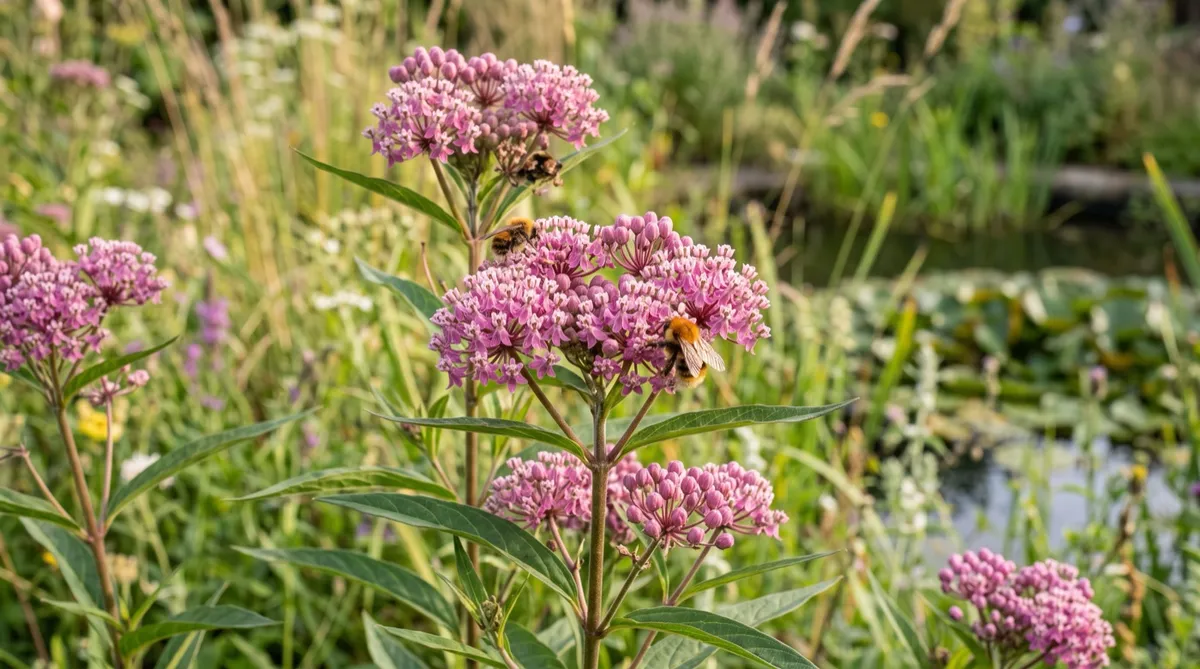
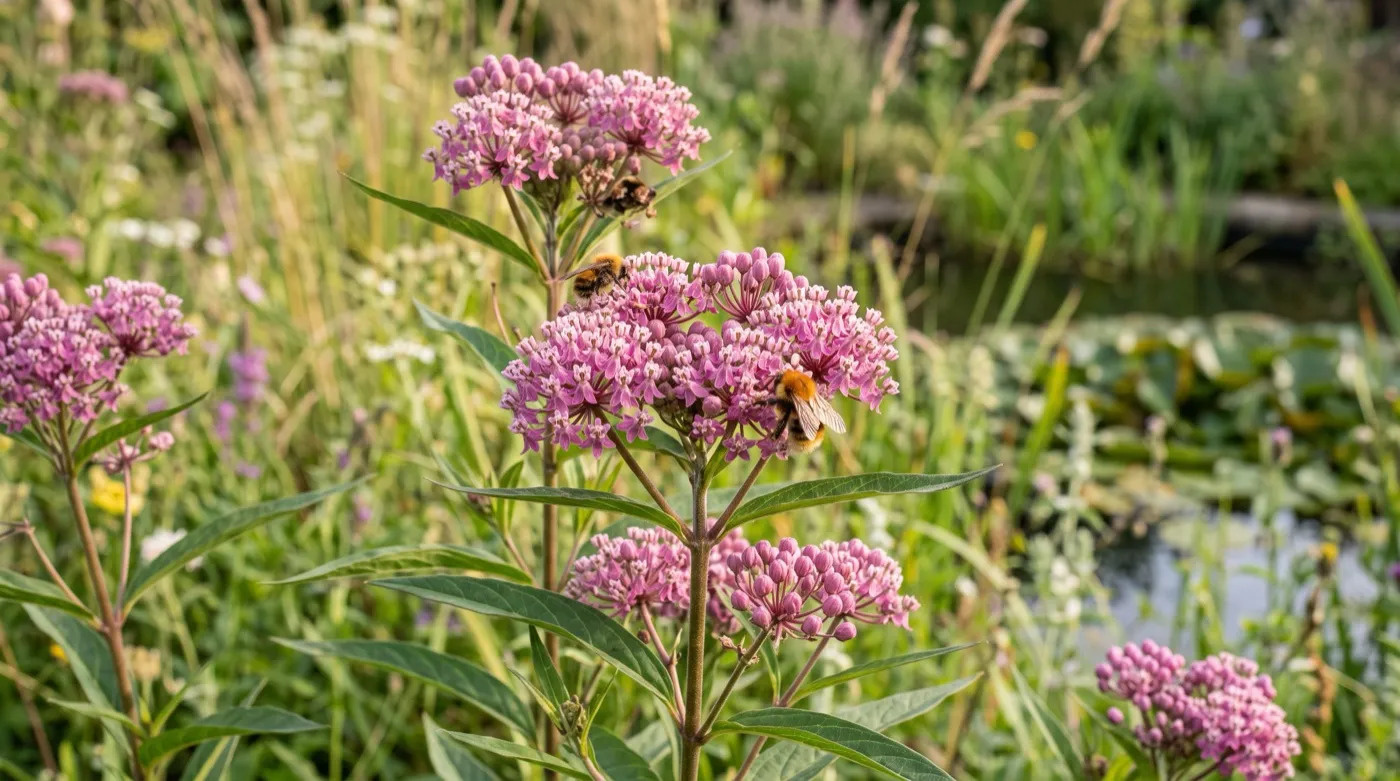 Swamp milkweed in a damp UK border, its pink umbels working hard for bumblebees from mid-summer onwards. This is the real reason to grow milkweed here: nectar, not monarchs.
The plants build a clump of upright stems clothed in paired, narrow leaves, then carry their flowers in rounded heads at the top. After flowering come the seed pods, slim horns that split to release silk-tufted seeds on the wind. Every stage has its own appeal, and every stage bleeds that toxic sap when damaged.
Which milkweed species grow best in UK gardens?
Four milkweeds turn up in UK nurseries and seed catalogues, and they are not equally useful. One is genuinely easy, one is fussy but rewarding, one is a thug you should approach with caution, and one is a tender curiosity for the greenhouse. Getting the species right is 90% of success with this plant, so it is worth being clear about each before you buy.
The short version: grow Asclepias incarnata if you want reliable results. It is the hardiest, it tolerates the damp soil most British gardens have, and it flowers well without fuss. Everything else is a step up in difficulty or risk.
Milkweed species comparison for the UK
| Species | Hardiness | Soil | Height | Spread behaviour |
|---|---|---|---|---|
| A. incarnata (swamp milkweed) | RHS H4, to -10C | Damp, moisture-retentive | 1-1.5m | Well-behaved clump, no runners |
| A. tuberosa (butterfly weed) | RHS H4, to -10C | Dry, sharp drainage only | 40-70cm | Slow taprooted clump |
| A. syriaca (common milkweed) | RHS H4 | Any, tolerates poor | 1-2m | Runs hard by rhizome; EU invasive |
| Gomphocarpus physocarpus (balloon plant) | Tender, frost-sensitive | Free-draining | to 2m | Annual or under glass only |
Note the drainage column, because it is where most people come unstuck. Swamp milkweed and butterfly weed want opposite conditions. Plant them the wrong way round and both will struggle. The rest of this guide takes each species in turn.
How do you grow Asclepias incarnata, swamp milkweed?
Swamp milkweed, Asclepias incarnata, is the milkweed to grow if you grow only one. It is rated RHS H4, hardy to about -10C, and it thrives in exactly the conditions that defeat most drought-loving perennials: damp, heavy, moisture-retentive soil. The clue is in the name. In the wild it grows in wet meadows, ditches and pond margins, so a border that stays moist, or the edge of a wildlife pond, is perfect.
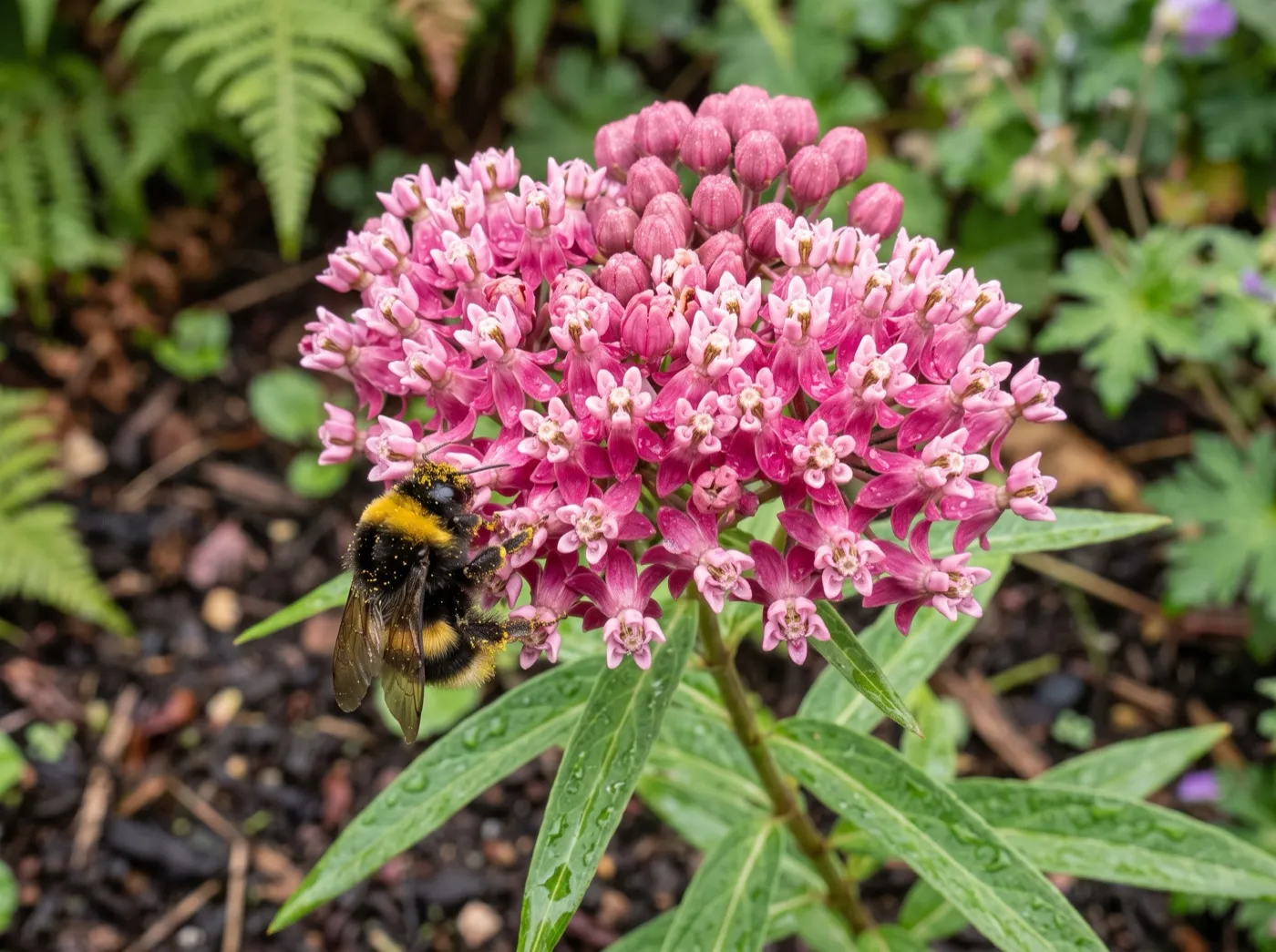 The domed pink heads of swamp milkweed are lightly scented and heave with bees. On damp clay it needs no special treatment.
If your aim is a border that works for insects, swamp milkweed sits naturally alongside other bee-friendly plants and earns its place through sheer nectar output. It is one of the few nectar plants happy in ground too damp for lavender or salvia.
Why does Asclepias tuberosa need sharp drainage?
Butterfly weed, Asclepias tuberosa, is the milkweed everyone wants for its flowers, and the one most likely to disappoint. The blooms are a vivid, almost fluorescent orange, unlike anything else in a July border, carried in flat heads on stems 40 to 70cm tall. It is also rated RHS H4. The problem is not cold. The problem is wet.
The fix is a raised bed, a gravel garden, or a planting hole improved with at least a third horticultural grit, with the crown set on a slight mound so water drains away from it. Butterfly weed also resents being moved, because of that deep taproot, so choose the spot once and leave it. It is slow to establish, often doing little in its first year, then flowering better each season after. Patience is rewarded, but only on the right soil.
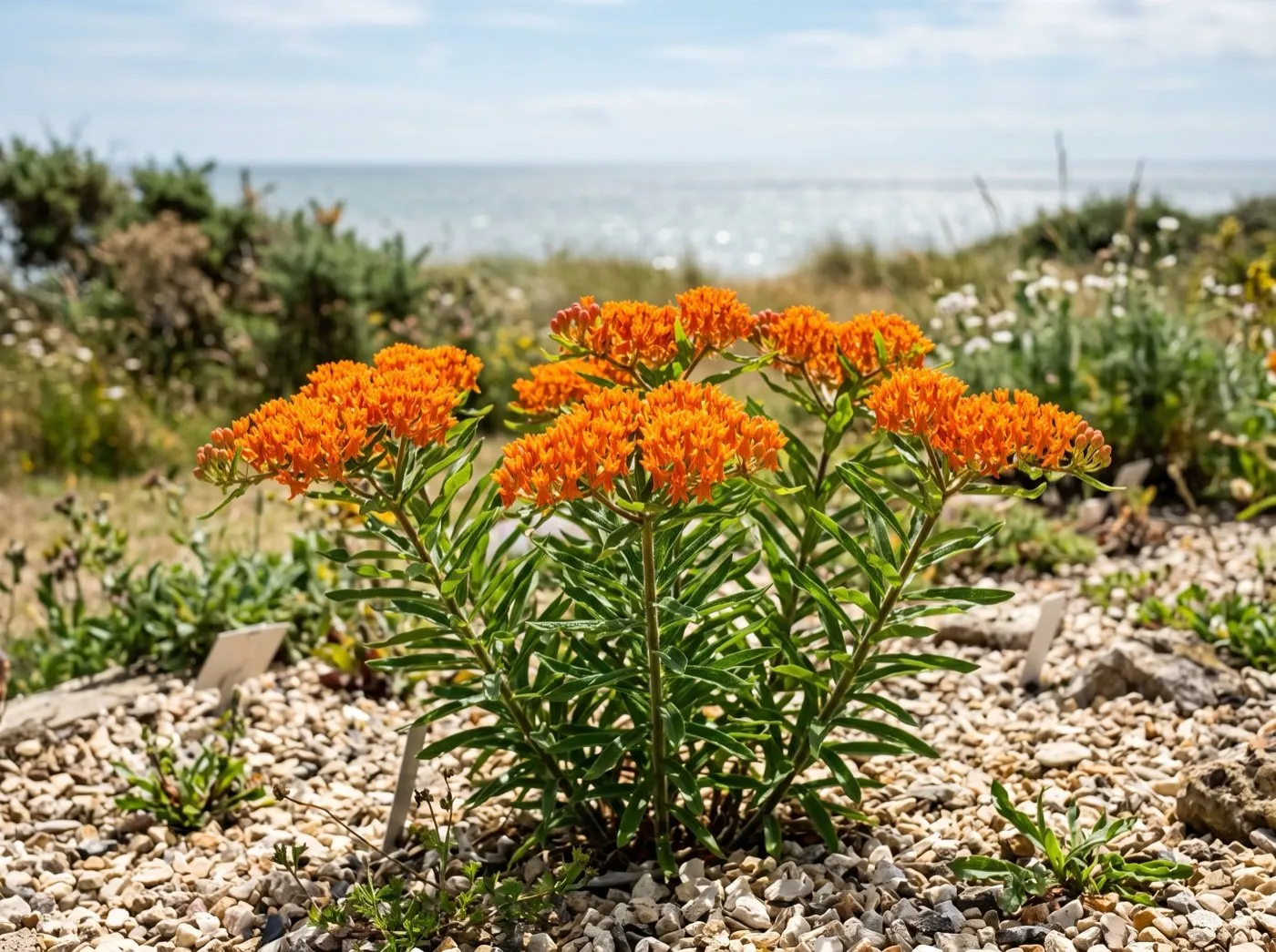 Butterfly weed’s orange heads are unmatched, but the plant demands sharp drainage. This clump sits on a raised grit bed in a coastal garden.
Should you grow Asclepias syriaca, common milkweed?
Common milkweed, Asclepias syriaca, is the species to think hard about before you plant. It is the classic North American roadside milkweed, tall at 1 to 2m, with big greyish leaves and dense, rounded heads of dusky pink, sweetly fragrant flowers. It is easy to grow. That is exactly the trouble.
Unlike the two clump-formers, A. syriaca spreads by running underground roots, or rhizomes, and it spreads hard. A single plant can throw up new shoots a metre or more away and form a dense colony within a few seasons. It is difficult to dig out once settled, because every root fragment left behind regrows. This is not garden hearsay: the species is listed as an invasive alien across the European Union, with import and trade banned since 2017, precisely because of how aggressively it colonises open ground.
Gardener’s tip: If you want common milkweed’s fragrance and stature without the invasion, sink a large bottomless pot or a lined bed to contain the roots, and cut off every seed pod before it splits. Better still, grow the well-behaved swamp milkweed instead. It gives you the same nectar value in a clump that stays where you put it.
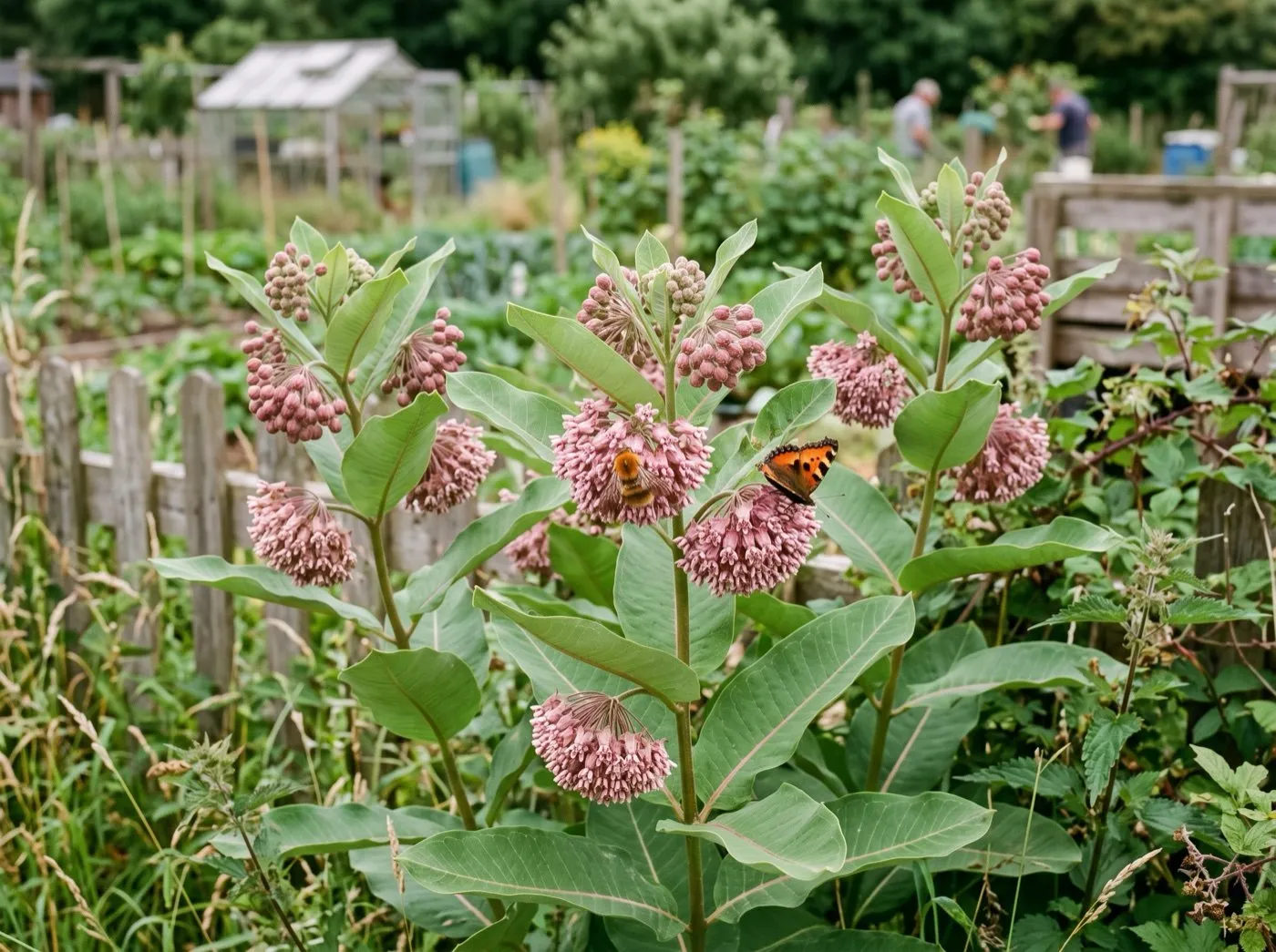 Common milkweed spreads by running roots and forms dense colonies. It is EU-listed as invasive, so contain it or avoid it altogether.
Is Gomphocarpus (balloon plant) worth growing in the UK?
Gomphocarpus physocarpus, once classed as Asclepias physocarpa and still sold under both names, is the milkweed grown as a curiosity rather than for its flowers. An African relative, it is a fast, upright plant reaching up to 2m in a season, with narrow leaves and small cream flowers. The draw is the seed pods: inflated, pale green, hairy spheres the size of a plum, which have earned it the common names balloon plant, swan plant, hairy balls and bishop’s balls. Children love them, and they are striking in a late-summer arrangement.
The catch is hardiness. Gomphocarpus is frost-tender and will not survive a UK winter outdoors. Treat it as a half-hardy annual: sow seed under glass in spring, grow it on in a warm spot or a large container, and it will flower and set its balloon pods by late summer. When frost threatens, either let it die as an annual or bring the pot into a frost-free greenhouse or conservatory to overwinter.
It is a fun plant to grow for the pods and for children, but it contributes little to a pollinator border in our climate and is more effort than the hardy species. Grow it for novelty, in a pot, and enjoy the balloons. Do not expect it to earn a permanent place in the ground.
How do you handle milkweed’s toxic sap safely?
Every milkweed bleeds a milky white sap when cut or broken, and that sap is genuinely toxic. It contains cardiac glycosides, the same class of compounds that make foxgloves dangerous, concentrated in the latex. Respect it, and milkweed is a perfectly safe garden plant. Ignore it, and you can hurt yourself.
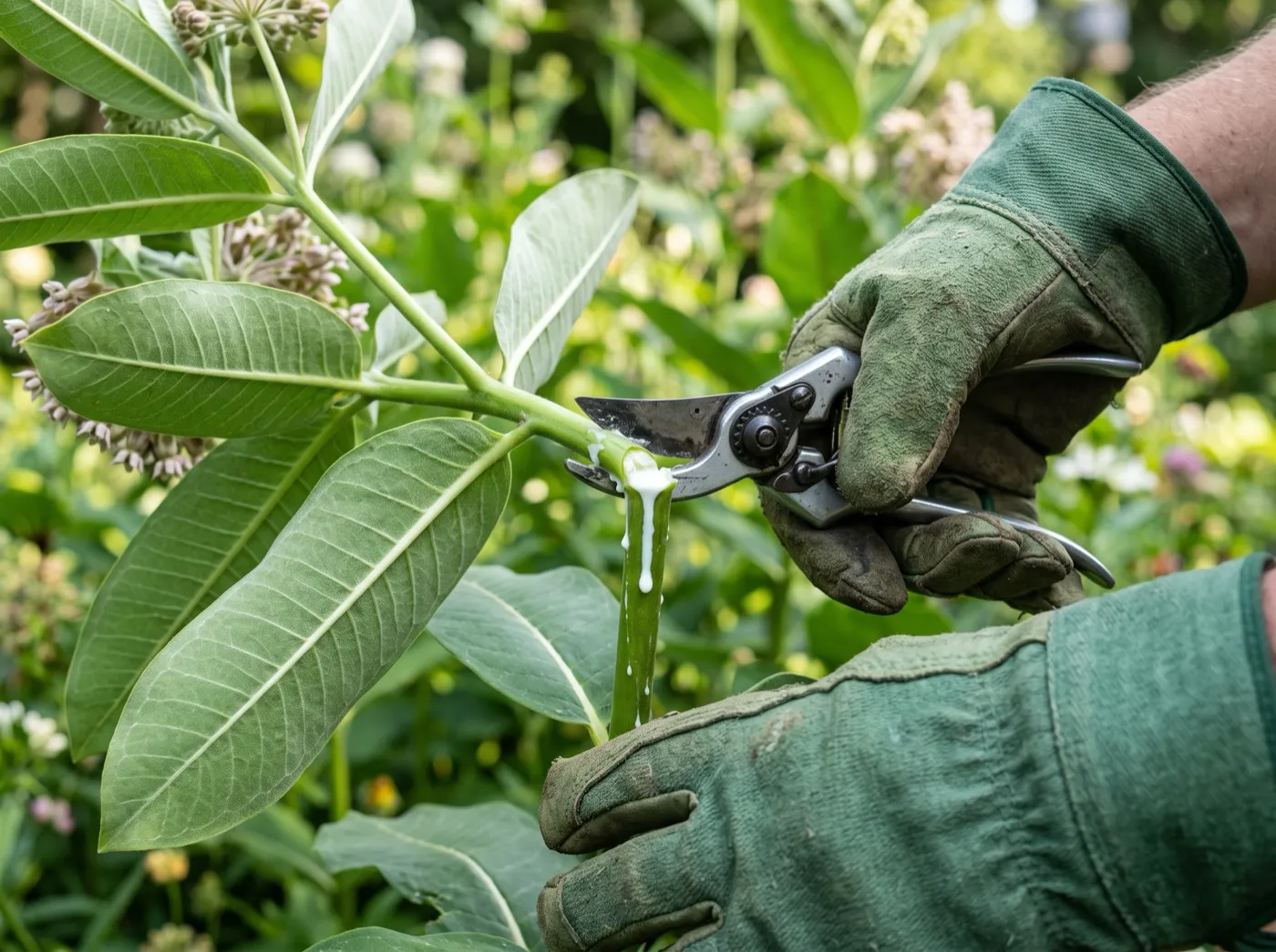 The white latex bleeds from any cut and irritates skin and eyes. Gloves are not optional when handling milkweed.
The plant is also poisonous if eaten, and this matters if you keep animals. All parts are toxic to dogs, cats, horses and grazing livestock, and serious poisonings are far more common in livestock than in pets, because grazing animals eat volume while a dog usually spits out the bitter sap fast. Keep milkweed out of paddocks and away from any area livestock can reach, and site it sensibly in a family garden with pets or young children. This is not a reason to avoid the plant. It is a reason to plant it thoughtfully and handle it with gloves, the same way you already do with foxgloves, aconites and many other border staples.
How do you grow milkweed from seed?
Most milkweed is raised from seed, and the key detail for UK gardeners is cold stratification. Milkweed seed evolved to fall in autumn, sit through a cold winter, then germinate in spring. Skip that cold spell and germination is patchy, especially with butterfly weed, whose seed barely sprouts without it.
You have two easy ways to give the seed its cold period:
- Autumn sowing outdoors. Sow fresh seed in autumn in pots or trays, stand them outside in a cold frame or against a north wall, and let the winter do the work. Seedlings appear in spring.
- Fridge stratification. In late winter, mix the seed with a little damp vermiculite or a folded moist paper towel in a labelled bag, and refrigerate it for about four weeks. Then sow indoors in spring at around 18-20C.
Sow the stratified seed on the surface or barely covered, keep it moist and warm, and germination takes one to three weeks. Prick out seedlings early, before the taproot lengthens, because milkweed resents root disturbance once established. Grow them on in deep pots to accommodate that taproot, and plant out after the last frost. Butterfly weed in particular is slow, and a seed-raised plant may take two or three years to flower well, so buy a pot-grown plant if you want colour sooner.
Swamp milkweed is the easiest from seed and often flowers in its second year. If you enjoy raising plants for insects, milkweed sits well alongside the other autumn-flowering plants for bees you might sow to extend the nectar season.
When does milkweed emerge and how do you plant it?
Plant pot-grown milkweed in late spring, from May to June, once the soil has warmed and all frost has passed. Spring planting gives the crown a full season to root in before winter, which matters for the borderline-hardy species. Autumn planting into cold, wet ground is a gamble, especially for butterfly weed.
Now the single most useful thing to know about this plant. Milkweed emerges very late in spring. While everything around it is up and growing in April, the milkweed crown will look completely dead, a bare patch of soil with nothing showing. It commonly does not break ground until May, and sometimes not until June. Every year, gardeners give up on healthy plants, dig the spot over, and destroy a crown that was about to sprout.
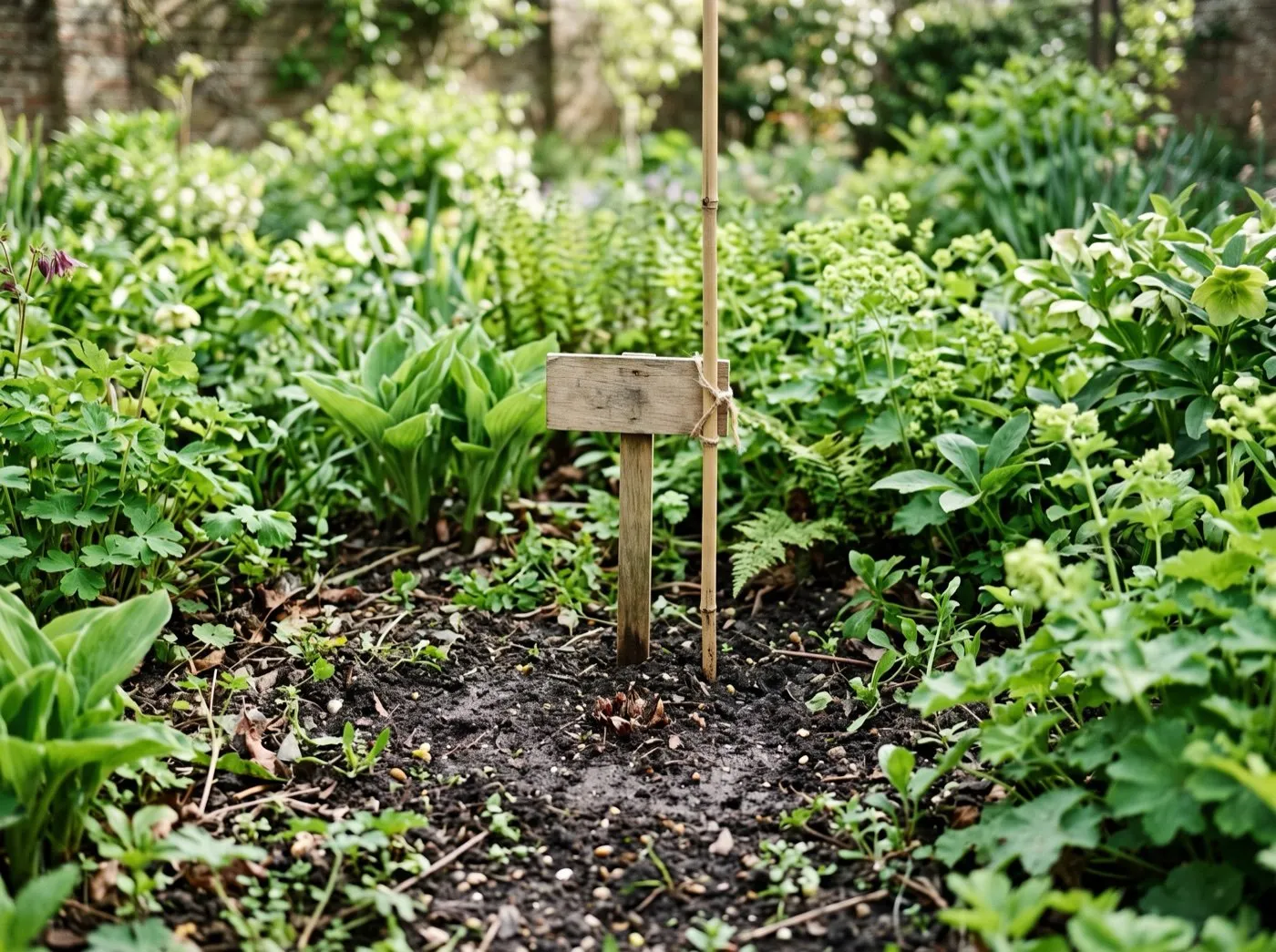 Mark the crown in autumn. Milkweed stays below ground long after other perennials are up, and the bare spot fools everyone.
The fix costs nothing. Mark the crown with a labelled cane in autumn, before the top growth dies down, so you know exactly where it is and leave it alone. Then be patient. When it does come up, milkweed grows fast and catches up quickly.
For planting itself, match the hole to the species. Swamp milkweed goes into ordinary or damp soil with no special treatment. Butterfly weed needs a hole improved with a third grit and a raised crown on heavy ground. Set both at the same depth they sat in the pot, water in, and space plants 45-60cm apart. Group three or five for the best show and the strongest pollinator pull.
Month-by-month milkweed calendar
| Month | Task |
|---|---|
| January | Do nothing; leave dead stems standing for crown protection and seed for birds |
| February | Sow seed into damp paper or vermiculite in the fridge to stratify for spring |
| March | Sow stratified seed under glass at 18-20C; leave outdoor crowns untouched |
| April | Resist tidying; the bare crown is not dead, only late. Do not dig the spot |
| May | Main emergence begins; plant pot-grown stock once soil is warm and frost has passed |
| June | Late crowns finally show; plant out seedlings after hardening off; water dry-soil plants |
| July | First flowers open; enjoy peak pollinator activity; deadhead A. syriaca to stop seeding |
| August | Full flowering; count the bees and hoverflies; keep swamp milkweed watered in drought |
| September | Flowering fades; seed pods swell and start to ripen from green to brown |
| October | Collect ripe seed as pods split, or leave some for the birds and self-sowing |
| November | Top growth dies back; mark every crown with a labelled cane before it vanishes |
| December | Leave the plant alone; standing stems shelter the crown through winter wet |
What are milkweed seed pods and silk?
The seed pods are half the fun of growing milkweed. After flowering, each fertilised head produces slim, horn-shaped pods, 5-10cm long depending on species, which turn from green to brown as they ripen through autumn. When ripe, they split along one seam to reveal ranks of flat brown seeds, each attached to a tuft of fine silky floss. On a dry, breezy day the pods burst open and the seeds drift off on their parachutes, sometimes carrying a long way.
That silk, called the coma, is what spreads milkweed, and it is worth knowing if you want to control self-seeding or collect seed for sowing. To save seed, cut the pods just as they begin to split, before the silk fluffs out, and open them somewhere sheltered indoors. Separate the seeds from the floss over a bowl, or slide a coin into the split pod to hold the seeds together while you pull the silk away in one piece. Store dry seed cool over winter, then stratify and sow in spring.
If you would rather the plant did not sow itself around, simply cut the pods off before they open. This is essential with common milkweed and optional with the clump-formers, which self-seed only gently. Gomphocarpus, the balloon plant, carries the showiest pods of all, and its inflated hairy spheres are the whole reason many people grow it.
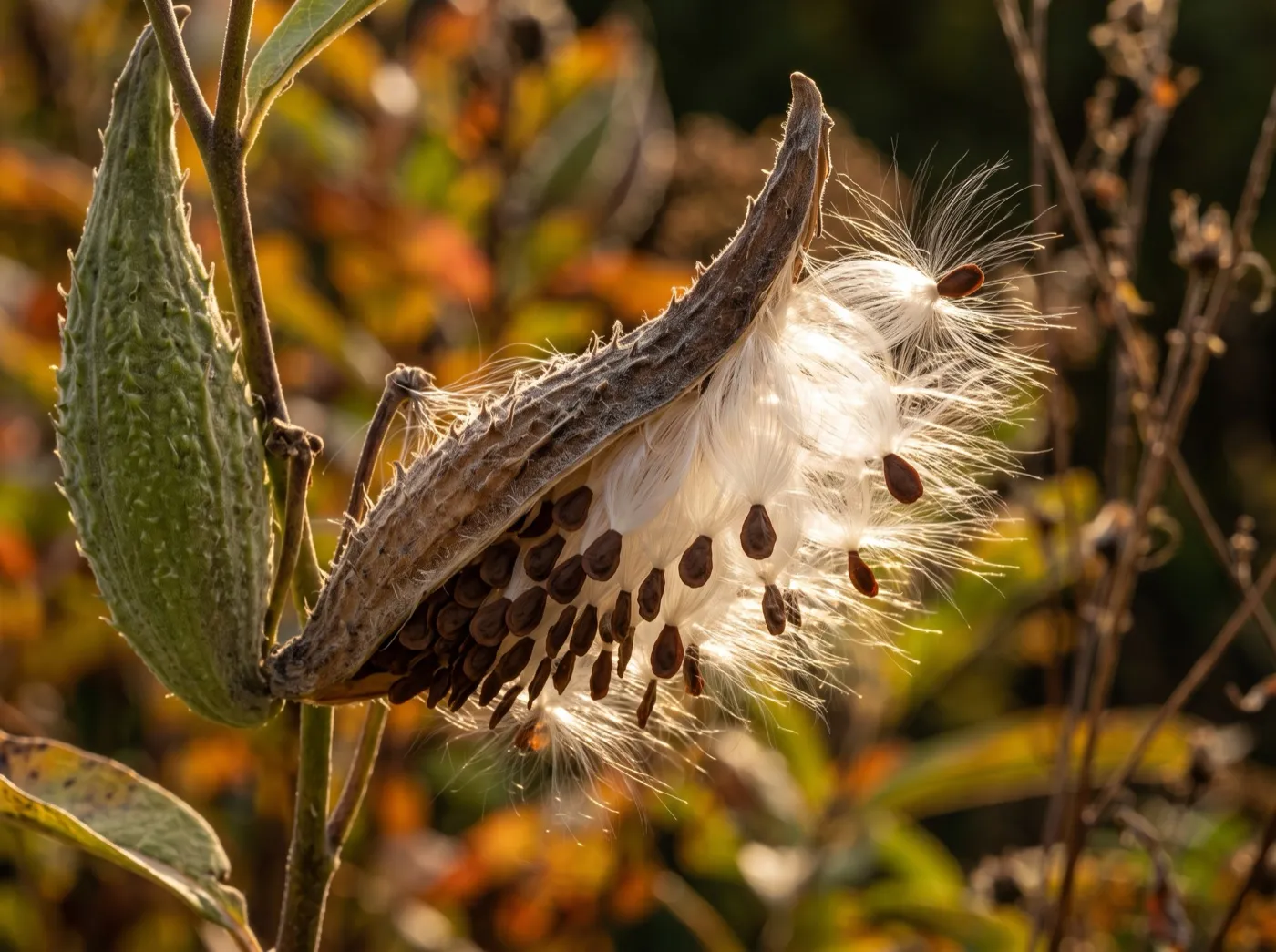 Ripe pods split to release silk-tufted seeds on the wind. Cut them before they open to collect seed or to stop self-sowing.
Which pollinators does milkweed attract in the UK?
This is the reason to grow milkweed here, and it delivers. The flowers are built to reward nectar-feeders, with sugar-rich nectar held in structures that make insects work, and in doing so pick up the plant’s pollen. Across a British summer that means a steady, varied crowd of visitors from July into September.
To get the most from it, plant milkweed in a sunny, sheltered spot where insects can work undisturbed, and site it near other nectar plants so pollinators have a reason to linger. It combines well with the hoverflies and solitary bees favourites already in most wildlife borders, and it slots naturally into a mini meadow or wildflower area among grasses and other perennials. If you track which insects turn up, a milkweed clump is a good place to learn your bumblebee species, because they visit so reliably and feed so long that you can watch them properly.
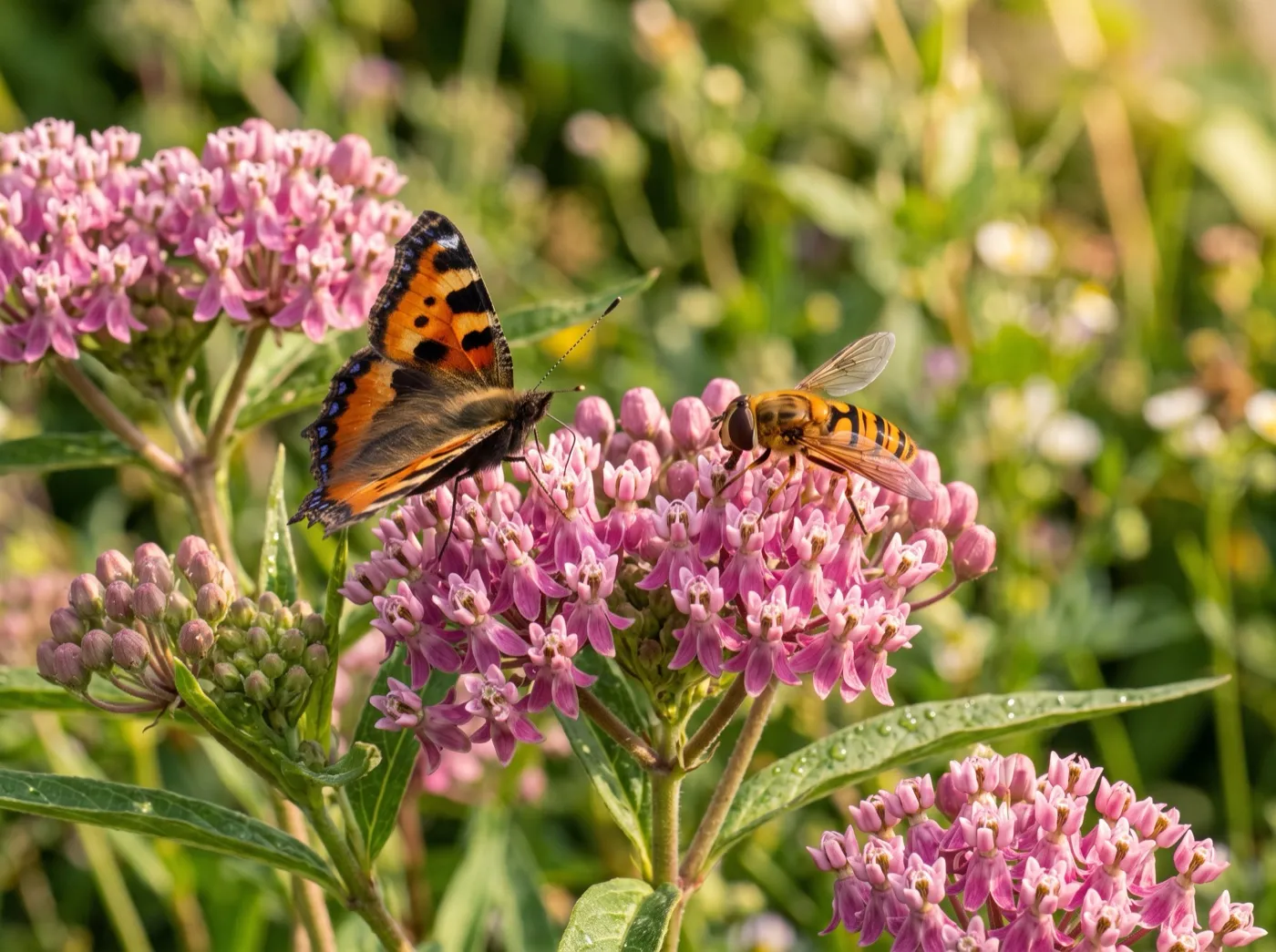 Milkweed feeds a wide range of UK pollinators from July onwards. This is its genuine value here: nectar through the late-summer gap.
Common mistakes when growing milkweed
Most milkweed failures come from applying American advice to British conditions, or from getting the species and its soil the wrong way round. Avoid these and the plant is close to trouble-free.
Growing it for monarchs
The commonest misunderstanding of all. Monarchs do not breed in the UK, so milkweed is not a caterpillar nursery here. Grow it as a nectar plant for our own bees, hoverflies and butterflies, and judge it on that. Held to the right expectation, it excels.
Planting butterfly weed on wet clay
Butterfly weed dies in cold, saturated soil. Gardeners plant it in an ordinary damp border, watch it rot over winter, and blame the cold. Give it sharp drainage, a raised bed or a gritty pot, or grow swamp milkweed instead, which actively wants the damp.
Digging up a late crown
Milkweed emerges weeks after everything else and looks dead in spring. Mark the crown in autumn and leave the spot alone until June. Do not dig it over. Do not plant on top of it. It is not dead, only slow.
Handling the sap bare-handed
The milky sap irritates skin and can hurt your eyes badly. Always wear gloves, keep sap away from your face, and wash your hands after. This is basic and worth repeating, because the plant looks harmless and is not.
Letting common milkweed run
Planting A. syriaca in an open border invites a spreading colony that is hard to remove and is EU-listed as invasive. Contain it, deadhead it, or skip it in favour of the well-behaved clump-formers.
Now you know which milkweed to grow and why the monarch story does not apply here, plan the rest of your nectar border with our guide to early spring pollinator plants so your garden feeds insects from the first warm days to the last.
Our team produces practical UK gardening guidance from source research, contributor records and established horticultural practice. Editorial standards are overseen by Matt W.