Key takeaways
- Chocolate cosmos is a tender tuberous perennial, not the annual cosmos you grow from seed
- The maroon flowers really do smell of dark chocolate, strongest on warm, still afternoons
- Rated RHS H3, it needs the dahlia treatment: lift the tubers after first frost or mulch deeply in mild areas
- Grow it in full sun in moist but well-drained soil, or in a pot you can move under cover
- Propagate by basal cuttings in spring; the thin-necked tubers do not split cleanly like dahlias
- The original clone is sterile and sets no seed; fertile cultivars like 'Chocamocha' are newer selections
Chocolate cosmos is the plant that stops people in their tracks when they catch the scent. Cosmos atrosanguineus carries small, velvety, deep maroon flowers on thin wiry stems, and on a warm afternoon they smell unmistakably of dark chocolate. It is one of the few plants that lives up to a gimmicky name. Get your nose to the flower and there it is: cocoa, with a faint edge of vanilla.
What is chocolate cosmos?
Chocolate cosmos is a tender tuberous perennial from Mexico, grown for its chocolate-scented, maroon-crimson flowers in late summer. Botanically it is Cosmos atrosanguineus, a member of the daisy family. It builds a low clump of divided, ferny leaves, then throws up branching wiry stems to about 60-75cm, each topped with a single bowl-shaped flower around 4-5cm across.
The colour is the first thing you notice. The petals are so dark a red that they read as brown-black in shade and glow deep crimson in low sun, with a soft, velvety, almost felt-like texture and a yellow-and-dark central disc. From a distance the flowers hover over the foliage like small dark moths, and the whole plant has an airy, see-through quality.
The scent is the second thing. On a warm, still afternoon the flowers release a genuine dark-chocolate smell, sometimes with a hint of vanilla. It is not strong across a border; you have to lean in. Warmth drives it, so a plant in full afternoon sun smells far more than one in shade, and the scent all but vanishes on a cool, breezy day.
This is a very different plant from the cosmos most people know. If you want the tall, fast annuals in pink and white, that is a separate species and a separate job. Our guide to how to grow cosmos from seed covers those. Chocolate cosmos grows from a tuber, comes in one deep colour, and is kept year to year, not sown fresh.
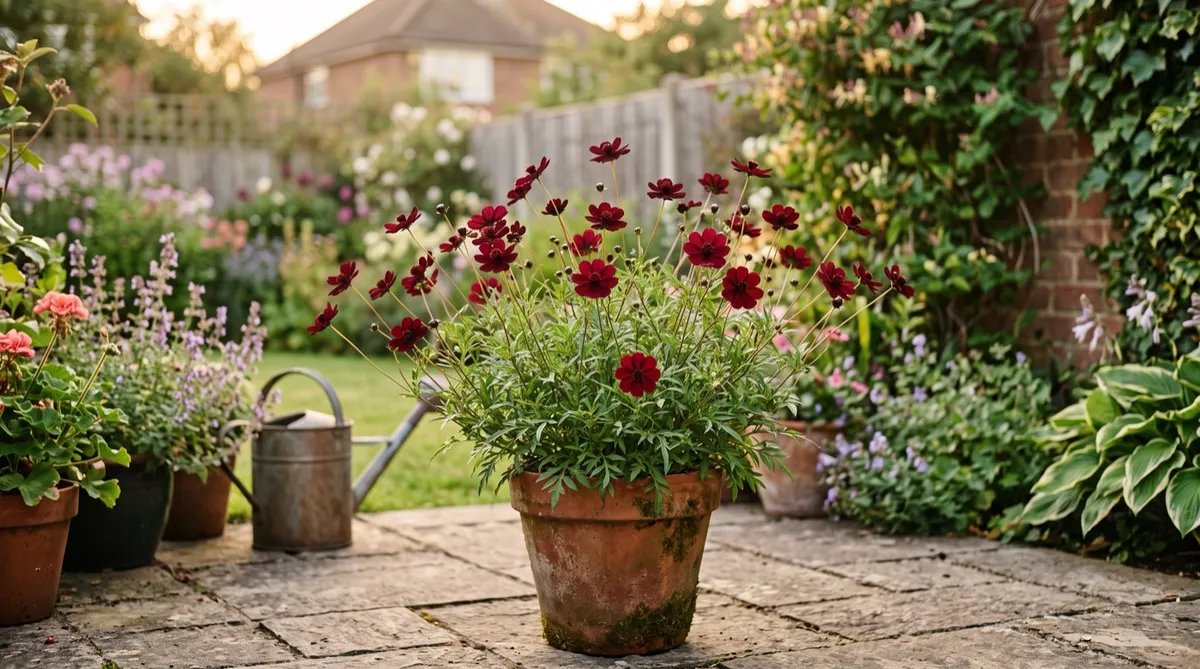
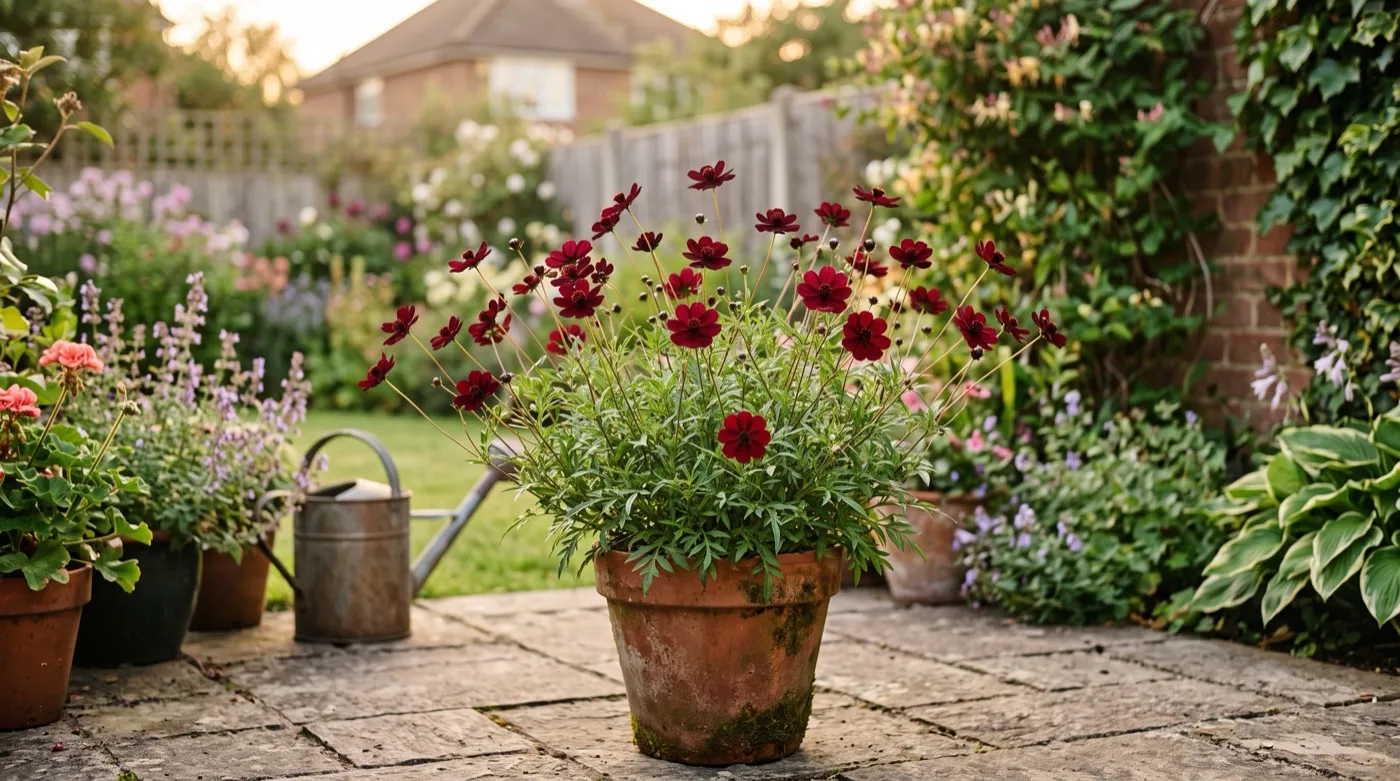 Chocolate cosmos in a terracotta pot: velvety maroon flowers on thin, wiry stems, scented of dark chocolate on warm afternoons.
The strange story: extinct in the wild and grown from one clone
Chocolate cosmos has one of the odder back stories in the garden. For most of the last century the plant in cultivation was thought to be extinct in the wild, and every specimen grown in Britain descended from a single plant. That plant was collected in Mexico around 1902. Because the classic chocolate cosmos is self-incompatible, it sets no viable seed, so gardeners could only increase it by dividing tubers or, later, by tissue culture.
The upshot is remarkable. If you bought the traditional Cosmos atrosanguineus during the twentieth century, you were growing a clone: genetically identical to plants across the world, all traced to that one Mexican collection. That sterility is why so many gardeners are puzzled when their chocolate cosmos never sets seed.
That has changed in recent decades. Breeders have raised fertile forms and named cultivars. ‘Chocamocha’ is the best known: compact, around 30cm, with a stronger scent, ideal for pots. Others include ‘Black Magic’, the darker ‘Eclipse’, and ‘Cherry Chocolate’. Some newer strains grow from seed, but the classic velvety-maroon species you picture when you hear the name is still the sterile clone.
Gardener’s tip: Buy chocolate cosmos as a growing plant or a dormant tuber in spring, never expecting seed. If a supplier sells “chocolate cosmos seed”, check the species. It will be a lookalike or a newer fertile strain, not the true scented clone. The real thing is only ever sold as a tuber or a potted plant.
Chocolate cosmos vs annual cosmos vs dahlia
It helps to place chocolate cosmos between the two plants gardeners most often confuse it with. It shares a name with annual cosmos and shares a lifecycle with the dahlia. Understanding both saves you from treating it wrongly.
Annual cosmos is a throwaway summer plant. You sow it in spring, it flowers hard for one season, then dies with the frost and you start again. Chocolate cosmos, by contrast, is a perennial you keep. And the way you keep it is pure dahlia: an underground tuber that must be protected from winter frost, either lifted and stored or heavily mulched. If you already grow dahlias, you know almost everything you need. Our guide to growing dahlias covers the same lift-and-store rhythm in more detail.
| Feature | Chocolate cosmos | Annual cosmos | Dahlia |
|---|---|---|---|
| Species | Cosmos atrosanguineus | Cosmos bipinnatus | Dahlia hybrids |
| Lifecycle | Tender perennial | Annual | Tender perennial |
| Grows from | Tuber | Seed | Tuber |
| Flower colour | Deep maroon only | Pink, white, crimson | All colours |
| Scent | Dark chocolate | None to speak of | Little to none |
| Propagation | Basal cuttings | Seed | Division or cuttings |
| Overwintering | Lift or mulch tuber | None; dies with frost | Lift or mulch tuber |
| Hardiness | RHS H3 (tender) | Half-hardy annual | RHS H3 (tender) |
To understand where the tuber sits among the other underground storage organs, our explainer on bulbs, corms, tubers and rhizomes is worth a read; a chocolate cosmos tuber behaves much like a small dahlia one.
Where to plant chocolate cosmos: sun and drainage
Chocolate cosmos needs full sun and a moist but free-draining soil to flower well and survive. This is a warmth-loving Mexican plant. In sun it flowers hard, smells strongest, and builds a tuber fat enough to store. In shade it sulks, produces few flowers, and barely scents at all.
Give it at least six hours of direct sun a day, ideally a hot, sheltered spot. The foot of a south or west-facing wall is perfect: the stored heat lifts the scent and shelters the plant from the wind that snaps its wiry stems. A sunny raised bed, the front of a warm border, or a patio pot all suit it.
Do not plant out until all danger of frost has passed, usually late May, later in the north. A young plant put out too early is easily killed by a late frost, so harden off garden-centre stock for a week first.
 The dahlia-like tuber. Chocolate cosmos grows from this fleshy root, which must be kept frost-free through winter to regrow.
Growing chocolate cosmos in pots vs the border
Chocolate cosmos does well both in a pot and in a border, and the right choice comes down to your soil and how you plan to overwinter it. A pot is the easier option for most UK gardeners, especially on heavy or wet ground, because it solves the drainage problem and makes lifting for winter a non-event.
In a pot, use a container at least 25cm wide with good drainage holes and a free-draining mix: two parts John Innes No.2 to one part horticultural grit. One tuber per pot suits the species; the compact ‘Chocamocha’ works in a smaller pot on a table where you can smell it. Stand it in full sun, water through summer, and feed. When frost threatens, carry the whole pot into a frost-free shed or greenhouse. No lifting, no cleaning.
In the border, chocolate cosmos earns its place threaded among other late-summer plants, the dark flowers floating over its neighbours. Plant it 30-40cm apart in improved, free-draining soil, the top of the tuber about 5cm down, in groups of three or more. The trade-off is winter: on all but the mildest, best-drained sites you must lift the tubers, which is more work than moving a pot.
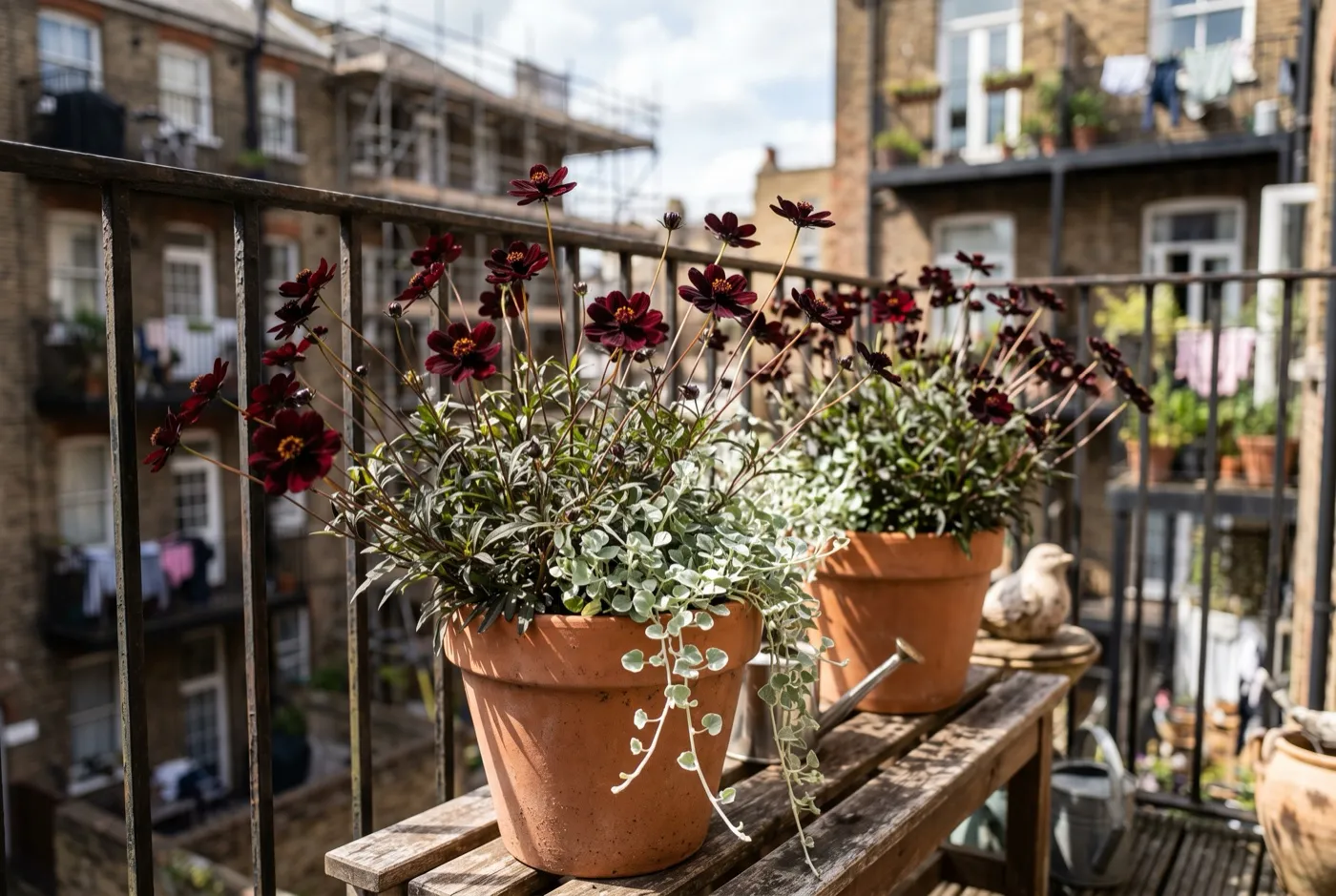 Grown in pots on a sunny balcony, chocolate cosmos is easy to move under cover for winter. A container solves the drainage problem too.
Feeding and watering for more flowers
To keep chocolate cosmos flowering from July to the frosts, water steadily and feed with a high-potash fertiliser. Unlike drought-tolerant Mediterranean plants, it likes a moist root run in summer. Let it dry out badly and flowering stalls, as the buds abort.
Water plants in the ground once or twice a week in dry spells, more for anything in a pot, which dries fast in full sun. Keep the compost evenly moist, never bone dry and never sitting in a saucer of water.
Feeding makes the difference between a shy plant and a generous one. Nitrogen-heavy feeds give leaf at the expense of flower. Switch to a high-potash feed, the same tomato food you use on dahlias, every two weeks from midsummer. Potash drives flower and helps the tuber ripen for winter. In the ground, a scatter of general fertiliser in spring plus liquid tomato feed through summer is plenty.
Month-by-month chocolate cosmos calendar
| Month | Task |
|---|---|
| January | Check stored tubers monthly; discard any that are soft or rotting, lightly re-moisten if shrivelling |
| February | Keep tubers cool and frost-free; resist starting them too early |
| March | Pot up stored tubers in gritty compost, water sparingly, give gentle bottom heat to start growth |
| April | Growth begins; take basal cuttings from new shoots; grow plants on frost-free |
| May | Harden off; plant out only once all frost risk has passed, usually late May |
| June | Water in new plants; begin liquid high-potash feeding as buds form |
| July | Flowering starts; feed fortnightly, deadhead spent blooms, water in dry spells |
| August | Peak flowering and scent; keep deadheading and feeding for a long display |
| September | Flowers continue; ease off feeding late in the month as growth slows |
| October | First frost blackens foliage; lift and dry tubers, or apply deep mulch on mild sites |
| November | Clean and store lifted tubers frost-free in barely-damp compost or vermiculite |
| December | Check stored tubers for rot; keep the store cool, dark and free of frost |
Deadheading and keeping the display going
Deadhead chocolate cosmos regularly to keep it flowering into autumn. Like most daisies, it flowers harder when you stop it setting seed. Even though the sterile clone never makes viable seed, the plant still spends energy on fading flowers, so removing them redirects that effort into new buds.
Snip each spent flower just above the next leaf or side shoot, with fingers or small scissors, every few days at the height of summer. A well-deadheaded plant carries fresh flowers from July right up to the first frost, while a neglected one looks tired by September. Our guide to deadheading flowers covers the technique.
The flowers also cut well for a small vase, though the wiry stems are short. A few stems in a jam jar fill a room with faint chocolate scent on a warm day. Chocolate cosmos sits nicely among the darker options in our roundup of the best flowers for cutting.
 The velvety maroon flower and its yellow-and-dark central disc. The chocolate scent is strongest when you lean in on a warm afternoon.
Is chocolate cosmos hardy? Understanding the frost problem
Chocolate cosmos is tender, rated RHS H3, so it survives only to about -5C to 1C. That puts it among the plants you cannot rely on to overwinter outdoors across most of the UK. In a mild, sheltered coastal or city garden on light soil it may come through a normal winter in the ground. On cold, wet or exposed sites it will be killed.
So plan for winter from the start. You have three routes: lift and store the tuber, mulch it deeply on a mild site, or grow it in a pot and move the pot under cover. The pot route is safest and least work. Our wider guide to protecting plants from frost sets out the principles; the sections below give the exact routine.
Overwintering chocolate cosmos: the dahlia routine
Overwinter chocolate cosmos exactly as you would a dahlia: lift the tuber after the first frost, dry it, and store it frost-free until spring. This is the most important skill for keeping the plant year to year, and it is straightforward once you have done it once.
Wait for the first proper frost to blacken the top growth, usually October. That frost signals the plant to move energy into the tuber. Cut the stems to about 5cm, then ease the tuber out with a fork, lifting from well clear so you do not spear it. Brush off the soil.
Let the tuber dry for a few days somewhere cool and airy, upside down, so moisture drains from the hollow stems. Then pack it into a box of barely-damp old compost, spent coir or vermiculite, crown just showing. Store it frost-free at 5-10C: a shed, garage or cool spare room all work. Check it monthly, remove anything soft or mouldy, and mist the medium lightly if a tuber shrivels.
On a mild site with free-draining soil, you can gamble on leaving it in the ground. Cut it back after the frost and pile on a deep, dry mulch, 15cm or more of bark, straw or leaf mould over the crown. This works in warm coastal and urban gardens on sandy soil, but it is a real risk on cold or heavy ground. Our guide to overwintering tender plants weighs up lifting versus mulching.
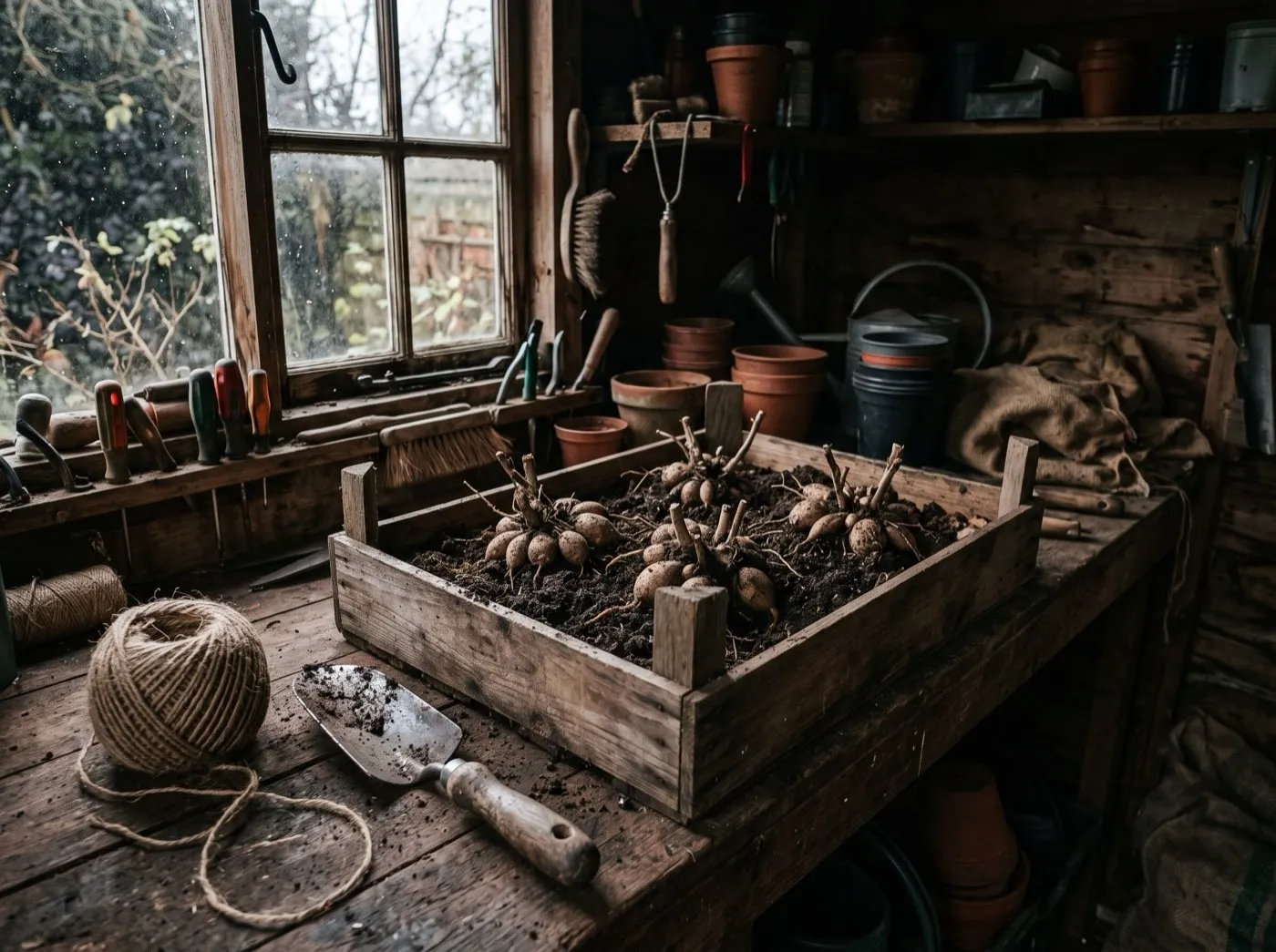 Lifted tubers stored in barely-damp compost in a cool, frost-free shed. Check monthly and remove any that turn soft.
Starting chocolate cosmos back into growth in spring
Restart stored tubers in early spring by potting them up in gritty compost and giving gentle warmth. From late February to March, bring the tubers out of storage. Discard any that are soft, hollow or rotten; a healthy tuber feels firm. Pot each one into free-draining compost, crown near the surface, and water sparingly at first.
Warmth wakes them. A little bottom heat from a heated propagator or warm windowsill speeds things up, and shoots appear within a few weeks. Keep the compost just moist until you see growth. Grow the plants on somewhere frost-free until the last frost has passed.
Do not rush them outside. Harden off over a week of daytime trips outdoors, then plant out in late May once nights are reliably above freezing. Plants started early indoors flower far sooner than tubers left to wake in cold ground, giving blooms from early July rather than August.
Propagating chocolate cosmos by basal cuttings
Propagate chocolate cosmos by basal cuttings in spring, not by dividing the tuber. This is the one place the dahlia comparison breaks down. Dahlia tubers form fat clumps you can slice into named-eye pieces. Chocolate cosmos tubers are thin and neck together awkwardly, with few clear growth points, so division is unreliable and often loses you the plant. Cuttings are the sure route to more.
The method pairs perfectly with the spring restart. As a stored tuber warms up and pushes short shoots, wait until they are 5-8cm long. Cut each off cleanly near its base with a sharp knife, taking a sliver of the crown if you can. Strip the lowest leaves, dip the cut end in rooting hormone, and push it into gritty, free-draining compost.
Keep the cuttings warm, ideally with bottom heat, lightly covered and out of direct sun. They root in three to four weeks. Once you see new leaves and roots at the drainage holes, pot them on and grow them frost-free until early summer. A single tuber gives several new plants this way, the cheapest way to build a drift or replace losses. For the wider principles, see our guide to plant propagation by cuttings, division and layering.
 Basal cuttings taken from a sprouting tuber in spring. Cut short shoots near the crown, dip in rooting hormone, and root them warm.
Pairing chocolate cosmos in dark-flower schemes
Chocolate cosmos is a designer’s plant, and it shines in dark, moody schemes. The near-black maroon flowers are too subtle to carry a border alone, but as a repeated accent they add depth that nothing else quite matches. The trick is contrast: place the dark flowers where something bright throws them into relief.
Silver and grey foliage does this best. Set chocolate cosmos against artemisia, senecio, or a silvery dianthus and the maroon looks richer still. Chartreuse and lime foliage works the same magic from the other direction. For hot, saturated schemes the maroon sits well among deep oranges, scarlets and bronzes, echoing a dark dahlia such as ‘Bishop of Llandaff’.
It also loves grasses. Threaded through a low, airy Stipa or a compact Pennisetum, the wiry stems and floating flowers read as intentional movement. Dark heucheras, Sedum and late salvias make good partners on the same sunny, well-drained ground. For putting these darker combinations together, our notes on the best plant combinations for UK borders give a framework.
Design around the scent. Because you have to lean in to catch it, place chocolate cosmos where you pass close by: beside a path, at the edge of a patio, or in a pot on a table. Grow it near other fragrant plants and you build a small scented corner; our roundup of the best scented plants for UK gardens suggests companions that carry perfume through the day.
 Chocolate cosmos as a dark accent, lifted by silver foliage and airy grasses in a moody late-summer border.
Common problems with chocolate cosmos
Most trouble with chocolate cosmos comes from treating it as hardier or thirstier than it is. Get a handful of things right and it is close to trouble-free.
Losing the plant over winter
The number one failure, nearly always because the plant was left in cold, wet ground. On all but the mildest, best-drained sites, lift the tuber and store it frost-free, or grow it in a pot you can move under cover. Do not assume a plant that flowered well all summer will simply reappear.
Few flowers or weak scent
Both usually trace to too little sun or the wrong feed. Chocolate cosmos wants a hot, open spot and a high-potash feed, not a shady corner and a nitrogen-rich general fertiliser. Move it into full sun and switch to tomato food.
Slugs and snails on new growth
The soft young shoots in spring are a magnet for slugs, exactly as dahlias are. Protect emerging growth with your usual method until the stems toughen up.
Tubers rotting in store
A tuber packed away damp, or stored somewhere that gets frost or stays warm and humid, will rot. Dry it before storing, keep the medium barely moist, hold the store at 5-10C, and check monthly.
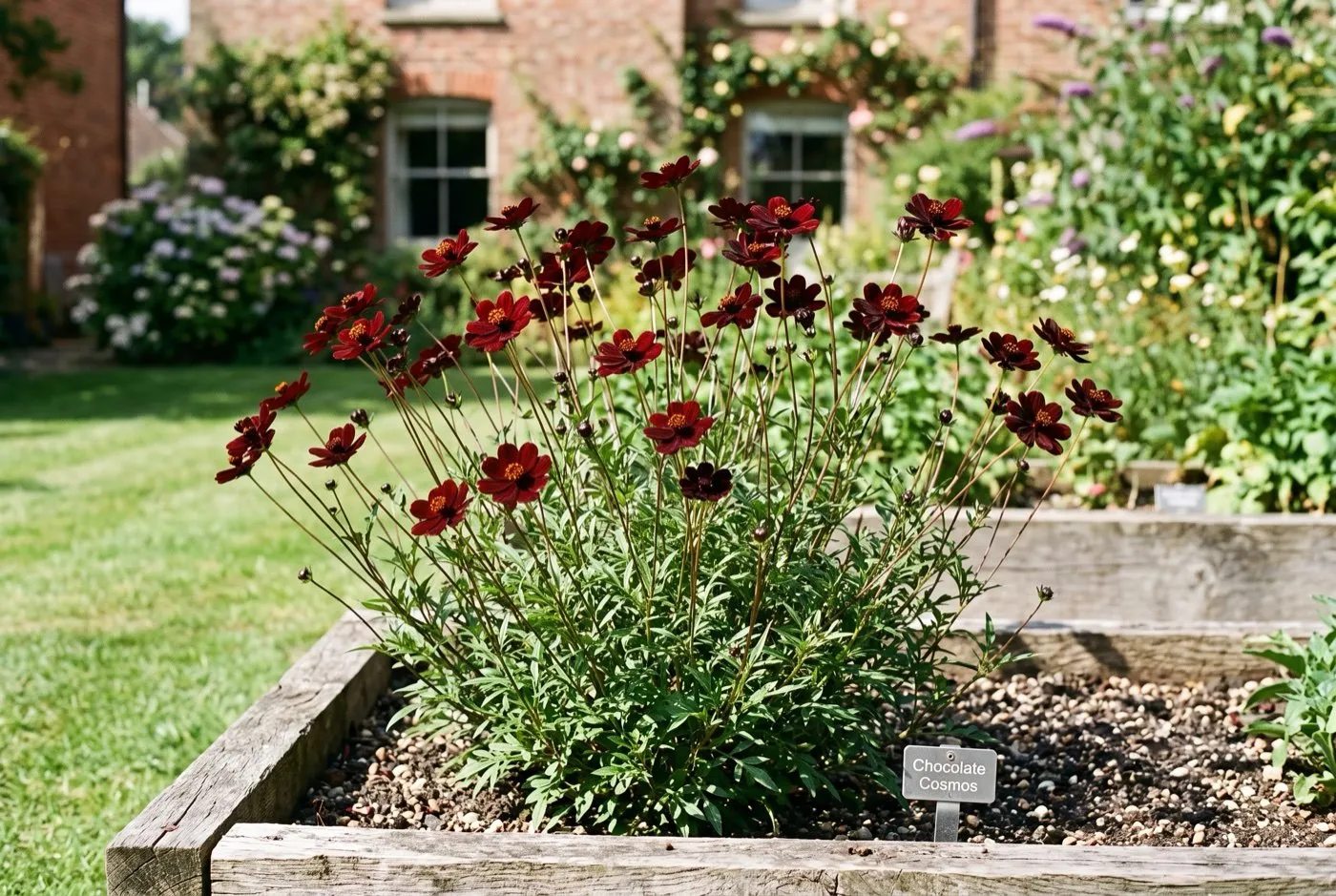 A well-grown clump in a sunny raised bed. Full sun, free drainage and high-potash feeding give the longest, most fragrant display.
Buying chocolate cosmos: species or named cultivar
Buying chocolate cosmos means choosing between the classic scented species and the newer named cultivars. The straight species, Cosmos atrosanguineus, reaches 60-75cm, flowers in the deepest maroon, and carries the strongest, most reliable chocolate perfume. It is sterile, so it sells only as a plant or tuber. ‘Chocamocha’ is compact at around 30cm and bred for an even stronger scent, ideal for a pot on a table. ‘Black Magic’ and ‘Eclipse’ push the colour closer to black, and some modern strains are fertile.
Frequently asked questions
Is chocolate cosmos a perennial?
Yes, chocolate cosmos is a tender tuberous perennial, not an annual. It grows from a dahlia-like tuber that returns year after year if protected from frost. Rated RHS H3, it survives outdoors only in mild, sheltered spots. In most of the UK you lift the tuber after the first frost and store it frost-free, or mulch deeply on light soil in a warm area.
Does chocolate cosmos really smell of chocolate?
Yes, the flowers give off a genuine dark-chocolate scent, sometimes with a hint of vanilla. It is strongest on warm, still afternoons and fades in cool or windy weather. Put your nose right to the bloom. The scent is a real chemical trait, not marketing, and the compact cultivar ‘Chocamocha’ is bred to smell stronger than the species.
How is chocolate cosmos different from ordinary cosmos?
They are different species with different lifecycles. Ordinary cosmos (Cosmos bipinnatus) is a fast annual grown fresh from seed each year in pinks and whites. Chocolate cosmos (Cosmos atrosanguineus) is a tender perennial grown from a tuber, in one deep maroon colour, and it smells of chocolate. You overwinter the tuber rather than sowing again.
How do you overwinter chocolate cosmos in the UK?
Treat it like a dahlia. After the first frost blackens the foliage, lift the tuber, cut the stems to 5cm, and let it dry for a few days. Store it frost-free at 5-10C in barely-damp compost or vermiculite through winter. In mild coastal or urban gardens on light soil you can instead leave it in the ground under a deep dry mulch.
Can you grow chocolate cosmos in pots?
Yes, and a pot is the easiest way to overwinter it. Use a container at least 25cm wide, gritty free-draining compost, and full sun. Feed with a high-potash tomato feed through summer for more flowers. When frost threatens, move the whole pot into a frost-free shed, porch or greenhouse and keep it barely moist until spring.
Why won’t my chocolate cosmos set seed?
The traditional plant is a single sterile clone. Nearly every old chocolate cosmos in cultivation descends from one plant collected in Mexico around 1902, and it is self-incompatible, so it sets no viable seed. That is why it is propagated by tubers and cuttings, not seed. Newer fertile cultivars exist, but the classic maroon species will never give you seed to sow.
How do you propagate chocolate cosmos?
Take basal cuttings in early spring with a little bottom heat. As the stored tuber wakes and pushes short shoots, cut them off near the base at about 5cm, dip in rooting hormone, and pot into gritty compost. The thin-necked tubers do not divide cleanly like dahlia clumps, so cuttings are the reliable route to more plants.
Our team produces practical UK gardening guidance from source research, contributor records and established horticultural practice. Editorial standards are overseen by Matt W.