Key takeaways
- Peregrine is the best all-round peach for UK gardens with excellent flavour and reliability
- Avalon Pride is the only widely available variety with natural peach leaf curl resistance
- Fan training against a south-facing wall is the most reliable method in UK climates
- A rain shelter from December to May prevents peach leaf curl without chemicals
- Hand pollination with a soft brush doubles fruit set because few insects fly in February
- Dwarf varieties like Bonanza fruit well in large containers on sunny patios
Peach trees are among the most rewarding fruit trees a UK gardener can grow. The flavour of a sun-warmed peach picked ripe from your own tree bears no resemblance to anything sold in supermarkets. UK-grown peaches ripen fully on the tree and develop a depth of flavour that imported fruit, picked green and ripened in transit, never achieves.
The challenge is that peach trees flower early, need warmth, and suffer from peach leaf curl. All three problems are solvable. A south-facing wall provides warmth. Hand pollination ensures fruit set. A simple rain shelter prevents leaf curl. Thousands of UK gardeners grow excellent peaches using these techniques, from Cornwall to Yorkshire. Read our guide to growing fruit trees for the general principles of fruit growing in UK gardens.
Which peach varieties grow best in the UK?
Variety choice matters more for peaches than almost any other fruit. The wrong variety in a cold garden fails completely. The right one crops reliably for decades.
| Variety | Flesh | Flavour | Ripens | Leaf curl resistance | Best for |
|---|---|---|---|---|---|
| Peregrine | White | Excellent, rich | Mid-August | Low, needs rain shelter | Best all-round flavour |
| Rochester | Yellow | Good, sweet | Early August | Low | Reliable cropper |
| Red Haven | Yellow | Very good | Late July | Moderate | Early harvest |
| Avalon Pride | Yellow | Good | Mid-August | High, naturally resistant | Leaf curl problem areas |
| Duke of York | White | Excellent | Late July | Low | Early, fine flavour |
| Garden Lady | Yellow | Good | August | Moderate | Containers, dwarf tree |
Peregrine is the UK standard. RHS Award of Garden Merit. Outstanding flavour that the RHS Fruit Group consistently rates as the finest UK-grown peach. White-fleshed, red-blushed skin. The benchmark against which all others are judged.
Avalon Pride is the breakthrough variety for gardeners tired of fighting leaf curl. It shows strong natural resistance to Taphrina deformans and produces good crops without a rain shelter. The flavour is a step below Peregrine but the convenience of growing without protection makes it the top choice for busy gardeners or wet regions.
Rochester is the classic commercial peach with reliable yellow-fleshed fruit. Slightly earlier than Peregrine. A solid choice where you want dependability rather than peak flavour.
How do you fan-train a peach against a wall?
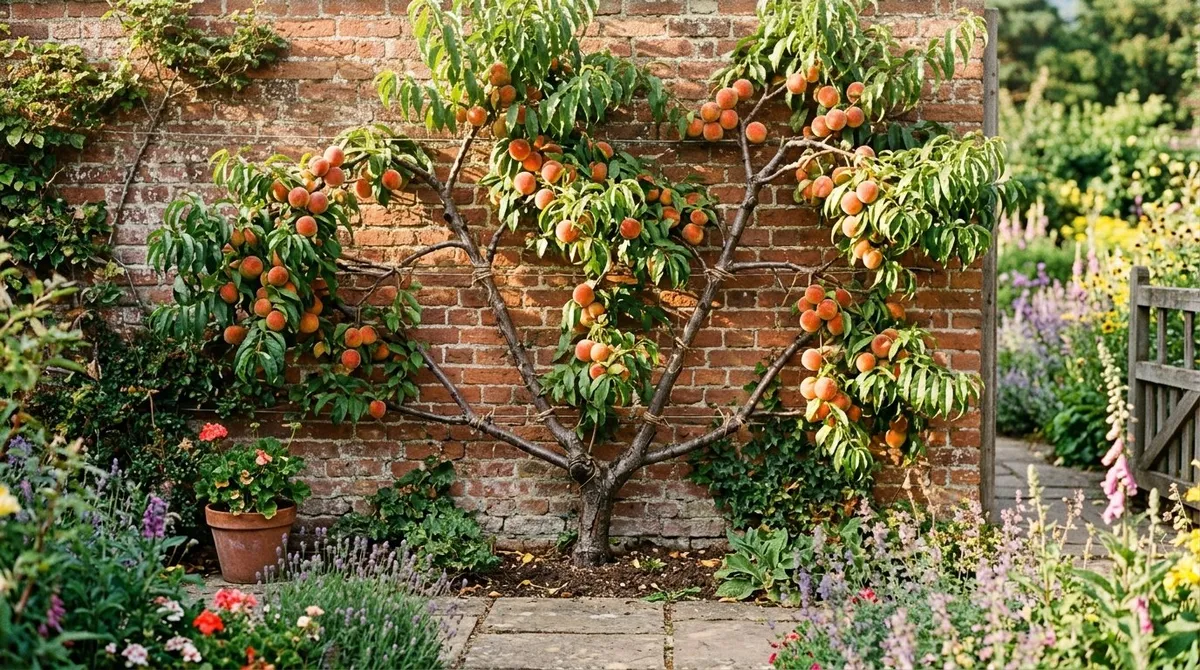
Fan training is the best method for UK peach growing. The wall provides reflected heat, shelter from wind, and a framework for the rain shelter that prevents leaf curl.
Wall requirements: South-facing or south-west facing. Minimum 3 metres wide and 2.5 metres tall. Fix horizontal wires at 15cm intervals using vine eyes and 3mm galvanised wire. The lowest wire should be 40cm from the ground.
Starting a fan: Buy a partially trained maiden or two-year fan from a specialist nursery. A maiden whip (single stem) takes an extra year but costs less. Cut a maiden to 60cm in February and select two strong side shoots. Tie these to canes angled at 45 degrees. The following year, select 3-4 shoots from each arm and train them to fill the wall space.
Rootstock matters. St. Julien A produces a tree filling a 4m wall. Pixy gives a smaller tree for a 3m wall or large container. Montclair is the most dwarfing for containers and restricted spaces.
The key principle is that peaches fruit on wood produced the previous year. Every year you must generate new replacement shoots while removing wood that has already fruited. This annual renewal keeps the tree productive. Our guide to training fruit trees as espaliers covers the basic principles of wall-trained fruit.
How do you prevent peach leaf curl?
Peach leaf curl is caused by the fungus Taphrina deformans. It distorts and reddens new leaves in spring, weakening the tree and reducing the crop. Left untreated, it can debilitate a tree within a few seasons. It is the single biggest challenge for UK peach growers.
The rain shelter method is the most effective prevention. The fungus spores land on buds during winter rain. Keep rain off the tree from December to late May and the spores cannot infect.
Build a simple shelter:
- Fix a wooden batten or metal bracket to the wall above the tree’s top wire.
- Attach clear polycarbonate sheets or heavy-gauge clear plastic, angled outward and downward.
- The shelter must extend at least 30cm beyond the tree on each side.
- Leave the front open for air circulation. Do not create a sealed box.
- Remove the shelter in late May once new leaves have fully expanded and hardened.
Chemical alternatives: Copper fungicide (Bordeaux mixture) sprayed at leaf fall in November and again in February provides partial protection. It is less effective than a rain shelter in wet winters, which describes most of the Midlands and north.
If leaf curl strikes: Pick off affected leaves as soon as you see them. Water and feed the tree well. It will usually produce a second flush of clean leaves in June. A strong tree recovers from one bad year. Two consecutive bad years weakens it significantly.
How do you hand-pollinate peach flowers?
Peach trees flower in February and early March, when temperatures in most UK gardens are between 2 and 10 degrees Celsius. Very few pollinating insects fly at these temperatures. Without intervention, fruit set is poor.
Technique: Use a soft artist’s paintbrush, a makeup brush, or a ball of cotton wool on a stick. Visit every open flower and gently brush the centre to collect and deposit pollen. Work around the tree systematically so you do not miss flowers. The best time is late morning on a dry day when the pollen is powdery.
Pollinate every other day while flowers are open. A well-pollinated tree sets far more fruit than it can ripen. You will need to thin the fruitlets in May anyway, so do not worry about over-pollinating.
Thinning fruitlets: In May and early June, when fruitlets are walnut-sized, thin to one fruit every 15-20cm along the branch. This produces fewer but much larger and better-flavoured peaches. Without thinning, you get masses of small, tasteless fruit that may split.
Can you grow peach trees in containers?
Container growing suits gardeners without a south-facing wall or with limited space. Genetic dwarf varieties perform well in large pots and produce full-sized fruit on compact trees.
Best container varieties: Bonanza (naturally dwarf, 1.5m, good flavour, August). Garden Lady (compact, 1.2m, yellow flesh, August). Both are self-fertile.
Container setup:
- Pot: 50-litre minimum. Half-barrel, large terracotta, or plastic pot with drainage holes.
- Compost: John Innes No. 3 mixed with 20% perlite for drainage. Avoid peat-free multipurpose composts alone as they dry out too fast and lack weight for stability.
- Position: Full sun against a south-facing wall. Move against the wall for winter, into an open position for summer.
- Watering: Daily in summer. Peaches in pots dry out fast and dropped fruit is usually caused by inconsistent watering.
- Feeding: High-potash liquid feed (tomato food) fortnightly from March to August. Top-dress with fresh compost each spring.
Repot every three years into slightly larger containers, or root-prune and replant into the same pot with fresh compost. See our fruit in pots guide for general container fruit-growing advice.
How do you prune fan-trained peach trees?
Pruning peach trees follows a different logic from apples and pears. Peaches fruit on shoots produced the previous summer. The aim of pruning is to remove wood that has fruited and replace it with new growth.
Spring pruning (April):
- Remove any shoot growing directly towards the wall or directly outwards.
- Select one replacement shoot at the base of each fruiting shoot. Tie it in parallel to the wall.
- Allow one shoot to grow from the tip of each fruiting branch for extension.
- Remove all other new shoots to prevent congestion.
After harvest (August-September):
- Cut each fruited shoot back to the replacement shoot you selected in spring.
- Tie the replacement shoot into the position of the removed fruited shoot.
- This replacement shoot will produce next year’s fruit.
Winter: Do not prune peach trees in winter. Open cuts in cold, wet weather invite bacterial canker and silver leaf disease. All pruning happens in the growing season when cuts heal quickly. Our guide to pruning fruit trees covers the principles that apply across all trained fruit.
When and how do you harvest UK peaches?
Peaches ripen over a two to three week period from late July to early September, depending on variety and location. In the West Midlands, expect Peregrine to ripen from mid to late August.
Signs of ripeness:
- The background colour changes from green to yellow or cream.
- The fruit gives slightly when pressed gently near the stalk end.
- A ripe peach pulls away from the branch with a gentle twist. If you have to tug, it is not ready.
- The aroma is noticeable when you stand near the tree.
Pick every two to three days as fruit ripens unevenly across the tree. Sun-facing fruits ripen first. Fruits in the interior and lower branches ripen last.
Handling: Peaches bruise easily. Handle with care and eat or process within 2-3 days. They do not store well. For preserving, make jam, freeze sliced fruit, or bottle in light syrup. A mature fan-trained Peregrine on St. Julien A rootstock produces 10-15kg of fruit per year. That is more than enough for fresh eating, jam, and a few bags for the freezer.
What pests and diseases affect UK peach trees?
Beyond leaf curl, several other problems can affect UK peach trees.
Bacterial canker: Causes sunken, gummy lesions on branches. Prune out affected wood in summer only. Copper spray at leaf fall helps prevent it. See our canker guide for details.
Silver leaf: Fungal disease entering through winter pruning wounds. Affected branches show a silvery sheen on leaves. Cut back to clean wood in summer. Never prune stone fruit in winter.
Peach-potato aphid: Greenfly on new growth in spring. Spray with soapy water or leave for ladybirds and hoverflies. Rarely causes serious damage on outdoor trees.
Brown rot: Affects ripening fruit, causing brown patches with white fungal spots. Remove and destroy affected fruit immediately. Do not compost it. Good air circulation and prompt harvest reduce risk.
Birds: Bullfinches strip flower buds in late winter. Netting the tree from January to March protects buds. Blackbirds and starlings peck ripening fruit. Net or use deterrent tape in summer.
Frequently asked questions
Can you grow peach trees outdoors in the UK?
Yes, peach trees grow outdoors in all UK regions with wall protection. Fan-train against a south or south-west facing wall for reflected heat and shelter. Free-standing peach trees crop reliably only in the warmest parts of southern England. In the Midlands and further north, wall training is essential. The wall stores daytime heat and releases it at night, raising the local temperature by 2-3 degrees Celsius.
What is the best peach tree for UK gardens?
Peregrine is the best all-round peach for UK gardens. It produces large, red-flushed fruits with white flesh and outstanding flavour. Peregrine crops reliably in most of England and Wales. For northern gardens or areas with persistent leaf curl, Avalon Pride resists the disease without treatment. Rochester is another reliable choice with yellow flesh and a slightly earlier harvest.
How do you prevent peach leaf curl?
A rain shelter from December to May prevents peach leaf curl. The Taphrina deformans fungus spreads in rain splash during winter and early spring. Keeping rain off the tree during this period stops infection. Use clear polycarbonate or plastic sheeting angled away from the wall. Remove the shelter in late May once new leaves have hardened. Copper fungicide sprayed in autumn and early spring is an alternative but less effective.
Do peach trees need hand pollination in the UK?
Hand pollination significantly improves fruit set on UK peach trees. Peach trees flower in February and March when few pollinating insects are active. Use a soft paintbrush or cotton wool ball to transfer pollen between flowers on warm, dry days. Brush each flower gently, working around the tree. Pollinate every other day while flowers are open for the heaviest crop.
Can you grow peach trees in pots in the UK?
Dwarf peach trees grow well in large containers. Choose a genetic dwarf like Bonanza or Garden Lady on a dwarfing rootstock. Use a 50-litre pot minimum with loam-based compost like John Innes No. 3. Water daily in summer and feed fortnightly with a high-potash fertiliser from March to August. Move the pot against a south-facing wall for winter and cover with fleece during hard frosts.
When do peach trees fruit in the UK?
UK peach trees fruit from late July to early September depending on variety and location. Peregrine ripens in mid-August in southern England and late August in the Midlands. Rochester is a week earlier. Red Haven is mid-July in warm years. Fruit is ripe when it gives slightly to gentle pressure and pulls away from the branch with a gentle twist. Pick every two or three days as fruits ripen unevenly.
How do you prune a fan-trained peach tree?
Prune fan-trained peach trees twice: in spring and after harvest. In April, remove shoots growing directly towards or away from the wall. Tie in replacement shoots parallel to the wall. After harvest in August, cut out the fruited wood back to the replacement shoot you tied in earlier. Peaches fruit on wood produced the previous year, so the aim is always to generate new growth for next year’s crop.
Our team produces practical UK gardening guidance from source research, contributor records and established horticultural practice. Editorial standards are overseen by Matt W.