Key takeaways
- Salsify has white skin and a delicate oyster flavour — hence its name 'vegetable oyster'
- Scorzonera has black skin and a milder, sweeter, nutty taste that most beginners prefer
- Both need 150-180 days from April sowing to November harvest — plan for the long haul
- Deep, stone-free soil is essential for straight roots — any obstruction causes forking
- Frost improves flavour by converting starches to sugars in the root
- Leave some roots in the ground over winter to harvest edible spring chards in March
Salsify and scorzonera are two of the most overlooked root vegetables in British gardening. Walk through any supermarket and you will not find them. Visit a farmers’ market in France or Belgium and they sit proudly alongside carrots and parsnips. These are crops that reward patience and a bit of soil preparation with flavours you cannot buy.
Both are long-season root vegetables sown in April and harvested from November through February. They share the same growing method, the same soil requirements, and the same place in the kitchen. Where they differ is in appearance and flavour, and understanding those differences helps you choose which to grow first.
What is the difference between salsify and scorzonera?
Despite often being grouped together, salsify and scorzonera are botanically distinct. Salsify (Tragopogon porrifolius) belongs to the daisy family and is sometimes called the vegetable oyster for the subtle seafood note in its cooked flesh. Scorzonera (Scorzonera hispanica) is also in the daisy family but a different genus entirely.
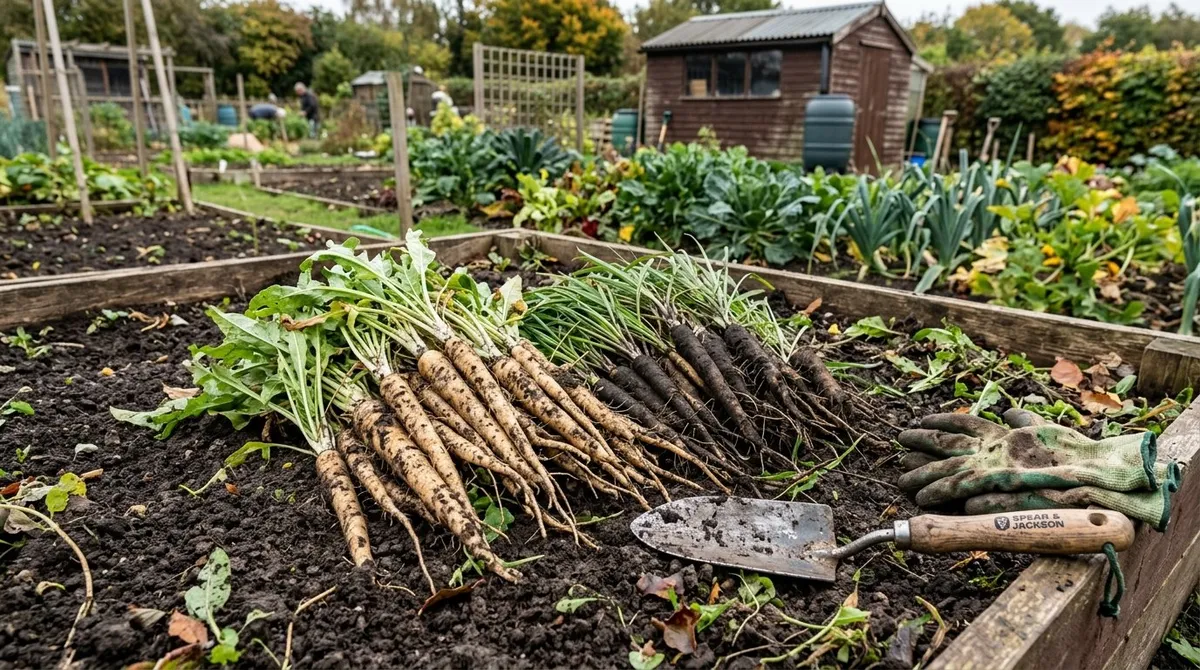
The roots look different at harvest. Salsify has pale, creamy-white skin resembling a slender parsnip. Scorzonera has coal-black skin covering white flesh. Both produce long, tapering roots 25-30cm in length when grown well.
| Feature | Salsify (T. porrifolius) | Scorzonera (S. hispanica) |
|---|---|---|
| Root skin colour | Creamy white | Coal black |
| Root flesh colour | White | White |
| Flavour | Subtle oyster or artichoke | Mild, sweet, nutty |
| Root length | 25-30cm | 25-30cm |
| Germination reliability | Moderate (60-70% with fresh seed) | Good (75-85% with fresh seed) |
| Forking tendency | High, needs perfect soil | Moderate, more forgiving |
| Ease of peeling | Fiddly, discolours fast | Easier, skin slips after cooking |
| Perennial option | No (biennial) | Yes (can leave 2 years) |
| Flower colour | Purple | Yellow |
| Days to harvest | 150-180 | 150-180 |
Scorzonera has a practical advantage. It is a perennial, meaning roots left in the ground for a second year grow thicker and longer. Salsify is strictly biennial and must be harvested in the first winter or it runs to seed the following spring. For beginners, scorzonera is the more forgiving crop.
How do I prepare the soil for salsify and scorzonera?
Soil preparation is the most important step. Both crops produce long, slender taproots that penetrate 25-30cm into the ground. Any stone, compacted layer, or lump of fresh organic matter in their path causes the root to fork, twist, or split. The result is unusable.
Depth and texture
Dig the bed at least 30cm deep in autumn or early winter. Remove every stone you find. On stony ground, this is tedious but essential. Break up any compacted subsoil with a fork. The goal is loose, fine-textured soil to at least spade-and-a-half depth.
If your soil is heavy clay or very stony, raised beds offer the best solution. Fill with a mix of sieved topsoil and well-rotted compost. A bed 30cm deep and at least 60cm wide provides enough root run. Our guide to raised bed gardening covers construction methods.
Fertility
Add well-rotted compost or leaf mould the autumn before sowing. Never add fresh manure in the same season as sowing. Fresh organic matter causes forking just as stones do. The nitrogen also promotes leafy top growth at the expense of roots.
Both crops follow potatoes well in a crop rotation because potatoes break up the soil and the manure applied for potatoes has time to decompose. This is the traditional placement in four-bed rotation systems.
How do I sow salsify and scorzonera?
Direct sowing is the only option. Both crops develop a single, deep taproot that cannot tolerate transplanting. Any disturbance causes forking.
When to sow
Sow in April once the soil has warmed above 7C. Earlier sowings in cold, wet soil produce poor germination. Later sowings (May or June) do not give the roots enough time to reach full size before winter. The window is narrow.
Seed viability
This is critical. Salsify and scorzonera seed loses viability faster than almost any other vegetable. Fresh seed (current year) germinates at 60-85%. Year-old seed drops to 30-50%. Two-year-old seed is rarely worth sowing. Always buy fresh seed each year. The long, feathery seeds are distinctive and cannot be confused with anything else.
Sowing method
Create drills 1.5cm deep in rows 30cm apart. Sow 2-3 seeds per station at 15cm intervals. Cover and water gently. Germination takes 10-21 days depending on soil temperature. Thin to the strongest single seedling at each station once the first true leaves appear. Avoid disturbing neighbouring seedlings when thinning.
For parsnips growers, the method is almost identical. The same soil preparation, the same direct-sowing approach, and the same need for patience. If you can grow parsnips successfully, salsify and scorzonera present no additional challenge.
How do I care for the growing crop?
Both crops are low-maintenance once established. The foliage is grass-like for salsify and broader for scorzonera, reaching 30-40cm tall by midsummer.
Watering
Keep soil consistently moist during the first 6 weeks after sowing. Once established, both crops tolerate dry spells well. Their deep taproots access moisture that shallow-rooted crops miss. Prolonged drought causes woody, fibrous roots, so water deeply during extended dry periods in July and August.
Weeding
Weed carefully by hand around the plants. Hoe between rows but keep the blade away from the crowns. Both crops grow slowly in the early stages and cannot compete with vigorous weeds. A mulch of compost or leaf mould applied once plants are 10cm tall suppresses weeds and retains moisture. Green manures sown between rows also help suppress weeds while adding organic matter.
Feeding
No additional feeding is needed if the soil was properly prepared with compost the previous autumn. On very poor soil, a light dressing of general-purpose organic fertiliser in June provides enough nutrients. Avoid high-nitrogen feeds, which promote leaves over roots.
Pest and disease
Both crops are remarkably trouble-free. White blister (Albugo tragopogonis) occasionally affects salsify leaves, producing white pustules on the underside. It is cosmetic and rarely affects the roots. Carrot root fly does not attack either crop. Slugs may damage young seedlings but lose interest once plants are established. The RHS pest and disease finder lists no major threats to either crop.
When and how do I harvest?
Timing matters. Both crops improve in flavour after exposure to frost. The cold converts stored starches into sugars, giving a sweeter, more rounded taste.
When to lift roots
Begin harvesting from November, after the first frosts. Roots left in the ground remain in good condition through December, January, and February. Lift as needed rather than all at once. The ground acts as the best possible storage.
Lifting technique
Push a long-handled fork into the ground 15cm away from the plant stem and lever gently. Work the soil loose before attempting to pull the root. Salsify and scorzonera roots snap easily when they meet resistance. A broken root cannot be stored and starts to discolour within minutes. Patience pays here.
On heavy clay, lifting is easier after rainfall when the soil is moist but not waterlogged. Dry clay grips roots like concrete.
Storage
Freshly lifted roots store for 2-3 weeks in a box of damp sand kept in a cool shed or garage at 2-5C. Do not wash roots before storing. The soil coating protects the skin from drying out. For longer storage, leave them in the ground and lift as needed.
What are chards and how do I harvest them?
Leave some roots in the ground over winter rather than lifting the entire crop. In late February or early March, these roots produce new shoots called chards. This is a second harvest from the same plants and a genuine gourmet ingredient.
Blanching the chards
Mound 10-15cm of soil, leaf mould, or straw over the crowns in late February. The shoots grow up through this covering and emerge blanched, pale, and tender. Without blanching, the shoots are green, tougher, and more bitter. The technique is the same principle used for forcing rhubarb and blanching chicory.
Harvesting
Cut blanched chards when they reach 15-20cm tall, roughly 3-4 weeks after mounding. Use a sharp knife to cut at ground level. Each root produces 3-5 shoots. The flavour sits somewhere between chicory and asparagus, delicate, slightly bitter, and unlike anything else in the garden.
Cooking chards
Steam or saut in butter for 3-4 minutes. The texture is tender and the flavour is delicate. Serve as a side vegetable with fish or poultry. In Belgium and northern France, salsify chards are considered a spring delicacy alongside asparagus.
How do I cook salsify and scorzonera roots?
Both roots deserve more attention in the kitchen than they receive. The flavour is subtle and refined, nothing like the strong earthiness of beetroot or the sweetness of carrots.
Preparation
Scrub roots clean under running water. Salsify discolours rapidly once the skin is broken. Peel and immediately drop into water with a squeeze of lemon juice (acidulated water). Scorzonera is easier. Boil or roast with the black skin on and it slips off readily once cooked.
Roasting
Cut prepared roots into even lengths of 8-10cm. Toss in olive oil with salt and a sprig of thyme. Roast at 200C for 25-30 minutes until golden and tender. This is the best cooking method for both crops. The edges caramelise and the interior turns creamy and sweet.
Boiling and serving
Boil prepared roots in salted water for 15-20 minutes until tender. Drain and serve with melted butter and parsley. A béchamel sauce or cheese sauce also pairs well, particularly with scorzonera. The texture is smooth and creamy, similar to a fine-grained parsnip.
Soup
Simmer diced salsify or scorzonera with onion, potato, and stock for 20 minutes. Blend until smooth and finish with cream. The resulting soup is silky and elegant, ideal as a winter starter alongside leek and potato soup.
Gratins and bakes
Par-boil root pieces, layer in a dish with cream, garlic, and Gruyère cheese, and bake at 180C for 25 minutes. This treatment suits scorzonera particularly well. The mild, nutty flavour stands up to rich sauces without being overwhelmed.
Which varieties should I grow?
Named varieties are limited compared to mainstream root vegetables. Seed catalogues typically offer one or two selections of each crop.
Salsify varieties
Mammoth Sandwich Island is the standard variety available from most UK seed suppliers. It produces long, creamy-white roots with the classic oyster flavour. No significant alternatives are widely available. Stick with fresh seed from a reputable supplier and you will get good results.
Scorzonera varieties
Russian Giant (also sold as Duplex or Maxima) is the most common. It produces the longest, thickest roots and has reliable germination. Hoffmanns Schwarze Pfahl is occasionally available from specialist suppliers and offers slightly earlier maturity. For most growers, Russian Giant is the only variety worth seeking out.
Where to buy seed
Thompson and Morgan, Chiltern Seeds, and The Real Seed Catalogue all stock fresh salsify and scorzonera seed. Order early (January or February) to ensure current-season stock. Heritage seed suppliers are the most reliable source for scorzonera. Remember, seed viability drops sharply after 12 months.
For an unusual sweet tuber to try, see our guide to growing yacon.
Frequently asked questions
What does salsify taste like?
Salsify has a subtle, delicate flavour often compared to oysters or artichokes. The resemblance is gentle rather than strong. Roasting brings out a mild sweetness with earthy undertones. The texture when cooked is creamy and smooth, similar to parsnip but less fibrous. Frost-sweetened roots harvested from December onwards have the best flavour.
Is scorzonera easier to grow than salsify?
Yes, scorzonera is easier to grow and more forgiving of imperfect conditions. It germinates more reliably, tolerates slightly heavier soils, and produces fewer forked roots than salsify. The black skin also peels more easily after cooking. For first-time growers, scorzonera is the better choice.
Why do salsify roots fork?
Roots fork when they hit stones, compacted soil, or fresh manure in their path. Salsify roots grow 25-30cm deep and any obstruction causes branching. Prepare beds by digging deeply and removing all stones. Do not add fresh manure in the same season. Well-rotted compost incorporated the previous autumn is safe. Raised beds filled with sieved soil give the straightest roots.
Can I transplant salsify or scorzonera seedlings?
No, both crops must be direct sown because transplanting damages the taproot. Any disturbance to the developing root causes forking and misshapen results. Sow 2-3 seeds per station at the final spacing and thin to the strongest seedling. This is the only reliable method for straight roots.
When should I harvest salsify and scorzonera?
Harvest from November onwards, after the first frosts have improved the flavour. Lift roots carefully with a long fork to avoid snapping. Leave some roots in the ground over winter and harvest as needed through to February. Both crops store well in damp sand in a cool shed for 2-3 weeks after lifting.
What are salsify and scorzonera chards?
Chards are the blanched spring shoots that grow from roots left in the ground over winter. In February or March, mound 10-15cm of soil or leaf mould over the crowns. The pale shoots that emerge 3-4 weeks later are a gourmet delicacy. Cut them at 15-20cm long. They taste like a cross between chicory and asparagus.
How do I cook salsify and scorzonera?
Roasting is the best way to bring out the sweet, nutty flavour of both roots. Scrub clean, cut into even lengths, toss in olive oil and roast at 200C for 25-30 minutes until golden. You can also boil for 15-20 minutes and serve with butter. The black skin of scorzonera peels easily after boiling. Salsify discolours quickly once peeled, drop peeled roots into acidulated water.
Our team produces practical UK gardening guidance from source research, contributor records and established horticultural practice. Editorial standards are overseen by Matt W.