Key takeaways
- Full sun and sharp drainage are non-negotiable: scabious rots in cold wet clay over winter
- Deadhead every 3-4 days and perennials flower June to October, up to 16 weeks of bloom
- 'Butterfly Blue' and 'Pink Mist' are the longest-flowering compact perennials, 40-45cm tall
- Sow annual 'Black Knight' under cover February to April at 18-20C for tall cutting stems
- Cut stems when buds are just cracking open for a vase life of 5-7 days
- One clump can carry 30-40 flowers a week and feeds bees and butterflies all summer
Learning how to grow scabious rewards you with one of the longest-flowering plants in the British garden. Scabious, the pincushion flower, throws up wiry stems topped with domed, honey-scented heads that bees and butterflies cannot resist. Get the two basics right, full sun and sharp drainage, and a single clump flowers from June to October.
The genus covers hardy perennials, a crimson cousin, and tall annuals bred for the vase. This guide covers all of them: which varieties to grow, how to sow and space them, and the one habit that turns a few weeks of flower into months. That habit is relentless deadheading. It also explains why so many UK plants die in their first winter, and how a barrow of grit fixes it.
Which scabious to grow: perennials, annuals and Knautia
Scabious splits into three useful groups, and picking the right one matters. The hardy perennials are the backbone. Scabiosa columbaria ‘Butterfly Blue’ and ‘Pink Mist’ are compact, at 40-45cm, and flower for months on end. Scabiosa caucasica ‘Fama Blue’ and ‘Fama White’ carry much larger heads, up to 7-8cm across, the classic florist’s scabious for cutting.
The related Knautia macedonica deserves a place too. It is not a true Scabiosa but grows the same way, throwing a haze of small crimson pincushions on 60-75cm stems from June to September. It self-seeds gently and suits a relaxed cottage border.
The annuals are the cutting stars. Scabiosa atropurpurea ‘Black Knight’ and ‘Salmon Queen’ reach 75-90cm, taller than any perennial, on long straight stems ideal for the vase. They are frost-tender and grown fresh from seed each year. For more ideas on filling a cutting patch, see our guide to the best flowers for cutting.
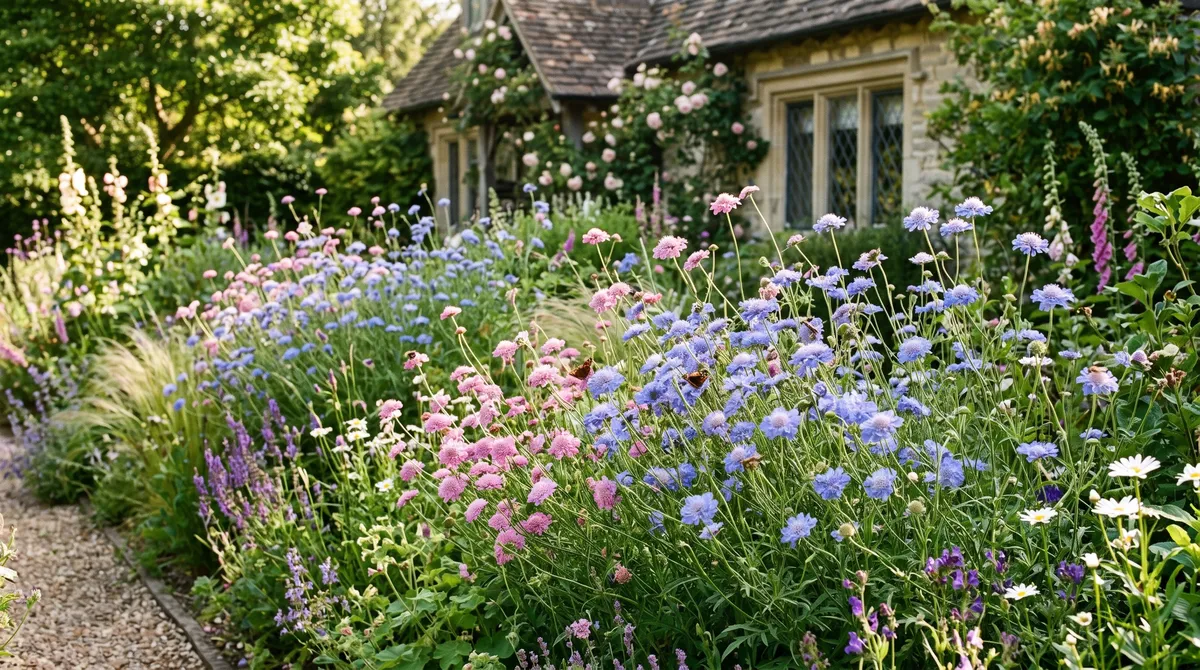
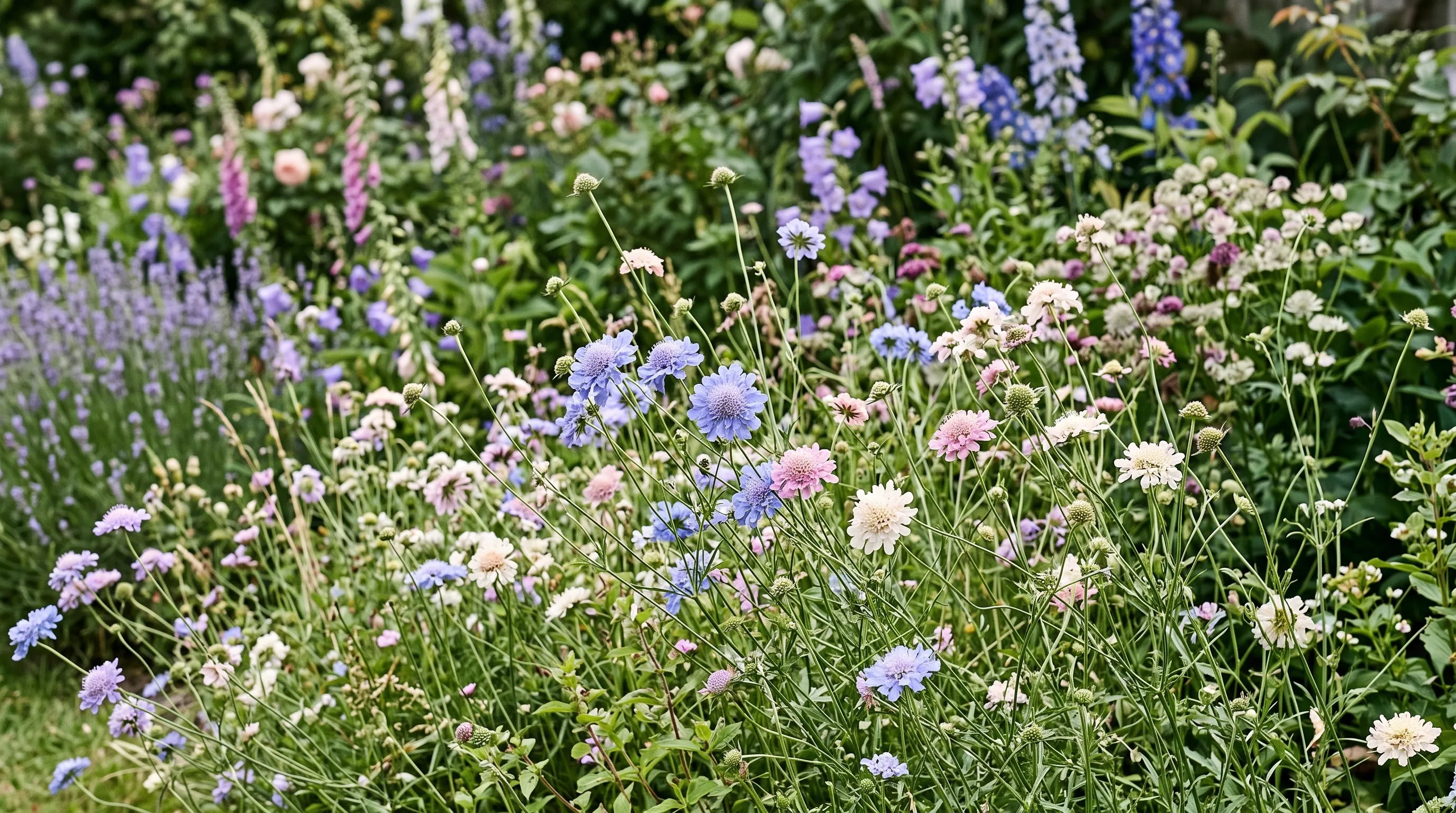 A mixed drift of perennial scabious in blue and pink. Compact ‘Butterfly Blue’ and ‘Pink Mist’ knit together at 30cm spacing.
The growing conditions scabious must have
Two conditions decide whether scabious thrives or dies: light and drainage. Scabious demands full sun, meaning at least six hours of direct light a day. In shade the stems flop, flowering stalls, and mildew sets in. This is not a plant for damp shade under trees, whatever the label promises.
Drainage is the killer variable in the UK. Scabious comes from open, sunny chalk and limestone grassland. It wants sharp, free-draining soil at a neutral to alkaline pH of 6.5-7.5. On acid ground, add garden lime. What it cannot survive is cold, wet soil in winter. The crown sits and rots, and the plant collapses in a slimy heap by February.
Heavy wet clay is the usual grave. If that is your soil, you have three options. Fork in plenty of horticultural grit, at least 5-8cm into the top 20cm. Plant on a raised ridge so water drains off the crown. Or grow scabious in pots of gritty, peat-free compost, which is the safest route on truly waterlogged ground.
Warning: Never plant scabious in autumn on heavy soil. Young plants going into cold wet ground almost always rot before spring. Plant in April or May instead, so roots establish through the growing season.
Sowing annual scabious under cover
Annual Scabiosa atropurpurea is the easiest cut flower to raise from seed. Sow under cover from February to April for flowers from July onward. Fill module trays with peat-free seed compost, firm gently, and sow one or two seeds per cell. Cover lightly with vermiculite, because the seed needs a little darkness to germinate.
Keep the trays at 18-20C on a warm windowsill or in a heated propagator. Germination takes 10-14 days. Once seedlings have two true leaves, thin to the strongest per cell and grow on cooler, at 12-15C, to stop them stretching. Harden off over 7-10 days in late April, then plant out after the last frost, usually mid-May in most of the UK.
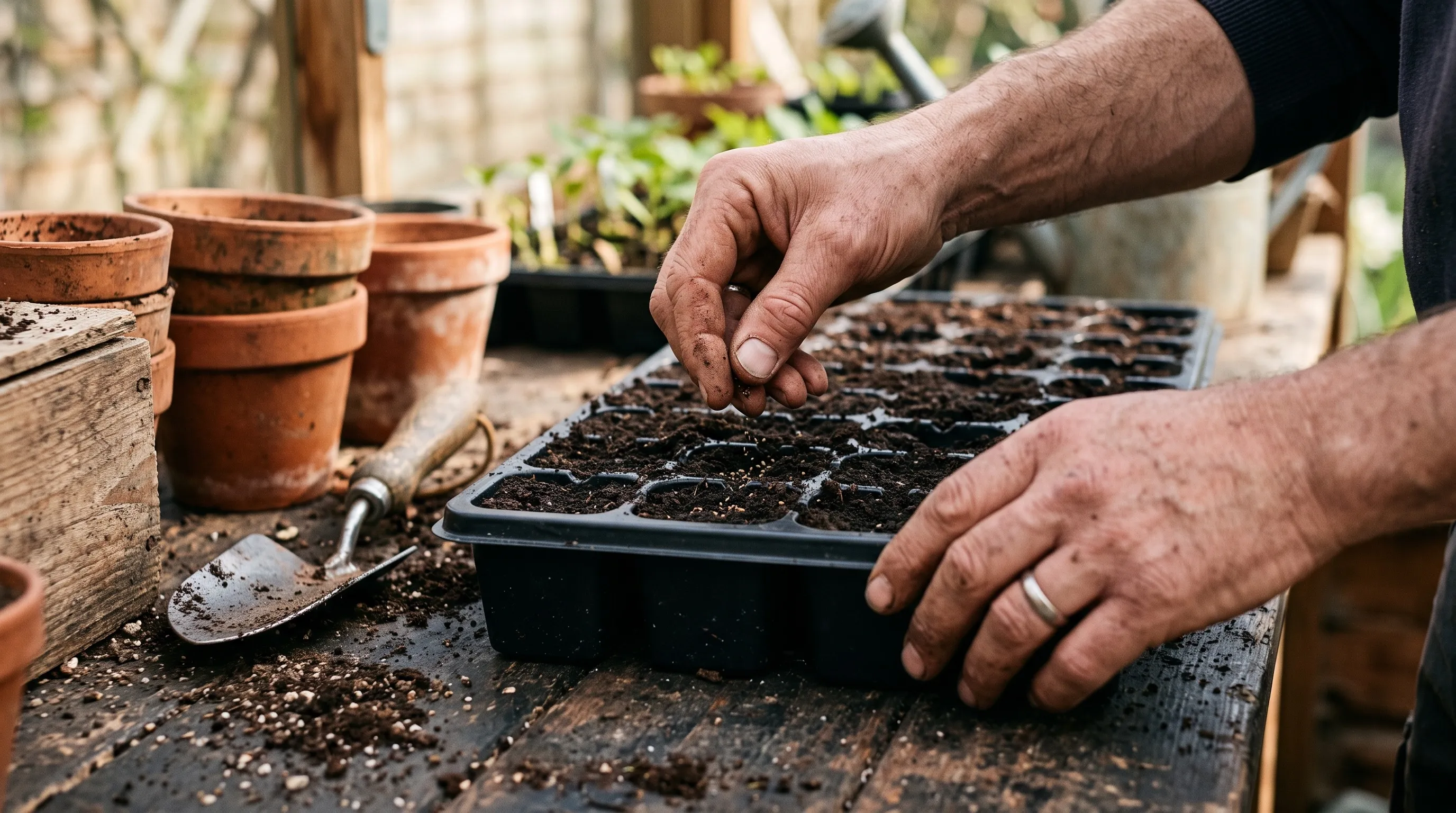 Sow annual scabious into modules at 18-20C from February. One or two seeds per cell, covered lightly with vermiculite.
Sowing, planting and spacing perennials
Perennial scabious can be raised from seed or bought as young plants. Sow perennials March to May under cover at 15-18C. Germination is slower and less even than the annuals, taking 14-21 days, so many gardeners buy plug plants or 9cm pots instead. A single 9cm ‘Butterfly Blue’ costs around 4-6 pounds and flowers the same summer.
Spacing depends on the type. Set compact perennials like ‘Butterfly Blue’ and ‘Pink Mist’ 30cm apart for a solid front-of-border drift. Give taller Scabiosa caucasica and Knautia 40-45cm each, as they make wider clumps. Plant into improved, gritty soil in spring, firm gently, and water in well.
The secret to months of flower: deadhead relentlessly
This is the section that matters most. Scabious flowers for one reason: to set seed. Every bloom you leave on the plant ripens into a seed head, and once the plant has seed, it slows or stops flowering. Deadhead relentlessly and you break that cycle, forcing wave after wave of new blooms.
The rule is simple. From June, walk the plants every three to four days and remove every spent flower. Cut back to a leaf joint or the next visible bud, not just the flower head. Done properly, a perennial clump flowers unbroken from June to October, up to 16 weeks. Miss a week in July and flowering drops off within days.
Gardener’s tip: Keep a jam jar of water and a pair of snips by the back door in summer. Two minutes twice a week is all it takes. Snip spent heads into a bucket and drop cutting stems straight into the water. The plants never get a chance to set seed.
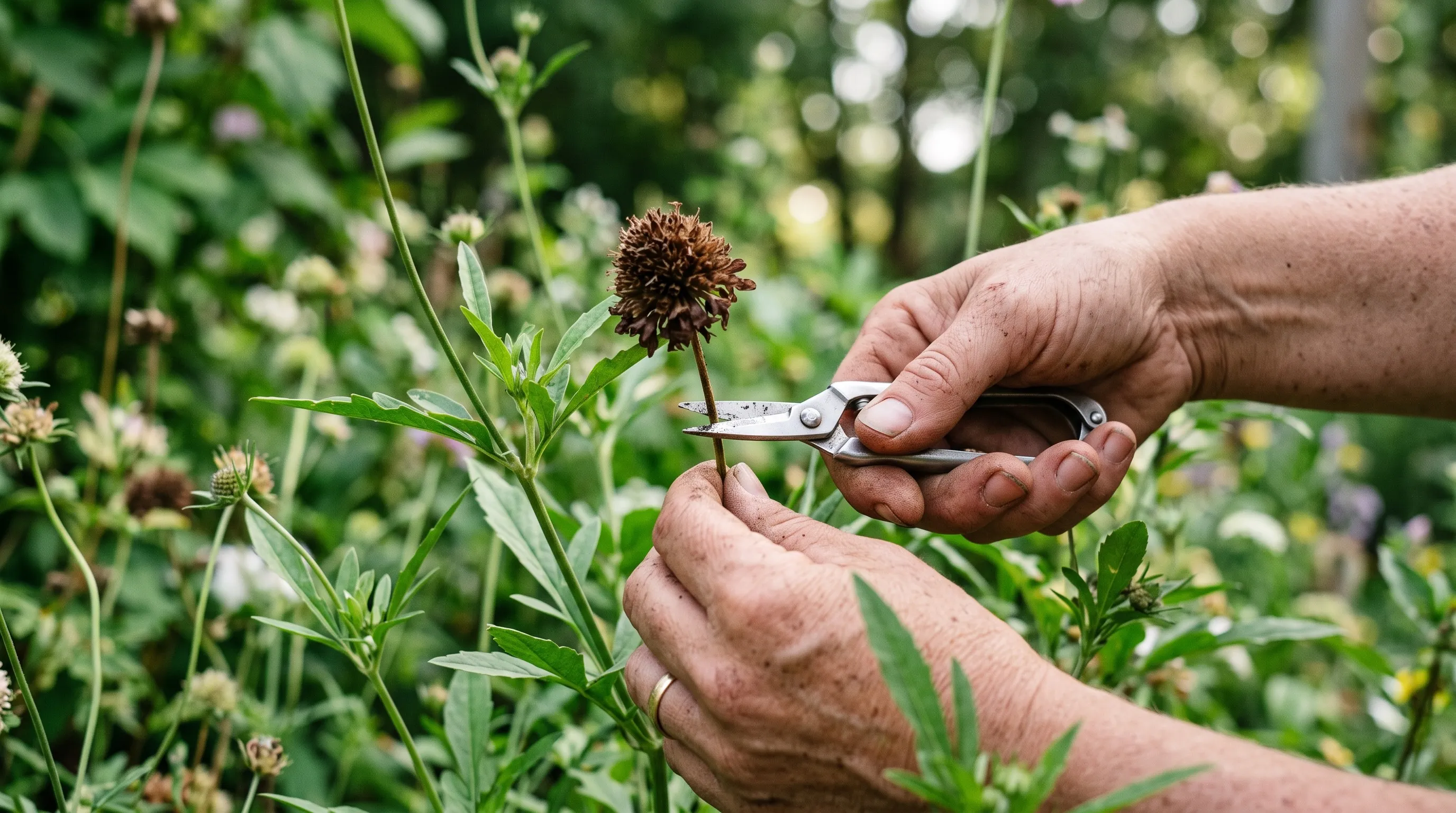 Deadhead every three to four days. Cut back to a leaf joint or the next bud, not just the faded head, to force fresh flowers.
Cutting scabious for the vase and conditioning stems
Scabious is a florist’s favourite for good reason: airy, long-stemmed and long-lasting if cut right. Timing is everything. Cut stems when the buds are just cracking open, showing colour but not fully out. Cut too tight and they stay shut in the vase. Cut fully open and the petals drop within a day or two.
Cut in the cool of early morning, when stems are full of water. Use clean, sharp snips and cut low, taking a long stem. Strip the lower leaves so none sit below the waterline, where they rot and foul the water. Condition the stems by standing them in deep, cool water in a bucket for two to three hours, or overnight, before you arrange them.
With good conditioning, cut scabious lasts five to seven days in the vase. Change the water every two days and re-cut the stem ends. The tall annuals ‘Black Knight’ and ‘Salmon Queen’ give the longest, strongest stems, while Knautia adds a see-through crimson filler. A hand-tied bunch of mixed scabious is one of the simplest joys of a July garden.
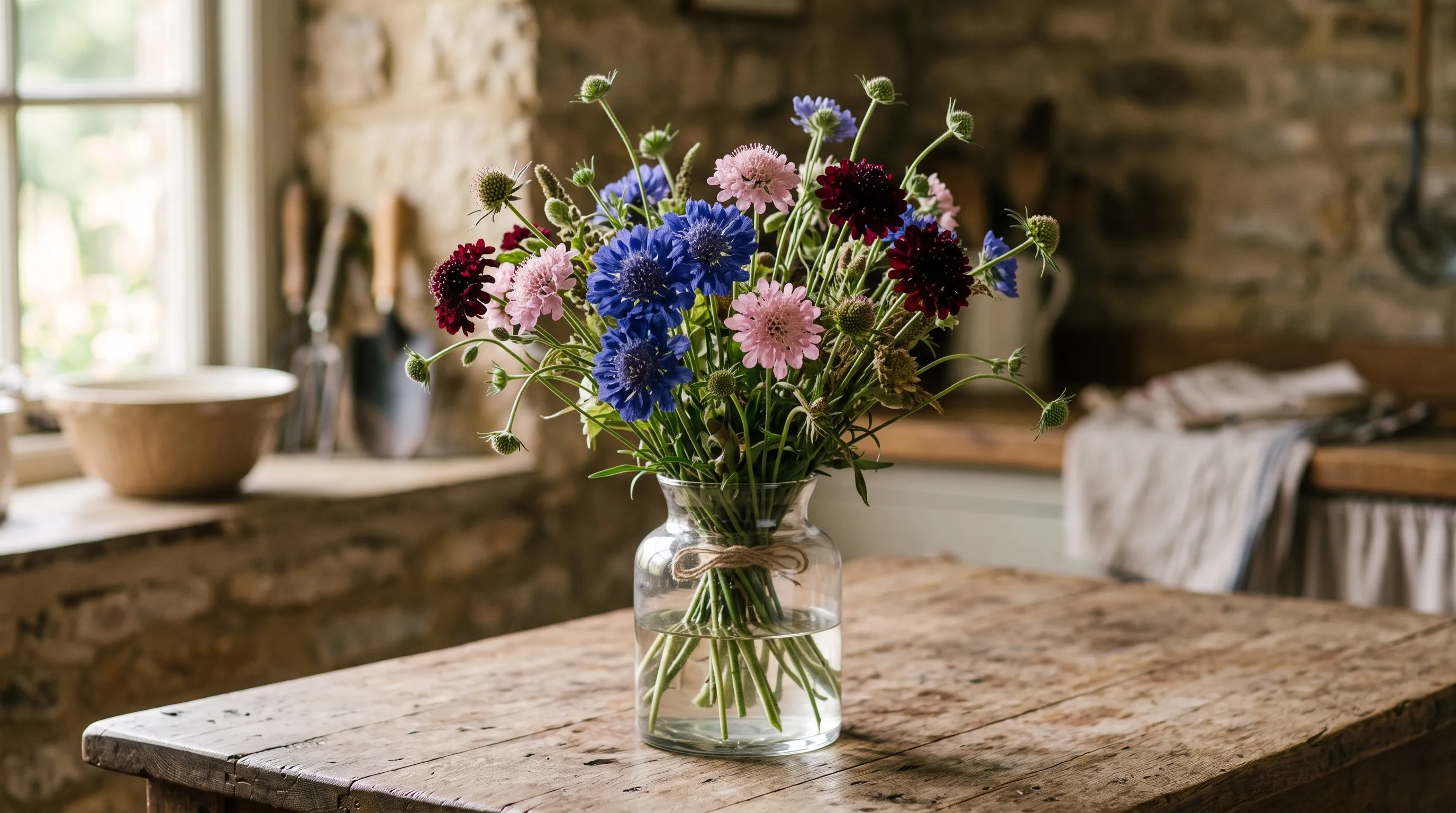 Cut when buds are just cracking open, condition in deep water, and mixed scabious lasts five to seven days in the vase.
Feeding, dividing and overwintering scabious
Scabious is not a hungry plant. Feed lightly and no more. A single dose of balanced granular fertiliser in June, at around 30g per square metre, carries a clump through the season. Overfeeding, especially with high-nitrogen feed, gives soft leafy growth, fewer flowers and floppy stems. On poor soil a spring mulch of compost is plenty.
Divide perennials every two to three years in spring, as clumps tire and flower less from the centre. Lift the whole plant in March or April, tease or cut it into three or four pieces each with roots and shoots, and replant into refreshed, gritty soil. Division keeps plants vigorous and gives you free stock. Knautia and caucasica types divide most readily.
Overwintering comes down to drainage, not fleece. Perennial scabious is hardy to about -15C provided the crown stays dry. On free-draining soil it needs no winter protection at all. On heavy ground, the wet is the enemy: a pane of glass or a cloche over the crown through the worst of winter can save a plant. The annuals are frost-tender and die at the first hard frost, so save or buy fresh seed each year.
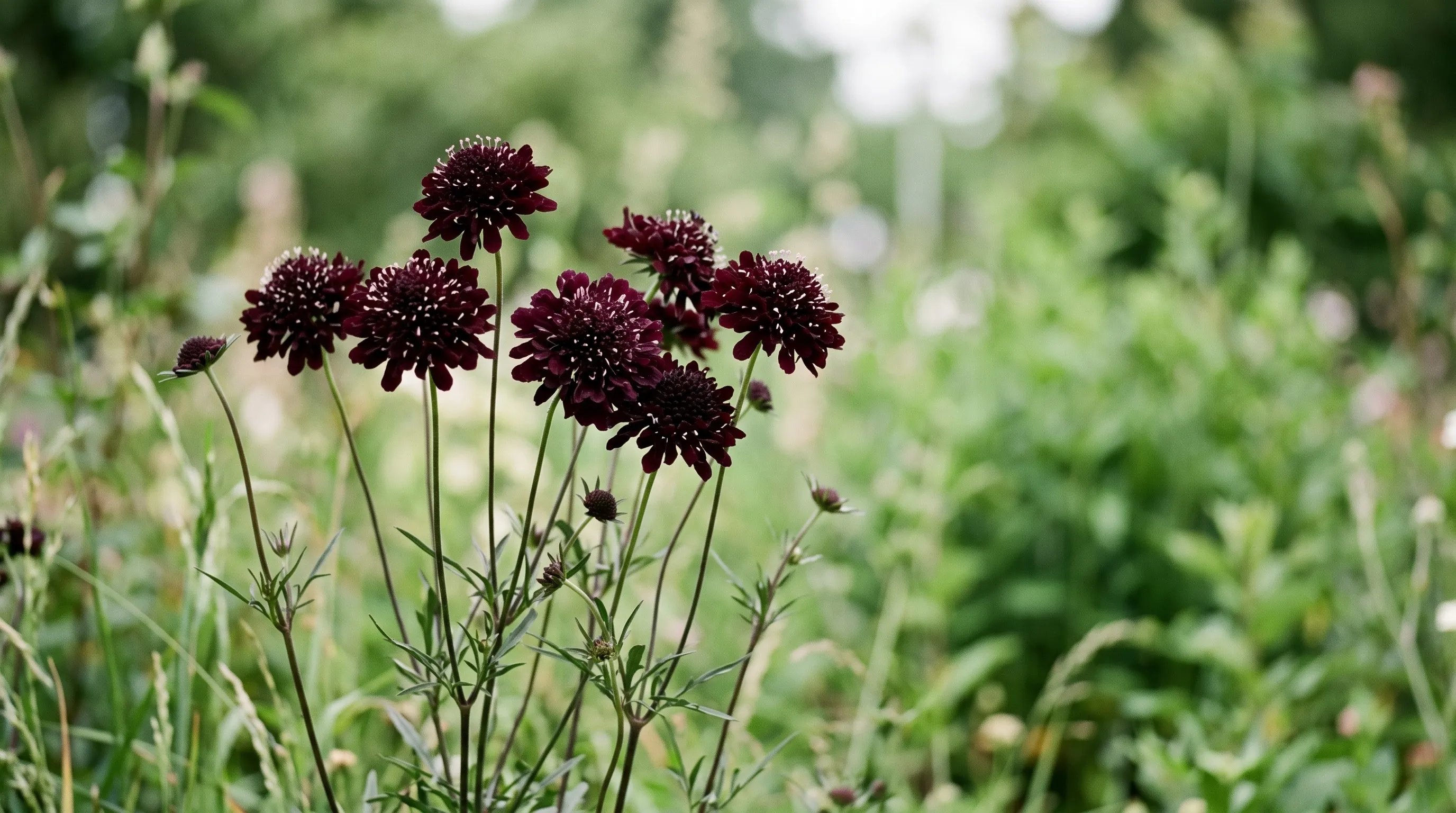 Annual ‘Black Knight’ carries deep maroon, almost black pincushions on 75-90cm stems, the tallest and best scabious for cutting.
Why scabious is one of the best plants for bees and butterflies
Few plants pull in as much wildlife as scabious. The flat, open pincushion head is a perfect landing platform, and the ring of florets holds nectar and pollen that stays accessible to short and long-tongued insects alike. On a warm July afternoon a single clump hums with honeybees, bumblebees, hoverflies and butterflies together.
The real value is the length of the season. Because a well-deadheaded plant flowers from June to October, it feeds pollinators across the entire active period, including the lean late-summer weeks when many borders fade. This continuity matters more than a single spectacular flush. Butterflies such as small tortoiseshell, peacock and painted lady work the flowers steadily.
To build a full nectar border around them, pair scabious with other proven plants for butterflies so there is always something in flower. Leave a few final seed heads standing into autumn as well: goldfinches pick over ripe scabious seed, so relentless deadheading can pause once the flowering season ends.
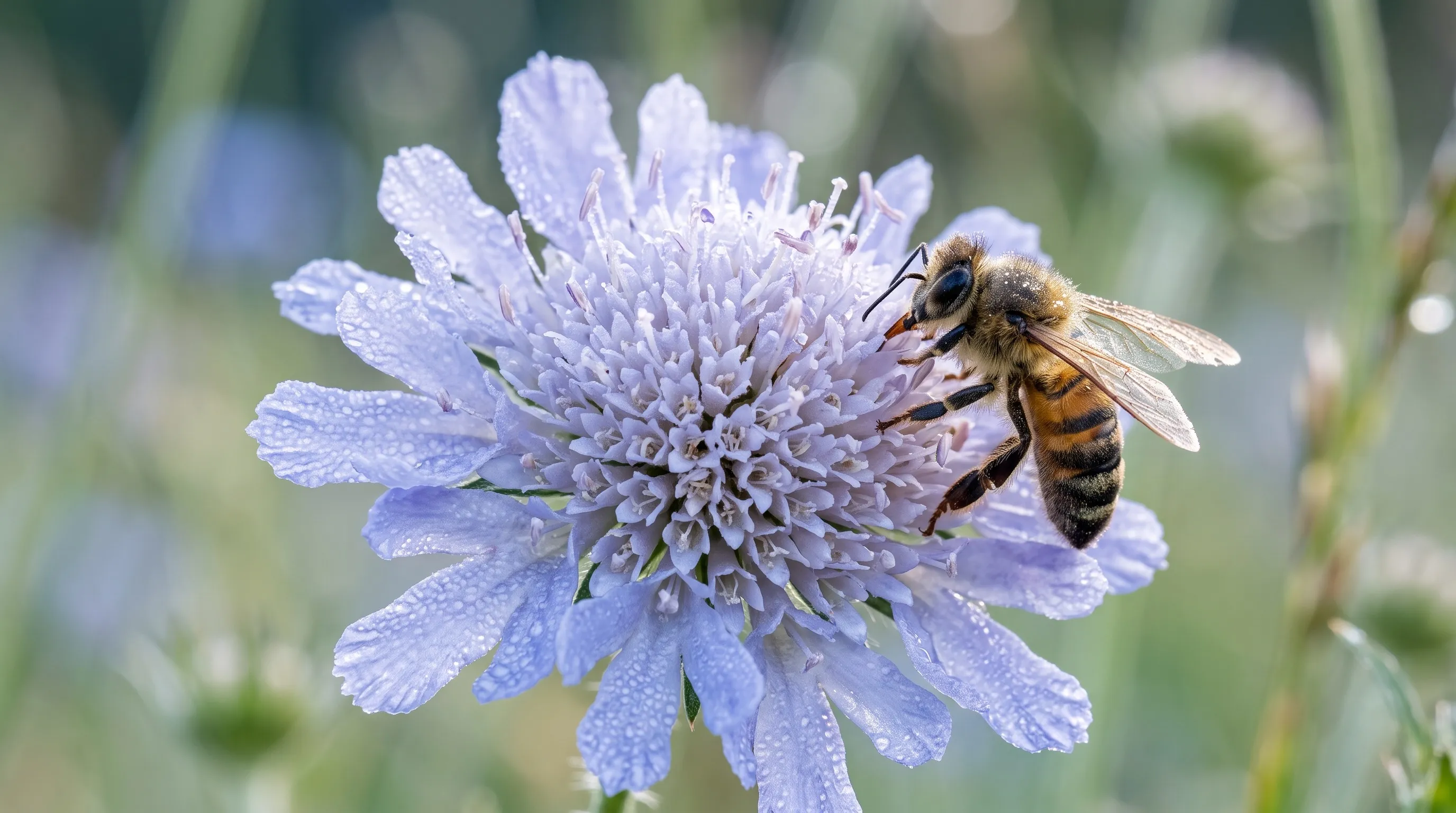 The flat pincushion head is a perfect landing pad. Bees, hoverflies and butterflies feed on scabious from June to October.
Scabious variety comparison
Choosing the right variety comes down to what you want: a compact long-flowering perennial, big florist blooms, or tall cutting stems. The table ranks the most reliable UK varieties by type, colour and flowering season. Compact Scabiosa columbaria wins on sheer length of flower, while the annuals win on stem length.
| Variety | Type | Colour | Height | Flowering |
|---|---|---|---|---|
| ’Butterfly Blue’ | Hardy perennial | Lavender-blue | 40-45cm | June to October |
| ’Pink Mist’ | Hardy perennial | Soft pink | 40cm | June to October |
| ’Fama Blue’ | Hardy perennial | Sky blue | 50-60cm | June to September |
| ’Fama White’ | Hardy perennial | Pure white | 50-60cm | June to September |
| Knautia macedonica | Short-lived perennial | Crimson | 60-75cm | June to September |
| ’Black Knight’ | Annual | Deep maroon | 75-90cm | July to October |
| ’Salmon Queen’ | Annual | Salmon pink | 75-90cm | July to October |
For year-round pincushions, grow a mix: ‘Butterfly Blue’ and ‘Pink Mist’ at the front for length of flower, ‘Fama Blue’ behind for large heads, and a row of ‘Black Knight’ in the cutting patch for tall stems. Browse the wider growing section for companion crops and cut-flower guides.
Month-by-month scabious care calendar for the UK
This calendar covers a mix of perennials and annuals in a typical UK garden. Shift timings a week or two later for Scotland and the north, and earlier for the mild south-west.
| Month | Task |
|---|---|
| January | Order seed. Keep pots of perennials off cold wet ground on pot feet. |
| February | Sow annual scabious under cover at 18-20C. Check perennial crowns are not sitting wet. |
| March | Sow more annuals and perennials. Divide established perennial clumps now. Fork grit into planting sites. |
| April | Prick out and grow on seedlings. Sow annuals direct. Plant out young perennials. |
| May | Harden off and plant out annuals after the last frost. Space at 30-45cm. Support tall types. |
| June | Flowering begins. Feed lightly once. Start deadheading every 3-4 days. |
| July | Peak flowering. Deadhead and cut for the vase twice weekly. Water in dry spells. |
| August | Keep deadheading. Take cuttings of choice perennials. Watch for mildew in dry heat. |
| September | Flowering continues on deadheaded plants. Collect seed from annuals for next year. |
| October | Final flush before frost. Leave a few seed heads for goldfinches. Annuals die at first hard frost. |
| November | Cut back tired perennial foliage. Ensure crowns drain freely. Cloche vulnerable plants on clay. |
| December | Little to do. Keep pots raised and drained. Plan next year’s varieties. |
Common scabious mistakes UK growers make
Most scabious failures trace back to the same few errors. Avoid these four and you avoid nearly all the trouble.
Planting into wet clay in autumn
This is the number one killer. Young plants set into cold, waterlogged ground in autumn rot at the crown before spring. The soil never dries and the roots suffocate. Plant in April or May instead, into soil improved with grit, or grow in pots. Give roots a full season to establish before their first winter.
Not deadheading often enough
Gardeners deadhead once a fortnight and wonder why flowering fizzles out in July. Scabious sets seed fast, and once it seeds, it stops. The fix is a strict routine: every three to four days, remove every spent head. Treat it like a chore with a fixed day, and the flowers keep coming for months.
Growing it in shade
Scabious in shade flops, sulks and mildews. It is a full-sun grassland plant and needs six hours of direct light minimum. If your only spot is shady, this is the wrong plant. Give it the sunniest, most open position you have, with air moving freely around the stems.
Feeding too heavily
A common mistake is treating scabious like a hungry dahlia. Rich soil and high-nitrogen feed give soft, leafy, floppy growth and fewer flowers. One light feed in June is enough. On decent soil, skip feeding altogether and let the plant flower hard on lean rations, which is what it prefers.
Frequently asked questions
How do I keep scabious flowering all summer?
Deadhead every three to four days without fail. Scabious flowers to set seed, so removing every spent bloom before it seeds forces the plant to keep producing. Cutting stems for the vase does the same job. Feed lightly in June and keep the plant in full sun. Done properly, perennials flower from June to October.
Why does my scabious keep dying over winter?
Cold wet soil rots the crown, not the cold itself. Scabious is hardy to about -15C but hates sitting in waterlogged winter ground. Heavy clay is the usual killer. Add grit for drainage, plant on a raised ridge, or grow in pots of gritty compost. Plant in spring, not autumn, so roots establish before winter.
Is scabious a perennial or an annual?
Both, depending on the type. Scabiosa columbaria and caucasica are hardy perennials that return for years. Scabiosa atropurpurea is a frost-tender annual grown fresh from seed each year. Knautia macedonica is a short-lived hardy perennial. Choose perennials for permanence and annuals for tall cutting stems.
When should I sow scabious seed in the UK?
Sow annuals under cover February to April at 18-20C. Prick out and harden off, then plant out after the last frost in May. Perennials can be sown March to May under cover, or you can buy young plants. Annual scabious can also be sown direct in April where it is to flower.
How far apart should I plant scabious?
Space compact perennials 30cm apart, taller types 40-45cm. ‘Butterfly Blue’ and ‘Pink Mist’ knit together at 30cm for a solid front-of-border drift. Tall annuals like ‘Black Knight’ need 40cm and often a few twiggy supports. Closer spacing gives more flowers but less airflow, which matters on damp sites.
When do you cut scabious for a vase?
Cut when the buds are just cracking open, not fully out. Stems cut too tight stay shut, and fully open flowers drop fast. Cut in the cool of early morning, strip lower leaves, and stand in deep water for a few hours before arranging. Expect five to seven days in the vase.
Do bees and butterflies like scabious?
Yes, scabious is one of the best pollinator plants you can grow. The flat pincushion heads give bees and butterflies an easy landing pad and a long nectar supply. A single clump can draw honeybees, bumblebees, hoverflies and butterflies all day. Long-flowering perennials feed pollinators from June right through to October.
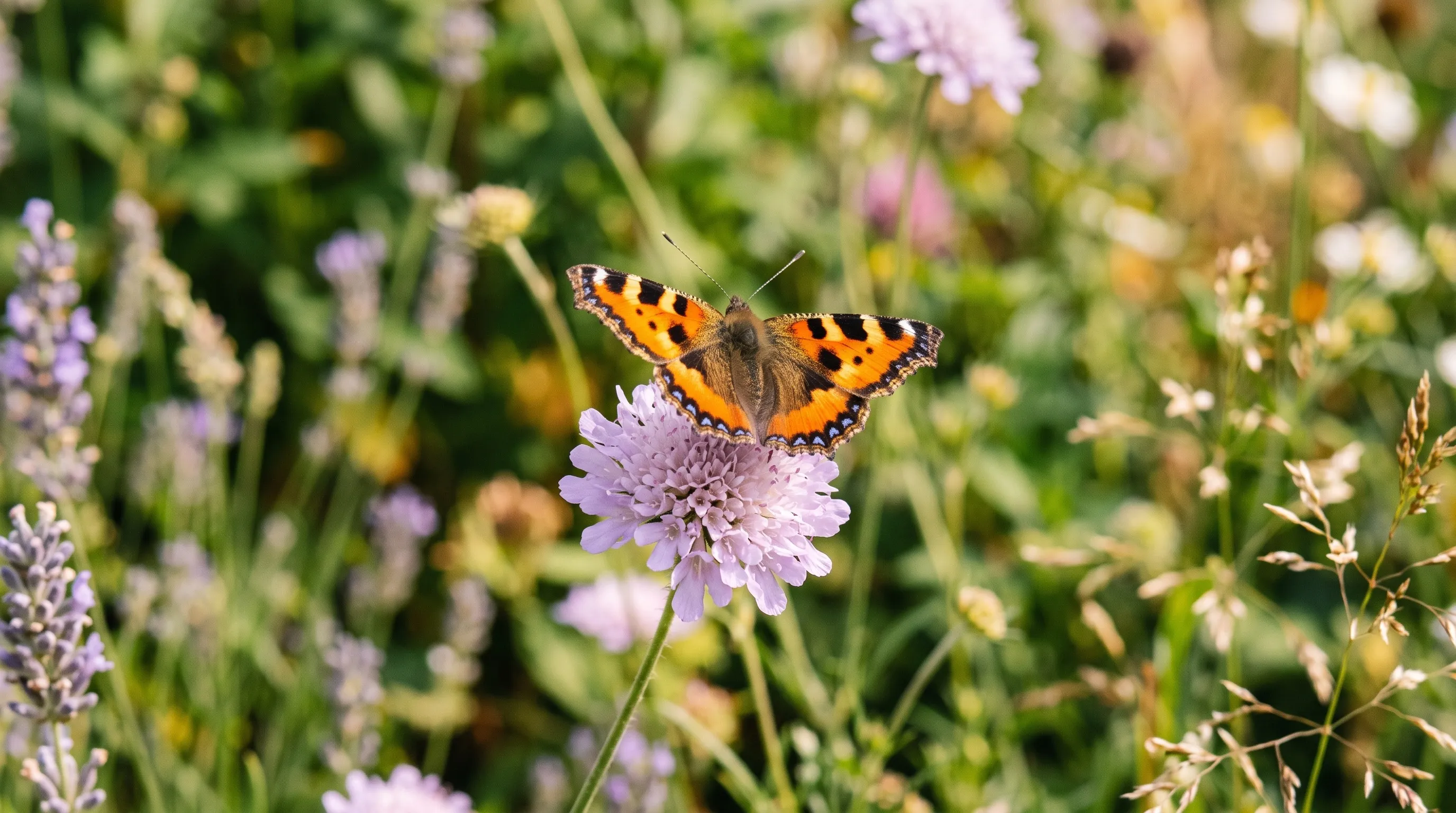 Scabious feeds butterflies across the whole season. A well-deadheaded clump flowers from June to October, bridging the late-summer nectar gap.
Now you know how to grow scabious for months of flower, the trick is keeping it cut. For a garden full of vase-worthy blooms all summer, read our guide to the best flowers for cutting in the UK.
Our team produces practical UK gardening guidance from source research, contributor records and established horticultural practice. Editorial standards are overseen by Matt W.