Key takeaways
- Space bergenia 45cm apart for weed-suppressing ground cover; it fills the gap in 2-3 seasons
- It tolerates full sun to deep dry shade, heavy clay, coastal and exposed sites, most soils
- Flowers appear on red stems from February to April, sometimes with a second autumn flush
- Winter-colour types ('Bressingham Ruby', 'Eroica') turn red-bronze below about 5C
- Remove wind-burnt and slug-holed old leaves in early spring; that is the only real job
- Divide congested clumps every 3-4 years in autumn or spring to propagate and refresh
Learning how to grow bergenia, commonly called elephant’s ears, is the easiest win in shade gardening. Bergenia is a tough evergreen perennial that forms dense ground cover from big, leathery, rounded leaves. It flowers on red stems from February to April, then holds structure all year. Few plants do so much for so little effort.
The name elephant’s ears comes from those large paddle-shaped leaves, some as wide as 25cm. In winter, varieties like ‘Bressingham Ruby’ flush deep red and bronze. This guide covers where to plant it, how far apart to space it for weed-suppressing cover, which varieties earn their place, and the one seasonal job that keeps it looking sharp. It thrives in dry shade, heavy clay and coastal wind, the exact spots that defeat most perennials.
What bergenia is and why it earns its place
Bergenia is a genus of evergreen perennials from the saxifrage family, native to central Asia, the Himalayas and Siberia. That mountain heritage is why it shrugs off UK cold, wind and poor soil. The plants grow from thick, creeping surface rhizomes that slowly spread into solid clumps 30-45cm tall and just as wide.
Three things make it a workhorse. First, it is fully evergreen, so it holds cover and structure through the bleakest months, unlike deciduous ground cover that vanishes in winter. Second, the dense canopy of overlapping leaves is genuinely weed-suppressing, shading out annual weed seedlings once established. Third, it thrives in tricky spots: dry shade, heavy clay, exposed and coastal sites where fussier plants fail.
The leaves are the main event for most of the year. They are big, glossy, leathery and rounded, held on short stalks in a low rosette. Flowers are a seasonal bonus. As a front-of-border filler, a path edging, or a carpet under trees, bergenia does a job few other plants manage in one package.
Winter leaf colour versus the best flowers
Here is the choice that decides which bergenia to buy. Some varieties are grown for dramatic winter leaf colour, others for the best flowers, and a few balance both. Knowing your priority saves disappointment.
The winter-colour group turns red, bronze or burgundy as temperatures fall, usually below about 5C. ‘Bressingham Ruby’ is the benchmark, its leaves flushing deep beetroot-red from November. ‘Overture’ and ‘Eroica’ colour hard too, giving months of foliage interest when the garden is bare. These types look their best in a spot where low winter sun catches the leaves.
The green-leaved group keeps its leaves green through winter but delivers the finest flowers. ‘Bressingham White’ carries clean white blooms fading to pale pink. ‘Silberlicht’ (Silver Light) is a classic white-flowered form. For sheer size, Bergenia cordifolia ‘Purpurea’ has the biggest leaves of all, up to 25-30cm, with magenta-purple flowers on tall red stems and a modest bronze winter tint.
Gardener’s tip: If you want both winter colour and good flowers, plant ‘Bressingham Ruby’ for the leaves and ‘Silberlicht’ for the blooms in the same drift. They knit together and give you interest from October right through to April.
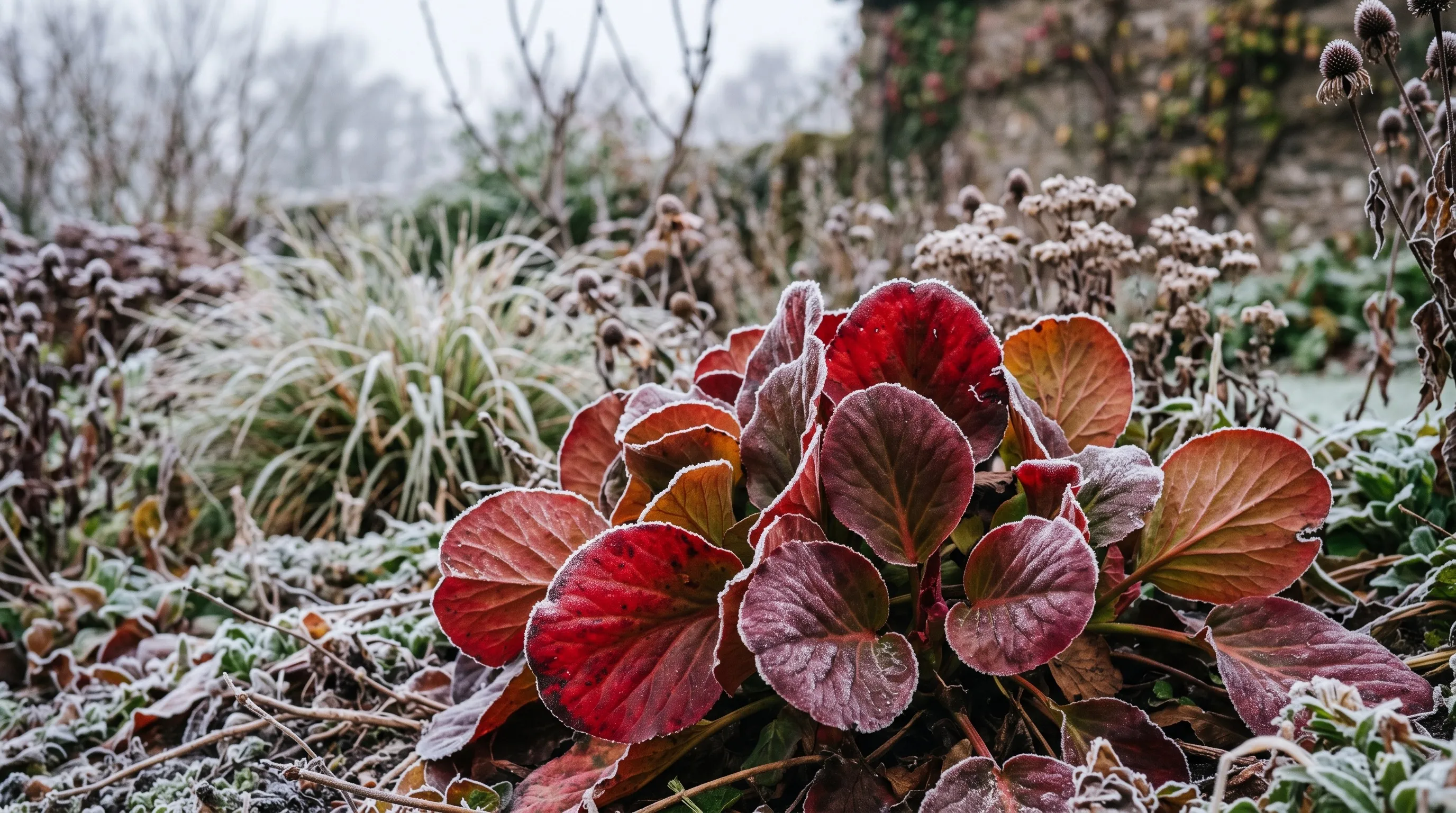 Winter-colour varieties like ‘Bressingham Ruby’ and ‘Eroica’ flush red and bronze once temperatures drop below about 5C.
Spring flowers on red stems from February to April
The flowers are what lift bergenia above ordinary ground cover. From February to April, depending on the variety and your region, sturdy red stems push up above the leaves carrying dense clusters of bell-shaped flowers. Colours run through pink, magenta, rose and pure white.
Flower size and abundance depend on light. In full sun or light shade, plants flower freely and hold their stems upright. In deep shade, expect fewer, shorter spikes, though the foliage stays lush. Some varieties, including ‘Bressingham Ruby’, throw a lighter second flush in autumn after a cool, damp late summer. Deadheading the spent spring stems keeps clumps tidy and occasionally encourages that repeat.
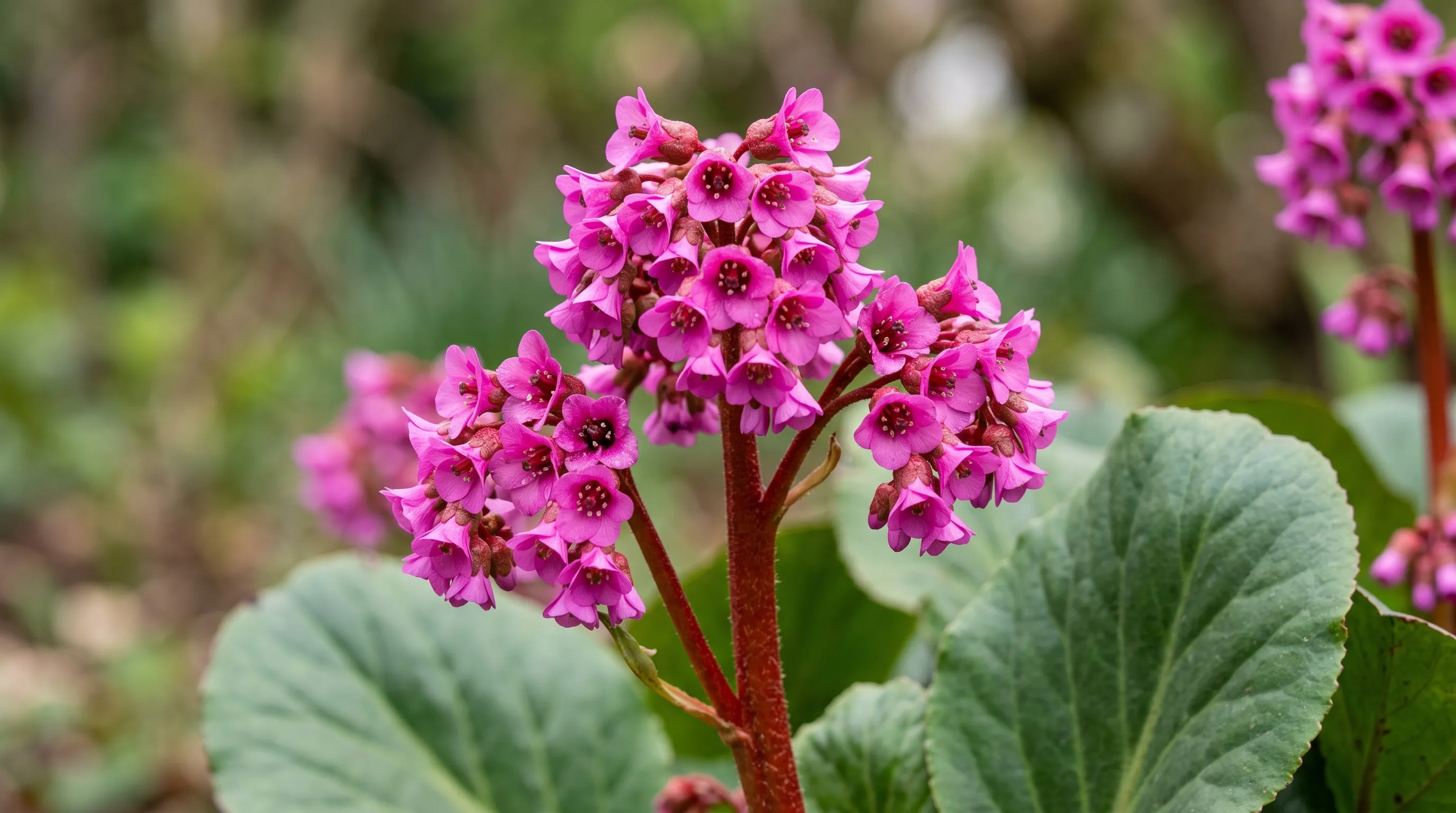 Pink and magenta bell-shaped flowers cluster on red stems from February to April, well before most border perennials wake up.
Where to grow bergenia, from full sun to dry shade
Bergenia is one of the most adaptable perennials you can plant. It grows in full sun to full shade, in most soils, and copes with conditions that kill fussier plants. That flexibility is why designers reach for it so often.
For the lushest leaves and heaviest flowering, give it moisture-retentive soil in sun or light shade. In deep dry shade the plant survives and covers ground, but leaves stay smaller and flowers thinner. Improve poor soil at planting with a barrowload of garden compost, then mulch. It is not fussy about pH, growing happily from acid to alkaline.
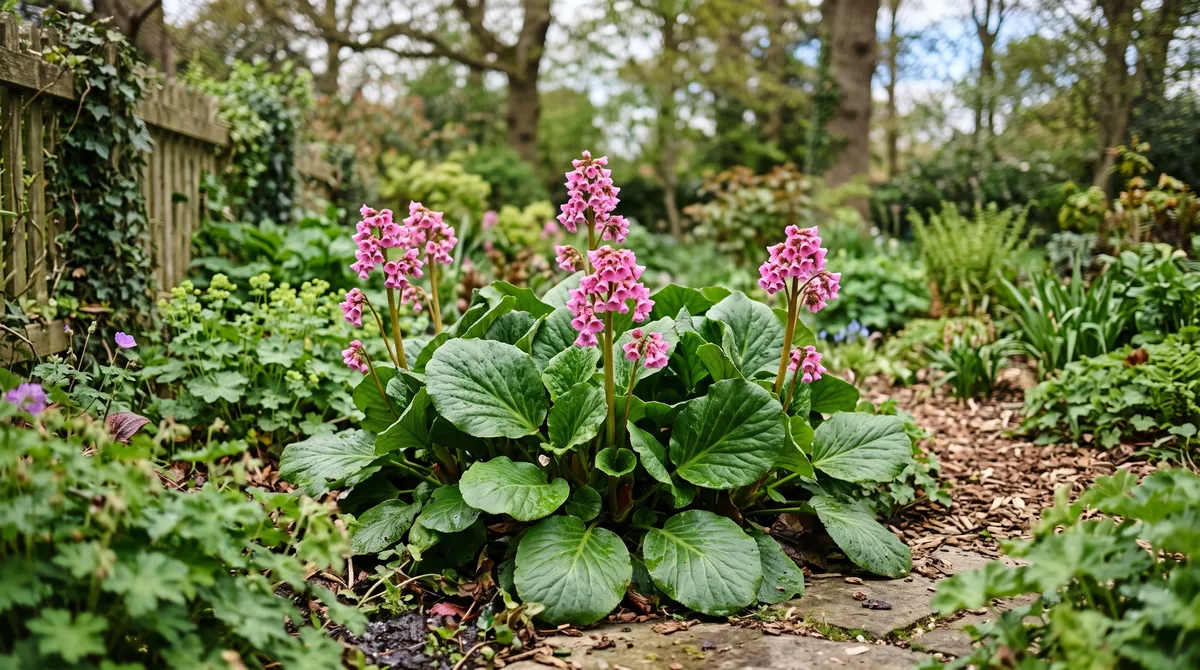
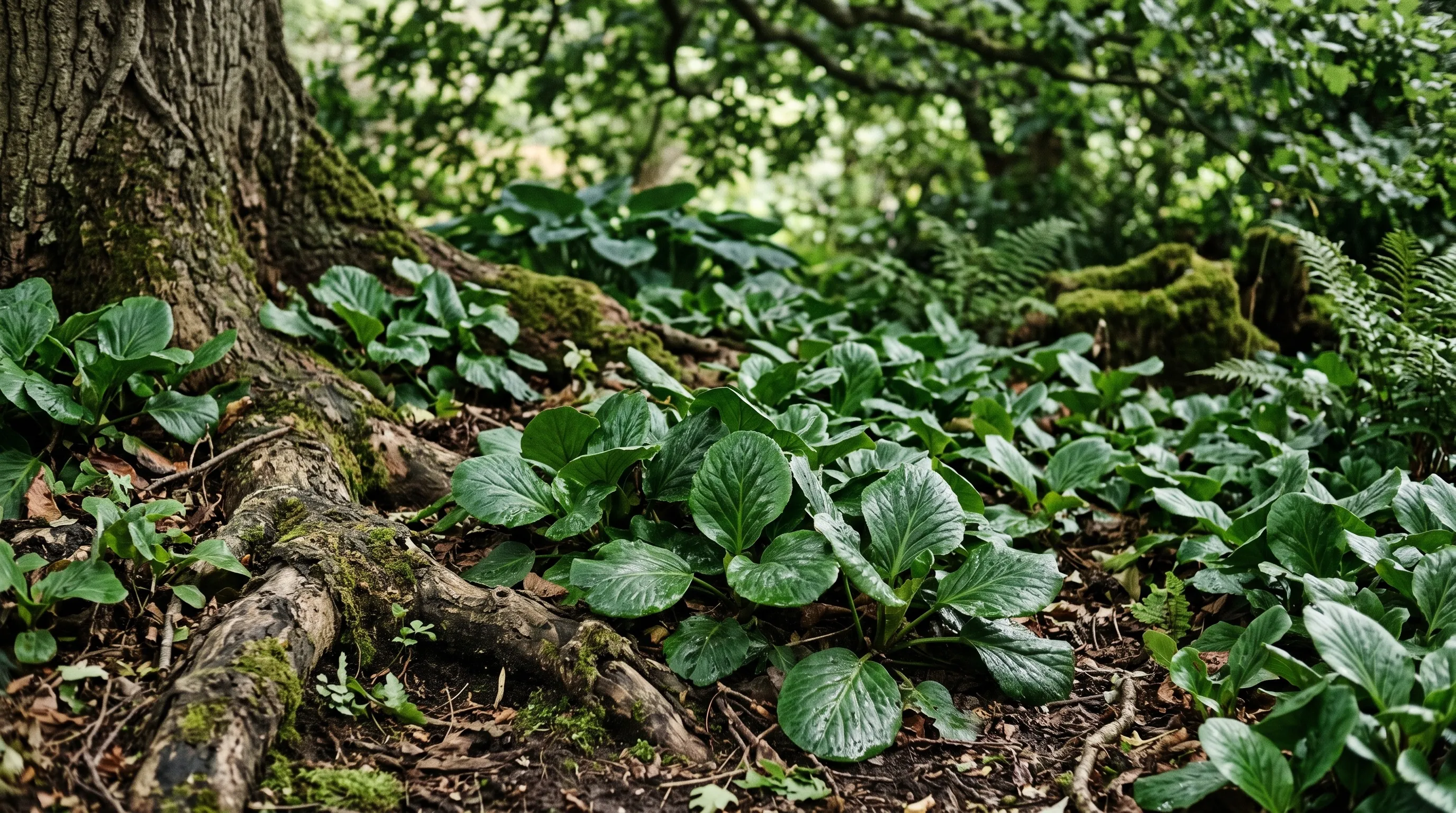 Bergenia colonises dry shade under trees, giving reliable evergreen cover where bare soil would otherwise sit.
Spacing and planting bergenia as ground cover
To use bergenia as ground cover, spacing is everything. Plant at about 45cm apart in staggered rows. At that spacing the spreading rhizomes and overlapping leaves knit into continuous, weed-suppressing cover within two to three seasons. Plant at 30cm for faster cover if you can afford more plants, or 50-60cm apart for a looser front-of-border effect.
Plant pot-grown bergenia at any time the soil is workable, ideally in spring or autumn when it is moist. Dig a hole a little wider than the rootball, set the crown at soil level with the rhizome sitting on or just below the surface, and firm in. Never bury the rhizome deep, as it likes to run along the top of the soil. Water in well and keep new plantings watered through their first dry spell.
For a path edging, run a single row 40cm apart to make a neat evergreen ribbon. As a weed-suppressing carpet, cover the soil with a 5cm mulch of bark or compost between young plants to hold moisture and block weeds while the bergenia fills in. Once established it does the weed-blocking itself.
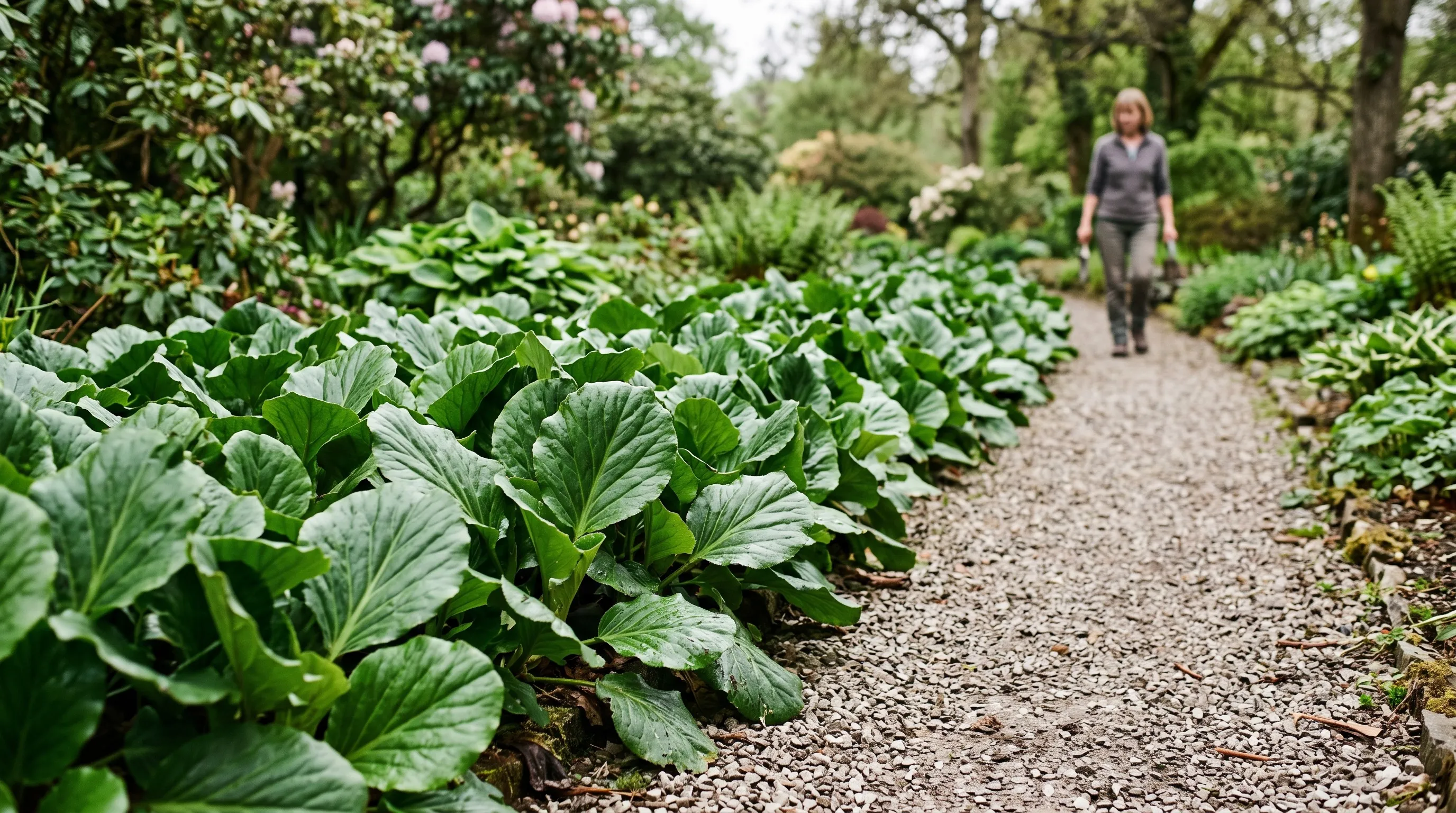 A single row of bergenia planted 40cm apart makes a neat, weed-suppressing evergreen edge along a path.
Bergenia variety comparison for UK gardens
Choosing the right variety comes down to whether you want winter leaf colour, top flowers, or the biggest leaves for ground cover. The table below ranks the reliable performers by what they do best.
| Variety | Leaf colour | Flower colour | Height | Best for |
|---|---|---|---|---|
| ’Bressingham Ruby’ | Deep red-bronze in winter | Deep rose-pink | 30-40cm | Winter foliage colour |
| ’Overture’ | Rich burgundy-red winter | Magenta-pink | 30-40cm | Winter colour, small spaces |
| ’Eroica’ | Red-purple winter tint | Bright magenta | 40-45cm | Winter colour plus flowers |
| ’Silberlicht’ | Green, bronze edges | White ageing to pink | 30-40cm | White spring flowers |
| ’Bressingham White’ | Mid-green | Pure white to blush | 30cm | Best white flowers |
| B. cordifolia ‘Purpurea’ | Large, bronze-purple tint | Magenta-purple | 45-60cm | Biggest leaves, ground cover |
For a shady dry bank where you want maximum cover, B. cordifolia ‘Purpurea’ has the largest leaves and spreads fastest. For a small border where winter colour matters most, ‘Bressingham Ruby’ or ‘Overture’ earn their keep. If flowers are your priority, pair a white like ‘Silberlicht’ with a pink for contrast.
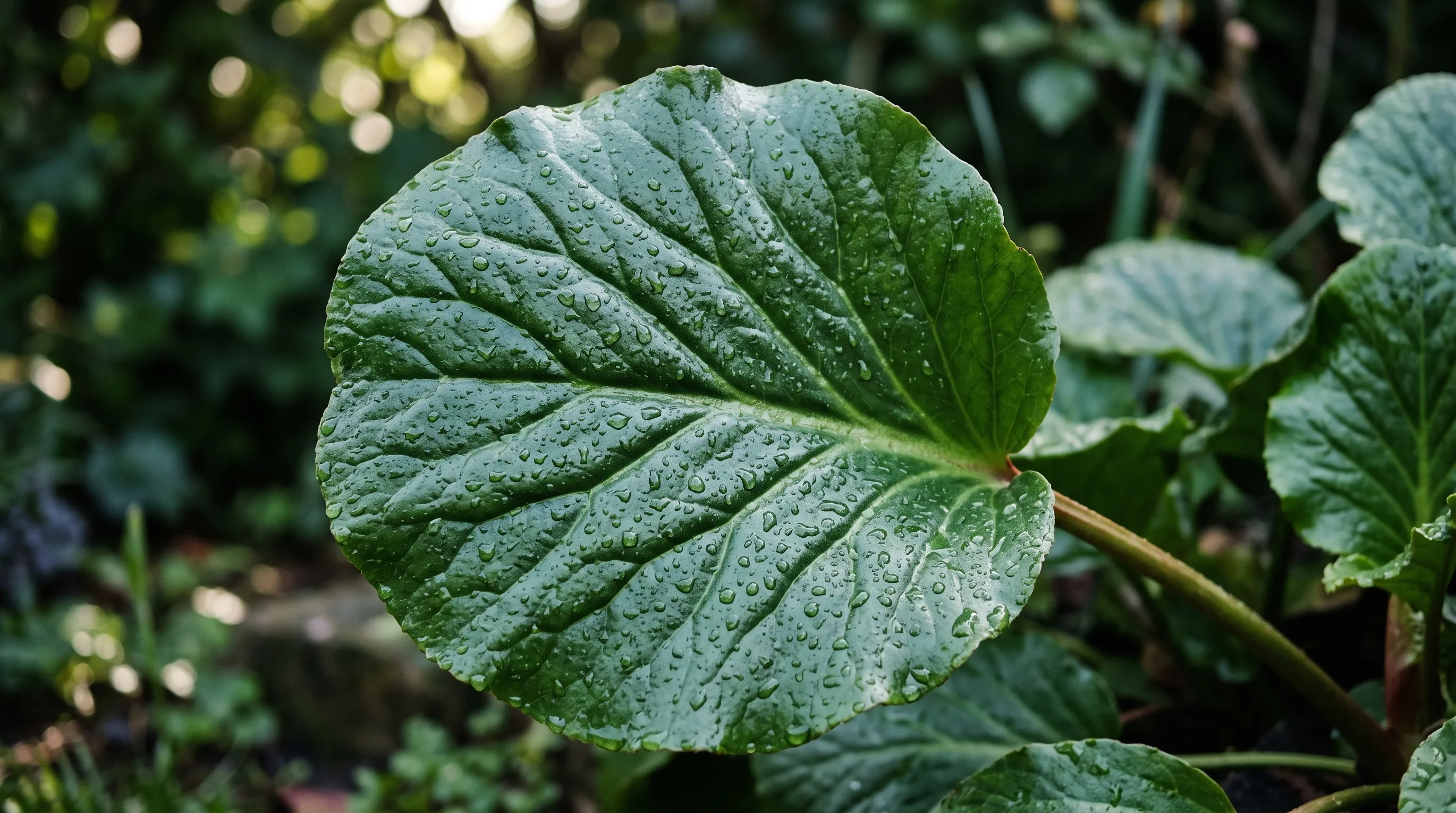 The big, leathery, glossy leaves give bergenia its common name, elephant’s ears, and provide the weed-suppressing cover.
Low-maintenance care through the year
Bergenia is close to a plant-and-forget perennial, but a little attention keeps it looking sharp rather than scruffy. The one job that matters is the early spring tidy. By late winter, last year’s evergreen leaves are often wind-burnt, frost-scorched and slug-holed. Pull or snip away the worst of them in early spring, before the new flush and flowers appear. Fresh leaves replace them within weeks.
After flowering, tidy the spent flower stems by cutting them off at the base. This keeps clumps neat and, on repeat-flowering varieties, can encourage an autumn flush. On decent soil bergenia needs no feeding. A light mulch of garden compost in spring is plenty, and over-feeding just produces soft, floppy leaves. It rarely needs watering once established, though a soak in a long dry spell keeps leaves plump in shade.
Every 3-4 years, lift and divide congested clumps to keep them vigorous. Old clumps go bare and woody in the centre, with a ring of leaves around a dead middle. Division fixes that and gives you free plants. That is genuinely the whole care routine: tidy, deadhead, divide.
 The single seasonal job: pull away wind-burnt and slug-holed old leaves in early spring before the new flush appears.
Dividing bergenia to propagate and refresh clumps
Division is the main way to propagate bergenia and the best way to rejuvenate tired clumps. Do it in autumn or spring, when the soil is moist and the plant is not flowering. It is quick, free and almost foolproof because bergenia roots so readily from its rhizomes.
Lift the whole clump with a fork or spade. You will see thick, woody, surface rhizomes with fibrous roots below and leaf rosettes along their length. Cut the rhizomes into sections with a sharp knife or spade, making sure each piece has roots and at least one growth bud or leaf rosette. Discard the exhausted, bare woody centre. Trim any long, tatty leaves to reduce moisture loss.
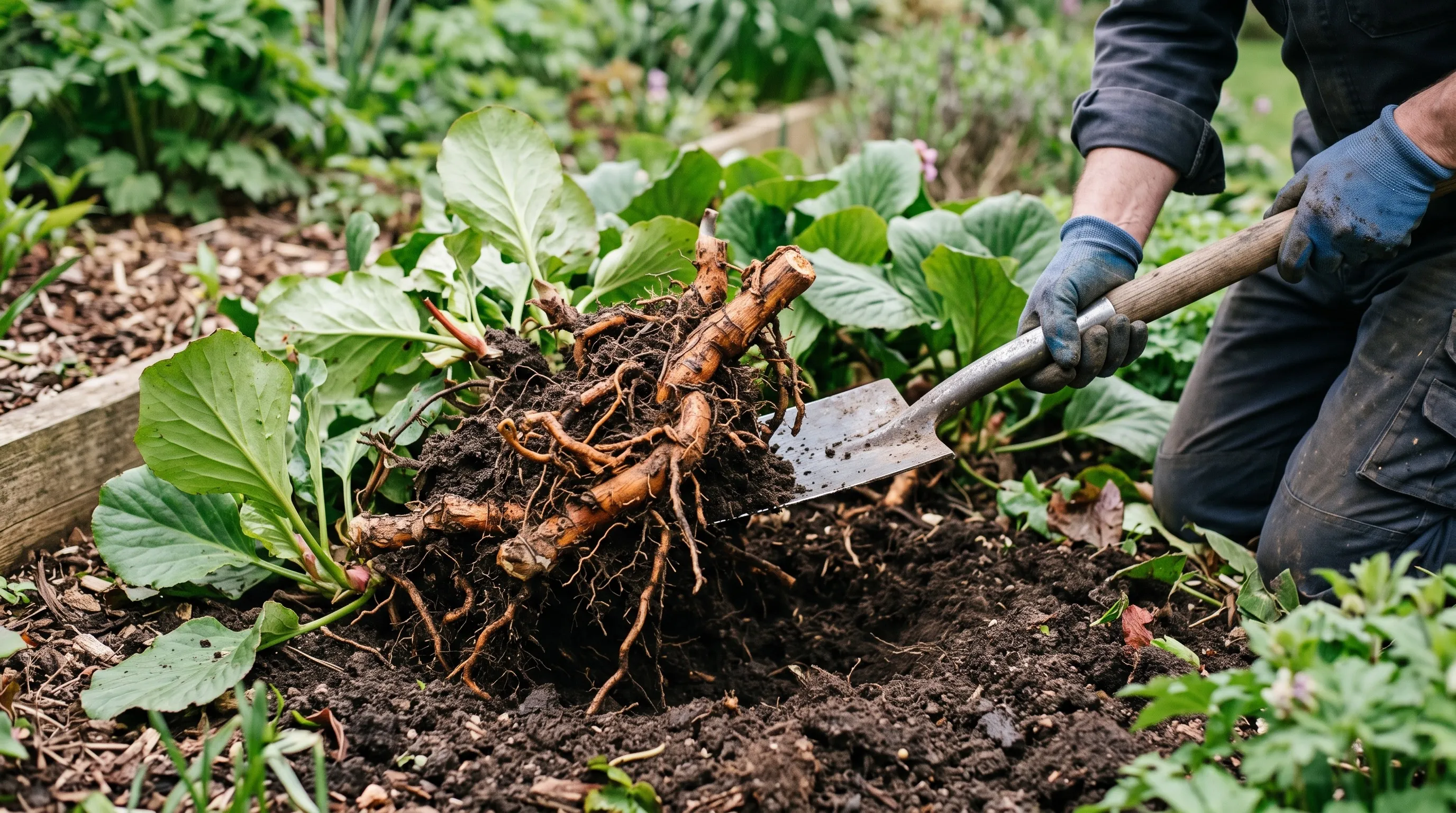 Split a lifted clump into sections, each with roots and a growth bud, then replant 45cm apart. One clump gives 8-15 new plants.
Vine weevil and slug damage to watch for
Bergenia is largely trouble-free, but two pests leave their mark. Vine weevil is the main one. The adult beetles chew neat, U-shaped notches from the leaf edges through summer, mostly at night. The notching is cosmetic and rarely harms an established garden plant. The real danger is the C-shaped white grubs, which eat roots and can kill container-grown bergenia over winter.
Check pot-grown plants by tipping them out and inspecting the compost for grubs, especially in autumn. Treat pots with a nematode drench (Steinernema kraussei) when soil is above 5C, typically in spring and again in autumn. In open ground, encourage birds, ground beetles and hedgehogs, which keep numbers down naturally. Garden plants seldom need treatment.
Slugs and snails are the second issue. They rasp holes in the softer new leaves and, more annoyingly, damage the flowers, chewing the petals and stems in wet spring weather. The tough old leaves largely resist them. Clear leaf litter where slugs shelter, and protect emerging flower spikes with wool pellets or organic slug controls if damage is bad.
Warning: Never assume leaf notching means your bergenia is dying. Notches are harmless adult vine weevil feeding. The threat is the root-eating grubs in pots. Only container plants usually need nematode treatment; garden clumps shrug off both pests.
Using bergenia in the garden
Bergenia is a designer’s staple because it works in so many roles. As edging, a single row of a uniform variety makes a crisp, evergreen line along a path or bed front that looks good in every month. The glossy leaves catch light and hide the bare stems of taller plants behind.
As ground cover, it suppresses weeds and knits difficult ground together. Mass a single variety under trees, on a shady bank, or in a wide drift beneath the best ground cover plants for UK gardens approach, and it becomes low-effort permanent cover. It pairs well with other tough shade plants; see our roundup of the best plants for shade in the UK for companions.
Its winter value is where it really shines. As front-of-border winter structure, the leathery leaves and red-flushed foliage hold the border together when perennials have died back. Set it against the bare stems of dogwoods, the seedheads of grasses, or spring bulbs pushing through. For more permanent planting ideas, our guide to the best perennial plants for UK gardens shows how bergenia fits a mixed border, and it is a natural choice among the best plants for dry shade in the UK. Explore more options on our growing hub.
Month-by-month bergenia care calendar for the UK
This calendar suits a typical UK garden. Nudge timings a couple of weeks later for Scotland and the north, or earlier for the mild south-west.
| Month | Task |
|---|---|
| January | Enjoy the winter leaf colour on red-leaved types. Clear fallen leaves off the crowns. |
| February | First flower stems rise in mild areas. Watch for slug damage on emerging spikes. |
| March | Main flowering begins. Remove wind-burnt and tatty old leaves before new growth. |
| April | Flowering peaks. Deadhead spent stems. Plant new pot-grown bergenia in moist soil. |
| May | Divide clumps if not done in autumn. Water new plantings in dry spells. |
| June | Watch for vine weevil notching. Check container plants for grubs. Mulch to hold moisture. |
| July | Little to do. Keep new plants watered. Tidy any scruffy leaves. |
| August | Continue watering pots and new plants. Order or split more plants for autumn. |
| September | Best month to divide congested clumps as soil is warm and moist. Replant 45cm apart. |
| October | Divide and plant. Apply nematodes to pots for vine weevil while soil is above 5C. |
| November | Winter leaf colour begins on ‘Bressingham Ruby’ and similar as cold sets in. |
| December | Enjoy the evergreen structure and red-bronze foliage. Keep crowns clear of debris. |
Common bergenia mistakes to avoid
Most bergenia problems come down to a few avoidable errors. Fix these and the plant looks after itself.
Planting too deep
Bergenia grows from surface rhizomes that want to sit on top of the soil. Burying the rhizome deep causes it to rot and stops it spreading. Set the crown at soil level with the rhizome on or just below the surface, then mulch around, not over, it.
Never removing the old leaves
Skip the early spring tidy and clumps look permanently scruffy, with tatty, brown, holed leaves masking the fresh growth and flowers. The plant survives fine, but it looks tired. Pull off the worst old leaves every early spring. It takes minutes and revives the display.
Leaving clumps undivided for years
An undivided clump slowly dies out in the centre, leaving a bare woody ring. Flowering drops off and the cover breaks up. Divide every 3-4 years in autumn or spring to keep clumps dense, floriferous and covering the ground.
Expecting heavy flowering in deep shade
Bergenia survives deep dry shade, but it will not flower well there. Growers who plant it in a dark corner then complain of no flowers have simply asked too much. For the best flower display, give it sun or light shade and decent soil. Use the shady spots for foliage cover.
Overfeeding rich borders
On fertile, well-fed soil bergenia can produce soft, floppy, oversized leaves and fewer flowers. It performs best on lean to average ground. Skip the feed, give it a thin compost mulch at most, and let its natural toughness show.
Frequently asked questions
Where does bergenia grow best in the UK?
Almost anywhere, including dry shade under trees. Bergenia tolerates full sun to deep shade, heavy clay, coastal wind and exposed sites. It flowers most freely in sun or light shade, but its real value is covering difficult dry ground where little else survives. Give it moisture-retentive soil for the lushest leaves.
How far apart should I plant bergenia for ground cover?
Space plants about 45cm apart in staggered rows. At that spacing the leathery leaves knit together into weed-suppressing cover within two to three seasons. Closer planting of 30cm fills faster but costs more plants. For edging a path, a single row 40cm apart gives a neat evergreen ribbon.
When does bergenia flower?
Mainly February to April on red stems. Pink, magenta, rose or white flowers rise above the leaves in late winter and early spring. Some varieties give a lighter second flush in autumn. Winter cold intensifies the flower stem colour and the leaf tints on red-leaved types.
Why are my bergenia leaves going brown and tatty?
Wind-burn, frost scorch and slug damage on old leaves. Bergenia is evergreen, so last year’s leaves take a battering by late winter. Simply pull or cut away the worst leaves in early spring. Fresh new foliage replaces them fast once temperatures rise.
How do I propagate bergenia?
Divide the rhizomes in autumn or spring. Lift a congested clump, cut the thick woody rhizomes into pieces, each with roots and a growth bud. Replant 45cm apart at the same depth. Division every 3-4 years both propagates the plant and revives tired, bare-centred clumps.
Does bergenia need much care?
No. It is one of the lowest-maintenance perennials you can grow. Remove tatty leaves in early spring, tidy spent flower stems, and divide every few years. It needs no feeding on decent soil, no staking and little watering once established.
What is eating notches out of my bergenia leaves?
Usually adult vine weevil, which chew neat notches from leaf edges. The notches are cosmetic, but the grubs eat roots and can kill plants in pots. Slugs and snails rasp holes in the flowers and softer leaves. Check container-grown plants for C-shaped white grubs in the compost.
Now you know how to grow bergenia as reliable evergreen cover, put it to work in the toughest corners of your plot. For more planting inspiration, read our guide to the best plants for dry shade in the UK.
Our team produces practical UK gardening guidance from source research, contributor records and established horticultural practice. Editorial standards are overseen by Matt W.