Key takeaways
- You MUST grow at least two tomatillo plants for cross-pollination — one plant alone will not fruit
- Sow indoors in March at 20-22C, 8-10 weeks before the last frost date
- Greenhouse growing is more reliable than outdoors in most of the UK
- Harvest when the papery husk splits open and the fruit fills it completely
- Each plant yields 2-4kg of fruit from August to October in a good season
- Toma Verde is the most reliable variety for UK growing — large green fruits that ripen fast
Tomatillo is the essential ingredient for authentic Mexican salsa verde, and it grows surprisingly well in UK greenhouses. These tart, citrusy fruits develop inside papery husks on bushy plants that reach 1-1.5m tall. They belong to the same family as tomatoes and peppers but need one critical condition that catches most first-time growers out: you must plant at least two for cross-pollination.
Physalis philadelphica is related to the cape gooseberry but the fruits are larger, savoury rather than sweet, and used for cooking rather than eating fresh. This guide covers sowing, the pollination requirement, greenhouse versus outdoor growing, and what to do with your harvest. For background on starting heat-loving crops, see our guide to growing tomatoes in the UK.
Why you need two or more tomatillo plants
This is the single most important thing to know: tomatillos are self-incompatible. A lone plant will flower profusely but never set fruit. The pollen from one plant cannot fertilise its own flowers. You need at least two genetically distinct plants growing within 1m of each other.
Each seed within a packet is genetically different, so planting two or three seeds from the same packet gives you genetically distinct individuals. You do not need to buy different varieties for pollination, though mixing varieties is fine.
Help pollination along by gently shaking the plants when flowers are open, or by running a soft paintbrush between flowers. Tomatillos are pollinated by bees and other insects outdoors. In a greenhouse, manual pollination or leaving doors and vents open for insects is essential.
When to sow tomatillo seeds
Sow tomatillo seeds indoors in March, 8-10 weeks before the last frost date. They need the same long growing season as peppers. Starting too late means fruit does not ripen before autumn cold arrives.
Sowing method: Fill 7cm pots with peat-free seed compost. Sow seeds 5mm deep, two per pot. Water from below. Place in a heated propagator at 20-22C. Seeds germinate in 7-14 days. Remove the weaker seedling after germination.
Growing on: Once seedlings have two true leaves, pot on into 1-litre pots. Grow at 18-20C in bright light. Feed fortnightly with a balanced liquid fertiliser. Tomatillo seedlings grow faster than tomato seedlings and need potting on promptly to avoid becoming root-bound.
Hardening off: Begin hardening off in mid to late May. Move plants outdoors during the day and back inside at night for 10-14 days. Plant out after all frost risk has passed, early June in the Midlands, late May in southern England.
For general indoor seed-starting techniques, see our seed sowing guide.
Tomatillo seedlings at the potting-on stage, 4 weeks after sowing
Greenhouse vs outdoor growing in the UK
Greenhouse growing is more reliable for tomatillos in most of the UK. The extra warmth accelerates ripening and extends the season by 4-6 weeks compared with outdoor plants.
Greenhouse: Plant directly into greenhouse border soil or in 25-litre pots. Space plants 60cm apart. Tomatillos grow 1-1.5m tall and equally wide, so they need room. Train up a central stake and remove lower side shoots to keep an open shape. Ventilate well, tomatillos dislike stagnant, humid air. Open doors and side vents on warm days.
Outdoors: Choose the warmest, most sheltered spot you have. A south-facing wall is ideal. Plant 60-80cm apart with a stout stake for support. Outdoor plants produce smaller yields and fruit ripens later. In the Midlands and north, expect 30-50% less fruit than greenhouse plants. Cover with fleece in September to protect against early frosts and extend the harvest.
| Factor | Greenhouse | Outdoors |
|---|---|---|
| First harvest | Late July-early August | Late August-September |
| Yield per plant | 3-4kg | 1.5-2.5kg |
| Season length | 10-12 weeks | 6-8 weeks |
| Staking needed | Yes (central stake) | Yes (cage or stake) |
| UK suitability | All regions | Southern England mainly |
Polytunnel: An excellent middle ground. Better ventilation than a greenhouse with more warmth than outdoors. Yields are comparable to greenhouse growing.
Best tomatillo varieties for the UK
Toma Verde is the most reliable variety for UK conditions. Large green fruits of 5-7cm ripen faster than other varieties. This is the standard salsa verde tomatillo and the one most commonly available from UK seed suppliers. It sets fruit well even in cooler summers.
Purple tomatillo produces slightly smaller fruits of 4-5cm that turn deep purple when ripe. The flavour is sweeter and less acidic than green types. Purple tomatillos need more warmth to ripen fully, grow in a greenhouse rather than outdoors. They look striking in the garden and on the plate.
Grande Rio is a larger-fruited variety reaching 6-8cm. Excellent for cooking but needs a long, warm season to ripen. Best suited to greenhouse growing in southern England. The plants are more vigorous and sprawling, reaching 1.5m tall.
De Milpa is a small-fruited heritage variety (2-3cm) with an intense, sweet-tart flavour. Prolific cropper, each plant produces hundreds of small fruits. Good for salsa and raw eating. More tolerant of cooler conditions than the larger varieties.
Planting and caring for tomatillos
Soil: Tomatillos are less demanding than tomatoes. Any fertile, well-drained soil works. Dig in a bucketful of garden compost per planting hole. On heavy clay, add grit to improve drainage. In containers, use multipurpose compost in pots of at least 25 litres.
Staking: Insert a 1.5m stake at planting time. Tie the main stem to the stake every 30cm as it grows. Tomatillos become top-heavy when laden with fruit. Without support, branches snap or fruits rot on the ground. A tomato cage works equally well.
Watering: Water regularly but avoid waterlogging. Tomatillos are more drought-tolerant than tomatoes once established. In a greenhouse, water every 2-3 days. Outdoors, water during dry spells only. Inconsistent watering causes fruit to split inside the husk.
Feeding: Feed every 10-14 days with a high-potash tomato fertiliser once the first flowers open. This promotes fruit development over leaf growth. Do not overfeed with nitrogen, it produces lush foliage but delays fruiting.
Pruning: Remove lower side shoots up to 30cm to improve air circulation. Above 30cm, let the plant branch naturally. Do not prune as aggressively as tomatoes, tomatillos fruit on side branches. Remove any yellowing leaves promptly to reduce disease risk.
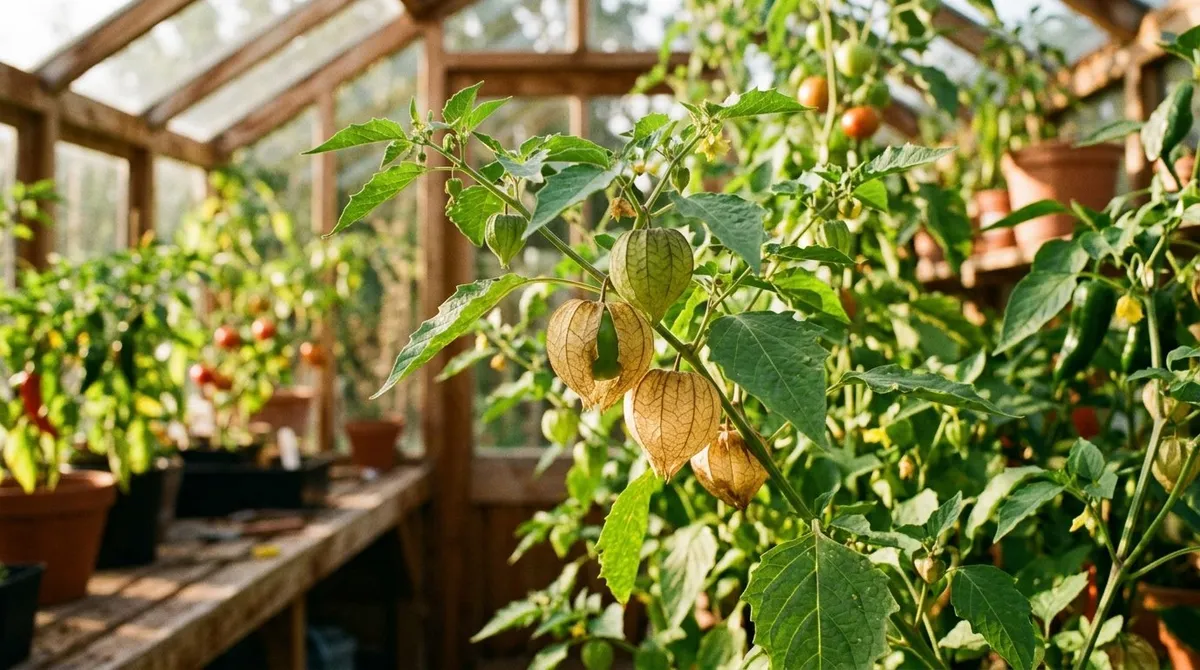
Tomatillo plants staked in a greenhouse, showing developing fruits inside their papery husks
When and how to harvest tomatillos
Harvest tomatillos when the papery husk turns tan-brown and splits open. The fruit inside should fill the husk completely and feel firm when gently squeezed. A ripe tomatillo pops out of the husk cleanly.
Green varieties: The fruit is ripe when it reaches full size (4-7cm depending on variety), turns bright green, and the husk begins to dry and split. Do not wait for the fruit to change colour, green tomatillos are harvested green. Overripe fruits turn yellow and lose their tart flavour.
Purple varieties: Allow fruits to develop full purple colour before picking. The husk dries and splits as with green types. Purple tomatillos are sweeter when fully ripe.
Picking frequency: Check plants every 3-4 days from August onwards. Fruits ripen over several weeks, not all at once. Regular picking encourages the plant to set more fruit.
Storage: Remove the husks before storing. The sticky residue on the fruit’s surface washes off under running water. Whole tomatillos keep for 2-3 weeks in the fridge. For longer storage, roast and freeze as puree (see below).
End of season: Before the first frost, pick all remaining fruits including unripe ones. Green, immature tomatillos will ripen slowly on a windowsill over 1-2 weeks. Alternatively, use unripe fruits in green salsa, they are tart but perfectly usable.
What to cook with tomatillos
Salsa verde is the classic use and worth growing tomatillos for alone. Roast 500g of husked tomatillos under a hot grill for 8-10 minutes until charred and soft. Blend with a handful of fresh coriander, half a white onion, one green chilli (or to taste), juice of one lime, and salt. Serve with tacos, grilled chicken, eggs, or as a dip with tortilla chips.
Green enchilada sauce: Double the salsa verde recipe and thin with 200ml chicken or vegetable stock. Simmer for 15 minutes. Pour over filled tortillas, top with cheese, and bake at 180C for 20 minutes.
Preserving: Roast tomatillos, blend to a puree, and freeze in ice cube trays. Pop out frozen cubes and store in bags. Each cube gives you a tablespoon of salsa verde for winter cooking. Tomatillos also make an excellent chutney with green chilli, ginger, and sugar.
For growing other crops that pair well with Mexican cooking, see our guide to growing sweet peppers and when to plant tomatoes.
Pests and problems
Tomatillos share the same pests as tomatoes but are generally more resistant. They are tougher plants that tolerate wider conditions.
Aphids: Greenfly and blackfly cluster on growing tips in June and July. Squash by hand, blast with water, or encourage natural predators. Aphid damage is usually cosmetic and does not affect yield.
Whitefly: A common greenhouse pest. Use yellow sticky traps and the parasitic wasp Encarsia formosa as biological control. Ventilate well, whitefly thrives in hot, still air.
Blight: Tomatillos can suffer from late blight (Phytophthora infestans), the same disease that affects tomatoes and potatoes. Greenhouse growing significantly reduces blight risk. Outdoors, avoid overhead watering and remove affected foliage immediately.
Poor fruit set: Almost always caused by growing a single plant (self-incompatibility) or poor pollination in a closed greenhouse. Grow at least two plants and assist pollination by shaking stems or using a paintbrush. Open greenhouse vents to allow pollinating insects access.
Blossom end rot: Occasionally seen on the first fruits. Caused by inconsistent watering and calcium uptake issues. Maintain even soil moisture and avoid drought-flood cycles. Mulch around the base of plants to stabilise soil moisture.
Tomatillos with husks splitting open, the signal that they are ready to pick
For a companion crop from the same family, see our guide to best greenhouse plants month by month. The RHS Physalis growing guide covers the broader genus including cape gooseberries.
Frequently asked questions
Why is my tomatillo plant flowering but not fruiting?
Tomatillos are self-incompatible. A single plant cannot pollinate itself. You need at least two genetically different plants for cross-pollination. Ideally grow three or more. Plant them within 1m of each other. If you grew all your plants from the same seed packet, this is fine, each seed is genetically distinct. Shake the plants gently when flowers are open to help pollen transfer.
Can I grow tomatillos outdoors in the UK?
Yes, in warm southern England with a sheltered, south-facing position. Outdoor yields are 30-50% lower than greenhouse-grown plants. Fruit takes longer to ripen outdoors. In the Midlands and north, a greenhouse or polytunnel is strongly recommended. Outdoor plants need staking and benefit from a fleece cover in September to extend the season.
When are tomatillos ready to harvest?
Harvest when the papery husk turns from green to tan and splits open. The fruit inside should fill the husk completely and feel firm. Green varieties like Toma Verde are ready when they are bright green and 4-5cm across. Purple varieties deepen in colour as they ripen. Do not wait for fruits to soften, firm tomatillos have the best flavour for cooking.
What is the difference between tomatillos and cape gooseberries?
Both are Physalis species but different plants. Tomatillos (Physalis philadelphica) produce larger fruits of 4-7cm, are savoury and tart, and used in Mexican cooking. Cape gooseberries (Physalis peruviana) produce smaller fruits of 1-2cm, are sweet, and eaten as dessert fruit. Tomatillos need cross-pollination; cape gooseberries are self-fertile. Both grow well in UK greenhouses.
Can I save tomatillo seeds?
Yes. Cut a ripe fruit in half and scoop seeds into a sieve. Rinse under running water to remove the sticky gel. Spread on kitchen paper and dry for a week in a cool, airy room. Store in a labelled envelope in a cool, dry place. Seeds remain viable for 3-4 years. If growing multiple varieties, they will cross-pollinate, so saved seed may not be true to type.
Do tomatillos need staking?
Yes. Tomatillo plants grow 1-1.5m tall with a sprawling, bushy habit. Without support, branches bend under the weight of fruit and touch the ground. Use a stout central stake with string ties every 30cm. Alternatively, grow through a tomato cage or horizontal netting. Pinch out lower side shoots to keep an open, airy structure that reduces disease risk.
What do I do with tomatillos?
Tomatillos are the key ingredient in Mexican salsa verde. Roast or boil the fruits, then blend with coriander, onion, chilli, and lime juice. They also work well in green enchilada sauce, added to stews for acidity, or sliced raw into salads. Surplus tomatillos freeze well, roast first, then freeze the puree in ice cube trays for year-round use.
Our team produces practical UK gardening guidance from source research, contributor records and established horticultural practice. Editorial standards are overseen by Matt W.