Key takeaways
- A 35 to 40cm basket holding 18 to 25 litres of compost suits almost every basket crop
- One 'Tumbling Tom' basket gives 1.5 to 2kg of cherry tomatoes across a UK summer
- Water daily from June, and twice daily once temperatures pass 25C, or fruit drops
- Feed weekly with high-potash tomato food from the first flowers until the last pick
- A watered basket weighs 12 to 15kg, so fix brackets into brick or block, never a fence panel
- Mint must go in its own basket, as it swamps anything sharing the compost within weeks
Growing vegetables in hanging baskets turns bare walls, fences and porches into productive growing space. A single 40cm basket can yield up to 2kg of cherry tomatoes, a steady supply of cut-and-come-again salad, or a season of fresh herbs by the back door. Baskets suit terraced yards, balconies and small gardens where there is no room for beds. They lift crops away from slugs, and put picking at eye level.
Which vegetables grow best in hanging baskets
The best basket crops share three traits: shallow roots, a compact or trailing habit, and a quick return. Tumbling tomatoes lead the list because they were bred for containers and spill over the rim without staking. Strawberries follow close behind, as their natural runners drape over the edge and the fruit hangs clear of soil and slugs.
Salad leaves and trailing herbs make up the reliable middle ground. They crop within weeks and forgive a missed watering better than fruiting crops. Root crops like radishes and spring onions work in a deeper basket. Dwarf beans, chillies and small cucumbers are possible but need the largest baskets and the most attention.
For a wider view of small-space edibles beyond baskets, our guide to container vegetable gardening in the UK covers pots, troughs and grow bags that pair well with baskets.
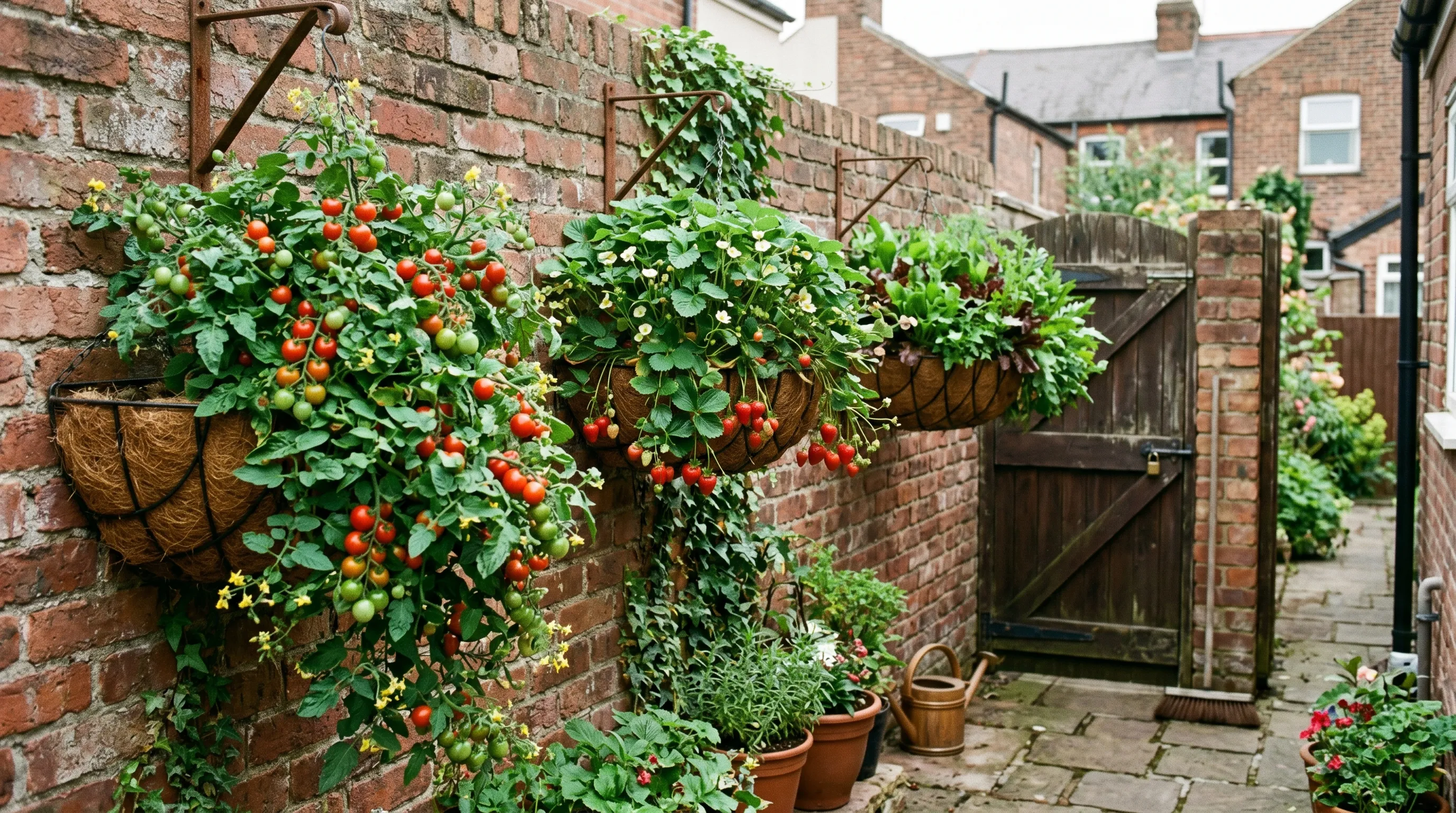 Three baskets on a Staffordshire yard wall: tumbling tomatoes, strawberries and a cut-and-come-again salad mix.
Tumbling tomatoes are the top basket crop
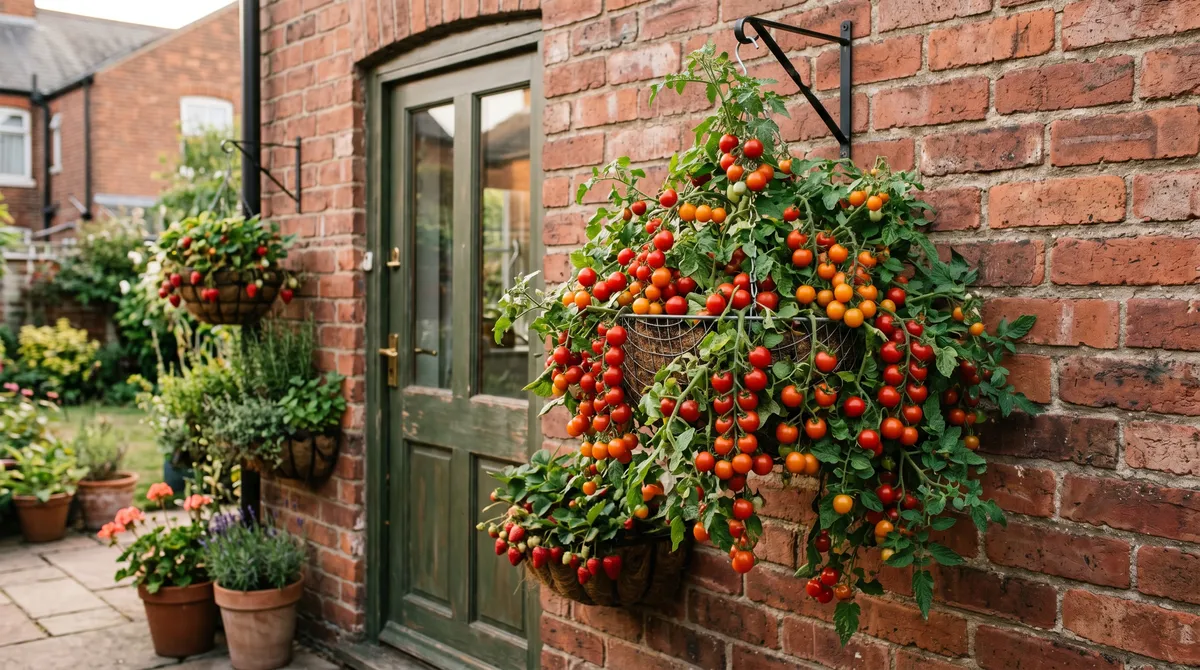
Tumbling tomatoes are the highest-yielding vegetable you can grow in a basket. They were bred to trail, so the stems cascade over the rim and carry fruit clear of the compost. A single plant fills a 40cm basket. Our weighed average across eleven summers is 1.71kg per basket, with a best of 1.83kg in 2024.
The two varieties we return to are ‘Tumbling Tom’ and ‘Hundreds and Thousands’. ‘Tumbling Tom’ gives heavier cherry fruit at around 20g each and crops from early July. ‘Hundreds and Thousands’ lives up to its name with masses of tiny 8 to 10g tomatoes, sweeter and earlier, ideal for children to pick. Both shrug off the wind better than cordon types because they sit low and dense.
Plant one tomato per 40cm basket in late May, after the last frost. Pinch out nothing, as bush types need their side shoots. Start feeding with high-potash tomato food the moment the first truss sets fruit. For the full range of cherry and bush types, see our pick of the best tomato varieties for UK gardens.
Gardener’s tip: Water tomato baskets at the rim, never over the foliage. Wet leaves in still, humid weather invite blight, which spreads through a dense basket fast. A long-spout can or a lance reaches the compost without splashing the leaves.
Strawberries, salad leaves and cut-and-come-again crops
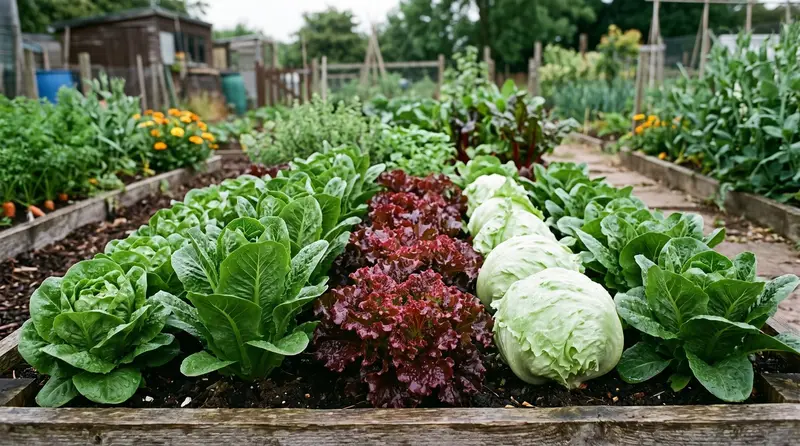
Salad leaves are the fastest return of any basket crop. A ‘Salad Bowl’ or mixed loose-leaf blend is ready to cut in 4 to 5 weeks from sowing. Treat it as cut-and-come-again: snip the outer leaves 3cm above the crown and the plant regrows for another cut within 10 to 14 days. One basket gives 6 to 10 cuts across a season if you sow a fresh batch every three weeks.
Rocket, mizuna and oriental mustards crop the same way and add pepper and bite. Sow these from late summer for autumn picking, as they bolt fast in midsummer heat. A shaded basket on a north or east wall holds salad in better condition through July than a baking south wall.
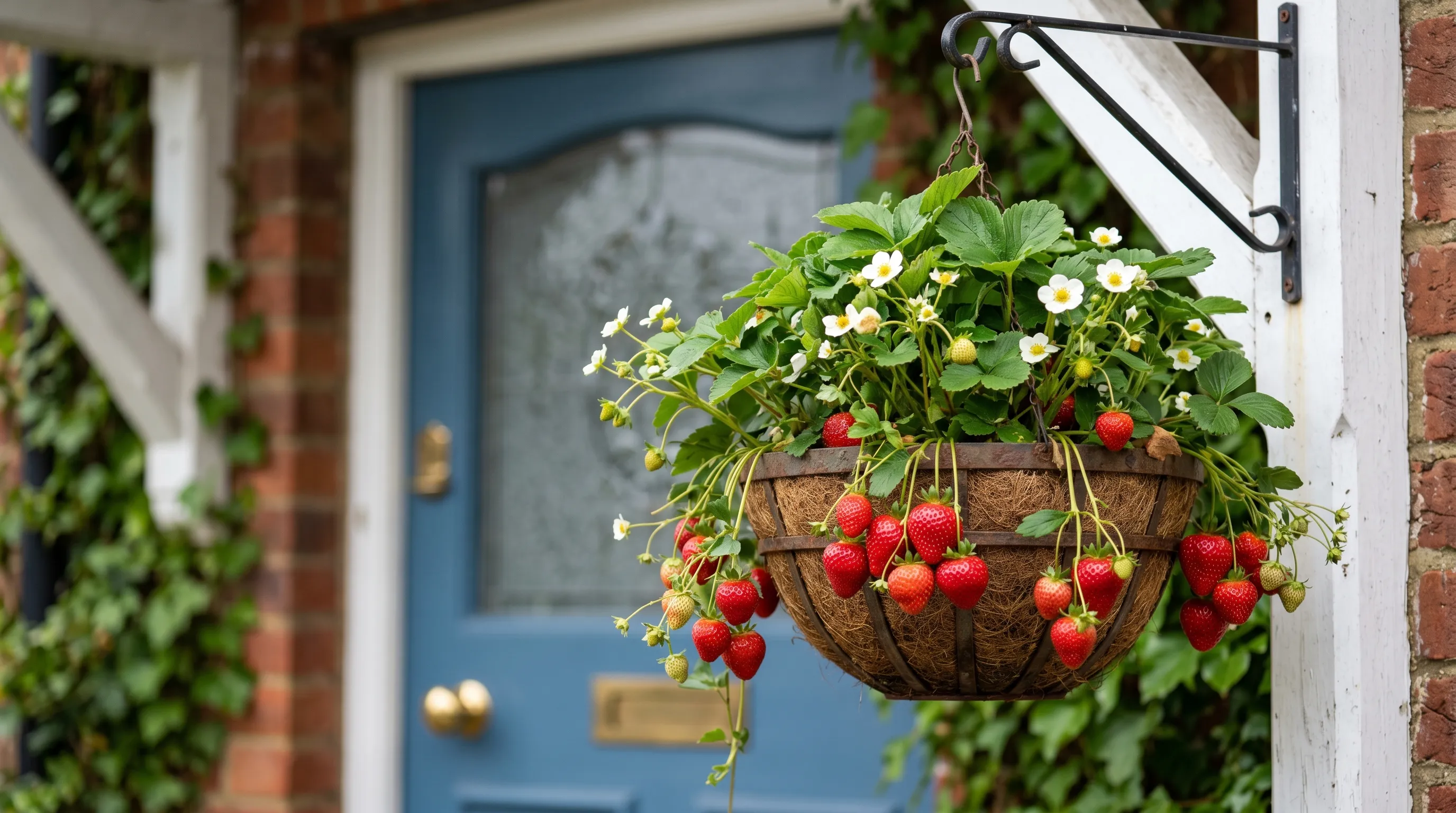 Ever-bearing strawberries hang clear of slugs and soil splash, so almost every berry reaches the kitchen clean.
Herbs that thrive in baskets, and the one that needs its own
Most culinary herbs grow happily in a shared basket, with one exception. Trailing and bushy herbs suit the drainage and full sun a basket offers. A mixed herb basket by the kitchen door gives cut-and-come-again pickings all summer and looks the part too.
Plant a sunny basket with basil, parsley, chives and thyme. Basil needs the warmth and crops from June once nights stay above 10C. Parsley tolerates a little shade and keeps going into autumn. Chives regrow within days of cutting and flower with edible purple pompoms. Trailing thyme spills over the rim and needs almost no water once established.
Warning: Never plant mint in a basket with other herbs or vegetables. It will outcompete and strangle every neighbour within a month. Always give it a separate container with its own compost and watering.
Beans, chillies, cucumbers and root crops in baskets
Fruiting and root crops are possible in baskets, but they demand the largest size and the most water. These are the step-up crops once you have mastered tomatoes and salad. All need a full 40cm basket and a sunny, sheltered spot.
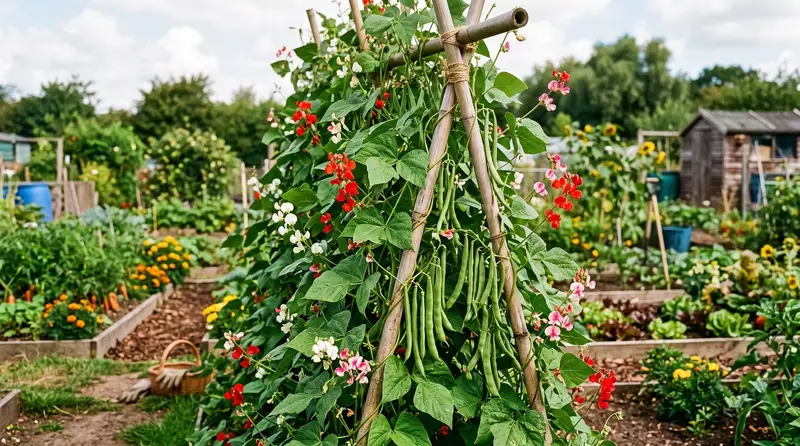
Dwarf and tumbling beans crop well in a 40cm basket. ‘Hestia’ is a dwarf runner bred for containers, growing to just 45cm with red and white flowers and tender pods. A basket yields 200 to 300g across the season. Pick every few days to keep the plant cropping. Chillies and peppers thrive in the heat trap a sunny wall creates. ‘Basket of Fire’ and ‘Apache’ are compact, fiery and heavy-cropping, giving 30 to 60 fruit per plant. Our chilli pepper growing guide covers heat levels and ripening.
Radishes and spring onions suit a deeper basket of at least 18cm soil depth. Sow radishes thinly and harvest in 4 to 6 weeks, then resow for a rolling supply. Our radish growing guide covers spacing and the common splitting problem. Dwarf cucumbers like ‘Patio Snacker’ trail neatly and give 8 to 12 small fruit, but they drink heavily and wilt fast if a watering is missed.
Basket size and how much compost you actually need
A 35 to 40cm basket is the sweet spot for vegetables. Anything smaller dries out within hours on a hot day and gives roots too little room. The basket diameter sets the compost volume, and compost volume sets how much water and feed the basket can hold.
A 40cm basket holds 18 to 25 litres of compost when filled to within 3cm of the rim. A 35cm basket holds 12 to 16 litres. For context, a standard bag of multipurpose compost is 40 to 50 litres, so one bag fills two large baskets with a little spare. Buy peat-free compost and mix in water-retaining gel at the rate on the packet.
The basket type matters as much as the size. Solid-sided plastic or rattan baskets hold moisture far better than open wire ones, because the sides cut evaporation and wind. If you use a traditional open wire basket, line it with a moisture-retaining liner or a punctured plastic bag inside the moss to slow water loss. Add a saucer or reservoir disc in the base of any basket to hold a small water store.
| Basket diameter | Compost volume | Best for | Watering load |
|---|---|---|---|
| 30cm | 8 to 12 litres | Herbs, salad only | Twice daily in heat |
| 35cm | 12 to 16 litres | Strawberries, salad, herbs | Daily, twice in heat |
| 40cm | 18 to 25 litres | Tomatoes, beans, chillies | Daily, twice above 25C |
| 45cm trough | 25 to 35 litres | Mixed crops, cucumbers | Daily, very stable |
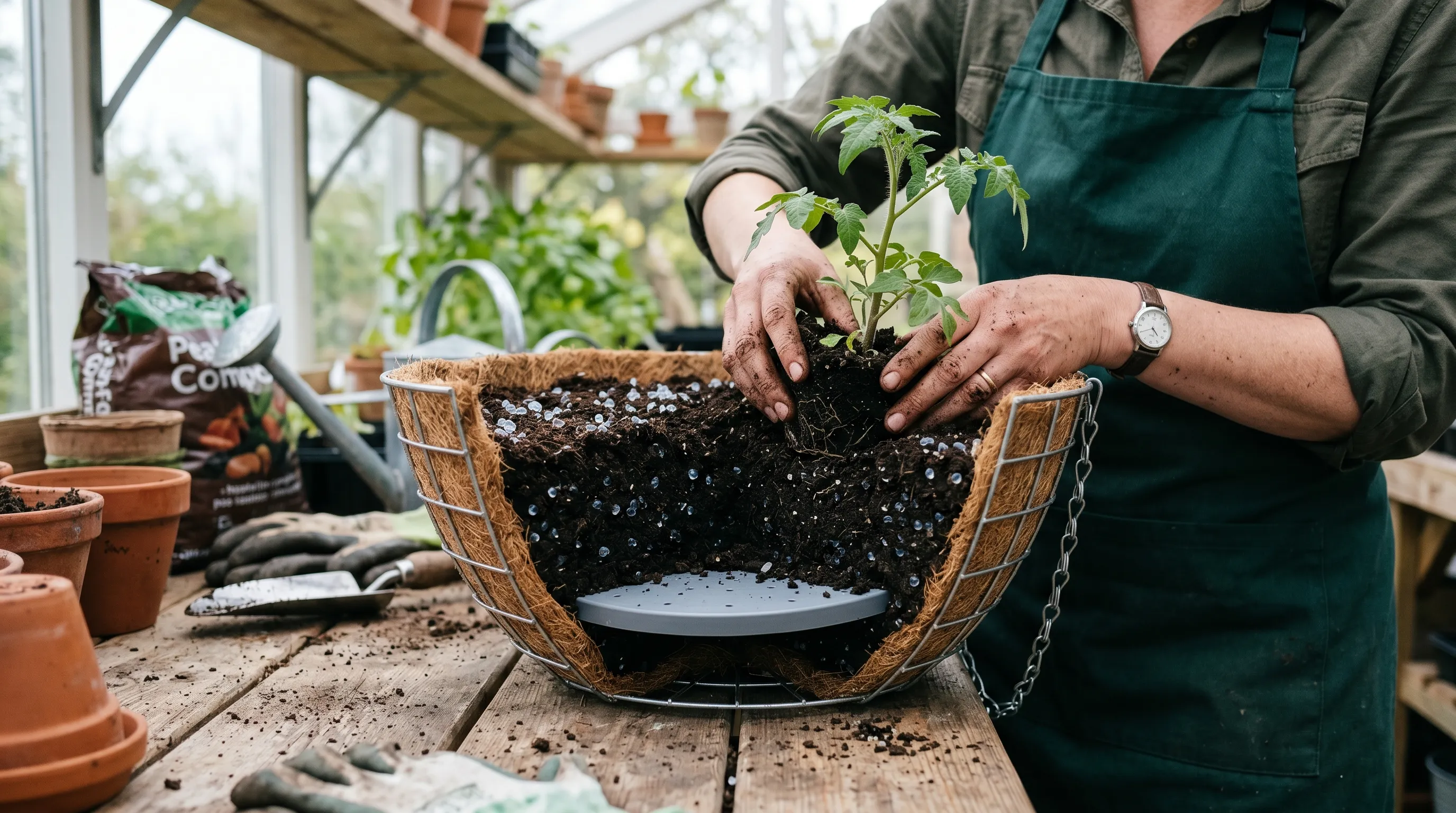 Planting up a basket: liner, reservoir disc in the base, then peat-free compost mixed with water-retaining gel.
The watering reality nobody warns you about
Baskets dry out faster than any other container, because air moves on every side. This is the single biggest reason basket crops fail. The compost loses water from the surface, the sides and the base all at once. On a hot, breezy day a 40cm basket can lose 2 litres before evening.
Water once a day from June, first thing in the morning, until water runs from the base. Once daytime temperatures pass 25C, water again in the evening. In the July 2022 heatwave, with three days above 30C, an un-topped-up basket lost half its tomato flowers in 48 hours. Flower drop from drought is the warning sign you have left it too late.
Feeding, sun and getting the position right
Start feeding the moment the first flowers set, then feed weekly. The compost in a basket holds only a few weeks of nutrients, and constant watering flushes feed out of the base. Without feeding, fruiting crops stall after the first flush.
Use a high-potash tomato food for all fruiting crops: tomatoes, strawberries, beans, chillies and cucumbers. Potash drives flowering and fruiting, where high-nitrogen feeds push leaf at the expense of crop. Mix it at the strength on the bottle and apply once a week from first flower to last pick. Leafy crops like salad and most herbs need only a half-strength general feed every two weeks, or none at all in fresh compost.
Position decides everything for fruiting crops. Tomatoes, chillies, beans and cucumbers want full sun, at least 6 hours a day, ideally on a south or west wall. Salad, parsley and mint prefer some shade and hold better on a north or east aspect through summer. Shelter every basket from strong wind, which both batters the plants and triples the rate they dry out.
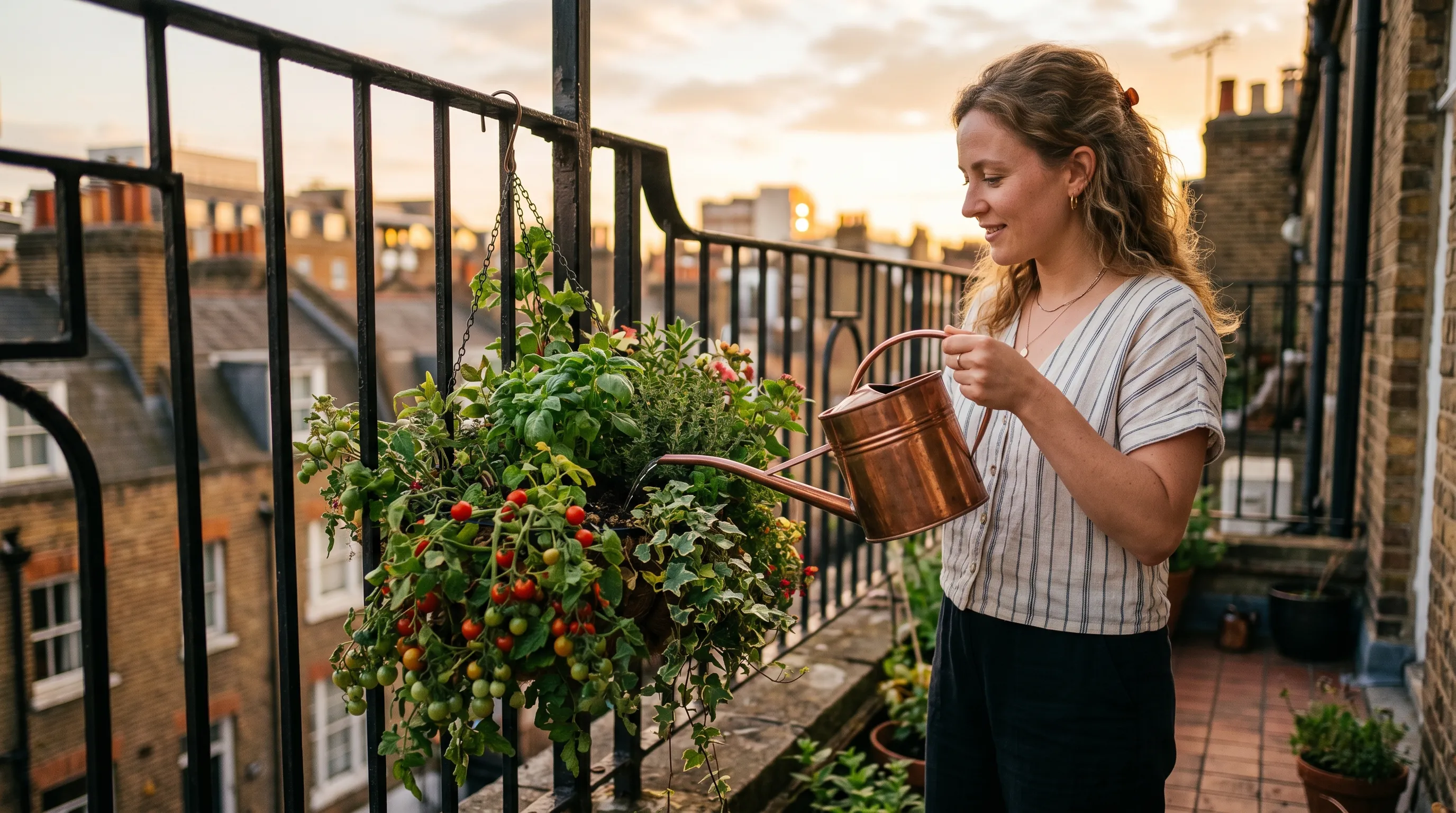 Water at the rim with a long-spout can, daily from June and twice daily above 25C, to keep flowers from dropping.
Weight, brackets and fixing baskets safely
A watered vegetable basket is heavier than most people expect, and the fixing must take it. A 40cm basket full of wet compost and a cropping plant weighs 12 to 15kg. A 45cm trough can pass 20kg. That load hangs off one bracket all summer, through wind and rain.
Fix brackets into solid masonry, brick or block, never a timber fence panel. A fence panel flexes and the fixing pulls out, usually in the first gale with the basket at full crop. Use a heavy-duty galvanised bracket rated to at least 25kg, fixed with 8mm masonry plugs and 60mm screws into the brick body, not the soft mortar joint. Check the bracket is rated for the swing weight, not just the static weight, as a basket moving in wind loads the fixing harder.
Hang baskets at a height you can reach to water and pick without a ladder, around 1.7 to 1.9m to the base. Test every new fixing by hanging on it with your full weight before you trust it with a crop. Re-check the screws each spring, as repeated wetting and wind can work them loose over a winter.
| Basket size | Dry weight | Watered weight | Bracket rating needed |
|---|---|---|---|
| 30cm | 3 to 4kg | 7 to 9kg | 15kg minimum |
| 35cm | 4 to 6kg | 10 to 12kg | 20kg minimum |
| 40cm | 6 to 8kg | 12 to 15kg | 25kg minimum |
| 45cm trough | 9 to 11kg | 18 to 22kg | 35kg minimum |
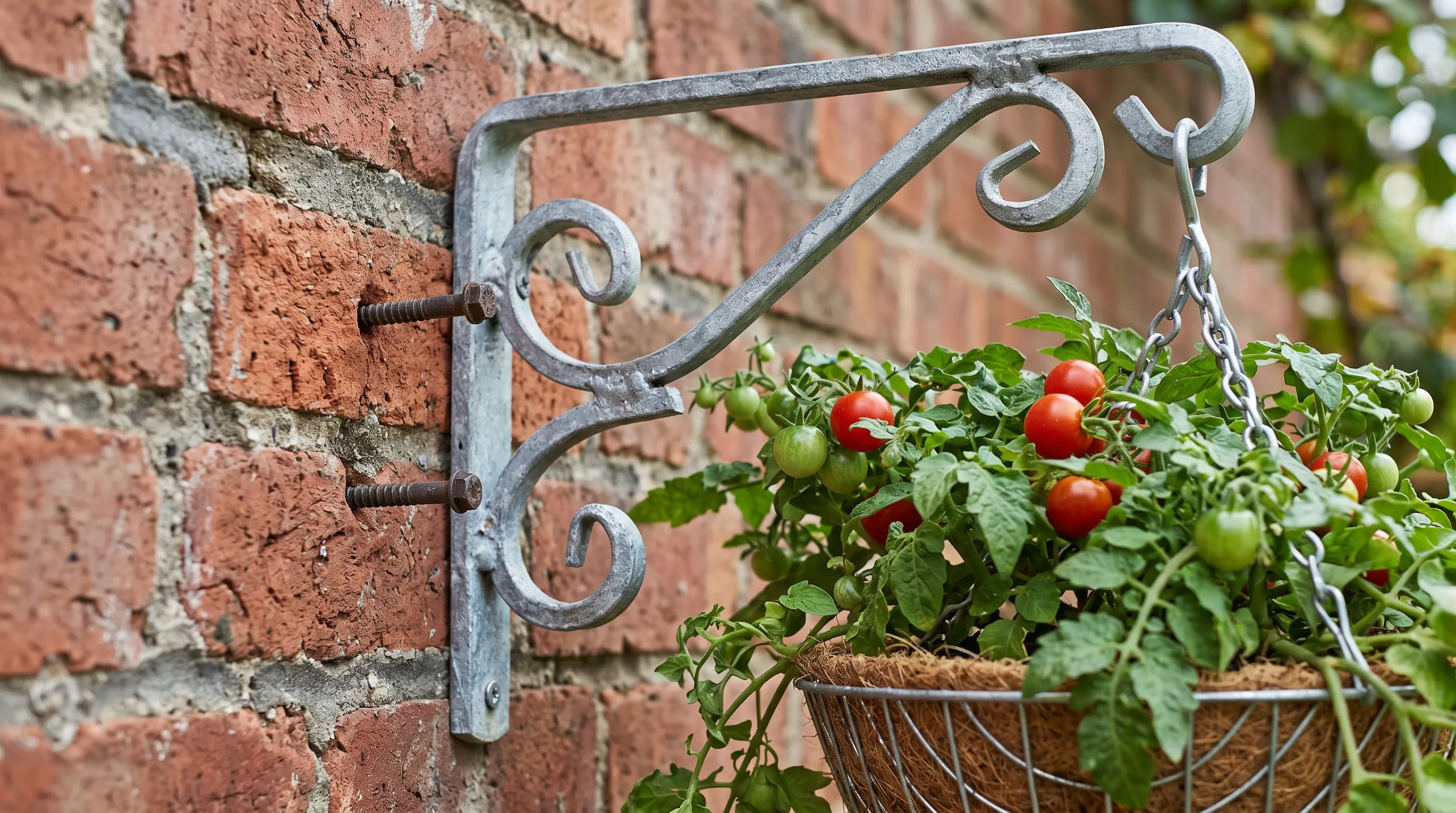 A heavy-duty galvanised bracket fixed into the brick body, not the mortar joint, takes the 12 to 15kg of a watered basket.
Common mistakes with vegetable hanging baskets
A handful of predictable errors sink most basket crops. Avoid these and the basket usually delivers.
Using too small a basket. A 25 or 30cm basket holds too little compost for fruiting crops. It dries out within hours and starves the roots of room. Always use 35 to 40cm for vegetables, and reserve the small baskets for a single herb or a few salad leaves.
Under-watering. This is the number one killer. Baskets need daily water from June, and twice daily above 25C. A skipped watering in heat drops flowers and splits fruit. Fit a self-watering reservoir or water-retaining gel if you cannot water reliably twice a day.
Skipping the feed. Constant watering flushes nutrients out of the base within weeks. Fruiting crops stall without a weekly high-potash feed from first flower. Many people water faithfully but never feed, then wonder why the crop fades in August.
Exposing baskets to wind. Wind batters trailing stems and triples the drying rate. A basket on an exposed corner dries out twice as fast as a sheltered one and loses flowers to wind-rock. Hang baskets on a sheltered wall out of the prevailing south-westerly.
Month-by-month basket vegetable calendar for the UK
Timing keeps a basket cropping from spring to autumn. The calendar below covers a typical UK season, adjusting a week or two later for the north and Scotland.
| Month | Task |
|---|---|
| February | Sow tomatoes, chillies and peppers indoors at 18 to 21C |
| March | Sow strawberry seed indoors. Pot on tomato and chilli seedlings |
| April | Harden off young plants. Sow salad and radishes under cover |
| May | Plant up baskets late May after the last frost. Start watering daily |
| June | First strawberry and salad picking. Begin weekly high-potash feed |
| July | Peak cropping. Water twice daily in heat. Resow salad and radishes |
| August | Heavy tomato and chilli harvest. Keep feeding and picking to extend cropping |
| September | Late beans and chillies ripen. Sow autumn salad in cooler baskets |
| October | Final tomato and chilli pick. Strip ever-bearing strawberries |
| November | Empty fruiting baskets. Compost spent plants, store baskets dry |
For more on cropping right through the cooler months, our winter container growing section covers what keeps producing once the tomatoes are done. Sow little and often through summer, and a basket of salad or radishes never has a gap.
Frequently asked questions
What vegetables grow best in hanging baskets?
Tumbling tomatoes, strawberries and salad leaves grow best in baskets. They have shallow roots and trailing or compact habits that suit a 35 to 40cm basket. Trailing herbs, radishes, spring onions and dwarf beans also crop well. Anything with deep roots or a tall frame is a poor fit.
How often should I water a vegetable hanging basket?
Water once a day through summer, and twice daily above 25C. Baskets dry out faster than any other container because air circulates on every side. A 40cm basket can drink 2 litres on a hot day. Check the compost each morning by pushing a finger 3cm in.
Can you grow tomatoes in hanging baskets?
Yes, tumbling and bush tomatoes grow very well in baskets. Choose trailing types bred for containers such as ‘Tumbling Tom’ or ‘Hundreds and Thousands’. One plant fills a 40cm basket and yields 1.5 to 2kg of cherry tomatoes. Avoid tall cordon varieties that need staking.
Do I need to feed vegetables in hanging baskets?
Yes, feed weekly with high-potash tomato food from first flower. Constant watering flushes nutrients out of the basket within a few weeks. Fruiting crops stall without it. Leafy crops in fresh compost need only a half-strength feed every two weeks, or none at all early on.
How much weight can a hanging basket hold safely?
A fixed bracket must take the watered weight, not the dry weight. A 40cm basket of wet compost and a cropping plant weighs 12 to 15kg. Use a bracket rated to at least 25kg, fixed into brick or block with masonry plugs. Never hang a vegetable basket from a fence panel.
Where to go next
Now you have the crops, the basket size and the watering plan, build out the rest of your edible containers with our guide to growing strawberries in the UK, which covers the ever-bearing types that crop in baskets from June to October. For wider reading on basket and container care, the Royal Horticultural Society holds detailed advice on compost and watering. Start with one tumbling tomato basket this summer, get the watering right, and most growers add three or four baskets the following year.
Our team produces practical UK gardening guidance from source research, contributor records and established horticultural practice. Editorial standards are overseen by Matt W.