Key takeaways
- White currants are a colour variant of redcurrants (Ribes rubrum), not a separate species
- Mature bushes yield 3-5kg of fruit per year once established after 3 seasons
- Plant bare-root bushes November to March in fertile, moisture-retentive soil
- Prune to an open goblet shape each winter, removing one-third of old wood annually
- Net bushes from June to protect fruit from birds — blackbirds strip crops in hours
- White Versailles and Blanka are the best-performing UK varieties for flavour and yield
White currants are among the least-grown soft fruits in UK gardens, yet they produce some of the sweetest berries you will ever pick. These translucent, honey-gold fruits are a colour variant of the common redcurrant (Ribes rubrum) and share the same growing requirements. The difference is flavour. Where redcurrants are sharp and tart, white currants are mild and sweet enough to eat straight from the bush by the handful.
A mature white currant bush yields 3-5kg of fruit per year and remains productive for 15-20 years. They tolerate partial shade, heavy soil, and the cold winters that define much of the UK. If you can grow gooseberries, you can grow white currants. This guide covers varieties, planting, pruning, and the one essential step that makes or breaks your harvest: netting against birds.
What are white currants and how do they differ from redcurrants?
White currants and redcurrants are the same species: Ribes rubrum. White currants lack the red pigment (anthocyanins) present in standard redcurrant varieties. This is a natural genetic variation, not a separate species or hybrid. The fruit is translucent white to pale gold when ripe, sometimes with a pink blush.
The flavour difference is significant. Redcurrants contain higher levels of citric and malic acid, giving them the characteristic tartness that makes them suited to jellies and sauces. White currants have the same sugar content but less acid, shifting the balance towards sweetness. They are the only currant type that most people enjoy eating fresh and uncooked.
White currants also have a longer harvesting window. The berries hold on the plant for 2-3 weeks longer than redcurrants without dropping or splitting, giving you more time to pick. They make excellent fresh eating, dessert toppings, white currant jelly, and sparkling white currant juice. Growing requirements mirror those for redcurrants and blackcurrants, so existing currant growers will find the transition straightforward.
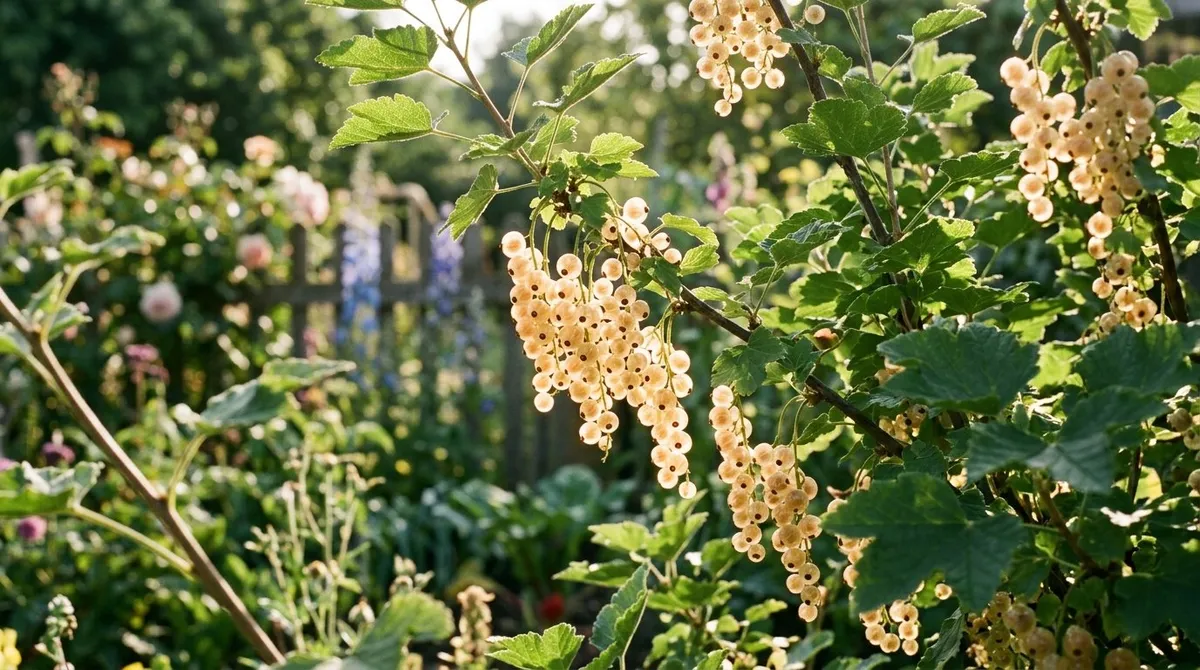
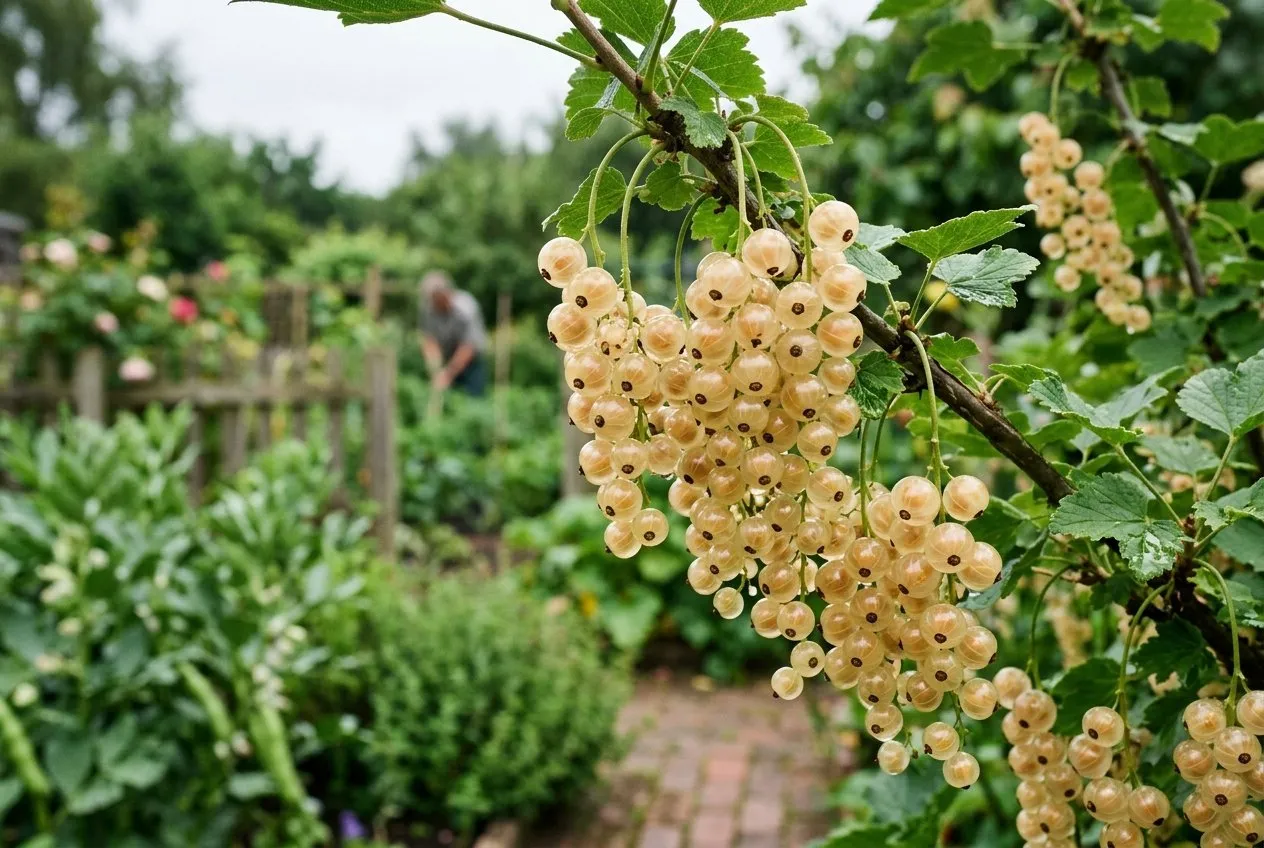 White currant berries turn translucent and honey-gold when ripe. They are sweet enough to eat straight from the bush.
The best white currant varieties for UK gardens
Four varieties dominate the UK market. Each has distinct strengths.
| Variety | Yield per bush | Berry size | Flavour | Bush habit | Best for |
|---|---|---|---|---|---|
| White Versailles | 3.5-4.5kg | Medium-large | Sweet, balanced | Upright, vigorous | All-round performer |
| Blanka | 4-5kg | Large | Sweet, mild | Spreading, heavy crop | Maximum yield |
| White Dutch | 2.5-3.5kg | Small-medium | Sweet, delicate | Compact, tidy | Small gardens, containers |
| White Grape | 2-3kg | Large | Very sweet | Moderate, upright | Fresh eating, desserts |
Blanka is a Czech variety that produces the heaviest crops of any white currant. The berries are large and sweet, though slightly less complex in flavour than White Versailles. If you want maximum fruit weight for preserving or juicing, Blanka is the one.
White Dutch suits smaller gardens and containers. The compact bush reaches only 120cm compared to 150-180cm for Versailles and Blanka. Yields are proportionally lower, but the berries have an elegant, delicate sweetness.
White Grape has the sweetest individual berries of any variety. The name is apt, ripe White Grape currants genuinely taste like small, sweet grapes. Yields are lower than Versailles, but for fresh eating quality, nothing beats it.
How to plant white currant bushes
Plant bare-root white currants between November and March when the bushes are dormant. November planting is ideal because roots establish over winter and plants grow strongly from the first spring.
Choose a spot with full sun or partial shade. White currants tolerate more shade than most fruit, cropping well on north-facing walls and in dappled shade beneath deciduous trees. Avoid frost pockets where late spring frosts damage flowers and reduce fruit set.
Prepare the soil by digging in a bucket of well-rotted manure or garden compost per planting hole. White currants prefer moisture-retentive but free-draining soil with a pH of 6.0-6.5. On heavy clay, improve drainage by adding coarse grit to the planting hole. On sandy soil, add extra organic matter to retain moisture.
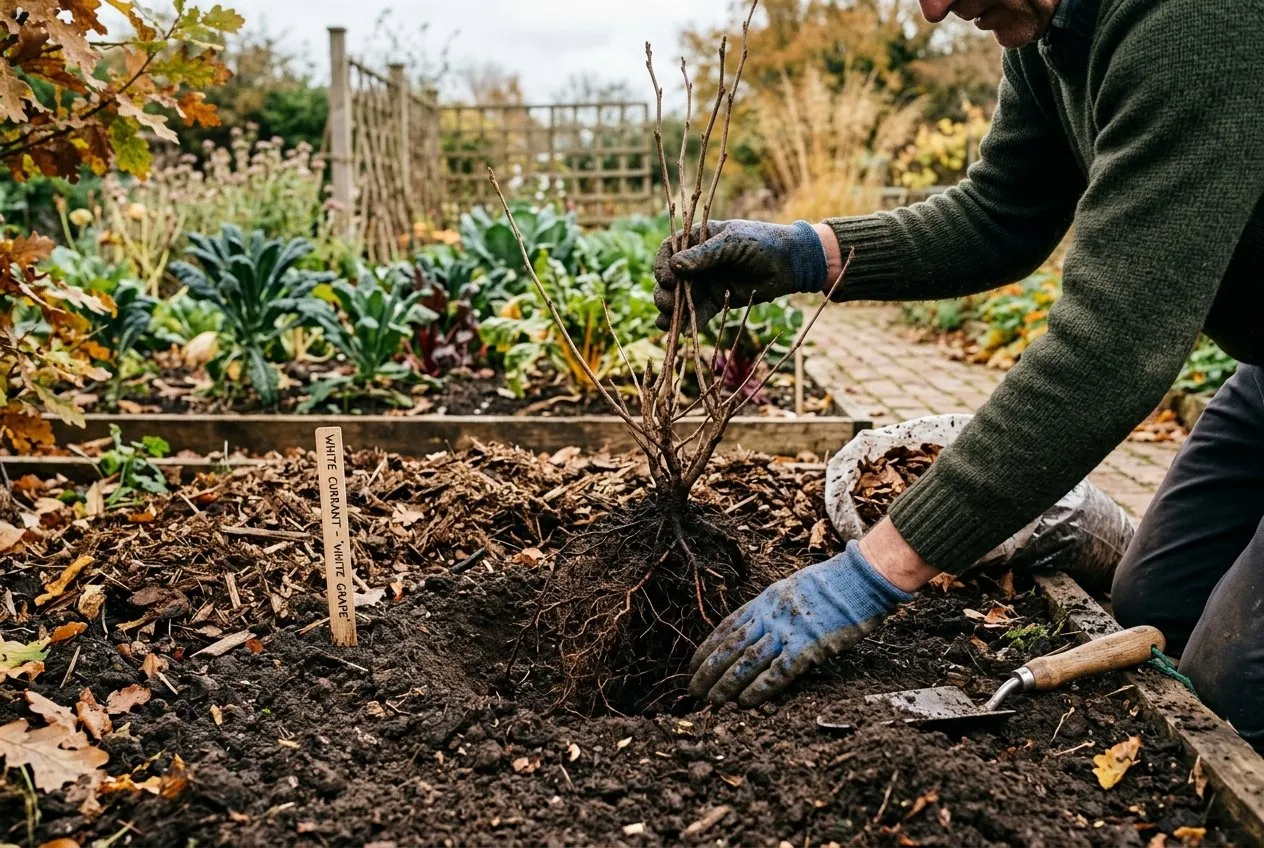 Plant bare-root white currants in November with the graft union 5cm above soil level.
Dig a hole 60cm wide and 30cm deep. Position the bush so the graft union sits 5cm above soil level. Spread the roots evenly and backfill with the improved soil, firming gently. Water thoroughly after planting. Space bushes 150cm apart for open-grown specimens. For cordons (single-stem trained forms), space at 45cm along a fence or wall.
Mulch around each bush with 8-10cm of well-rotted manure, leaving a gap of 5cm around the stem to prevent rot. This retains moisture through the growing season and feeds the soil as it decomposes. Replenish the mulch every spring.
How to prune white currant bushes
Pruning maintains an open, productive bush shape that allows air circulation and light into the centre. White currants fruit on old wood and at the base of one-year-old sideshoots, so pruning aims to maintain a balance of young and old branches.
Winter pruning (December to February)
Each winter, remove one-third of the oldest branches at the base. This stimulates replacement growth from the crown. Keep 8-10 main branches arranged in an open goblet shape. Shorten sideshoots to 2-3 buds from the main branch. Remove any crossing, dead, or diseased wood. The centre of the bush should be open enough to reach your hand in.
Summer pruning (July)
In mid-July, after harvest, shorten all sideshoots to 5 leaves from the main branch. This improves air circulation, allows light to reach next year’s fruit buds, and removes aphid-infested shoot tips. Summer pruning is particularly important in humid regions where powdery mildew affects currants.
Training as cordons
White currants train as single, double, or triple cordons against walls and fences. This saves space and suits small gardens. A single cordon is a vertical stem with short fruiting spurs. Prune sideshoots to 3 leaves in summer and 1-2 buds in winter. Cordons yield 1-1.5kg per stem, less than an open bush but efficient per square metre. Our fruit tree training guide covers the principles of restricted training.
How to care for white currants through the year
Spring (March to May)
Feed with a general-purpose fertiliser such as Growmore at 70g per square metre in March. Water during dry spells. Watch for currant blister aphid, raised red or yellow blisters on leaves. The damage is cosmetic and does not affect fruit yield. Gooseberry sawfly larvae can strip leaves in 48 hours. Check leaf undersides from April and pick off larvae by hand.
Summer (June to August)
Net bushes from early June. Water regularly, especially during fruit swell. A stressed, dry bush drops berries before they ripen. Harvest in July when berries are fully translucent and taste sweet. Cut whole fruit trusses (strigs) rather than picking individual berries. Hold the strig over a bowl and run a fork down the stem to strip berries.
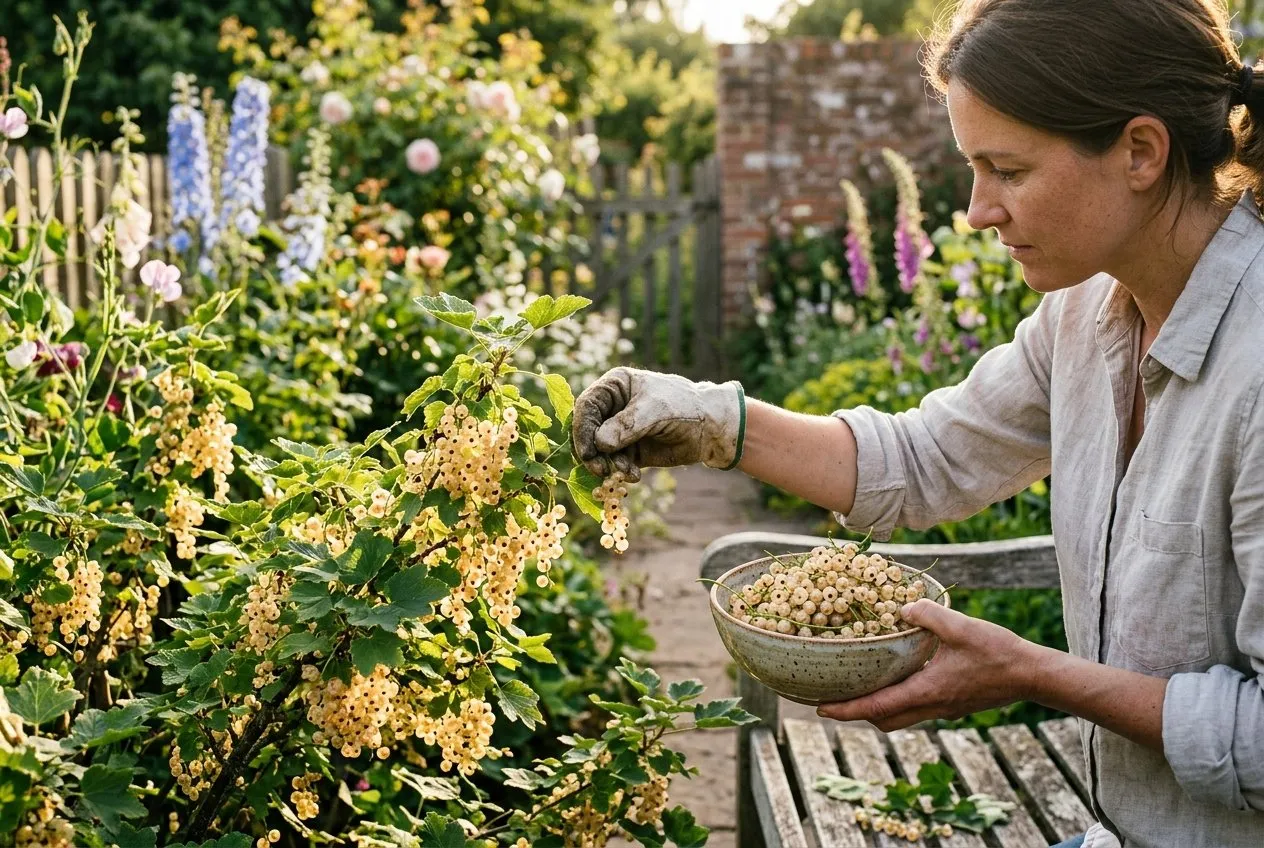 Strip white currant berries from the strig using a fork. Harvest when fruit is fully translucent.
Autumn and winter (September to February)
After leaf fall, clear fallen leaves and mulch around the base. Prune in December to February as described above. Order new bare-root plants for November planting. White currants are fully hardy throughout the UK, tolerating temperatures to -20C with no winter protection required.
Pests and diseases affecting white currants
Birds
The single biggest threat. Blackbirds, starlings, and thrushes will strip a bush of ripe white currants within hours. Netting is essential. Use 20mm mesh draped over a frame that keeps netting 15-20cm away from the berries. Netting laid directly on the bush allows birds to peck through and traps small birds. A permanent fruit cage with a door is the most effective solution for multiple bushes.
Gooseberry sawfly
Sawfly larvae are pale green caterpillars with black spots that hatch on leaf undersides in April. They feed voraciously and can defoliate a bush in 2-3 days. Check leaf undersides weekly from mid-April. Pick off larvae by hand or spray with an approved insecticide. Biological pest control options include encouraging parasitic wasps and ground beetles.
Currant blister aphid
Causes raised red or yellow blisters on upper leaf surfaces in spring. The aphids feed on leaf undersides. Damage looks alarming but has little effect on fruit yield. Prune out heavily infested shoot tips in summer. Encourage ladybirds and hoverflies as natural predators.
Big bud mite
Swollen, rounded buds in winter indicate big bud mite (Cecidophyopsis ribis). Pick off and destroy affected buds between November and March. Severe infestations require bush replacement. Big bud mite also transmits reversion virus, which permanently reduces yield. Buy certified virus-free stock from reputable nurseries.
Powdery mildew
White powdery coating on leaves in summer. Maintain good air circulation through pruning. Avoid overhead watering. Mildew is worse in dry soil with humid air. Mulch and water at the base. Our powdery mildew treatment guide covers organic and chemical options.
White currants in the kitchen
White currants are best eaten fresh within 2 days of picking. They do not store well but freeze excellently. Spread berries on a tray, freeze for 2 hours, then bag. They keep for 12 months frozen.
White currant jelly is delicate and golden, ideal for serving with fish, poultry, or cheese. Use a 1:1 ratio of fruit to sugar and the natural pectin in the berries sets the jelly without additives.
White currant juice is refreshing when diluted. Press berries through muslin, add sugar to taste, and dilute with sparkling water. In France, Bar-le-duc jelly made from hand-seeded white currants is considered a delicacy and sells for over £30 per jar.
For gardeners growing a range of soft fruit, white currants complement the harvest calendar perfectly. Gooseberries crop in June, white currants in July, and blackberries from August onwards.
Frequently asked questions
Are white currants the same as redcurrants?
Yes, white currants are a colour variant of redcurrants. Both belong to Ribes rubrum. The only differences are fruit colour (translucent white to pale gold instead of red) and flavour (sweeter, less tart). Growing requirements, pruning, and pest management are identical. White currants work well in recipes where the red colour of standard currants is unwanted.
When do you plant white currant bushes?
Plant bare-root white currants between November and March when dormant. Container-grown plants can go in year-round but establish best in autumn. November planting gives roots 4-5 months to establish before spring growth. Avoid planting in waterlogged soil or during hard frost. Space bushes 150cm apart, or 45cm for single cordons.
How do you prune white currant bushes?
Prune in winter (December to February) to an open goblet shape. Remove one-third of the oldest wood at the base each year. Shorten sideshoots to 2-3 buds. Keep 8-10 main branches forming an open centre. In summer, shorten sideshoots to 5 leaves in July to improve air circulation and light to ripening fruit.
Why are birds eating my white currants?
Blackbirds, thrushes, and starlings eat white currants as they ripen. Net bushes from early June using 20mm mesh draped over a frame. Netting laid directly on the bush traps birds and allows them to peck through. A purpose-built fruit cage is the most reliable long-term solution. Without protection, birds can strip an entire bush in a single morning.
Can you grow white currants in containers?
Yes, white currants grow well in large containers of 40 litres or more. Use soil-based John Innes No. 3 compost. Water regularly and feed with a high-potash liquid fertiliser from flowering to harvest. Repot every 2-3 years. Container-grown bushes yield 2-3kg rather than the 3-5kg achievable in the ground, but suit small gardens and patios.
What is the best white currant variety for the UK?
White Versailles is the best all-rounder for UK gardens. It produces heavy crops of sweet, translucent berries on vigorous bushes. Blanka is the highest-yielding variety, producing up to 5kg per bush. White Dutch is compact and suits smaller gardens. White Grape has the sweetest individual berries but lower overall yield.
Our team produces practical UK gardening guidance from source research, contributor records and established horticultural practice. Editorial standards are overseen by Matt W.