Key takeaways
- Sweet chestnut takes 8-12 years from planting to first crop
- Mature trees produce 5-50kg per year and live 100-500 years
- All UK chestnuts need a pollinator pair within 50 metres
- Marron de Lyon and Marigoule give the largest UK nuts
- Acid to neutral soil (pH 5.0-6.5) is essential; chestnuts hate chalk
- Plant at 8-12m spacing for orchard, 15-20m for woodland canopy
Sweet chestnut is a generational planting decision. The tree planted today crops for a great-grandchild. UK fruit growers used to ornamental fruit trees and 2-3 year cropping schedules find sweet chestnut bewildering. Eight years from planting to first nuts. Twelve years to a usable harvest. Fifty years to peak production. The tree planted at age 30 starts producing properly when the grower retires.
This guide covers the realistic timeline, the three UK cultivars that produce the largest nuts, the pollination requirements that decide whether trees fruit at all, and the soil chemistry that must be checked before planting. You will find the 12-year planting schedule, the harvest method that catches every nut, and the spike-glove disease protocol. Pair this with our growing citrus trees guide for the wider Mediterranean fruit cluster and our how to grow hazel/cobnut guide for short-cycle UK nuts.
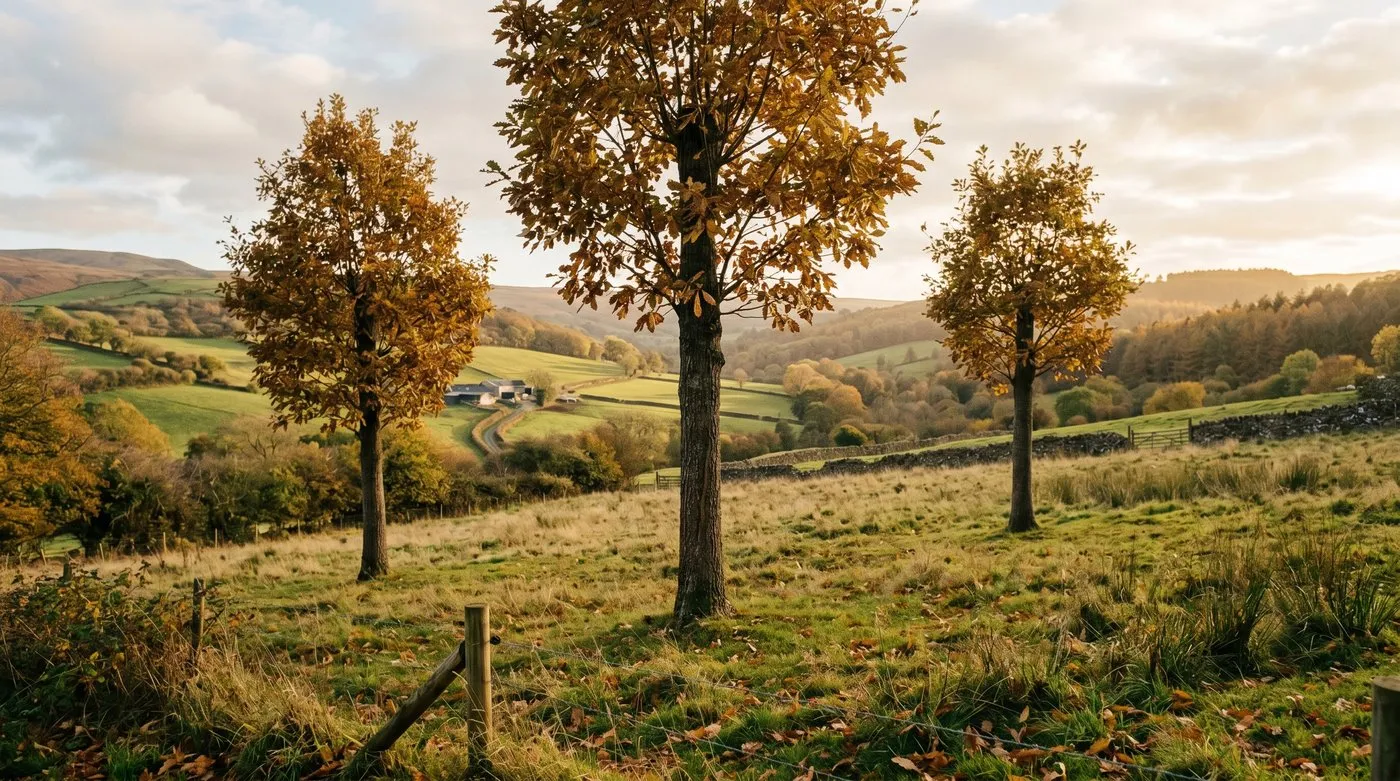 Eight-year-old chestnut trio at 12-metre spacing, the year first fruits appeared. Three different cultivars give the cross-pollination needed for any meaningful crop
Why sweet chestnut is a different scale of planting
Sweet chestnut (Castanea sativa) is native to southern Europe and has grown in the UK since Roman introduction. Records of UK chestnut cultivation date from 50-100 AD. The Romans imported the tree as a staple food source. Today the UK has roughly 12,000 hectares of chestnut woodland, mostly in Kent, Sussex, Cornwall, and parts of Wales.
The tree is a long-term planting in every dimension. Mature trees reach 25-30m height and 8-15m crown spread. Productive lifespan is 100-500 years; the oldest UK chestnut at Tortworth in Gloucestershire is estimated 1,200 years old. A planting today rewards multiple generations.
Cropping starts at year 8-12 from planting. Grafted cultivars on productive rootstock can crop at year 6-7. Seedling trees from a wild nut take 12-15 years. The yield ramps slowly: 100-500g in year 8, 2-5kg by year 12, 10-20kg by year 18, 25-50kg at full maturity.
Compare to other UK fruit and nut trees:
| Tree | First crop | Productive lifespan |
|---|---|---|
| Strawberry | Year 1 | 3-5 years |
| Raspberry cane | Year 1 | 8-10 years |
| Apple (dwarf) | Year 2-3 | 25-50 years |
| Apple (standard) | Year 5-6 | 60-100 years |
| Pear | Year 4-6 | 60-150 years |
| Cobnut/hazel | Year 4-6 | 60-100 years |
| Walnut | Year 6-10 | 200-300 years |
| Sweet chestnut | Year 8-12 | 100-500 years |
Yield at full maturity is substantial. A mature 30-year UK chestnut produces 25-50kg of nuts per year. Three trees yield 75-150kg per autumn. By contrast a single mature apple tree gives 30-80kg. Chestnut competes on yield once established.
The UK climate suits sweet chestnut well. Cool damp summers, mild winters, sufficient rainfall, and acid-leaning soil match Mediterranean conditions in the upland fringes of southern Europe where chestnut originated. UK chestnuts often crop more reliably than they do further south because dry hot summers stress trees.
The three UK cultivars that produce edible nuts
Choose grafted named cultivars over seedling trees. Seedling chestnuts grown from a UK wild nut are common and inexpensive but produce tiny nuts (5-10g each) and crop unpredictably. Named cultivars on grafted rootstock give larger nuts and faster cropping.
Marron de Lyon (France, mid-1800s) is the standard large-nut UK cultivar. Nuts average 12-20g each, up to 25g in good years. Peels easily. Sweet flavour. Reliable cropper from year 10 onwards. Available from specialist nurseries at £45-£80 per grafted tree.
Marigoule (France, modern hybrid) flowers early and ripens early. Nuts 10-18g each. Often the first cultivar to crop each season. Pairs well with Marron de Lyon as cross-pollinator.
Bouche de Betizac (France, modern hybrid) is the chestnut blight tolerant choice. Larger nuts 15-25g each. Resistance to chestnut blight (Cryphonectria parasitica) is partial but significant. Best choice if any blight reports exist within 50 miles.
A trio of all three gives maximum cross-pollination. Each cultivar flowers slightly differently across June, so the trio pollinates each other across the full 2-3 week window. Two of the same cultivar give limited fruit.
Avoid seedling trees from supermarket nuts. They grow but rarely produce edible-sized nuts in UK conditions. The 12-15 year wait for a 5g kernel is wasted.
| Cultivar | Origin | Nut size | UK availability | Notes |
|---|---|---|---|---|
| Marron de Lyon | France 1800s | 12-25g | Specialist nurseries | Standard large-nut choice |
| Marigoule | France modern | 10-18g | Specialist nurseries | Early flowering, pollinator |
| Bouche de Betizac | France modern | 15-25g | Specialist nurseries | Blight tolerant |
| Marron Comballe | France | 12-20g | Limited UK supply | Late flowering option |
| Belle Epine | France | 10-15g | Limited UK supply | Heritage cultivar |
| Seedling C. sativa | UK wild | 5-10g | Common cheap | Avoid for nut crop |
Soil, site and spacing
Soil pH 5.0-6.5 is essential. Sweet chestnut on alkaline soil dies within 5-10 years. Severe iron deficiency causes yellow leaves, weak growth, and progressive decline. Test pH before planting; do not attempt chestnut on chalk.
Acid sandy loam is ideal. Free-draining, deep, organic. Heavy clay is workable if drainage is improved with grit and compost in the planting hole.
Position requires shelter from north and east winds and full sun for the canopy. Mature canopies cast deep shade so chestnuts are usually outermost in a mixed planting.
Spacing 8-12m for orchard (max canopy contact between trees), 15-20m for woodland (full canopy development). Close orchard spacing speeds canopy closure and competing for sunlight. Wider woodland spacing develops the largest individual trees.
Plant November to March in dormant season. Bare-root trees from specialist nurseries plant cheapest. Container trees plant any season but autumn establishment is best for chestnut.
Plant on a raised mound 30cm above ground level if drainage is at all questionable. Chestnut roots rot in standing water.
Stake firmly for 5 years. Young chestnuts rock in wind. Use two stout angled stakes on opposite sides of the leeward bias.
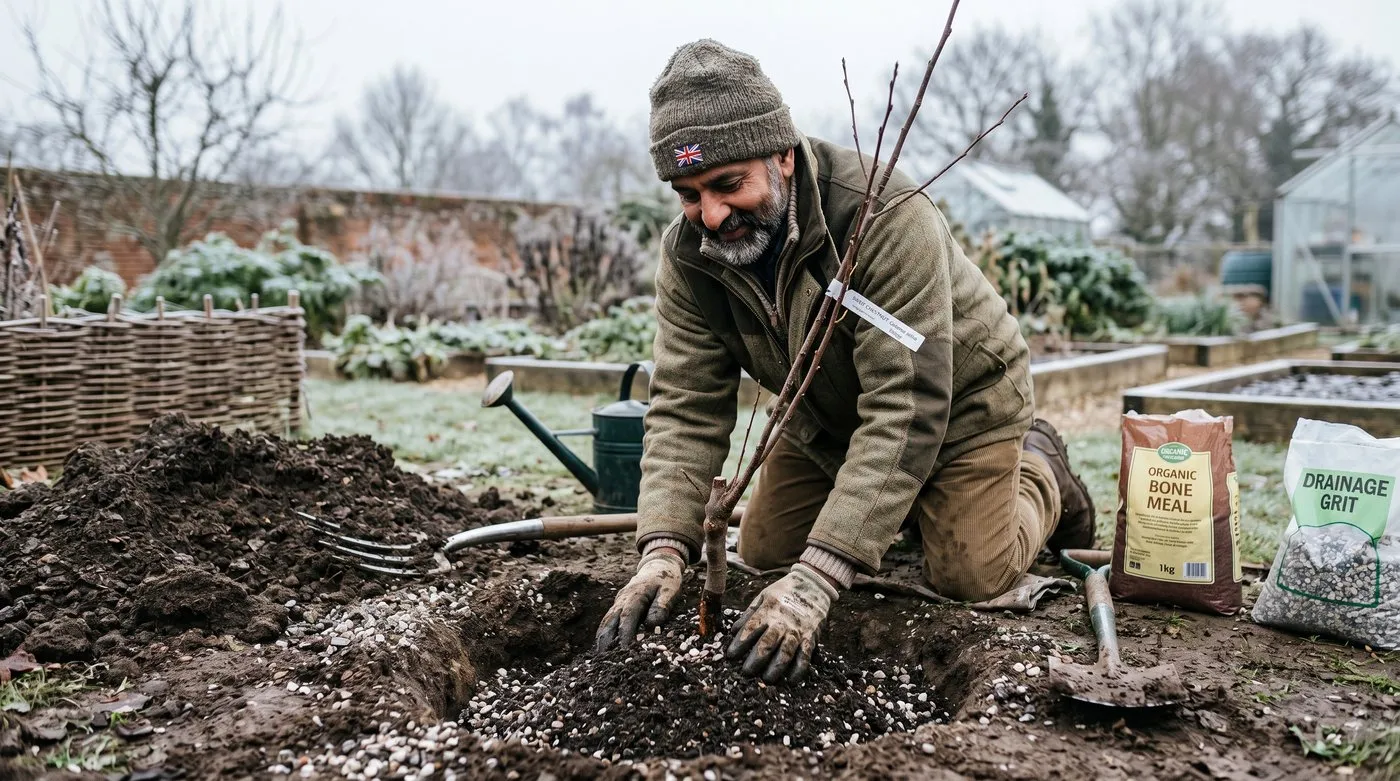 Bare-root planting in December on a raised mound with grit-improved drainage. Sweet chestnut hates wet roots; the mound prevents rot in winter saturation
The 12-year planting plan
Year 1: establishment. Bare-root tree planted November to March. Stake. Mulch with 10cm compost or composted bark in a 1m circle. Water deeply through dry weather year one.
Year 2-3: framework. Annual February prune for central leader plus 3-5 main branches. Remove competing stems. Continue mulching.
Year 4-5: stand development. Branch framework continues. First flowers may appear; remove to direct energy to growth.
Year 6-7: pre-cropping. Tree height 4-5m. Crown spreads. Bear first few fruits.
Year 8: first proper crop. 100-500g per tree. Validates cultivar choice and pollination success.
Year 9-11: ramp up. Yield rises to 1-5kg per tree.
Year 12: usable harvest. 5-15kg per tree. Trees becoming productive.
Year 15-18: mature production. 15-30kg per tree per year.
Year 20+: peak. 25-50kg per tree per year for 100+ years.
| Year | Tree height | Yield expected | Key action |
|---|---|---|---|
| 1 | 1.5-2m | None | Plant, stake, mulch |
| 3 | 2.5-3m | None | Annual prune, mulch |
| 5 | 3-4m | None to trace | Remove first flowers |
| 8 | 4-5m | 0.1-0.5kg | First harvest |
| 12 | 6-8m | 5-15kg | First usable crop |
| 15 | 8-12m | 15-30kg | Approaching maturity |
| 20+ | 15-25m | 25-50kg annually | Full production |
Pruning and shape
Sweet chestnut grows naturally with a strong central leader. Prune lightly to keep this structure. Heavy formative pruning shortens the productive lifespan.
February prune annually in years 1-5. Remove competing leaders, crossing branches, damaged wood. Aim for 3-5 main scaffold branches at different heights.
After year 5, prune only damaged or diseased wood. Mature chestnuts need almost no annual pruning. The tree finds its own shape.
Removed wood is excellent firewood. Chestnut splits easily, burns hot, and seasons in 12-18 months. Even prunings have value.
Coppicing is an alternative to fruit production. Coppiced chestnut produces straight poles for fencing every 12-20 years. UK chestnut woodland is mostly coppiced for this reason. A coppice and orchard mix gives both nuts and timber from a small area.
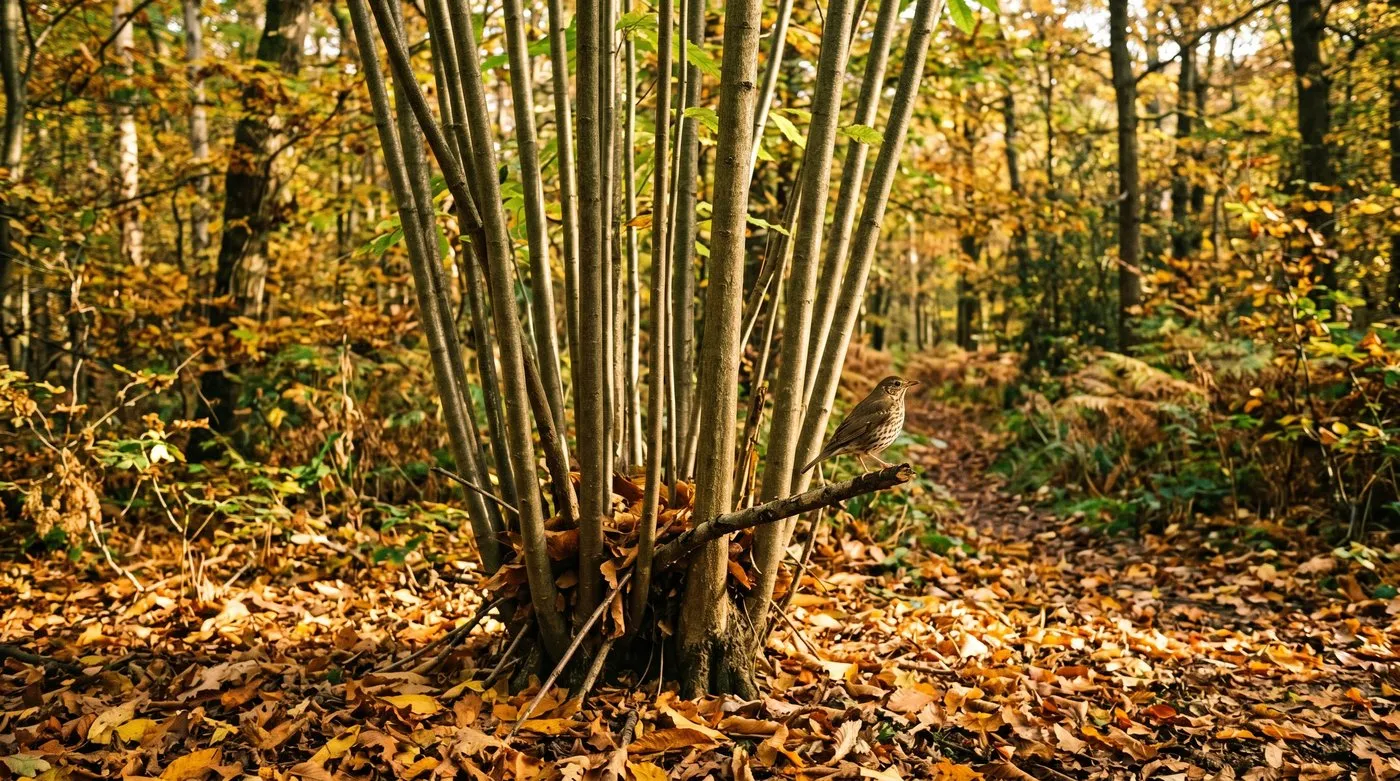 Coppiced sweet chestnut stool, the traditional UK management for fencing poles. A 15-year coppice cycle yields straight 4-6m poles
Pests, diseases and the 2025 UK reality
Three serious threats to UK sweet chestnut: chestnut blight, ink disease, and oriental chestnut gall wasp.
Chestnut blight (Cryphonectria parasitica) is the most serious. The fungus killed nearly all American chestnut by 1940. Reached the UK in 2011. Symptoms: sunken orange-brown cankers on bark, dieback above the canker, red leaves in summer. Notification disease: report suspected cases to Forestry Commission within 1 month. Bouche de Betizac shows partial resistance; resistance breeding continues.
Ink disease (Phytophthora cinnamomi and P. cambivora) is a soil-borne fungus. Affects roots and lower trunk. Symptoms: blue-black ooze from trunk, root rot, sudden decline. Wet sites worse. Prevention: raised planting mounds, free drainage.
Oriental chestnut gall wasp (Dryocosmus kuriphilus) arrived UK in 2015. Tiny wasp lays eggs in chestnut buds; larval feeding causes leaf galls. Reduces yields 30-50% in infested trees. No effective UK treatment yet. Biological control with parasitoid wasps is being trialled.
Smaller pests: grey squirrels strip bark and steal mature nuts. Bird wire round trunks helps. Pick nuts immediately when burrs split.
Defra notification rules apply for chestnut blight and gall wasp. Inspect trees twice annually (June and October) and report symptoms.
Harvest, peeling and storage
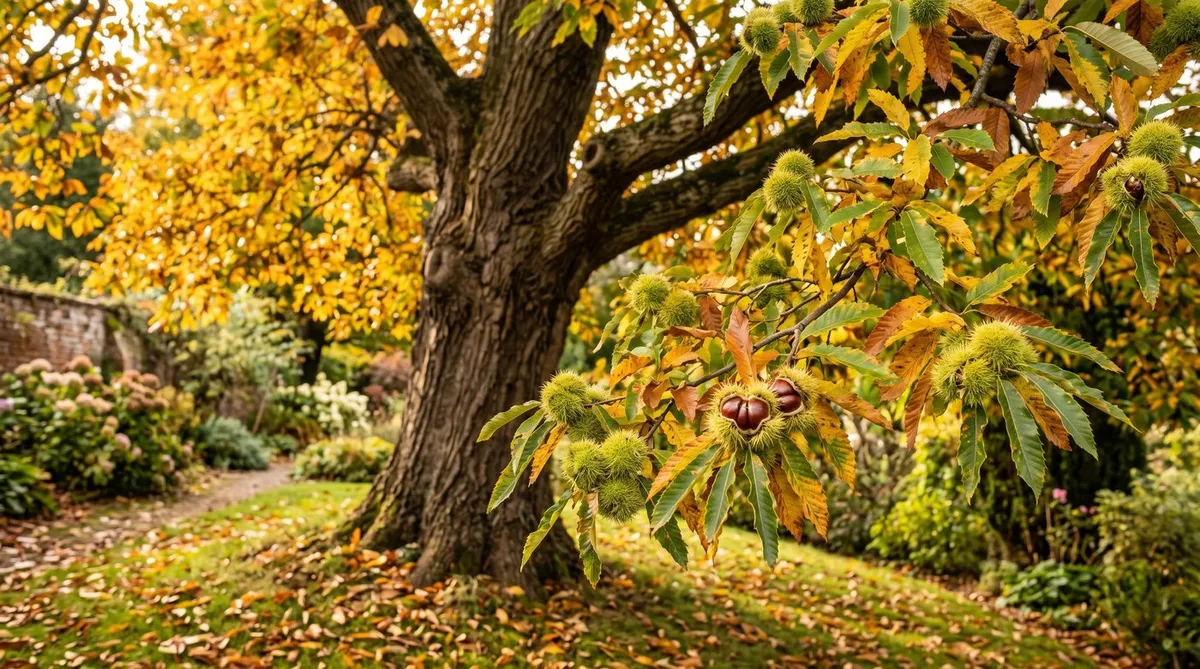
Sweet chestnuts ripen October to early November in the UK. Spiky green burrs (cupules) split open to reveal 1-3 brown nuts inside. Harvest when burrs have split or fallen to the ground.
Wear thick gloves; spikes are vicious. Heavy-duty gardening gloves or specialist chestnut gloves with leather palms.
Pick from the ground daily during the 2-3 week harvest window. Squirrels and pigs (wild boar in some areas) clear fallen nuts within 24 hours.
Cure nuts for 1-2 weeks before storage. Spread in single layer in cool dry shed. Husks dry, kernels firm, sweetness develops.
Store cured nuts in jute sacks at 0-2C for 3-6 months. Refrigerator cold-store works. Plastic bags cause mould.
Peel by scoring and roasting. Cut an X in the flat side of each nut. Roast at 200C for 20-25 minutes. Peel while still warm; the shell and inner skin lift off cleanly.
Yield per kg of cured nuts gives roughly 600g edible kernel. Three mature trees yielding 30kg each give 18kg of kernel: enough for a year’s supply for most households.
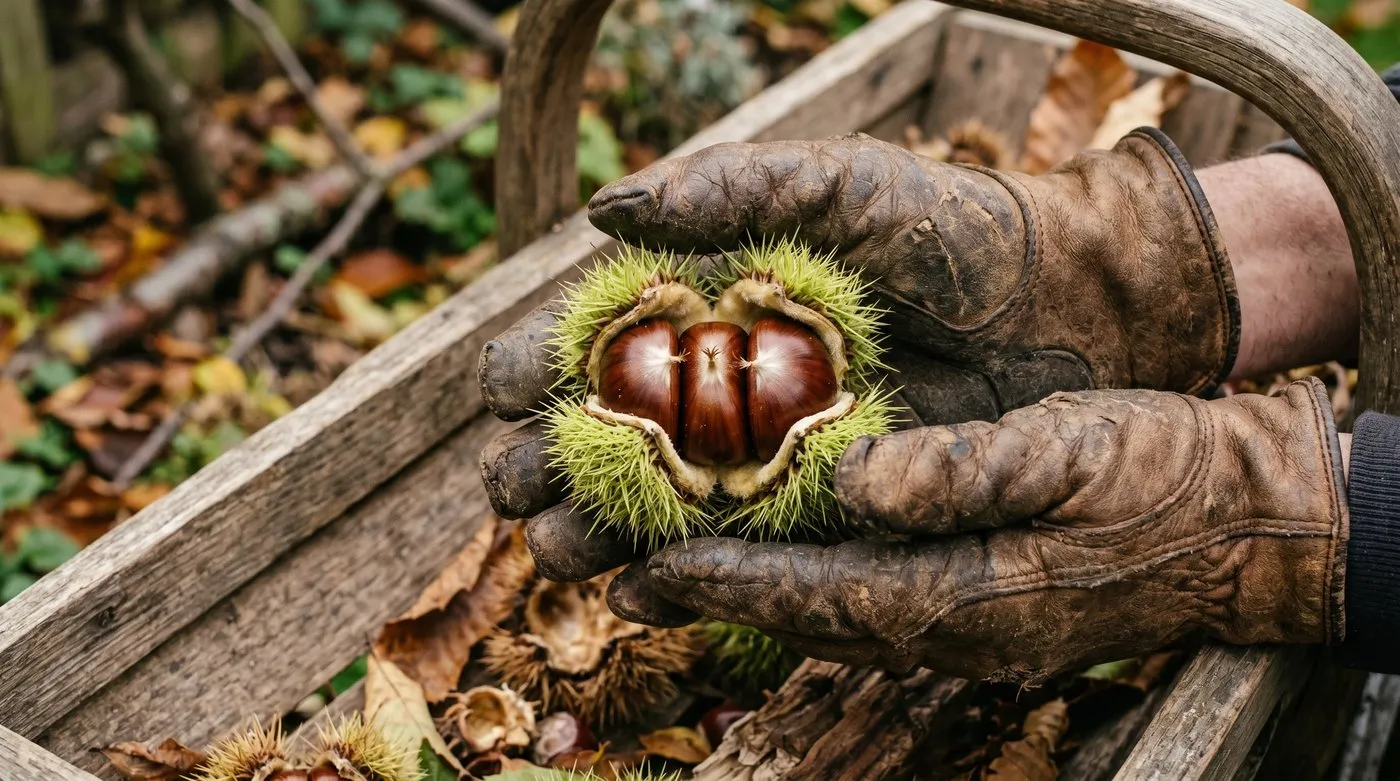 October harvest. Burrs split naturally when nuts are ripe. Thick leather gloves are essential; the spikes draw blood from bare hands
Common mistakes to avoid
Planting on chalk or alkaline soil. Trees decline and die within 5-10 years. Test pH before purchase. Do not attempt on pH above 7.0.
Single-cultivar planting. Self-sterile means almost no fruit. Always plant at least two different cultivars within 50 metres.
Seedling trees from supermarket nuts. Yield small kernels at year 12-15. Pay for grafted cultivars.
Skipping pollinator pairing. Two of the same cultivar is barely better than one. Three different cultivars is the safest plan.
Underestimating canopy spread. Mature trees reach 15m crown. Plant well clear of buildings, roads, and overhead cables.
Ignoring blight symptoms. Early detection and removal of cankered branches can save a tree. Skipping inspections leads to whole-tree loss.
Step-by-step: planting a trio
Step 1: test soil pH at three points across the planting area. Acid pH 5.0-6.5 is the only viable range. Above pH 7.0, do not plant.
Step 2: mark three planting positions at 8-12m spacing. Triangle layout maximises cross-pollination. Each tree within 50m of the others.
Step 3: clear vegetation in 2m circles at each position. Remove turf, perennial weeds.
Step 4: dig planting holes 60-90cm wide, 50-60cm deep. Break up the base. On clay sites, dig deeper and add 30cm grit at the bottom.
Step 5: build a raised mound 30cm above surrounding ground level in each hole. Mix excavated soil 50/50 with garden compost.
Step 6: place tree on the mound. Spread roots radially. Ensure graft union sits 5cm above final soil level.
Step 7: backfill, firm gently. Water in heavily.
Step 8: stake firmly with two angled stakes. Tie loosely with tree ties.
Step 9: mulch with 10cm compost or composted bark in 1m circle. Keep mulch 5cm clear of the trunk.
Step 10: protect from rabbits and deer. Spiral guards or mesh fence to 1.2m height.
Step 11: water deeply through first three summers. 20-30 litres per tree weekly in dry weather.
Step 12: prune lightly in February each year. Maintain central leader and 3-5 scaffold branches.
Frequently asked questions
How long does a sweet chestnut take to fruit?
Sweet chestnut takes 8-12 years from planting to first crop. Grafted named varieties on a productive rootstock can crop at year 6-7. Seedling trees from a wild nut take 12-15 years to first crop. Mature trees crop reliably from year 15 onwards and yield 5-50kg per year for 100+ years. The wait is the single biggest barrier to UK chestnut planting.
Do sweet chestnuts need a pollinator?
Yes, sweet chestnuts are self-sterile and need cross-pollination from a different cultivar within 50 metres. A solo tree gives almost no fruit. Two trees of the same cultivar give little fruit. Plant at least two different cultivars; three cultivars give the most reliable cross-pollination across the staggered flowering period in June.
What is the best sweet chestnut variety for UK gardens?
Marron de Lyon is the most reliable large-nut UK cultivar. Bred for size and ease of peeling, it gives kernels up to 25g each. Pair with Marigoule (early flowering, French) and Bouche de Betizac (large, blight resistant) for a cross-pollination trio that crops across all UK conditions. Bouche de Betizac is the best choice if chestnut blight has been reported nearby.
Can sweet chestnuts grow on alkaline soil?
No. Sweet chestnuts demand acid to neutral soil (pH 5.0-6.5). Chalk and alkaline clay soils above pH 7.0 cause severe iron deficiency, leaf yellowing, and tree death within 5-10 years. Test soil pH before planting; do not attempt sweet chestnut on chalk. The Kent and Sussex chestnut belt sits on acidic sandstone for this reason.
What is sweet chestnut blight?
Sweet chestnut blight (Cryphonectria parasitica) is a fungal disease that killed billions of American chestnuts in the 20th century. It reached the UK in 2011. Symptoms are sunken cankers on bark, dieback above the canker, and red leaves in summer. Defra has notification rules; report suspected cases to the Forestry Commission within one month of suspicion. Bouche de Betizac shows partial resistance.
Now you have the timeline and cultivars sorted, see our growing citrus trees guide for another Mediterranean fruit crop and our hazel/cobnut growing guide for a short-cycle UK-native nut. The Agroforestry Research Trust supplies grafted sweet chestnut cultivars and offers UK growing advice.
Our team produces practical UK gardening guidance from source research, contributor records and established horticultural practice. Editorial standards are overseen by Matt W.