Key takeaways
- NVS judging criteria cover condition (40%), size and shape (30%), and uniformity (30%) — condition always matters most
- Exhibition onions need sowing in late December under heat, 10 months before the show date
- Long carrots for competition grow in 1.2-metre sand-filled drums with no stones or compaction
- Runner beans must be 38-45cm long, straight, snap cleanly, and show no visible string or seeds
- Collection classes score highest and require five distinct types, each matching single-dish standards
- Harvest timing is critical — most crops peak for 24-48 hours, so plan backwards from show day
Vegetable showing is one of gardening’s best-kept secrets. Every summer, thousands of village halls, allotment sites, and community centres across the UK host horticultural shows where growers compete to produce the finest specimens from their gardens and plots.
You do not need a giant pumpkin or a world-record leek to enter. Most village shows have classes for everyday crops, runner beans, tomatoes, potatoes, onions, judged on quality, uniformity, and presentation rather than sheer size. The entry fee is usually one pound per class. The prizes are rarely more than a certificate and a few pounds, but nobody enters for the money.
What do judges actually look for at vegetable shows?
The National Vegetable Society (NVS) sets judging standards used by most UK horticultural shows, scoring condition (40%), size and shape (30%), and uniformity (30%). Condition always carries the most weight. A perfectly formed vegetable with a blemish will lose to a slightly smaller specimen in flawless condition.
Condition means the overall health and freshness of the exhibit. No pest damage, no disease marks, no splits, no wilting. The vegetable should look as though it was harvested minutes ago, even if it was picked at five in the morning and transported across the county.
Size and shape follow the NVS ideal for each crop. Onions should be globe-shaped with tight skin. Carrots should taper smoothly with no forks. Potatoes should match the expected shape for their variety, kidney, oval, or round.
Uniformity is what separates experienced exhibitors from beginners. Three onions of identical size, shape, and colour will always outscore three mismatched specimens, regardless of individual quality. Growing more than you need and selecting the best-matched set is the key technique.
The NVS publishes detailed judging standards for every crop. Their handbook is essential reading for anyone serious about competitive showing.
Which are the best vegetables for showing?
Eight crops dominate UK show benches: onions, carrots, potatoes, runner beans, tomatoes, beetroot, parsnips, and leeks. Each requires different growing techniques and preparation methods for the bench.
| Crop | Show standard | Growing start | Key challenge | Presentation notes |
|---|---|---|---|---|
| Onions | 250-500g, globe, tight skin | December (seed) | 10-month growing season | Peel to clean skin, trim roots to 10mm |
| Carrots | 45-60cm, straight, no fork | February (drum) | Stone-free growing medium | Wash gently, trim foliage to 75mm |
| Potatoes | 170-220g, uniform, shallow eyes | March (chit) | Skin blemishes, scab | Wash softly, never scrub, white napkin |
| Runner beans | 38-45cm, straight, no string | May (direct) | Timing peak straightness | Stand upright, matched length within 1cm |
| Tomatoes | Uniform colour, firm, with calyx | March (seed) | Even ripening across set | Fresh calyces, no split skin |
| Beetroot | Matched globe, smooth skin | April (direct) | Uniform sizing | Twist tops to 75mm, do not cut |
| Parsnips | 45cm+, straight, smooth | February (drum) | Canker and forking | Same technique as carrots |
| Leeks | Tight blanch, uniform diameter | January (seed) | Consistent blanching depth | Clean to white, trim roots and flags |
Our guide to growing onions covers the fundamentals, but show onions need a longer season and more careful selection than kitchen onions. Similarly, show carrots grow in purpose-built sand drums rather than open ground.
How do I grow exhibition onions?
Sow exhibition onion seed in late December or early January in a heated propagator at 15-18C. This gives the plants a 10-month growing season, double the time of a spring-sown kitchen onion, to reach exhibition size of 250-500g.
Use varieties bred specifically for showing. Kelsae, Mammoth Improved, and Ailsa Craig are proven exhibition cultivars available from specialist seed suppliers. Sow individually in modules to avoid root disturbance at potting on.
Pot on into 9cm pots in February, then into final 3-litre pots or plant out in May after last frost. Feed weekly with a balanced liquid feed until bulbs start to swell in July, then switch to a high-potash feed to firm the skins.
Stop watering entirely three weeks before the show. This tightens the outer skins and improves presentation. Lift bulbs carefully by hand, fork damage is invisible until the judge picks up the onion and sees the puncture underneath.
How do I grow long carrots for showing?
Exhibition carrots grow in purpose-built sand-filled drums 1.2 metres deep. Open ground produces forked, stumpy roots because stones, compaction, and uneven soil moisture deflect the tap root sideways.
Build drums from stacked car tyres, drainage pipe, or plywood tubes. Fill with a mix of 70% sharp sand and 30% sieved compost. No stones, no lumps, no fresh manure. The growing medium must be completely uniform from top to bottom.
Sow three seeds per drum in February under cover. Thin to the strongest seedling at the two-leaf stage. Water consistently, erratic moisture causes splitting. Feed with a low-nitrogen liquid feed from June onwards.
Harvest on show day if possible. Soak the drum thoroughly the evening before to loosen the growing medium. Ease the carrot out by hand, working from the top. Never pull, exhibition carrots snap if forced. Wash immediately with a soft sponge and cold water.
The same technique works for exhibition parsnips, though parsnips need sowing in January for September shows. Both crops need the same stone-free growing environment to produce the straight, smooth roots that judges demand. Our seed sowing calendar covers timing for all show crops.
How do I grow runner beans for the show bench?
Show runner beans must be 38-45cm long, perfectly straight, and snap cleanly with no visible string or seeds. This means picking at exactly the right moment, usually 14-18 days after the flower opens.
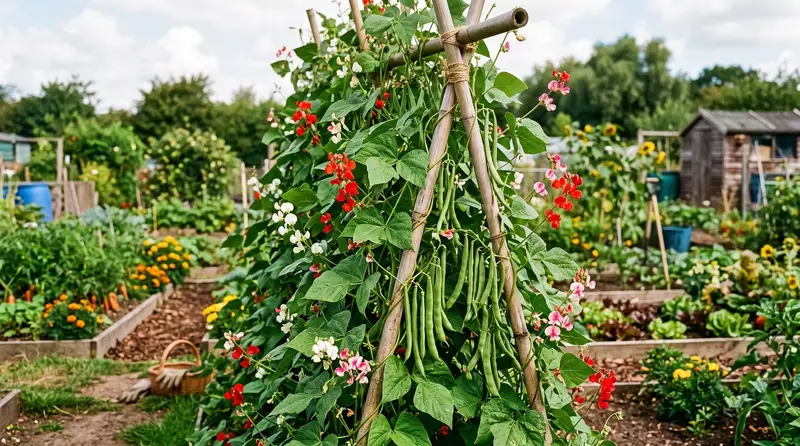
Grow on individual cane systems rather than traditional wigwams. Tie each plant to its own 2.4m cane, removing all side shoots to direct energy into fewer, higher-quality pods. Limit each plant to 8-10 pods for exhibition quality rather than the 30+ you would leave for kitchen use.
Pollination affects bean straightness. Hand-pollinate flowers in the morning by gently brushing pollen between blooms with a soft paintbrush. Poor pollination causes curved, lumpy pods with uneven seed development.
Water consistently from flowering onwards. Irregular watering causes constrictions in the pod that show as bumps along the length. Mulch the base of each plant with 10cm of compost to maintain even soil moisture. Our guide to growing runner beans covers the fundamentals of bean cultivation.
Pick potential show beans the morning of the show, as early as possible. Stand them upright in a jug of cold water for transport. Select sets of five that match in length (within 1cm), colour, and thickness.
How do I grow show potatoes?
Exhibition potatoes need uniform tubers of 170-220g with smooth, unblemished skin and shallow eyes. Grow in bags or raised beds filled with sieved, stone-free compost to prevent skin damage from ground contact.
Chit seed potatoes from February in a cool, light room. Plant in March, 15cm deep in bags of multi-purpose compost mixed with perlite. Use varieties bred for showing: Kestrel (red/white), Maris Peer (white), and Cara (red-eyed) are popular exhibition choices. Our potato growing guide covers the basics, and our best potato varieties guide compares performance across different types.
Water consistently and feed with a balanced liquid fertiliser every two weeks from June. Avoid high-nitrogen feeds which produce large tubers with rough, scabby skin. Common scab thrives in dry, alkaline soil, keep pH below 6.5 and maintain even moisture.
Harvest the day before or morning of the show. Lift entire bags and sort by hand. Wash gently with a soft cloth under running water. Never scrub or use a brush, the skin damages invisibly and darkens by judging time. Present on a white paper napkin on a plate.
How do I present vegetables for the show bench?
Presentation accounts for 30-40% of the overall impression, even though it is not scored separately. A well-staged exhibit signals to the judge that the grower understands their craft.
General principles apply across all crops:
- Clean without damage. Wash root vegetables gently. Wipe fruits with a soft cloth. Never scrub, peel, or polish.
- Uniform arrangement. Place specimens evenly spaced, largest at the back if displayed on a tiered stand.
- Correct foliage. Beetroot tops twist off (never cut) and trim to 75mm. Carrot foliage trims to 75mm. Onion tops tie neatly downwards. Tomatoes display with calyx attached.
- White plate or board. Most shows provide paper plates. Bring your own white napkins for potatoes and onions.
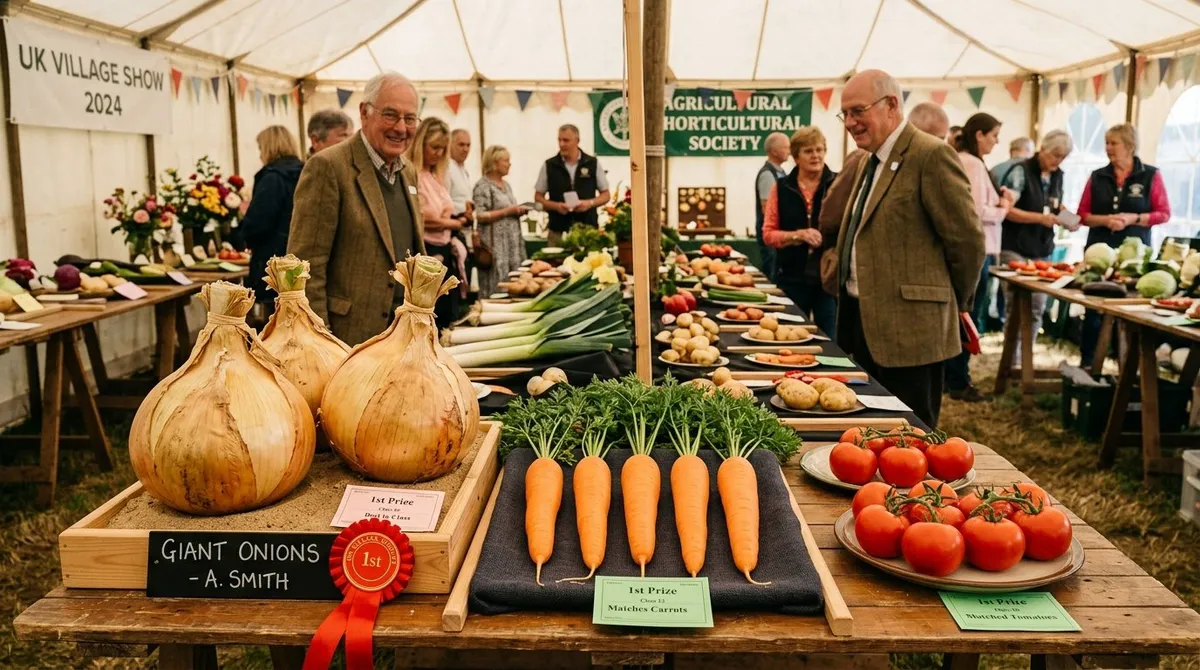
For collection classes, present five or six distinct vegetable types on a single board or tray. Each type must meet its individual class standard. Balance the display with colour contrast, red tomatoes beside white potatoes, green beans beside orange carrots. Collections score highest at most shows and carry the most prestige.
Study the show schedule months in advance. Entry requirements vary by show. Some require three specimens, others five. Some classes specify “with foliage,” others “trimmed.” Getting the numbers wrong means automatic disqualification regardless of quality.
How do I time the harvest for show day?
Most exhibition vegetables peak for a 24-48 hour window, so plan backwards from the show date. Harvest timing is the skill that separates winners from also-rans.
Runner beans are the most time-critical. Too early and they lack length. Too late and seeds bulge through the pod wall. Check potential show beans daily from 12 days after flowering. Mark the best pods with coloured string so you can find them in early-morning darkness on show day.
Tomatoes need picking 2-3 days before the show if they are not fully ripe on the vine. Ripen at room temperature in a single layer. Never refrigerate show tomatoes, cold temperatures dull the skin and reduce the glossy finish judges expect.
Onions lift 3-4 weeks before the show. Dry under cover with good ventilation. Peel outer skins to reveal a clean, unblemished layer underneath. The best exhibitors keep spare onions drying at different stages so they can select the finest set on the morning of the show.
Potatoes and beetroot harvest the day before or morning of the show. Carrots and parsnips harvest on show day if possible. The fresher the root vegetable, the better the skin condition and colour.
How do I transport vegetables to a show without damage?
Pack each specimen individually in tissue paper inside shallow boxes with no stacking. One bruise, one scrape, one scuffed patch of skin and the exhibit drops from first place to third.
Use seed trays lined with bubble wrap for tomatoes. Stand runner beans upright in a tall jug with 5cm of water in the base. Wrap onions individually in tissue paper and nestle them in egg-box style dividers.
Transport in a car boot on a flat, stable surface. Drive slowly over speed bumps. Arrive at least 90 minutes before judging starts. This gives time to unwrap, inspect for transport damage, replace any damaged specimens from your spares, and stage the exhibit carefully.
Bring a small toolkit: soft cloth, scissors, white napkins, spare plates, string for tying onion tops, a spray bottle of water for refreshing foliage, and paper towels for last-minute clean-up. Experienced exhibitors also bring a set of digital scales to check uniformity.
Frequently asked questions
What are the easiest vegetables to show for beginners?
Potatoes, beetroot, and runner beans are the easiest show crops for beginners. Potatoes need uniform size and clean skin. Beetroot requires matched roots with unblemished skin. Runner beans need straightness and consistent length. All three are forgiving to grow and simple to prepare for the bench.
How many vegetables do I need for a show class?
Single-type classes typically require 3 or 5 matched specimens. Three is standard for onions, potatoes, and beetroot. Five is common for runner beans, tomatoes, and carrots. Collection classes need 5-6 distinct types. Check your show schedule, every show sets its own class requirements.
When should I start growing exhibition onions?
Sow exhibition onion seed in late December or early January under heat. Use a heated propagator at 15-18C. Pot on in stages through spring. Plant out after last frost in May. This gives onions a 10-month growing season to reach exhibition size of 250-500g per bulb.
How do I transport vegetables to a show without damage?
Wrap each vegetable individually in tissue paper and pack in shallow boxes with no stacking. Use seed trays lined with bubble wrap for tomatoes. Stand runner beans upright in a jug of water. Transport in a car boot on a flat surface. Arrive early to allow time for final presentation and to replace any damaged items.
What do judges look for in show potatoes?
Judges want uniform size, smooth unblemished skin, shallow eyes, and correct shape for the variety. Wash gently with a soft cloth, never scrub. Present on a plate lined with a white paper napkin. All specimens must be the same variety and roughly the same weight. Aim for 170-220g per tuber.
Can I enter a village show if I have never shown before?
Yes, village shows actively welcome first-time exhibitors. Most schedules include a novice class for growers who have not won a first prize before. Talk to the show secretary before entering, they will explain staging times, bench layout, and any specific rules. Arrive early on show day to watch experienced exhibitors prepare.
Our team produces practical UK gardening guidance from source research, contributor records and established horticultural practice. Editorial standards are overseen by Matt W.